U.S. President Donald Trump is still considering a possible declaration of a national emergency in order to circumvent Congress and build a wall along the southern border with Mexico, the White House said on Wednesday.
As the partial shutdown of the federal government over wall funding entered its 19th day, White House spokeswoman Sarah Sanders said a national emergency declaration is “certainly still an option, something that’s on the table.”
Still, Sanders said the White House hoped the administration and U.S. lawmakers could find a solution to the wall funding.
“We’re hopeful, again, that they’ll get serious about doing their jobs and work with us,” Sanders said. “We’ve shown our willingness to work with them.”
Sanders’ comments come after Trump sought to build public support for his demand of $5.7 billion for the border wall in a televised address on Tuesday night.
Trump stopped short of an emergency declaration in his televised speech but repeated his assertion that illegal immigrants and drugs flowing across the southern border are a serious threat to American safety.
Democrats and other opponents of a border wall have threatened to take legal action if Trump issued the order.
By declaring a national emergency, Trump could circumvent Congress’ authority under the U.S. Constitution to appropriate funds and redirect money at his direction. The law allows Congress to override such a decision but would require approval by both the U.S. House of Representatives, where Democrats have a majority, and the Republican-dominated Senate.
Building the wall and having Mexico pay for it was a primary theme of Trump’s 2016 presidential campaign. Democrats have denounced a wall as immoral, inefficient and costly, but said they support additional funding for other border security measures including increased border agents and technology.
Before the partial shutdown began on Dec. 22, Trump said he would be “proud” to close the government over the issue of border security and would not blame Democrats. He has since said they are responsible.
One of the biggest myths about government shutdowns is that presidents usually win.
This may explain why President Donald Trump threatened to continue the shutdown for months, even years. However, a poll conducted in the first week of January shows that 51 percent of adults believe Trump is to blame for the shutdown.
There have been 18 shutdowns since 1977. I found that in the nine longest shutdowns during that time, presidents lose an average of 3 percentage points of public support or approval during a government shutdown of four or more days.
Most presidents lose shutdowns
In only two of the nine cases that I looked at did a chief executive boost his numbers. Jimmy Carter inched up a percentage point or two in 1977 and 1978 during the government shutdowns that took place during his presidency.
In the seven other cases, the shutdown led to declines in public approval of the president. And in the majority of cases, the president’s party lost the next presidential election.
The clearest example is President George H. W. Bush. In 1990, this GOP president was riding a 66 percent approval rating after the successful Operation Desert Shield (when we sent U.S. troops to Saudi Arabia to deter an attack by Iraq) and a long period of economic growth.
But Bush and the Democratic-controlled Congress battled over the budget deficit, triggering a government shutdown from Oct. 5 to 9. Public approval for Bush fell 10 percentage points.
Some of this may have been the result of Bush approving tax increases to close the budget deficit, which broke one of his campaign pledges of “no new taxes.”
But images of closed federal facilities didn’t help, giving voters the appearance of Bush presiding over gridlock. This hurt him in the 1992 election, when voters agreed with Democrats that Bush’s policies led to legislative deadlock.
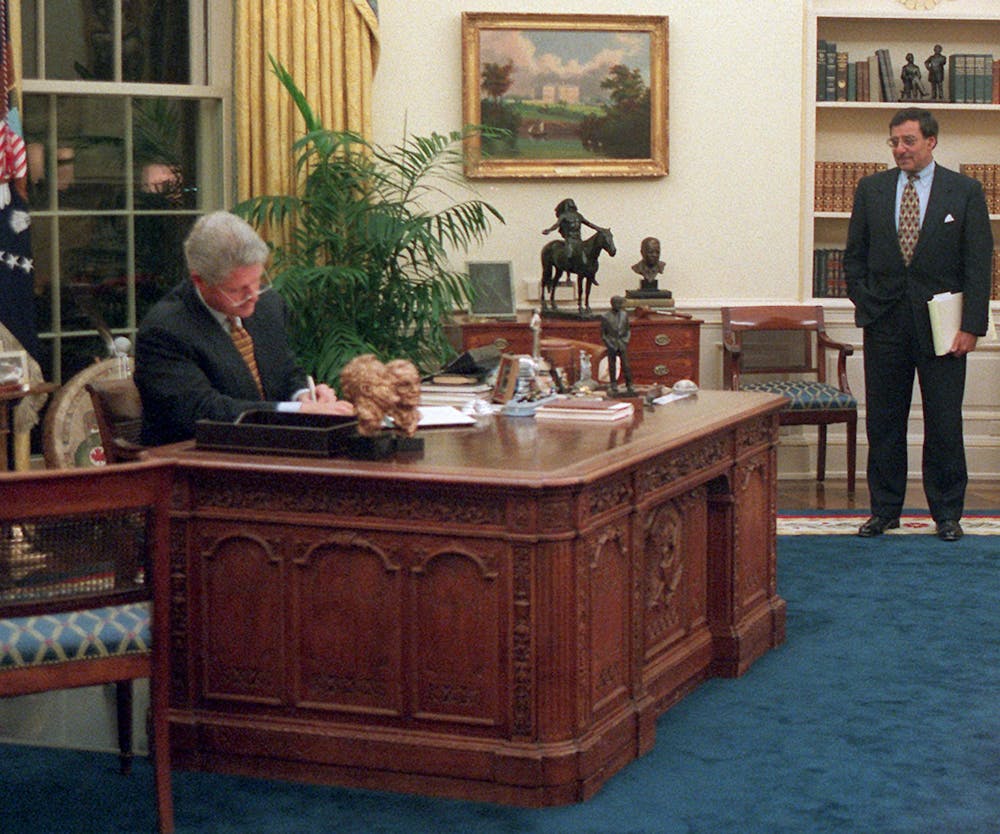
President Clinton vetoes the second spending and borrowing bill Monday, Nov. 13, 1995.
Pundits often cite the case of Democratic President Bill Clinton as an exception. They claim he “won”the longest shutdown in U.S. history. This shutdown took place from Dec. 5, 1995 to Jan. 6, 1996, or 21 full days.
GOP House Speaker Newt Gingrich wanted to reduce the budget deficit, while Clinton opposed deep cuts in Social Security and Medicare.
It’s true that Clinton went on to defeat GOP Sen. Robert Dole – one of his rivals during the shutdown – in the 1996 election. But Gallup polling shows that Clinton’s approval ratings from mid-November to early January had fallen 11 percentage points to 42 percent.
In other circumstances, this could have cost Clinton another term. But in this case, he faced no opposition in his Democratic primary, while Dole lost precious time and money battling several rivals for the 1996 GOP nomination. I believe Clinton won in spite of the shutdown, not because of it.
Why presidents lose
People see the president as the most powerful actor in government.
“Presidents have more authority than anyone else in the United States government, and control more money and military forces than any other person in the world,” write Hoover Institution scholars Paul T. Hill and Ashley E. Jochim in their book “The Power of Persuasion.”
Hill and Jochim note that despite all of that power, presidents much work with Congress to get tasks accomplished. Because of their perceived power, presidents are often expected to accomplish more than their constitutional authority allows them to get done, notes Richard Neustadt in his book “Presidential Power.”
When the government is closed, history shows the president will be held accountable.
One of the most cherished science fiction scenarios is using a black hole as a portal to another dimension or time or universe. That fantasy may be closer to reality than previously imagined.
Black holes are perhaps the most mysterious objects in the universe. They are the consequence of gravity crushing a dying star without limit, leading to the formation of a true singularity – which happens when an entire star gets compressed down to a single point yielding an object with infinite density. This dense and hot singularity punches a hole in the fabric of spacetime itself, possibly opening up an opportunity for hyperspace travel. That is, a short cut through spacetime allowing for travel over cosmic scale distances in a short period.
Researchers previously thought that any spacecraft attempting to use a black hole as a portal of this type would have to reckon with nature at its worst. The hot and dense singularity would cause the spacecraft to endure a sequence of increasingly uncomfortable tidal stretching and squeezing before being completely vaporized.
Flying through a black hole
My team at the University of Massachusetts Dartmouth and a colleague at Georgia Gwinnett College have shown that all black holes are not created equal. If the black hole like Sagittarius A*, located at the center of our own galaxy, is large and rotating, then the outlook for a spacecraft changes dramatically. That’s because the singularity that a spacecraft would have to contend with is very gentle and could allow for a very peaceful passage.
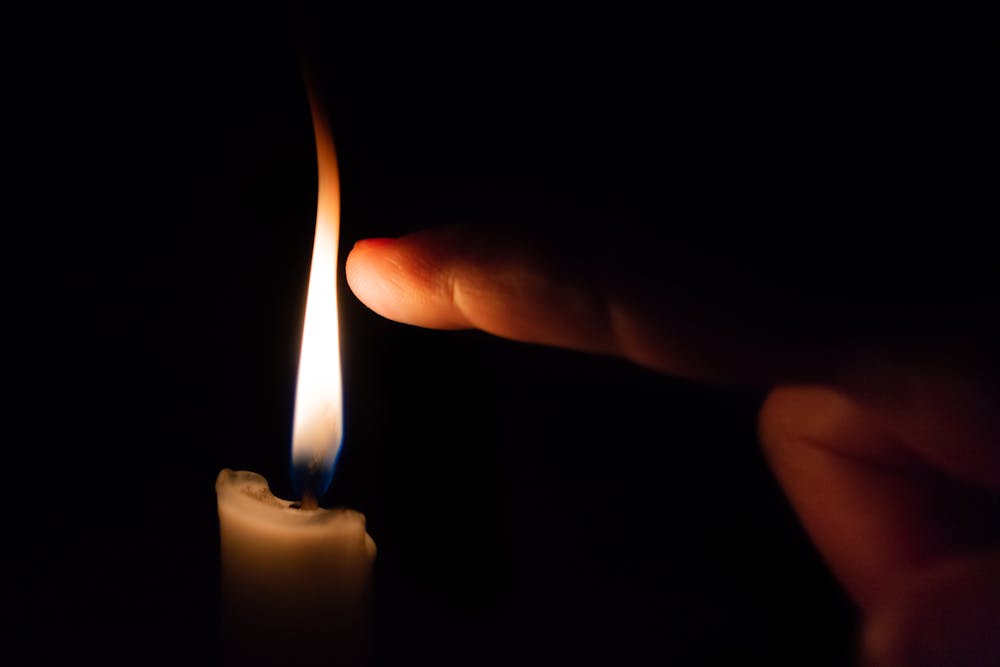
The reason that this is possible is that the relevant singularity inside a rotating black hole is technically “weak,” and thus does not damage objects that interact with it. At first, this fact may seem counter intuitive. But one can think of it as analogous to the common experience of quickly passing one’s finger through a candle’s near 2,000-degree flame, without getting burned.
Hold your finger close to the flame and it will burn. Swipe it through quickly and you won’t feel much. Similarly, passing through a large rotating black hole, you are more likely to come out the other side unharmed.
My colleague Lior Burko and I have been investigating the physics of black holes for over two decades. In 2016, my Ph.D. student, Caroline Mallary, inspired by Christopher Nolan’s blockbuster film “Interstellar,” set out to test if Cooper (Matthew McConaughey’s character), could survive his fall deep into Gargantua – a fictional, supermassive, rapidly rotating black hole some 100 million times the mass of our sun. “Interstellar” was based on a book written by Nobel Prize-winning astrophysicist Kip Thorne and Gargantua’s physical properties are central to the plot of this Hollywood movie.
Building on work done by physicist Amos Ori two decades prior, and armed with her strong computational skills, Mallary built a computer model that would capture most of the essential physical effects on a spacecraft, or any large object, falling into a large, rotating black hole like Sagittarius A*.
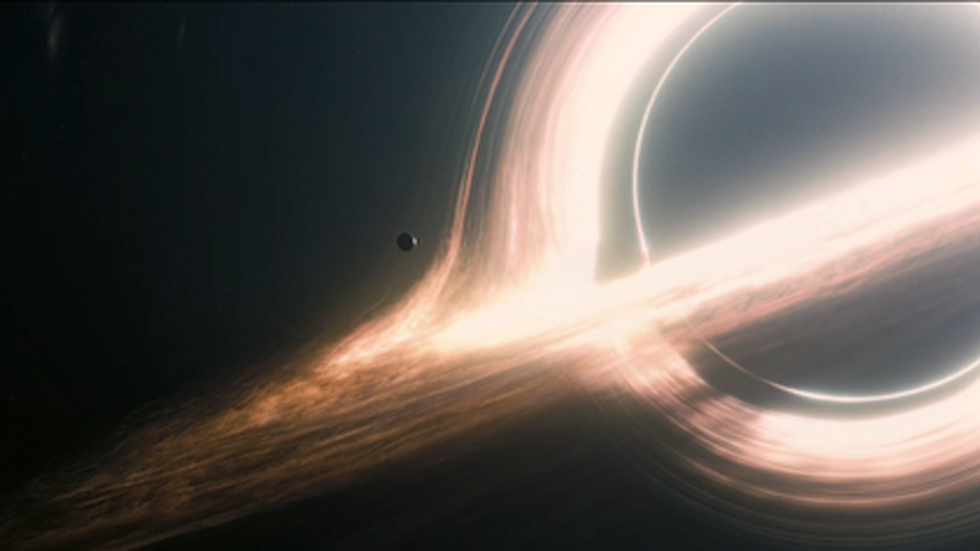
The fictional Miller’s planet orbiting the black hole Gargantua, in the movie ‘Interstellar.’
What she discovered is that under all conditions an object falling into a rotating black hole would not experience infinitely large effects upon passage through the hole’s so-called inner horizon singularity. This is the singularity that an object entering a rotating black hole cannot maneuver around or avoid. Not only that, under the right circumstances, these effects may be negligibly small, allowing for a rather comfortable passage through the singularity. In fact, there may no noticeable effects on the falling object at all. This increases the feasibility of using large, rotating black holes as portals for hyperspace travel.
Mallary also discovered a feature that was not fully appreciated before: the fact that the effects of the singularity in the context of a rotating black hole would result in rapidly increasing cycles of stretching and squeezing on the spacecraft. But for very large black holes like Gargantua, the strength of this effect would be very small. So, the spacecraft and any individuals on board would not detect it.
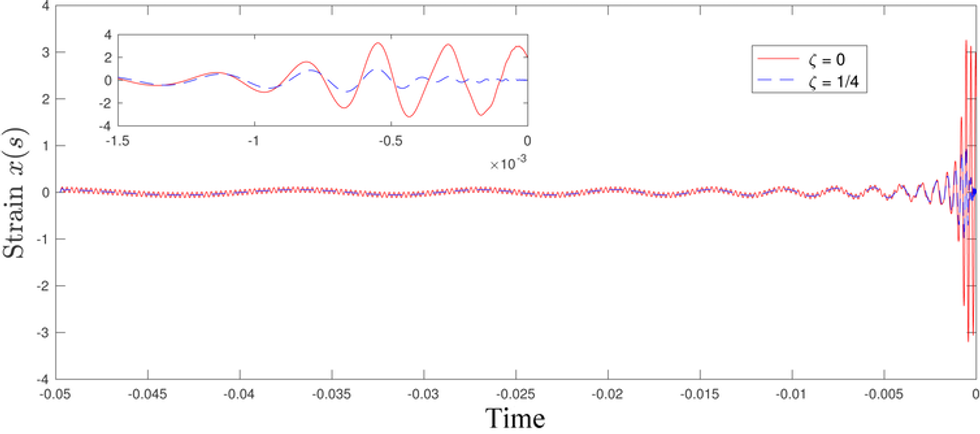
This graph depicts the physical strain on the spacecraft’s steel frame as it plummets into a rotating black hole. The inset shows a detailed zoom-in for very late times. The important thing to note is that the strain increases dramatically close to the black hole, but does not grow indefinitely. Therefore, the spacecraft and its inhabitants may survive the journey.
Khanna/UMassD
The crucial point is that these effects do not increase without bound; in fact, they stay finite, even though the stresses on the spacecraft tend to grow indefinitely as it approaches the black hole.
There are a few important simplifying assumptions and resulting caveats in the context of Mallary’s model. The main assumption is that the black hole under consideration is completely isolated and thus not subject to constant disturbances by a source such as another star in its vicinity or even any falling radiation. While this assumption allows important simplifications, it is worth noting that most black holes are surrounded by cosmic material – dust, gas, radiation.
Therefore, a natural extension of Mallary’s work would be to perform a similar study in the context of a more realistic astrophysical black hole.
Mallary’s approach of using a computer simulation to examine the effects of black hole on an object is very common in the field of black hole physics. Needless to say, we do not have the capability of performing real experiments in or near black holes yet, so scientists resort to theory and simulations to develop an understanding, by making predictions and new discoveries.
U.S. Senator Lisa Murkowski (R-AK) undercut President Trump, announcing she opposes his shutdown of the federal government – just hours before he will defend it, and the "need" for a border wall in a live, nationally-televised Oval Office address.
President Trump is holding America hostage as he demands taxpayers fund his border wall, refusing to reopen the government until he gets his cash.
Murkowski disagrees, and says she wants the government re-opened.
“I think we can walk and chew gum,” Murkowski told reporters Tuesday evening.
CNN's Manu Raju reports Murkowski is calling for the federal agencies affected by the GOP shutdown to be reopened, which would require Senate Majority Leader Mitch McConnell to allow a vote on bills the Senate previously passed, and the president to sign them.
Only three other Republican Senators have said the shutdown should end: Susan Collins, Cory Gardner, and Thom Tillis.
Disgraced movie mogul Harvey Weinstein will go on trial in Manhattan on May 6 on charges of sexually assaulting two women, his lawyer said on Tuesday.
Weinstein is accused of forcibly performing oral sex on a woman in July 2006 and raping another woman in March 2013. He faces five charges, including rape, and a maximum sentence of life in prison if convicted.
More than 70 women, mostly young actresses and others in the movie business, have accused Weinstein, 66, of sexual assaults dating back decades. The scandal helped launch the #MeToo movement, in which hundreds of women have publicly accused powerful men in entertainment, politics and other fields of sexual misconduct.
Weinstein, who pleaded not guilty after his arrest last May, has denied all the accusations, saying any sexual encounters were consensual.
The New York prosecution, which was brought by the Manhattan district attorney’s office, is the only criminal case to emerge from those allegations to date.
Weinstein’s lawyer, Benjamin Brafman, confirmed the trial date in an email on Tuesday.
A spokesman for the Manhattan district attorney’s office declined to comment.
Weinstein is due back in court for a pretrial conference on March 7.
Reporting by Joseph Ax; editing by Tom Brown and Jonathan Oatis
A growing proportion of Americans blame President Donald Trump for a partial government shutdown that will cut off paychecks to federal workers this week, though Republicans mostly support his refusal to approve a budget without taxpayer dollars for the U.S.-Mexico border wall, according to a Reuters/Ipsos poll released on Tuesday.
The national opinion poll, which ran from Jan. 1 to Jan. 7, found that 51 percent of adults believe Trump “deserves most of the blame” for the shutdown, which entered its 18th day on Tuesday. That is up 4 percentage points from a similar poll that ran from Dec. 21 to 25.
Another 32 percent blame congressional Democrats for the shutdown and 7 percent blame congressional Republicans, according to the poll. Those percentages are mostly unchanged from the previous poll.
Trump has promised to keep the government partially closed until Congress approves funding for an expanded barrier along the border.
Illegal border crossings into the United States have declined dramatically in recent years, yet Trump insists a wall is still necessary to stem a “humanitarian and national security crisis” in the region.
The president has asked Congress for nearly $6 billion for the wall and was expected to make his case directly to the public on Tuesday night in a nationally televised address.
Democratic leaders in Congress have refused to approve funding for additional border fencing, saying that it is an ineffective way to secure the border.
Public support for a border wall has shifted considerably over the past few years as it became a centerpiece of the Trump agenda. The poll found that 41 percent of the public supports building additional border fencing, down 12 points from a similar poll that ran in the first week of 2015, as opposition doubled among Democrats.
It also found that only 35 percent of adults in the United States support a congressional spending bill that includes funding for the wall, and 25 percent support Trump’s decision to keep the government closed until Congress approves funding for the wall.
Republicans, however, strongly support Trump’s pursuit of an expanded border wall. They have consistently ranked immigration as their top concern for the country. Seventy-seven percent of Republicans said in the most recent poll that they want additional border fencing, and 54 percent said they support Trump shutting down the government until Congress approves funding for the wall.
The government shutdown has affected a broad swatch of the federal government already, including national parks, airline security screening, housing and food aid, and the release of economic data. About 800,000 federal workers have been furloughed or are working without pay, and many will miss paychecks for the first time on Friday.
The Reuters/Ipsos poll was conducted online in English throughout the United States. It gathered responses from 2,203 adults, including 722 Republicans and 867 Democrats. The poll has a credibility interval, a measure of precision, of 2 percentage points.
Reporting by Chris Kahn; editing by Jonathan Oatis
Super Bowl fans may have to go without guacamole this year if avocado farmers in Mexico cannot send their fruit to the United States because of a prolonged fuel shortage.
Like clockwork, Mexican producers ship thousands of tonnes of avocado to the United States in early February every year, where guacamole is a staple living room snack on Super Bowl Sunday.
But the Mexican government’s efforts to clamp down on years of mounting fuel theft has a prompted a week-long fuel shortage that has left many states in central and western Mexico high and dry.
Among those states is Michoacan, the country’s main avocado grower. Producers there expect to ship 120,000 tonnes for this Super Bowl, 20,000 tonnes more than last year.
“Our three most important weeks of the year are this one and the next two. This is when we ship for Super Bowl week,” said Ramon Paz, spokesman for APEAM, a business association representing Mexican avocado producers and exporters.
“We have from now to January 24, 25 to ship all that volume. If we don’t ship it (by then), we can’t do so later,” Paz said.
So far, 27,000 tonnes have been sent to the United States for the Super Bowl, which will be held on Feb. 3 in Atlanta, Georgia. The annual football championship is the most-watched U.S. television broadcast of the year, regularly drawing more than 100 million viewers.
The fuel shortage has not yet affected exports to the United States, but it has begun to hamper transportation in Mexico for workers and harvested avocados, Paz added.
In addition to the Super Bowl, Mexican producers also have to meet commitments with supermarkets and restaurants in the United States.
The crackdown on fuel theft, which has drained billions of dollars from state coffers and is blamed for rising violence in some regions, is leftist President Andres Manuel Lopez Obrador’s first major move against criminals and corruption since taking office on Dec. 1. The move risks angering consumers and hurting the economy.
Reporting by Adriana Barrera; Writing by Anthony Esposito; Editing by Lisa Shumaker
President Donald Trump and Vice President Mike Pence will meet with Senate Republicans on Wednesday on Capitol Hill, amid a government shutdown now in its 18th day, the White House said on Tuesday.
Reporting by Eric Beech; Editing by David Alexander
MSNBC host Nicolle Wallace joined the prime-time crew Tuesday night to add commentary to President Donald Trump's Oval Office address -- and pointed out the biggest of his lies.
"Here's the deal: he doesn't have public support," Wallace told fellow MSNBC hosts Rachel Maddow and Chris Hayes. "What he had a candidate, was at the base of the Republican-supported strain of fear-mongering about illegal immigration."
"If he had public support, he'd have a bill because members in Congress would support it," she added.
Wallace went on to note that when she worked for President George W. Bush, he addressed the nation in a similar fashion about immigration reform -- but that he had the support of both parties when doing so.
"This is a president with no bill and no Republicans on board and doesn't have the public," she said. "It boggles the mind."
During his first Oval Office address to the nation to argue for a Mexican border wall, President Donald Trump claimed he wants to build a steel border wall "at the request of Democrats" -- though the idea was his.
“I informed my folks to say that we’ll build a steel barrier,” Trump said on January 6, adding that Democrats "don’t like concrete, so we’ll give them steel.”
"Fox & Friends" co-host Brian Kilmeade is furious that undocumented immigrant children have been released into the U.S. by the Border Patrol and are actually attending local schools across the country, trying to learn English.
Focusing on the border wall ahead of President Trump's Tuesday night address to the nation, Kilmeade led by fear-mongering about drugs and "potential gang members making their way through," warning viewers, "there is danger."
Then he turned his focus to the migrant children.
"There’s also families and humanitarian aid that's needed at the border, and then with the catch-and-release and courts saying we've got to release these people and these kids within 20 days, they go into our school system," he complained, according to a Media Matters transcript.
"And our school system, the last time there was unaccompanied minors, they flooded into Long Island, and I want to tell you, I can't tell you how many teachers said their classroom size doubled and a lot of them don't speak any English."
There are state and federal government programs that offer funding for students who speak little or no English.
"And suddenly, they're trying to teach kids with other kids who are paying taxes, whose parents are paying taxes, the same subjects, and the other kids don't speak English. So, in comes more teachers, in comes more tax dollars to fund those more teachers, more classrooms -- temporary classrooms. And they had no say in what was happening."
Kilmeade then concludes with this statement: "These people are now being stacked up, at the border in make-shift shelters."
It's unclear if he believes that is preferable to having the children in local classrooms.
Those funds could be used to improve classrooms and education in America.
Here's Kilmeade:
Kilmeade has been accused of espousing racist views. For example, he came under fire last June for complaining that the migrant children separated from their families at the border "aren’t our kids," they "are people from another country," implying they don't deserve to be treated as well as American children.
By now many know Joyce Vance, a former U.S. Attorney who also spent 25 years as a federal prosecutor. Vance frequently appears on MSNBC, where she is a contributor who patiently explains the ins and outs of the Mueller investigation and other legal matters.
Right now many are furious that the Trump administration, in the days leading up to President Trump's Tuesday night address to the nation on the border wall, has lied to the American people
Secretary of Homeland Security Kirstjen Nielsen has claimed over 3000 potential terrorists were captured last year at the southern border. Press Secretary Sarah Sanders claimed "nearly 4000."
Those are lies.
The real number? Six
The fact that officials can't or won't give an actual number is a red flag.
But Vance offers a better barometer of whether or not Trump administration officials are telling the truth.
And she's done it in a single tweet.
Vance, pointing to Monday night's report from NBC News that reveal six – not 3000, not 4000 – immigrants in terrorism database were stopped art the southern border over thew past six months, offers this insight:
Where are the prosecutions?
"You don’t just let terrorists go when you catch them. So where are the thousands of federal prosecutions we should see if Sanders was accurate?"
It will be up to President Trump to convince Americans of the need to give him $5.7 billion as a downpayment on his border wall in his speech tonight, in return for him opening up the federal government – which he is currently holding hostage to fulfill a campaign promise created as a mnemonic device to make sure he didn't forget to talk about immigration in his stump speeches.
Each new year, people vow to put an end to self-destructive habits like smoking, overeating or overspending.
And how many times have we learned of someone – a celebrity, a friend or a loved one – who committed some self-destructive act that seemed to defy explanation? Think of the criminal who leaves a trail of evidence, perhaps with the hope of getting caught, or the politician who wins an election, only to start sexting someone likely to expose him.
Why do they do it?
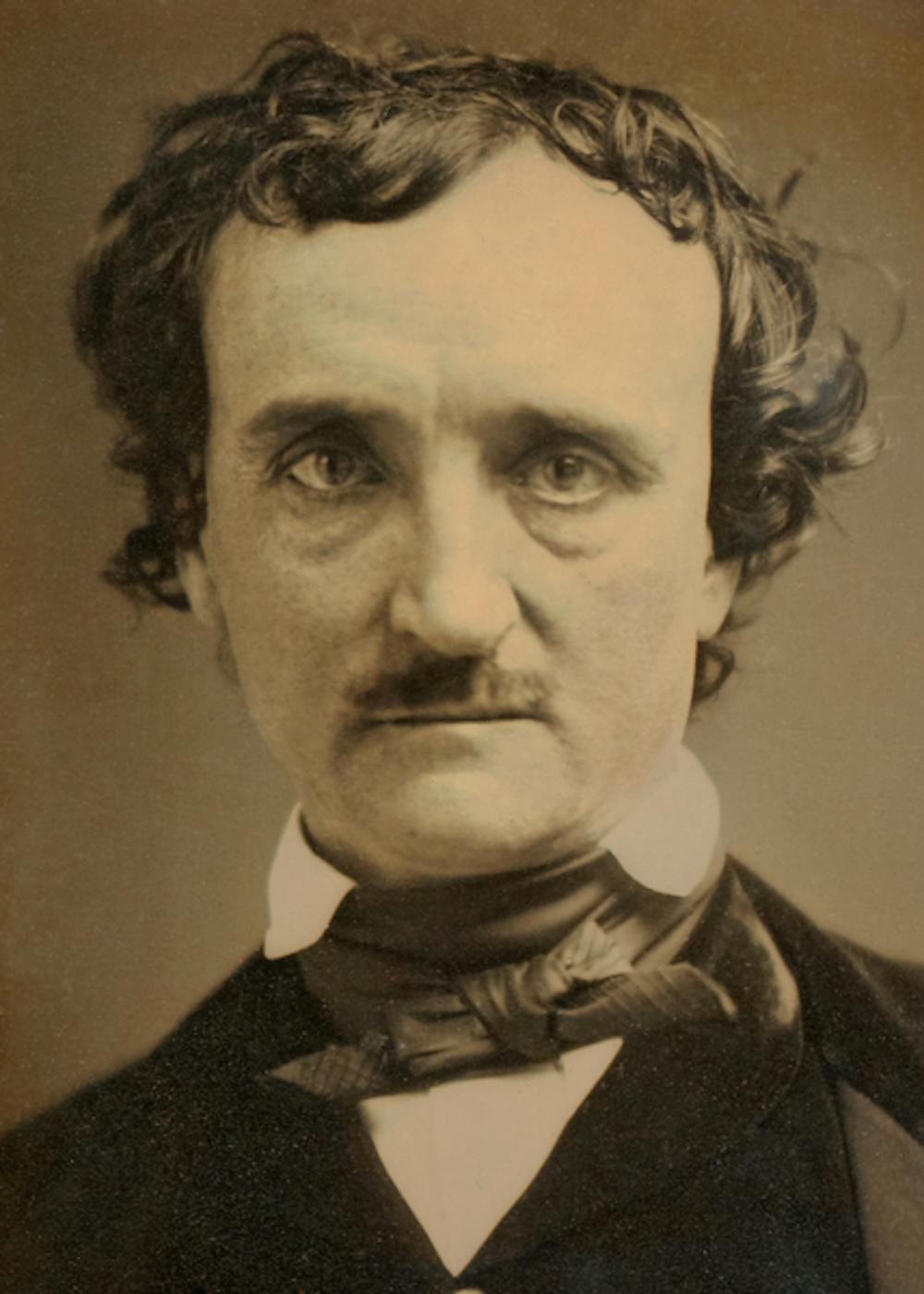
Edgar Allan Poe, one of America’s greatest – and most self-destructive – writers, had some thoughts on the subject. He even had a name for the phenomenon: “perverseness.” Psychologists would later take the baton from Poe and attempt to decipher this enigma of the human psyche.
Irresistible depravity
In one of his lesser-known works, “The Imp of the Perverse,” Poe argues that knowing something is wrong can be “the one unconquerable force” that makes us do it.
It seems that the source of this psychological insight was Poe’s own life experience. Orphaned before he was three years old, he had few advantages. But despite his considerable literary talents, he consistently managed to make his lot even worse.
He frequently alienated editors and other writers, even accusing poet Henry Wadsworth Longfellow of plagiarism in what has come to be known as the “Longfellow war.” During important moments, he seemed to implode: On a trip to Washington, D.C. to secure support for a proposed magazine and perhaps a government job, he apparently drank too much and made a fool of himself.
According to Edgar Allen Poe, knowing something is wrong can make it irresistible.
After nearly two decades of scraping out a living as an editor and earning little income from his poetry and fiction, Poe finally achieved a breakthrough with “The Raven,” which became an international sensation after its publication in 1845.
But when given the opportunity to give a reading in Boston and capitalize on this newfound fame, Poe didn’t read a new poem, as requested.
Instead, he reprised a poem from his youth: the long-winded, esoteric and dreadfully boring “Al Aaraaf,” renamed “The Messenger Star.”
As one newspaper reported, “it was not appreciated by the audience,” evidenced by “their uneasiness and continual exits in numbers at a time.”
Poe’s literary career stalled for the remaining four years of his short life.
Freud’s ‘death drive’
While “perverseness” wrecked Poe’s life and career, it nonetheless inspired his literature.
It figures prominently in “The Black Cat,” in which the narrator executes his beloved cat, explaining, “I…hung it with the tears streaming from my eyes, and with the bitterest remorse at my heart…hung it because I knew that in so doing I was committing a sin – a deadly sin that would so jeopardise my immortal soul as to place it – if such a thing were possible – even beyond the reach of the infinite mercy of the Most Merciful and Most Terrible God.”
Why would a character knowingly commit “a deadly sin”? Why would someone destroy something that he loved?
Was Poe onto something? Did he possess a penetrating insight into the counterintuitive nature of human psychology?
A half-century after Poe’s death, Sigmund Freud wrote of a universal and innate “death drive” in humans, which he called “Thanatos” and first introduced in his landmark 1919 essay “Beyond the Pleasure Principle.”
Sigmund Freud wrote of a universal death drive, which he dubbed ‘Thanatos.’
Many believe Thanatos refers to unconscious psychological urges toward self-destruction, manifested in the kinds of inexplicable behavior shown by Poe and – in extreme cases – in suicidal thinking.
In the early 1930s, physicist Albert Einstein wrote to Freud to ask his thoughts on how further war might be prevented. In his response, Freud wrote that Thanatos “is at work in every living creature and is striving to bring it to ruin and to reduce life to its original condition of inanimate matter” and referred to it as a “death instinct.”
To Freud, Thanatos was an innate biological process with significant mental and emotional consequences – a response to, and a way to relieve, unconscious psychological pressure.
Toward a modern understanding
In the 1950s, the psychology field underwent the “cognitive revolution,” in which researchers started exploring, in experimental settings, how the mind operates, from decision-making to conceptualization to deductive reasoning.
Self-defeating behavior came to be considered less a cathartic response to unconscious drives and more the unintended result of deliberate calculus.
In 1988, psychologists Roy Baumeister and Steven Scher identified three main types of self-defeating behavior: primary self-destruction, or behavior designed to harm the self; counterproductive behavior, which has good intentions but ends up being accidentally ineffective and self-destructive; and trade-off behavior, which is known to carry risk to the self but is judged to carry potential benefits that outweigh those risks.
Think of drunk driving. If you knowingly consume too much alcohol and get behind the wheel with the intent to get arrested, that’s primary self-destruction. If you drive drunk because you believe you’re less intoxicated than your friend, and – to your surprise – get arrested, that’s counterproductive. And if you know you’re too drunk to drive, but you drive anyway because the alternatives seem too burdensome, that’s a trade-off.
Baumeister and Scher’s review concluded that primary self-destruction has actually rarely been demonstrated in scientific studies.
Rather, the self-defeating behavior observed in such research is better categorized, in most cases, as trade-off behavior or counterproductive behavior. Freud’s “death drive” would actually correspond most closely to counterproductive behavior: The “urge” toward destruction isn’t consciously experienced.
Finally, as psychologist Todd Heatherton has shown, the modern neuroscientific literature on self-destructive behavior most frequently focuses on the functioning of the prefrontal cortex, which is associated with planning, problem solving, self-regulation and judgment.
When this part of the brain is underdeveloped or damaged, it can result in behavior that appears irrational and self-defeating. There are more subtle differences in the development of this part of the brain: Some people simply find it easier than others to engage consistently in positive goal-directed behavior.
Poe certainly didn’t understand self-destructive behavior the way we do today.
But he seems to have recognized something perverse in his own nature. Before his untimely death in 1849, he reportedly chose an enemy, the editor Rufus Griswold, as his literary executor.
True to form, Griswold wrote a damning obituary and “Memoir,” in which he alludes to madness, blackmail and more, helping to formulate an image of Poe that has tainted his reputation to this day.
Then again, maybe that’s exactly what Poe – driven by his own personal imp – wanted.