A scientific mega-project to unlock cosmic conundrums from dark energy to detecting extraterrestrial life was given a boost on Friday, when the 64-dish MeerKAT radio telescope was inaugurated in the remote South African town of Carnarvon.
Built at a cost of 4.4 billion rand, MeerKAT will be incorporated into the complex Square Kilometre Array (SKA) instrument, which when fully operational in the late 2020s would be the world’s biggest and most powerful radio telescope.
Up to 3,000 dishes co-hosted in Africa and Australia will then be able to scan the sky 10,000 times faster with 50 times the sensitivity of any other telescope and produce images that exceed the resolution quality of the Hubble Space telescope, scientists said of SKA.
“MeerKAT will address some of the key science questions in modern astrophysics – how did galaxies form, how are they evolving, how did we come to be here ... and for those purposes MeerKAT is the best in the world,” said Fernando Camilo, chief scientist at the South African Radio Astronomy Observatory which built and operates the telescope.
At an inauguration attended by government officials and foreign dignitaries, Camilo released new images taken by MeerKAT of the region surrounding the supermassive black hole at the centre of the Milky Way galaxy, some 25,000 light years away.
“We didn’t expect to use our telescope so early in the game, it’s not even optimized, but to turn it to the centre of the galaxy and obtain these stunning images, the best in the world, tells you you’ve done something right, better than right,” he told Reuters.
MeerKAT is a followup to the KAT 7 (Karoo Array Telescope), built in the vast semi-desert Karoo region north of Cape Town to demonstrate South Africa’s ability to host the SKA. Its name is a play on words: in Afrikaans “meer” means “more”, as in “more KAT”, but it also refers to the small mammal native to the Karoo and famed for standing on its hind legs to view the world.
Besides ground-breaking astronomy research, MeerKAT is also pushing boundaries in big data and high-performance computing with the likes of IBM (IBM.N) helping develop systems able to handle the dizzying amount of data fed from each individual antenna to supercomputers buried deep underground to limit radio interference.
The biggest radio telescope of its kind in the southern hemisphere, MeerKAT looks like a cluster of eggs when you first see it about an hour’s drive outside Carnarvon.
But up close, each sensitive dish is almost as high as a three storey building, rotating on a fixed pedestal as it scans the sky. Chosen because of its remoteness, with hills providing an extra shield against radio interference, the project site is the main African base for hundreds of antennae that will eventually be placed as far as Kenya and Ghana.
“The first phase of SKA 1 in South Africa is to add 133 antennas to that (of MeerKAT),” said Rob Adam, an SKA international board member.
The expansion is expected to start next year, said Adam, with the first prototype dish built in China already on site about 450 kilometers north of Cape Town in the Northern Cape province. MeerKAT will operate independently before being incorporated into SKA 1 sometime around 2023, Adam said.
Reporting by Wendell Roelf; Editing by Peter Graff
Scarlett Johansson on Friday pulled out a movie in which she was cast to play a transgender character following a backlash from the LGBT community.
“Rub & Tug” was due to star Johansson, who is straight, as the late real-life American crime kingpin Dante “Tex” Gill, who used his massage parlor as a front for prostitution in the 1970s and 1980s. Gill was born a woman but identified as a man.
It was the second time Johansson, 33, found herself in the middle of a casting controversy after appearing in 2017’s “Ghost in the Shell” in a role originally conceived as a Japanese character.
Johansson said she had decided to withdraw from “Rub & Tug” for ethical reasons.
“Our cultural understanding of transgender people continues to advance, and I’ve learned a lot from the community since making my first statement about my casting and realize it was insensitive,” the actress said in a statement to the lesbian, gay, bisexual and transgender magazine “Out.”
“I understand why many feel he (Gill) should be portrayed by a transgender person, and I am thankful that this casting debate, albeit controversial, has sparked a larger conversation about diversity and representation in film,” she added.
On social media, newspaper editorials and videos, the transgender community had slammed her casting as highlighting the limited opportunities given to transgender actors.
In recent years, straight actor Eddie Redmayne played a transgender woman in “The Danish Girl,” Jared Leto won an Oscar for playing a trans woman in “Dallas Buyers Club,” and Jeffrey Tambor has won awards for playing a father who transitions to a man in television series “Transparent.”
According to LGBTQ advocacy group GLAAD, none of the 109 movies released by Hollywood’s seven biggest studios in 2017 included a transgender character.
Filming has yet to begin on “Rub & Tug” and no replacement for Johansson was immediately announced.
Reporting by Jill Serjeant; Editing by Marguerita Choy
An escalation of U.S. trade tariffs would harm the economy’s prospects, according to a Federal Reserve official who is making it his business to raise the alarm with lawmakers and government officials.
“What’s going on in the short-run certainly isn’t positive, but for me it isn’t sufficient yet – yet – to materially change my outlook,” Dallas Fed President Robert Kaplan told Reuters in an interview on Friday. Still, he said, he would need to downgrade his outlook if tensions between the U.S. and its trade partners escalate. Even though the Fed’s job is not to set trade policy, it must react to it, he said.
“I’m not doing my job if we don’t call out this trade analysis,” to the public, Republican and Democratic policymakers, and to appointed and elected officials, he said. “It is also part of my job to call out relevant issues that affect economic growth in the United States, even if they are not in the purview of the Fed.”
The Trump administration earlier this week again raised the stakes in its tit-for-tat trade war with China, saying it would slap 10 percent tariffs on an extra $200 billion worth of Chinese imports. U.S. trade disputes are also escalating with Europe, Canada and Mexico that could slow business investment at home.
Kaplan, whose district heavily relies on exports to Mexico, said this is already having a “chilling effect” on capital expenditures plans and is hurting, for example, soybean shipments and companies reliant on aluminum. Longer-term impacts like currency fluctuations and geopolitical instability could be even worse, he said.
For now, Kaplan, who already leans dovish on monetary policy, continues to expect one more interest rate hike this year and a bit more tightening next year. And if tariffs expand to more goods or North American automobiles in particular, he said, “obviously that would cause me to rethink.”
The U.S. central bank is careful not to overstep its inflation and employment mandates into fiscal decisions like trade. A Fed report to Congress on Friday barely addressed the impact of the Trump administration’s protectionist policies aside from noting that uncertainty was a concern to markets.
Yet a Reuters review of Fed chair Jerome Powell’s public calendar showed that in his first four months as head of the U.S. central bank, he spent more time with lawmakers and White House advisers than did his predecessor, Janet Yellen.
In an interview with radio show Marketplace on Thursday, Powell said: “I’m going to wear the carpets of Capitol Hill out by walking those halls and meeting with members” to explain Fed decisions and respond to concerns.
Kaplan said it was yet too soon to predict how trade policy will unfold. “I still have as a possibility if not a probability that we look back two years from now, we’ll look back on this period as rhetoric and some actions but this ultimately won’t intensify,” he said. “But I don’t know.”
Reporting by Ann Saphir and Jonathan Spicer, Editing by Chizu Nomiyama
It seems incredible that White House aides would schedule the first U.S.-Russia summit of the Donald Trump Presidency for the day after the World Cup final soccer match in Moscow, given the assiduous attention to detail that has, historically, governed every meeting between the two superpowers.
One-nil, Vladimir Putin. And the game hasn’t even begun.
Amid constant pop culture chatter of an illicit Putin-Trump “bromance,” coupled with an FBI investigation into possible collusion between Russian operatives and members of the Trump 2016 Presidential campaign, the timing of the event appears to be just another sign Trump’s people don’t care if they make Putin look good. Or they don’t understand the various ways they do.
As a historian of Russia specializing in Kremlin media strategy, I see confirmation of a Putin public relations victory in headlines around the world. The summit is taking place just as the World Cup has, to quote one German news magazine, “shown Russia in a new light.” For the past month, Moscow has been able to advertise itself as more international, not to mention more welcoming of foreigners, than Washington.
Above all, the summit with Trump has created an opportunity for Putin – even as he refers to the U.S. president with ostensible respect as a “good, tough entrepreneur” – to widen a growing divide between the U.S. and Europe.
Germany and France in particular have long warned of Kremlin-sponsored efforts to destabilize Europe and undermine liberal democracy. But over the past year, they’ve also grown increasingly upset about what they claim have been U.S. attempts to use sanctions against Russia to promote U.S. economic interests at the expense of European companies.
Trump only added to the growing hostility when he kicked off a week in Europe by insulting Germany over a Russian pipeline deal and demanding NATO members start paying their own way.
“I’m sure that the overwhelming majority of people who visited here will leave with the best feelings … and will come again many times,” he proclaimed.
Such positive soundbites can obscure darker realities of how power works in Russia, including the censorship that boosts Putin’s prestige. For example, one sports commentator who jokingly mentioned the name of dissident Alexei Navalny while on air suddenly disappeared from further World Cup coverage.
Nevertheless, global footage of cheering crowds across Russia have, for weeks, have posed a stark contrast to pictures shared around the world and in Russia of U.S. immigration authorities separating children from parents at the Mexican border.
More than America First
The looming summit allows Putin to highlight this ostensible contrast between his presidency and that of Trump’s.
Russia’s state-controlled media, once a champion of the U.S. leader, now tends to damn him with faint praise, holding up Putin as a counterexample of stability and strength.
“Comedy Club,” a popular show on one of Russia’s several government-funded television channels, features sardonic skits between Trump and Putin impersonators in which the Trump figure is always at the mercy of the wily Russian. The U.S. leader cowers when the Putin actor jokes he owns a jet plane “that can fly to America in a single second.” The faux Trump then orders all the Mexicans in the U.S. to be sent to a city he mistakenly believes Putin might bomb.
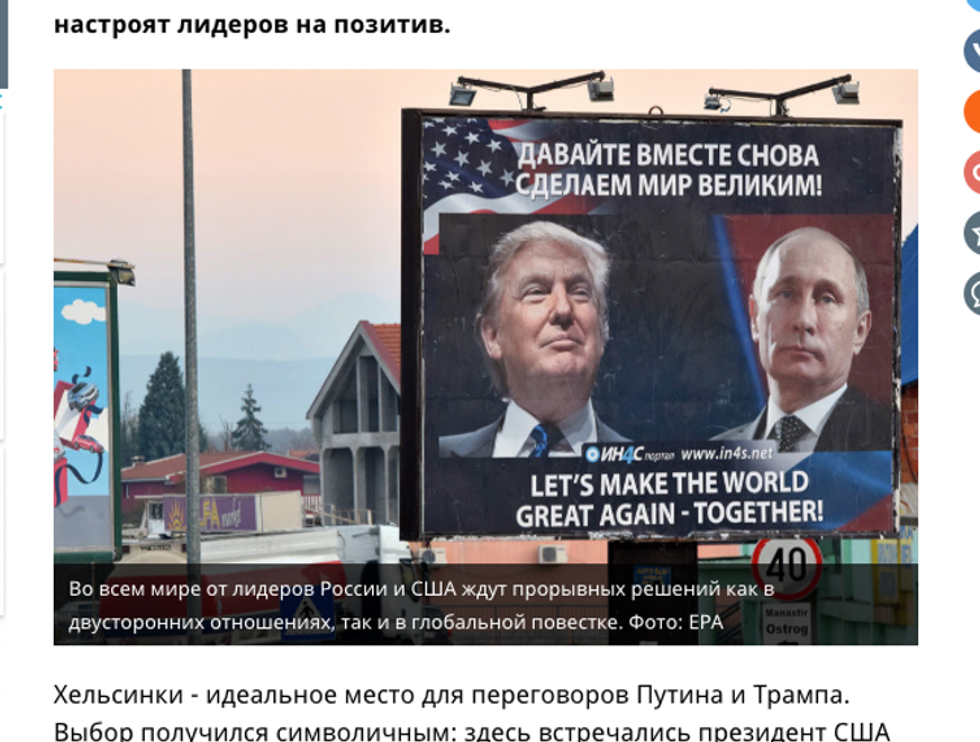
A recent photo in newspaper Rossiiskaia Gazeta of a 2016 Putin and Trump billboard.
Rossiiskaia Gazeta
The official press, in reporting on the summit, appears more respectful. The newspaper Rossiiskaia Gazeta is recycling triumphant images of the two leaders side-by-side that first emerged after Trump’s presidential win and which proclaim – in both Russian and English – “Let’s make the world great again – together!”
These images present Putin and Trump as powerful equals, the only men necessary to shape a new and improved global order, in which other nations would seem to play only an auxiliary role. But they also show Putin as more farsighted than Trump, calling attention to the narrowness of the latter’s “Make America Great Again” election slogan.
Speaking to Europe
These purported contrasts between the two leaders are meant to resonate with Europeans, horrified at Trump’s apparent disregard for international cooperation.
In an English-language editorial, the German news magazine Der Spiegel warned that the NATO summit, held just before the Trump-Putin meeting, could end in a disastrous “Trumper Tantrum.”
Trump’s recent decision to levy tariffs on steel and aluminum imports from the European Union as part of an ostensibly China-focused trade war has also enraged Western allies – to the benefit of the Kremlin.
“Trade War: Is Trump driving Europe into Russia’s Arms?” ran a June headline in the German newspaper Die Welt.
“It’s very sad when Germany makes a massive oil and gas deal with Russia when we are supposed to be guarding against Russia,” he proclaimed.
The German Foreign Minister responded with scorn, tweeting, “We are no captives, neither of Russia nor of the United States.”
With such friends, who needs enemies?
At the same time, Trump has avoided any critique of Putin and even predicted that his one-on-one with the leader “could be the easiest” of his week-long tour.
Such apparent double standards help keep the Putin-Trump illicit “bromance” story alive. Yet Trump seems blithely willing to dismiss any negative media coverage as “fake news.” His off-the-cuff comments praising the Russian leader play into conspiracy theories at home, while offering Russians innumerable chances to showcase U.S. stories accusing Trump, rightly or wrongly, of incompetence and wrongdoing.
This way, the Russian press can highlight Trump’s weakness, even while seeming to rise to his defense.
One example: RT coverage of a video posted on the New York Times website, portraying Trump and Putin as lovers, which the Kremlin-funded outlet indignantly condemned as homophobic. Similarly, it ridiculed a July cover story in New York Magazine entitled “Prump Tutin” claiming that Trump has been a Russian agent since 1987.
In such a setting, Russia wins. If the summit ends in failure, the Kremlin can blame U.S. Russophobia and focus on cultivating closer European ties. If it ends in agreement, Putin emerges as triumphant statesman.
Meanwhile, any deals Trump might try to make – even in regard to Syria and Iran – can be cast by his critics as capitulating to a tyrant he has too long failed to condemn.
Putin has only to stand back and – in World Cup parlance – wait to take advantage of a perfect “scoring” opportunity.
President Donald Trump must seek a deal with Russian President Vladimir Putin to end Moscow’s interference in American elections, the top Democrat in the House of Representatives said on Friday after fresh indictments against Russian military officers.
“President Trump must demand and secure a real, concrete and comprehensive agreement that the Russians will cease their ongoing attacks on our democracy,” House Democratic leader Nancy Pelosi said in a statement. “Failure to stand up to Putin would constitute a profound betrayal of the Constitution and our democracy.”
Reporting by Makini Brice and Doina Chiacu; Editing by Bernadette Baum
President Donald Trump infamously asked Russia -- if they were listening -- to help find Hillary Clinton's emails, and a new indictment shows their intelligence agents tried.
Special counsel Robert Mueller obtained an indictment Friday against 12 Russian intelligence officers accused of hacking the Democratic National Committee and Democratic Congressional Campaign Committee during the 2016 campaign and posting them online through Guccifer 2.0 and DC Leaks, which investigators confirmed were fronts for Russian agents.
The indictment shows that Russia first tried to hack into Clinton's email system the same evening that Trump publicly asked them to during a July 27, 2016, news conference.
“Russia, if you’re listening, I hope you’re able to find the 30,000 emails that are missing,” Trump said at the time. “I think you will probably be rewarded mightily by our press.”
Trump has steadfastly denied that Russia had anything to do with the hacks, despite the findings of U.S. intelligence and law enforcement agencies, and now alleged in the grand jury indictment.
That indictment shows Russian agents tried to break into an email system used by Clinton and her associates that same day.
"The Conspirators spearphised individuals affiliated with the Clinton Campaign throughout the summer of 2016," the indictment says.
"For example, on or about July 27, 2016," prosecutors said, "the Conspirators after hours to spearphish for the first time email accounts at a domain hosted by a third-party provider and used by Clinton's personal office. At or around the same time, they also targeted seventy-six email addresses at the domain for the Clinton campaign."
Jeff Bezos’ rocket company plans to charge passengers about $200,000 to $300,000 for its first trips into space next year, two people familiar with its plans told Reuters.
Potential customers and the aerospace industry have been eager to learn the cost of a ticket on Blue Origin’s New Shepard space vehicle, to find out if it is affordable and whether the company can generate enough demand to make a profit on space tourism.
Executives at the company, started by Amazon.com Inc founder Bezos in 2000, told a business conference last month they planned test flights with passengers on the New Shepard soon, and to start selling tickets next year.
The company, based about 20 miles (32 km) south of Seattle, has made public the general design of the vehicle - comprising a launch rocket and detachable passenger capsule - but has been tight-lipped on production status and ticket prices.
Blue Origin representatives did not respond to requests for comment on its programs and pricing strategy. Bezos said in May ticket prices had not yet been decided.
One Blue Origin employee with first-hand knowledge of the pricing plan said the company will start selling tickets in the range of about $200,000 to $300,000. A second employee said tickets would cost a minimum of $200,000. They both spoke on condition of anonymity as the pricing strategy is confidential.
The New Shepard is designed to autonomously fly six passengers more than 62 miles (100 km) above Earth into suborbital space, high enough to experience a few minutes of weightlessness and see the curvature of the planet before the pressurized capsule returns to earth under parachutes.
The capsule features six observation windows Blue Origin says are nearly three times as tall as those on a Boeing Co 747 jetliner.
Blue Origin has completed eight test flights of the vertical take-off and landing New Shepard from its launch pad in Texas, but none with passengers aboard. Two flights have included a test dummy the company calls “Mannequin Skywalker.”
The company will do the first test in space of its capsule escape system, which propels the crew to safety should the booster explode, “within weeks,” one of the employees said.
SMALL STEP FOR A MAN
Blue Origin, whose Latin motto means “step by step, ferociously,” is working towards making civilian space flight an important niche in the global space economy, alongside satellite services and government exploration projects, already worth over $300 billion a year.
Bezos, the world’s richest person with a fortune of about $112 billion, has competition from fellow billionaires Richard Branson and Elon Musk, Tesla Inc’s chief executive.
Branson’s Virgin Galactic says it has sold about 650 tickets aboard its own planned space voyages, but has not set out a date for flights to start. The company is charging $250,000 per ticket, in line with Blue Origin’s proposed pricing.
SpaceX, founded by Musk in 2002, says its ultimate goal is to enable people to live on other planets.
All three are looking to slash the cost of spaceflight by developing reusable spacecraft, meaning prices for passengers and payloads should drop as launch frequency increases.
While Blue Origin has not disclosed its per-flight operating costs, Teal Group aerospace analyst Marco Caceres estimated each flight could cost the firm about $10 million. With six passengers per trip, that would mean losing millions of dollars per launch, at least initially.
Three sources said Blue’s first passengers are likely to include its own employees, though the company has not selected them yet.
Reporting by Eric M. Johnson in Seattle; Editing by Greg Mitchell and Rosalba O'Brien
British counter-terrorism police said on Friday they believed they had found the source of the Novichok nerve agent that killed Dawn Sturgess in southwest England this month and left her partner Charlie Rowley critically ill in the hospital.
“On Wednesday, 11 July, a small bottle was recovered during searches of Charlie Rowley’s house in Amesbury,” police said in a statement. “Scientists have now confirmed to us that the substance contained within the bottle is Novichok.”
Reporting by Stephen Addison; editing by Michael Holden
U.S. President Donald Trump said on Friday he looked forward to finalizing a post-Brexit trade deal with Britain, marking an abrupt change from a newspaper interview when he said Prime Minister Theresa May’s strategy would kill such an agreement.
In an interview published just hours before the two leaders held talks, Trump chided the “very unfortunate” results of the prime minister’s proposals for Brexit and her negotiating tactics as Britain prepares to leaves the European Union in March next year.
However, Trump later said May was doing a “fantastic job”.
“Once the Brexit process is concluded and perhaps the UK has left the EU, I don’t know what they’re going to do but whatever you do is OK with me, that’s your decision,” Trump told a press conference with May in the garden of her official country residence Chequers.
“Whatever you do is OK with us, just make sure we can trade together, that’s all that matters. This is an incredible opportunity for our two countries and we will seize it fully.”
Last week at the same location, May finally won agreement for her Brexit plans from her cabinet but within days two senior ministers had quit, departures which Trump said earlier in the week had left Britain in turmoil.
Hours after those proposals were formally published, Trump cast further doubt on the strategy, delivering a withering verdict in an interview with the Sun newspaper.
“If they do a deal like that, we would be dealing with the European Union instead of dealing with the UK, so it will probably kill the deal,” Trump said. “I would have done it much differently. I actually told Theresa May how to do it, but she didn’t listen to me.”
Asked about that interview, Trump said he did not criticize the prime minister and was gushing in his praise of his host, saying she was tough and capable.
“This incredible woman right here is doing a fantastic job, a great job,” he said. “Unfortunately, there was a story that was done which was generally fine but it didn’t put in what I said about the prime minister and I said a tremendous thing. It’s called fake news.”
“HIGHEST LEVEL OF SPECIAL”
May, likewise, glossed over the comments.
“We agreed today that as the UK leaves the European Union we will pursue an ambitious U.S.-UK free trade agreement,” she said. “The Chequers agreement reached last week provides the platform for Donald and me to pursue an ambitious deal that works for both countries right across our economies.”
May and Trump both spoke of the importance of the “special relationship” between their two countries, something that Brexit supporters hope will reap benefits when Britain leaves the EU, allowing it to forge closer trade ties with the world’s biggest economy.
“I would say I would give our relationship in terms of grade the highest level of special,” Trump said.
However, many have cast May’s “business-friendly” plan as a betrayal that would leave Britain too close to the EU, including lawmakers in her deeply divided Conservative Party who have warned that she might face a leadership challenge.
During the press conference, May also thanked Trump for his support over Russia which Britain has blamed for a nerve agent attack on a former Russian spy in southwest England in March.
Trump is due to meet Putin, who has rejected the nerve agent claims, at a summit when he finishes his four-day visit to Britain, and said he would raise the issue of reducing nuclear weapons.
“It will certainly be something that we bring up and talk about,” the U.S. president said.
As Trump and May spoke, thousands of protesters marched against the president through central London, one of more than 100 demonstrations planned against the president during his stay.
While Trump’s trip was not a full state visit, he has been given red carpet treatment and is scheduled to have tea later with Queen Elizabeth at Windsor Castle, where her grandson Prince Harry married U.S. actress Meghan Markle in May.
Writing by Guy Faulconbridge and Michael Holden, editing by Larry King, Kevin Liffey and David Stamp
Another retailer has evidently stopped selling Ivanka Trump products on its website.
Shannon Coulter, who started the #GrabYourWallet boycott of Trump branded companies, announced Friday morning on Twitter that Hudson Bay's website no longer listed products sold by the president's daughter, reported Business Insider.
"There are suddenly zero Ivanka Trump items on the @hudsonsbay website," Coulter tweeted. "Yesterday there were still over 150 items there. What's going on? Has the Bay finally dropped the Ivanka Trump brand?"
The Canadian department store, which removed 150 Ivanka Trump items from its website, is one of 24 retailers that Coulter says have stopped carrying products associated with the U.S. president's family.
Coulter's boycott movement, which began after the release of the "Access Hollywood" tapes ahead of the election, has gained momentum in recent months -- especially after the Trump administration's controversial family separation policy was announced.
Hudson Bay's decision came after a poll showed 70 percent of Canadians say they will avoid buying U.S.-made products after Trump launched a trade war against the American ally and neighbor.
President Donald Trump retreated from his criticism of British prime minister Theresa May while standing next to her during a joint news conference -- and Twitter users buried him in scorn.
The president wrecked May's fragile position in the unfolding Brexit debacle during a harshly critical video interview with the Rupert Murdoch-owned newspaper The Sun, but dismissed his own recorded remarks the following day as "fake news" when asked about them by a reporter.
Trump refused to take a question from a CNN reporter, accusing the network of broadcasting "fake news," and moved on to a Fox News reporter, and also reaffirmed his criticism of May after denying those remarks.
While taking questions following his joint press conference with British Prime Minister Theresa May, President Donald Trump used "fake news" as an excuse to to dismiss recorded comments he made to a reporter for the UK's Sun magazine.
"You seem rather to have changed your tune from what you said earlier this week, when you said that on the current Brexit plan, that would probably kill the possibility of a trade deal with the UK," BBC political editor Laura Kuenssberg remarked. "Our countries are meant to have a special relationship, yet you publicly criticized the prime minister's policy and her personally for not listening to you this week."
"Is that really the behavior of a friend and, prime minister, isn't the problem for you that some of the things Mr. Trump has said about your Brexit plan, are right," she continued, directing her comments towards Prime Minister May. "It will limit the possibilities of doing trade deals easily in the future."
Without waiting for May to answer the question posed to her, Trump jumped in.
"I didn't criticize the prime minister," the president responded. "I have a lot of respect for the prime minister. And unfortunately, that was a story that was done which was, you know, generally fine, but it didn't put in what I said about the prime minister — and I said tremendous things."
"And fortunately, we tend to record stories now, so we have it for your enjoyment if you'd like it, but we record when we deal with reporters," he continued. "It's called fake news. We solve a lot of problems with the good old recording instrument."
The interview Trump and the BBC editor were referencing took place earlier in the week, was recorded, and had the president on record saying newly-resigned Boris Johnson — May's erstwhile political rival — would make "a great prime minister." Trump also said the prime minister "wrecked" Brexit after he told her how to do it, and again attacked London Mayor Sadiq Khan and Europe generally for allowing migrants and "terrorists" into their borders.
Tens of thousands of protesters demonstrated in London on Friday against US President Donald Trump, whose four-day visit to Britain has been marred by his extraordinary attack on Prime Minister Theresa May's Brexit strategy.
"#DumpTrump", "This is the carnival of resistance" and "My mum doesn't like you! And she likes everyone" read some of the signs held up by protesters as they marched down Oxford Street towards Trafalgar Square.
"No Trump, no KKK, no fascist USA!", the protesters chanted.
AFP / Isabel INFANTESPeople gathered outside Chequers, the country residence of British premier Theresa May where she and Donald Trump were meeting on Friday
Some protesters banged on pots and pans, others blew on trumpets and many held up orange "Stop Trump" balloons.
One woman wore a pink knitted "pussy hat" at the start of the "Women's March", which will be followed later in the day by the main "Together Against Trump" coalition.
"Donald Trump is misogynistic, chauvinistic, homophobic, xenophobic, promotes bigotry... and has tiny little hands!", said one of the participants, 42-year-old Georgina Rose.
AFP / Tolga AKMENElsewhere in London, campaigners flew a "Baby Trump" balloon, an act of protest approved by the city's mayor Sadiq Khan
Grant White, 32, carried a sign depicting Trump as the Twitter bird symbol wearing a swastika around his arm.
"I am anti-Brexit, anti-Trump. There is a wave of fascism which we have to get rid of," he said.
Dawn, 49, came with her 11-year-old daughter Sadie.
"Trump is the man with the biggest ego in charge of the biggest power in the world. He doesn't have a grasp of what is needed in the world," the mother said.
AFP / Niklas HALLENTens of thousands of people took to the streets of London to protest against the visit of US President Donald Trump
Her daughter said: "He doesn't accept people who have a different religion in his country, where there is big diversity."
Campaigners elsewhere in London flew a "Baby Trump" balloon, an act of protest approved by London mayor Sadiq Khan which has proved particularly contentious for Trump and his supporters.
"As an American, I think it's great. It's a peaceful way of protesting and there are a lot of people who agree with it," said Brett Kirchner, 25, from the US state of North Carolina.
AFP / Niklas HALLE'NDrag queens joined the anti-Trump rallies in London
"Back home in the States, there will be some who are very upset about this protest and who think it's insulting. I have been asked to send photos back though. Not everyone likes Trump," he said.
Jason Caines, 50, said of the inflatable: "It's good. It needs to be done because he's a bigot and a racist. He shouldn't be president, it should have been Hillary Clinton."
Paul Fonseca, 23, said: "I think it's hilarious. It's an accurate representation of his politics which are so immature. He never enters into adult discussion."




 Putin has only to stand back and – in World Cup parlance – wait to take advantage of a perfect “scoring” opportunity.
 AFP / Isabel INFANTES
 AFP / Tolga AKMEN
 AFP / Niklas HALLEN
 AFP / Niklas HALLE'N