Seventy percent of Canadians say they will start looking for ways to avoid buying U.S.-made goods in a threat to ratchet up a trade dispute between Prime Minister Justin Trudeau and U.S. President Donald Trump, an Ipsos Poll showed on Friday.
The poll also found a majority of Americans and Canadians are united in support of Trudeau and opposition to Trump in their countries’ stand-off over the renegotiation of the 1994 North American Free Trade Agreement (NAFTA).
Amid the spat, Trump pulled out of a joint communique with six other countries last weekend during a Quebec summit meeting of the Group of Seven rich nations and called Trudeau “very dishonest and weak.”
Trump was reacting to Trudeau’s having called U.S. steel and aluminum tariffs insulting to Canada. Trudeau has said little about the matter since a Trump Twitter assault.
Despite the tensions, 85 percent of Canadians and 72 percent of Americans said they support being in NAFTA, and 44 percent of respondents in both countries said renegotiation of the deal would be a good thing for their country.
While the poll showed support for a boycott of U.S. goods in Canada, pulling it off could be difficult in a country that reveres U.S. popular culture and consumer goods over all others. Canada is the largest market for U.S. goods.
TRUDEAU OVER TRUMP
The poll showed 72 percent of Canadians and 57 percent of Americans approved of the way Trudeau had handled the situation, while 14 percent of Canadians and 37 percent of Americans approved of Trump’s behavior.
More than eight in 10 Canadians and seven in 10 Americans worry the situation has damaged bilateral relations.
Canada has vowed to retaliate against U.S. tariffs on steel and aluminum with tariffs against a range of U.S. goods, a move supported by 79 percent of Canadians, according to the poll.
By contrast, Americans opposed escalating the situation. Thirty-one percent of Americans said they favored even stronger tariffs, and 61 percent said other elected U.S. officials should denounce Trump’s statements.
Canadian respondents also signaled approval of the united front their politicians have shown, with 88 percent saying they welcomed the support of politicians from other parties for the Liberal government’s decision to push back on tariffs.
While Canadian consumers appeared ready to boycott U.S. goods, 57 percent of Canadians and 52 percent of Americans said Canada should not overreact to Trump’s comments because it was just political posturing.
The Ipsos Poll of 1,001 Canadians and 1,005 Americans - including 368 Democrats, 305 Republicans and 202 Independents - was conducted June 13-14. It has a credibility interval of 3.4 percentage points.
Reporting by Andrea Hopkins; Editing by Howard Goller
Blood testing company Theranos Inc said on Friday its founder, Elizabeth Holmes, would step down as chief executive officer, amid fraud charges leveled against the privately held firm.
Holmes agreed in March to settle “massive fraud” charges with the Securities and Exchange Commission under which she was barred from serving as an officer or director of a public company for 10 years.
Once called the Steve Jobs of biotech, Holmes started Theranos aged 19 and the company was soon considered a Silicon Valley darling with a $9 billion valuation based on its promise to disrupt the laboratory testing business.
Theranos claimed its innovative blood testing device would give quicker results using just a single drop of blood.
In 2015, the Wall Street Journal reported that Theranos’ devices were flawed and inaccurate, setting off a downward spiral for the company that had bagged investors including venture capital firm DFJ, Walgreens, media mogul Rupert Murdoch and Oracle co-founder Larry Ellison.
Earlier this month, a U.S. judge ruled investors who claimed that Theranos defrauded them into investing indirectly in the company by touting revolutionary blood-testing technology that never existed could not pursue their claims as a class action.
Holmes will remain chair of the company’s board and David Taylor, the firm’s general counsel, has been appointed its CEO, Theranos said.
Reporting by Tamara Mathias in Bengaluru; Editing by Maju Samuel
A plan requested by U.S. President Donald Trump to prevent struggling nuclear and coal power plants from shutting is still being “fleshed out” by the U.S. Department of Energy (DOE) and the White House, Energy Secretary Rick Perry said on Friday.
Trump on June 1 directed Perry to take emergency steps to keep nuclear and coal plants running, in what would amount to an unprecedented intervention in U.S. power markets that has drawn backlash from environmentalists as well as oil, gas and renewable energy companies.
“This is not just singularly an economic issue,” Perry told reporters at the G20 Energy Ministers’ meeting in Bariloche, Argentina, citing risks of cyberattacks by “nefarious actors” or “terrorist groups” on the civilian electric grid, which also provides U.S. military bases with nearly all their power.
According to the DOE, cyber and physical threats are “minimized” at nuclear and coal plants because they can store months of fuel on site to survive a supply cut. Some experts have said coal infrastructure is just as susceptible to cyber attacks as natural gas pipelines.
The U.S. coal and nuclear power industries have been shrinking for years, under pressure from cheaper natural gas along with advances in solar and wind energy.
“You would not want to wager that your liberties and your freedoms in a country - the United States in this case - should be left solely to the free market,” Perry said.
He did not respond to questions on when the plan would be announced or its details.
Embattled U.S. Environmental Protection Agency chief Scott Pruitt obtained tickets to this year’s Rose Bowl college football game from a public relations executive, said a letter by the top Democrat on the House of Representatives oversight committee released on Friday.
Renzi Stone, chief executive officer of public relations company Saxum, which is based in Pruitt’s home state of Oklahoma and does work for energy companies, provided the tickets to Pruitt, said a letter from Representative Elijah Cummings, a copy of which was seen by Reuters. The letter, addressed to Stone, was first reported by The Washington Post.
EPA spokesman Jahan Wilcox said it seemed Cummings “is misconstruing the facts.”
“Stone, a friend of Administrator Pruitt and regent to the University of Oklahoma, simply connected Pruitt to the athletic department. Pruitt purchased the tickets at face value from the OU athletic department,” Wilcox said.
Stone said in a tweet that Pruitt “asked through an aide if he could buy Rose Bowl tix. I made connection to OU ticket office. He bought them. That’s it.”
Federal ethics rules prohibit government employees from accepting gifts, such as tickets to sports games, unless they pay market value. Gifts include any favor, discount, or entertainment that has monetary value.
Pruitt has been under scrutiny amid reports involving questionable spending on first class plane tickets, use of security detail, connections with lobbyists and industry groups and use of his office for favors.
He currently faces a dozen investigations by the Office of the Inspector General, Congress and the White House.
In the letter, Cummings asked Stone for documents regarding his actions in providing Pruitt the coveted tickets for the game, in which Oklahoma State played Georgia.
Former Pruitt aide Millan Hupp, who was interviewed by lawmakers on the committee in May, said in the letter that Pruitt got the tickets for himself and his family from Stone. Hupp said Pruitt paid for the tickets but did not know how much.
At least one of Saxum’s clients, Plains All American Pipeline, has a petition before the EPA to discharge test water from a pipeline in Corpus Christi, Texas, the letter said.
Plains All American spokesman Brad Leone said his company was no longer a client of Saxum and that their association ended in November 2017.
Stone said in the tweet Saxum does not do “any work for clients at EPA,” and that he would respond to Cummings’ request for documents.
President Donald Trump has repeatedly praised Pruitt, despite the mounting ethics scandals, for the work he has done to overturn regulations put in place by former President Barack Obama’s administration.
Several Republican senators have called for a hearing later this year to look into Pruitt’s scandals, but stopped short of calling for him to resign.
Senator John Barrasso, the Republican head of the Senate environment committee that has oversight over the EPA, has said he intends to call Pruitt back up to the committee after an initial hearing held in January. Before doing so, Barrasso is waiting for findings from reviews into Pruitt’s ethics by the EPA inspector general and the White House.
Reporting by Timothy Gardner; Editing by Bernadette Baum
U.S. President Donald Trump said on Friday he had given Kim Jong Un a direct phone number and suggested he might call the North Korean leader on Sunday, following their summit in Singapore this week.
“I’m going to be actually calling North Korea,” Trump told Fox News in an interview when asked what he planned to do on Father’s Day, without saying who he would be speaking to.
Trump, who has hailed his meeting with Kim on Tuesday as a success that removed the North Korean nuclear threat, told reporters later that he had given Kim a phone number to allow him to reach him directly.
“I can now call him. I can now say, ‘Well, we have a problem.’ I gave him a very direct number. He can now call me if he has any difficulties, I can call him,” Trump said during an impromptu news conference on the White House lawn.
Asked about who he would speak to on Sunday, Trump said: “Well, I’m going to speak to people in North Korea, and I’m going to speak to my people who are over in North Korea.” He did not elaborate.
Trump and Kim issued a joint statement after their meeting that reaffirmed the North’s commitment to “work toward complete denuclearization of the Korean Peninsula,” while the United States undertook to provide security guarantees.
Democratic critics in the United States said the agreement was short on detail and the Republican president had made too many concessions to Kim, whose country is under U.N. sanctions for its nuclear and weapons programs and is widely condemned for human rights abuses.
Trump has said he trusts Kim to follow through as the two countries negotiate dismantling North Korea’s nuclear program.
Critics have assailed Trump for talking warmly of Kim after their meeting. In response to a reporter who suggested on Friday that he was defending Kim’s human rights record, Trump said, “You know why, I don’t want to see a nuclear weapon destroy you and your family ... I want to have a good relationship with North Korea.”
U.S. Defense Secretary Mattis said Trump’s summit with Kim, the first between a sitting U.S. president and a North Korean leader, showed that the past did not have to define the future, but that the U.S. military remained vigilant.
“While a possible new avenue to peace now exists with North Korea, we remain vigilant regarding pursuit of nuclear weapons anywhere in the world,” Mattis said, speaking at a U.S. Naval War College graduation.
President Donald Trump said on Friday he would not sign the more moderate of two bills under consideration in the U.S. House of Representatives that are meant to address the threat of deportation hanging over the United States’ “Dreamer” immigrants.
“I’m looking at both of them. I certainly wouldn’t sign the more moderate one,” Trump said in an interview with Fox News Channel in front of the White House. “I need a bill that gives this country tremendous border security. I have to have that.”
House Speaker Paul Ryan plans to bring up the two bills for votes in the Republican-controlled House next week, moving to break a long-standing stalemate on Capitol Hill over immigration law. But Ryan said on Thursday he could not guarantee passage of either measure.
Up to 1.8 million young Dreamers, mostly Hispanics who entered the country illegally years ago as children, could qualify for protection under the more moderate of the two Republican bills.
It would allow the Dreamers to apply for temporary “non-immigrant” visas to remain in the United States. It would also provide $25 billion to strengthen security at the U.S.-Mexico border, including funding construction of a border wall that the Republican president wants to build.
The other bill is a conservative Republican measure that would build the border wall and deny Dreamers the chance of citizenship.
Reporting by Justin Mitchell; editing by Kevin Drawbaugh, Tim Ahmann and Jonathan Oatis
The U.S. Supreme Court upheld a lower court ruling, on June 11, that asked Washington state to remove culverts that block the migration of salmon. The ruling has significant implications for Northwest Coast tribes, whose main source of food and livelihood is salmon.
As a scholar of environmental history and Native American religion, I have looked at how indigenous people find religious meaning in the natural world and traditional foods.
This latest Supreme Court case coincides with a resurgence of interest among a new generation of scholars and activists who are learning about and reviving indigenous food systems.
Indigenous foods in the ‘New World’
Indigenous people from around the world revere certain traditional foods as sacred. Like salmon in the Northwest U.S. and Canada, corn or maize has, for millennia, been the most important food for indigenous communities, in Mexico and Central America.
Cylinder vase with dancing Maize God, Central Mayan area earthenware, Mexico.
Contemporary scientists believe the ancient Mayan were skilled agriculturalists who strategically developed corn around 6,000 years ago. Science writer Charles Mann for example, describes that the creation of corn was not accidental but “a bold act of conscious biological manipulation” by the Mayan.
The Mayan, however, believe that corn is primordial and a part of their creation stories. They tell how the gods successfully created humans out of corn in the “Popul Vuh,” a written version of their timeless oral narratives – one reason corn is deeply revered.
Today, the Mayan and other indigenous groups of Mexico and Central America hold ceremonies for corn at planting time, throughout the growing season and at harvesting time.
Plant foods as sacred
The stories of sacred foods have deep value in indigenous cultures. As I learned from my grandmother, the Blackfeet viewed the wild prairie turnip, known botanically as Psoralea esculenta, as sacred.
The Blackfeet believed that the prairie turnip came from the Sky realm. It was Ko’komiki’somm (the Moon) who taught her daughter-in-law Soatsaki (Feather Woman) how to harvest prairie turnips. When Feather Woman returned to the earth, she shared her knowledge, and the prairie turnip became a staple food.
But colonization had an impact on how this knowledge passed down. My grandparents attended a Catholic boarding school on the Blackfeet reservation. The priests discouraged the use of indigenous foods and taught them about “American foods.”
They exchanged wild prairie turnips for garden vegetables, like carrots, and wild game meat for domesticated beef. My grandparents also learned about completely new foods such as wheat flour and dairy products. The nuns taught my grandmother how to bake bread and churn butter.
My grandparents, however, continued to learn about Blackfeet religious practices and Indigenous foods from their grandmothers. They passed that knowledge on. Although, as a Native American, I know this is not true for many homes today.
Elders’ knowledge
The good news is that there is renewed interest among young indigenous activists, scholars and chefs to research and write about this ancestral knowledge.
Activist and writer Abaki Beck’s oral history project, for example, explores the impact of colonization on indigenous food systems. She interviewed Native American elders to help the next generation understand the health benefits of indigenous foods. She learned how some traditional indigenous herbs could replace over-the-counter medications and wild berries could be a healthier substitute for sugar in muffins and smoothies.
Similarly, Lakota chef Sean Sherman’s cookbook “The Sioux Chef’s Indigenous Kitchen” also seeks to fill a gap in knowledge about indigenous foods. Sherman learned from ethnobotanists and elders about indigenous plant foods traditionally gathered by women in his research, details often ignored by male scholars.
Scholar Elizabeth Hoover, interviewed elders and the Mohawk community about their fight against contamination of their land in upstate New York. She highlighted the resistance of indigenous people to safeguard their traditional food systems.
The recent Supreme Court case is a reminder that traditional food, such as salmon, is more than just food – it is a connection to ancestral knowledge that holds a deeper religious meaning within the natural world.
President Donald Trump has been "singularly obsessed" with formally meeting Russian president Vladimir Putin -- even if the summit risks blowing up the NATO alliance.
Talks have been underway for weeks to arrange a meeting -- which Trump hoped would take place at the White House -- against the advice of his staff, who warned the summit was politically risky at home and abroad, reported the New Yorker.
“There’s no stopping him,” a senior Administration official told the magazine. “He’s going to do it. He wants to have a meeting with Putin, so he’s going to have a meeting with Putin.”
Trump has had a "singular obsession" with formally meeting with Putin since he was inaugurated in January 2017, according to MSNBC's Joe Scarborough, but the New Yorker reported his focus has intensified since the Russian president was re-elected to a sixth term in March.
He ignored the all-caps warning "do not congratulate" during a post-election phone call with the Russian president, and the Kremlin revealed Trump had also invited Putin to visit the White House.
However, Putin balked at the invitation and has reportedly asked Austria's hard-right chancellor Sebastian Kurz to arrange a summit in Vienna, which the White House is considering.
“Putin doesn’t want to come to Washington, the senior administration official said. "Putin wants to meet in a third-party location. Originally, Trump didn’t want to do that."
Two senior U.S. officials told the New Yorker they had been briefed on Trump's order to staffers to plan for a Putin summit soon -- possibly on the first leg of his trip to Europe next month.
That would take place before Trump attended the annual NATO summit.
Meeting with Putin before those allies would be "breaking every rule we've ever had," the former U.S. official said.
In 1948, during the drafting of the Universal Declaration of Human Rights – the founding document of the international human rights system – Mexican delegate Pablo Campos Ortiz advocated for a “very broad conception” of asylum. Seconding a Lebanese proposal, Campos Ortiz said the world should recognize “not only the right of seeking asylum but also the right to be granted asylum.”
Asylum rights
Mexico and Lebanon lost that debate.
The 1951 Convention for Refugees and subsequent agreements require that signatory countries offer asylum to migrants who can prove they have a “credible fear” of certain kinds of persecution. As demonstrated by U.S. Attorney General Jeff Sessions’ recent exclusion of domestic abuse as grounds for asylum, they are not obliged to accept all applications.
Mexico provides an exception to that rule – in law, if not in practice. It took almost 60 years, but in August 2016, a Campos Ortiz-inspired amendment to the Mexican Constitution recognized migrants’ right to seek and be granted asylum. The amendment proposal called Mexico a “country of refuge.”
The next year, Mexico City approved a local constitution declaring itself a sanctuary city where authorities will “prevent, investigate, sanction and offer reparations for human rights violations.”
As a human rights scholar and immigrant, I have watched Mexico’s 2018 presidential election season closely. Would any candidates take a page out of Donald Trump’s playbook and demonize Central American migrants for political gain?
Migrants in the presidential election
Despite an official commitment to the rights of migrants, Mexico has recently followed the U.S.‘s punitive lead on immigration.
Between 2007 and March 2017, the U.S. government invested US$1.5 billion in the Mérida Initiative, a U.S.-Mexico partnership officially intended “to fight organized crime and associated violence while furthering respect for human rights and the rule of law.”
The U.S. has funded Mexico to increase enforcement along its southern border with Guatemala.
AP Photo/Rebecca Blackwell
The Programa Frontera Sur targets Central American migrants attempting to cross Mexico. U.S.-trained Mexican immigration officials use American-funded surveillance towers and biometric data equipment to control the southern Mexican states of Chiapas, Oaxaca and Tabasco.
Despite Trump’s Twitter claims that Mexico has done “nothing at stopping people” from coming to the U.S., the Frontera Sur program has proven effective. Between 2014 and 2015, Mexican deportations of Central American migrants – primarily Guatemalans, Hondurans and Salvadorans – more than doubled, from 78,733 in 2013 to 176,726 in 2015.
From restrictions on asylum claims to mass deportations, the Trump administration’s draconian immigration policies may actually push Mexico closer to becoming the “refuge country” it claims to be.
According to a 2017 study by the country’s National Human Rights Commission, around 20 percent of 1,000 Central American migrants surveyed while passing through Mexican territory have now decided to stay in the country. Border Patrol detained some 351,000 people attempting to cross illegally into the U.S. in 2017, down from 600,000 in 2016.
That has made migrants a hot topic in the lead-up to Mexico’s July 1 general election – but not in the way that might be expected. Presidential candidates have largely been largely sympathetic to their plight.
During the second presidential debate, which aired on May 21, an audience member from the border city of Tijuana asked the four candidates how they would improve Mexico’s “outrageous” treatment of undocumented Central Americans.
Front-runner Andres Manuel López Obrador, from the Morena party, answered that he would stop doing the U.S.’s “dirty work” on immigration if elected.
López Obrador proposed instead an “alliance for progress” between the U.S., Mexico, Canada and Central America to foster regional job creation, economic development and security, thus reducing the need to migrate. He did not explain how he would persuade Trump to join.
Candidate Ricardo Anaya, who heads an unusual left-right alliance between the progressive Revolutionary Democratic Party and the conservative National Action Party, said Mexico must be the “moral authority” on immigration. It should treat Central American migrants the way Mexicans would like to be treated in the U.S.: justly and humanely.
Even José Antonio Meade, from President Peña Nieto’s Revolutionary Institutional Party, acknowledged that criminals, economic migrants and victims of violence are different groups of people and should treated as such.
Rebuking Trump
In a rebuke to a Trump administration policy of separating migrant children from their parents, Meade added that unaccompanied minor migrants should be offered special health services and legal protection.
A message from late British astrophysics giant Stephen Hawking will be beamed towards the nearest black hole as his remains are laid to rest in London's Westminster Abbey on Friday.
As the ashes of the British theoretical physicist are interred, a specially-written composition featuring his famous synthesised voice will be beamed into space by the European Space Agency.
"This is a beautiful and symbolic gesture that creates a link between our father's presence on this planet, his wish to go into space and his explorations of the universe in his mind," said his daughter Lucy Hawking.
The wheelchair-bound professor, who dedicated his life's work to unravelling the mysteries of the universe and fought to overcome his disability, will be buried by the graves of fellow science greats Isaac Newton and Charles Darwin.
"The broadcast will be beamed towards the nearest black hole, 1A 0620-00, which lives in a binary system with a fairly ordinary orange dwarf star," Hawking's daughter said.
"It is a message of peace and hope, about unity and the need for us to live together in harmony on this planet."
- Time-travellers welcome -
Hawking, who captured the imagination of millions around the world, died on March 14 at the age of 76.
Propelled to stardom by his 1988 book "A Brief History of Time", an unlikely worldwide bestseller, Hawking's genius and wit won over fans from far beyond the rarefied world of astrophysics.
His death triggered a flood of tributes from Queen Elizabeth II to NASA, reflecting his impact as a scientist but also a beacon of hope for people affected by motor neurone disease.
AFP/File / NIKLAS HALLE'NBritish scientist Stephen Hawking captured the imagination of millions around the world
The British government announced on Monday that exceptional students in mathematics and physics can compete for research fellowships in Hawking's honour.
Friday's service attended by family, friends and colleagues will celebrate not only his achievements as a scientist, but also his character and endurance living with a devastating illness.
"We are so grateful to Westminster Abbey for offering us the privilege of a service of thanksgiving for the extraordinary life of our father and for giving him such a distinguished final resting place," said his children Lucy, Robert and Tim.
Around 1,000 members of the public drawn from more than 100 countries were due to attend the service, following an online ballot in which 25,000 applied for tickets.
Applicants needed to give their birth date -- but eagle-eyed fans spotted that it could be any day up to December 31, 2038, opening the door to time-travelling guests from the future.
- 'He inspired me' -
Three young people who use electronic communication devices to speak, just as Hawking did, will also be among the guests.
"He has inspired me to be the best that I can be and not let anything, including my disability, hold me back," said Jason Felce, 20, who controls his equipment with eye movement.
Drama student Rose Brown, 20, was hit by a drink-driver in 2009.
"I am going to be an actress. Everybody who puts their mind to something gets to be it. Stephen Hawking proves this more than anyone," she said.
Guests will be welcomed by volunteers from the London 2012 Paralympic Games opening ceremony, in which Hawking starred.
The track being beamed into space will feature Hawking's voice set to music and has been written by Greek composer Vangelis.
British astronaut Tim Peake, astronomer royal Martin Rees, and actor Benedict Cumberbatch, who played Hawking in a television film and narrated his documentaries, will deliver addresses.
Westminster Abbey will also be open to the public free of charge after the service so people can pay their respects at his grave.
Once the biggest foreign money manager in Russia, Bill Browder has some advice for the West: If you want to counter Kremlin chief Vladimir Putin, then go after Russian money and Russian oligarchs.
Browder, the British 54-year-old head of investment fund Hermitage Capital Management, leads a campaign to expose corruption and punish Russian officials he blames for the 2009 death of Sergei Magnitsky who he employed as a lawyer.
To American-born Browder, who made millions in Russian markets, the West is playing a poor game against Russia, which he casts as corrupt and ultimately weak by comparison.
“With an incredibly bad hand, Putin is bluffing the hell out of the West,” Browder told Reuters at his offices in London. “If this is a poker analogy: Putin has a pair of twos, we have a full house and we are folding our cards.”
The United States has a $20 trillion economy and the combined might of the G7 is nearly $40 trillion while Russia’s economy is worth about $1.7 trillion, smaller than Italy’s.
Browder is lobbying Western governments to adopt a so-called Magnitsky Act to impose sanctions on Russian officials for corruption and rights abuses.
Western leaders were surprised by Russia’s annexation of Crimea in 2014 and Moscow’s 2015 intervention in the Syrian civil war, and imposed sanctions on Russian officials and businessmen.
Since then, fears that Russia meddled in Western elections and the poisoning of a former Russian spy in England have prompted a debate in the West over how to deal with Putin, who has been Russia’s paramount leader since the end of 1999.
Russia says Crimea was historically Russian, that claims of meddling in Western elections are an attempt to stoke anti-Russian hysteria and that it had nothing to do with the attack on former agent Sergei Skripal and his daughter, Yulia.
Putin, a former KGB spy, has repeatedly said he wants peace with the West which he casts as the aggressor.
CHECKMATE
For Browder, the best way to counter Putin is to go after the hundreds of billions of dollars that hemorrhaged out of the former Soviet Union since its 1991 collapse.
The British capital earned a nickname of “Londongrad” because it became the destination of choice for rich and middle class Russians, though Prime Minister Theresa May has indicated Britain will go after “dirty” money.
“If you go after Putin’s money via the biggest oligarchs, as the U.S. has just started to do, that will stop him,” Browder said. “That is a checkmate situation.”
“If you want to go after Putin, go after his money and if you want to go after his money go after the oligarchs.”
The U.S. Treasury in April imposed sanctions against billionaire Oleg Deripaska and the eight companies in which he is a large shareholder, including the world’s second largest aluminum producer, Rusal, in response to what it called “malign activities” by Russia.
Some Russian tycoons, especially those who made their fortunes before Putin’s rise to power in 1999, say they have little to do with the Kremlin and that U.S. sanctions help Putin by forcing Russian capital back to Moscow.
A Russian court sentenced Browder to nine years in prison in absentia in December after finding him guilty of deliberate bankruptcy and tax evasion.
Browder, who has repeatedly dismissed the allegations, was briefly arrested in Spain last month before being released.
“I am much happier fighting for justice than I ever was fighting for money,” Browder said. “It is just a much more meaningful and satisfying life.
“I much more enjoy the company of freedom fighters and justice campaigners than I do the company of hedge fund managers.”
President Donald Trump’s former campaign chairman Paul Manafort is set to ask a federal judge on Friday not to revoke his bail and send him to jail pending trial after Special Counsel Robert Mueller filed new charges of witness tampering last week.
Manafort, whose charges arise from Mueller’s ongoing investigation into Russia’s role in the 2016 U.S. presidential election, is expected to plead not guilty to the charges in the latest indictment against him during an arraignment before U.S. District Judge Amy Berman Jackson in Washington.
Manafort has been indicted by Mueller in both Washington and Virginia on a raft of charges including conspiracy against the United States. Jackson could immediately revoke his bail conditions and send Manafort to jail awaiting his trial scheduled for September in the Washington case.
His trial on the related charges in Virginia is set for July 25. Manafort has pleaded not guilty to all charges.
Manafort is currently confined to his home in the Washington suburb of Alexandria, Virginia, and forced to wear a GPS monitoring device.
Mueller, whose investigation could threaten Trump’s presidency, is investigating whether the president’s 2016 campaign colluded with Moscow and whether Trump has unlawfully sought to obstruct the Russia probe. Trump has called Mueller’s investigation a witch hunt and has denied wrongdoing.
Jackson has rebuffed Manafort’s repeated requests to end his home confinement in exchange for pledging $10 million in real estate as collateral.
A June 8 indictment charged Manafort and Konstantin Kilimnik, a Manafort aide and political operative with alleged ties to Russian intelligence, with tampering with witnesses about their past lobbying for Ukraine’s former pro-Russian government.
The indictment accused Manafort and Kilimnik of attempting to call, text and send encrypted messages in February to two people from a political discussion group - the so-called Hapsburg Group - that Manafort worked with to promote Ukraine’s interests in a bid to sway their testimony.
Mueller’s team this month asked the judge to revoke Manafort’s bail, saying his “obstructive” conduct “instills little confidence that restrictions short of detention will assure Manafort’s compliance with the court’s orders and prevent him from committing further crimes.”
Manafort has longstanding ties to a pro-Russian political party in Ukraine and a Russian oligarch close to the Kremlin.
The charges against Manafort in Washington include conspiracy to launder money, conspiracy to defraud the United States and failing to register as a foreign agent for the pro-Russia Ukrainian government under former President Viktor Yanukovych.
Reporting by Sarah N. Lynch; Editing by Will Dunham
U.S. President Donald Trump on Thursday approved federal emergency housing aid and other relief for victims of the six-week-old Kilauea Volcano eruption on Hawaii’s Big Island, where hundreds of homes have been destroyed, state officials said.
The approval came a day after Governor David Ige formally requested assistance for an estimated 2,800 residents who have lost their homes to lava flows or were forced from their dwellings under evacuation orders since Kilauea rumbled back to life on May 3.
Hawaii County Mayor Harry Kim has said that rivers of molten rock spewed from volcanic fissures at the foot of Kilauea have engulfed roughly 600 homes. The governor’s office put the number of residences destroyed at 455.
Either tally marks the greatest number of homes claimed over such a short period by Kilauea - or by any other volcano in Hawaii’s modern history - far surpassing the 215 structures consumed by lava in an earlier eruption cycle that began in 1983 and continued nearly nonstop for three decades, experts say.
The latest volcanic eruption also stands as the most destructive in the United States since at least the cataclysmic 1980 explosion of Mount St. Helens in Washington state that reduced hundreds of square miles to wasteland.
The geographical footprint of Kilauea’s current upheaval is much smaller, covering nearly 6,000 acres, or just over 9 square miles (2,400 hectares) of the Big Island in lava, an area roughly seven times Central Park in Manhattan.
No specific sum of money was sought by the governor for federal disaster aid, and no dollar figure was attached to the package Trump approved under the Individuals and Households Program, administered by the Federal Emergency Management Agency (FEMA).
The Honolulu Star-Advertiser newspaper reported this week that eligible homeowners and renters could get up to $34,000 each.
The program provides grants to displaced residents to secure temporary housing while their homes are repaired or rebuilt. Assistance can also be obtained for repair and replacement costs.
In addition to housing assistance, Trump approved relief from several other FEMA programs, including crisis counseling, unemployment benefits and legal aid.
Trump previously issued a major disaster declaration weeks ago authorizing money from FEMA public assistance grants for the County of Hawaii, the island’s local governing authority.
Residents will be able to register for assistance at a disaster recovery center that will open on Friday at the Kea’au High School Gymnasium. The center will be jointly operated by Hawaii County, the State of Hawaii and FEMA.
NO END IN SIGHT
His expansion of FEMA assistance came as the Kilauea eruption entered its 43rd day on Thursday.
In addition to lava and toxic sulfur dioxide gas spewing from about two-dozen fissures on the eastern flank of the volcano, daily periodic explosions of ash from the crater at Kilauea’s summit have created a nuisance and health hazard to communities downwind.
Volcanic smog, or vog, carried aloft by the winds has hampered air quality for parts of the island and been detected as far away as the western Pacific island of Guam.
The volcanic activity at Kilauea’s summit has also triggered thousands of mostly small-scale earthquakes that have added to the jitters of residents living nearby and damaged facilities at the Hawaii Volcanoes National Park, the island’s biggest attraction. Most of the park remains closed.
A report from the governor accompanying his request for federal aid documented the larger toll taken on residents of the island’s volcano-stricken Puna district, including disruption of power, communications and drinking water infrastructure.
It cited an uptick in reports of residents “experiencing acute mental health effects of fear, anxiety and stress” as the crisis drags on with no end in sight.
With about one-fifth of Puna’s population displaced by the eruption, the disaster has created a “housing crisis in a rental market that was already severely constrained,” the report said.
In other economic impacts, the report cited losses of nearly $37 million in vacation rentals and $14 million from agriculture, including half of the state’s entire cut-flower industry and 80 percent of its papaya crop.
Additonal reporting and writing by Steve Gorman in Los Angeles






 The recent Supreme Court case is a reminder that traditional food, such as salmon, is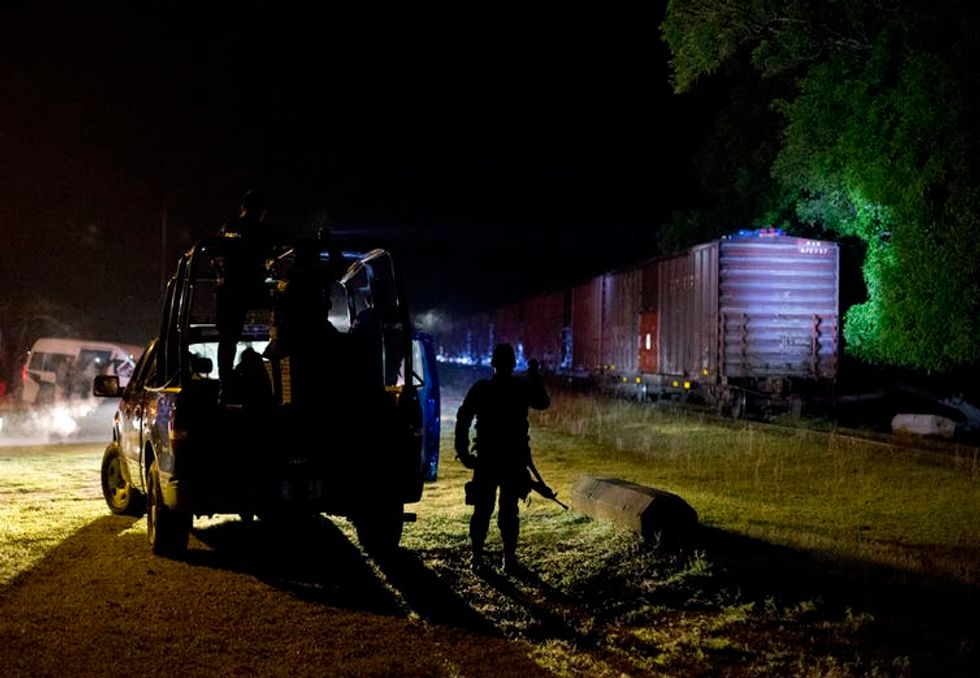
 For the next president, complying with Mexico’s new humanitarian law will mean passing policies that truly
  AFP/File / NIKLAS HALLE'N