A senior Iranian military commander poured scorn on U.S. threats to tighten sanctions on Tuesday, saying the Islamic Republic’s people would respond by punching U.S. Secretary of State Mike Pompeo in the mouth.
Pompeo said on Monday Washington would impose new penalties if Tehran did not make sweeping changes, including dropping its nuclear program and pulling out of the Syrian civil war.
Two weeks after President Donald Trump pulled out of an international nuclear deal with Iran, his administration has threatened to impose “the strongest sanctions in history,” setting Washington and Tehran further on a course of confrontation.
“The people of Iran should stand united in the face of this and they will deliver a strong punch to the mouth of the American Secretary of State and anyone who backs them,” Ismail Kowsari, the deputy commander of the Sarollah Revolutionary Guards base in Tehran said, according to the Iranian Labour News Agency.
Limiting Iran’s missile capabilities was one of Pompeo’s main demands.
“Who are you and America to tell us to limit the range of ballistic missiles?” Kowsari said, according to ILNA. “History has shown that with the attacks on Hiroshima and Nagasaki, America is the top criminal with regard to missiles,” he added.
Qassem Soleimani, the head of the branch of the Revolutionary Guards that carries out operations outside Iran’s borders, was singled out by Pompeo as a top troublemaker in the Middle East.
Kowsari said that the Iranian people back Soleimani.
“Soleimani is not a single person. The great people of Iran support him,” Kowsari said.
Separately, Iran’s government spokesman said that the plan outlined by Pompeo would exacerbate the public’s hostility to the United States.
“Do the Americans think that the silk glove that they’ve taken out and the iron hand that they’ve extended to the people, a hand that’s backed by Israel and the [Mujahedin-e-Khalq Organization], will make Iranian people think that America wants democracy?” Mohammad Baqer Nobakht said on Tuesday, according to state media.
The Mujahedin-e-Khalq Organization (MKO) is an exiled Iranian armed opposition group which has called for the overthrow of the Iranian government for decades.
John Bolton, the U.S. national security advisor, has been a supporter of the MKO, which the Iranian government sees as a terrorist group.
Reporting By Babak Dehghanpisheh; Editing by Andrew Heavens
Three weeks before an unprecedented U.S.-North Korea summit is supposed to take place, President Donald Trump will meet South Korean President Moon Jae-in on Tuesday as U.S. officials try to figure out whether Pyongyang is serious about negotiating a deal on denuclearization.
Moon’s White House visit was originally arranged as a meeting to fine-tune a joint strategy for dealing with North Korean leader Kim Jong Un but has instead become more of a crisis session after Pyongyang last week threatened to pull out of the planned June 12 summit in Singapore.
Moon’s government led efforts to resume dialogue with North Korea and gave enthusiastic accounts of its encounters with Kim, spurring Trump to accept an offer of a first-ever meeting between U.S. and North Korean presidents.
But the White House was caught off-guard when, in a dramatic change of tone, North Korea last week condemned the latest U.S.-South Korean air combat drills, suspended North-South talks and threw into doubt the summit with Trump if Pyongyang was pushed toward “unilateral nuclear abandonment.”
Trump has insisted he remains committed to the summit. His aides are looking to Moon to help determine whether Kim is taking a harder line against denuclearization than South Korea had previously communicated to them, a U.S. official said, speaking on condition of anonymity.
Other U.S. officials have privately expressed concern that Moon, eager to make progress with the North, may have overstated Kim’s willingness to negotiate in good faith over the dismantling of his nuclear arsenal.
Two visits by U.S. Secretary of State Mike Pompeo over the past two months have apparently failed to yield much clarity on Kim’s intentions.
Some in the U.S. government worry that Moon may be prepared to accept a less-stringent version of North Korean denuclearization than Washington wants and could be open to faster sanctions relief for Pyongyang, the officials said.
Most analysts say it is unrealistic to believe North Korea will agree to complete abandonment of its nuclear program, which has focused on developing a missile capable of hitting the United States and which Kim sees as crucial to his survival in power.
If the summit is canceled or fails, it would be a major blow to what Trump supporters hope will be the biggest diplomatic achievement of his presidency.
The uncertainty comes at a time when Trump’s withdrawal from the Iran nuclear deal has drawn criticism internationally, his moving of the U.S. embassy to Jerusalem has fueled violence on the Israel-Gaza border and he is on the defensive over an investigation into alleged Russian meddling in the 2016 election.
TESTING TRUMP?
North Korea’s warning of a possible withdrawal from the summit is seen as an effort to test Trump’s willingness to make concessions on his demands for Pyongyang’s denuclearization, the U.S. official said.
“It’s straight out of North Korea’s playbook,” the official said.
North Korea’s condemnation of Trump’s hawkish national security adviser, John Bolton, for proposing that North Korea should emulate Libya by abandoning its program of weapons of mass destruction was believed meant to sow divisions within the administration.
Despite Trump having contradicted Bolton on the Libya point, there has been no sign of Bolton losing influence.
Seoul has been hoping to ensure a successful summit after a historic meeting last month between Moon and Kim produced a declaration of goodwill.
But South Korea’s role has been brought into question since last week when North Korea’s chief negotiator derided Seoul as “ignorant and incompetent.”
Seoul has refrained from responding.
“The heads of South Korea and the United States are expected to discuss measures to guarantee a bright future for North Korea in the case it truly goes through complete denuclearization,” said Nam Gwan-pyo, an official at the presidential Blue House.
Trump has sought to placate Kim by holding out the possibility of economic development, and he pledged on Thursday that Kim’s security would be guaranteed in any deal.
But Trump has insisted on concrete steps before any easing of sanctions, and warned that failure to reach a denuclearization agreement could lead to “decimation” of Kim’s rule.
“They are locked into not giving much to the North Koreans early...whereas South Korea probably has a bit more interest in economic incentivization,” said Christopher Green, an analyst with the International Crisis Group. “So they need to calibrate between the two of them.”
China could also be on the agenda. Trump suggested last week that Beijing, which Washington is at odds with over trade, may be influencing North Korea’s hardened stance.
Beijing responded on Friday that it stands for stability on the Korean peninsula and for settlement through diplomacy.
However, Trump on Monday urged China, North Korea’s main trading partner, to maintain tight sanctions, tweeting that “the word is that recently the Border has become much more porous.”
Reporting By Matt Spetalnick, David Brunnstrom and Christine Kim; Additional reporting by Joori Roh and Josh Smith in Seoul and John Walcott in Washington; Editing by Mary Milliken and Alistair Bell
The U.S. Justice Department on Monday agreed to expand its investigation into alleged Russia collusion in the 2016 election to include “any irregularities” in FBI tactics involving Trump’s presidential campaign, a White House spokeswoman said.
Trump suggested on Friday that the FBI might have planted or recruited an informant in his presidential campaign for political purposes, citing unidentified reports that at least one FBI representative was “implanted.”
he agreement came during a meeting that Trump had with Deputy Attorney General Rod Rosenstein and Federal Bureau of Investigation Director Christopher Wray, the spokeswoman, Sarah Sanders, said.
The Justice Department “has asked the inspector general to expand its current investigation to include any irregularities with the Federal Bureau of Investigation’s or the Department of Justice’s tactics concerning the Trump Campaign,” Sanders said in a statement.
Federal investigators are probing whether anyone in the Trump campaign worked with Russia to sway the election to the Republican candidate. Trump has denied any collusion and repeatedly dismissed the investigation as a “witch hunt.”
Trump said in a Twitter post on Sunday that he would demand the Justice Department look into whether the FBI “infiltrated or surveilled the Trump Campaign for Political Purposes - and if any such demands or requests were made by people within the Obama Administration!”
Hours later, a spokeswoman said the department asked its inspector general to expand a review of the process for requesting surveillance warrants to include determining whether there was impropriety or political motivation in how the FBI conducted its investigation.The FBI was looking into Trump election campaign ties to Moscow before Special Counsel Robert Mueller took over the probe a year ago.
“If anyone did infiltrate or surveil participants in a presidential campaign for inappropriate purposes, we need to know about it and take appropriate action,” Rosenstein said in a statement on Sunday evening.
Democrats said Mueller and his investigation should be protected and information, such as about any informant, should not be shared with Congress.
Justice Department “regulations protect this type of information from disclosure to Congress for legitimate investigative and privacy reasons,” Senator Dianne Feinstein, the top Democrat on the Senate Judiciary Committee, said in a letter to Rosenstein on Monday.
Trump has shown increasing signs of impatience with the investigation led by Mueller as it enters its second year, saying it was politically motivated and had its roots in the administration of Democratic President Barack Obama.
His Republican allies in Congress, led by House Intelligence Committee Chairman Devin Nunes, have pushed the same message.
In March, the Justice Department’s inspector general launched a review into allegations by Republican lawmakers that the FBI made serious missteps when it sought a warrant to monitor a former adviser to Trump’s 2016 election campaign.
Justice Department Inspector General Michael Horowitz said his review will examine whether the FBI and Justice Department followed proper procedures when they applied for a warrant with the Foreign Intelligence Surveillance Court to secretly conduct surveillance on former adviser Carter Page and his ties to Russia.
Republican U.S. Representative Lee Zeldin said he and 16 other members of Congress will introduce a resolution on Tuesday alleging Justice Department and FBI misconduct involving surveillance in the Trump-Russia probe.
Neither Trump nor his new lawyer, Rudy Giuliani, provided any evidence of government infiltration into Trump’s presidential campaign.
The New York Times, citing people familiar with the matter, reported that the FBI sent an informant to talk to two Trump campaign advisers, Page and George Papadopoulos, after the agency received evidence that the two men had suspicious contacts linked to Russia during the campaign.
Papadopoulos pleaded guilty last fall to lying to FBI agents about his contacts with Russia.
Reporting by Steve Holland, Doina Chiacu, Roberta Rampton and Patricia Zengerle; editing by Cynthia Osterman
Deadly white clouds of acid and fine shards of glass boiled into the sky over Hawaii on Monday as lava from the Kilauea volcano flowed into the ocean, creating a new hazard from a more than two-week eruption.
Hawaii’s Civil Defense agency warned motorists, boaters and beachgoers to beware of toxic clouds of so-called “laze” — a combination of “lava” and “haze” — which formed as two streams of hot lava poured into sea water.
The caustic plume, which can be fatal if inhaled, was the latest danger in an eruption that shows no signs of stopping, Since it started on May 3. It has already produced around two dozen lava-spewing cracks, the same number as a previous 88-day event in 1955.
The eruption has entered a more violent phase, in which large volumes of rich, orange molten rock, hotter and faster than older magma, are streaming out of fissures in the ground that have erupted around a small area of rural communities.
“We’ve seen Phase 1. We’ve seen the clearing out of the system. We call that the ‘throat-clearing’ phase,” Carolyn Pearcheta, operational geologist at the Hawaiian Volcano Observatory, told reporters on a conference call.
Lava has destroyed at least 44 homes and other structures in the Leilani Estates and Laipuna Gardens area of the Puna district.
A “lava bomb”, a plate-sized chunk of lava that flew horizontally out of a fissure, seriously injured one man on Saturday.
Two thousand people have been ordered from their homes due to lava flows and toxic sulfur dioxide gas, levels of which have tripled in the last two days, according to the County of Hawaii Civil Defense. Hawaii National Guard has warned of more mandatory evacuations if further highways are blocked.
Flows of molten rock are traveling at around 400 yards (meters) per hour, twice as fast as earlier streams, Pearcheta said. Lava is expected to begin sending fountains of lava up to 600 feet (183 meters) into the air, three times as high as before, she added.
The new laze threat, which killed two people when a lava flow reached the coast in 2000, is a mix of hydrochloric acid fumes, steam and fine volcanic glass specks created when erupting lava, which can reach 2,000 degrees Fahrenheit (1,093 degrees Celsius), reacts with sea water.
The cloud could extend as far as 15 miles (24 km), mostly along the coast and offshore, geologists said on Sunday. Even a wisp can cause eye and respiratory irritation, and it causes acid rain that has corrosive properties equivalent to diluted battery acid, the U.S. Geological Survey said.
An air quality index for Kona, about 40 miles (64 km) northwest of the eruption site, was at “orange,” meaning older individuals and those with lung problems could be affected.
Reporting by Terray Sylvester, additional reporting by Jolyn Rosa in Honolulu; Writing by Andrew Hay; Editing by Bill Tarrant and Sandra Maler
U.S. and Canadian state securities regulators announced Monday they have launched dozens of investigations into cryptocurrency scams.
The North American Securities Administrators Association announced the wide-ranging series of probes on Monday, dubbed “Operation Crypto-Sweep.” The investigations, some of which have already concluded, are aimed at unregistered securities offerings and initial coin offerings that promise significant returns without informing investors of the risks.
A task force convened by the group of state regulators in April has launched 70 investigations, with 35 already facing completed or pending enforcement actions.
Regulators have already sent cease and desist letters to several alleged schemes, including websites that relied on fake addresses and photos to appear legitimate when seeking investors. Officials said there will be additional enforcement actions to come against companies looking to defraud cryptocurrency investors.
“The actions we’ve taken to date are just the tip of the iceberg,” said Joe Borg, NASAA president and director of the Alabama Securities Commission.
Regulators invited the public to come forward with additional potential scams, while urging investors to be vigilant in seeking investments in the new arena.
The move by state regulators to crack down on cryptocurrency scams comes amid growing attention to virtual currencies by federal regulators, including the Securities and Exchange Commission and the Commodity Futures Trading Commission.
“You’re going to see in this space a lot more collaboration and cooperation going forward,” said Borg.
Reporting by Pete Schroeder; Editing by Bernadette Baum and Andrea Ricci
On May 6, the “All of Us” study started enrolling participants. This national study will be one of the largest ever examining the connection between genetics, behavior and medical outcomes, with a goal of 1 million or more participants. Anyone over the age of 18 in the U.S. can join.
As a researcher who studies personalized medicine, I believe it’s important for Americans to be able to make an informed decisions in their quest for cutting-edge health care, but it does raise important questions over privacy. Given modern concerns about data security, I see positives and negatives to participating in trials like All of Us.
You may question how this will benefit you and potentially compromise your privacy. Your skepticism is warranted and worthy of investigation to help you make the correct decision.
Why do a clinical trial
Clinical trials often offer benefits to their participants. Many offer early access to cutting edge treatment that’s not available to others. Another perk may be free or discounted treatment, or some other incentive.
In my view, participating in a clinical trial is also somewhat a personal duty. In the U.S., as of 2013, the Food and Administration has approved 1,453 drugs for use in humans. When you take an approved drug, you benefit from not only the work of scientists and billions of dollars of investment, but the sacrifice of many participants who took a chance on an experimental drug.
In contrast, the All of Us trial is not designed for any direct improved treatment. Instead, it aims to collect data to help researchers understand the connections between genetics, lifestyle and disease. For example, the study could identify novel biomarkers to measure long-term average blood glucose levels.
Despite careful tests on safety and dosage, when some drugs reach market, some individuals have serious adverse reactions, which in rare cases can be lethal. Others see no benefit from the drug.
Why does this happen? The answer in large part comes from genetics. Like a computer program that codes for some task, DNA codes for many traits – including a person’s susceptibility to disease and response to drugs.
Each person’s DNA sequence encodes millions of variations compared to another person, unless that person has an identical twin. Cost-effective sequencing of all or part of a person’s DNA now enables scientists to look at the potential relationship between one or more of these genetic variations and disease diagnosis, prognosis or treatment. In fact, about 8 percent of all approved drugs now recommend a specific genetic test on their label to identify the right drug and dosage.
The large number of participants in All of Us will give researchers enough data to detect links between treatments, lifestyles and health outcomes.
Risks to your data
One should be aware of the amount of genetic information you are disclosing in a research study, whether it’s in a clinical trial or a more generalized study.
About 8 percent of all approved drugs now recommend a specific genetic test on their label.
Sergei Drozd/shutterstock.com
Some studies are genotyping based, examining about 1 to 100 genetic variations, often in a specific gene or set of genes, called a panel. Other studies may use a microarray that has 0.5 to 1 million common genetic variants. This is typically the technology used by recreational genetic companies like 23andMe and Ancestry. Even more data comes from whole exome sequencing. It’s not yet clear what type of tests All of Us will use.
What are your risks of giving away your genetic information? Research has shown that you and your relatives can likely be identified from your DNA, so your privacy could potentially be compromised.
In a clinical trial, you will not have ownership or even access to your genetic data. In a company-driven trial, data might be shared with third parties and protections against a data breach are not regulated. If you have used a recreational genetics company, you should review the websites and company policies for the protections afforded.
However, if a dangerous mutation in one of the 59 genes defined by the American College of Medical Genetics is identified in a research study, the participant will be informed of this incidental finding. This screening is an added benefit for the participant.
Weighing the costs
A number of laws protect against the misuse of participant genetic data, especially in a trial sanctioned by the National Institutes of Health, such as All of Us.
As part of a trial, you will be asked to sign an informed consent form, which lets you know the risks and how your information will be used. The trial and consent form must be approved by an Institutional Review Board that monitors human subject research. Read these documents.
The NIH requires that any genetic data resulting from their funding be shared through secure web systems such that your contribution maximizes impact. That means the use of your genetic data is strictly controlled and protected.
Genetic data can undoubtedly lead to more drugs with more focused targeting and better health care for all. High-quality studies with strong statistical power, like All of Us, may need millions of participants. Clearly, a system that lets scientists comprehensively share genetic and clinical data, yet maintains acceptable privacy, is desperately needed.
By sharing medical records and having the large data set accessible to other scientific researchers, All of Us is a key step in the right direction.
A well-worn joke in American Jewish culture goes like this. A Jewish immigrant landed at Ellis Island in New York. The procedures were confusing, and he was overwhelmed by the commotion. When one of the officials asked him “What is your name?” he replied, “Shayn fergessen,” which in Yiddish means “I’ve already forgotten.” The official then recorded his name as Sean Ferguson.
Today, members of many white ethnic groups – including Jews, Italians and Poles – believe that insensitive or ignorant Ellis Island officials changed their families’ names when they arrived in the U.S. to make them sound more American.
But there is actually much more evidence demonstrating that Jews and members of other white ethnic groups changed names on their own. In the research for my forthcoming book, I looked at legal name change petitions in New York City throughout the 20th century showing that thousands of Jewish immigrants and their children indeed changed their own names.
As American Jews celebrate Jewish American Heritage Month this May, it is worth revisiting where and why the portrait of coercive Ellis Island name changing emerged.
Historians Marian Smith and Vincent Cannato argue convincingly that insensitive Ellis Island officials did not forcibly change immigrants’ names. In fact, immigration procedures did not typically include the question “What is your name?” Bureaucrats simply checked immigrants’ names to make sure they matched the names already listed on ships’ passenger lists.
Evidence from popular literature further supports their argument. Between 1892 and 1920, when thousands of immigrants passed through the immigration station on Ellis Island each day, there were no descriptions of Ellis Island name changing in popular magazines or books. And even after immigration slowed significantly in the 1920s, popular books and magazines for the next four decades did not typically describe Ellis Island officials changing immigrant names.
Indeed, one 1969 Jewish humor book even told a joke with the Sean Ferguson punchline. But the joke was about a Yiddish actor who went to California to become a movie star. All through the train ride, he worked on memorizing a stage name, only to forget it when he came face to face with an imposing Hollywood producer.
Cultural changes of the 60s and 70s
It was not until the 1970s that the image of Ellis Island name changing took hold of the American imagination. One popular 1979 book about Ellis Island and the immigrant experience, for example, described officials who were “casual and uncaring on the matter of names.”
Francis Ford Coppola’s 1974 film “The Godfather, Part II” featured an insensitive immigration officer giving young Vito Corleone his name.
What I’d like to argue is that the culture of the late 1960s and 1970s shaped these portraits of Ellis Island name changing. After the 1965 Immigration and Nationality Act eliminated the discriminatory immigration quotas that had restricted immigration from southern and eastern Europe, American popular culture began to tell new stories that valorized the success of immigrants from those very regions.
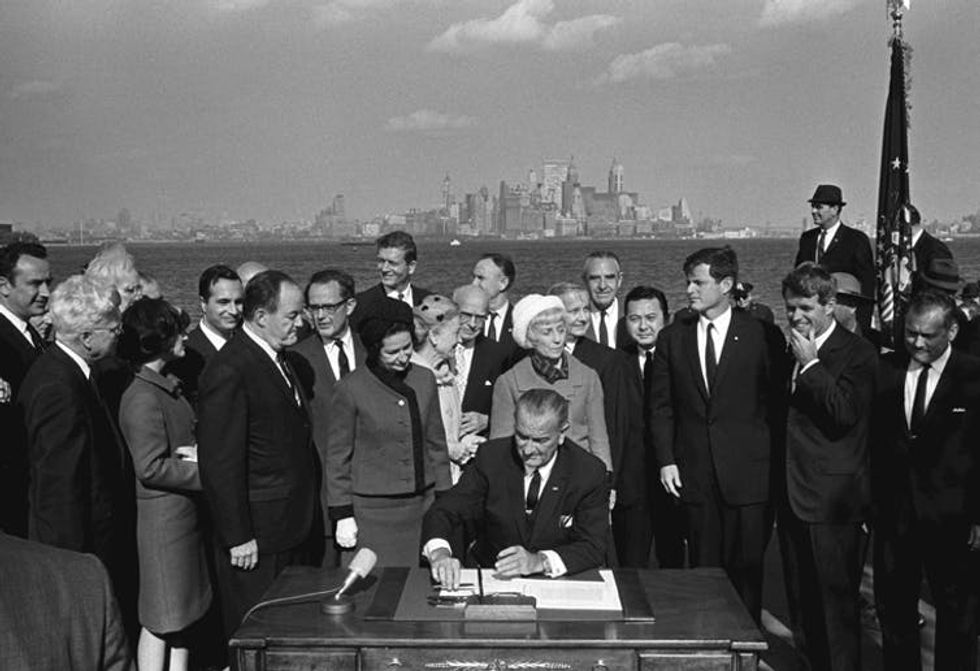
Ellis Island itself – where Lyndon Johnson signed the 1965 act – transformed in the public mind from a set of abandoned buildings to a prominent symbol of European immigrants’ struggles and triumphs.
President Lyndon B. Johnson signs the Immigration and Nationality Act at Ellis Island.
The late 1960s and 1970s also witnessed significant challenges to the authority of the United States government: The Pentagon Papers showed that the government had misled the American people, as the U.S. committed more and more troops to Vietnam. Persistent racial inequality exploded in riots in cities throughout the country. And the Watergate scandal exposed criminality and obstruction of justice at the highest levels of government.
Portraits of involuntary name changing at Ellis Island fit both with the island’s new prominence as a symbol of immigration, and with growing distrust of government authority.
Name changing a betrayal of family values?
Ellis Island name changing also fit another emerging theme in American culture in the 1970s: a quest for authenticity. Historian Matthew Frye Jacobson has documented the quest of many white ethnic groups during this era, including Jews, to seek “authentic” culture to bolster their ethnic identities.
With films like “The Godfather” and “Hester Street,” which portrayed the challenges immigration posed for one young Jewish family in New York, American culture turned to the Old World – the European countries from which white immigrants had immigrated – as a source for family values and communal integrity. And within this context, changing names seemed like a betrayal of family, community and identity.
From the 1970s through the 1990s, novels, films and plays that portrayed Jewish life, such as Wendy Wasserstein’s play “Isn’t It Romantic?” and Barry Levinson’s movie, “Avalon,” represented name changers as phonies or sellouts.
Although Jews were not the only ones to experience this longing for authenticity, my research suggests they changed their names in disproportionate numbers compared with other groups in response to American anti-Semitism.
In a culture that had begun to embrace the Old World as a source of authentic values, the fact that their parents and grandparents voluntarily changed their own names from their original Jewish ones may have been painful for many American Jews to accept. Blaming insensitive government officials at Ellis Island for erasing Jewish names was a much easier task.
But this emphasis upon Ellis Island only obscured the complicated reasons why Jews actually changed their own names.
The Sean Ferguson joke is thus more than a simple joke. It illustrates the ways that Jewish people have struggled, and continue to struggle, with their identity in America. It shows how hard it is to grapple with the past, but also how important that grappling is.
Several socially conscious investment firms are selling or rethinking their Facebook Inc holdings, unsatisfied by the company’s moves to strengthen personal data protection and online safety after scandals involving the improper sharing of users’ information.
The retreat from the world’s largest social media network is one of the sharpest responses by investors to concerns about Facebook’s handling of user data.
Cambridge Analytica, a now-defunct political data firm hired by Trump’s 2016 election campaign, has been accused of harvesting data for 87 million Facebook users and is under investigation in the United States and Europe.
Facebook shares fell in the first quarter when the scandal broke, and recovered after founder and Chief Executive Mark Zuckerberg testified before U.S. lawmakers in April. Although he deflected questions and avoided pledging to support new regulation, doubts were raised about his commitment to fully resolve the issue.[
“Facebook’s problems, we believe, are founded on a lack of sufficient attention to consumer privacy and data security, compounded by inadequate governance,” wrote Adam Kanzer, vice president of Domini Funds, in a May 8 letter to Facebook explaining its plan to sell its 111,000 Facebook shares held in the Domini Impact Equity Fund.
In April Eaton Vance Corp unit Calvert Research and Management also sold Facebook shares on concerns about lax controls that meant “the company clearly violated users’ fundamental right to privacy,” contrary to the firm’s investment principles, according to Emma Doner, one of its Environmental, Social and Governance analysts.
The divestment by the two well-known firms build on previous concerns by other so-called ESG managers, which consider social responsibility when buying stocks.
Others may follow. Joe Keefe, president of Pax World Funds, said Facebook’s place in investment vehicles like the Pax ESG Beta Dividend Fund will be reviewed with an eye on recent controversies that “may very well affect the company’s scores and its eligibility for continued inclusion in those portfolios.”
A Facebook spokeswoman declined to comment.
Zuckerberg controls a majority of Facebook’s voting power, but must face shareholders at its annual meeting on May 31. Top proxy advisers have recommended a number of votes contrary to the board’s positions.
ESG funds represent just a small fraction of Facebook shares, but their moves may influence top investors including BlackRock Inc and Vanguard Group, which have paid more attention to social issues in recent years. Representatives for both declined to comment.
Facebook had already faced skepticism from ESG funds which on average had kept the company at a market-neutral weighting of 1.7 percent, according to Morningstar data, likely tied to Facebook’s average score from ESG rating service Sustainalytics.
Martin Kremenstein, senior managing director at Nuveen, said one reason it would be hard for the company’s socially minded funds to own Facebook is because the problems occurred despite a settlement the company struck with the Federal Trade Commission in 2011, which included a pledge to improve privacy protections.
Referring to the latest revelations involving Cambridge Analytica, he said, “This is a bigger scandal than before, but it’s not a new one.”
Not all ESG managers aim to divest. Lauren Compere of Boston Common Asset Management said Facebook remains attractive given its strong growth and cash generation, and said the company deserved credit for steps like fighting unreasonable government requests for users’ information.
Julie Goodridge of NorthStar Asset Management, with about 36,900 Facebook shares, said managers should keep their shares and vote in support of upcoming proxy resolutions like one from her firm calling for Facebook to give all shares an equal vote, which would reduce Zuckerberg’s power.
Reporting by Ross Kerber; Editing by Peter Henderson and Richard Chang
President Donald Trump's high-stakes meeting with North Korean leader Kim Jong-un will take place in the coming weeks -- but it's increasingly clear that neither the president nor his advisers know what the outcome will be.
Robert E. Kelly, a professor of political science who teaches in Korea, writes on Twitter that Trump has essentially been tricked into holding a major summit with Kim, and he isn't sure how the president will react once he realizes that North Korea has no real plans to scrap its nuclear arsenal.
"It increasingly looks like the [South Korean President Moon Jae-in] administration overstated North Korea’s willingness to deal," Kelly writes. "Moon likely exaggerated this to tie Trump to a diplomatic track to prevent him from backsliding into last year’s war-threats which scared the daylights out of South Koreans."
Kelly then writes that a more cool-headed president would have taken some time to consider various factors before agreeing to meet with Kim -- but, argues Kelly, Trump likely had visions of a Nobel Peace Prize, which led to him accepting the offer less than an hour after it was made.
However, Kelly believes that this fluffing of Trump could have a serious price tag, as he might eventually realize that he's been played.
"None of this Trump-whispering is true: NK is not going to denuclearize; NK was not driven to negotiate by maximum pressure (they chose to negotiate, because they established nuclear deterrence with the US mainland); and Trump does not deserve a Nobel, because, well, I am pretty sure that threatening national genocide at the United Nations – ‘totally destroy North Korea’ – is a disqualifier," he writes.
U.S. Secretary of State Mike Pompeo said on Monday the United States would impose the “strongest sanctions in history” against the Iranian leadership, after Washington pulled out of the 2015 nuclear deal.
Pompeo laid out 12 demands for Iran and said relief from sanctions would only come when Washington had seen tangible shifts in Iran’s policies.
Reporting by Lesley Wroughton; Writing by Yara Bayoumy; Editing by Bernadette Baum
U.S. Treasury Secretary Steven Mnuchin said on Monday significant issues remained in talks between the United States, Mexico and Canada to renegotiate the North American Free Trade Agreement(NAFTA).
“There are still some very significant, open issues,” Mnuchin said in an interview on CNBC. He said the Trump administration remained focused on crafting a new NAFTA deal that would require congressional approval, but that Trump could consider a possible so-called ‘skinny deal’ that would not.
U.S. President Donald Trump on Monday said China had pledged to buy “massive amounts” of American agricultural products but gave no other details about planned commitments from Beijing following U.S.-China trade talks last week.
“Fair Trade, plus, with China will happen!” Trump wrote in a series of posts on Twitter that came a day after U.S. Treasury Secretary Steven Mnuchin said a trade war between the world’s largest economies was “on hold.”
Reporting by Susan Heavey; Editing by Chizu Nomiyama
Facebook chief Mark Zuckerberg has agreed to live-stream his meeting with European Parliament members as he answers questions in the wake of the Cambridge Analytica scandal, a top official said Monday.
The meeting on Tuesday with the parliament's most senior members was initially set to be held behind closed doors.
But influential MEPs had pushed for a public hearing following the worst crisis in Facebook's history.
"I have personally discussed with Facebook CEO Mr Zuckerberg the possibilty of webstreaming meeting with him," the parliament's leader Antonio Tajani wrote on Twitter.
"I am glad to announce that he has accepted this new request. Great news for EU citizens," he added.
Tajani had invited Zuckerberg, saying the 2.7 million EU citizens affected by the data sharing scandal deserved a full explanation.
The visit comes as the EU is introducing tough new data protection rules later this month, which Facebook has said it will comply with.
Facebook admitted earlier this month that up to 87 million users may have had their data hijacked by British consultancy Cambridge Analytica, which worked for US President Donald Trump during his 2016 campaign.
The EU's General Data Protection Regulation (GDPR), which comes into effect on May 25, aims to give users more control over how their personal information is stored and used online, with big fines for firms that break the rules.
Zuckerberg, who has repeatedly apologised for the massive data breach, told the US Congress in April that the more stringent EU rules could serve as a rough model globally.
The European Parliament hearing will run from 6:15 pm to 7:30 pm (1615 GMT to 1730 GMT) on Tuesday.
Tajani will also hold a private meeting with Zuckerberg the same day, a spokesman for the parliamentary chief told AFP.





 By sharing medical records and having the large data set accessible to other scientific researchers, All of Us is a key step in the right direction.
 The Sean Ferguson joke is thus more than a simple joke. It illustrates the ways that Jewish people have struggled, and continue to struggle, with their identity in America. It shows how hard it is to grapple with the past, but also how important that grappling is.