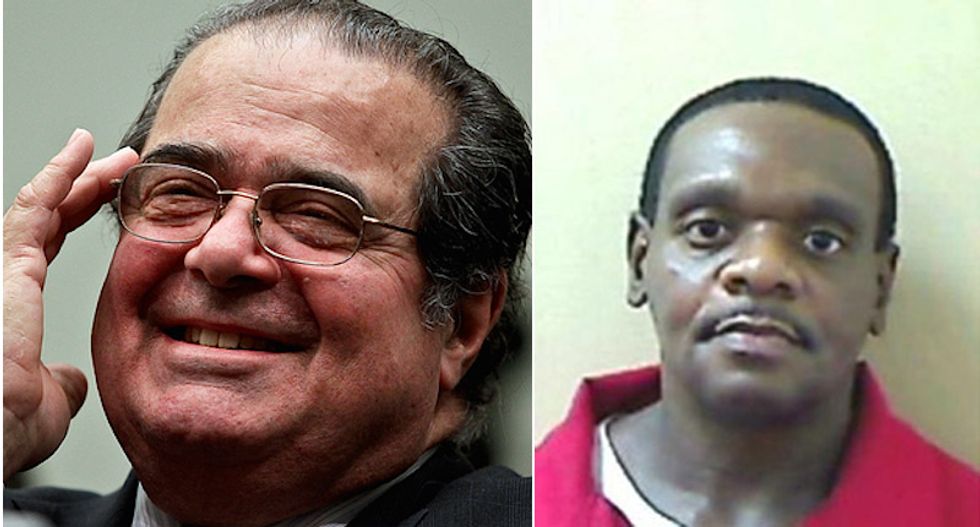
Justice Antonin Scalia, Henry Lee McCallum - Flickr. North Carolina Corrections

In a 1994 opinion, Supreme Court Justice Antonin Scalia took a shot at fellow Justice Harry Blackmun’s concerns about the death penalty by citing a case in North Carolina where a man was convicted of raping and murdering an 11-year-old girl.
Referring to convicted killer Henry Lee McCollum, Scalia wrote, “For example, the case of an 11-year-old girl raped by four men and then killed by stuffing her panties down her throat. How enviable a quiet death by lethal injection compared with that!”
The two men were prosecuted by Joe Freeman Britt, a Bible-quoting district attorney later profiled by “60 Minutes” as the country’s “deadliest D.A.” known for his frequent seeking of the death penalty.
McCollum, who was never executed by lethal injection for the rape and murder over 30 years ago, was exonerated last year after he and his half-brother, Leon Brown, were cleared by investigators using DNA evidence.
According to the News-Observer, both Henry McCollum and Leon Brown were officially pardoned by North Carolina Governor Pat McCrory on Thursday, making each of them eligible to now receive $750,000 in compensation from the state.
“This has been a comprehensive and thoughtful process during the past nine months,” McCrory said. “Based on the available evidence I’ve reviewed, I am granting pardons of innocence to Henry McCollum and Leon Brown. It’s the right thing to do.”
Robeson County District Attorney Johnson Britt, a distant relative of the original prosecutor, lauded the governor's pardons, saying, “I think the governor made the right decision. I fully support the action that he’s taken.”
As Dahlia Lithwick wrote when the DNA evidence cleared the two men, "Several years after he baited Blackmun over McCollum, Scalia floated the notion that executing even innocents doesn’t violate the Constitution. After the court ordered a retrial in a controversial capital case, Scalia wrote for himself and Justice Clarence Thomas, that “[t]his court has never held that the Constitution forbids the execution of a convicted defendant who has had a full and fair trial but is later able to convince a habeas court that he is ‘actually’ innocent.”
Ken Rose, an attorney with the Center for Death Penalty Litigation, explained that it doesn't end here despite Scalia's dismissal of the finality of death penalties when wrongfully applied.
“If we continue executions we are going to be executing some innocent people on death row," he said.
Report typos and corrections to corrections@rawstory.com.
For customer support contact support@rawstory.com.