




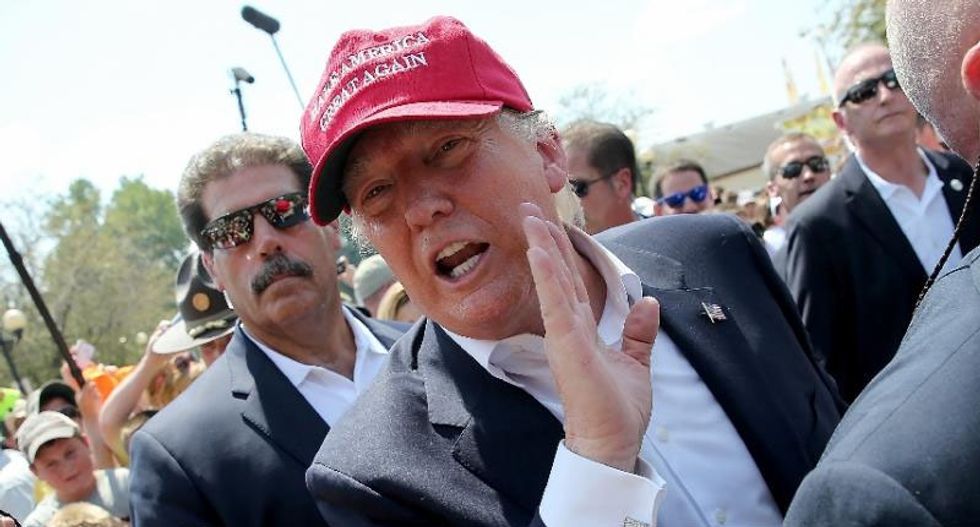
Lower-wage workers love Donald Trump -- even though he thinks many of them are overpaid.
The real estate tycoon and reality TV star has led national polls of likely Republican voters for months, largely driven by strong support from low-income, blue-collar, church-going voters who are drawn to his image as a "straight-talking political outsider," according to Reuters.
A recent Marist poll found that 34 percent of Republican and Republican-leaning independents who earn less than $50,000 a year back Trump for president -- by far the highest of any GOP candidate.
That support even carries over to workers or families who depend on minimum wage.
“A lot of people, they can’t make it -- people with little kids, they’re working two or three jobs just to pay the rent and pay groceries,” said Barb Harkins, a registered Democrat who spoke to USA Today outside a Walmart in Des Moines, Iowa.
The 60-year-old Harkins, whose grandchildren work minimum wage jobs, thinks the minimum wage should be increased but still supports Trump -- who has said the minimum wage is too high for American businesses to compete with other countries.
Why?
“He’s not a politician,” Harkins said.
Another Trump supporter in that same Walmart parking lot said he appreciated the wealthy businessman's belligerent demeanor.
"He doesn't take crap from anybody," said Chad Stiver, a 39-year-old electrician.
Trump has been a celebrity for decades, so his gaudy personality was already well-known to voters.
But political observers continue to express shock that Trump's brazen but vague policy proposals -- whether he's calling for Mexico to build a wall to prevent its citizens from migrating to the U.S. or suggesting that Muslims should be entered into a special database -- continue to resonate with voters.
His message appeals to white working-class voters, particularly his proposal to deport millions of undocumented workers and bring back jobs from other countries that pay workers less than U.S. law permits.
“You have voters who are saying loudly and clearly that they want a strong leader to run our country, and that leader is Mr. Trump,” said his campaign manager, Corey Lewandowski. “Some of the other candidates didn’t have that vision."
There exists, however, a certain tension between Republican voter perceptions and economic realities.
A recent Bloomberg poll found that Republicans said by a 53-38 margin that the U.S. unemployment rate was worse now than when President Barack Obama took office.
Overall, Americans said the opposite by a nearly inverse 56-34 margin.
In reality, the unemployment rate was 7.8 percent when Obama was inaugurated in January 2009 and spiked at 10 percent by October 2009, according to the Bureau of Labor Statistics, and has declined steadily ever since to 5.0 percent last month.
Trump's promise to bring back jobs -- even if they don't pay much -- resonates with workers who perceive, accurately or not, that they're competing with foreign nationals for work.
“When they hear Trump complaining about Mexicans and talking about his wall, they may be envisioning a lot more jobs and higher pay for them versus the folks he wants to deport,” said Jared Bernstein, a former economic adviser to Vice President Joe Biden. “The other stuff gets buried under, placed in a folder called cognitive dissonance.”
Some Trump backers simply dismissed the news when told that Trump opposed raising their rate of pay -- insisting the wealthy businessman had "working class" appeal.
“That’s part of why I like him," said Randy Nicholson, a 61-year-old retired carpenter who says he worked all his life for $9 an hour.
A bipartisan polling team has for several years conducted focus groups with "Walmart moms," and their Nov. 5 report found that these women are more concerned with the “rising cost of living" than with "jobs," which they had highlighted in previous discussions.
Those perceptions still don't seem to hurt Trump, who has said he would not favor raising the minimum wage to $15 an hour but would instead keep the federal minimum wage at its current $7.25.
Nearly half, 49 percent, of Iowa Republicans say Trump would do the best job handling the economy, while no other GOP candidate cracks double digits in that CNN poll.
"Look what he's done with his business," said Harkins, the Iowa grandmother.
