




There is a myth about feminism that sees feminists as Valkyries armed with battle axes and impervious to criticism or the potential to have their feelings hurt. In this mythology, feminists are too tough and too ugly to ever attract anyone’s sexual attention. These are obvious myths, but when I taught undergraduates, I stopped being surprised at the number of young women who told me that they didn’t consider themselves to be feminists because “I like to wear make-up and I like men.” It’s how I knew that the rightwing noise machine had been more successful at defining feminism than the many real-life feminists that I did know, who came in all shapes and sizes, ethnicities and racial identities, sexualities and gender identities. I had feminist friends who had happily adopted their husband’s last names on their wedding days and I had lesbian-separatist feminist friends who were happier not having to deal with men at all. To each her own. As most feminists will tell you, there are a variety of feminisms, and it is not a one-size-fits-all philosophy.
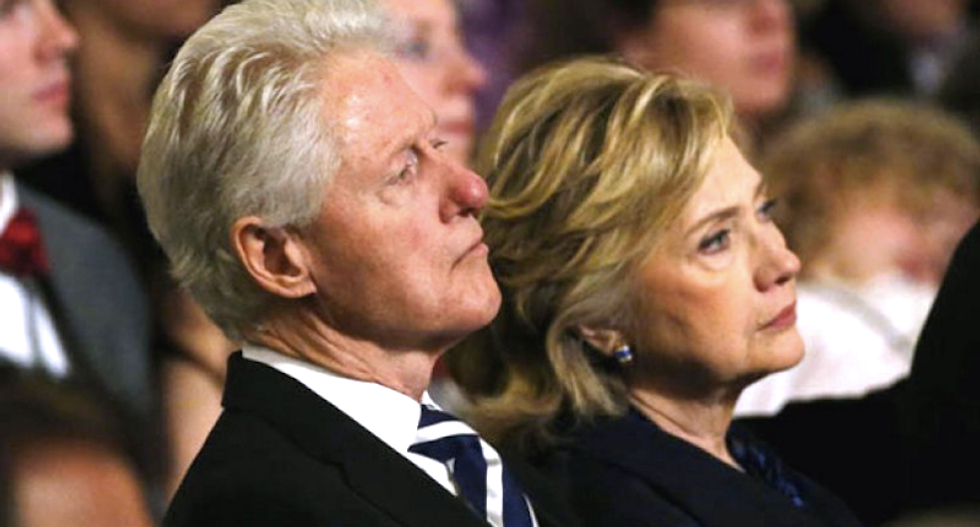
I mention this because while it may seem like old news to most on the left that feminism is not a monolithic belief system, those who struggle with nuance find various feminists’ approach to the marriage of Hillary Clinton, the Democratic candidate for president, and her husband of forty years, Bill, a mishmash of contradictions. The complexities of the Clinton marriage, and Hillary Clinton’s bona fides as a feminist have once again come under question with the publication on August 14 of an interview with Juanita Broaddrick in BuzzFeed News.
In the long interview, skillfully conducted and written in a painstakingly balanced manner by Katie J.M. Baker, Broaddrick repeats her claim that in the spring of 1978, while she was in Little Rock, Arkansas for a conference, Bill Clinton, who was then a candidate for office and for whose campaign Broaddrick was doing some volunteer work, came to Broaddrick’s motel room for a breakfast meeting and forcibly raped her.
Broaddrick did not file charges at the time of the alleged rape, although she did tell a friend the morning that she says it happened. In the late 1990s, when Clinton was being investigated by Ken Starr in the period leading up to his impeachment, Broaddrick initially denied that anything untoward had happened with Clinton, but then changed her testimony and came forward to testify that she had been raped. The statute of limitations in Arkansas for rape is six years; Broaddrick had waited 21 years to tell her story.
In 1999, she gave an on-camera interview to NBC's Dateline in which she repeated the details of what she said happened that morning. The problem is that there is no corroborating evidence to support Broaddrick’s charges. She did not go to a hospital at the time of the alleged assault. She did not take photographs of the bruised lip she said that Clinton gave her. She did not preserve the clothing that she wore that day. As for Clinton, he has always refused to speak of Juanita Broaddrick.
Rape culture tells a woman that, unless she dies resisting, if she survives a rape—even one in which she is admitted into a hospital bleeding from all of her orifices, covered in her rapist’s DNA—unless there is a witness to the assault, how is anyone supposed to know that all of the bruises and internal damage was not the result of consensual rough sex? The canard that “women lie about rape” has a history that can be traced in writing as far back as we have recorded history in the west. Distrust of women is one of the major symptoms of cultures steeped in misogyny. So, it has been one of the major maxims of feminism to “trust women,” one that I have written about in the pages of Raw Story on more than one occasion.
Yet, it’s difficult to write about Juanita Broaddrick. Watching the video of the 1999 interview, her account of what happened to her is credible. And her anger at the man whom she said raped her is understandable. She hates Bill Clinton. She says it openly. And if Bill Clinton did rape Juanita Broaddrick and he was never brought to justice for it, then I am sorry that that happened. Clearly, we failed her.
But, in writing about her now, in 2016, it is impossible for me to figure out how her hatred of Bill Clinton has turned into what appears to be a deep-seated paranoia – as evidenced by her Twitter feed – about Hillary Clinton. It would be easy to write about Broaddrick as some naïve victim who has allowed her hatred of Bill Clinton to turn her into some stooge for the conspiracy-loving rightwing press – especially Breitbart – so much so that they have made a mockery of what she said happened to her on that day. On the other hand, Juanita Broaddrick is an intelligent woman, and it would be just as easy to see her as capable of playing the slathering-for-Clinton-meat attack-dog press as her personal vendetta vanity press, who print what she wants them to say because they all share the same goal of bringing the Clintons down.
Reading Broaddrick’s Twitter feed is unsettling. There are outreach tweets in which she offers support to victims of rape who have shared their stories with her, and then there are posts that are either re-tweets, or her own composition, that are pure New World Order conspiracy theories with Bill or Hillary Clinton at the center of them. She even plays with the names of Clinton and Attorney General Lynch on July 1, and writes, “That’s a catchy phrase 'lynch Clinton' :)” And the smiley face is either daft or menacing, depending on which version of Juanita Broaddrick you believe.
Juanita Broaddrick doesn’t make it easy to be an advocate for her, frankly, but that’s not anything that she owes to anyone. That’s the trouble with alleged rape victims. They’re not perfect. It’s a rape victim’s lack of perfection that defense attorneys make their cases on: was she drinking, was she in “inappropriate” clothing, had she had “too many” boyfriends, was she out too late, was she mouthy? She says that she has never wanted anything from telling her story about Clinton other than to tell her truth. She has never written a book, and, as far as anyone has been able to document, is not making money off telling her story.
But now, however, Broaddrick’s story has been seemingly taken over by Breitbart, which has posted 40 articles about her since January 1, 2016. Given the alt-right’s failure to take most women’s rape claims seriously, this “appropriation”of Broaddrick’s story for the right wing’s political gain feels like yet another claim of a woman’s pain in order to make their political point. Breitbart’s favorite tactic for referring to the Broaddrick case is to mention the latest case of a celebrity rape case – for example, that of Nate Parker – in order to say, “why are you making a fuss about this rape but you’re still not talking about Juanita?” It’s clear that if Juanita did not exist, Breitbart wouldn’t report on rape at all, unless it was to warn its readers about Muslim rape gangs or that girls lie about rape. But this is the company that Broaddrick is choosing to keep. And it still doesn’t change what did or did not happen to her in 1978.
The other question that arises from all of this, of course, is why all of these old allegations are coming up again. The answer is obvious: Hillary is running for president. But it’s not obvious what one has to do with the other. According to both Broaddrick and Breitbart, Hillary is somehow at fault for Bill’s behavior.
According to Juanita Broaddrick, and something that she is not on record of having mentioned for years, is that shortly after the alleged rape, she encountered Hillary Clinton at a campaign event. She says that when Hillary shook her hand, something in Hillary’s tone "threatened" Broaddrick when Hillary thanked her for everything that Broaddrick had done for Bill. While most would see the phrase as standard campaign verbiage of candidate’s wife to volunteer, Broaddrick insists it was a threat that told her she had to stay silent. When NBC’s Andrea Mitchell re-interviewed Broaddrick in January to see if the story should be re-reported, she decided that there was nothing new to report that hadn’t been reported in 1999, which has led both Broaddrick and Breitbart to wage a campaign against Mitchell for being in Clinton’s pocket.
When the BuzzFeed interview appeared, despite its balanced approach to the entire topic, because it did not call for Clinton to drop out of the race, Breitbart published a piece saying that Broaddrick had been disrespected.
But again, even if Bill Clinton raped Juanita Broaddrick, why should Hillary Clinton be punished for it now? Some of the reporters who have tried to write about this issue have gotten themselves into trouble by trying to minimize rape. They have floated the idea that somehow, rape wasn’t rape in the 1970s. Their argument is that we have different conceptions of what constitutes rape now, and back in the 1970s, it’s possible that Bill Clinton didn’t know that he had raped Juanita Broaddrick. I think that’s a terrible argument to make. As a teenager in the 1970s, I have clear memories of what rape was, and rape did not get invented as a crime sometime after the new millennium. To minimize Broaddrick’s alleged experience in order to allow Clinton off the hook is intellectually dishonest.
But to hold Hillary Clinton accountable for her husband’s actions is to once again hold women to different standards than men are held. Rebecca Traister wrestles with the question of whether a wife can be held responsible for her husband’s actions when looking at the distinct cases of Camille Cosby and Hillary Clinton. She says that she is comparing the two not because she thinks that serial adultery and serial rape are equivalent crimes, but rather, because the Clinton marriage and the Cosby marriage took place at around the same time, when there were certain expectations of marriage, especially of a woman’s role within that marriage.
As she describes it,
“Husbands were the centers and wives were supposed to work around them, in reaction to them: to tame them, domesticate them, prop them up, offer them emotional support, raise their families, clean their houses, often to provide them free ideas for which the men might receive paychecks … perhaps cruelest of all the inequities of traditionally unequal marriage was that while the successes of the husband, no matter how enabled by the labor and sacrifice or intellectual contributions of the wife, never accrued directly to the wife, the failures (emphasis original) of the husband, especially and damnably those failures that took place outside the purview of the marriage, somehow redounded more seriously to her.”
In other words, while Bill Clinton’s presidency was credited with many good things and those were seen as Bill’s alone, his failures – including the failure to pass health care reform – were seen as Hillary’s. It’s not surprising therefore, that Hillary is held responsible for Bill’s failures to be sexually monogamous.
It’s ironic – infuriating, actually – that we live in a culture that holds as an ideal the concept of the individual and yet finds ways to hold certain individuals responsible for failures of others. We claim that we have a right to privacy in our culture, and yet we find multiple opportunities to claim judgment over others’ personal lives. Gossip culture has given many the sense that their opinions about someone’s private life are as valid as the person's who is going through the situation: should a celebrity wife who is being abused deserve a larger divorce settlement? Should a celebrity boyfriend who was cheated on forgive the transgression and take his girlfriend back?
One of the top country songs of all time is “Stand by your Man” written by Tammy Wynette. When Hillary Clinton made the gaffe of saying in a 60 Minutes interview that she wasn’t going to be that kind of woman, the condemnation was severe, and it further fueled the hate-based insanity toward her. But, as others have written, there are others who hate Hillary Clinton for not leaving her marriage.
The right, which tells women it has to stay in marriages despite long-term physical abuse, now holds Hillary Clinton accountable for not leaving Bill Clinton because it is to the right’s political gain to see him as a rapist. In another one of those moments where the Christian right is trying to crawl into bed with feminists, as it did with anti-porn legislation, it is attempting to co-opt the language of feminism to say that Hillary Clinton cannot call herself a feminist because feminists believe women when they say they have been raped and Hillary doesn’t believe Juanita.
But, again, we are back to a stereotype of feminism that takes all of the humanity out of it. First of all, it assumes – again – that a woman is responsible for her husband’s behavior, which is hardly a feminist belief. And, it assumes that feminism denies the human bonds that keep us tied to the people we love even if we recognize that they may have hurt us or others. This isn’t even a new problem. Emma Goldman, the anarchist and feminist who wrote extensively in the early 20th century, went on lecture tours in which she lectured on topics that ranged from birth control to the philosophy of Nietzsche to the idea that the institution of marriage was bad for women and that couples should stay together freely. And yet, in her private life, Goldman was tormented by the fact that the man she was in love with was a serial philanderer. She couldn’t criticize him – she didn’t believe that monogamy was natural – and yet, her human emotions were devastated by his straying. Life is more complicated than the words of philosophers.
The right wing may think that they score bully points by pointing out that Hillary Clinton is somehow a “bad feminist” because she “trusts women” and she “loves Bill.” But words are words, and love is love. And if we could get words and human emotions to match up, thousands of years of literature and art would have been unnecessary.
