





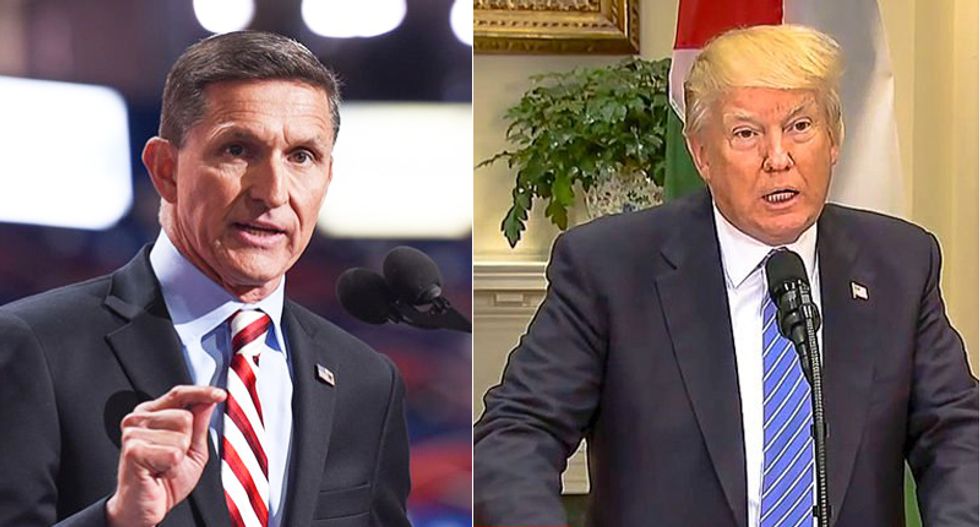
Writing for the Daily Beast, a former U.S. Attorney for Michigan explained the legal maneuvers she believes special counsel Robert Mueller is using on former National Security Director Michael Flynn that will compel him to give up information on President Donald Trump.
Based upon a New York Times report that attorneys for Flynn have “notified the president’s legal team in recent days that they could no longer discuss the special counsel’s investigation,” former prosecutor Barbara McQuade explained that Flynn and his legal team have likely exited a joint defense agreement with Trump's attorneys, agreeing to share information.
Under the agreement, "attorneys can compare notes, allocate work efficiently by dividing tasks and avoiding duplication, and develop a unified strategy," McQuade wrote. "The main advantage of joint defense agreements is that the information that they share is protected by a form of the attorney-client privilege, known by some courts as a joint interest privilege."
As to why it would be in Flynn's interest to no longer be attached to Trump from a legal standpoint, McQuade said that circumstances have likely changed and Flynn has chosen to "cooperate with Mueller to provide truthful information and possibly testimony in exchange for leniency for any crimes of which he is convicted."
Along with his failure to file notice with the Department of Justice regarding his own lobbying work for the government of Turkey in a timely manner -- a similar charge to one that led to the indictment of former Trump campaign manager Paul Manafort -- Flynn may have been confronted with evidence that he was committing crimes based upon wiretaps.
"The congressional testimony of former acting Attorney General Sally Yates in May provides further evidence of criminal exposure for Flynn," McQuade explains. "Her testimony about Flynn’s contacts with Russians suggest that his conversations may have been intercepted by a wiretap authorized by the Foreign Intelligence Surveillance Court. This surveillance could yield a great deal of incriminating information about Flynn and his contacts with Russia on behalf of the Trump team."
"All of these potential charges provide an incentive for Flynn to cooperate against others," the ex U.S. Attorney elaborated. " And even if Flynn is unwilling to cooperate to obtain leniency for himself, he may be willing to do so for his son, Michael Flynn Jr. Reports indicate that Flynn Jr. also faces potential charges arising from his work as chief of staff for his father at Flynn Intel Group. Prosecutors will sometimes agree to give what is known as “third-party credit” in the form of leniency to another person in exchange for a defendant’s cooperation."
"Flynn may be able to provide the crucial links between all of the disparate pieces of evidence that have come to light to date – the June 2016 meeting with Russians to obtain disparaging information about Hillary Clinton, the overtures for meetings with George Papadopoulos, the travels of Carter Page," McQuade continued. "And if there was substantial cooperation between the Trump campaign and the government of Russia to influence the election, then Trump’s request to former FBI Director James Comey to 'letting Flynn go' takes on a more ominous tone, and becomes a more egregious alleged case of obstruction of justice."
You can read her entire analysis here.
