





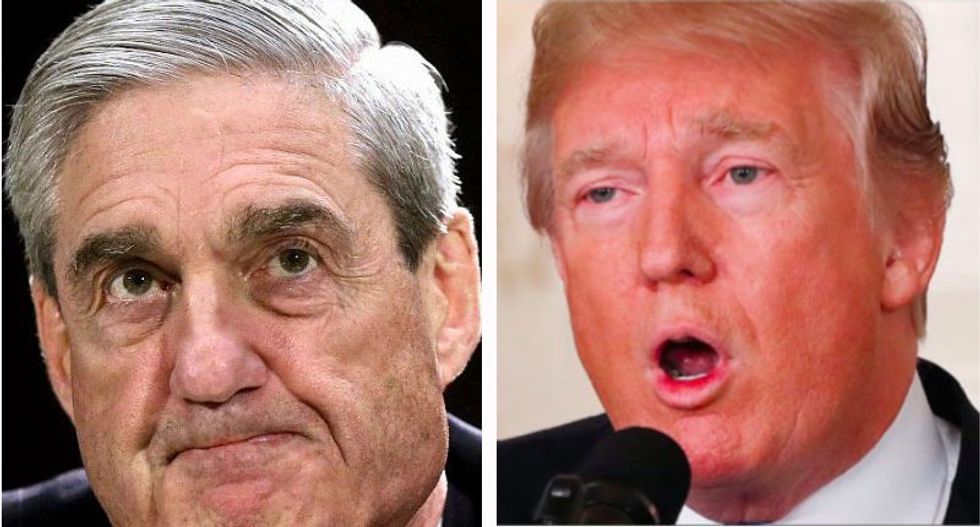
The attacks on Robert Mueller are seen by many as a prelude to firing the special counsel -- but legal experts say the strategy could also mean President Donald Trump knows he can't get him removed without risking impeachment.
Trump's allies in Congress and on Fox News have been dragging Mueller's reputation through the mud as his prosecutors draw closer to the president and his inner circle in the probe of Russian election interference, reported Politico.
But legal experts told the website those attacks don't necessarily mean Trump is planning to trigger a constitutional crisis.
“This could be to lay the groundwork for firing him, but it seems more likely to me to be a strategy to cast doubt on any charges that Mueller files down the road,” said Barbara McQuade, a former U.S. attorney from eastern Michigan under the Obama administration. “Putting the police on trial in this way is a common tactic of criminal defense attorneys. If the public is conditioned to doubt the credibility of Mueller, then the public may also doubt the validity of the charges themselves.”
The attacks might also be aimed at justifying a pardon for Mike Flynn, the former national security adviser who pleaded guilty Dec. 1 to lying to FBI agents -- and who agreed to cooperate with Mueller's probe.
“The collective criticism of Mueller and his staff, the truly bizarre complaint to Congress from the transition team — are we cooperating or not? — and the calls for a second special counsel are clearly part of an orchestrated strategy to try to discredit Mueller and, in turn, to potentially lay the groundwork to justify a pardon for Flynn,” an attorney representing a senior Trump aide told Politico in an email.
“Whether Trump actually pulls the trigger will depend, in part, on what sort of feedback they get from this barrage of trial balloons,” that lawyer added. “But — not to mix metaphors too awfully — this is plainly a shot across the bow.”
Mark Corallo, a Justice Department spokesman under John Ashcroft who also briefly worked as press secretary for Trump's legal team, said politically charged emails sent by FBI officials later removed from Mueller's team had likely damaged the investigation's credibility with the public.
“Whether or not the facts that underpin the Flynn, (Paul) Manafort and (Rick) Gates charges are legitimate or not is now irrelevant to a large portion of the American people,” Corallo said.
If the public doesn't trust Mueller's findings, it might not matter to the public -- and the Republican-led Congress -- what evidence the special counsel turns about the president's possible campaign ties to Russia.
“It is definitely a smarter strategy than outright firing of Mueller, because that is likely to create a firestorm,” said Elizabeth de la Vega, a former assistant U.S. attorney from the Northern District of California. “It is also entirely consistent with Trump’s modus operandi because he is surprisingly non-confrontational, preferring to be manipulative and, frankly, sneaky.”
