



Quantcast
Connect with us

This is your brain on poverty: Sanders and Warren probe insidious consequences of being poor

Published

on

While most Americans think of poverty in material terms, said the senate’s lone independent, its effects were more insidious and long-lasting.

The U.S. Senate subcommittee on primary health and aging met Wednesday morning to discuss the effects of poverty and stress on children, communities and health in America.

“Stress and poverty, wondering how I’m going to feed my family tomorrow, pay my bills get the income I need to survive, takes a toll on human life,” said Sen. Bernie Sanders (I-VT).

ADVERTISEMENT

Recent studies have shown that stress caused by poverty can influence brain development in children and lay the groundwork for physical health problems that show up later in life.

“Lack of choice and the increased stress that low-income people experience increases their level of cortisol (the primary stress hormone), and we know that higher levels of cortisol are correlated with cardiovascular disorders and other chronic illnesses, including diabetes,” said Michael Reisch, a professor of social justice at the University of Maryland.

Another witness testified before the panel that the poor tend to engage in riskier behavior – such as smoking, drinking and eating unhealthy foods – but stress tended to trigger some of those bad habits.

“It’s very clear that behavioral pathways are only part of that,” said Lisa Berkman, director of the Harvard Center for Population and Development Studies.

The effects of poverty on health and learning were much greater in the U.S. than other developed countries that had stronger safety nets, testified Dr. Steven Woolf, director of the Center on Society and Health and professor of family medicine and population health at Virginia Commonwealth University.

ADVERTISEMENT

“Obviously they have poverty in other countries, too, but there appears to be more programming and policies in place in those other countries to buffer the impact of material deprivation on families so that in effect children growing up in poor families in these other countries are more protected from the adverse effects than American children are,” Woolf said.

He also noted a Yale University study that found that other countries spent more on social programs and less on health care than the U.S., yet people in those countries tended to live longer and lead healthier lives.

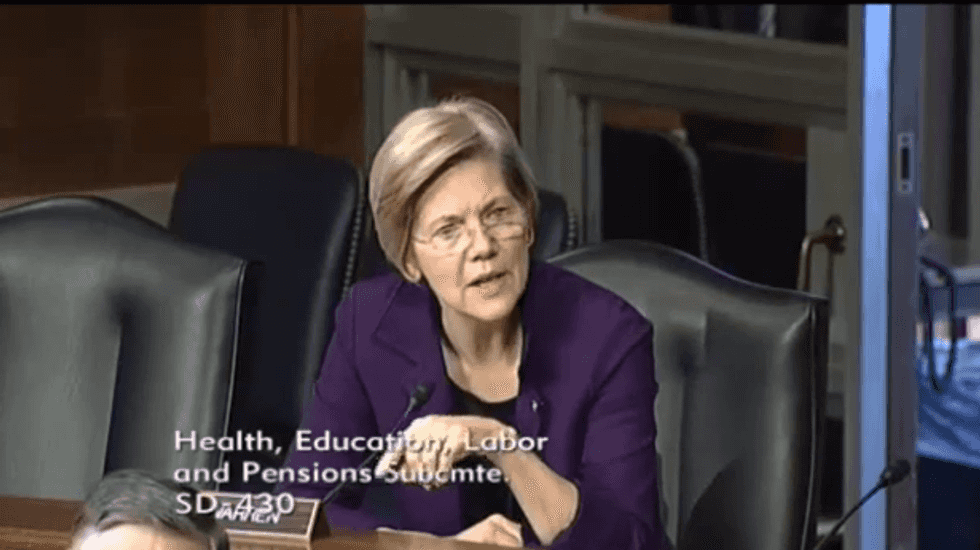
Sen. Elizabeth Warren (D-MA) agreed that the U.S. wastes “far too much money treating people after they become sick,” rather than spending money on preventative measures.
“Healthy people have stable, safe, clean housing, they live in safe neighborhoods with sidewalks (and) they have lots of outdoor spaces,” Warren said.

ADVERTISEMENT

“Health people can afford nutritious food, healthy people have clean air to breathe (but) for many Americans, these necessities of good health are luxuries they can’t afford,” she said.

ADVERTISEMENT


Report typos and corrections to: [email protected].
READ COMMENTS - JOIN THE DISCUSSION
Continue Reading

Breaking Banner

‘No one prevents a witness who can exonerate them from testifying’: Legal experts respond to acquittal vote of Trump

Published

on

It was never expected that President Donald Trump would be acquitted by two-thirds of the U.S. Senate for his crimes and the attempts to cover up his behavior by denying subpoenas.

While the impeachment trial is over, it's likely that hearings will continue. Given the conflicting arguments by the White House that impeachment are the only way subpoenas are valid, and also that the House should have used the courts to enforce subpoenas, it's likely that the House will continue to fight in court to obtain denied documents form the White House. The goal from the Trump legal team has been to stall as much as possible through the election.

Continue Reading

Breaking Banner

Senate acquits President Donald Trump of two articles of impeachment — but it’s not bipartisan

Published

on

All Senate Democrats will vote to support the conviction and removal of President Donald Trump. To make matters worse, the conviction votes of the Senate will be bipartisan, thanks to Sen. Mitt Romney (R-UT) who decided that he will vote to convict.

Conservative Democrats were even willing to vote for impeachment less than 24 hours after Trump's State of the Union Address.

Other Republicans moderates decided that what Trump did was irresponsible and inappropriate but they voted against learning more information that could sway their opinions. As a result, Sens. Susan Collins (R-ME) and Lisa Murkowski (R-AK) refused to vote to convict. Collins' vote was specifically controversial, as she's up for reelection in 2020 and her polling is not strong.

Continue Reading
 

Breaking Banner

West Virginia’s Joe Manchin will vote to convict Trump — and calls out the Senate for bad vote against witnesses

Published

on

In a statement from Sen. Joe Manchin's (D-WV) office, he revealed he agreed that it was time to vote to convict President Donald Trump.

"Voting whether or not to remove a sitting President has been a truly difficult decision, and after listening to the arguments presented by both sides. I have reached my conclusion reluctantly," Manchin said in the statement. "For the reasons above I must vote yes on the articles of impeachment. I take no pleasure at these votes, and I am saddened this is the legacy we leave our children and grandchildren. I have always wanted this president and every president to succeed, but I deeply love our country and must do what I think is best for the nation."

Continue Reading
 
 
close-image