





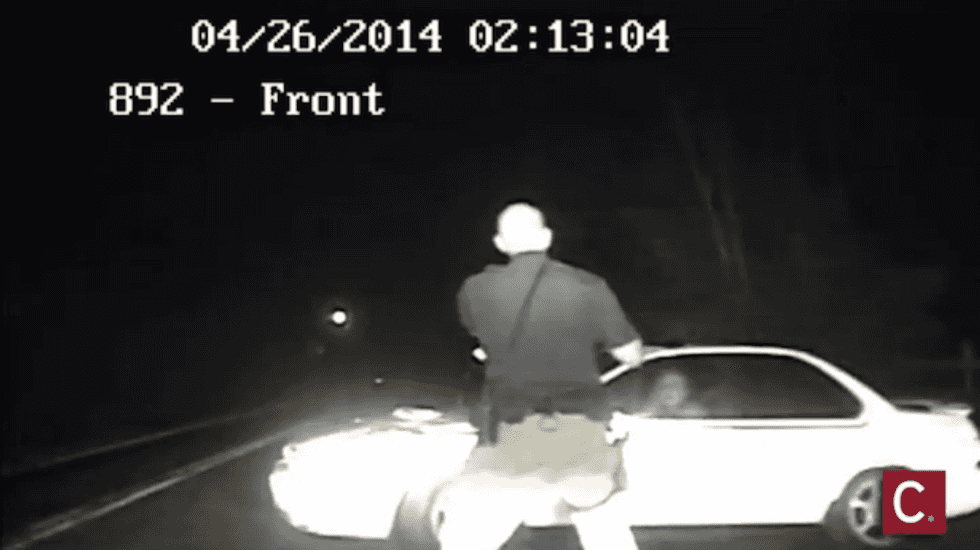
The recent shooting death of an unarmed teen by a Ferguson, Missouri, police officer has renewed calls for all officers to wear body cameras, but a recent study raises questions about the reliability of video evidence.
The study found that viewers were more likely to confirm their own prejudices toward police officers when confronted with video evidence – and their bias was strengthened the longer they looked, reported Science Daily.
"One might think that the more closely you look at videotape, the more likely you are to view its contents objectively, but that is not the case," said Emily Balcetis, an assistant professor at New York University. "In fact, the more you look, the more you find evidence that confirms your assumptions about a social group -- in this case, police."
Not surprisingly, participants were more likely to punish a defendant less severely if they identified with his social group and more severely if they did not.
However, these biases were amplified in participants who frequently looked at the defendant on the video, researchers said.
"Our findings show that video evidence isn't evaluated objectively -- in fact, it may even spur our existing biases,” Balcetis said.
The study, which was published in the Journal of Experimental Psychology: General, asked 152 participants to watch a 45-second muted video showing an altercation between a police officer and civilian.
The officer attempted to handcuff the resisting civilian in the video, and the two men struggled until the cop pushed the man against a patrol car.
The civilian then bit the officer’s arm, and the officer hit the man in the back of his head.
Researchers monitored participants’ eye movements without their awareness to gauge how often they fixed their gaze on the police officer.
After they watched the video, participants were asked to imagine they were jurors and indicate the likelihood that the officer would be punished or fined.
The study found that punishment could be predicted among participants who looked frequently at the officer, based on their level of identification with his social group.
Participants who looked less often at the officer were not as strongly influenced by group identification, researchers said.
A second experiment used another video that shows an armed police officer speaking in a subway stairwell to a civilian who flinches and moves toward the cop – who then wrestles the man to the ground.
Some participants were asked to focus their attention on the officer, while others were asked to watch the civilian, as researchers tracked each group’s eye movements.
The results were similar to the first experiment, researchers said.
Participants who paid closer attention to the police officer found his actions more incriminating and more serving of punishment if they felt little social connection to him.
"With the proliferation of surveillance footage and other video evidence, coupled with the legal system's blind faith in information we can see with their own eyes, we need to proceed with caution,” Balcetis said. “Video evidence is seductive, but it won't necessarily help our understanding of cases, especially when it's unclear who is at fault."
Researchers conducted a third study to rule out the possibility their findings apply only to police interactions.
Participants in that study watched an orchestrated fight between two college-age white men – one wearing a blue shirt and another wearing a green shirt.
They answered personality questions prior to watching the video and told their answers were more similar to the blue group or the green group to suggest social similarity to one of the fighting men.
The results found that participants were more likely to recommend punishment when they focused on the man determined to be outside their social group, researchers said.
"We think video evidence is a silver bullet for getting at truth, but it's not," said Yael Granot, a NYU doctoral student and the study’s lead author. “These results suggest that the way in which people view video evidence may exaggerate an already pervasive 'us-versus-them' divide in the American legal system."
