



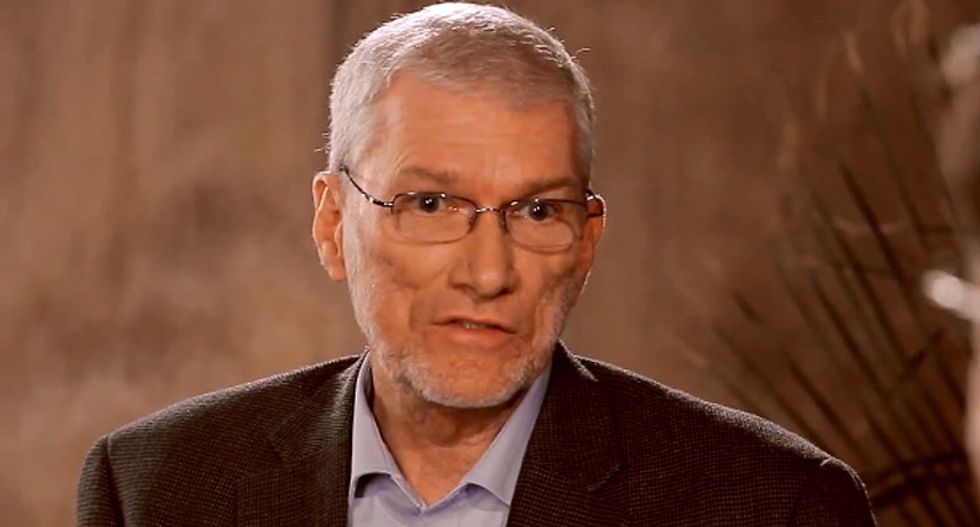
Answers in Genesis president Ken Ham appears in a YouTube video (Screenshot)
A controversial Noah's Ark-themed amusement park in Kentucky will open on July 7, 2016, the park's founder said on Thursday.
Currently under construction in Williamstown, northern Kentucky, Ark Encounter will include a full-sized wooden replica of the ship from the Biblical story of Noah and the great flood.
Ken Ham, president and chief executive of Answers in Genesis, the Christian organization behind the project, announced the opening date at a press conference and said the park should attract at least 1.4 million people annually.
"It'll certainly be one of the biggest Christian attractions in the world," he said from the site of the park.
In the summer of 2014, Kentucky officials awarded the park’s developers tax incentives, potentially worth more than $18 million over 10 years. However, state officials in December pulled the credits after developers said they would only hire workers who shared their fundamentalist Christian beliefs.
Ark Encounter officials then sued the state in federal court in February to get the incentives reinstated.
The opening date for the park was based on a verse from the book of Genesis - the seventh verse of the seventh chapter details when Noah and his family entered the ark, Ham said.
Because of the perceived high interest in the park, he said attendance will be limited for the first 40 days and nights, tying the opening again to the Noah story, Ham said. Those tickets will be available for purchase in January through an online reservation system.
Answers in Genesis also runs the Creation Museum, 40 miles north in Petersburg, just outside of Cincinnati. It is an organization that believes the world is about 6,000 years old and events in the Bible, such as the creation of the Earth in six days, happened as they were written.
Scientists have calculated the earth is over 4 billion years old, based on carbon dating of rocks and other research.
“We make no apology about our Christian message,” Ham said in a post on the organization's website last week. “We have never hidden the fact that our purpose is to spread the truth of God’s Word and its life-changing gospel message.”
Previously, officials said the Ark would be part of a $73 million initial phase of the 800-acre park, which would later add other biblically themed attractions. However, Ham in his online statement said the cost of the Ark structure is $29.5 million and the park needs another $6.5 million to complete it.
At Thursday's press conference, Ham said the Ark section will include a restaurant, theater and petting zoo.
(Reporting by Steve Bittenbender, Editing By Ben Klayman and Andrew Hay)

On Thursday, former President Donald Trump’s lawyers appeared in court in Fulton County, Ga., to argue that election fraud is protected by the First Amendment.
Trump’s counsel described Trump’s efforts to overturn his electoral defeat in Georgia as “core political speech” entitled to heightened legal protection. In Trump-speak, when he called Georgia Secretary of State Brad Raffensperger and pressured him to “find” 11,780 votes to change the election’s outcome, Trump was merely engaging in protected political expression.
Trump’s counsel argued before Fulton County Superior Judge Scott McAfee that “Criminalizing President Trump’s speech and advocacy disputing the outcome of the election, while speech endorsing (Biden’s win) is viewed as unimpeachable, is blatant viewpoint discrimination,” prohibited by the First Amendment.
While it is legally accurate to say that political viewpoint discrimination is a prohibited form of content discrimination, words of advocacy intended and likely to incite imminent lawless action, are not — and have never been — protected under the First Amendment.
It's the same rationale under which hiring a hitman, inciting a riot, inducing fraud, impersonating a government official or promoting a Ponzi scheme — although typically done with mere words — are not protected under the First Amendment. Trump would have the Georgia court protect his words by divorcing them from their meaning.
Enter the Bible grift
Coming from a presidential candidate shamelessly hawking Bibles for $59.99 (plus shipping and handling), Trump’s manipulation of the First Amendment should come as no surprise.
The First Amendment has carefully guarded Americans’ core freedoms of religion and speech since it was adopted in 1791.
After the Constitution was ratified three years earlier, the First Congress of the United States proposed 12 amendments to it. First among them was the preeminent guarantee that the government would stay out of religion — forever — by neither establishing nor prohibiting its practice.
Cognizant of centuries of religious persecution, serious men of the First Congress did not stutter, demur or obfuscate. Their opening salvo in the First Amendment, now known as the Establishment Clause, declares that, “Congress shall make no law respectingan establishment of religion.”
“Congress” in this context includes the federal government, since allowing the U.S. president or judicial branch to promote religion while prohibiting Congress from doing so would render the separation of church and state meaningless.
To solidify the symbolic merger of church and state, Trump’s Bible includes copies of the U.S. Constitution, Declaration of Independence and Pledge of Allegiance. His Truth Social promotion declares, “Religion and Christianity are the biggest things missing from this country… Order yours today! Please allow 4-6 weeks for delivery.”
Who knew a country music singer alive today inspired the Bible? Or that Bibles could be monetized to pay royalties to Trump like his steaks, Trump University or gold lamé sneakers? If Christian Nationalism weren’t so dangerous, the swindle would be funny.
In late 2022, for example, Trump claimed that the 2020 election “fraud” — Biden won, of course — “allows for the termination of all rules, regulations, and articles, even those found in the Constitution.”
Moving to dismiss Georgia’s criminal election fraud indictment as unconstitutional, his counsel argued that the criminal indictment “directly targets core protected political speech and activity,” meaning Trump’s words were just words and the conduct he tried to orchestrate was immaterial.
Extending the theory, Trump’s words didn’t march into the U.S. Capitol with zip ties to assault elected officials on January 6, 2021 — just like guns don’t shoot people, people shoot people.
Trump continues to argue he is above the law
Trump’s claim that he is free to engage in election fraud — a crime — comports with his belief that presidents can commit crimes with impunity because of presidential immunity.
Trump’s immunity argument, still outrageously pending before the Supreme Court, asserts, “A denial of criminal immunity would incapacitate every future President with de facto blackmail and extortion while in office, and condemn him to years of post-office trauma at the hands of political opponents.”
Applying Trump’s putative immunity in the Georgia case — under the First Amendment or otherwise — a sitting president would have the right to strongarm state election officials, advance a fraudulent slate of electors, impersonate elected officials, “find” 11,780 non-existent votes, and change the outcome of an election.
After all, to Trump’s legal team, them’s just words.
Sabrina Haake is a columnist and 25 year litigator specializing in 1st and 14th Amendment defense. Follow her on Substack.
Have you ever wondered why so many images depicting the crucifixion show Jesus with a very defined, slender and toned body? Either slim, but with a six-pack, or displaying muscles and brawn. While these images are hardly a reflection of what little can be surmised about the historical Jesus, they certainly reflect social and cultural ideas about masculinity and idealised notions of manhood.
In many images of the crucifixion, Jesus is depicted as both strong and vulnerable. Crucifixion paintings showing a muscular messiah suggest that Jesus could perhaps physically have overcome his fate, had he wanted to. This interpretation of the crucifixion story amplifies the emotional and spiritual strength of his sacrifice.
The Bible is full of strong men and pumped prophets. Working the land is Adam’s punishment for eating from the Tree of Knowledge. Noah builds a massive ark, filling it with every bird, animal and food. Samson has superhumanstrength in the book of Judges – his only weakness is women.
The opening of Matthew’s Gospel details Jesus’ genealogy in detail, and it is clear that he has other hardmen in his DNA. It speaks of Abraham and David, particularly. In Genesis 14, we learn how Abraham gathered an army of over 300 men and launched an attack to save his family. In Genesis 21, he also fathers a child at the age of 100 – his son, Isaac.
While some portrayals of Jesus have caused outrage, like those, for example, that represent him as feminine or sexualised, a similar outcry does not seem to follow the muscular Jesus.
There is a story in the gospels of Jesus’s physical strength, when he drives out those who were buying and selling in the temple, overturning tables in his anger. In the New Testament, the gospels even narrate a Parable of the Strong Man.
The endurance of physical torture before the crucifixion has been well documented in religious iconography, such as the Stations of the Cross, as well as in films such as Mel Gibson’s The Passion of the Christ (2004). Jesus also has to be mentally strong to overcome Satan, so depictions of his physical strength are perhaps supposed to echo his superhuman, spiritual strength.
‘Behold the man!’
Paintings that depict Jesus with a six-pack have influenced factions of Christianity. In the 19th century, the idea of “muscular Christianity” took hold. The term, invented in 1857, describes those Christians who see moral and religious value in sports.
In his book God’s Gym (1997), professor of religion Stephen Moore explores the quest for Jesus in a perfect human masculine form, and how this is connected to physical culture and male narcissism. Masculine Christian spirituality is often aligned with the values of courage, strength and power.
Through the Eucharist (“take and eat, this is my body”), Jesus’s body became sacrament. This has palpable implications for many modern Christians. If Jesus’s physical fitness is a sign of his holiness, then it is something to aspire to.
Theologian Lisa Isherwood’s book The Fat Jesus (2008) explores Christian women’s weight-loss cultures through programmes such as “Slim for Him”. Feminist theologian Hannah Bacon’s book Feminist Theology and Contemporary Dieting Culture (2019), meanwhile, analyses the problematic use of “sin/syn” to refer to “bad” foods in weight-loss programmes.
For some Christians, depictions of Jesus as strong and muscular represent the ideal of a man’s body. They interpret Biblical stories in ways that mirror these paintings. Many of these groups believe that Biblical ideas of masculinity are under attack. In response, they put on events designed to attract men to church and promote the ideals of biblical manhood. Praising a muscular body ideal for men – and for Jesus – is part of that.
So next time you’re looking at a painting of Jesus in a church or gallery, do remember that such images reflect contemporary social and cultural attitudes to men’s bodies, rather than authenticity, in their artistry.
Looking for something good? Cut through the noise with a carefully curated selection of the latest releases, live events and exhibitions, straight to your inbox every fortnight, on Fridays. Sign up here.
Right-wing news outlets and MAGA influencers were quick to jump on rumors that Donald Trump had paid off the mortgage of fallen New York police officer Jonathan Diller, but it appears that's simply not true.
While the ex-president has yet to comment on or debunk the claim that he paid off the home of the man whose wake he recently attended, the apparent source of the information has walked it back.
According to publicly available information, Diller's mortgage was paid off, but it was by an organization called Tunnel to Towers Foundation.
"Tunnel to Towers is honored to announce a mortgage payoff for the family of NYPD officer Jonathan Diller, who was fatally shot and killed during a routine traffic stop on March 25th," the group said. "Officer Diller is survived by his loving wife, Stephanie, and their one-year-old son."
This may have been the source of the Trump rumor, as David Zere, host of Breaking Point on Real America's Voice News, has implied.
"I may have been mistaken about Trump donating the money to Tunnel and Towers for the Diller family," he said. "I had several people approach me this was the case. I apologize if I reported misinformation. But it was a special day with Trump meeting with the Diller family! #Backtheblue"
In a separate post, Zere said, "I just feel awful."
This didn't go unnoticed by The Spectator's Jacqueline Sweet.
"Looks like the rumor, then reported as fact by Bannon’s War Room and other MAGA influencers, that Trump donated to pay off Officer Diller’s mortgage, started with David Zere, of Real America’s Voice, who has since walked it back," she wrote.