





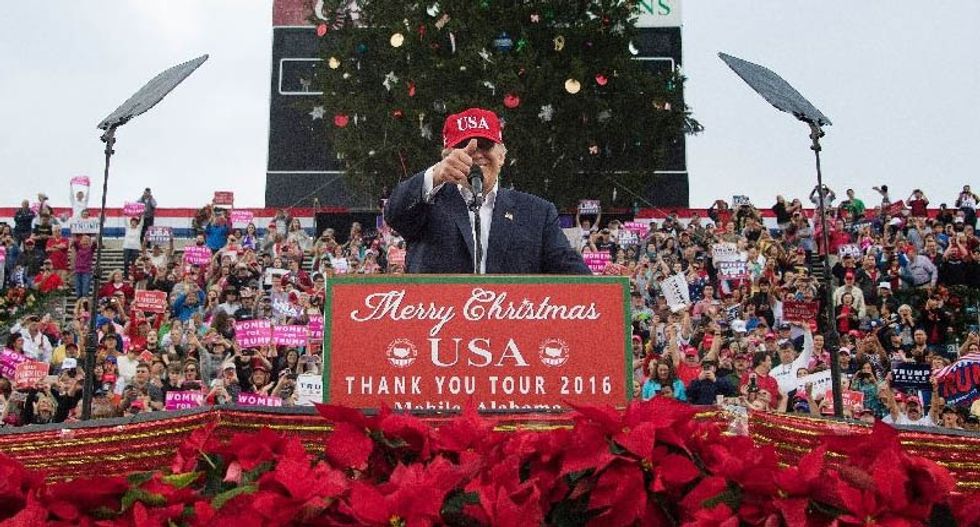
According to a historian who specializes in the growth of religion in the U.S., the common greeting of "Merry Christmas" was once viewed by the Puritans as vulgar -- an opinion they also held about celebrating Christmas as a holiday.
Writing at the Los Angeles Times, Neil J. Young -- author of 'We Gather Together: The Religious Right and the Problem of Interfaith Politics' -- stated that conservatives who have an annual meltdown about declining numbers of Americans wishing each other "Merry Christmas" lack an understanding of U.S. history.
"Rather than religious, its origins are secular and commercial, even profane," Young explained, adding, "For most of its history, the Christian church regarded Christmas as a small event on its calendar not requiring much observation. "
Citing fellow historian Stephen Nissenbaum, Young noted that "Puritans in England and later the American colonies went one step further, banning the holiday altogether since they could find no biblical support for celebrating the day."
"Puritans imposed fines on anyone caught celebrating and designated Christmas as a working day," Young lectured. "These strict rules were necessary since so many men and women engaged in the drunken carousing that accompanied winter solstice festivities, an ancient tradition that the church had failed to stamp out when it appropriated Dec. 25 as a Christian holiday."
According to Young, the phrase was considered so disgraceful that papers at the time editorialized against it.
"The greeting was an act of revelry and religious rebellion, something the uncouth masses shouted as they traveled in drunken mobs," Young wrote. "Troubled by such behavior, the New Haven Gazette in 1786 decried the 'common salutation' of 'Merry Christmas.' 'So merry at Christmas are some,' the paper lamented, 'they destroy their health by disease, and by trouble their joy.'"
Young asserts that churches were eventually worn down by the growing popularity of the salutation, eventually co-opting it.
"Given the seemingly irreversible prominence of Christmas, churches gave up the argument," he wrote. "They began to emphasize the day’s religious meaning to their congregants and incorporate 'Merry Christmas' into their vernacular. But observant Christians just as routinely wished each other 'Happy holidays.'"
"'Holiday' is a religious word, after all, derived from the Old English word for 'holy day,'" he puckishly added.
You can read his whole essay here.
