




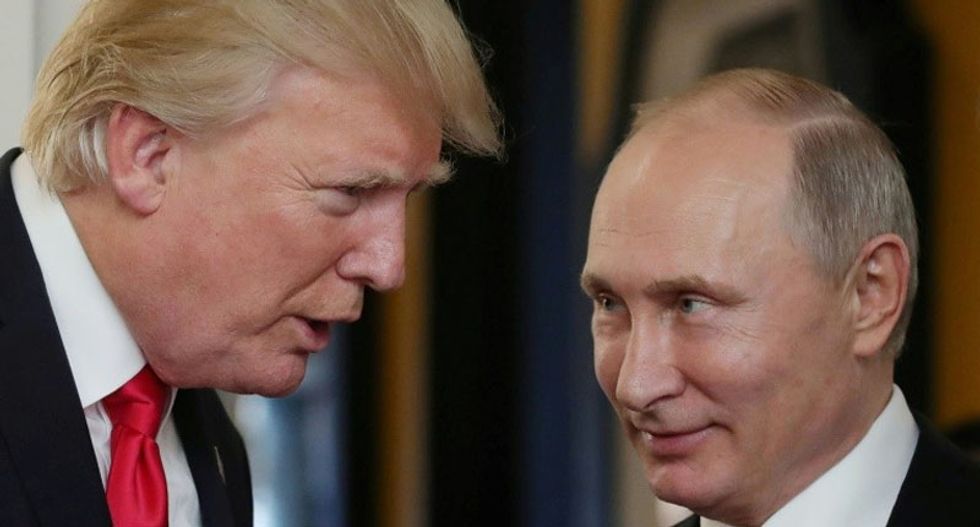
Discussing the recent report that President Donald Trump received a boost from Russian-linked Twitter accounts, which retweeted Trump nearly 500,000 times just prior to the 2016 election, a CNN security analyst said Trump was, and still may be, a "tool" of the Kremlin whether he knows it or not.
Speaking with hosts Martin Savidge and Christi Paul, analyst Samantha Vinograd said those tweets had a "definite" impact on the election.
With host Savidge noting that the Russian-backed tweets were "4.25 percent of the retweets of President Trump's Twitter account," Vinograd claimed they were likely a "drop in the bucket" of overall support for Trump from Russian operatives.
"A few months ago, we learned from Facebook that 126 million people were exposed to Russian-linked content," Vinograd -- who served on President Barack Obama's National Security Council -- began. "We have this story now of Russia retweeting Donald Trump and probably have more stories about Russian psy-ops, psychological operations online campaign. I think it's just going to continue apace."
"I think it's really important to remember that this story isn't about Donald Trump," she elaborated. "In fact, Donald Trump was a tool and may continue to still be a tool for Russia's larger mission to sow divisions and create confusion and undermine U.S. democracy and leadership around the world."
"You say Donald Trump is a tool," host Paul stated. "Does this new information, should it be considered, would it be considered evidence of collusion then?"
"I think I'll leave that to Bob Mueller to answer," Vinograd replied. "What I do think is, we already know from the intelligence community -- and the entire intelligence community agrees on this -- is that Donald Trump was Russia's preferred candidate. Now that is not because any kind of personal love for Donald Trump. It is because they viewed him and his election as being more preferable to advancing their policies and to advancing their mission again of undermining U.S. democracy by polarizing the American constituency and decreasing American leverage around the world, and that is what Vladimir Putin wants."
Regarding the recent release of the information on Russian meddling, Vinograd added, "I think that there are real questions about why we are doing post-game analysis of this stuff and why didn't we have this information coming in in real-time in 2016 or even 2015 when this Russian activity started?"
"We are spending a lot of time looking backward at data and finger pointing and the truth is, we are out of time. Russia's attack is ongoing and I think and both the private sector and public sector need to sit down and say, okay what are we doing today?" she suggested. "We were unprepared before to confront Russia's attack on digital platforms because the 2018 election is coming up very quickly."
"Also because Americans, as consumers of information, need to know that what they are experiencing online is accurate," she concluded.
You can watch the video below via CNN:
