





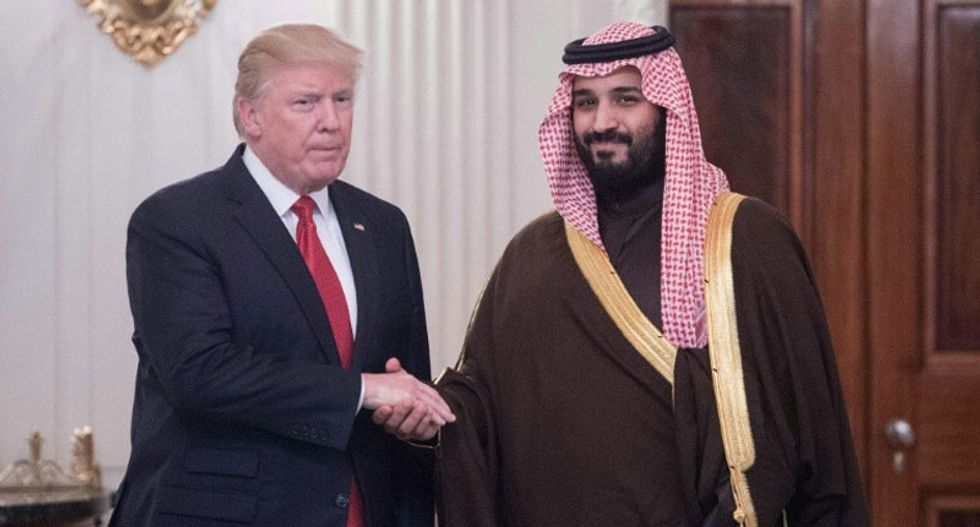
President Donald Trump hasn't kept it a secret that he hates the Middle East. But it's unknown how that translates into actual foreign policy. Considering he keeps increasing the troops in the region, his pledge to keep America out of "endless wars," seems to have fallen by the wayside.
During the 2016 campaign, Trump claimed that there was a holy war going on in the region.
"In the Middle East, we have people chopping the heads off Christians, we have people chopping the heads off many other people. We have things that we have never seen before - as a group, we have never seen before, what's happening right now. The medieval times - I mean, we studied medieval times - not since medieval times have people seen what's going on. I would bring back waterboarding and I'd bring back a hell of a lot worse than waterboarding," Trump said.
Professor Daniel Drezner of international politics at the Fletcher School of Law and Diplomacy at Tufts University wrote in the Washington Post that Trump's Middle East policy has gone from a pledge to get Americans out of endless wars to deploying troops out of a malicious grudge.
It prompted him to pose the question: "The hard-working staff here at Spoiler Alerts has a more basic question to ask after the past 10 days: What, exactly, does this administration want to accomplish in the Middle East?"
After a round of Sunday news talk shows, it became clear that not even the president's closest advisers are clear on the overall mission. It seems the only real demand is to "win," though no one knows what that looks like.
He said that he poses the question because over the weekend the president tweeted that sanctions were working -- but that he didn't care to negotiate.
"National Security Adviser suggested today that sanctions & protests have Iran 'choked off', will force them to negotiate. Actually, I couldn’t care less if they negotiate. Will be totally up to them but, no nuclear weapons and 'don’t kill your protesters,'" Trump tweeted.
In a Fox News interview, Trump revealed that he was willing to sell troops to the Saudis for $1 billion. What they're doing there is unknown.
"Back in 2017, Walter Russell Mead explained that Trump’s triumph represented a Jacksonian revolt against foreign policy elites who had gotten the United States embroiled in Middle East conflicts," wrote Drezner. "Jacksonians mostly want to be left alone by the rest of the world, but react strongly against perceived threats. In theory, this allows them to escalate and de-escalate quickly."
"In practice, the Trump administration keeps sending more and more troops to a region that Trump disdained throughout his 2016 campaign. The administration reacts to requests to leave with angry sanctions and stubborn refusals," he closed. "What does this administration want in the Middle East? Damned if I know. All I am sure about in 2020 is that a grand strategy based on spite and pique seems like a bad way to advance the national interest."
