




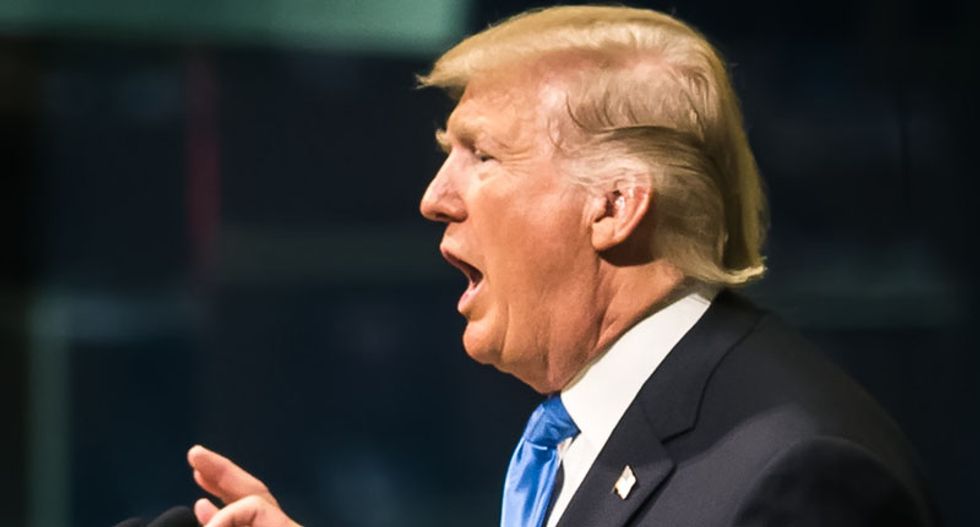
President Donald Trump's attacks on Iranian targets last week and killing of top Gen. Qasem Suleimani weren't the right call, even if Soleimani was evil and a war criminal, the Washington Post editorial board wrote Friday.
"His death in a drone strike was being cheered Friday by U.S. allies and progressive forces across the region, from Israelis and Saudis to the pro-reform demonstrators of Beirut and Baghdad," the board wrote. "That, however, doesn’t mean that President Trump’s decision to assassinate him was wise, or that it will ultimately benefit U.S. interests."
They explained that the consequences of an erratic regime are "unpredictable."
"But there is no denying the risk that the United States will be pulled more deeply into the Middle East and its conflicts. Having made clear that he wants to pull the nation out of those conflicts, and having said as recently as Tuesday that he wanted peace with Iran, Mr. Trump has committed an act of escalation and now is deploying more than 4,000 additional troops to Kuwait as a hedge against Iranian counterstrikes," the paper explained.
The U.S. State Department has said that the act was not to provoke Iran and that it will deter Iran. Iranian leaders have called it an "act of war" and warned of "harsh revenge."
"But Iran might choose to strike back, if not immediately then in coming days and weeks," The Post wrote. "Targets within Iranian reach include U.S. embassies and citizens across the Middle East; shipping in the Persian Gulf; Saudi oil fields; and Israeli cities, against which Suleimani aimed thousands of missiles. Have Mr. Trump and his aides thought through the possible Iranian responses and fully prepared for them? Does the administration have a clear goal? While Mr. Trump was still tweeting about negotiation, some of his aides appeared bent on regime change in Tehran."
The board noted that when Trump took office, the Iran nuclear program was at least "quiescent," but when he pulled out of the treaty that limited their nuclear activity it was the beginning of Trump's erratic Middle East policies.
Not only did Trump shore up sanctions, "he took sides in a regional battle between an intolerant Sunni regime in Saudi Arabia and an intolerant Shiite regime in Iran. Now, even as short- and long-term threats from Russia, China and North Korea require urgent attention, the United States finds itself in an ever tenser confrontation with Iran. Mr. Trump has yet to offer any explanation of why this is in America’s strategic interest," The Post closed.
