"This is a really big deal. This kind of courage is what we need right now, in every workplace and walk of life."
Amazon vice president Tim Bray won praise from labor rights advocates on Monday after resigning from the company over its treatment of whistleblowers during the Covid-19 pandemic, publishing a "scathing" letter on his personal blog explaining the decision.
After more than five years as a vice president at the company, Bray wrote that he was quitting "in dismay at Amazon firing whistleblowers who were making noise about warehouse employees frightened of Covid-19."
In the letter, Bray defended Amazon workers including Staten Island warehouse employee Chris Smalls and Amazon Employees for Climate Justice (AECJ) organizers Emily Cunningham and Maren Costa, all of whom were fired after leading petitions and protests over unsafe conditions in the retailer's warehouses as the pandemic continues to spread across the United States.
"Firing whistleblowers isn't just a side-effect of macroeconomic forces, nor is it intrinsic to the function of free markets," wrote Bray, who was a "distinguished engineer" and is now the highest-ranking Amazon employee to speak out about the company's conduct during the pandemic. "It is evidence of a vein of toxicity running through the company culture. I choose neither to serve nor drink that poison."
Smalls, Costa, and Cunningham were among those who thanked Bray for speaking out.
Other advocates noted the significance of Bray's stand against the powerful company.
"This is a really big deal," wrote author Naomi Klein. "This kind of courage is what we need right now, in every workplace and walk of life."
Bray said he brought his concerns to company executives in April after Cunningham and Costa were fired after starting a petition on behalf of the warehouse workers. He formally resigned and published the open letter after his complaints went unheeded.
Amazon's actions in recent weeks—including its attempted smear campaign against Smalls, who organized a walkout over a lack of social distancing protocols and transparency at the Staten Island facility—were "designed to create a climate of fear," wrote Bray, who also slammed his former employer as "chickenshit."
Bray acknowledged in his post that Amazon says it is taking precautions to protect workers in its warehouses, but wrote, "The big problem isn't the specifics of Covid-19 response. It's that Amazon treats the humans in the warehouses as fungible units of pick-and-pack potential. Only that's not just Amazon, it's how 21st-century capitalism is done."
The former company executive pointed out that the e-commerce giant, while a formidable power in the U.S., has been reined in elsewhere. In France, where Amazon workers are represented by unions, a court last month ruled that the company must only complete deliveries of essential products while its warehouses' safety measures are being investigated.
"If we don't like certain things Amazon is doing, we need to put legal guardrails in place to stop those things," Bray wrote. "We don't need to invent anything new; a combination of antitrust and living-wage and worker-empowerment legislation, rigorously enforced, offers a clear path forward. Don't say it can't be done, because France is doing it."
Bray's letter comes three days after employees at Amazon were joined by workers at Trader Joe's, FedEx, Whole Foods, and Instacart in a May Day strike over wages, public health precautions, and working conditions.
Increasing low-wage workers' influence over decision-making at huge companies will require sustained pressure campaigns with widespread support, particularly from those in positions of power, suggested Bray.
"At the end of the day, it's all about power balances," Bray wrote. "The warehouse workers are weak and getting weaker, what with mass unemployment and (in the U.S.) job-linked health insurance. So they're gonna get treated like crap, because capitalism. Any plausible solution has to start with increasing their collective strength."
A political action committee has launched to counter false and misleading statements about the coronavirus pandemic from US President Donald Trump with a wide-ranging, tech-infused social media campaign.
Defeat Disinfo, which started last week, plans to use "a sophisticated set of tools that allows us to spot misinformation just as it's beginning to go viral on social media," according to a statement.
It also aims to promote the "truthful counter narrative" about COVID-19 with tweet-for-tweet responses to limit the impact of inaccurate information.
Curtis Hougland, director of the committee and head of a technology firm which has worked to counter online propaganda from Russia and Islamic State extremists, said artificial intelligence would play a role in the effort.
The technology "uses techniques such as natural language processing and machine learning classifiers to determine the emotions, themes and messages animating the conversation in a predictive way," Hougland said.
"The technology is unique in its ability to geo-infer the location of data to understand the attitudes of voters in states such as Wisconsin or Arizona. We also have the ability to identify who has interacted with or been exposed to disinformation."
He said this technology "was incubated and tested at the front-line of ISIS propaganda" and has been updated for the latest initiative.
The committee is not aligned with any candidate but argues that Trump "is denying the facts on his administration's coronavirus response," adding that "we're holding him accountable."
"President Donald Trump is the largest amplifier of disinformation in the United States," said Hougland. "People are dying as a result of his political agenda."
The effort is already in full swing with messages aimed at pointing out the danger of Trump's comments suggesting injecting disinfectant could help fight the coronavirus.
Defeat Disinfo said it would not use automated accounts or "bots" to amplify its messages but seek an army of people, including prominent individuals sometimes described as "influencers," to counter the president's narratives.
Hougland said the organization is working to build a network of some 3.4 million "credentialed content creators and social influencers."
"The organization will rely on real stories from real people," the group said in a statement.
The group said it would "map" tweets from Trump's account which are gaining traction as part of the effort to push back at false claims.
Hougland said the organization would be seeking to self-fund, largely with small donations, offering no other details on its finances.
In a series of tweets this Friday morning, Elon Musk wiped out billions of dollars in Tesla’s value. The outburst comes on the heels of the Tesla CEO using Twitter to voice his opinion that the coronavirus outbreak is being overblown by the media and politicians.
Today, Musk took on a strange tone. In one tweet, Musk wrote that Tesla's "stock price is too high [in my opinion]." He also claimed that he's going to sell everything he owns.
"I am selling almost all physical possessions," he wrote. "Will own no house."
According to a report from Electrek, there was a massive selloff of millions of Tesla shares in the wake of Musk's bizarre rants.
Fred Lambert of Electrek chalked Musk's rant up to just being a result of stress from the coronavirus economy.
"I know a lot of people are calling him crazy on Twitter, and that’s the easy thing to do," Lambert wrote. "While I don’t necessarily agree with his stance, I don’t blame him for it. I have been cutting everyone some slack over their comments and stances on this crisis since it is a stressful time for everyone."
It all began when Huggler commented on one of Fuentes' TikTok videos. Huggler is an influencer with over 70,000 subscribers. Frequently new users will pick fights with such influencers to garner more attention and increase their profile by punching up. Huggler said she was joining an effort with other users making a point about exposing white nationalists.
She wrote that “we as political TikTok needed to come together” over Fuentes joining the site.
Alt-right activists and white nationalists went on the attack, threatening to invade her bedroom and implying they'd murder her. They took it a bit further by attacking Huggler's followers on social media platforms.
"The combination of Huggler being a woman and having a nose piercing—in the eyes of the online trolls—made her an instant target," wrote the Dot. With comments like “Bull-ring” equals “no opinion” and “woman-log off.”
“Maybe you’re projecting a little, so why don’t you take your own advice and log off you alt-right scum,” Huggler shot back.
That's when Fuentes got involved personally, responding to her in a video using Sesame Street character Cookie Monster, which signifies Holocaust denialism after he once used in a baking analogy.
"Huggler says that following her rebuttal she received threatening and harassing messages, which only intensified as Fuentes began mocking her on Twitter and TikTok," the Dot reported. "It spilled over onto other social media sites, such as Instagram and Reddit."
There was a flood of images and memes using Huggler's photo bringing more white nationalists to the digital mob. Threats got more dangerous with increasing threats of harm.
When she did an Instagram Live video, appearing emotional about the incident, the followers of Fuentes generated more memes about her.
Ultimately, after the reporting, Fuentes and right-wing activists Jacob Lloyd and Jaden McNeil were kicked off of TikTok. The onslaught didn't stop, with followers continuing their threats
“We should run electricity through her nose ring,” one comment said. Another said she needed a “self-defense situation at 3 AM through her bedroom window.”
Her home address was posted online and alt-right websites got in on the attacks.
“She is a mediocre e-girl who uses social media to get her daily dopamine fix, nothing more,” one site wrote. “She needs to just shut the hell up, get her ass in the kitchen, and pump out a bunch of white babies for a white man.”
A fake account was even created on Twitter to make it appear that she was sending people direct messages
“I think Twitter for me was the scariest part of this ordeal … I’d noticed he’d retweeted memes and some users’ comments on me … The responses to these posts ranged from violent, tone-deaf, to just plain nasty,” Huggler told the Dot.
It violates the Twitter terms of use and the abusive behavior policy, but the moderators were unable to stop the attacks.
“I felt like I was being spotlighted for speaking up for myself when someone told me my opinion didn’t matter. I had no idea at the time but whenever I went live, white nationalists would post on Twitter to go raid my live [saying] it was my fault TikTok banned Nick Fuentes, even though that is very far from the truth," she said.
She was ultimately forced to delete her Twitter account due to the "mass amount of hate."
Fuentes’ remains on Instagram, Twitter, and a streaming platform DLive.
On April 10, Apple and Google announced a coronavirus exposure notification system that will be built into their smartphone operating systems, iOS and Android. The system uses the ubiquitous Bluetooth short-range wireless communication technology.
There are dozens of apps being developed around the world that alert people if they’ve been exposed to a person who has tested positive for COVID-19. Many of them also report the identities of the exposed people to public health authorities, which has raised privacy concerns. Several other exposure notification projects, including PACT, BlueTrace and the Covid Watch project, take a similar privacy-protecting approach to Apple’s and Google’s initiative.
So how will the Apple-Google exposure notification system work? As researcherswho study security and privacy of wireless communication, we have examined the companies’ plan and have assessed its effectiveness and privacy implications.
Recently, a study found that contact tracing can be effective in containing diseases such as COVID-19, if large parts of the population participate. Exposure notification schemes like the Apple-Google system aren’t true contact tracing systems because they don’t allow public health authorities to identify people who have been exposed to infected individuals. But digital exposure notification systems have a big advantage: They can be used by millions of people and rapidly warn those who have been exposed to quarantine themselves.
Bluetooth beacons
Because Bluetooth is supported on billions of devices, it seems like an obvious choice of technology for these systems. The protocol used for this is Bluetooth Low Energy, or Bluetooth LE for short. This variant is optimized for energy-efficient communication between small devices, which makes it a popular protocol for smartphones and wearables such as smartwatches.
Bluetooth allows phones that are near each other to communicate. Phones that have been near each other for long enough can approximate potential viral transmission.
Bluetooth LE communicates in two main ways. Two devices can communicate over the data channel with each other, such as a smartwatch synchronizing with a phone. Devices can also broadcast useful information to nearby devices over the advertising channel. For example, some devices regularly announce their presence to facilitate automatic connection.
To build an exposure notification app using Bluetooth LE, developers could assign everyone a permanent ID and make every phone broadcast it on an advertising channel. Then, they could build an app that receives the IDs so every phone would be able to keep a record of close encounters with other phones. But that would be a clear violation of privacy. Broadcasting any personally identifiable information via Bluetooth LE is a bad idea, because messages can be read by anyone in range.
Anonymous exchanges
To get around this problem, every phone broadcasts a long random number, which is changed frequently. Other devices receive these numbers and store them if they were sent from close proximity. By using long, unique, random numbers, no personal information is sent via Bluetooth LE.
Apple and Google follow this principle in their specification, but add some cryptography. First, every phone generates a unique tracing key that is kept confidentially on the phone. Every day, the tracing key generates a new daily tracing key. Though the tracing key could be used to identify the phone, the daily tracing key can’t be used to figure out the phone’s permanent tracing key. Then, every 10 to 20 minutes, the daily tracing key generates a new rolling proximity identifier, which looks just like a long random number. This is what gets broadcast to other devices via the Bluetooth advertising channel.
When someone tests positive for COVID-19, they can disclose a list of their daily tracing keys, usually from the previous 14 days. Everyone else’s phones use the disclosed keys to recreate the infected person’s rolling proximity identifiers. The phones then compare the COVID-19-positive identifiers with their own records of the identifiers they received from nearby phones. A match reveals a potential exposure to the virus, but it doesn’t identify the patient.
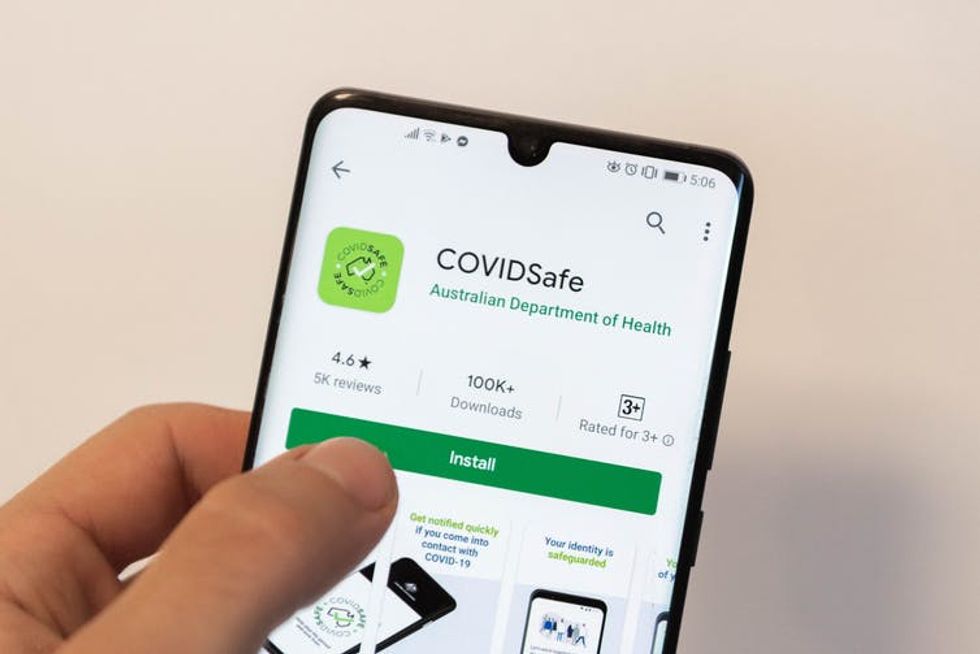
The Australian government’s COVIDSafe app warns about close encounters with people who are COVID-19-positive, but unlike the Apple-Google system, COVIDSafe reports the contacts to public health authorities.
Most of the competing proposals use a similar approach. The principal difference is that Apple’s and Google’s operating system updates reach far more phones automatically than a single app can. Additionally, by proposing a cross-platform standard, Apple and Google allow existing apps to piggyback and use a common, compatible communication approach that could work across many apps.
No plan is perfect
The Apple-Google exposure notification system is very secure, but it’s no guarantee of either accuracy or privacy. The system could produce a large number of false positives because being within Bluetooth range of an infected person doesn’t necessarily mean the virus has been transmitted. And even if an app records only very strong signals as a proxy for close contact, it cannot know whether there was a wall, a window or a floor between the phones.
However unlikely, there are ways governments or hackers could track or identify people using the system. Bluetooth LE devices use an advertising address when broadcasting on an advertising channel. Though these addresses can be randomized to protect the identity of the sender, we demonstrated last year that it is theoretically possible to track devices for extended periods of time if the advertising message and advertising address are not changed in sync. To Apple’s and Google’s credit, they call for these to be changed synchronously.
But even if the advertising address and a coronavirus app’s rolling identifier are changed in sync, it may still be possible to track someone’s phone. If there isn’t a sufficiently large number of other devices nearby that also change their advertising addresses and rolling identifiers in sync – a process known as mixing – someone could still track individual devices. For example, if there is a single phone in a room, someone could keep track of it because it’s the only phone that could be broadcasting the random identifiers.
Another potential attack involves logging additional information along with the rolling identifiers. Even though the protocol does not send personal information or location data, receiving apps could record when and where they received keys from other phones. If this was done on a large scale – such as an app that systematically collects this extra information – it could be used to identify and track individuals. For example, if a supermarket recorded the exact date and time of incoming rolling proximity identifiers at its checkout lanes and combined that data with credit card swipes, store staff would have a reasonable chance of identifying which customers were COVID-19 positive.
And because Bluetooth LE advertising beacons use plain-text messages, it’s possible to send faked messages. This could be used to troll others by repeating known COVID-19-positive rolling proximity identifiers to many people, resulting in deliberate false positives.
Nevertheless, the Apple-Google system could be the key to alerting thousands of people who have been exposed to the coronavirus while protecting their identities, unlike contact tracing apps that report identifying information to central government or corporate databases.
Digital rights group Fight for the Future didn't mince words Wednesday in its response to reporting that a controversial tech company is in discussions with federal and state authorities to use facial recognition technology to help track the spread of Covid-19.
"This is a clear example of an unscrupulous company trying to exploit this public health crisis to sell dangerous, invasive, and ineffective surveillance software," said Sarah Roth-Gaudette, Fight for the Future's executive director.
The company in question is U.S.-based Clearview AI, a firm that has a database of at least three billion images and the New York Timessaid recently "might end privacy as we know it." The ACLU has said the company threatens a "privacy, security, and civil liberties nightmare" by marketing its facial recognition tool security to law enforcement agencies.
Now, Clearview has its sights set on taking advantage of the coronavirus pandemic to further push its facial recognition tool, NBC News reported this week. The company's CEO, Hoan Ton-That, spoke to the outlet about the plan for harnessing footage from surveillance cameras to trace the path of someone found to be infected with Covid-19.
Ton-That brushed off privacy concerns, saying, that people are "in the public area so there's not necessarily [the] expectation of privacy."
"Will an agency that uses your technology on top of other contact tracing technologies wind up with a repository that includes my identity and my health information and my whereabouts over the last few months in a way that we're all going to be uncomfortable with?" asked NBC's Jacob Ward.
Ton-That replied that "it's really up to those agencies" as to what they will do with that trove of data.
Evan Greer, Fight for the Future's deputy director, gave the proposal to use Clearview AI's tool to fight the spread of Covid-19 an unequivocal no.
"Absolutely the fuck not," she said in a statement.
Fight for the Future said that Ton-That's indication that the personal data would be in the hands of federal and state agencies without safeguards against abuse was just one of a number of concerns about the proposal. The group also called Clearview "the world's most cartoonishly shady surveillance vendor" and said the tool would likely not even be effective given facial recognition softwares' frequent misidentificationproblems.
Fight for the Future's warning comes amid broader concerns that the coronavirus pandemic is being exploited to further push invasive digital surveillance.
In a statement earlier this month, over 100 human rights groups, including Amnesty International and the Committee to Protect Journalists, addressed that threat. "An increase in state digital surveillance powers, such as obtaining access to mobile phone location data, threatens privacy, freedom of expression and freedom of association, in ways that could violate rights and degrade trust in public authorities—undermining the effectiveness of any public health response," the groups wrote.
"Technology can play an important role in the global effort to combat the COVID-19 pandemic," Rasha Abdul Rahim, deputy director of Amnesty Tech, said, "however, this does not give governments carte blanche to expand digital surveillance."
"The recent past has shown governments are reluctant to relinquish temporary surveillance powers," she continued. "We must not sleepwalk into a permanent expanded surveillance state now."
Amazon was placed on a US government "notorious markets" list Wednesday over complaints that it failed to crack down on sales of counterfeit merchandise in five of its global e-commerce platforms.
The US Trade Representative's office placed Amazon on the list of retail operations under scrutiny for intellectual property protection.
As part of its annual review, USTR said Amazon platforms in Canada, Britain, France, Germany and India were cited.
The report said copyright holders complained about "alleged high levels of counterfeit goods" in the five markets.
Some expressed concern that in Britain, for example, "it is difficult for consumers and right holders alike to determine who is selling the goods and that anyone can become a seller on Amazon with too much ease because Amazon does not sufficiently vet sellers on its platforms," the document said.
The report said Amazon's counterfeit removal processes were cited as "lengthy and burdensome, even for right holders that enroll in Amazon's brand protection programs."
Amazon said it "strongly disagreed" with the findings and called the report a "purely political act" by the administration of President Donald Trump, who has engaged in a public feud with the company and its founder Jeff Bezos.
"Amazon makes significant investments in proactive technologies and processes to detect and stop bad actors and potentially counterfeit products from being sold in our stores," a spokesperson said in an email.
"We also work closely with law enforcement agencies and are reporting all confirmed counterfeiters to help them build stronger criminal cases."
The 2019 Notorious Markets List provides examples of sellers believed to be facilitating counterfeiting but the agency noted that it is not "a legal finding of a violation" or prelude to enforcement action.
"This year's review process also identified a growing concern about the proliferation of counterfeits facilitated by social media platforms," the report said, including the Chinese-based WeChat.
"USTR will further study and monitor these concerns," the report said.
The 49-page report also listed streaming media and e-commerce websites under scrutiny in China, Italy, Poland, Indonesia and other countries.
It said Pirate Bay, a popular digital media operation which has been the target of authorities for years, remains active despite the shutdown of some of its websites.
Singapore's first drone delivery service has begun by taking vitamins to a ship, with its operator saying Wednesday the devices are crucial in reducing human contact during the coronavirus pandemic.
The use of drones is part of the city-state's drive to embrace technological innovation, as well as an effort to tackle a manpower shortage in a country of just 5.7 million.
The drone delivered two kilograms (4.4 pounds) of vitamins to the ship owned by Eastern Pacific Shipping, its first paying customer, said F-drones, the company behind the service.
The flight on April 19 lasted seven minutes and was over a distance of 2.7 kilometres (1.7 miles), it said.
"Besides being efficient, delivery drones can also reduce unnecessary human contact amid the COVID-19 pandemic," said F-drones chief executive Nicolas Ang.
F-drones said it plans to develop drones that can deliver 100 kilos over distances of 100 kilometres to ships and offshore platforms by the second half of 2021.
Deliveries offshore are currently being done by small boats and helicopters but the company said the use of its unmanned vehicles will save up to 80 percent of the cost and is more environmentally friendly.
Singapore's civil aviation authority has got behind the use of drones, and is working with industry players as it seeks to shape regulation for the sector.
YouTube on Tuesday began adding fact-check panels to search results in the US for videos on hot-topic claims shown to be bogus.
The Google-owned video streaming service said it is expanding to the US a fact-check information panel feature launched last year in Brazil and India.
Fact-check information panels highlight credible findings by third-parties so YouTube viewers can make informed decisions about claims, according to the company.
"Over the past several years, we've seen more and more people coming to YouTube for news and information," the service said.
"The outbreak of COVID-19 and its spread around the world has reaffirmed how important it is for viewers to get accurate information during fast-moving events."
YouTube described the fact-check feature as part of ongoing efforts to raise the profile of authoritative sources while reducing the spread of misinformation.
Two years ago, YouTube began testing panels providing vetted sources of information on topics prone to bogus assertions such as the world being flat.
"We're now using these panels to help address an additional challenge: Misinformation that comes up quickly as part of a fast-moving news cycle, where unfounded claims and uncertainty about facts are common," YouTube said.
Fact-check panels will be shown at YouTube when people search on specific claims found to be false, such as COVID-19 being a bioweapon, according to the company.
YouTube said that more than a dozen US organizations including FactCheck.org and PolitiFact were partners in the effort.
It will take time for the feature to fully ramp up at YouTube, which planned to expand it to more countries as the accuracy of the system improved.
Vietnam sentenced a 24-year-old man to five years in prison on Tuesday for Facebook posts that were considered anti-state, as the hardline communist regime ramps up pressure against dissent on the social media platform.
Facebook is massively popular in Vietnam and is often used as a tool for activists and civilians to disseminate news in the one-party state, which bans all independent media.
Phan Cong Hai, 24, used it to post support for activists jailed in protests against the government's handling of a toxic dump in 2016, as well as other controversial issues.
A court in central Nghe An province sentenced him on Tuesday for posts that were "against the party and state, defaming central and local officials", reported the state-run daily People's Newspaper.
The content posted was "running counter to party and state's policies".
Another 43-year-old man in southern Can Tho city was sentenced Monday to 18 months in prison for the same offence, according to the newspaper.
Chung Hoang Chuong had posted several news reports on a land dispute case in Hanoi.
As of Tuesday evening, the Facebook accounts of both men were still online.
The social media giant has come under fire for complying with Hanoi to restrict content "deemed to be illegal", with rights group Amnesty International calling Facebook "complicit" in Vietnam's online censorship.
Around 10 percent of Vietnam's current crop of political prisoners were jailed because of their activity on Facebook, Amnesty says.
Amnesty International on Wednesday accused Facebook of "caving" to Vietnam's strict censorship regime, after the US tech giant confirmed it was blocking content deemed illegal by the country's communist government.
Authorities regularly sentence domestic critics to harsh prison terms but have come under fire recently for targeting dissent on the world's most popular social network.
Facebook is a popular platform for activists in Vietnam, where all independent media is banned, but the company confirmed in a statement to AFP that it had been instructed by Hanoi to restrict access to content "deemed to be illegal".
"We have taken this action to ensure our services remain available and usable for millions of people in Vietnam, who rely on them every day," a spokesperson said.
But Amnesty said the decision was "a devastating turning point for freedom of expression" in the country.
"Ruthless suppression of freedom of expression is nothing new, but Facebook's shift in policy makes them complicit," said the rights watchdog's William Nee.
More than 53 million people in Vietnam -- over half the population -- use Facebook. The platform is also a crucial marketing tool for local business.
Domestic social media networks have so far failed to win a share of that lucrative online market.
Since the beginning of the year, authorities have questioned hundreds of Facebook users over posts connected to the coronavirus pandemic and the government's handling of the health crisis.
Several were slapped with fines and had their posts removed after admitting they had spread "fake news".
The government introduced a new regulation this month that makes it easier for authorities to fine and jail online critics.
Around 10 percent of Vietnam's current crop of political prisoners were jailed because of their activity on Facebook, Amnesty says.
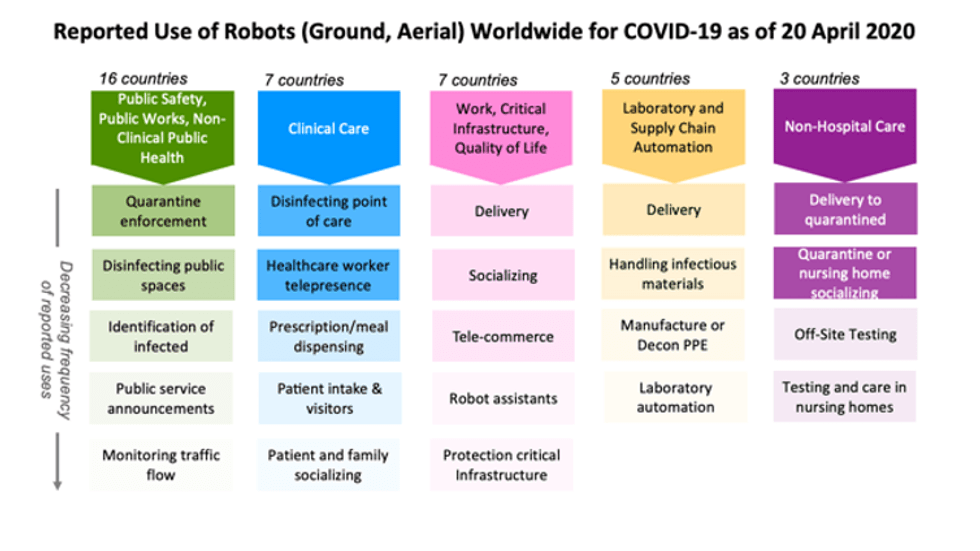
These are just a few of the two dozen ways robots have been used during the COVID-19 pandemic, from health care in and out of hospitals, automation of testing, supporting public safety and public works, to continuing daily work and life.
The lessons they’re teaching for the future are the same lessons learned at previous disasters but quickly forgotten as interest and funding faded. The best robots for a disaster are the robots, like those in these examples, that already exist in the health care and public safety sectors.
Research laboratories and startups are creating new robots, including one designed to allow health care workers to remotely take blood samples and perform mouth swabs. These prototypes are unlikely to make a difference now. However, the robots under development could make a difference in future disasters if momentum for robotics research continues.
Robots around the world
As roboticists at Texas A&M University and the Center for Robot-Assisted Search and Rescue, we examined over 120 press and social media reports from China, the U.S. and 19 other countries about how robots are being used during the COVID-19 pandemic. We found that ground and aerial robots are playing a notable role in almost every aspect of managing the crisis.
R. Murphy, V. Gandudi, Texas A&M J. Adams, Center for Robot-Assisted Search and Rescue, CC BY-ND
At work and home, robots are assisting in surprising ways. Realtors are teleoperating robots to show properties from the safety of their own homes. Workers building a new hospital in China were able work through the night because drones carried lighting. In Japan, students used robots to walk the stage for graduation, and in Cyprus, a person used a drone to walk his dog without violating stay-at-home restrictions.
Helping workers, not replacing them
Every disaster is different, but the experience of using robots for the COVID-19 pandemic presents an opportunity to finally learn three lessons documented over the past 20 years. One important lesson is that during a disaster robots do not replace people. They either perform tasks that a person could not do or do safely, or take on tasks that free up responders to handle the increased workload.
The majority of robots being used in hospitals treating COVID-19 patients have not replaced health care professionals. These robots are teleoperated, enabling the health care workers to apply their expertise and compassion to sick and isolated patients remotely.
A robot uses pulses of ultraviolet light to disinfect a hospital room in Johannesburg, South Africa.
A small number of robots are autonomous, such as the popular UVD decontamination robots and meal and prescription carts. But the reports indicate that the robots are not displacing workers. Instead, the robots are helping the existing hospital staff cope with the surge in infectious patients. The decontamination robots disinfect better and faster than human cleaners, while the carts reduce the amount of time and personal protective equipment nurses and aides must spend on ancillary tasks.
Off-the-shelf over prototypes
The second lesson is the robots used during an emergency are usually already in common use before the disaster. Technologists often rush out well-intentioned prototypes, but during an emergency, responders – health care workers and search-and-rescue teams – are too busy and stressed to learn to use something new and unfamiliar. They typically can’t absorb the unanticipated tasks and procedures, like having to frequently reboot or change batteries, that usually accompany new technology.
Fortunately, responders adopt technologies that their peers have used extensively and shown to work. For example, decontamination robots were already in daily use at many locations for preventing hospital-acquired infections. Sometimes responders also adapt existing robots. For example, agricultural drones designed for spraying pesticides in open fields are being adapted for spraying disinfectants in crowded urban cityscapes in China and India.
Workers in Kunming City, Yunnan Province, China refill a drone with disinfectant. The city is using drones to spray disinfectant in some public areas.
A third lesson follows from the second. Repurposing existing robots is generally more effective than building specialized prototypes. Building a new, specialized robot for a task takes years. Imagine trying to build a new kind of automobile from scratch. Even if such a car could be quickly designed and manufactured, only a few cars would be produced at first and they would likely lack the reliability, ease of use and safety that comes from months or years of feedback from continuous use.
Alternatively, a faster and more scalable approach is to modify existing cars or trucks. This is how robots are being configured for COVID-19 applications. For example, responders began using the thermal cameras already on bomb squad robots and drones – common in most large cities – to detect infected citizens running a high fever. While the jury is still out on whether thermal imaging is effective, the point is that existing public safety robots were rapidly repurposed for public health.
Don’t stockpile robots
The broad use of robots for COVID-19 is a strong indication that the health care system needed more robots, just like it needed more of everyday items such as personal protective equipment and ventilators. But while storing caches of hospital supplies makes sense, storing a cache of specialized robots for use in a future emergency does not.
This was the strategy of the nuclear power industry, and it failed during the Fukushima Daiichi nuclear accident. The robots stored by the Japanese Atomic Energy Agency for an emergency were outdated, and the operators were rusty or no longer employed. Instead, the Tokyo Electric Power Company lost valuable time acquiring and deploying commercial off-the-shelf bomb squad robots, which were in routine use throughout the world. While the commercial robots were not perfect for dealing with a radiological emergency, they were good enough and cheap enough for dozens of robots to be used throughout the facility.
Robots in future pandemics
Hopefully, COVID-19 will accelerate the adoption of existing robots and their adaptation to new niches, but it might also lead to new robots. Laboratory and supply chain automation is emerging as an overlooked opportunity. Automating the slow COVID-19 test processing that relies on a small set of labs and specially trained workers would eliminate some of the delays currently being experienced in many parts of the U.S.
Automation is not particularly exciting, but just like the unglamorous disinfecting robots in use now, it is a valuable application. If government and industry have finally learned the lessons from previous disasters, more mundane robots will be ready to work side by side with the health care workers on the front lines when the next pandemic arrives.
A Belgian biotech firm has started producing tests to rapidly detect antibodies against coronavirus infections, part of a push several countries are making to determine who might be immune.
The Liege-based company, ZenTech, told AFP Tuesday it has started making tens of thousands of the government-certified tests and plans to ramp up output to eventually make up to three million per month.
Founder and CEO Jean-Claude Havaux said diagnosis takes just 10-15 minutes and "sensitivity is 100 percent -- meaning all patients who have COVID-19 antibodies, we see them with our test".
He emphasised that the test kits were only for medical professionals, first in Belgium and then later in other countries in the EU and beyond. They are not for the public to use at home.
"We don't want, and don't intend for, these tests to be used by just anybody. It's not a pregnancy test," said Havaux.
"It's really pretty complicated to carry out and to interpret the results."
Antibody, or serology, tests are seen as a crucial tool for determining who has had COVID-19 -- especially non-symptomatic carriers -- and could therefore be immune to it, at least for a time.
Such tests could possibly pave the way to allowing people to return to work as countries mull easing widespread lockdown measures.
That could be especially important for healthcare workers on the front line of the novel coronavirus pandemic.
As a result, labs in several countries are racing to roll out huge numbers of reliable testing kits.
But the World Health Organization has warned that while reliable testing is welcome, the presence of COVID-19 antibodies is not proof that an individual is immune.
Even if there was immunity, it says, it is unknown how long it might last.
Dr Pascale Huynen, clinic head of the microbiology unit in Liege's university hospital -- which confirmed ZenTech's test was reliable to 97 percent -- also underscored the point.
"Nobody knows if the (COVID-19) antibodies are protective," she said.
She added that scientists also do not know how long immunity could last, or whether the new coronavirus might mutate around any initial immunity, as happens with the flu.
"This is a virus that we don't know very well," she said.
ZenTech's test, she said, simply indicates whether a patient has "come into contact" with COVID-19 with a positive or negative result. It does not show the level of antibody response.
But that in itself is useful for determining the spread of the virus in a population, and for patients who have not received a nasal swab tests that detect whether a person is in the infectious phase, thought to last around two weeks.