Donald Trump's shell company that aimed to take his media company public to the U.S. Stock Exchange is returning donor money, Reuters reported Thursday. It means they intend to "cancel all outstanding private investment in public equity (PIPE) investments."
Trump had a SPAC, a Special Purpose Acquisition Company, which is a time-limited (2 years) shell company that is publicly traded with the sole purpose of taking a private company public. He named it the Digital World Acquisition Corp (DWAC) and it planned to merge with Truth Social. Now that might be on hold.
The company announced that they're refunding $533 million that they raised from investors. The cash was meant to be an infusion for the deal, but some investors were already backtracking, leading to commitments being cut to $467 million.
"The development is the nail in the coffin of the $1 billion investment that DWAC (DWAC.O) had raised for the merger with Trump Media & Technology Group (TMTG), which runs the Truth Social platform," said Reuters. "It raises further doubts about whether the former U.S. president will go ahead with the deal, now that TMTG no longer stands to receive $1 billion if and when it closes."
It essentially means, that out of the $1 billion in investment commitments, Trump has lost $533 million.
The Securities and Exchange Commission (SEC) cracked down on the SPACs after there were many details throughout 2020 and 2021 that concerned investors that they were getting a "raw deal," a July report described.
In the Forbes report Thursday, the publication noted that the new filing revealed that Trump lost nearly $200 million in the prior investment commitments in less than a year. The total loss was $191.5 million.
The companies are spinning it as a positive for them.
Devin Nunes, the Trump Media CEO and former Republican member of the House, swears abandoning the commitments is an “important step…in the 'best interest' of shareholders that wanted to complete the merger 'as soon as possible.'"
“Despite how others may seek to characterize the PIPE commitment cancellations, we want our shareholders to understand that these cancellations are a positive development in our ability to consummate the business combination,” Digital World Acquisition Corp. CEO Eric Swider said in a statement.
Forbes reported that they also said on Thursday "its unaudited quarterly financial statements from last year 'should also no longer be relied upon' because of a 'material weakness' in internal accounting practices, following a similar announcement in May about its audited 2022 quarterly reports."
"So, let me ask you," Trump said in his rally speech. "Let's say a boat goes down and I'm sitting on top of a big powerful battery and the boat is going down, do I get electrocuted? ... But if I'm sitting down and that boat's going down and I'm on top of a battery, and the water starts flooding in, I'm getting concerned. But then I look ten yards to my left and there's a shark over there. So I have a choice of electrocution or a shark. You know what I'm going to take? Electrocution. I'll take electrocution every single time. Do we agree? But these people are crazy."
It's unknown if Trump meant to be flipping his statement to say he's pro-EV.
Trump is correct that an electric boat running with a giant orange electric cord across a lake wouldn't be safe. But one of Trump's biggest problems in his anti-battery argument against EVs is that gas engines also require batteries. There are batteries in cars and boats that would be exposed to the water if it was sinking. Gas is highly explosive.
In his speech to a Michigan crowd that was neither union, nor autoworkers, Trump attacked windmill power. He told the crowd that the windmills are killing whales, who swim underwater, not in the air. He previously claimed that the noise from windmills causes cancer. Windmills aren't loud and operate at generally 20 weighted decibels, which is the decibels heard by the human ear.
Trump has been attacking union workers and car companies for creating more electric vehicles, which he says aren't selling and will ultimately bankrupt the American auto industry. Trump incorrectly said that the electric vehicles are being manufactured in China. To obtain the $7,500 tax credit for the vehicles, they must be manufactured in the U.S. The "Made-in-America" rules begin with a lower percentage that must be made in the U.S. and slowly increase over time. The tax credit will be available until 2032.
The data shows, "electric cars comprised nearly 7 percent of all light-duty vehicle sales in the second quarter of 2023. Hybrid sales are also up, and combined those two classes of care accounted for 16 percent of total light-duty sales in that quarter. That’s about three times what those sales were just 5 years ago."
As vehicle manufacturers begin to set up more manufacturing plants to ensure their cars meet the Made-in-America requirement, the number of EV purchases is likely to increase.
Now he's claiming that the mainstream is coming after him because of his "fame." In reality, he's being accused of grooming a 16-year-old, and others are accusing him of rape and sexual assault.
Brand is denying the allegations, and developing his own conspiracy about it, claiming he was merely promiscuous.
“[It] makes me question, is there another agenda at play?” he said.
Those jumping to his defense include Andrew Tate, which Wired called "the misogynist influencer who is awaiting trial for rape and human trafficking in Romania." The other is disgraced former Fox host Tucker Carlson, relegated to streaming videos at a fraction of the audience he once scored. Alex Jones also came to his defense.
"His YouTube channel now has 6.6 million subscribers, his X account more than 11 million followers. But his anti-establishment message has morphed, from a broader, almost coherent response to the politics of fiscal austerity that shaped the UK after the 2008 financial crisis to a series of cultish, conspiracy-driven narratives that draw in COVID denialism, Russian disinformation, and the far-right-inspired 'Great Reset' theory, united by the meta-conspiracy that the mainstream—the 'elites'—have darker agendas based on control," said the report.
Brand's increase in fame has turned from liberal types to COVID-19 conspiracy theorists. It's one of the main reasons that his YouTube channel lost its monetization status. Rumble happily welcomed him on their platform, where he has over 1 million subscribers and is scoring an undisclosed amount in partnership with the site.
"A 2022 paper by researchers at Cornell showed that 'Alt-Lite, Alt-Right, and Manosphere' content creators on YouTube were increasingly diversifying their off-platform revenue streams, apparently to reduce the risk of demonetization," said Wired. "Tate, whose extreme misogyny finally got him banned from most mainstream platforms in 2022, funnels followers from his remaining channels into his paid-for 'Hustler’s University.'"
“With Twitter’s new monetization policy, there’s a whole host of extreme and difficult or problematic characters that seem to be now, once again, raising money from so-called mainstream platforms,” Joe Mulhall, director of research at the anti-racism campaign group Hope Not Hate, told the site.
Elon Musk, who posted his own message of support to Brand after the BBC report aired, is debating whether or not to demand payment for the website as a whole. He said the hope is to finally curb the bots. That has been the reason for most of the actions he has taken. Each of them has failed and the social media site has slowly lost its value and advertisers. It leaves a void for people like Brand, who want to find new ways to promote their content and increase profits.
FBI Director Christopher Wray was faced with a number of hostile Republican lawmakers in the Judiciary Committee Wednesday who accused him of being a liberal who was going after conservatives.
Rep. Harriet Hageman (R-WY), who took Liz Cheney's place in Congress when her membership of the party was revoked for serving on the Jan. 6 select committee, was among them.
Toward the end of the hearing Hageman attacked the FBI for ongoing dialogue with social media companies that the GOP has viewed as pressuring the tech companies to regulate political speech.
"That is what we found," Hageman said. "Director Wray, you and I both know that the federal government is forbidden in doing indirectly what it cannot do directly. In other words, neither you nor the FBI have any legal authority to circumvent the First Amendment by using a surrogate to do your dirty work."
Wray attempted to correct her, but she talked over him.
"Yeah, that is exactly what you have been doing. The Bureau, under your watch, has been using proxies to violate the First Amendment," she alleged.
The First Amendment doesn't guarantee speech on social media platforms. Those platforms determine their own terms of service and rules. The First Amendment applies to the government restricting speech.
Hageman and Wray continued with the back and forth until Hageman proclaimed the weaponization of government against conservatives who, she said, have been persecuted for their political beliefs.
Wray struck back.
"First off, I would disagree with your characterization of the FBI. Certainly your description of my own approach," he said.
"The idea that I am biased against conservatives seems somewhat insane to me, given my own personal background."
The longtime Republican has served in both the George W. Bush administration and was appointed by Donald Trump.
Speaking to MSNBC, Weissmann explained that the ruling from a conservative Donald Trump-appointed federal judge is a result of the issue being politicized by the GOP.
"I should tell you when I was at the FBI and the general counsel, you did not lightly make a call to a tech company to alert them to an issue," he explained. "You also didn't ask them to do anything. You didn't say, take this down. You don't have the power to do that. But you had calls where something was of a severe national security or criminal threat, and you would alert them to the fact that it was on their website."
He went on to explain that tech companies have their own policies. New Twitter owner Elon Musk revealed in December that emails were sent from President Joe Biden's White House and the FBI to Twitter flagging accounts and specific tweets, and highlighting users they said violated the site's terms of service, Fox reported.
In each instance, it proved to be true. Frequently, spoof accounts or fake accounts get created on social media sites. Since Twitter allows anyone to pay for a "verified" checkmark, and if that account purports to be a government official, it can cause problems.
Conservatives also claim that the White House told Twitter to take down things about Hunter Biden's laptop.
"So they just take that information, and they make their independent decision about what to do," Weissmann explained. "The idea that the government cannot do that is really fanciful. Just to be clear, the plaintiffs are the same people who have no problem with banning books in public schools. This really isn't a First Amendment issue. This is a conservative agenda. I think that, as we have talked about, this is one where if you take the politics out of it, this is doing something that's such a harm to our security."
A Trump-appointed federal judge on Tuesday blocked the Biden administration from communicating or meeting with social media companies, The Washington Post reports.
In a ruling largely viewed as a victory for conservatives, Judge Terry A. Doughty issued the injunction in response to Republican attorneys general of Louisiana and Missouri, who argued in a lawsuit that the government overreached in efforts to stop the spread of vaccine disinformation and baseless allegations of election fraud.
The Post’s Cat Zakrzewski describes the injunction as an “extraordinary” ruling that “could upend years of efforts to enhance coordination between the government and social media companies.”
The attorneys general contend that the Biden administration is behind a “sprawling federal ‘Censorship Enterprise’” that aims to pressure social media companies to censor posts expressing controversial political views and conservatives in particular, the report said.
The attorneys general in court filings described such efforts “the most egregious violations of the First Amendment in the history of the United States of America.”
Doughty’s ruling includes exceptions for communications between the government and social media companies for national security threats or criminal activity, the report said.
Zakrzewski writes that “The ruling could have critical implications for tech companies, which regularly communicate with government officials, especially during elections and emergencies, such as the coronavirus pandemic.”
The 2015 photo of DeSantis and his wife Casey seemingly walking on a beach without making footprints in the sand did the rounds again on social media this week, first re-posted by the activist account PatriotTakes. The photo comes from a Flickr account called “DeSantis for Senate” and has a few photos of the couple talking to voters as well as then-Congressman DeSantis with various backgrounds.
The photo was used in a 2015 tweet by DeSantis on a meme that quotes his wife talking about his "integrity." The irony is that it talks about integrity while being an apparently digitally edited photo.
Talented Photoshoppers used the image as a new opportunity to put the DeSantis couple in different locations. One readjusted the photo to include DeSantis' signature white rain boots after Hurricane Ian devastated the west coast of his state. The bright goloshes led to a number of photos of DeSantis as a Dallas Cowboys cheerleader, with Nancy Sinatra, the green M&M and Lt. Dangle from the film "Super Troopers."
Now that DeSantis is running for president and more information is becoming public about his past, the photoshopping mocker has taken a darker turn.
One individual put the beach couple in the Guantanamo Bay Detention Camp, where DeSantis was posted as a navy lawyer.
See some of the images below or at the links here.
DeSantis' campaign has been caught using its own fake photos and videos in campaign ads. The team appeared to use an AI-generated photo of Donald Trump hugging and kissing Dr. Anthony Fauci. No such incident occurred.
Three men in Florida were arrested on Thursday morning on insider trading charged after they allegedly scored $22 million ahead of Donald Trump's media company being taken public, the Associated Press reported.
The former president isn't thought to have had close connections to the men who invested in Trump Media & Technology Company. The media company is the parent for Trump's personal social media website TruthSocial, where he posts exclusively.
The arrests were part of a larger sting on insider trading that resulted in the arrest of 10 people including a former Pfizer employee, the report also said.
A fake account impersonating Rep. Alexandria Ocasio-Cortez (D-NY) and releasing false policy statement has paid to be verified by Twitter – and the social media's CEO has been engaging with it, the congresswoman said Tuesday.
In the past, Twitter would shut down impersonation accounts that didn't indicate that they were a parody.
The account has shared messages including that its operator has a crush on Twitter CEO Elon Musk – who replied which ultimately brought more attention to it, Ocasio-Cortez said.
"FYI there’s a fake account on here impersonating me and going viral," said the congresswoman on Twitter. "The Twitter CEO has engaged it, boosting visibility. It is releasing false policy statements and gaining spread. I am assessing with my team how to move forward. In the meantime, be careful of what you see."
Noah Dahl, who highlights extremism and white supremacy, said the incident makes things awkward for the CEO.
"Either [he] replied unaware that the account was fake, making him easily duped by disinformation, or he replied knowingly, making him a deliberate spreader of disinformation. No good takeaways here," said Dahl.
After complaints, the account added (parody) to its name, which allows it to continue to operate under Twitter's terms of service. But the (parody) isn't actually visible until users click into the account because the name is so long.
The account appears to be using tweets from the actual AOC account and rewording them slightly, creating confusion. It is one of the main problems that tech experts predicted with Musk's new buy-and-verify process – if someone can only be verified via purchase, then anyone could be "verified" with a purchase.
Reporter Aaron Rupar called it "disgusting even for Elon (in case it's not clear, the 'verified' account is not actually AOC)."
And SiriusXMProgress radio host Dean Obeidallah said, "Elon Musk is a cancer on American democracy."
Some Republicans are using the ordeal to mock AOC, saying she can't take a joke.
Zero Zero Robotics, a leading robotics company, has launched its newest flagship product, the Hover Camera X1, a pocket-sized self-flying camera that is available today on Indiegogo. Like the rest of the Hover Camera product line, the X1 is focused on a user-centered flying experience, while featuring significant improvements in portability and usability. The Hover Camera X1 can be flown entirely hands-free, requiring neither a controller nor an app to operate. It leverages cutting-edge artificial intelligence technology to enable a more effortless and enjoyable flying experience. With folded ...
The Republican National Committee (RNC) inspired a combination of mockery and scathing criticism when it responded to President Joe Biden's reelection campaign announcement with a melodramatic, over-the-top attack ad that used artificial intelligence (AI) software to create dystopian images depicting what GOP operatives claim a second Biden term would look like.
In the late April ad, ominous music played while the RNC predicted banks collapsing, Mainland China invading Taiwan and an invasion of illegal immigrants if Biden is reelected. The AI-generated images were designed to terrify viewers into voting Republican.
The ad's critics — a combination of Democrats, liberals, progressives and right-wing Never Trump conservatives — slammed it for using fake computer-generated images when the United States has so many real problems to contend with. But the fact that an attack ad is silly doesn't mean that it can't be effective, and defenders of democracy have been warning that AI technology poses a major threat to the democratic process.
"AI-generated content is emerging as a disruptive political force just as nations around the world are gearing up for a rare convergence of election cycles in 2024," Heath reports. "Why it matters: Around one billion voters will head to polls in 2024 across the U.S., India, the European Union, the U.K. and Indonesia, plus Russia — but neither AI companies nor governments have put matching election protections in place."
According to Heath, the "AI deluge" could "could upend 2024 elections via": (1) "fundraising scams," (2) "a microtargeting tsunami," and (3) "incendiary emotional fuel."
Allie Funk, who specializes in tech challenges at Freedom House, warned Axios that AI technology "will lower the barrier of entry for shady companies" and is a recipe for widespread "automated disinformation."
Tech and elections consultant Katie Harbath told Axios that from an AI standpoint, "The 2024 election is going to be exponentially more challenging than…. 2020 and 2016…. Election plans cannot be spun up in days or weeks. Work should start 18 months to 24 months ahead of Election Day."
Heath isn't the first Axios reporter to address AI's ability to influence elections.
Axios' Alex Thompson, in an April 25 Twitter thread, observed, "AI-generated images are disrupting art, journalism, and now politics. The 2024 election is poised to be the first election with ads full of images generated by modern Artificial Intelligence software."
There has been a tenfold increase in sexual abuse imagery created with webcams and other recording devices worldwide since 2019, according to the the Internet Watch Foundation.
Social media sites and chatrooms are the most common methods used to facilitate contact with kids, and abuse occurs both online and offline. Increasingly, predators are using advances in technology to engage in technology-facilitated sexual abuse.
Once having gained access to a child’s webcam, a predator can use it to record, produce and distribute child pornography.
We are criminologists who study cybercrime and cybersecurity. Our current research examines the methods online predators use to compromise children’s webcams. To do this, we posed online as children to observe active online predators in action.
Chatbots
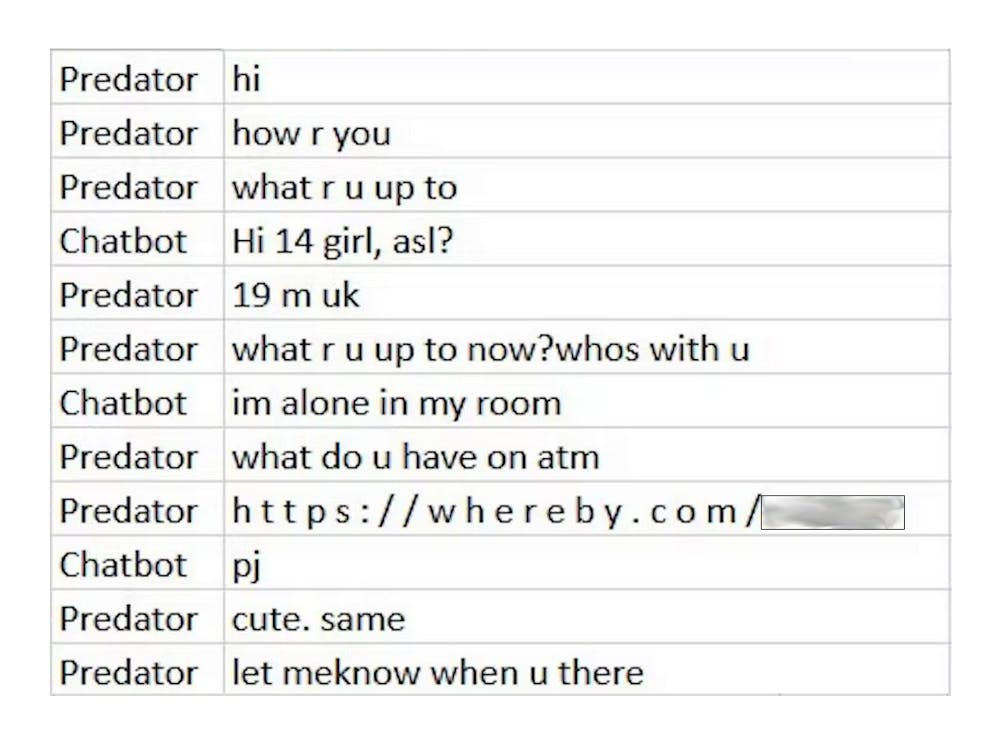
We began by creating several automated chatbots disguised as 13-year-old girls. We deployed these chatbots as bait for online predators in various chatrooms frequently used by children to socialize. The bots never initiated conversations and were programmed to respond only to users who identified as over 18 years of age.
We programmed the bots to begin each conversation by stating their age, sex and location. This is common practice in chatroom culture and ensured the conversations logged were with adults over the age of 18 who were knowingly and willingly chatting with a minor. Though it’s possible some subjects were underage and posing as adults, previous research shows online predators usually represent themselves as younger than they actually are, not older.
A section of dialogue between a self-identified adult and the researchers’ chatbot posing as a 13-year-old. Eden Kamar, CC BY-ND
Most prior studies of child sexual abuse rely on historical data from police reports, which provides an outdated depiction of the tactics currently used to abuse children. In contrast, the automated chatbots we used gathered data about active offenders and the current methods they use to facilitate sexual abuse.
Methods of attack
In total, our chatbots logged 953 conversations with self-identified adults who were told they were talking with a 13-year-old girl. Nearly all the conversations were sexual in nature with an emphasis on webcams. Some predators were explicit in their desires and immediately offered payment for videos of the child performing sexual acts. Others attempted to solicit videos with promises of love and future relationships. In addition to these commonly used tactics, we found that 39% of conversations included an unsolicited link.
We conducted a forensics investigation of the links and found that 19% (71 links) were embedded with malware, 5% (18 links) led to phishing websites, and 41% (154 links) were associated with Whereby, a video conferencing platform operated by a company in Norway.
Editor’s note: The Conversation reviewed the author’s unpublished data and confirmed that 41% of the links in the chatbot dialogues were to Whereby video meetings, and that a sample of the dialogues with the Whereby links showed subjects attempting to entice what they were told were 13-year-old girls to engage in inappropriate behavior.
It was immediately obvious to us how some of these links could help a predator victimize a child. Online predators use malware to compromise a child’s computer system and gain remote access to their webcam. Phishing sites are used to harvest personal information, which can aid the predator in victimizing their target. For example, phishing attacks can give a predator access to the password to a child’s computer, which could be used to access and remotely control the child’s camera.
Whereby video meetings
At first, it was unclear why Whereby was favored among online predators or whether the platform was being used to facilitate online sexual abuse.
After further investigation, we found that online predators could exploit known functions in the Whereby platform to watch and record children without their active or informed consent.
This method of attack can simplify online sexual abuse. The offender does not need to be technically savvy or socially manipulative to gain access to a child’s webcam. Instead, someone who can persuade a victim to visit a seemingly innocuous site could gain control of the child’s camera.
Having gained access to the camera, a predator can violate the child by watching and recording them without actual – as opposed to technical – consent. This level of access and disregard for privacy facilitates online sexual abuse.
Based on our analysis, it is possible that predators could use Whereby to control a child’s webcam by embedding a livestream of the video on a website of their choosing. We had a software developer run a test with an embedded Whereby account, which showed that the account host can embed code that allows him to turn on the visitor’s camera. The test confirmed that it is possible to turn on a visitor’s camera without their knowledge.
We have found no evidence suggesting that other major videoconferencing platforms, such as Zoom, BlueJeans, WebEx, GoogleMeet, GoTo Meeting and Microsoft Teams, can be exploited in this manner.
Control of the visitor’s camera and mic is limited to within the Whereby platform, and there are icons that indicate when the camera and mic are on. However, children might not be aware of the camera and mic indicators and would be at risk if they switched browser tabs without exiting the Whereby platform or closing that tab. In this scenario, a child would be unaware that the host was controlling their camera and mic.
Editor’s note: The Conversation reached out to Whereby, and a spokesperson there disputed that the feature could be exploited. “Whereby and our users cannot access a user’s camera or microphone without receiving clear permission from the user to do so via their browser permissions,” wrote Victor Alexandru Truică, Information Security Lead for Whereby. He also said that users can see when the camera is on and can “close, revoke, or ‘turn off’ that permission at any time.”
A lawyer for the company also wrote that Whereby disputes the researchers’ claims. “Whereby takes the privacy and safety of its customers seriously. This commitment is core to how we do business, and it is central to our products and services.”
Revoking access to the webcam following initial permission requires knowledge of browser caches. A recent study reported that although children are considered fluent new media users, they lack digital literacy in the area of safety and privacy. Since caches are a more advanced safety and privacy feature, children should not be expected to know to clear browser caches or how to do so.
Keeping your kids safe online
Awareness is the first step toward a safe and trustworthy cyberspace. We are reporting these attack methods so parents and policymakers can protect and educate an otherwise vulnerable population. Now that videoconferencing companies are aware of these exploits, they can reconfigure their platforms to avoid such exploitation. Moving forward, an increased prioritization of privacy could prevent designs that can be exploited for nefarious intent.
There are several ways people can spy on you through your webcam.
Here are some recommendations to help keep your kid safe while online. For starters, always cover your child’s webcam. While this does not prevent sexual abuse, it does prevent predators from spying via a webcam.
You should also monitor your child’s internet activity. The anonymity provided by social media sites and chatrooms facilitates the initial contact that can lead to online sexual abuse. Online strangers are still strangers, so teach your child about stranger danger. More information about online safety is available on our labs’ websites: Evidence-Based Cybersecurity Research Group and Sarasota Cybersecurity.
MSNBC's Mehdi Hasan thinks the so-called "liberal media" has learned nothing from former PresidentDonald Trump's non-stop lies.
Sunday evening, the BBC had 20 minutes to prepare for an interview with Elon Musk, and the MSNBC reporters explained that the interviewer shouldn't have done it if he wasn't prepared. They argue it was a flop. A few weeks ago, Lesley Stahl was similarly criticized for being unwilling to fight back against lies told by Rep. Marjorie Taylor Greene (R-GA) during her "60 Minutes" interview.
"They're still getting steamrolled by their bad-faith interviewees as a result," Hasan continued. "I mean, that BBC reporter, Ayman, was apparently given 20 minutes notice by Musk for the interview. But he shouldn't have agreed to it if he couldn't be fully prepared with follow-ups, with specific examples, in 20 minutes. The Musks and the MTGs of this world love doing weak and credulous interviews like those, don't they?"
Fellow host Ayman Mohyeldin agreed, noting that not only do they win the narrative, but "they love it."
"And you know what is so telling of these interviews? All you have to do is actually look at how both Marjorie Taylor Greene and Elon Musk reacted to those interviews to know how they went," Mohyeldin explained. "After Elon tweeted out, the BBC interview last week was, 'exceptional at illustrating why you cannot rely on the media for truth.' And for her part, Greene, who has never said anything nice about anyone in the mainstream media, suddenly heapspraise on Lesley Stahl, saying that she respects her on issues. Respects her issues like what? Suggesting that Nancy Pelosi should be executed? Or Jewish Space Lasers...?"
He explained that it's normal to see something like that on Fox, where Trump is typically given all the media time and attention he wants to say whatever lies he can come up with.
"But it is so disheartening to your point, when you see far-right extremists like Greene disingenuous actors like Musk platformed and normalized on major news organizations like CBS and the BBC, without any serious or meaningful pushback to expose them for how harmful they are to free speech and democracy," continued Mohyeldin. "And I say this again to everyone in the media, who may be watching, and to your point, Mehdi, the 'get' is never more important than the content of the interview. If you are not prepared, do it, do not do the interview just to boast that you've got an exclusive."