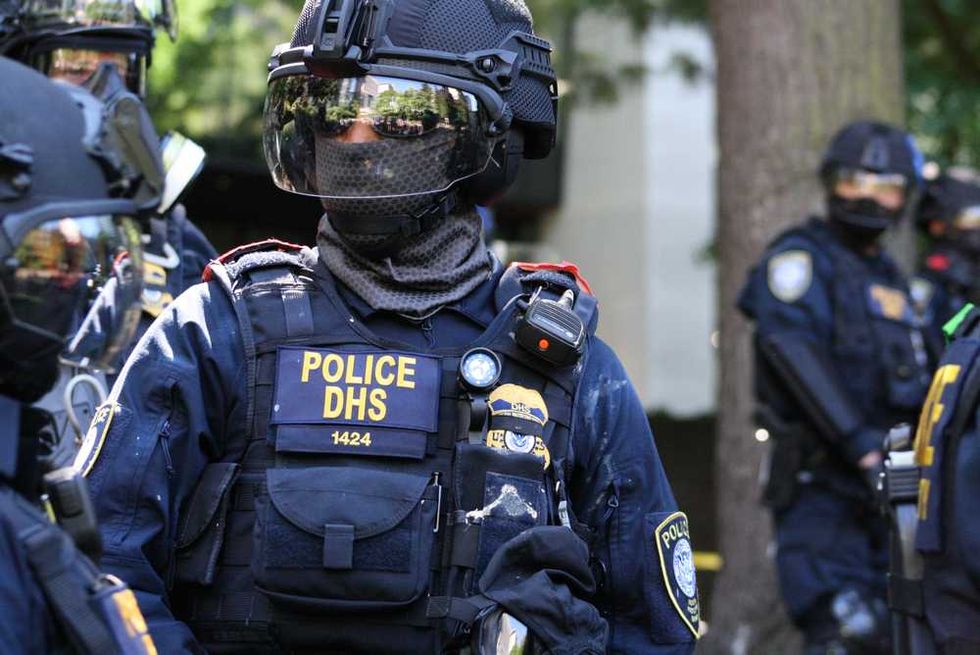
Portland, Oregon / United States - August 22, 2020: Federal police from the Department of Homeland Security (DHS/D.H.S.) (Photo credit: Robert P. Alvarez / Shutterstock)

The Trump administration is quietly using a little-known customs law to obtain private records on journalists and activists without a judge's sign-off, according to a new report.
The Department of Homeland Security has been leaning on a customs-import provision to demand phone logs, social media account details, and financial data with only an agency official's approval and instructions to keep requests secret, according to a Saturday report by The Guardian.
"They don't want a judge to take away this scary tool," warned Lauren Regan, the executive director of the Civil Liberties Defense Center. "They are getting stuff out of it."
In one Minnesota case, DHS obtained six months of phone records for Minneapolis reporter Georgia Fort, according to The Guardian. DHS seized records covering more than 10,000 calls and texts after a federal judge had already turned down the Trump administration's request twice.
Fort is fighting a case brought by the Department of Justice after she and former CNN anchor Don Lemon were charged after covering anti-ICE protests in January. After a judge rejected search-warrant requests for Fort and Lemon's YouTube data and said both should get a chance to push back, the Trump administration backed off, The Guardian noted.
Several weeks later, DHS, the parent agency of ICE, served Google with a summons for the same information and used the customs-import provision in question to skip the courtroom entirely, according to The Guardian. Google refused to turn over Fort's account data, but T-Mobile complied with a demand for Fort's phone records.
DHS has also used the provision to serve summonses to Democracy Now, right-wing podcaster Megyn Kelly, several unions and nonprofits, even though none of them face charges, The Guardian noted.
Legal experts told The Guardian that the tactic is a plain abuse of a narrow statute built for customs enforcement.
"It's outrageous conduct on so many levels," John Roth, who ran the DHS inspector general's office from 2014 to 2017, told The Guardian. He called the DHS tactic an "improper use of the subpoena under any circumstances."
Former DHS attorney Chris Duncan said the customs-import provision doesn't reach speech or protest cases.
"These laws have absolutely nothing to do with a domestic situation at a church, a social media post, even an immigration matter," Duncan told The Guardian.
Report typos and corrections to corrections@rawstory.com.
For customer support contact support@rawstory.com.