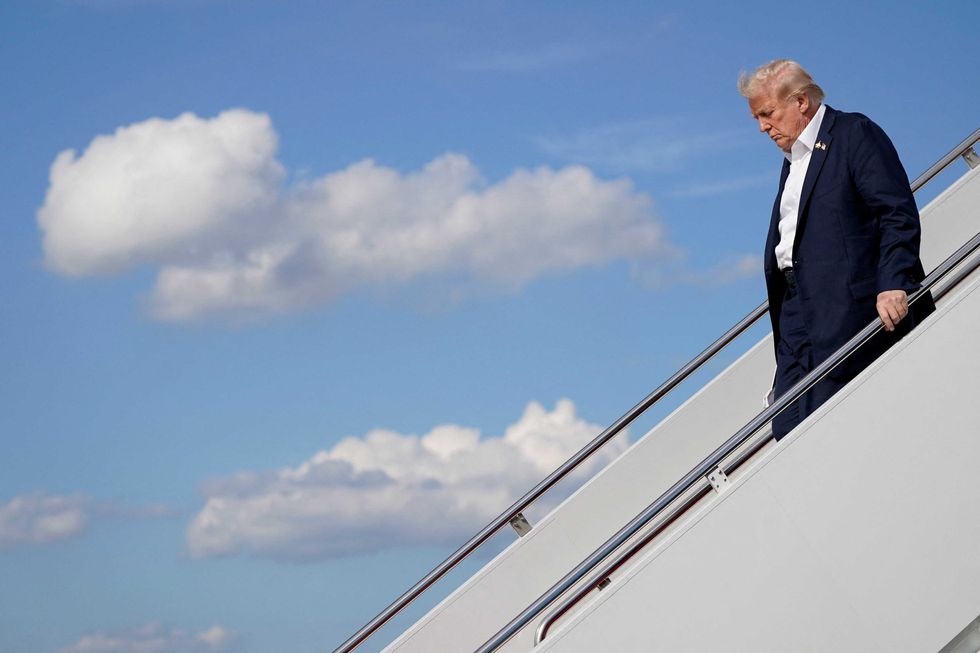
Donald Trump disembarks Air Force One. REUTERS/Elizabeth Frantz

President Donald Trump is traveling to Michigan on Monday to promote his economic agenda ahead of the state's Aug. 4 primary, as Republican strategists privately worry that rising prices could weigh heavily on this fall's elections.
The trip lands in one of the toughest possible settings for that message, reported the Washington Post. Michigan's economy is deeply tied to the automotive industry, which has been rattled by the administration's tariffs, including a newly announced 50 percent tariff on Canadian goods — a major blow given the tens of billions of dollars in trade between the state and Canada.
“We are going to have to navigate a difficult time in terms of oil prices and the impact on the economy,” said Michigan-based GOP strategist Jason Cabel Roe. “But removing one of the most hostile actors towards the United States of the last 50 years from the board is a pretty significant accomplishment.
”Roe, who is working on a competitive House race, said he expects cost-of-living concerns to weigh heavily on voters, even as he argues Republicans can frame short-term price pain as the cost of confronting a hostile foreign adversary. Still, he admitted feeling uneasy about the political terrain with the election roughly 100 days away.
“I’m a little nervous right now,” Roe said.
That unease is shared elsewhere in the party. Longtime GOP operative Doug Heye warned that any policy fueling inflation is a liability for Republican candidates broadly, even as other Michigan strategists argue the tariffs can be sold as protecting American workers and supply chains from exploitation.
Compounding the challenge, Trump himself has periodically undercut his party's economic message, dismissing affordability concerns as a "hoax" and saying he likes inflation — comments strategists worry blunt the GOP's own talking points on tax cuts and manufacturing investment.
Some Republican strategists see the party's best path forward not in defending the economy directly, but in pivoting to a contrast with Democrats, particularly by highlighting a contentious Michigan Senate primary featuring a further-left candidate. But even that approach carries risk, Heye said, cautioning that leaning too hard into attacking Democrats could look like changing the subject from voters' financial pain.
Meanwhile, Democrats are moving to capitalize, with the state party chair framing Republicans as having enabled Trump's cost-raising agenda heading into November.
“The economy? I got two words: It sucks,” said Armetris Hare, a caterer set up outside a Detroit courthouse. “The war made everything higher. Why are we even in this war?”
“I want Trump to make America great again — but not the way he did it,” she added.
Report typos and corrections to corrections@rawstory.com.
For customer support contact support@rawstory.com.