CNN host Wolf Blitzer confronted Donald Trump's lead spokesperson on Monday regarding his comments about a federal judge, as well as their effect on his standing among Republicans.
"Who does he expect to stand beside him in the coming weeks and months?" Blitzer asked Katrina Pierson.
"The American voter, and that's all that matters here," she replied.
Blitzer pointed out that both House Speaker Paul Ryan (R-WI) and Senate Majority Leader Mitch McConnell (R-KY) had criticized Trump for continually referring to Judge Gonzalo P. Curiel as "Mexican" despite Curiel being born in Indiana.
"This is typical reaction from Republican leaders," she said. "At the first hint of controversy or criticism regarding race, they tuck their tails and run and want to condemn immediately without even trying to understand what's happening here."
Trump has accused Curiel of being a "hater" and of having an inherent conflict of interest while overseeing a case involving his for-profit university because the judge's parents are Mexican immigrants, prompting criticism from both liberal and conservative circles.
Pierson questioned reports stating that Trump ordered his surrogates to defend his rhetoric.
"The surrogates want to get the facts out," she argued. "They don't want to sit here and listen to this nonsense calling Mr. Trump a racist, because that's not what's happening here. Mr. Trump is now the victim of judicial activism. Many people in this country know exactly what that feels like, and they don't like it."
Idiocracy star Terry Crews will reprise his role as President Dwayne Elizondo Mountain Dew Herbert Camacho in a series of ads targeting current Republican presidential candidate Donald Trump, Buzzfeed reported.
"This is what satire is for," said the film's co-writer, Etan Cohen. "To be able to hold up a mirror and say, 'This is crazy.' Idiocracy was like that, but this all of a sudden felt like a very immediate need for the true meaning of satire and what it can actually do."
Cohen said the commercials will begin shooting as soon as Crews clears up rights issues with the film's distributor, 20th Century Fox. The idea came about after Cohen's comparison between the movie and the current political climate attracted widespread attention in February.
The positive response to his remark, Cohen said, led him to contact the film's director and co-writer, Mike Judge, and they started working on writing the commercials.
Naturally, Cohen said that in a head-to-head race, he would choose Camacho.
"The most dangerous contrast to Trump is that Camacho actually realizes he needs advice from other people, and knows that he's not the smartest guy in the room," Cohen said. "Also, not a racist."
Real Time host Bill Maher attributed Donald Trump's ascent to the top of the Republican Party to a backlash against a perceived decline in masculinity on his show's blog.
"It feels right, doesn't it? What we're experiencing now, not just in America, but around the world, is the revenge of the cavemen," Maher wrote.
While admitting he had no definitive evidence behind his reasoning, Maher was buoyed by a YouGov study asking male respondents to identify themselves on a 0-6 scale of masculinity. While 65 percent of men older than 65 years of age said they were "completely masculine," only 30 percent of men between the ages of 18 and 29 gave a similar response.
According to Maher, this age difference helps explain Trump's popularity.
" Trump voters are overwhelmingly male and older, and think the world has gotten too PC, too 'gay,' and they'd like their country to be more 'manly' again," the host said. "That's where Trump comes in. He's going to kick everyone's ass. He's going to win. He doesn't care about your feelings. He wants to dominate you. This appeals to a certain cross-section of America."
The host also gave backhanded credit to the younger respondents' responses, quipping, "Points for self-awareness, I guess."
Online media outlet BuzzFeed has pulled out of an advertising deal reported to be worth $1.3 million with the Republican National Committee over objections to the party's presumptive nominee Donald Trump.
In an e-mail to employees on Monday, BuzzFeed founder and CEO Jonah Peretti wrote: "We don't run cigarette ads because they are hazardous to our health, and we won't accept Trump ads for the exact same reason."
"The Trump campaign is directly opposed to the freedoms of our employees in the United States and around the world and in some cases, such as his proposed ban on international travel for Muslims, would make it impossible for our employees to do their jobs," Peretti wrote in the note, which was posted to BuzzFeed.com.
BuzzFeed declined further comment.
Neither BuzzFeed nor the RNC would confirm the exact value of the deal, reported by Politico to be $1.3 million.
According to an RNC official who declined to be identified, the deal was less than 1 percent of the party's ad budget of about $150 million and was effectively a reservation for ad space, not a firm commitment to place ads with BuzzFeed.
Trump's campaign spokeswoman Hope Hicks said she had "nothing to add."
The RNC provides national leadership for the Republican Party. Trump is expected to be officially nominated as the party's candidate for the Nov. 8 U.S. presidential election at the Republican National Convention in July.
(Reporting by Angela Moon; Editing by Dan Burns and Andrew Hay)
Donald Trump is getting ripped from all sides over his decision to quadruple down on his claims that Judge Gonzalo Curiel has an inherent conflict of interest in overseeing the Trump University case because he's Mexican American. So naturally, the presumptive Republican presidential nominee has decided to quintuple down.
Two Trump campaign officials tell Bloomberg that Trump on Monday held a strategy session with supporters where he instructed them to more forcefully attack the credibility of Judge Curiel, whom Trump has accused of being a "hater" who is biased against him because his parents were from Mexico and he's opposed to Trump's plan to build a wall on the U.S.-Mexico border. Even better, the sources say that Trump instructed surrogates to accuse anyone who questions his racist attacks of being racist themselves.
"The people asking the questions—those are the racists," Trump said, according to Bloomberg's sources. "I would go at 'em."
Trump's campaign has been beset by major internal dissent over his decision to attack Curiel, and it seems that some unhappy staffers are delivering a steady stream of leaks to eager reporters. Trump, for his part, seems to remain defiant even in the face of adversity from his own campaign team.
"We will overcome," Trump reportedly said during the meeting. "And I’ve always won and I’m going to continue to win. And that’s the way it is."
GOP presumptive nominee Donald Trump is having a rough time with veterans lately. After lying about giving $1 million of his own money to his veterans charity event, protesting veterans showed up outside his campaign's headquarters. Trump then tweeted that the veterans were ungrateful. On Monday, he botched another attempted outreach to veterans. June 6 marks the 72nd anniversary of D-Day, the day that the allied forces in World War II landed on the beach in Normandy.
Donald Trump commemorated the day by tweeting out a photo with "D-Day 1944" at the top, saying, “Remembering the fallen heroes on #DDay – June 6, 1944."
[caption id="attachment_815198" align="aligncenter" width="500"] Donald Trump's tweet of Not D-Day (Photo: Screen capture)[/caption]
The problem is that the photo is actually from a 1943 training mission. As Mediaite cites, you can see a man in the foreground with his hands on his hips overlooking the scene. The actual invasion was bloody and violent, with bodies washing up on the beach. No one was just standing around.
The photo is actually from a news article that uses a Getty Images archive photo that is captioned “1943: Troops coming ashore during training exercises for the Allied D-Day invasion.”
Oops.
[caption id="attachment_815200" align="aligncenter" width="500"] This is not D-Day[/caption]
On Sunday voters across Puerto Rico headed to the polls and cast their votes for their preferred Democratic nominee. Early results show Hillary Clinton came out about 20 points ahead of Bernie Sanders, leaving her just a few delegates shy of the Democratic nomination heading into Tuesday’s voting in California and five other states.
Puerto Rico’s primary did not receive the media attention of many of those that preceded it. None of the major public polling firms conducted polls in Puerto Rico. Little attention was given to Puerto Rican primaries in the most popular national news outlets. And with only 60 pledged delegates, a primary late in the election season, and a population that is ineligible to vote in the elections in November, why should it?
Apart from respecting basic democratic ideals, there are at least two strategic reasons the Puerto Rican primaries should be the focus of broad public interest. To their credit, both the Clinton and Sanders campaigns seemed to understand this.
The new route to Washington
First, campaigning on the island is campaigning on the mainland. There is a long history of back and forth migration between the island and the mainland. This has accelerated in recent years with the sliding economy and a poverty rate approaching 50 percent. Today, about one third of Puerto Ricans born on the island live stateside. This means many Puerto Ricans living in the continental U.S. have been deeply affected by the woes facing the island. Many others have family who have.
The significance of this pattern is heightened by the fact that Puerto Ricans are no longer concentrated in solidly Democratic states in the northeast like they once were. Today, their growing numbers are felt in more regions of the U.S. and are becoming an especially powerful force in the critical swing state of Florida. With the third most electoral votes in the nation and a history of voting for the winning presidential candidate in nine out of 10 of the last presidential elections, candidates can not underestimate the significance of this demographic shift.
In turn, the unique political attention that Cuban Americans once received may shift as Puerto Ricans take over Cubans as the largest Latino ethnic sub-group in this critical state.
An important litmus test
In addition to the effect that campaigning on the island has on stateside Puerto Ricans, the primaries in Puerto Rico are widely viewed as a litmus test for Latino support.
Low turnout in political primaries combined with limited (and often deeply flawed) polling of Latinos makes it difficult to gauge which candidates have the greatest capacity to engage and mobilize Latino voters. Puerto Rico, however, averts these challenges in many ways, and offers an initial sense of the degree to which Latino voters will support the candidates.
Of course, Latinos are not a monolith. There is vast political, as well as economic and cultural, heterogeneity among Latinos. But a poor performance in Puerto Rico impedes a candidate’s ability to claim they can engage the increasingly fundamental Latino vote in November.
So with the significance of Puerto Rico’s primaries in mind, what mattered to voters there?
“Hispandering” doesn’t work
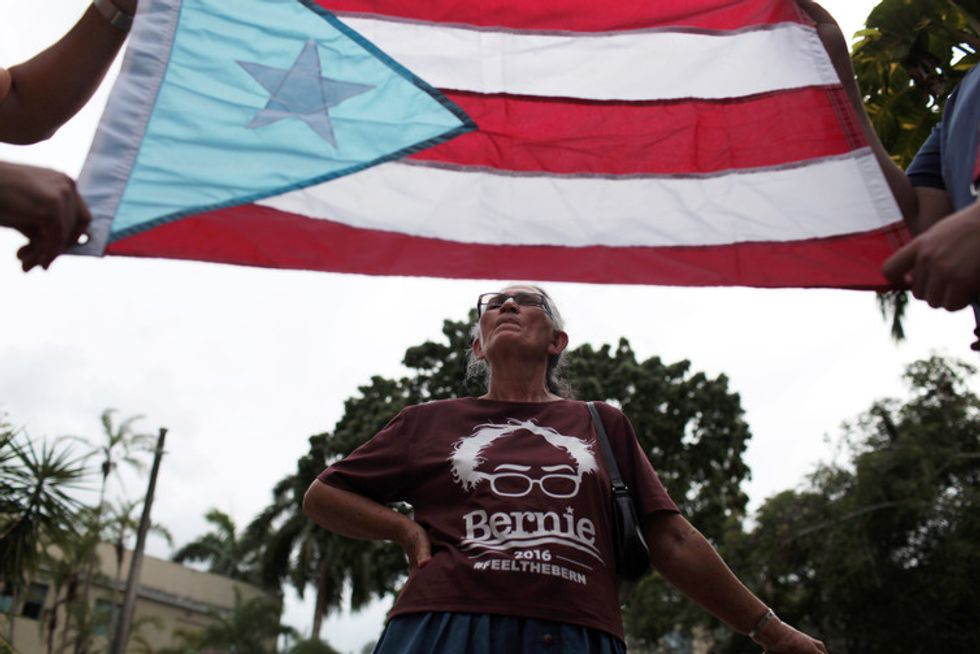
A supporter of U.S. Democratic presidential candidate Bernie Sanders stands behind a Puerto Rican flag in San Juan, Puerto Rico, May 16, 2016.
REUTERS/Alvin Baez
Voters and politicians in Puerto Rico tend to organize themselves around how they see the future of the territory’s political status.
Political parties on the island are largely centered around the most common positions - statehood, independence or maintaining some form of the status quo. But while this issue is arguably the most salient political cue, it is not necessarily driving voter’s choice of a presidential candidate.
And although the island’s inability to make payments on its massive debt is currently the center of attention, it is not clear that candidates' position on the territory’s right to declare bankruptcy motivated voters, either.
Broad positions on these issues alone often come across as philosophical abstractions or even symbolic pandering, as opposed to positions on issues deeply implicated in the daily experiences and opportunities of the island’s 3.5 million residents.
For many voters, it is less important that a candidate favors or opposes the debt deal or another plebiscite on the island’s status, than it is that he or she illustrates a recognition of the gravity of what is occurring in Puerto Rico, and can explain a thoughtful plan to address it.
That is arguably why Marco Rubio swept the Republican primary in March, picking up over 70 percent of the vote and all 23 of the island’s Republican delegates. In his two campaign visits to Puerto Rico, and in an article he penned for El Nuevo Día, the island’s largest daily newspaper, he highlighted his opposition to granting Puerto Rico the same bankruptcy protections afforded to municipalities in the 50 U.S. states. But he also outlined his own plan to address the challenges facing Puerto Rico. And whether one agreed with his ideas or not, he conveyed an awareness of what was going on in Puerto Rico that went beyond a blanket endorsement or rejection of someone else’s proposal.
The Clintons in San Juan in 2008.
REUTERS/Ana Martinez
This same approach served both of the Democratic candidates well, and was a key factor in Sunday’s results.
Clinton started off with a huge advantage in Puerto Rico. As a former senator from New York, a state with a large concentration of Puerto Ricans, she had an established history of involvement with Puerto Ricans on both the island and mainland. She won over voters in the territory’s 2008 Democratic primary by a 2-1 margin over Barack Obama. More recently she won the support of more than 70 percent of non-Cuban Latinos in Florida. And while Bill is not Hillary, it would be negligent to discount the significance of her husband’s popularity. In 1992, he won support from 95 percent of voters in the territory’s Democratic primary. Well aware of this, he was sent to Puerto Rico on her behalf while Sanders was campaigning there earlier in May. Her strong performance was therefore widely anticipated.
What was not anticipated was how much Sanders would cut into her margin of victory. The Vermont senator had a limited history with Puerto Rican politics prior to his presidential campaign. But he campaigned aggressively on the island.
People watch Sanders at University of Puerto Rico in San Juan, May 16, 2016.
REUTERS/Alvin Baez
Sanders spoke at the University of Puerto Rico – Rio Piedras a few weeks ago, and aired television ads on the island. He spoke out forcefully about the inadequacy of the debt deal proposed by Congress, and came out with his own detailed plan to address not just the island’s debt, but the “humanitarian crisis” it was producing. While Sanders still ultimately trailed Clinton by about 20 percentage points, he did better than Obama did in 2008 - who also campaigned aggressively in Puerto Rico and was more widely recognized - and far better than most anticipated.
Puerto Ricans on the island have a long history of high levels of political engagement. And as they move in troves to the U.S. mainland and obtain the right to formally express their political preferences in both primaries as well as in the general election, their presence will unquestionably be felt. The effectiveness of Rubio, Clinton and Sanders' thoughtful positions on island politics – beyond simply speaking Spanish and making generic endorsements of the island’s right to self determination - offer a sense of what will attract and engage this growing political force.
After staying above the campaign fray for months, U.S. President Barack Obama could endorse Hillary Clinton as early as this week as the Democratic presidential nominee, nudging Bernie Sanders to finally abandon his long-fought challenge, U.S. media reported on Monday.
The expected Obama endorsement, reported by The New York Times and CNN, would come as a welcome boost to Clinton and to Democrats concerned that the party needs to turn its attention fully to campaigning against Republican nominee Donald Trump.
While he has made remarks indicating a preference for Clinton, his former secretary of state, Obama has so far avoided a clear endorsement and has focused his remarks about the campaign on blasting Trump.
A senior White House official would not comment on timing of any endorsement but said Obama is eager to campaign where he might be useful.
Clinton has long been the front-runner to be the Democratic nominee in the Nov. 8 election but has faced an unexpectedly tough fight against Sanders, a U.S. senator from Vermont who has attacked her from the left.
She is expected to clinch the party nomination on Tuesday when voters in six states cast ballots. Her campaign hopes an expected victory in New Jersey will give her enough delegates to effectively lock up the nomination early in the evening, before the results come in from California, the biggest electoral prize and likely the last to report results on Tuesday.
But although he lags well behind in delegates needed to win the nomination, Sanders has vowed to take the fight to the Democratic National Convention in July.
Clinton supporters said on Monday that Sanders should acknowledge her victory and move toward uniting the party behind her.
"I think at the bare minimum what he can do is not try to delegitimize the process or call into question the fact that Hillary Clinton is truly the nominee after Tuesday," Brian Fallon, Clinton's press secretary, said on CNN.
Mo Elleithee, executive director of Georgetown University's Institute of Politics and Public Service and a former Clinton campaign staffer, said her June 2008 concession to Obama in the closely fought Democratic primary that year should be a roadmap for Sanders.
"She gave her supporters who wanted a chance to vote for her a chance to vote for her. Then she stood up and said to her supporters, 'Now let's get behind the presumptive nominee,'" Elleithee said.
CALIFORNIA VOTES
Clinton has 2,357 delegates going into Tuesday's contests, just 26 short of the 2,383 she needs to clinch the nomination at next month's convention in Philadelphia.
Montana, North Dakota, South Dakota and New Mexico also hold nominating contests on Tuesday, but most attention will focus on California. Clinton once held a sizable lead there over Sanders, but opinion polls in recent days show a dead heat between the two.
While Clinton expects to become the presumptive nominee regardless of the California result, a Sanders victory there could embolden his supporters to urge him to wage a fractious convention fight.
It could also help Trump argue that she is a weak candidate. Trump secured the delegates he needed to clinch the Republican nomination last month, leaving him free to focus on battering Clinton.
Sanders' campaign appeared to burn through cash to get to the final nominating contests, ending April with just $5.8 million on hand, compared to Clinton's $30 million. The senator has not released his May fundraising figures. Spokesman Michael Briggs said in an email the campaign was "doing fine."
Clinton heads into Tuesday's contests with a victory this weekend in Puerto Rico's primary. And though Sanders could campaign in Washington, D.C., ahead of the final primary of the year on June 14, Clinton is expected to win there.
Trump, a real estate developer, has regularly stirred up controversy on the campaign trail and has frequently dismayed Republican establishment leaders. In recent days, his comments about a judge he believes to be biased against him because he is Mexican-American have drawn a fresh wave of criticism, including concern in his own party.
On Monday Trump rejected criticism of his allegations of bias, insisting his concerns were valid.
The latest Reuters/Ipsos tracking poll shows Clinton with an 11-percentage-point edge over Trump, 46 percent to 35 percent, a marked change from just 10 days ago, when fewer than 4 percentage points separated the two.
(Additional reporting by Ginger Gibson, Amanda Becker, Emily Stephenson, Timothy Gardner and Doina Chiacu in Washington; Editing by Caren Bohan and Frances Kerry)
If you've ever done interviews with lots of voters, you realize that some people make decisions on which candidate to support for rather strange reasons. Exhibit A of this comes to us courtesy of Politico reporter Michael Grunwald, who talked on Twitter Monday about meeting a Latino Democrat in Florida this weekend who said he's voting for Trump just to see what will actually happen.
"The whole system is fucked," said the man, whom Grunwald says is a 32-year-old Democrat who works at a bank. "Why not vote for the craziest guy, so we can see the craziest shit happen?"
What makes this truly weird is that the voter told Grunwald that he voted for Obama twice and would do so again were he up for reelection this year. When Grunwald asked him why he'd still vote for Obama but not Hillary Clinton this year, the man gave him a rather depressing answer.
"We got ISIS, we got Zika, we got this, we got that," he said. "At least Trump is fun to watch. Politics sucks, man."
There's no arguing with that, although it's easy to imagine Trump will be a lot less "fun to watch" when he has the power of the FBI, IRS, and the United States Armed Forces at his disposal.
As she looks ahead to the November White House election, Democratic candidate Hillary Clinton has hired the leader of a group that seeks to built political power among Latinos to help mobilize key voting communities.
Cristobal Alex, president of the non-partisan Latino Victory Project, will be the Clinton campaign's new deputy director of voter outreach and mobilization, starting later this month, an aide said. Alex will work under Addisu Demissie, the national voter outreach and mobilization director.
Minority voters have been major blocs for Clinton as she has built a commanding lead over Senator Bernie Sanders, her rival for the Democratic nomination, and they could prove a crucial factor in the general election.
Among those minority voters are Latinos, a fast-growing group that, many activists say, has recently seen a spike in voter registration. Many activists point to presumptive Republican nominee Donald Trump as the spur for those registrations.
Seeking to portray himself as tough on illegal immigration, Trump has angered Latinos by saying Mexico is sending rapists and drug dealers over the border, and pledging to build a border wall that he says he will make Mexico pay for. Most recently, he has drawn criticism, including from senior Republicans, for saying a Mexican-American federal judge overseeing lawsuits involving fraud allegations against Trump University cannot do his job properly because of his Mexican heritage.
In contrast, both Clinton and Sanders have actively wooed Latino voters, releasing ads in Spanish and promising to hire Latinos to key cabinet positions.
But one complication when courting these voters is the difficulty in polling multi-lingual, multi-cultural communities.
"Throughout the election cycle we know that we are going to see a lot of really bad Latino polling," said Matt Barreto, co-founder of research firm Latino Decisions and pollster for the Clinton campaign for Latino issues.
Barreto said that he has used "large sample surveys of Latino voters" for the campaign. "We are very confident that the Clinton campaign is taking all the necessary steps to gather the most accurate data possible on Latinos voters," he added.
Clinton added to her delegate lead Sunday, when she won Puerto Rico's primary. Primaries on Tuesday, when Clinton hopes to wrap up the nomination, include delegate-rich California, with a diverse population including Latinos, African Americans and Asian Americans.
Latino activists have warned Democrats that merely attacking Trump is not enough to win their votes, pressing for engagement on a range of issues.
(Reporting by Luciana Lopez; Editing by Robert Birsel and Frances Kerry)
MSNBC political correspondent Kasie Hunt suggested on Monday that people close to Bernie Sanders -- and even the candidate himself -- were bracing for his campaign to be suspended after Tuesday's Democratic primary.
Reporting from Los Angeles, Hunt revealed that campaign insiders were "more solemn than you would expect" ahead of the final primary contests in six states when Hillary Clinton could earn enough delegates to become the Democratic nominee.
"She is expected to become the presumptive Democratic nominee on Tuesday with all of those states that are voting," Hunt explained. "The question of course [is] what is Bernie Sanders going to do?"
"He had some aggressive comments over the weekend suggesting he's going to stay in this," she observed. "But I will say, I'm picking up from some sources -- I covered the Sanders campaign for quite some time -- that the mood in the campaign is a little bit more solemn than you might expect, even for the candidate himself and his family."
Hunt concluded: "So, potentially something going on there to keep an eye on."
Watch the video below from MSNBC, broadcast June 6, 2016.
U.S. Republican presidential candidate Donald Trump on Monday rejected criticism - including from his own party - of his allegations of bias against a Hispanic judge, insisting his concerns were valid.
"All I want to do is figure out why I'm being treated unfairly by a judge. And a lot of people agree with it," Trump said on Fox News.
Trump has been on the defensive since his comments last week about Mexican-American U.S. District Judge Gonzalo Curiel, who is overseeing fraud lawsuits against Trump University, the New York businessman's defunct real estate school.
He has suggested that Curiel's heritage is influencing his opinion about the case because of Trump's campaign rhetoric about illegal immigration. Trump, the presumptive Republican nominee for the Nov. 8 presidential election, has pledged to seal the U.S.-Mexico border with a wall, and has said Mexico is sending rapists and drug dealers to the United States.
Trump has regularly stirred up controversy on the campaign trail and has frequently dismayed Republican establishment leaders. His view of an ethnically biased judiciary has drawn a fresh wave of criticism, including concern in his own party.
He doubled down on Sunday when asked if - by the same token - he believed a Muslim judge would be biased against him based on Trump's call for a temporary ban on Muslims entering the country. "It's possible. Yes," Trump said on CBS' "Face the Nation."
Republican leaders including House of Representatives Speaker Paul Ryan and Senate Republican leader Mitch McConnell have distanced themselves from Trump's comments, saying they are worried the tone of his presidential campaign could enrage Latinos, who are a growing U.S. voting bloc.
On Monday, Senator Jeff Flake expressed alarm.
"If this doesn't change we're in for big trouble," the Arizona Republican said on MSNBC. "I hope to be able to support the nominee. I certainly can't now," said Flake, whose state has a large percentage of Hispanics.
A former rival for the Republican presidential nomination, Ohio Governor John Kasich, called on Trump to apologize to Curiel, who was born in Indiana to Mexican immigrant parents.
"Attacking judges based on their race (and/or) religion is another tactic that divides our country," Kasich wrote on Twitter. "More importantly, it is flat out wrong."
CLINTON SEIZES THE MOMENT
Hillary Clinton, who is hoping to clinch the Democratic presidential nomination in nominating contests on Tuesday, loses no opportunity to point out when Republicans disagree with their standard bearer. She jumped in on the controversy over Curiel.
"@realDonaldTrump's bigoted comments about a Latino judge are so disgusting, even other Republicans are offended," she said in a Twitter post.
Trump fought back against his Republican critics on Monday, calling it inappropriate for Newt Gingrich, a former House speaker, to weigh in on the issue.
Gingrich, who has been mentioned as a possible running mate to Trump, on Sunday called Trump's comments inexcusable.
"I was surprised at Newt," Trump told the "Fox & Friends" program. "I thought it was inappropriate what he said."
(Additional reporting by Susan Heavey and Megan Cassella; Editing by Frances Kerry)
Cartoonist Scott Adams is endorsing Hillary Clinton for president because he fears he'll be murdered by the Democratic frontrunner's supporters if he doesn't.
It's a convoluted theory, and appears to be based on Adams' abiding interest in hypnosis, persuasion and other forms of mind control.
"This past week we saw Clinton pair the idea of President Trump with nuclear disaster, racism, Hitler, the Holocaust, and whatever else makes you tremble in fear," Adams wrote on his personal blog.
Adams, who last week said he realized Donald Trump was no "crazy clown" but was actually a master of persuasion, said Clinton's new line of attack would personally, specifically and certainly imperil him in a racist eruption against white people.
"The only downside I can see to the new approach is that it is likely to trigger a race war in the United States," Adams said. "And I would be a top-ten assassination target in that scenario because once you define Trump as Hitler, you also give citizens moral permission to kill him. And obviously it would be okay to kill anyone who actively supports a genocidal dictator, including anyone who wrote about his persuasion skills in positive terms."
It's not clear how many readers Adams' blog actually has -- or how many he thinks it has -- but the syndicated cartoonist, author and occasional talk show guest fears violent reprisals for his not entirely negative appraisal of Trump's campaign skills if Clinton loses.
"About a quarter of the country will think it is morally justified to assassinate their own leader," Adams warned. "I too would feel that way if an actual Hitler came to power in this country. I would join the resistance and try to take out the Hitler-like leader. You should do the same. No one wants an actual President Hitler."
"So I’ve decided to endorse Hillary Clinton for President, for my personal safety," Adams said. "Trump supporters don’t have any bad feelings about patriotic Americans such as myself, so I’ll be safe from that crowd. But Clinton supporters have convinced me – and here I am being 100% serious – that my safety is at risk if I am seen as supportive of Trump. So I’m taking the safe way out and endorsing Hillary Clinton for president."