Flies, maggots and methamphetamine: how insects can reveal drugs and poisons at crime scenes
So flies use us, our products, our waste, and even the bodies of our dead. How can we use them in return?
One way is the science of forensic entomology. At a crime scene, flies and maggots can be used to determine how long it has been since a person or animal died, if they have been moved or neglected prior to death – and what drugs or poisons they had in their system.
From flies on a sickle to modern forensics
The first recorded instance of flies helping out in a murder case was during the 13th century.
A Chinese judge named Sung T'zu was sent to investigate a fatal stabbing in a rice field.
At the scene of the murder, he asked all the workers to lay down their sickles. After a short time, several flies swarmed on one of the sickles, attracted by the smell of invisible traces of blood.
Sung T'zu wrote about the case in The Washing Away of Wrongs, the oldest known book on forensic medicine, printed in 1247. He showed how thinking “outside the box” using clues from nature can help in forensic investigations.
It was several more centuries before the scientific method was applied to the use of flies in criminal investigations. The discipline of forensic entomology as we know it was not born until 1894, with the publication of Carrion Fauna: The Application of Entomology to Legal Medicine, by the French army veterinarian and entomologist Jean Pierre Mégnin.
Since then, research on blowfly growth rates, decomposition patterns in different environments and use of blowflies to clean up the wounds (debridement or “maggot” therapy) have gained momentum.
Often flies can help estimate the time of death, as an entomologist can identify the flies or maggots, look at environmental conditions such as temperature, and thereby calculate the amount of time they have been growing.
Forensic entomologists are often involved at crime scenes, and many suspicious deaths of humans and animals have been solved with the help of insects.
You are what you eat
However, drugs and poisons can also affect how attractive blowflies find the carcass, and how quickly maggots grow on it. This means we often need to identify what drugs or poisons we are dealing with.
This can be found by analysing blood, urine, solid tissue or hairs from the dead body. But in some cases all that remains is a skeleton, so these are unavailable.
In these cases, we need to think outside the box, just like Sung T'zu. The old adage says “you are what you eat”, so insects feeding on a body should take in substances from the body and store them in their own bodies.
Furthermore, insects’ hard external skeleton is made of chitin, a comparable substance to the keratin protein from which hair is made. Similarly to hair keratin, insect chitin stores drugs for a long time, which is helpful for toxicological analyses.
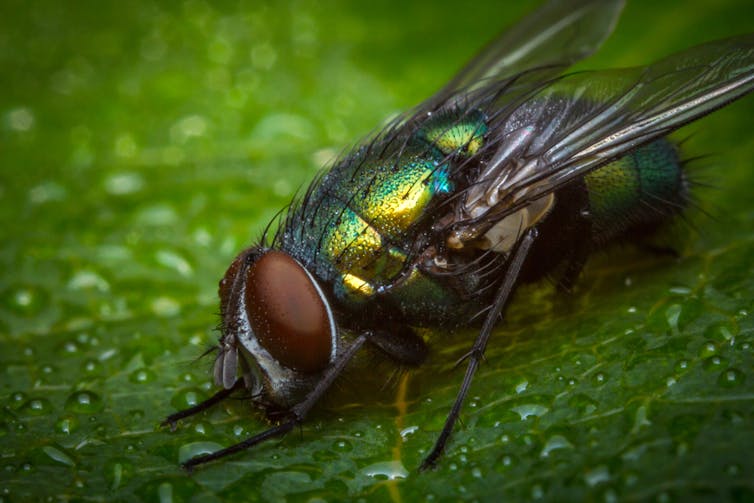
Insect exoskeletons are made of chitin, a substance that stores traces of drugs for a long time.
Shutterstock
Insects collected from a carcass can be used as alternative toxicological specimens in situations where traditional sources are not available. Knowing the effect of the toxins on the life cycles of the flies can be used to adjust what we know about their growth rates.
In the early 1970s, the Finnish biologist Pekka Nuorteva showed mercury from a fish carcass could transfer to carrion flies. A few years later a similar analysis was used to determine whether a murder victim had lived in a polluted area. By 1977 the hybrid discipline of entomotoxicology (entomology + toxicology) became a reality.
When tissues and fluids are unavailable, insects are more reliable than hair to detect drug use just before death. They are also easier to analyse than decomposed matter.
What’s more, they are available for a very long time. Empty fly puparial cases (cocoons left in the environment by the adult fly after its metamorphosis) as well as skin of carrion beetles have even been used for toxicological studies of mummified bodies found weeks, months, or even years after death.
And since cocaine has been detected in the hair of 3,000-year-old Peruvian mummies, it might also be possible to detect drugs in the insects associated with ancient skeletal remains.
Ice and antifreeze
Since the beginning of the COVID-19 pandemic, there has been an increase in drug overdose deaths and also pet poisonings.
My research group is developing ways to detect a range of drugs and other substances commonly found in the suspicious death of humans and animals.
One of these is methamphetamine, a large problem for Australian law enforcement and health authorities. Another is ketamine, a sedative and hallucinogen sometimes used to facilitate sexual assault.
We have also studied the effect of cheap, dangerous, and readily available poisons on blowflies, including
- nicotine, which can be lethal if ingested from e-cigarette refills or if passed through the skin via nicotine patches
- car antifreeze (ethylene glycol), as it is sometimes used to make home-made alcoholic drinks or consumed by homeless people in winter in the hope to keep themselves warm at night
- endosulfan, a pesticide often used to make poison baits to kill animals.
More to be done
Many compounds (such as drugs, metals and pesticides) as well as accelerants and gunshot residues have been detected in insect tissues in a forensic context. However, fewer than 100 such studies have been carried out.
Furthermore, older research often lacks consistency, robust study protocols and method validations. Standard protocols and more sophisticated analytical methods can provide more accurate results that will hold more weight in court.
Paola Magni, Senior Lecturer in Forensic Science, Murdoch University
This article is republished from The Conversation under a Creative Commons license. Read the original article.