President Donald Trump left a reporter baffled recently when he told him about unspecified medical "manuals" that advise against excessive testing for the novel coronavirus.
In a set of brief preview clips of an upcoming interview set to air on HBO Monday, Trump can be seen telling Axios reporter Jonathan Swan about the perils of mass testing for the disease.
"You know, there are those that say you can test too much, you do know that," the president told Swan, who had a look of bewilderment on his face.
"Who says that?" Swan asks.
"Well, just read the manuals," the president replies.
"Manuals?" Swan asks. "What manuals?"
"Read the books," Trump insists. "Read the books!"
"What books?" an increasingly incredulous Swan asks.
Millions of people, including the president of the United States, have seen or shared a video in which a doctor falsely claims there is a cure for the coronavirus, and it’s a medley starring hydroxychloroquine.
The video shows several doctors in white coats giving a press conference outside the Supreme Court in Washington, D.C. It persists on social media despite bans from Facebook, Twitter and YouTube, and it was published by Breitbart, a conservative news site.
The July 27 event was organized by Tea Party Patriots, a conservative group backed by Republican donors, and attended by U.S. Rep. Ralph Norman, R-S.C.
In the video, members of a new group called America’s Frontline Doctors touch on several unproven conspiracy theories about the coronavirus pandemic. One of the most inaccurate claims comes from Dr. Stella Immanuel, a Houston primary care physician and minister with a track record of making bizarre medical claims, such as that DNA from space aliens is being used in medical treatments.
“This virus has a cure. It is called hydroxychloroquine, zinc, and Zithromax,” Immanuel said. “I know you people want to talk about a mask. Hello? You don’t need [a] mask. There is a cure.”
As of July 27, nearly 150,000 Americans had died because of the coronavirus. Could those deaths have been prevented by a drug that’s used to treat lupus and arthritis?
No. Immanuel’s statement is wrong on several points.
‘This Virus Has a Cure’
There is no known cure for COVID-19.
According to the Centers for Disease Control and Prevention, there is no specific antiviral treatment for the virus. Supportive care, such as rest, fluids and fever relievers, can assuage symptoms.
The Cure Is ‘Hydroxychloroquine, Zinc and Zithromax’
In spite of Immanuel’s anecdotal evidence, hydroxychloroquine alone or in combination with other drugs is not a proven treatment (or cure) for COVID-19.
The Food and Drug Administration has not approved hydroxychloroquine for the prevention or treatment of COVID-19. In mid-June, the FDA revoked its emergency authorization for the use of hydroxychloroquine and the related drug chloroquine in treating hospitalized COVID-19 patients.
“It is no longer reasonable to believe that oral formulations of HCQ and CQ may be effective in treating COVID-19, nor is it reasonable to believe that the known and potential benefits of these products outweigh their known and potential risks,” FDA Chief Scientist Denise M. Hinton wrote.
The WHO and the National Institutes of Health have also stopped their hydroxychloroquine studies. Among the safety issues associated with treating COVID-19 patients with hydroxychloroquine include heart rhythm problems, kidney injuries and liver problems.
While some studies have found that the drug could help alleviate symptoms associated with COVID-19, the research is not conclusive. Few studies have been accepted into peer-reviewed journals. And large, randomized trials — the gold standard for clinical trials — are still needed to confirm the findings of studies conducted since the pandemic began.
In the video, Immanuel cited a 2005 study that found chloroquine — not hydroxychloroquine — was “effective in inhibiting the infection and spread of SARS CoV,” the official name for severe acute respiratory syndrome. But the drug was not tested on humans, the authors wrote that more research was needed to make any conclusions, and SARS is different from COVID-19.
‘You Don’t Need a Mask’
Health officials advise everyone to wear a mask in public.
The reason has to do with how the coronavirus spreads. When an infected person coughs or sneezes, they expel respiratory droplets containing the virus. Those droplets can then land in the mouths or noses of people nearby.
Since some people infected with the coronavirus may exhibit no symptoms, public health officials say everyone should cover their face in public — even if they don’t feel sick.
“The spread of COVID-19 can be reduced when cloth face coverings are used along with other preventive measures, including social distancing, frequent handwashing, and cleaning and disinfecting frequently touched surfaces,” according to the CDC.
Our Ruling
In a viral video, Immanuel said there is a cure for COVID-19, hydroxychloroquine can treat it, and people don’t need to wear masks to prevent the spread of the virus.
All of those claims are inaccurate. There is no known cure for COVID-19, hydroxychloroquine is not a proven treatment, and public health officials advise everyone to wear a face mask in public.
As millions of people are recovering from COVID-19, an unanswered question is the extent to which the virus can “hide out” in seemingly recovered individuals. If it does, could this explain some of the lingering symptoms of COVID-19 or pose a risk for transmission of infection to others even after recovery?
A chronic or persistent infection continues for months or even years, during which time virus is being continually produced, albeit in many cases at low levels. Frequently these infections occur in a so-called immune privileged site.
What is an immune privileged site?
There are a few places in the body that are less accessible to the immune system and where it is difficult to eradicate all viral infections. These include the central nervous system, the testes and the eye. It is thought that the evolutionary advantage to having an immune privileged region is that it protects a site like the brain, for example, from being damaged by the inflammation that results when the immune system battles an infection.
An immune privileged site not only is difficult for the immune system to enter, it also limits proteins that increase inflammation. The reason is that while inflammation helps kill a pathogen, it can also damage an organ such as the eye, brain or testes. The result is an uneasy truce where inflammation is limited but infection continues to fester.
A latent infection versus a persistent viral infection
But there is another way that a virus can hide in the body and reemerge later.
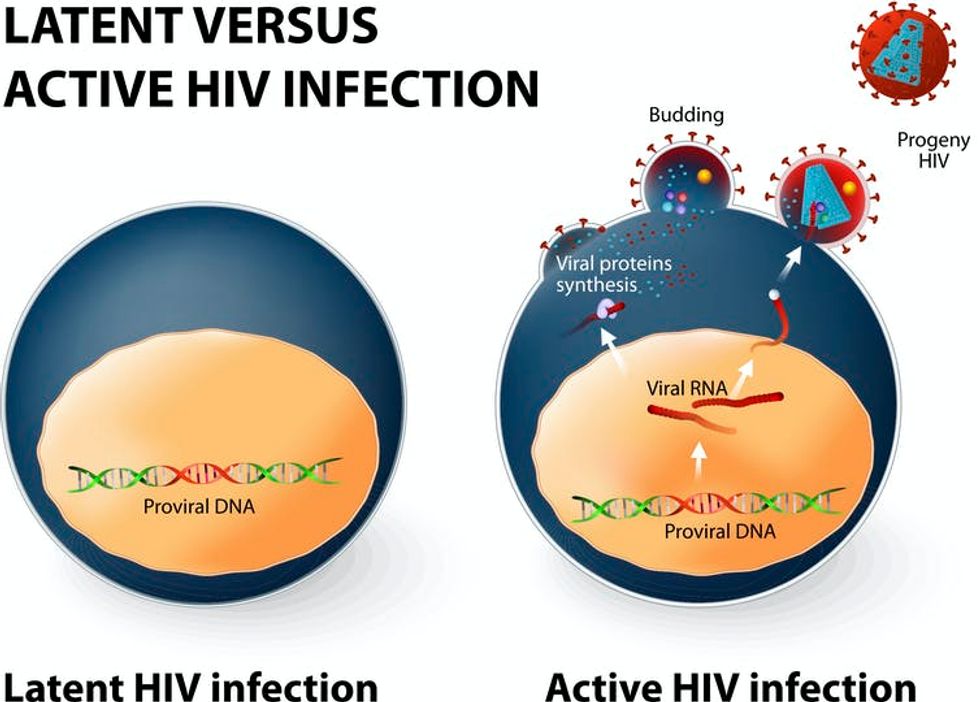
A latent viral infection occurs when the virus is present within an infected cell but dormant and not multiplying. In a latent virus, the entire viral genome is present, and infectious virus can be produced if latency ends and the infections becomes active. The latent virus may integrate into the human genome – as does HIV, for example – or exist in the nucleus as a self-replicating piece of DNA called an episome.
A latent virus can reactivate and produce infectious viruses, and this can occur months to decades after the initial infection. Perhaps the best example of this is chickenpox, which although seemingly eradicated by the immune system can reactivate and cause herpes zoster decades later. Fortunately, chickenpox and zoster are now prevented by vaccination. To be infected with a virus capable of producing a latent infection is to be infected for the rest of your life.
Latent infection (left) is when a cell is infected and the virus has inserted its genetic code into our human DNA. The immune system cannot detect this cell as being infected. An HIV infection can shift from latent to active if the infected cell is producing new viruses.
Herpes viruses are by far the most common viral infections that establish latency.
This is a large family of viruses whose genetic material, or genome, is encoded by DNA (and not RNA such as the new coronavirus). Herpes viruses include not only herpes simplex viruses 1 and 2 – which cause oral and genital herpes – but also chickenpox. Other herpes viruses, such as Epstein Barr virus, the cause of mononucleosis, and cytomegalovirus, which is a particular problem in immunodeficient individuals, can also emerge after latency.
Retroviruses are another common family of viruses that establish latency but by a different mechanism than the herpes viruses. Retroviruses such as HIV, which causes AIDS, can insert a copy of their genome into the human DNA that is part of the human genome. There the virus can exist in a latent state indefinitely in the infected human since the virus genome is copied every time DNA is replicated and a cell divides.
Viruses that establish latency in humans are difficult or impossible for the immune system to eradicate. That is because during latency there can be little or no viral protein production in the infected cell, making the infection invisible to the immune system. Fortunately coronaviruses do not establish a latent infection.
Is it safe for a man to have sex after recovering from COVID-19?
Could you catch SARS-CoV-2 from a male sexual partner who has recovered from COVID-19?
In one small study, the new coronavirus has been detected in semen in a quarter of patients during active infection and in a bit less than 10% of patients who apparently recovered. In this study, viral RNA was what was detected, and it is not yet known if this RNA was from still infectious or dead virus in the semen; and if alive whether the virus can be sexually transmitted. So many important questions remain unanswered.
Ebola is a very different virus from SARS-C0V-2 yet serves as an example of viral persistence in immune privileged sites. In some individuals, Ebola virus survives in immune privileged sites for months after resolution of the acute illness. Survivors of Ebola have been documented with persistent infections in the testes, eyes, placenta and central nervous system.
Could persistent symptoms after COVID-19 be due to viral persistence?
Recovery from COVID-19 is delayed or incomplete in many individuals, with symptoms including cough, shortness of breath and fatigue. It seems unlikely that these constitutional symptoms are due to viral persistence as the symptoms are not coming from immune privileged sites.
Where else could the new coronavirus persist after recovery from COVID-19?
Other sites where coronavirus has been detected include the placenta, intestines, blood and of course the respiratory tract. In women who catch COVID-19 while pregnant, the placenta develops defects in the mother’s blood vessels supplying the placenta. However, the significance of this on fetal health is yet to be determined.
The mounting evidence suggests that SARS-CoV-2 can infect immune privileged sites and, from there, result in chronic persistent – but not latent – infections. It is too early to know the extent to which these persistent infections affect the health of an individual like the pregnant mother, for example, nor the extent to which they contribute to the spread of COVID-19.
Like many things in the pandemic, what is unknown today is known tomorrow, so stay tuned and be cautious so as not to catch the infection or, worse yet, spread it to someone else.
A blood test to diagnose Alzheimer’s disease moved closer to reality this week after new findings were announced at the Alzheimer’s Association International Conference on July 29, 2020. The test showed extremely high accuracy – around 90% – for detecting chemicals in the blood that are specific for Alzheimer’s.
Those who treat patients with Alzheimer’s say that the tests need only a bit higher level of accuracy before they can be used clinically, which could be in two to three years. This breakthrough could perhaps allow doctors to not only identify symptomatic patients with the disease, but also to identify people with no symptoms who are at risk of developing the disease, and thus begin interventions.
While blood tests have been slowly increasing their diagnostic accuracy, the new blood test – analyzing the amount of a brain protein, p-217, in the blood – appears to be accurate in over 90% of cases in a study looking at blood samples from people with definite Alzheimer’s disease. Accuracy rates of other tests will likely increase over time. But this result shows that a breakthrough test is indeed possible. Before the tests are available to the public through FDA approval, we’ll need another two to three years to complete the studies.
As researcherswho have spent our professional lives studying this disease and treating patients with it, we think this news is especially important. It represents a significant leap forward in our ability to use peripheral blood tests for detection of Alzheimer’s and possibly as a marker of effectiveness in developing medical treatments. Here is why.
Testing a suspected Alzheimer’s patient for biomarkers isn’t easy or cheap.
Just one year ago, we wrote a piece for The Conversation on blood tests for Alzheimer’s disease, ending it with the hope that several promising blood tests would soon emerge as accurate and specific. Now, it appears they have. The tests have been centered on the ability to test for either beta amyloid or tau, the characteristic proteins that are deposited in the brain in Alzheimer’s disease, and the tau tests lagged behind the beta amyloid tests. Now tau testing has jumped into the lead.
Until the early 1990s, with the routine use of brain MRI scans, it was difficult to be certain whether a person with cognitive loss had Alzheimer’s. Even the best neurologists would get the diagnosis wrong about one in four times. MRIs increased accuracy; it could show vascular disease and atrophy characteristic of Alzheimer’s or other dementias, but could not confirm the diagnosis with certainty. Diagnosis was even harder in people over 80, where the changes in thinking and memory with aging were not always easy to separate from early Alzheimer’s symptoms, and normal age-related atrophy made differentiation from disease-based brain shrinkage more difficult.
And it was not unusual to find, following autopsy, that someone diagnosed clinically with Alzheimer’s disease had another neurodegenerative disease, disease related to blood vessels in the brain, or some combination of these.
Although the accuracy of an Alzheimer’s diagnosis has improved over the decades, it is still difficult.
Over the last two decades, however, the medical field has made progress in detecting the disease by identifying specific diagnostic biomarkers, or biological signs of disease. MRI scans helped by showing shrinkage of the areas of the brain that underlie memory. But they are not specific for Alzheimer’s.
Two key biomarkers, amyloid protein, found in plaques, and tau protein, found in tangles, became the targets outside of the brain tissue itself, since their presence in the brain defines the disease.
With the identification of these biomarkers, doctors could test patients to see if either amyloid or tau, or both, were abnormal in patients in whom they suspected Alzheimer’s. But the testing has not been easy or cheap.
One way was a spinal tap, whereby doctors could obtain cerebro-spinal fluid, the fluid around your brain and spine, and measure levels of tau and amyloid, which change if the disease is present. While doctors consider this procedure safe and routine, it is not a favorite among patients.
Another method involves imaging the brain using a positron emission tomography (PET) scan following administration of compounds (amyloid or tau “tracers”) that bind one of the proteins that accumulates in the Alzheimer brain. The amyloid scans came first, about 15 years ago, and revolutionized research in Alzheimer’s; tau scans have been developed over the past several years, and reveal neurofibrillary tangles on the PET scans. Although extremely safe, individual PET scans are expensive – typically from US$3,000 up – and Medicare does not pay for them.
The impact of these advances is huge, especially in research and clinical trials, where maximum likelihood of the right diagnosis is required. But the medical community badly needs a more convenient, less expensive, less “invasive” way to diagnose Alzheimer’s. Enter … a blood test.
A new target, and an exciting test emerges
For years, efforts to find such an easily obtainable Alzheimer’s diagnostic biomarker in the blood came up empty – they were not accurate enough.
A major reason for inconsistency of the prior reports was the extremely small amounts of these protein fragments in the blood. The tests have to be sensitive enough to detect either amyloid or tau, and be accurate enough that the blood level changes occurring in people with Alzheimer’s can be clearly different from those of non-affected people.
New blood test could aid in early diagnosis of Alzheimer’s.
Now, several publications and presentations at the recent Alzheimer’s Association International Conference have demonstrated that blood tests measuring amyloid and tau proteins have become much more sensitive and accurate enough to allow their possible future use as routine aids in Alzheimer’s disease diagnosis.
These various tests are at different stages of validation – assuring they’re accurate across many different patient populations. And, for each protein, there are several different methods for making the blood measurements. However, the research community is excited about the possibilities.
And one new tau blood test appears to meet a number of criteria necessary.
To be useful, the tests have to be nearly perfect predictors. Many aren’t there yet; so far, they seem to get it right up to over 85% of the time. And the accuracy will be very important if they’re to be used to screen people for positive tests and enter those people into clinical trials.
The newest blood assay for the tau protein, developed to look for a different site on the tau molecule than other tau tests, has now emerged with the highest accuracy yet – with data from three different large populations of patients.
In these studies, the sensitivity – or the ability to detect the disease when it is really there – and the specificity – negative test in people who do not have Alzheimer’s – were above 90% to 95%. It even detected elevated tau in the blood of people who had the disease in their brains but had not yet had any symptoms, identifying people at risk for the disease to enroll in trials to prevent the disease. It is the result of advances in the technology of the assays, or analysis techniques, and the collaboration of researchers to provide blood samples from proven Alzheimer’s cases.
These tests mark real progress. Cost-effective screening and diagnostic tests will help us reach our goal of finding novel treatments that can better treat the clinical symptoms of Alzheimer’s or delay its development, or both.
This article is updated from an original version, which was published Aug. 7, 2019.
Steven DeKosky, Deputy Director, McKnight Brain Institute, Aerts-Cosper Professor of Alzheimer’s Research, and Professor of Neurology and Neuroscience, University of Florida and Todd Golde, Director, Evelyn F. and William L. McKnight Brain Institute Director, 1Florida Alzheimer’s Disease Research Center, Professor, Department of Neuroscience, College of Medicine University of Florida, University of Florida
A report released Wednesday by a new nonprofit—in the midst of the coronavirus pandemic, the resulting economic disaster, and calls for a green recovery from those intertwined crises that prioritizes aggressive climate policies—lays out how rapidly decarbonizing and electrifying the U.S. economy could create up to 25 million good-paying jobs throughout the country over the next 15 years.
Mobilizing for a Zero Carbon America(pdf) envisions a dramatic transformation of the nation's power, transportation, building, and industrial sectors by 2035 to meet the global heating goals of the 2015 Paris climate agreement. The first project of the newly launched Rewiring America is "based on an extensive industrial and engineering analysis of what such a decarbonization would entail."
The report details a two-stage "maximum feasible transition" (MFT) that would involve a World War II-style production ramp-up for three to five years, followed by "an intensive deployment of decarbonized infrastructure and technology up to 2035," which would include both supply-side generation technologies and demand-side technologies like electric vehicles.
In addition to creating millions of green jobs in the wake of a public health crisis that has left tens of millions of Americans unemployed and helping the country contribute to the goals of the Paris accord—which President Donald Trump started withdrawing from last November—the report says that the MFT approach would save households nationwide up to thousands of dollars in annual energy costs.
"While government investment will be critical to the transition, private capital also has a large role to play," a summary document (pdf) from the group says. "The study estimates the government's share of overall costs to be about $300 billion per year for 10 years for an approximate total of $3 trillion, mostly in the form of loans and/or loan guarantees to spur lending, akin to similar loan systems that the government has created in the past."
"We can power our homes by the sun, charge our cars from clean energy while we sleep, and rethink city streets as we know them. In the process, we can create 25 million jobs in America. The only thing standing in the way is a leadership vacuum," lead author Saul Griffith, an engineer and inventor who was awarded the MacArthur "Genius Grant" in 2007, said in a statement.
Griffith, founder and chief scientist of the independent research and development lab Otherlab, joined with Alex Laskey, president and founder of the software company Opower, to lauch Rewiring America, which focuses on decarbonization in the U.S. The report, co-authored by Massachusetts Institute of Technology physicist Sam Calisch, is part of a forthcoming book by Griffith.
"I think the best way to describe what needs to happen politically is we need a president and some level of bipartisanship that will enable FDR levels of urgency in action," Griffith told Fast Company. "And you could use either FDR's response to the Great Depression or to World War II as your measure of that, but I think it's actually more analogous to the World War II effort in terms of the speed of industrialization to win that war."
As Fast Company reported:
The report attempts to make the idea of a Green New Deal more concrete. "I think all of the various Green New Deals and aspirational climate plans are narratively in the right direction, but we need to give them some ground truths and build some reality to them about what needs to happen from the ground up," he says. "Those aspirations are great, but this is actually what you now need to do to get there. I think this is one of the first analyses that really builds out that model from the ground up of what has to happen in order to keep this on target for two degrees."
The changes would also mean lower energy costs for consumers, and the report calculates that the average American household would save between $1,000 and $2,000 a year. Everyday life wouldn't necessarily change significantly. "We now have technologies that are transformative, meaning you can now roughly have the same size and shape car, but electric," Griffith says. "You can have the same size and shape house, but it will be run with electric heat pumps instead of the natural gas furnace. And if we have the sort of that spirit of can-do that America had mid-20th century, there's every reason to believe that our lives improve when we do this, and we can have and live something like the American dream. It'll just be electrified, not fossil-fueled."
Leaders of the Sunrise Movement—a youth climate organization that advocates for the Green New Deal—endorsed the findings of Rewiring America's report, as did Sen. Brian Shatz (D-Hawaii), former Environmental Protection Agency Administrator Carol Browner, Niskanen Center director of climate policy Joseph Majku, and Mike Fishman, past secretary-treasurer of Service Employees International Union and current president of Clean Jobs New York.
"The Rewiring America team asked the question: 'What would happen if we actually tried to transition all of the infrastructure in American society over the next 15 years to stay within the 1.5ºC safe upper limit of global warming?'" said Evan Weber, co-founder and political director of the Sunrise Movement. "The answer they found is that would save consumers and society money, and it would create lots and lots and lots of jobs—around 25 million of them."
The report comes a couple weeks after presumptive Democratic presidential nominee Joe Biden unveiled a $2 trillion green energy plan that progressive climate advocates, including Sunrise, welcomed as a "a major step forward." Biden's job-creating plan calls for a power sector free of carbon pollution by 2035.
Sunrise executive director Varshini Prakash served on a unity task force launched by Biden and his former primary rival Sen. Bernie Sanders (I-Vt.), who won Sunrise's endorsement. She welcomed Biden's recent proposal while also promising that her group will work to ensure he actually delivers on it if he wins.
Prakash also welcomed the analysis Wednesday, noting that "for so long we've been sold the lie that we have to choose between good jobs and a safe environment, that our generation has to choose between a livable planet and a thriving, equitable economy."
"The Rewiring America Plan puts that lie to rest once and for all," she said. "This report is a critical contribution that shows that urgently achieving an all-society clean energy future by 2035 is not only necessary and achievable, but will make the world that young people inherit more prosperous."
"We can achieve a just transition to a better world out of the wreckage of this economic crisis, with good union jobs for all, including low-income communities and communities of color," she added. "The only thing standing in the way is political will."
Anyone coming from the top COVID-19 states in the country must quarantine in Washington, D.C., for 14 days before going out and about. According to the Washington Post, Alabama U.S. Senate candidate Tommy Tuberville coughed in the face of that law. However, he's just another in a long line of Republicans breaking the laws all over Washington.
"Tuberville spent at least some of his time in D.C. at the Trump International Hotel, according to a photo posted to Facebook by Arkansas GOP Rep. Bruce Westerman showing the two men in the hotel lobby on Tuesday night," the Post reported. "In the photo, neither man is wearing a mask."
"A photo posted to Tuberville's Facebook page on Tuesday before he arrived in D.C. shows him in a cramped room with close to 25 people seated shoulder-to-shoulder around a conference table without masks," the report also said.
Tuberville has also opposed the mask order his GOP governor issued in the state when their numbers began to spike.
"Just like when he opposed the statewide mask order from Alabama's Republican governor, Tommy Tuberville is ignoring medical experts because he's more focused on raising campaign cash in Washington than doing what's right," said Democratic Senate Committee spokesperson Helen Kalla.
This summer, NASA is taking the next giant leap in the search for signs of life beyond Earth.
On July 30, if the weather in Florida holds, NASA will launch its most sophisticated and ambitious spacecraft to Mars: the aptly named Perseverance rover. This will be the third launch to Mars this month, following the UAE’s Hope and China’s Tianwen-1 spacecraft. Perseverance will look for signatures of ancient life preserved in Mars rocks. And, for the first time, this rover will collect rock samples that will be brought back to Earth, where they can be scrutinized in laboratories for decades to come.
Mars is one the few destinations in the Solar System that has had conditions suitable for life as we know it. There is a chance that Perseverance will collect the sample from Mars that answers the question: “Are we alone in the universe?” This question is especially relevant right now. During the coronavirus pandemic, the mission has remarkably stayed on track for launch in spite of disruptions and delays, and we have been reminded that life on Earth is vulnerable and precious.
As twoexperts in planetary science and members of the Perseverance science team, we expect that this mission will be the best chance – within our own lifetimes at least – to create a scientific revolution in astrobiology.
NASA’s Mars 2020 will land in Jezero Crater, pictured here. On ancient Mars, water carved channels and transported sediments to form fans and deltas within lake basins. Green colors indicate detections of carbonate minerals that may have formed in the ancient lake.
On Feb. 18, 2021, if all goes according to plan, Perseverance will enter the Martian atmosphere at 13,000 mph, and seven nerve-racking minutes later, will be lowered gently onto the surface by a jetpack. The rover will land in Jezero crater, a site that NASA hopes will provide a window to a time when rain fell and rivers flowed on ancient Mars.
Over the past 30 years, a fleet of rovers and orbiters have built a picture of an Earth-like ancient Mars. Between 3 and 4 billion years ago, Mars hosted vast river networks as long as the Mississippi, deep lakes that contained the building blocks of life, and hot springs that bubbled with potential for life. These watery environments were able to exist because ancient Mars had a thick atmosphere. However, that atmosphere has been leaking away, leaving the surface today cold, dry and inhospitable.
After five years of debate, Jezero crater was selected as the site on Mars that is most likely to preserve signs of life that might have inhabited Mars billions of years ago, when microbial life was first starting on Earth. Satellite images of Jezero show a river leading into the crater and ending in a large delta, which must have formed in a long-lived ancient lake. A bathtub ring of carbonate minerals around the edge of the crater might have formed along ancient beaches, and may preserve rocks with microbial textures known as stromatolites. Stromatolites record some of the earliest signs of life on Earth, and Perseverance will search for similar signs of life on Mars.
Advanced exploration technology
Perseverance will have many new capabilities that will transform how we explore Mars. The rover carries Ingenuity, a small helicopter that will be the first aircraft to fly on another planet. Because Mars’ atmosphere today is so thin – only 1% of the Earth’s – Ingenuity has to be extremely lightweight (4 lbs) with very large blades (4 feet tip-to-tip) to get off the ground. Ingenuity will take images of the distant landscape and help us scout the rover’s traverse; future Mars missions could adopt this model of rovers and aircraft working in tandem.
Looking even further ahead, Perseverance will help prepare for future human missions to Mars. One of many challenges for astronauts will be the packing list for a two-year roundtrip journey, which includes air, water and rocket fuel to get home. If these resources could be harvested on Mars, human missions would be much more feasible. Perseverance will test a process for creating oxygen from Mars’ carbon dioxide atmosphere. In the future, similar instruments could be sent ahead of astronauts, so that breathable air and liquid oxygen rocket propellant are waiting when they arrive.
In this illustration, NASA’s Mars 2020 rover uses its drill to core a rock sample on Mars.
The rover will collect and store rock and soil samples on the planet’s surface that future missions will retrieve and return to Earth.
The most immediate goal of the mission is to search for evidence of past life, and Perseverance’s science payload will allow the rover to search for organic materials and microbial textures at the scale of a grain of salt. However, finding definitive evidence of microbial life is extremely difficult. Ultimately, we will need to look at samples from Jezero with advanced instruments on Earth. This is why Perseverance will also collect pencil-sized rock cores that will be returned to Earth by a series of missions in the late 2020s.
By laying the groundwork for sample return with Perseverance, NASA is taking the next giant leap in its exploration of Mars. The rocks collected by Perseverance may be our only shot in the foreseeable future to search for signs of life with samples from another planet. This mission, therefore, is not just “go big or go home” – it is “go big and go home.”
The Virgin Galactic spaceship that will someday carry very moneyed tourists boasts windows and cameras galore for easy selfies with planet Earth.
The company, founded by British billionaire Richard Branson, provided a virtual tour Tuesday of the inside of the ship that will transport people willing to pay hundreds of thousands of dollars for a brief taste of being at the edge of space.
Besides all the windows and cameras, the craft will have a mirror in the back of the cabin so people can admire themselves.
There is no firm date for the first commercial flight and the company has repeatedly pushed it back, but executives said recently it is a question of months and not years away.
Several test flights must still be made before Branson himself steps aboard.
The inside of the cabin, which will have seats for six passengers and a two-member crew, will feature 12 windows and 16 cameras. It is designed to give the best possible view of our planet.
An AFP reporter made a remote tour of the spacecraft with a virtual reality headset provided by the company. Each seat is close to a large oval-shaped porthole, and a camera is attached to each window in such a way that passengers can be photographed with Earth behind them, with no need to take a selfie of their own.
The travelers can unbuckle their seatbelts and float. Portholes in the ceiling will give them a spectacular view of the blue planet standing out against a jet black sky.
So far, 600 people who have paid up to $250,000 -- Virgin Galactic calls them "future astronauts" -- have been waiting for years to take their seat on SpaceShipTwo.
Its development has been delayed by a devastating crash of the first one in 2014 due to a pilot error.
The spacecraft will be taken up by a special plane and released in high altitude. Seconds later, the spaceship -- part plane, part rocket -- will ignite its engine and blast upward with an acceleration of 3.5 g, meaning three and a half times that of Earth's gravitational force.
It will then cut off the engine, which will create a feeling of weightlessness for a few minutes as the spacecraft reaches its highest point, about 80 kilometers (50 miles) above the planet, and then begin its descent like a cannonball.
It will glide to landing at a place called Spaceport America, built in the New Mexico desert.
As for fares to be paid by new customers, "we may see an increase for a bit," chief space officer George Whitesides told a virtual news conference Tuesday.
A Republican Texas state congressman on Friday was instantly buried in mockery after he began musing about the possibilities of converting space aliens to Christianity.
Texas State Rep. Jonathan Stickland reacted to reports about declassifying information on UFO sightings by stating that any aliens aboard the ships would have to accept Jesus Christ into their hearts if they wanted a chance at eternal paradise.
"IF aliens are real, salvation through Jesus Christ is the only way they enter Heaven," wrote Stickland, who describes himself as a "Christian Conservative Liberty-Loving Republican."
Stickland's Twitter followers quickly piled on to ridicule his notions of bringing extraterrestrials to Jesus -- check out some reactions below.
A new DNA study published Thursday sheds fresh light on the horrors of the transatlantic slave trade, from the legacy of rape that can be seen in today's genetics to how disease likely decimated some groups forced to work in deadly conditions.
For example, DNA from one African region may be under-represented in the US because so many slaves from there died of malaria on American plantations.
The grim results from a paper, which appeared in the American Journal of Human Genetics, compiled genetic data from 50,000 consenting research participants from both sides of the Atlantic.
It cross-referenced these with detailed records from slave ships that transported 12.5 million men, women and children between 1515 and 1865. Some two million died on the journey.
"We wanted to compare our genetic results to those actual shipping manifest to see how they agreed and how they disagreed," Steven Micheletti, a population geneticist at 23andMe, which recruited most of the participants, told AFP.
"And in some cases, we see that they disagree, quite strikingly," he added.
The researchers found that while the genetic contributions from major African populations largely correspond to what they expected based on historic records, there are major exceptions.
For instance, most Americans of African descent have roots in Angola and the Democratic Republic of the Congo, in line with the major slave route.
But Nigerian ancestry was over-represented in African Americans in the US, probably because of the intra-continental slave trade which brought them from the Caribbean.
By contrast, there were fewer genetic connections between African Americans and the Senegambia region than would be expected given the number who disembarked on slave ships in North America.
The probable reasons are grim.
"Because Senegambians were commonly rice cultivators in Africa, they were often transported to rice plantations in the US," said Micheletti.
"These plantations were often rampant with malaria and had high mortality rates, which may have led to the reduced genetic representation of Senegambia in African Americans today."
- Racial 'whitening' -
Government and slave-owner practices had an enormous impact on African genetics too.
Despite the fact that more than 60 percent of enslaved people brought to the Americas were men, comparisons of genetics reveal a strong bias toward African female contributions in the modern gene pool of African heritage people across the region.
Much of this can be attributed to the rape of enslaved African women by white men, and other forms of sexual exploitation, like the promise of freedom if they birthed enough children.
But the imbalance is even more pronounced in Latin America, where 70 percent of the slaves who survived the ship voyages disembarked, compared to the United States, the new study showed.
In the US, slave-owners promoted marriages among slaves to ensure their children would form the next generation of the forced labor pool.
In countries like Brazil and Cuba, though, the governments implemented immigration policies in the 1900s, which involved women with African ancestry marrying whites.
These whitening or "branqueamento" policies were meant to cleanse or purify Black people toward a supposed ideal of whiteness.
"We have some regions that are essentially showing 17 African females reproducing for every one African male. We never expected the ratio to be that high," said Micheletti.
In the British-colonized Americas, the ratio is closer to 1.5 or two African women for every African man contributing to the gene pool.
The researchers also found evidence of frequent mixing between enslaved indigenous people with enslaved Africans in Latin America, something which previous work has shown to be the case in the US.
The researchers said they hoped to not only help people of African descent find their roots, but also to understand the historic experiences that had shaped their genes today.
The several species of crocodiles plying rivers and brackish byways in the Americas -- from Florida to Peru -- all came from Africa, according to a study published Thursday.
They may have descended, researchers speculate, from a single pregnant specimen that bobbed along Atlantic Ocean currents to the New World at least five million years ago, probably longer.
Based on the high-tech analysis of a skull fragment unearthed from the Libyan desert in 1939, the findings are bolstered by genetic evidence pointing in the same direction, they reported in the journal Scientific Reports.
"This is a really exciting discovery," lead authors Massimo Delfino from the University of Turin and Dawid Iurino, a palaeontologist at Sapienza University in Rome, told AFP by email.
"It supports the results of molecular biologists that proposed the origin of American crocodiles had to be found in Africa."
The out-of-Africa narrative is based on the re-examination of the skull and upper jaw of a seven-million-year-old fossil that had been tucked away for decades in a university museum drawer.
It belonged to an extinct species called Crocodylus checchiai.
Using CT-scans and 3D-modelling, the scientists identified a tell-tale protrusion in the middle of the animal's snout not found in any other African crocodile, living or extinct, but present in all four species currently found in the Americas.
In the world of paleontology, this is pretty close to a smoking gun.
"Our results are solid," the researchers said when asked if the evidence was conclusive.
"The main problem for paleobiologists is the rarity and fragmentary nature of fossil remains."
Four other fossils dug up in Libya at the same time -- including a complete skull and jaw -- were either destroyed during World War II or lost.
C. checchiai rewrites the story of how crocodiles spread across the planet in at least two ways.
- Missing link -
It lays to rest the already fading hypothesis that the giant, flesh-ripping reptiles -- which first emerged from Asia -- arrived in the Americas before moving on to Africa, and not the other way around.
The long-neglected fossil also supplants another contender from Africa -- Crocodylus niloticus, aka the Nile crocodile -- as the closest forebear of the American species.
"According to our results, C. checchiai nests between the Nile crocodile and the American species," the authors told AFP.
"It represents the missing link between the African and American lineages."
"We can therefore assume one or more specimens -- perhaps a pregnant female -- dispersed from Africa to America about seven million years ago, at the very least five million."
That such a voyage is possible has been demonstrated by a present-day cousin, Australia's saltwater crocodile, which satellite tracking has shown can travel 500 kilometres (310 miles) in about a month while passively transported by ocean currents.
More closely related to birds than dinosaurs, egg-laying crocodiles have been around for about 55 million years.
There are 16 species spread across the tropics of Africa, Asia, Australia and, of course, the Americas.
They vary in size from less than two metres (six feet) for the dwarf crocodile, to more than seven metres and 1,000 kilos (2,200 pounds) for the saltwater species.
The carnivores are able to replace each of their 80 teeth up to 50 times during their lifespan, which can top 60 years.
Scientists have for the first time identified an active leak of methane gas from the sea floor in Antarctica, increasing the possibility that the planet is close to one of the "tipping points" that would put the impacts of global heating out of humans' control.
According toThe Guardian, researchers led by Andrew Thurber at Oregon State University found the methane leak in a region known as Cinder Cones in McMurdo Sound, within the Ross Sea. The site is 30 feet below the surface of the ocean.
In addition to finding methane dissolved in the water there, the scientists found that microbes which usually consume the gas before it reaches the atmosphere had only formed in small numbers five years after they first began to study the site.
Thurber called the findings "incredibly concerning."
"It is not good news. It took more than five years for the microbes to begin to show up and even then there was still methane rapidly escaping from the sea floor," he told The Guardian. "The methane cycle is absolutely something that we as a society need to be concerned about."
Scientists have warned for years that the climate crisis could lead to the "tipping point" of methane leaks in the sea floor and the thawing of permafrost regions.
"At some point in a warming world, greenhouse gas emissions from nature will go way beyond anything we can control," tweeted Australian immunologist Peter Doherty.
The Ross Sea has not yet warmed significantly from the climate crisis, so the research did not directly link the methane leak to global heating.
But climate models have not yet accounted for significant delays in the development of microbes, which help to keep methane from leaking into the atmosphere.
"The big question is: how large is the lag [in microbe development] compared with the speed at which new leaks of methane might potentially form in the wake of retreating ice?" Prof. Jemma Wadham of the University of Bristol in the UK, who reviewed the study, told The Guardian.
Thurber called the discovery of the methane leak and the delayed microbe growth "a significant discovery that can help fill a large hole in our understanding of the methane cycle."
"Methane is the second-most effective gas at warming our atmosphere and the Antarctic has vast reservoirs that are likely to open up as ice sheets retreat due to climate change," he said in a statement.
Other tipping points identified by climate scientists include the disintegration of the ice sheet in West Antarctica, "dieback" in the Amazon which would transform the rainforest into a dry ecosystem, and the dying off of the coral reefs.
Scientists raised alarm earlier this year about unusually warm water beneath a massive glacier in West Antarctica, and researchers warned in February that the third major bleaching event in five years at the Great Barrier Reef would put the reef "on a knife edge."
Tools excavated from a cave in central Mexico are strong evidence that humans were living in North America at least 30,000 years ago, some 15,000 years earlier than previously thought, scientists said Wednesday.
Artefacts, including 1,900 stone tools, showed human occupation of the high-altitude Chiquihuite Cave over a roughly 20,000 year period, they reported in two studies, published in Nature.
"Our results provide new evidence for the antiquity of humans in the Americas," Ciprian Ardelean, an archeologist at the Universidad Autonoma de Zacatecas and lead author of one of the studies, told AFP.
"There are only a few artifacts and a couple of dates from that range," he said, referring radiocarbon dating results putting the oldest samples at 33,000 to 31,000 years ago.
"However, the presence is there."
No traces of human bones or DNA were found at the site.
"It is likely that humans used this site on a relatively constant basis, perhaps in recurrent seasonal episodes part of larger migratory cycles," the study concluded.
The stone tools -- unique in the Americas -- revealed a "mature technology" which the authors speculate was brought in from elsewhere.
The saga of how and when Homo sapiens arrived in the Americas -- the last major land mass to be populated by our species -- is fiercly debated among experts, and the new findings will likely be contested.
- 'Clovis-first' debunked -
"That happens every time that anybody finds sites older than 16,000 years -- the first reaction is denial or hard acceptance," said Ardelean, who first excavated the cave in 2012 but did not discover the oldest items until 2017.
Until recently, the widely accepted storyline was that the first humans to set foot in the Americas crossed a land bridge from present-day Russia to Alaska some 13,5000 years ago and moved south through a corridor between two massive ice sheets.
Archeological evidence -- including uniquely crafted spear points used to slay mammoths and other prehistoric megafauna -- suggested this founding population, known as Clovis Culture, spread across North America, giving rise to distinct native American populations.
But the so-called Clovis-first model has fallen apart over the last two decades with the discovery of several ancient human settlements dating back two or three thousand years before earlier.
Moreover, the tool and weapon remnants at these sites were not the same, showing distinct origins.
"Clearly, people were in the Americas long before the development of Clovis technology in North America," said Gruhn, an anthropology professor emerita at the University of Alberta, in commenting on the new findings.
In a second study, Lorena Becerra-Valdivia and Thomas Higham, researchers at the University of Oxford's Radiocarbon Accelerator Unit, used radiocarbon -- backed up by another technique based on luminescence -- to date samples from 42 sites across North America.
Using a statistical model, they showed widespread human presence "before, during and immediately after the Last Glacial Maximum" (LGM), which lasted from 27,000 to 19,000 years ago.
- Megafauna wiped out -
The timing of this deep chill is crucial because it is widely agreed that humans migrating from Asia could not have penetrated the massive icesheets that covered much of the continent during this period.
"So if humans were here DURING the Last Glacial Maximum, that's because they had already arrived BEFORE it," Ardelean noted in an email.
Human populations scattered across the continent during an earlier period also coincide with the disappearance of once abundant megafauna, including mammoths and extinct species of camels and horses.
"Our analysis suggests that the widespread expansion of humans through North America was a key factor in the extinction of large terrestrial mammals," the second study concluded.
Many key questions remain unanswered, including whether the first of our species to wander across the frozen tundra of Beringia made their way south via an interior route or -- as recent research suggests -- by moving along the coast, either on foot or in boats of some kind.
It is also a mystery as to "why no archaeological site of equivalent age to Chiquihuite Cave has been recognized in the continental United States," said Gruhn.
"With a Bering Straits entry point, the earliest people expanding south must have passed through that area."