An international team of researchers found that 320,000 years ago humans already developed impressive social structures and technological innovations such as using color pigments and manufacturing more sophisticated tools. The first evidence of human life in the Olorgesailie Basin comes from about 1.2 million years ago. For hundreds of the thousands of years, people living there…
Walmart is making moves on the bee's share of agriculture - the company recently filed a patent for autonomous, robotic bees. "I can't beelieve you're after my job too!" Image credits USGS Bee Inventory and Monitoring Lab / Flickr.
A team of Japanese researchers has confirmed the discovery of 15 new exoplanets, orbiting around red dwarfs - including a system of three super-Earths, one of which appears to be located in the star's habitable zone.
The PhD thesis of perhaps the world’s most famous living scientist, Professor Stephen Hawking, was recently made publicly available online. It has proved so popular that the demand to read it reportedly crashed its host website when it was initially uploaded.
But given the complexity of the topic – “Properties of Expanding Universes” – and the fact that Hawking’s book A Brief History of Time is also known as the most unread book of all time, you might benefit from a summary of its main result.
The thesis covers several topics, including recently discovered gravitational radiation, but the final chapter is the part that many physicists consider the most significant. It deals with the birth of the universe itself, and is simply titled “Singularities”.
Creation theories
The major achievement of Hawking’s thesis was to effectively show that the Big Bang theory of how the universe began from a single point was physically possible. It wasn’t just a mathematical nuisance that sprang out of the equations physicists had developed to describe the possible evolution of the cosmos.
The concept that the universe started a finite time ago in a Big Bang is now an accepted scientific fact, and yet it remains an astounding idea. Imagine: all the matter in your body was once – in one form or another – compressed into the same tiny volume as the most distant galaxy and everything in between. About 14 billion years ago, this point rapidly expanded to create space and time. It continues to expand today.
At the time of Hawking’s PhD in the 1960s, scientists were still arguing over the idea. A popular alternative to the Big Bang was the Steady State model. Proponents of the Steady State model were uncomfortable with a universe of finite age that began in this way. In fact, the moniker “Big Bang” was coined as a derisive term by Steady State champion Fred Hoyle. To understand how Hawking showed it really was possible, we need some background physics.
Spacetime and singularities
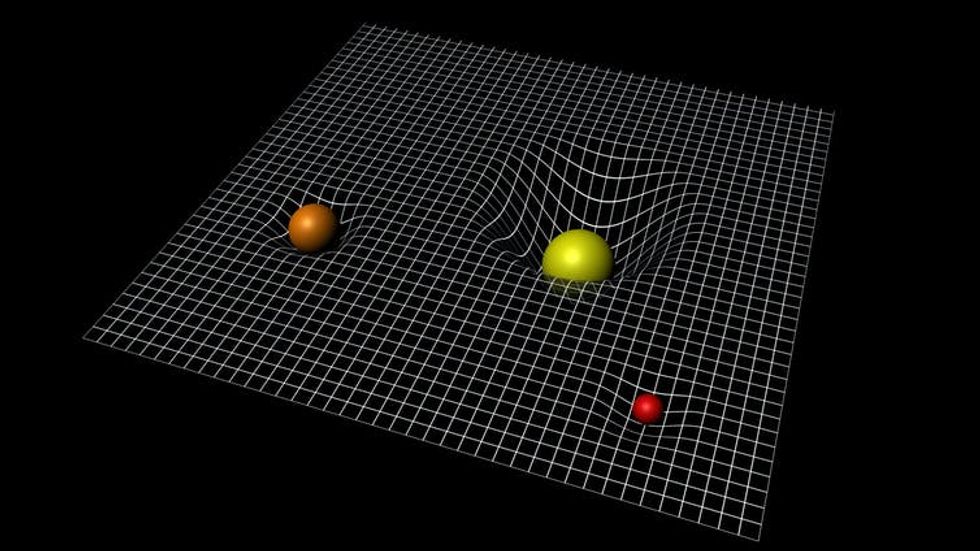
In the early 20th century, Albert Einstein revolutionised our understanding of gravity through his general theory of relativity. Einstein showed that we could think of gravity as the curvature of spacetime, caused by the presence of mass or energy.
Spacetime is a way of thinking about the framework of the universe that combines three-dimensional space and one-dimensional time. All objects exist and all events happen somewhere in spacetime. But it’s hard for most people to imagine because, although we can move freely in three-dimensional space, we cannot travel where we like through time. It’s a bit like being an insect trapped on the surface of a pond. It can only move in two dimensions, despite there being another spatial dimension to explore.
General relativity expresses how space and time are linked. In his theory, Einstein elegantly described how the curvature of spacetime is related to the density of mass and energy in his “field equations”.
The curvature of spacetime due to the presence of objects with mass.
ESA–C.Carreau
After these equations were published, other scientists used them to explore what happens to spacetime in different physical situations. In the case of objects where all the matter is concentrated into a single point, the field equations predict something unusual: the curvature of spacetime becomes so extreme that even light cannot escape. Today we know these objects actually exist as black holes, and we’ve since found evidence for them in space.
These situations where the solutions to the equations become infinite are called “singularities”. Hawking’s final thesis chapter explored this idea of singularities, not for the spacetime around black holes, but for the entire universe.
From black holes to the Big Bang
In cosmology, a central tenet is that space must, on average, be homogeneous and isotropic. In other words, over a large scale, the contents of the universe must be pretty evenly distributed and look the same in every direction.
The simplest solution to Einstein’s field equations that satisfies these conditions is called the “Robertson-Walker metric”, named after the scientists involved in its development. The metric is simply the term we use for describing the interval between two events in spacetime.
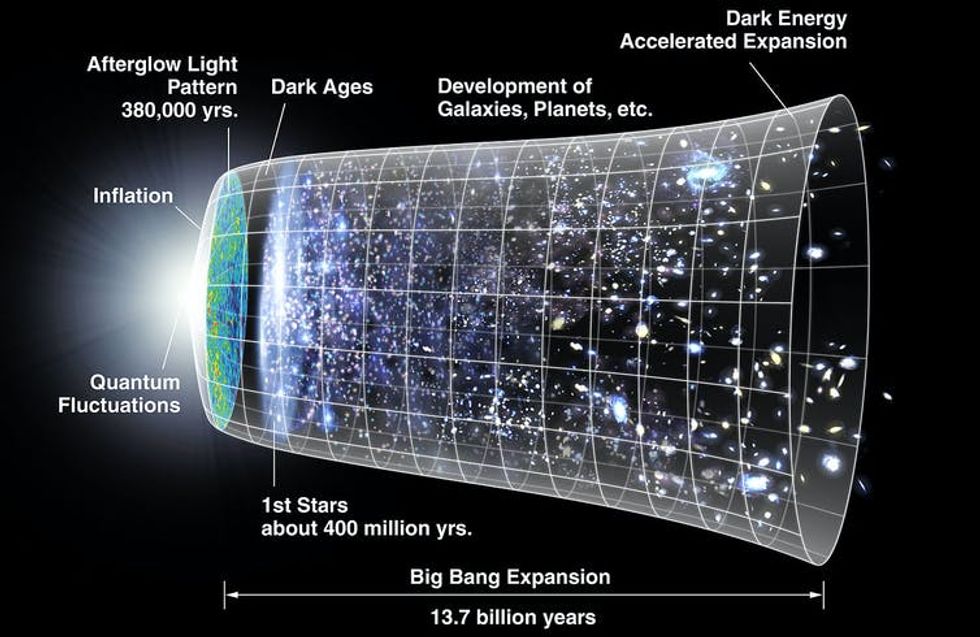
Importantly, the Robertson-Walker solution allows the spatial part of the metric to change with time. That means it can describe a universe in which space itself is expanding. Edwin Hubble found evidence that the universe really is expanding in the 1920s by showing that other galaxies are moving away from us.
Expanding universe.
NASA
The Robertson-Walker metric and field equations allow us to describe this expansion in terms of what cosmologists call the “scale factor”, describing how much space has expanded or contracted between a particular point in time and the present day.
If the universe is expanding, it should have been smaller and denser in the past. Run the clock back far enough and the scale factor should go to zero. All the matter and energy in the universe must have been contained in a single point with infinite density: a cosmological singularity. This is the basis of the Big Bang model, a bit like a black hole in reverse.
Scrapping the Steady State
The Steady State model tried to eliminate the cosmological singularity, which many argued wasn’t plausible. Singularities were seen as shortcomings of the predictions of general relativity and not in line with the known laws of physics.
In the Steady State model, the universe is eternal and doesn’t have a beginning at all. Its apparent expansion can be explained by adding a “creation field” or C-field to Einstein’s equations that would mean matter is continuously created in the space between galaxies as they move apart.
But in the final chapter of his PhD thesis, Hawking argued that the idea of a C-field came with its own set of problems and that the right model involved the Robertson-Walker solution describing an initial singularity.
What he did next was what many consider groundbreaking. Building on the work of fellow British physicist Roger Penrose, Hawking mathematically proved that singularities were not a shortcoming of theory but expected features of nature. He effectively demonstrated that general relativity allowed for a universe that began in a singularity.
Half a century later, the observational evidence for the Big Bang creation scenario is overwhelming and the Steady State model has long been abandoned. Hawking has gone on to make further monumental contributions to cosmology and theoretical physics. Reading Hawking’s thesis is an insight into an exceptionally creative mind – and the first steps of discovery in what has been a remarkable scientific journey.
The whole world is drying up. Cape Town's water reservoirs are drying up. NASA Earth Observatory Day Zero: that’s the ominous label officials in Cape Town have bestowed on the day that water will run out.
Temperatures in the Arctic could help drive extreme weather in the United States. Can we blame it on the Arctic? PJ Hanse via Flickr Last October, experts at the National Oceanic and Atmospheric Administration predicted a fairly mild winter for the United States.
Living with motor neurone disease for more than 50 years, Stephen Hawking transcended his disability to becoming one of science's brightest stars, harnessing technology to once again give voice to his ideas.
"My expectations were reduced to zero when I was 21. Everything since then has been a bonus," he told the New York Times in 2004.
Hawking was given only a few years to live when he was diagnosed in 1964, but defied the medical profession in typically stubborn fashion.
"I have lived five decades longer than doctors predicted. I have tried to make good use of my time," he said in 2013 autobiographical documentary "Hawking".
"Because every day could be my last, I have the desire to make the most of each and every minute," he added.
But the disease gradually deprived him of mobility and confined him to a wheelchair.
He was eventually left almost completely paralysed and unable to speak, except through a voice synthesiser operated by facial movements.
Despite his handicap, the scientist was one of the first to popularise deep science, utilising a range of media to educate the general public on the secrets of the universe.
- Household name -
His struggle was portrayed in the 2014 film "The Theory of Everything", which won an Oscar and Golden Globes.
But it was through scientific articles and his 1988 international bestseller "A Brief History of Time" that Hawking was able to communicate his genius and share his discoveries about black holes.
Hawking was an undisputed heavyweight in his field, holding the Lucasian Chair of Mathematics professorship at the University of Cambridge between 1978 and 2009, a post once held by Isaac Newton, the father of universal gravity.
"My disabilities have not been a significant handicap in my field, which is theoretical physics," he said in Science Digest in 1984.
"Indeed, they have helped me in a way by shielding me from lecturing and administrative work that I would otherwise have been involved in."
In recent years, he enthusiastically adopted social media to spread his scientific research, responding to fans with messages signed off "SH".
He boasted 4.1 million Facebook followers, nearly 30,000 on Twitter and amassed millions of followers within hours when he signed up to Chinese social media platform Weibo.
- 'Keep talking' -
Hawking credited the support of his family and friends with giving him the strength to keep up his remarkable pace.
"I have managed, however, only because of the large amount of help I have received from my wife, children, colleagues and students," he said.
As news broke of his death, Hawking's philosophical musings became particularly poignant.
"For millions of years, mankind lived just like the animals," he once said.
"Then something happened which unleashed the power of our imagination.
"We learned to talk and we learned to listen. Mankind's greatest achievements have come about by talking, and its greatest failures by not talking.
"With the technology at our disposal, the possibilities are unbounded. All we need to do is make sure we keep talking."
The death of theoretical physicist Stephen Hawking is rocking the world as science lovers everywhere mourn the loss of the funny genius. That sense of humor was on full display in an interview with HBO's John Oliver, who met Hawking for a segment on "Last Week Tonight" in 2014.
Launching the segment entitled "Great Minds: People Who Think Good," host John Oliver invited his first guest, theoretical physicist Stephen Hawking to weigh on a variety of subjects including imaginary time, artificial intelligence, killer robots and the possibility of Oliver landing a date with actress Charlize Theron.
Introducing Hawking, Oliver described his “breakthrough work in black holes and string theory” as “hugely important to anyone who pretends to understand it.”
Asking Hawking “If there is one thing you want people to understand about your work — bearing in mind that most people will never understand anything about your work — what would that thing be?,” Hawking replied, “Imaginary time.”
“People think it’s something you have in dreams, or when you’re up against a deadline. But it’s a well-defined concept. Imaginary time is like another direction in space,” said Hawking. Hawking added that it is one thing from his work that science fiction writers haven’t used, “because they don’t understand it.”
Oliver agreed, calling them “idiots.”
Turning to artificial intelligence, Oliver asked Hawking about previous comments he made claiming AI would be “the biggest event in human history. Unfortunately, it might also be the last.”
“Are you saying the robots are going to destroy humanity,” Oliver continued. “And is that a scientific argument or a pitch for an amazing movie?”
“Artificial intelligence could be a real danger in the not-too-distant future,” Hawking replied. “It could design improvements to itself and outsmart us all.”
When asked by Oliver why he shouldn’t be excited about the prospect of fighting a robot, Hawking replied, “You would lose.”
Questioning Hawking if he is actually talking to him or a sentient robot, Hawking tells Oliver, “You’re an idiot.”
Oliver then posed a series of yes and no theoretical questions to Hawking including the possibility of life on other planets (“yes”), the existence Schwartzchild wormholes (“yes”), before asking, “Me going on a date with Charlize Theron?,” which Hawking dismissed out of hand as not happening in any of one of the “infinite universes.”
Neil deGrasse Tyson is blaming "flat earthers" for a downfall in education.
In his recent "Star Talk" video, the astrophysicist explained he's had to live through scientific opinions of rapper B.o.B and NBA star Kyrie Irving, both of whom think the Earth is flat. Never mind the thousands of photos that exist of a spherical planet or the thousands of scientists that have studied the earth for over 2500 years. They know better.
So, he sat out on a crusade to explain the obvious -- the Earth isn't a giant blue pancake floating randomly like a lost game of Frisbee golf in the universe.
But when it came to explaining to the doubters why this is obvious, Tyson seemed a bit miffed.
"We have videos from space of the rotating spherical Earth," he told Chuck Nice in the video. What's interesting, according to Tyson, is that people who believe the Earth is flat, believe other planets and the moon are round.
Trying to make it simple so "flat earthers" can understand, Tyson walked through the shadows cast on the earth during a lunar eclipse. They're never straight, they're curved. An even more simple explanation is that if Nice kept walking all the way around the Earth, he'd end up where he began, but from the west.
Yet, no matter how simply Tyson attempted to explain the proof, there will always be some that call it an unproved "theory."
"For me, the fact that there's a rise of flat earthers is evidence of two things," an exasperated Tyson continued. "One, we live in a country that protects free speech."
His second point, however, was far more bleak: "We live in a country with a failed educational system," he said. "Our system needs to train you not only what to know, but how to think about information, knowledge and evidence."
A study published in the journal Neuropsychologia has shown that religious fundamentalism is, in part, the result of a functional impairment in a brain region known as the prefrontal cortex. The findings suggest that damage to particular areas of the prefrontal cortex indirectly promotes religious fundamentalism by diminishing cognitive flexibility and openness—a psychology term that describes a personality trait which involves dimensions like curiosity, creativity, and open-mindedness.
Religious beliefs can be thought of as socially transmitted mental representations that consist of supernatural events and entities assumed to be real. Religious beliefs differ from empirical beliefs, which are based on how the world appears to be and are updated as new evidence accumulates or when new theories with better predictive power emerge. On the other hand, religious beliefs are not usually updated in response to new evidence or scientific explanations, and are therefore strongly associated with conservatism. They are fixed and rigid, which helps promote predictability and coherence to the rules of society among individuals within the group.
Religious fundamentalism refers to an ideology that emphasizes traditional religious texts and rituals and discourages progressive thinking about religion and social issues. Fundamentalist groups generally oppose anything that questions or challenges their beliefs or way of life. For this reason, they are often aggressive towards anyone who does not share their specific set of supernatural beliefs, and towards science, as these things are seen as existential threats to their entire worldview.
Since religious beliefs play a massive role in driving and influencing human behavior throughout the world, it is important to understand the phenomenon of religious fundamentalism from a psychological and neurological perspective.
To investigate the cognitive and neural systems involved in religious fundamentalism, a team of researchers—led by Jordan Grafman of Northwestern University—conducted a study that utilized data from Vietnam War Veterans that had been gathered previously. The vets were specifically chosen because a large number of them had damage to brain areas suspected of playing a critical role in functions related to religious fundamentalism. CT scans were analyzed comparing 119 vets with brain trauma to 30 healthy vets with no damage, and a survey that assessed religious fundamentalism was administered. While the majority of participants were Christians of some kind, 32.5% did not specify a particular religion.
Based on previous research, the experimenters predicted that the prefrontal cortex would play a role in religious fundamentalism, since this region is known to be associated with something called ‘cognitive flexibility’. This term refers to the brain’s ability to easily switch from thinking about one concept to another, and to think about multiple things simultaneously. Cognitive flexibility allows organisms to update beliefs in light of new evidence, and this trait likely emerged because of the obvious survival advantage such a skill provides. It is a crucial mental characteristic for adapting to new environments because it allows individuals to make more accurate predictions about the world under new and changing conditions.
Brain imaging research has shown that a major neural region associated with cognitive flexibility is the prefrontal cortex—specifically two areas known as the dorsolateral prefrontal cortex (dlPFC) and the ventromedial prefrontal cortex (vmPFC). Additionally, the vmPFC was of interest to the researchers because past studies have revealed its connection to fundamentalist-type beliefs. For example, one study showed individuals with vmPFC lesions rated radical political statements as more moderate than people with normal brains, while another showed a direct connection between vmPFC damage and religious fundamentalism. For these reasons, in the present study, researchers looked at patients with lesions in both the vmPFC and the dlPFC, and searched for correlations between damage in these areas and responses to religious fundamentalism questionnaires.
According to Dr. Grafman and his team, since religious fundamentalism involves a strict adherence to a rigid set of beliefs, cognitive flexibility and open mindedness present a challenge for fundamentalists. As such, they predicted that participants with lesions to either the vmPFC or the dlPFC would score low on measures of cognitive flexibility and trait openness and high on measures of religious fundamentalism.
The results showed that, as expected, damage to the vmPFC and dlPFC was associated with religious fundamentalism. Further tests revealed that this increase in religious fundamentalism was caused by a reduction in cognitive flexibility and openness resulting from the prefrontal cortex impairment. Cognitive flexibility was assessed using a standard psychological card sorting test that involved categorizing cards with words and images according to rules. Openness was measured using a widely-used personality survey known as the NEO Personality Inventory. The data suggests that damage to the vmPFC indirectly promotes religious fundamentalism by suppressing both cognitive flexibility and openness.
These findings are important because they suggest that impaired functioning in the prefrontal cortex—whether from brain trauma, a psychological disorder, a drug or alcohol addiction, or simply a particular genetic profile—can make an individual susceptible to religious fundamentalism. And perhaps in other cases, extreme religious indoctrination harms the development or proper functioning of the prefrontal regions in a way that hinders cognitive flexibility and openness.
The authors emphasize that cognitive flexibility and openness aren’t the only things that make brains vulnerable to religious fundamentalism. In fact, their analyses showed that these factors only accounted for a fifth of the variation in fundamentalism scores. Uncovering those additional causes, which could be anything from genetic predispositions to social influences, is a future research project that the researchers believe will occupy investigators for many decades to come, given how complex and widespread religious fundamentalism is and will likely continue to be for some time.
By investigating the cognitive and neural underpinnings of religious fundamentalism, we can better understand how the phenomenon is represented in the connectivity of the brain, which could allow us to someday inoculate against rigid or radical belief systems through various kinds of mental and cognitive exercises.
Bobby Azarian is a freelance writer with a PhD in neuroscience. His research has been published in journals such as Cognition & Emotion and Human Brain Mapping, and he has written for The Atlantic, The New York Times, BBC Future, Scientific American, Psychology Today, and others. Follow him @BobbyAzarian.
Bases on the moon and Mars could help preserve human civilization and hasten its regeneration on earth in the event of a third world war, billionaire entrepreneur Elon Musk, said on Sunday.
Musk, the founder of rocket and spacecraft company SpaceX, said the company's interplanetary ship could begin test flights as soon as next year.
There is "some probability" that there will be another Dark Ages, "particularly if there is a third world war," Musk said at the SXSW conference.
"We want to make sure that there's enough of a seed of human civilization somewhere else to bring civilization back, and perhaps shorten the length of the Dark Ages," he said.
"I think a moon base and a Mars base that could perhaps help regenerate life back here on earth would be really important."
Musk said he thinks that SpaceX's interplanetary ship will "be able to do short flights, short sort of up and down flights, probably sometime in the first half of next year."
SpaceX launched the world's most powerful rocket, the Falcon Heavy, last month, sending Musk's red Tesla Roadster car toward an orbit near Mars.
They're windows into the heart of the Earth. ... of the planet. Petra Diamonds Diamonds have been in the news quite a lot thisweek, and not because of any celebrity engagement news. Instead, it’s what’s inside that counts. In separate studies, published ...
By Laurie Mintz, Professor of Psychology, University of Florida. Sleep affects sex, and sex affects sleep. It's important to pay attention to both. VGstockstudio/Shutterstock.com One in 3 American adults do not get enough sleep.




 Half a century later, the