Archaeologists have discovered two mass graves near the Greek capital containing the skeletons of 80 men who may have been followers of ancient would-be tyrant Cylon of Athens.
Regional archaeological services director Stella Chryssoulaki laid out the theory Thursday as she unveiled the findings at the Central Archaeological Council, the custodians of Greece's ancient heritage.
Given "the high importance of these discoveries", the council is launching further investigations, the culture ministry said in a statement.
Two small vases discovered amongst the skeletons have allowed archaeologists to date the graves from between 675 and 650 BC, "a period of great political turmoil in the region", the ministry said.
The skeletons were found lined up, some on their backs and others on their stomachs. A total of 36 had their hands bound with iron.
They were discovered during excavations at an ancient cemetery on Athens' seaside outskirts, on the construction site of the new National Library of Greece and National Opera.
Archaeologists found the teeth of the men to be in good condition, indicating they were young and healthy.
This boosts the theory that they could have been followers of Cylon, a nobleman whose failed coup in the 7th century BC is detailed in the accounts of ancient historians Herodotus and Thucydides.
Cylon, a former Olympic champion, sought to rule Athens as a tyrant. But Athenians opposed the coup attempt and he and his supporters were forced to seek refuge in the Acropolis, the citadel that is today the Greek capital's biggest tourist attraction.
The conspirators eventually surrendered after winning guarantees that their lives would be spared.
But Megacles, of the powerful Alcmaeonid clan, had the men massacred -- an act condemned as sacrilegious by the city authorities.
Historians say this dramatic chapter in the story of ancient Athens showed the aristocracy's resistance to the political transformation that would eventually herald in 2,500 years of Athenian democracy.
Former Alaska Gov. Sarah Palin (R) accused "Science Guy" Bill Nye of being an alarmist concerning global warming during an appearance on Capitol Hill, The Hill reported.
"Bill Nye is as much a scientist as I am," Palin said during a screening of Climate Hustle, a documentary by noted climate change-denier Marc Morano. "He's a kids' show actor, he's not a scientist."
The remarks came shortly after Nye accused Morano of falsely claiming that Nye denied his invitation to take part in a May 2 panel discussion alongside Palin.
According to Nye, Morano never invited him at all, but did interview him. Footage from that discussion is reportedly included in Morano's film, including Nye's call for organizations making a living denying global warming.
"I can see where people are very concerned about this and are pursuing criminal investigations as well engaging in discussions like this," Nye reportedly says in the film. "They're keeping us from getting to work, they're holding us back."
Palin, who has advocated for increases in drilling for oil and natural gas, responded by saying, "Some people would say I'm pushing progress and development too aggressively, certainly not holding anybody back, I want people to work, I want people to produce."
However, the former vice-presidential candidate's accusations regarding Nye's background do not hold up. Nye earned a Bachelors of Science from Cornell University, where he studied mechanical engineering. He has also served as both the vice-president and executive director of the Planetary Society, and was part of the design team behind sundials that were used in Mars Exploration Rover missions.
The new Hulu TV series “The Path” – described by Time as the streaming service’s “best show yet” – centers on a cult-like faith, Meyerism, whose adherents seek fulfillment under the guidance of their leader, Cal.
As pure entertainment, the show seems promising. But as someone who studies human cognition and why people believe scientifically dubious claims, I’m more interested in the real-life versions of Cal – specifically, the needs that leaders of cult-like faiths tap into that make them so attractive to certain people.
The illusion of comfort
An answer to this question can take a variety of forms. One that has gotten a considerable amount of attention over the years is the emotional comfort cults can provide.
California Institute of Technology psychologist Jon-Patrik Pedersen, in attempting to explain why people are drawn to cults, has argued that the human desire for comfort, in the face of fear and uncertainty, leads us to seek outlets that can soothe our anxieties.
In and of itself, the urge to quiet internal demons is not a negative trait. I’d argue that, to the contrary, it’s an effective adaptation that allows us to cope with the stressors, big and small, that bombard us on a regular basis.
However, cult leaders meet this need by making promises that are virtually unattainable – and not typically found anywhere else in society. This, according Pedersen, could include “complete financial security, constant peace of mind, perfect health, and eternal life.”
Beyond exploiting human desire for emotional comfort, cult leaders don’t always have the best intentions when it comes to the mental health of their followers.
Psychiatrist Mark Banschick has pointed out that cult leaders employ mind and behavioral control techniques that are focused on severing followers' connections to the outside world.
These methods can actually deepen members' existing emotional insecurities, while encouraging them to become completely reliant on their cult for all their physical and emotional needs. At the same time, they’re often told to sever ties with any friends or relatives who are not part of the group.
This can result in physical and psychological isolation, which actually exacerbates many of the problems, like anxiety and depression, that attracted people to the cult in the first place.
The anxiety and depression can become so overwhelming and feel so insurmountable that the followers feel trapped.
It’s a vicious cycle that can lead to truly tragic consequences, such as the well-documented 1978 Jonestown Massacre, when over 900 people died in a mass murder-suicide carried out under the supervision of cult leader Jim Jones. Then there were the Heaven’s Gate suicides in 1997, when 39 individuals, including cult leader Marshall Applewhite, willingly overdosed on phenobarbital and vodka in the hope of being transported to an alleged alien spaceship flying behind the (real) Hale-Bopp comet.
The case for reason
So just how can one face his or her fears, but avoid the potential danger of cult-like groups?
In a word: rationality.
Seeking reason-based solutions for emotion-focused conditions is by no means a new concept. Unfortunately, rationality is not as intuitively appealing as remedies that simply exploit sentimental cravings.
Sigmund Freud, in his 1927 text “The Future of an Illusion,” argued that religion was a mere mental trick constructed to comfort believers and help them overcome insecurities – even though their acceptance of dogma was irrational. While Freud’s position was focused on mainstream faiths, his highlighting of the emotional comfort central to them is analogous to the role that this element plays in cults.
His solution? Replace religion (or, in the present case, cults) with rational guides for living that deal with problems directly. Are you anxious about your appearance? Eat healthy and exercise regularly. Stressed about relationship problems? Talk directly to your partner in a clear and honest manner to arrive at mutually agreed-upon resolutions.
One could certainly argue that Freud, by highlighting religion’s negative elements, was ignoring the potential positive outcomes correlated with spirituality such as stable relationships, moral grounding and life satisfaction.
But there is no denying that emotions can cloud judgment and result in poor decisions.
For example, Gerd Gigerenzer, a German psychologist who studies decision-making, illustrated the very real consequences of favoring an emotional response over a more data-driven one. In his 2004 analysis of highway fatalities in the wake of the September 2001 terrorist attacks, he pointed out how people became afraid of flying in the immediate aftermath of the attacks. Many who still needed to travel ended up driving instead of flying in order to reach their destinations.
However, this influx of cars on the road led to approximately 350 more people dying in automobile accidents from October to December of 2001. As Gigerenzer noted, these deaths could likely have been avoided “if the public were better informed about psychological reactions to catastrophic events.”
It’s not easy to simply “use reason over emotion.” The fact that cults continue to exist – and that people continue to play the lottery despite the minuscule chance of winning, or insist on subjecting themselves to unproven cancer treatments such as urine therapy – is a testament to the potency of emotions as behavioral motivators.
Furthermore, this should not be taken as a directive to surrender our emotions, which can enhance human experiences in many ways.
But it’s important to be vigilant, and recognize the value of approaching decisions using logic, especially when emotion-driven choices can lead to negative, life-altering outcomes.
Which of these paths will Cal and his Meyerists pursue? My guess is emotions will win the day. In the fictional world of television, that’s OK.
But for those of us viewing their exploits from our living rooms, perhaps it’s an opportunity to think about our choices, and whether or not our feelings had the final say.
A father who's accused of allowing his toddler son to die from meningitis defended his actions, saying he and his wife decided against taking the child to his first-ever doctor visit because they thought he probably had a less serious illness.
David Stephen explained to jurors in three days of testimony that his 19-month-old son, Ezekiel, became ill in early March 2012 with what he and his wife, Collet Stephan, believed to be croup.
The toddler was sick for about two and a half weeks, but the couple never took him to a doctor until he stopped breathing -- and they rushed him to a hospital near their home in Glenwood, Alberta.
“Hindsight is 20/20," Stephan testified. "Looking back at it … had I known that this was going to take place, I would have been the first person to be advocating something else. Nobody would want an outcome like this as a parent.”
At the hospital, the first physician to examine the child in his short life shared a CT scan with the couple and explained that he had suffered brain damage.
Ezekiel was flown to a larger hospital in Calgary, where he was briefly revived, but doctors said he was probably already brain dead at that point, and he was taken off life support March 18, 2012, five days after he arrived.
David and Collet Stephan, who own a nutritional supplement company, were charged with failing to provide the necessities of life after investigators learned they had not sought any medical treatment but instead attempted to treat his life-threatening illness with natural remedies -- such as olive leaf extract, hot pepper and horseradish smoothies, water with maple syrup and juice with frozen berries.
David Stephan, 32, testified that the couple believed Ezekiel had become ill with the flu after his symptoms worsened, and they gave him natural remedies to boost his immune system -- but he admitted that neither he nor his wife have any medical training.
"You're working in the dark here," said prosecutor Clayton Giles, who cross-examined him. "You were throwing things at something without understanding what you're throwing those things at. I'm going to suggest, in fact, you felt you knew better than the medical establishment about how to deal with this issue. You are aware that doctors are out there?"
Giles asked why Stephan told police and social workers after his son's death that his wife had provided "constant care" and monitoring to the sick child if they believed he was getting better -- as the father testified during defense questioning.
A nurse friend previously testified that she told the Stephans the boy might have meningitis, a potentially fatal inflammation, and the prosecutor asked why the couple didn't take the boy to be examined by a physician to rule out that serious condition.
"You don't trust conventional medicine very much do you?" Giles asked
"Why would you say that?" Stephan said.
Stephan testified that he became alarmed after his son died when several police officers came to the hospital, fearing they could lose custody of their eldest son, but doctors assured him that was standard for any investigation of a child's death.
“You know what my main concern was at that point?" Stephan said. "It was the idea that they might think we were negligent parents if they found out that we didn’t put Ezekiel in a car seat.”
Witnesses testified that the toddler became so stiff from inflammation associated with meningitis that was unable sit in a car seat and was instead laid on a mattress in the back of the family’s vehicle on the way to the hospital.
Prosecutors argued in their opening statement that the Stephans loved their son and are not accused of ignoring or killing him — but they said the couple should have sought medical help sooner to prevent his death.
Stephan and his wife operate Truehope Nutritional Support Inc., a nutritional supplement company founded by his father, from their home in Raymond.
Health Canada unsuccessfully tried in 2004 to stop the company from distributing its supplement Empowerplus, which the couple claims can manage mental illnesses such as bipolar disorder.
The government did issue warnings about the supplement — which prosecutors say the couple gave to their dying son.
Stephan believes the Canadian government has targeted them to force parents through the courts — rather than the legislature — to vaccinate their children.
He argues that no evidence shows Ezekiel’s death could have been prevented if he had been given the vaccine for Haemophilus influenzae type b (Hib).
Stephan even expressed doubts on the witness stand that his son actually died from meningitis -- although it's not clear what he believes killed the child.
“I think it’s very likely he died of meningitis, but I’ve still got some questions around it,” Stephan testified. “I’ve heard many situations like that, but never once have I heard a situation like ours.”
It takes a bold person to declare that interstellar travel is now within our grasp. Physicist Stephen Hawking has shown that he is just that, taking part in the Breakthrough Starshot initiative. The project has announced a $100m research programme to investigate the technology of using light to propel spacecraft out of the solar system to explore neighbouring stars. For the first time in human history, interstellar travel is a realistic and achievable aspiration, and not just the playground of science fiction.
So what has changed that makes interstellar travel achievable? First of all, clear expectations. This is not about a great big spaceship with a colony of astronauts travelling for generations to settle a planet around a distant star. Neither is it about faster-than-light travel, tunnelling through wormholes to arrive at the other side of the universe in an instant of time. This is about technology that already exists, or nearly exists, being applied in new and exciting ways.
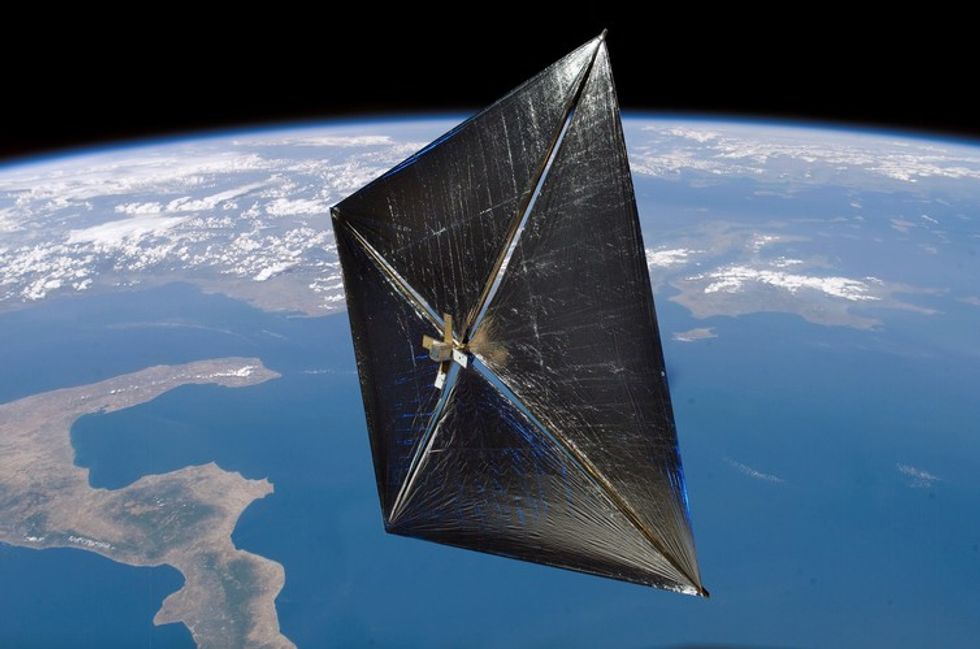
The technology is that of solar sails combined with the ability to miniaturize instruments. The idea behind solar sails is that the light that streams from the sun can be used to propel an object. Gradually, as the object is moved, it accelerates and builds up speed, eventually reaching values that are a significant fraction of the speed of light. So far, tests have been made on sails that are many metres across, carrying payloads of kilograms in weight. And the technology works – both the European Space Agency and NASA have developed systems that could be applied to spacecraft. To work efficiently, these sails need to be several metres across, just as a sail on a sea-going vessel needs to be a certain size to catch enough wind to push a ship forward.
Artist’s view of an experimental solar sail satellite built by NASA, dubbed NanoSail-D2.
Miniaturisation of instruments has been a significant driver of space exploration ever since the launch of Sputnik, the first artificial satellite to orbit the Earth. The ideal instrument for a space mission has minimal mass and requires minimal power. These requirements led to the concept of CubeSat, a tiny satellite where a standard platform has been developed onto which different instruments could be fitted. The entire satellite can also be launched by a variety of different vehicles.
We can all appreciate the rate at which equipment is getting ever smaller – a quick glance at a smart phone, with its powerful camera, ability to record and store gigabytes-worth of sound and images shows where technology sits at the moment. There have been proposals to use a CubeSat to launch multiple tiny probes carrying instruments to the moon and to Mars. Breakthrough Starshot, though, will be a single microchip – a spacechip that is a spaceship (and vice versa!).
The concept is to have individual microchips each propelled by a solar sail. Given that the sail is likely to be much, much bigger than the vessel – the spacechip is likely to be of the order of a centimetre long – there are practical as well as technological difficulties to overcome. But attaching the sail to the ship is probably one of the least serious potential problems.
Interstellar threats
Interplanetary and interstellar space are full of hazards for a tiny traveller. The two greatest hazards will be dust and radiation. Even though there have been great advances in production of thin but strong materials that would make appropriate solar sails, a dust grain travelling at speed could rip a sail apart. Also, microchips are very sensitive to high doses of radiation – and interstellar space is shot through by cosmic rays. While the chips are still within the solar system, how vulnerable will they be to changes in the solar wind?
Once all the technological development has taken place, and the chips are launched – which might be sooner rather than later, if the Breakthrough Starshot initiative is successful – where will they go and what will they do when they get there? The idea is that they will travel to our nearest neighbour beyond our Solar System, Alpha Centauri, taking about 20 years to get there, travelling at a speed of about 60,000 km per second (or 135m miles per hour).
This is not just an amazingly short time to travel a distance of 40 trillion km, it is also a reasonable length of time for a space mission to last – think of how long the Hubble Space Telescope has been operating and returning spectacular images. En route for Alpha Centauri, the chips will act as tourists – taking pictures, meeting the local inhabitants (planets? comets?), and looking at the scenery (such as more distant stars).
These findings in themselves are probably sufficient scientific justification for the project. For example, we have never seen a star or a supernova from interstellar space – we are always looking through the lens of the solar system. Once the tiny travellers reach Alpha Centauri, the instruments will make measurements of a stellar system, giving us – again for the first time – a detailed insight into stars that are different from our own. They might even find planets and moons.
We’ve had talk of surfing on gravitational waves to travel in time – which is still very much science fiction. Now, though, we are sailing in a solar wind, and interstellar travel is within our grasp. We might not yet be at the stage of interstellar travel for people, but being able to see what it is like to travel through interstellar space while still in the comfort of our own home is certainly a first step.
Six years after being paralyzed from the chest down, an American man can use his right hand to stir coffee and swipe a credit card, a groundbreaking study reported on Wednesday.
The unprecedented feat was made possible by computer software replacing the damaged spinal cord as the communication highway between Ian Burkhart's brain and his hand muscles.
"This is the first time a completely paralyzed person has regained movement just by using their own thoughts," said researcher Chad Bouton of the Feinstein Institute for Medical Research in Manhasset, New York.
Burkhart, a 24-year-old from Ohio, has a pea-sized chip in his head to read his brain signals, which are then deciphered by a computer and rerouted to the hand, wrist and finger muscles.
The muscles receive their instructions from an electrode sleeve worn on the right forearm -- with which Burkhart can now also swipe a credit card, pick up a spoon, hold a phone to his ear and play the cords of a guitar video game.
The US-based researchers hope their work, still in an early phase, will one day allow paralyzed people to feed and dress themselves.
Their device, called NeuroLife, reroutes messages from the brain to the muscles, bypassing the spinal cord.
Two years ago, they reported a major breakthrough when Burkhart was able to open and close his hand.
With a lot more training, he has since refined his skills and can now grip a "stir stick" with his fingertips, and use it.
Burkhart broke his neck in a holiday diving accident aged 19 and was left quadriplegic -- meaning his arms and legs are paralyzed.
"Doctors told me I'd broken my neck and that most likely I'd be able to move my shoulders around, but nothing else for the rest of my life," he told journalists in a teleconference ahead of the report's release.
- 'Now I can do it' -
He volunteered for the trial, Burkhart said, because he wanted to help people like himself regain their independence.
"Just not being able to use your hands does limit you quite a bit," he said. "I have to rely on other people for things."
Burkhart underwent surgery to have the chip implanted in the brain's motor cortex area, which controls movement.
The chip was attached on top of the skull to a "connector" linking it to a computer which Burkhart "trained" to read his mind and decode which movements he wanted to execute.
The command to open, clench or pinch is then relayed to an electrode sleeve on Burkhart's right arm.
"When we first hooked everything up... it was a big shot," he recounted.
"I hadn't moved in about three-and-a-half years at that point. Now it's something that's just so fluid it's kind of like it was before I had my injury.
"I just think about what I want to do, and now I can do it."
Some of the functions he has relearnt have the potential of changing his daily life for the better. But for now, he can only do them in the lab.
The researchers said they hope to improve the technology to help not only people with spinal cord injuries, but also those who suffered a stroke or traumatic brain injury.
"Maybe in a few years from now we can have a wireless system that allows a patient like Ian to be able to move his hand and his arm... without cables to connect," said Ali Rezai of Ohio State University.
"This becomes more streamlined hopefully over time, maybe integrated into your cellphone... communicating with your sleeve."
Several teams worldwide are researching ways to bypass a damaged spinal cord, many focusing on using the mind to control robotic limbs or exoskeletons.
But the holy grail is to allow quadriplegics to use their own limbs, limiting the need for surgery and prosthetics.
"If all the work we've been doing can help anybody get more independence back, I mean that's great," said Burkhart.
"I really cherish the independence I had before my injury, so if you can give someone that ability back, it's huge."
A video explaining the findings can be viewed here.
Every single person is different. We all have different backgrounds, views, values and interests. And yet there is one universal feeling that we all experience at every single moment. Call it an “ego”, a “self” or just an “I” – it’s the idea that our thoughts and feelings are our own, and no one else has access to them in the same way. This may sound a bit like post-war French existentialism or psycho-analysis, but it’s actually a topic that’s being increasingly addressed by neuroscientists.
We were part of a team interested in finding out how this sense of self is expressed in the brain – and what happens when it dissolves. To do that, we used brain imaging and the psychedelic drug LSD.
Our sense of self is something so natural that we are not always fully aware of it. In fact, it is when it is disturbed that it becomes the most noticeable. This could be due to mental illnesses such as psychosis, when people might experience the delusional belief that their thoughts are no longer private, but can be accessed and even modified by other people. Or it could be due to the influence of psychedelic drugs such as LSD, when the user can feel that their ego is “dissolving” and they are becoming at one with the world. From a scientific point of view, these experiences of “ego death” or ego dissolution are also opportunities to search for this sense of self in the brain.
Our study, led by Enzo Tagliazucchi and published in Current Biology, set out to probe what is happening in the brain when our sense of self becomes altered by psychedelic drugs (link to Enzo’s paper). We studied 15 healthy volunteers before and after taking LSD, which altered their normal feelings of their selves and their relationship with the environment. These subjects were scanned while intoxicated and while receiving placebo using functional MRI, a technique which allows us to study the brain’s activity by measuring changes in blood flow. By contrasting the activity of the brain when receiving a placebo with its activity after taking LSD, we could start exploring the brain mechanisms involved in the normal experience of the self.
A holistic understanding
Results of this study showed that the experience of ego-dissolution induced by LSD was not related to changes in only one region of the brain. Instead, the drug affected the way that several brain regions were communicating with the rest of the brain, increasing their level of connectivity. These included the fronto-parietal region, an area that has previously been linked to self awareness, and the temporal region, an area involved in language comprehension and creating visual memories. The brain on LSD would therefore be similar to an orchestra in which musicians are no longer playing together in time, rather than an orchestra in which some are missing or malfunctioning.
In a previous paper, we showed that the brain tends to organise itself into groups or modules of regions working closely together and specialising in a specific activity, a property called modularity. For example, the brain regions specialised for vision are normally organised as a module of the human brain network. LSD disrupted this modular organisation of the brain – and the level of modular disorganisation was linked with the severity of ego-dissolution that volunteers experienced after taking the drug. It seems the modular organisation of the healthy brain works as the scaffolding that allows us to maintain a sense of self.
But on a more fundamental note, these results highlight that a full understanding of the brain will never be complete unless we focus on the connectivity between regions as part of a complex network. This is irrespective of the level of microscopic detail we might have about what a single region does. Just as a symphony is fully appreciated only when one listens to all members of the orchestra playing it together, and not by studying each individual instrument separately.
By investigating the psychedelic effects of LSD with brain scanning, we can open the doors of perception to discover how the familiar, egotistical sense of self depends on a particular pattern of brain network organisation. Our sense of individuality may be down to the overall configuration that emerges from the interactions of multiple brain regions. When this organisation is disrupted by LSD, and particularly when the modular organisation falls apart, our sense of self, and the distinct boundaries between us, the environment and others might be lost.
Lysergic acid diethylamide (LSD) use causes changes in the way that people think about time that may help develop drug therapies for people suffering from depression, according to a study published in the Journal of Psychopharmacology.
LSD is a synthetic hallucinogenic drug, which has long been used recreationally. Changes in the perception of time is a commonly-reported effect of LSD use. In particular, people who have taken large doses of LSD often experience a sense of timelessness and dissociation from one’s own personal history that has been called “ego-disintegration.”
A team of scientists led by Jana Speth, of the University of Dundee, sought to quantify these changes in time perception and their relationship with DMN activity in a controlled study of LSD use. Twenty volunteers participated in two separate laboratory sessions at least two weeks apart. Each participant was given a dose of LSD in one session and a placebo dose in the other, with half randomly assigned to receive the LSD first and half to receive the placebo first.
Two hours after receiving the LSD or placebo dose, participants’ brain activity was monitored using functional magnetic resonance imaging (fMRI), which indicates which parts of the brain are more or less active. Afterwards, participants were interviewed about what they had been thinking about while the fMRI measurements were being taken. Their responses were analyzed to determine the number of references to thinking about the past, present, and future.
Compared with the placebo condition, participants reported dramatically less thinking about the past after being administered with LSD. At the same time, fMRI analysis showed significantly lower DMN activity after using LSD than after receiving a placebo. These results support the view that at least some of the temporal perception effects of LSD use are caused by the action of LSD on the DMN system.
“Results revealed a selective effect of LSD on mental spaces linked to the past, i.e. there were significantly fewer cases of mental time travel to the past under LSD than placebo, and this effect correlated with the general intensity of LSD’s subjective effects,” Speth and her colleagues wrote in their study. “These outcomes shed light on the phenomenon of ego-dissolution and specifically a decomposition of the ‘narrative-self’ or ‘narrative identity’, which is strongly associated with autobiographical thought.”
The authors of the study suggest that these results may have implications for treatment of depression. Excessive focus on one’s own past is a symptom of depression, and previous brain imaging studies have found that people suffering from depression tend to have elevated levels of DMN activity in comparison to people without depression. If the chemical components of LSD that modulate DMN activity can be identified, it may one day be possible to exploit its potential to help control this harmful rumination on the past.
When diners sat down at a recent gourmet experience held at the Harvey Nichols department store in Manchester, their food was filled with bacteria, fungus and mould. Far from being a public health hazard, this special five-course meal was designed to show how microorganisms are a fundamental part of the food we eat.
In general, microbes don’t have a good reputation. Yet while some cause disease and decay, the vast majority of the planet’s microorganisms are not harmful to us. In fact, they can be incredibly useful, producing alcohol, acids and other molecules that add flavour, texture and nutritional value to food, as well as helping to preserve it.
Baker’s yeast: keeping humanity fed for thousands of years
Shutterstock
Microorganisms are used to make many of the staples of our diets. Bread, cheese and wine all immediately spring to mind. But the roles of these tiny living cells is far more diverse than you might think. The term “artisanal food microbiology” has even been coined recently to describe an emerging interest among cooks to explore the potential for microbes to create new flavours and dishes.
At the gourmet meal we introduced in Manchester – the first of four we are running to raise awareness of the importance of microbes in food – almost every aspect of the food had been touched in some way by microorganisms.
Crostini canapés
Devin Louttit, Author provided
Sourdough crostini were the base for our delicious Welsh Rarebit canapes. Bread is produced through the action of the yeastSaccharomyces cerevisiae (baker’s yeast). This type of fungus is dormant until activated by the warm water in the dough, at which point it starts feeding on the sugars in the flour, releasing carbon dioxide that makes bread rise. Yeast adds many of the distinctive flavours and aromas we associate with bread and also produces the alcohol in beer and wine.
Sourdough bread dough ferments and rises more slowly because it uses lactic acid bacteria and wild yeasts found naturally on cereal grains, rather than baker’s yeast. This produces lactic acid that gives it a tart flavour and breaks down the gluten that some people struggle to digest.
Sauerkraut surprise
Devin Louttit, Author provided
Our first course was a prosciutto platter, with apple and sultana sauerkraut (sour cabbage). The sourness comes from lactic acid, which is produced by lactic acid bacteria naturally present on the cabbage that feed on sugars released when the vegetable is sliced. These bacteria also produce vitamins including vitamin C, which is why sailors used to take sauerkraut on long voyages to help prevent scurvy.
Deep-fried mould
Devin Louttit, Author provided
A warm salad of deep-fried Roquefort with smoked tofu followed. Cheese is made using bacteria such as Lactobacillus and Streptococcus that ferment the sugar in milk (lactose) into lactic acid. This causes a decrease in pH, preventing the growth and survival of other microbes and clotting the milk protein, turning it into solid cheese. The blue colour and distinct flavour of Roquefort comes from the mould Penicillium roqueforti, which – as you can guess – is related to the fungus that makes the antibiotic penicillin. Moulds are filamentous (thread-like) fungi that produce coloured spores, giving their colonies a distinctive and powdery appearance.
Merely a truffle
Devin Louttit, Author provided
The main course was truffled mushroom risotto and beer flatbread with rosemary. Like mushrooms, truffles are the fruiting body (spore-forming part) of fungi – organisms that are neither plants nor animals. Truffles form a symbiotic relationship (mycorrhiza) with the tree roots they grow on. This means they help the plant to gather water and minerals from the soil in exchange for sugars. Their pungent, musky smell is thought to come from a combination of molecules given off by the truffles themselves and more microbes – the bacteria that live on them.
And for dessert …
The dessert consisted of pears poached in sauternes, a sweet wine that is unusual because it is made from mouldy grapes. This concentrates the grape sugar so that a significant amount remains in the wine after the traditional fermentation converts most of it to alcohol. Because of the delicious flavour this develops, the mould is known as the “Noble Rot”. The scientific name for this grey mould is Botrytis cinerea and it is closely related to species of Penicillium. It produces a chemical aroma compound, phenylacetaldehyde, which is also commonly found in buckwheat and milk chocolate.
From slime to sublime
Devin Louttit, Author provided
We finished our gourmet microbe meal with chocolate tart with framboise beer sauce, followed by coffee and chocolate petit fours. Both chocolate and coffee beans, which are actually seeds, go through a fermentation process that is used to break down the slimy “mucilage” coating that holds the seeds in the pod and to develop delicious and important chemical compounds. A series of bacteria, yeasts and moulds are used to develop these flavour compounds, natural chemicals that we enjoy for their aroma and flavour.
Although many of these food fermentations are thousands of years old, chefs at experimental restaurants such as noma in Copenhagen are still playing with microbes to produce new flavours. There is even a growing fermentation community of professional and amateur microbiologists who can cook up new kinds of acid to help make your new dish taste just right. So when you’re looking for a special new ingredient, perhaps you should turn to some of the oldest lifeforms on the planet.
1) Depending on exactly how you measure the expert consensus, it’s somewhere between 90% and 100% that agree humans are responsible for climate change, with most of our studies finding 97% consensus among publishing climate scientists.
2) The greater the climate expertise among those surveyed, the higher the consensus on human-caused global warming.
Expert consensus is a powerful thing. People know we don’t have the time or capacity to learn about everything, and so we frequently defer to the conclusions of experts. It’s why we visit doctors when we’re ill. The same is true of climate change: most people defer to the expert consensus of climate scientists. Crucially, as we note in our paper:
Public perception of the scientific consensus has been found to be a gateway belief, affecting other climate beliefs and attitudes including policy support.
That’s why those who oppose taking action to curb climate change have engaged in a misinformation campaign to deny the existence of the expert consensus. They’ve been largely successful, as the public badly underestimate the expert consensus, in what we call the “consensus gap.” Only 12% of Americans realize that the consensus is above 90% .
Tol argues that when considering results from previous consensus studies, the Cook 97% figure is an outlier, which he claims is much higher than most other climate consensus estimates. He makes this argument by looking at sub-samples from previous surveys. For example, Doran’s 2009 study broke down the survey data by profession – the consensus was 47% among economic geologists, 64% among meteorologists, 82% among all Earth scientists, and 97% among publishing climate scientists. The lower the climate expertise in each group, the lower the consensus.
Like several of these consensus surveys, Doran cast a wide net and included responses from many non-experts, but among the experts, the consensus is consistently between 90% and 100%. However, by including the non-expert samples, it’s possible to find low “consensus” values.
The flaw in this approach is especially clear when we consider the most ridiculous sub-sample included in Tol’s critique: Verheggen’s 2015 study included a grouping of predominantly non-experts who were “unconvinced” by human-caused global warming, among whom the consensus was 7%. The only surprising thing about this number is that more than zero of those “unconvinced” by human-caused global warming agree that humans are the main cause of global warming. In his paper, Tol included this 7% “unconvinced,” non-expert sub-sample as a data point in his argument that the 97% consensus result is unusually high.
By breaking out all of these sub-samples of non-experts, the critique thus misrepresented a number of previous consensus studies in an effort to paint our 97% result as an outlier. The authors of those misrepresented studies were not impressed with this approach, denouncing the misrepresentations of their work in no uncertain terms .
We subsequently collaborated with those authors in this newly-published scholarly response, bringing together an all-star lineup of climate consensus experts. The following quote from the paper sums up our feelings about the critique’s treatment of our research:
Tol’s (2016) conflation of unrepresentative non-expert sub-samples and samples of climate experts is a misrepresentation of the results of previous studies, including those published by a number of coauthors of this paper.
Consensus on consensus
In our paper, we show that including non-experts is the only way to argue for a consensus below 90–100%. The greater the climate expertise among those included in the survey sample, the higher the consensus on human-caused global warming. Similarly, if you want to know if you need open heart surgery, you’ll get much more consistent answers (higher consensus) if you only ask cardiologists than if you also survey podiatrists, neurologists, and dentists.
That’s because, as we all know, expertise matters. It’s easy to manufacture a smaller non-expert “consensus” number and argue that it contradicts the 97% figure. As our new paper shows, when you ask the climate experts, the consensus on human-caused global warming is between 90% and 100%, with several studies finding 97% consensus among publishing climate scientists.
There’s some variation in the percentage, depending on exactly how the survey is done and how the question is worded, but ultimately it’s still true that there’s a 97% consensus in the peer-reviewed scientific literature on human-caused global warming. In fact, even Richard Tol has agreed :
The consensus is of course in the high nineties.
Is the consensus 97% or 99.9%?
In fact, some believe our 97% consensus estimate was too low. These claims are usually based on an analysis done by James Powell , and the difference simply boils down to how “consensus” is defined . Powell evaluated the percentage of papers that don’t explicitly reject human-caused global warming in their abstracts. That includes 99.83% of papers published between 1991 and 2012, and 99.96% of papers published in 2013.
In short, 97% of peer-reviewed climate research that states a position on human-caused warming endorses the consensus, and about 99.9% of the total climate research doesn’t explicitly reject human-caused global warming. Our two analyses simply answer different questions. The percentage of experts and their research that endorse the theory is a better description of “consensus.” However, Powell’s analysis is useful in showing how few peer-reviewed scientific papers explicitly reject human-caused global warming.
In any case, there’s really no question that humans are the driving force causing global warming. The experts are almost universally convinced because the scientific evidence is overwhelming . Denying the consensus by misrepresenting the research won’t change that reality.
With all of the consensus authors teaming up to show the 90–100% expert consensus on human-caused global warming, and most finding 97% consensus among publishing climate scientists, this paper should be the final word on the subject.
Why did humans become monogamous, apparently rejecting the promiscuity that is natural to most animals?
Was it morality? Religion? Maybe love?
The answer is germs, researchers said Tuesday, arguing that the havoc caused by sexually transmitted diseases (STIs) convinced our ancestors it would be better to mate for life.
A research duo from Canada and Germany observed that STIs flourished among large groups of people living in the villages, towns and cities that arose after prehistoric hunter-gatherers settled down to farm.
Left unchecked, spreading diseases can affect individual fertility and a group's overall reproduction rate.
Falling population numbers would force a rethink of sexual behavior -- which in turn gives rise to social mores.
The researchers developed a mathematical model of hunter-gatherer demographics and likely STI spread among them.
They used it "to show how growing STI disease burden in larger residential group sizes can foster the emergence of socially imposed monogamy in human mating."
In small groups of no more than 30 individuals, with no chance for epidemic spread, STI outbreaks are generally short-lived, the team said.
The reduced risk may explain why small groups, both among early humans and today, are often polygynous (when men have more than one partner).
- 'Evolutionary puzzle' -
Socially-imposed human monogamy has long been considered an "evolutionary puzzle", according to the research duo.
It requires societies to put in place checks and structures -- a police and court system, for example -- to uphold societal mores.
"Yet, many larger human societies transitioned from polygyny to socially imposed monogamy beginning with the advent of agriculture and larger residential groups," said the paper.
That riddle may now be solved.
The research showed that our natural environment, with factors such as disease spread, "can strongly influence the development of social norms, and in particular our group-oriented judgements," study author Chris Bauch of the University of Waterloo in Canada told AFP.
But this did not necessarily mean that humans would become wildly promiscuous if drugs were to make STIs a thing of the past, he added.
"Modern societies are more complicated... and there is probably more than one reason that explains socially imposed monogamy," Bauch said by email.
"I think it is premature to speculate that marriage will disappear, or that polygyny will return, if we solve the problem of STIs."
The research was published in the journal Nature Communications.
Some of the world's oldest prehistoric artwork, located in the Chauvet-Pont d'Arc cave in southeastern France, is actually 10,000 years older than previously thought, researchers said Tuesday.
The red and black cave drawings contained in the cave are more than 30,000 years old, according to a radiocarbon dating study published this week in the Proceedings of the National Academy of Sciences, a peer-reviewed US journal.
The cave is located in Vallon-Pont d'Arc, Ardeche, and was classified as a United Nations Educational, Scientific and Cultural Organization (UNESCO) World Heritage site in 2014, 20 years after it was first discovered.
"What is new in our study is that we have established the chronology of the cave for the first time in calendar years," said Anita Quiles, a scientist at the French Institute for Oriental Archaeology in Cairo.
Because of stylistic similarities, researchers had long believed that the Chauvet art was from about the same period as that contained in Lascaux, a prehistoric site in southwestern France that dates to 20,000 years ago.
"But now we know there is 10,000 years -- or even 15,000 years -- of a split in the dates of these two sites," she told AFP.
"We can now say with certainty that there has been no human activity in the Chauvet cave for about 30,000 years."
The study analyzed charcoal samples on the cave floor and walls, and found that there were two phases of human occupation.
The first lasted from 37,000 to 33,500 years ago, said the study, appearing to come to an end around the time of a rockfall in one section of the cave.
The second wave of human occupation lasted from 31,000 to 28,000 years ago.
"The end of the second human occupation correlates with a second rockfall 29,400 years ago that partially closed off the cave entrance," said the study.
Researchers also analyzed animal bones found in the cave and identified them as belonging to cave bears.
No human remains have been found inside, and experts believe this is because people did not live in the cave but rather visited from time to time.
The artwork contains 447 drawings of animals, including deer, horses and rhinoceroses.
The study took 18 years, and involved creating a statistical model which included more than 250 dates derived from samples of charcoal and bone, according to Jean-Michel Geneste, scientific director for the Chauvet-Pont d'Arc cave.
"This is pretty revolutionary for us. It is a new tool which could be used elsewhere to study other ancient time periods," he said.
"We can now confirm that 36,000 years ago, during the Upper Paleolithic period when modern tools, art and jewelry-making techniques appeared, we already had art that was quite evolved, accomplished, and already the object of a very long memory and a long cultural tradition in western Europe," he said.
"Before, this was a hypothesis. Now that we have dozens of dates, we have certainty."
“Hugging it out” is often touted as a good way to solve a problem. Now a group of Europeans have decided that that’s all Britons need to convince them to stay in the EU. Their #hugabrit campaign, in which people send in pictures of themselves hugging a Briton, aims to launch “a lovebomb” across the Channel.
Of course, hugs can help in many situations, from showing appreciation to beating loneliness and stress at work. Need a friendly cuddle to calm you down, but no one to cuddle with? The Japanese may have the answer … visit a soineya. Literally a “co-sleeping speciality shop” – or cuddle café to you and me – these establishments offer, for a fee, anything from 20-minute embrace to a whole night with a quiet cuddle or even sleeping (and I mean sleeping) with a stranger. Perhaps the prospect of cuddling a stranger fills you with abject horror? But ask yourself first why it is that we like to cuddle.
Touch is, in fact, very important in our relationships. My collaborators at Aalto University in Finland and I recently sampled people throughout Europe, and found much the same broad pattern everywhere: the closer the relationship we have with someone, the more of our body they are allowed to touch. I don’t know about the Japanese, but Europeans (and, no surprises, the Brits in particular) are a bit standoffish about where a stranger was allowed to touch them. A polite handshake is fine, shoulders and arms just about OK, but anywhere else is pretty much verboten.
To understand what’s going on when we cuddle, we need to step back to our primate past. Monkeys and apes create and maintain their friendships through social grooming. Useful as grooming may be for removing debris from skin and fur, its real effectiveness arises from the slow leafing through the fur that is involved as the groomer searches for foreign matter. We still do it, up to a point, for example when parents leaf through their children’s hair. And of course this is why we find the attentions of our hairdresser so relaxing.
The slow stroking involved in grooming stimulates a particular set of nerves – the afferent c-tactile neurons that are found only in hairy skin and are quite different to the usual nerves that convey information about touch, pain and pressure. These neurons respond only to light and slow stroking. They have a direct route into the brain, where they trigger the release of endorphins.
Endorphins are neuropeptides, small molecules that are used by neurons in the brain to signal to each other. Endorphins are part of the pain control system, and produce an opiate-like analgesic effect. In fact, they are chemically closely related to opiate drugs like morphine, but differ in two key respects: on a weight for weight basis, they are 30 times more effective as painkillers than morphine, and we don’t get so destructively addicted to them.
We used a form of brain imaging known as positron emission tomography (PET for short) to show that light stroking of the torso triggers a massive endorphin response in the human brain, just as grooming does in monkeys and apes. Cuddling, with its concomitant behaviours of stroking, patting and even the occasional leafing through the hair, is the human form of primate grooming, and is designed to create and maintain our relationships.
Because our feelings of psychological pain are processed in the same brain regions as our feelings of physical pain (notably the brain areas known as the anterior cingulate cortex and the periaqueductal gray), endorphins dampen our psychological pain. That’s why a hug is comforting when someone is in tears.
Endorphins also activate regions of the brain associated with reward, such as the orbitofrontal cortex – just above the eyes – and it is this that makes us want to repeat the experience.
It is because morphine overdoses on these same effects that addicts lose interest in their social world: in effect, they are getting their hugs artificially and don’t need human contact to provide the hit. These opiate-like effects of endorphins are reinforced by oxytocin, another neuropeptide that also tends to be stimulated by hugs and has light analgesic properties. Oxytocin’s main function is associated with lactation (its main job is to manage the body’s water balance), and because of this evolution has adapted it in mammalsnto create the feelings of warmth and attachment associated with suckling, and so any kind of physical contact.
Hug a hoodie or #hugabrit then? Well, maybe not, because the extent to which the experience of hugging gives us pleasure and helps bond relationships has a deep psychological component. Somewhere in the brain’s frontal lobes is a mechanism that can switch touch from being pleasurable to being unpleasant if the wrong person does it. Which, of course, is why we hate being crammed together in elevators. All that human flesh in close contact – ugh!