Work on a pair of U.S. commercial spaceships to ferry astronauts to and from the International Space Station will be delayed after a losing contender protested the NASA awards, agency Administrator Charles Bolden said on Monday.
The U.S. space agency awarded contracts worth up to $6.8 billion to Boeing and privately owned Space Exploration Technologies, or SpaceX, to finish designs, build, test and ultimately fly crews to the station, a $100 billion research laboratory that orbits about 260 miles (418 km) above Earth.
The awards, announced on Sept. 16, culminate a four-year program to restore U.S.-based human spaceflight services following the retirement of the space shuttles in 2011.Since then, NASA has been dependent on Russia to fly station crewmembers, a service that currently costs the United States about $70 million per seat.
In addition to Boeing and SpaceX, privately owned Sierra Nevada Corp bid to continue development of its Dream Chaser spaceplane under NASA’s so-called “Commercial Crew” program. The contracts include up to six operational missions.
Boeing’s award is for $4.2 billion. SpaceX offered to do the work for $2.6 billion. On Friday, Colorado-based Sierra Nevada formally protested the awards, saying its proposal would cost $900 million less than Boeing’s.
“NASA’s own Source Selection Statement and debrief indicate that there are serious questions and inconsistencies in the source selection process. SNC, therefore, feels that there is no alternative but to institute a legal challenge,” the company said in a statement.
The protest, filed with the Government Accountability Office, will temporarily keep NASA from moving forward with the next phase of its Commercial Crew program, NASA's Bolden told Reuters.
NASA has 30 days to respond to Sierra Nevada’s challenge. GAO is expected to issue its ruling by Jan. 5, 2015.
Bolden was in Toronto for the opening of the week-long International Astronautical Congress.
Biological brains are unlikely to be the final stage of intelligence. Machines already have superhuman strength, speed and stamina – and one day they will have superhuman intelligence. The only reasons this may not occur is if we develop some other dangerous technology first that destroys us, or otherwise fall victim to some existential risk.
But assuming that scientific and technological progress continues, human-level machine intelligence is very likely to be developed. And shortly thereafter, superintelligence.
Predicting how long it will take to develop such intelligent machines is difficult. Contrary to what some reviewers of my book seem to believe, I don’t have any strong opinion about that matter. (It is as though the only two possible views somebody might hold about the future of artificial intelligence are “machines are stupid and will never live up to the hype!” and “machines are much further advanced than you imagined and true AI is just around the corner!”).
A survey of leading researchers in AI suggests that there is a 50% probability that human-level machine intelligence will have been attained by 2050 (defined here as “one that can carry out most human professions at least as well as a typical human”). This doesn’t seem entirely crazy. But one should place a lot of uncertainty on both sides of this: it could happen much sooner or very much later.
Exactly how we will get there is also still shrouded in mystery. There are several paths of development that should get there eventually, but we don’t know which of them will get there first.
Biological inspiration
We do have an actual example of generally intelligent system – the human brain – and one obvious idea is to proceed by trying to work out how this system does the trick. A full understanding of the brain is a very long way off, but it might be possible to glean enough of the basic computational principles that the brain uses to enable programmers to adapt them for use in computers without undue worry about getting all the messy biological details right.
We already know a few things about the working of the human brain: it is a neural network, it learns through reinforcement learning, it has a hierarchical structure to deal with perceptions and so forth. Perhaps there are a few more basic principles that we still need to discover – and that would then enable somebody to clobber together some form of “neuromorphic AI”: one with elements cribbed from biology but implemented in a way that is not fully biologically realistic.
Pure mathematics
Another path is the more mathematical “top-down” approach, which makes little or no use of insights from biology and instead tries to work things out from first principles. This would be a more desirable development path than neuromorphic AI, because it would be more likely to force the programmers to understand what they are doing at a deep level – just as doing an exam by working out the answers yourself is likely to require more understanding than doing an exam by copying one of your classmates' work.
In general, we want the developers of the first human-level machine intelligence, or the first seed AI that will grow up to be superintelligence, to know what they are doing. We would like to be able to prove mathematical theorems about the system and how it will behave as it rises through the ranks of intelligence.
Brute Force
One could also imagine paths that rely more on brute computational force, such by as making extensive use of genetic algorithms. Such a development path is undesirable for the same reason that the path of neuromorphic AI is undesirable – because it could more easily succeed with a less than full understanding of what is being built. Having massive amounts of hardware could, to a certain extent, substitute for having deep mathematical insight.
We already know of code that would, given sufficiently ridiculous amounts of computing power, instantiate a superintelligent agent. The AIXI model is an example. As best we can tell, it would destroy the world. Thankfully, the required amounts of computer power are physically impossible.
Plagiarising nature
The path of whole brain emulation, finally, would proceed by literally making a digital copy of a particular human mind. The idea would be to freeze or vitrify a brain, chop it into thin slices and feed those slices through an array of microscopes. Automated image recognition software would then extract the map of the neural connections of the original brain. This 3D map would be combined with neurocomputational models of the functionality of the various neuron types constituting the neuropil, and the whole computational structure would be run on some sufficiently capacious supercomputer. This approach would require very sophisticated technologies, but no new deep theoretical breakthrough.
In principle, one could imagine a sufficiently high-fidelity emulation process that the resulting digital mind would retain all the beliefs, desires, and personality of the uploaded individual. But I think it is likely that before the technology reached that level of perfection, it would enable a cruder form of emulation that would yield a distorted human-ish mind. And before efforts to achieve whole brain emulation would achieve even that degree of success, they would probably spill over into neuromorphic AI.
Competent humans first, please
Perhaps the most attractive path to machine superintelligence would be an indirect one, on which we would first enhance humanity’s own biological cognition. This could be achieved through, say, genetic engineering along with institutional innovations to improve our collective intelligence and wisdom.
It is not that this would somehow enable us “to keep up with the machines” – the ultimate limits of information processing in machine substrate far exceed those of a biological cortex however far enhanced. The contrary is instead the case: human cognitive enhancement would hasten the day when machines overtake us, since smarter humans would make more rapid progress in computer science. However, it would seem on balance beneficial if the transition to the machine intelligence era were engineered and overseen by a more competent breed of human, even if that would result in the transition happening somewhat earlier than otherwise.
Meanwhile, we can make the most of the time available, be it long or short, by getting to work on the control problem, the problem of how to ensure that superintelligent agents would be safe and beneficial. This would be a suitable occupation for some of our generation’s best mathematical talent.
The Conversation organised a public question-and-answer session on Reddit in which Nick Bostrom, director of the Future of Humanity Institute at the University of Oxford, talked about developing artificial intelligence and related topics.
Nick Bostrom is the director of the Future of Humanity Institute and the Oxford Martin Programme on the Impacts of Future Technology, both based in the Oxford Martin School. He is the author of Superintelligence: Paths, Dangers, Strategies.
The sex act has many health benefits from reducing stress and tension, to boosting your immune system. It may even affect your risk of developing certain cancers.
But as with most matters health, how sex and cancer risk are linked is complicated and dependent on several factors. Your age, gender, and how often you practice safe sex will all influence your potential cancer risk.
To date, the only clear literature linking sex and cancer is that concerning the human papillomavirus (HPV). There are over 200 strains of HPV, but some are more cancer-causing than others. The good news is that we now have a vaccine against the most common cancer-causing strains of the virus.
Most commonly, HPV is linked to cervical cancer. But both men and women can increase their risk of developing cancer through sexual activities that pass on the virus.
HPV infection
A lot has been written about HPV and cervical cancer. So much, in fact, that most people don’t even realise men can also get HPV, and that they can get HPV-related cancers too. Indeed, men have largely been ignored in the media and promotion of the HPV vaccine.
Boys have been included in the Australian school-based HPV vaccination program since 2013. But preliminary results of research with male adolescents and their parents suggest there’s low awareness and understanding about the vaccine.
Adolescent boys aren’t sure what the vaccine is for, nor why they need to get it; parents think their sons are not at risk of HPV-related cancers. But HPV can cause a range of cancers in both men and women, in sites other than the cervix. These include cancers of the anus and genitals, as well as cancers of the head, neck, and throat.
In 2013, news reports of Hollywood veteran (and self-confessed ladies' man) Michael Douglas identified HPV as the cause of his throat cancer, creating public interest in the relationship between sexual activity and cancer risk.
Unfortunately, some interpretations of this news were incorrect, leading people to believe that oral sex could also “cure” cancer after Douglas also made that claim. In fact, the only “cure” in the case of HPV-related cancers is prevention.
HPV vaccination
Vaccination is the primary method of preventing HPV-related cancers. But as mentioned above, some parents still question why males need the vaccine if girls are receiving it through the school-based program.
The reason is twofold.
Among heterosexual couples, HPV is transmitted between males and females (either partner could be infected first and transmit it to the other). So, vaccinating women provides some benefits to men, but full protection of heterosexual men only occurs if most women receive the vaccine.
While the school-based program in Australia has reached quite high coverage of girls, it isn’t high enough to fully protect all heterosexual boys. What’s more, men who are vaccinated will help protect future partners who are not vaccinated.
The second reason is that adolescent boys who do or will eventually identify as bisexual or homosexual are not protected. It’s unrealistic, impractical, and stigmatising to try to single out this population at the age of 12, when school children receive the HPV vaccine.
By vaccinating adolescent boys in a school-based program, we can protect the homosexual community from developing HPV-related cancers as well. And this is very important given the higher prevalence of HPV infection and related disease in this population.
HPV is a real risk for developing cancer in both men and women, and it is transmitted through sex. But, reducing this cancer risk is easily done through vaccination. After HPV vaccination, the only real cancer worries are those not directly related to sexual behaviours.
So get vaccinated against HPV, eat your veggies, exercise, and watch out for those other carcinogens in your life. But you won’t have to worry about contracting cancer from your sexual partners.
Nial Wheate in the past has received funding from the ACT Cancer Council, Tenovus Scotland, Medical Research Scotland, Scottish Crucible and the Scottish Universities Life Sciences Alliance for research into anticancer drugs.
Hayden Fletcher and Spring Chenoa Cooper do not work for, consult to, own shares in or receive funding from any company or organisation that would benefit from this article. They also have no relevant affiliations.
When you think of horses in the Australia high country, you might imagine noble brumbies galloping out from snowgums across grassy peaks, tails and manes trailing like streamers.
But on a recent trip to the Snowy Mountains in Kosciuszko National Park we made a grim discovery about these denizens of the Australian psyche.
At Dead Horse Gap we encountered three brumbies standing calmly in the snow among the curly tree trunks. The brumbies did not flee as we quietly approached for a close encounter.
The first inkling we had that all was not well was our observation that these animals were emaciated, with ribs and bony hips protruding, skin sagging.
A few steps closer and we could see a fourth horse lying dead on the ground. Two of the horses had their snouts inside its gaping abdominal cavity, nibbling at what little remained of its digestive tract.
As far as we are aware, this behaviour has never been documented before. The noble brumbies of the silver screen have been reduced to starving cannibals in Kosciuszko National Park. What has gone wrong?
The authors make a grim discovery in the snow
Fateful decision to not shoot horses
In 2008, the Kosciuszko National Park Horse Management Community Steering Group made a fateful decision. After carefully considering the range of options for managing horses, the committee decided against a strategy of culling by aerial shooting, choosing instead to trap horses using lures and mustering. This was despite aerial shooting being cost-effective, humane, safe, and the only feasible method in inaccessible areas.
The consequences of this management choice are not just starving horses forced to scavenge the digestive tracts of their fallen comrades. There are well-established environmental impacts of feral horses in natural environments.
In a 2007 review, Dale Nimmo and Kelly MIller from Deakin University reported that horses reduce the number of native plants, promote weed invasion, degrade sphagnum bogs, increase soil erosion, increase tree deaths and alter communities of reptiles, mammals, crabs, fish, and birds.
There are substantial knowledge gaps regarding horse impacts on the natural environment. A recent Hot Topic released by the Ecological Society of Australia notes there are no peer reviewed papers examining horse impacts on native species in Australia. No one has measured the effects of horses on the mammals or other animals of Kosciuszko National Park. Nevertheless, the evidence available already, from Australia and overseas, is enough to demonstrate that large numbers of feral horses are not compatible with the natural values of national parks or wilderness areas.
Land under seige
A major wilderness area, the Pilot Wilderness in the southern part of Kosciuszko Noational Park, has some of the worst horse damage imaginable.
On a recent cycle trip into the Pilot Wildnerness, the smell of horse dung never left us. Instead of fresh mountain air, we were accompanied by a smell more commonly associated with horse stables. Riding along the fire trail, we dodged mountains of dung, and small groups of horses, for kilometre after kilometre. Stopping for rests along the grassy flats, we experienced first-hand the caved-in river banks, the flourishing weeds, the close-cropped grasses, and more dung heaps than you’d expect to see lying around after question time at Parliament house.
The authors document damage caused by horses in Kosciuszko National Park
Trampling, horse trails and grazing damage was widespread and not just confined to flats and roadsides.
For the first time in the evolutionary history of the Australian alpine ecosystems, horses appeared to be the dominant ecological process across the entire landscape. We weren’t visiting a wilderness. As ecologists, it appeared as though we were visiting a land under siege.
How many horses suffer?
Provoked by our observations, we wondered how many horses suffer from starvation under different management strategies. We also wondered how many horses might be left in the park.
Gathering the latest data on horse numbers and demographics, we made some simple calculations to model the fate of horses over ten years.
Estimates vary on how many horses are actually in the park now, but this uncertainty makes little difference to the relative outcomes for horses. Taking the low estimates, our calculations suggest between 7000 and 11000 horses will die from starvation, poisoning or dehydration over a ten year period if aerial culling is not included in management plans.
If horse numbers are at the high end of recent estimates, the number that die in ways that we saw at Dead Horse Gap in Kosciuszko National Park could be as high as 20,000. In contrast, with aerial culling, only one quarter of this number would suffer and die on the mountain.
Whatever the initial population, deaths from starvation, poisoning and dehydration are likely to be 2-5 times higher if aerial culling isn’t included in management.
The dead horse found by the authors at Dead Horse Gap, Kosciuszko National Park.
Sam Banks
If horses are managed by trapping alone, we estimate that 11-12,000 horses will be killed in abattoirs or will die of starvation, poisoning or thirst over a ten year period. If horse management includes aerial culling, we estimate that only 7000 horses would be shot, killed in abattoirs or die on the mountain.
From an animal ethics point of view, aerial culling spares thousands of horses from unsavoury deaths on the mountain due to starvation, thirst or poisoning, and spares hundreds to thousands of horses from the stress of capture, trucking and subsequent death in an abattoir. In a nutshell, many more horses will die miserable deaths without aerial culling.
If you care about horse welfare, aerial culling is by far the best management approach because it results in the smallest number of horses being killed or dying.
Culling also best way to save environment
Aerial culling also results in the best outcome for the environment. After ten years (assuming low numbers of horses to start with) our calculations suggest that thousands of horses will remain in the national park without aerial culling.
If there are high initial horse numbers and no aerial culling, 13-16,000 horses are likely to roam the park after ten years.
In contrast, regardless of initial starting numbers, if half of the horses can be destroyed each year using aerial culling, the population can be reduced to well under 100 animals within ten years. Low horse numbers mean a low environmental impact in addition to low costs of management.
There is substantial scope to quibble over these calculations, but the quibbling is unlikely to change the conclusion that over ten years, more horses suffer and die, and the environmental impacts are substantially worse without aerial culling than with it.
Rounding up and shipping out horses has had its chance as a management strategy, and it has failed completely. The result is that our iconic Kosciuszko National Park is under an accelerating path of degradation, while at the same time, thousands of horses face prolonged suffering and death in the wild.
Yes, horses are a part of the recent history and folklore of the Snowy Mountains, but in such high numbers they are doing serious damage to this special part of our country.
The 2008 decision to prohibit aerial shooting was a momentous animal ethics and environmental management stuff up. For the sake of the Kosciuszko National Park landscape, its native species and the welfare of thousands of horses, we hope the revised management plan implements horse management that will work.
Culling is an integral and effective component of pest animal management programs throughout Australia, and aerial shooting has to become a major component of the Kosciuszko horse control program.
By Don Driscoll, Australian National University and Sam Banks, Australian National University
The authors do not work for, consult to, own shares in or receive funding from any company or organisation that would benefit from this article. They also have no relevant affiliations.
Babies are born communicating. Their cries and coos speak volumes. However, much-anticipated first words do not appear until 12 months later. By 18 months, the average child says about 50 words. By the time a child is ready to start school, their vocabulary will be an estimated 2,300 to 4,700 words.
Speech and language development takes time. Speech gradually becomes easier to understand; language gradually becomes more sophisticated.
Problems arise when speech and language milestones are not met. Left untreated, children who start school with speech and language difficulties face an increased risk of reading and writing difficulties, more bullying, poorer peer relationships and less enjoyment of school. So, what should parents expect of children at different ages?
‘Normal’ speech and language development
During the early years a child learns language - that is, converting thoughts and emotions into words. A child also learns speech - that is, figuring out the mouth movements needed to make speech sounds in words and deciphering the rules for how those sounds combine to form words.
For instance, children learning English learn that you can start a word with three consonants, but that the first consonant must be s, the second consonant p, t or k and the third consonant l, r, w or j as in splash, street and square.
By 24 months, a child should have at least 50 words and should be putting two words together. These two-word utterances should form basic sentences to request actions (“mummy up”), request objects (“more milk”) and make comments (“big ball”).
The child should also understand a range of words and follow simple commands (“Where’s your nose?” “Where’s Amy’s tummy?”). Approximately 50% of a 24-month-old’s speech should be understood by an unfamiliar listener.
Speech errors such as substituting easy speech sounds for more difficult sounds (saying “wook” for “look”), omitting sounds in words (saying “poon” for “spoon”) and deleting entire syllables (saying “getti” for “spaghetti”) are typical of this age.
Between 24 and 36 months, a child’s speech and language ability should show rapid growth. By 36 months, 75% of what a child says should be understood by an unfamiliar listener.
By 48 months, a child should be talking in much longer, grammatically correct sentences. The child should be joining sentences using words such as “and” and “because”.
As many parents will be able to confirm, children can ask an average of 107 questions an hour including: what, where, who, whose, why and how? A four-year-old should be able to explain recent events. However, they may struggle with some elements, particularly those involving time. “When” questions can be difficult for a child to answer.
By 24 months, 50% of your child’s speech should be intelligible to a stranger.
Familiar two- and three-step instructions (“wash your hands and dry them”) as well as less routine-bound instructions (“show me the monkey sitting under the chair”) should be understood. Speech should be 100% intelligible to an unfamiliar listener by 48 months.
Errors such as “poon” for “spoon” should have disappeared. Some speech sounds may still be difficult: particularly “r” and “th”, so that “rabbit” may still be pronounced as “wabbit” and “thumb” may be pronounced as “fum”.
If your two-year-old isn’t talking, or your four-year-old’s speech is difficult to understand, seek the advice of a speech pathologist. Do not wait until your child starts school to seek help. Children can have better outcomes if they receive help before they start school.
Vocabulary and long-term outcomes
The amount and types of words addressed to children in the home from a young age correlates with their growing vocabulary. In an interesting longitudinal study of 42 children and their families, two researchers observed children at home once a month for an hour for 2 ½ years.
When they analysed their data according to family socio-economic status (upper socio-economic status, middle/lower socio-economic status and welfare) they noticed that the average child from a family on welfare heard 616 words per hour, the average child from a middle/lower socio-economic status (working class) family heard 1,251 words per hour while the average child from an upper socio-economic status (professional) family heard 2153 words per hour. When they extrapolated their results over four years of experience, they found that:
the average child in a professional family would have accumulated experience with almost 45 million words
while
an average child in a welfare family would have accumulated experience with 13 million words.
Not surprisingly, the children who heard more words, had bigger vocabularies and better language abilities by school age. Vocabulary size is important because children who start school with larger vocabularies develop superior reading abilities.
Children should be seen and heard, and engaged in conversation from a young age. If you are concerned about your child’s speech or language development, seek the advice of a speech pathologist.
Elise Baker has received funding from the Australian Research Council, and the New South Wales Department of Education. She works for The University of Sydney. She is affiliated with Speech Pathology Australia.
Natalie Munro has received funding from NSW SPELD. She works for The University of Sydney. She is affiliated with Speech Pathology Australia.
This story was originally published at Climate Central.
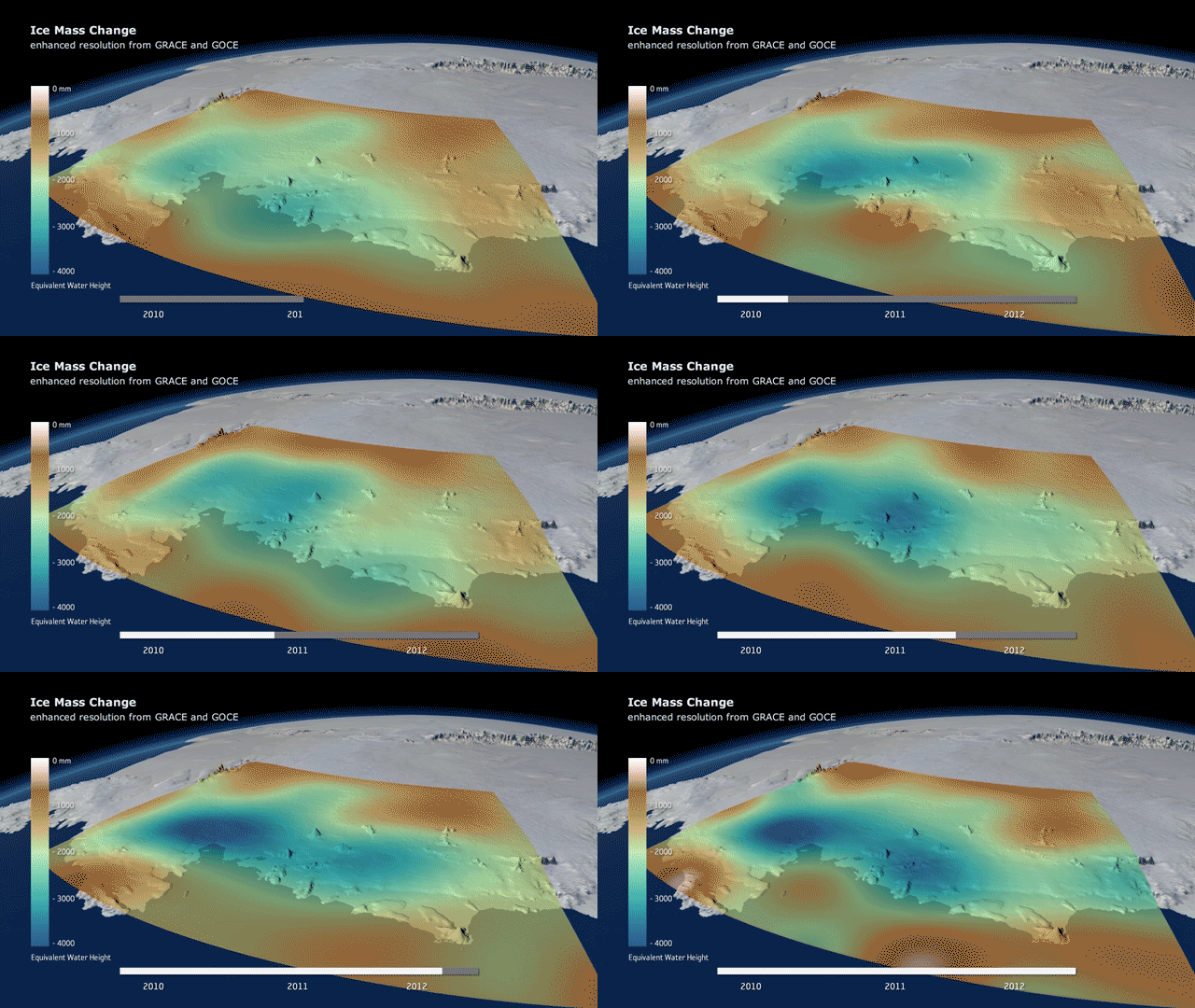
The West Antarctic Ice Sheet is headed toward “unstoppable” collapse according to recent studies. A new visual released by the European Space Agency show what the start of that collapse looks like both for the mass of the ice sheet and its signature on the planet’s gravitational field.
A map of West Antarctic showing ice loss from 2009-12.
We think of gravity as a constant, holding us in place on the planet. But the reality is there are small changes in gravity all over the globe. Not enough that you’ll feel lighter on your feet in one place compared to another, but enough that scientists can use satellites to measure the differences. Those measurements can, in turn, help us better understand the world around us, from how earthquakes shift land to how fast ice sheets are receding and what that means for sea level rise.
The measurements released by the European Space Agency on Friday fall into the latter category. They show gravity in the region is decreasing as the West Antarctic Ice Sheet has melted faster and faster over a 3-year period from 2009-12, sending more water into the sea.
This region of the ice sheet has been intensely studied by scientists and recent research indicate melt could be “unstoppable.” The melt of that section of the ice sheet would raise sea levels 10-13 feet, though the timetable for that happening is centuries, not single years or decades.
The new measurements will help scientists refine their understanding of what’s happening in the land way down under. Scientists are looking to expand the analysis to all of Antarctic to get a better sense of how ice is moving there. Recent estimates of Antarctic ice sheet loss are in the range of 125 cubic kilometers a year, which accounts for about 10 percent of observed sea level rise.
Ice sheets respond slowly to changes in climate, because they are so massive that they themselves dominate the climate conditions over and around them. But once they start flowing faster towards the shore and melting into the ocean the process takes centuries to reverse. Ice sheets are nature’s freight trains: tough to start moving, even harder to stop.
We know this process has been going back and forth throughout history – it’s why we’ve had ice ages and warm periods. But until now we haven’t known exactly how quickly ice sheets retreated and reformed. New research published in the journal Nature Communications gives us an answer, and it isn’t great news.
It turns out sea levels often rose at scary rates in response to natural climate changes, long before mankind began pumping carbon into the atmosphere.
In the short-term sea level is affected by ocean warming and so-called “thermal expansion”, or melting glaciers based on land. These changes can occur quickly – within a decade – but their impact on sea level is relatively small, in the tens of centimetres. The drivers of longer-term sea level rise, over decades or centuries, are the continental ice sheets of Greenland and Antarctica.
On the fringes of these ice sheets are “ice shelves” stretching far out into the ocean. Ice shelves can be hundreds of meters thick and, because 90% of ice in water floats below the surface, they remain “grounded” on the sea floor as long as the sea is less deep than 90% of the ice shelf thickness. Where the sea floor is deeper or the ice shelf gets thinner, there will be an area of floating land ice; here, warming ocean water can get underneath and melt the ice. Once sufficiently destabilised, an ice shelf can break up catastrophically.
One small portion of the West Antarctic ice shelf slides into the sea. Images via NASA
Such an ice shelf collapse takes the brakes off the ice stream that feeds into the ice shelf, and land ice starts to flow much quicker towards the ocean.
Ice flow is a relatively slow process, and it takes some forcing to get a major ice sheet to systematically respond (like trying to set a fully loaded freight train into motion). Once moving, however, it will be equally hard to arrest that movement (like trying to stop a moving, fully loaded freight train).
Still, we cannot ignore it, because the sheer volume of land ice on Earth is enormous – equivalent to more than 65m of global sea level rise; Greenland alone accounts for 6 to 7m, West Antarctica for some 5-6m, and East Antarctica for the remainder. These melting ice sheets will dominate major sea level changes for centuries to come.
We can learn something about what to expect by examining sea level changes during the past five ice-age cycles (past half million years), especially through comparing them with the total amount of ice on the planet at the time.
During a peak ice age, Earth held almost three times as much land ice as it holds today. For instance, during the most recent ice age the ice sheet over North America was 10-20% larger than the one we see today over all of Antarctica.
During warm periods in between ice ages the sea was often close to its present level but occasionally reached up to 8 or 9m above today’s shoreline – the equivalent of melting 1.3 Greenlands today.
Diving into deep-sea data
To get a sense of how quickly the sea went up and down, we need highly detailed and well-dated records. Over the past decade I’ve led a team of scientists at the University of Southampton and the Australian National University who have developed such records using data from the Red Sea.
The Red Sea has a very shallow and narrow connection with the open Indian Ocean. It also evaporates quickly – the equivalent of 2m of water each year – so new water must constantly flow in to top up sea levels and to avoid it getting too salty.
But such inflow is restricted by the tiny gap between Djibouti and Yemen, and in the past that connection was even smaller. As a result, the Red Sea was much saltier during previous ice ages, when sea level stood more than 100m below the present. Using microfossils from drill cores from the sea floor we can measure salinity through time and translate this to sea level changes in the Red Sea connection with the Indian Ocean. We were able to assess timings more accurately by comparing these sea level records to climate records from caves, which can be precisely dated by looking at radioactive decay in uranium.
So now we had a detailed sea level record, with a well-defined timescale. Finally, we could work out rates of past sea level changes, and compare changing sea levels with well-dated reconstructions of temperature and CO2 changes (from ice cores).
This allowed us to assess the speed of some 120 sea level rises in the past. Previously, this was possible only for one recent event. Now, for the first time, we had the information to look at how sea levels responded to natural climate change.
It appears the sea level could rise as quickly as 5.5m per century. However this only happened at the abrupt endings of ice ages, starting with about three times the modern ice volume. When starting with double the modern ice volume or less, sea levels did not rise faster than 2m per century. When global ice volume was similar to the present, the sea typically rose less than 1 to 1.5m per century.
A one metre rise in sea level would flood the areas shaded red.
So it seems the fastest losses of ice occur when there is more ice. Not much of a surprise, perhaps, but now at least we have some real numbers to say how fast, and how much ice. And the speed the sea can rise during periods with modern ice volumes is still worrying – a 1m rise this century would hugely affect millions of people. Given that Earth has achieved these rates even when warming was much slower than today, such a rise is very possible.
How long will it take?
In the 120 different events we looked at, ice sheets went from initial change to maximum retreat within 400 years 68% of the time, and within 1100 years for 95%. In other words: once triggered, ice sheet reduction (and therefore sea level rise) kept accelerating relentlessly for many centuries.
Research we carried out previously found that modern sea level rise seems to be conforming to what we would expect from (high end) natural responses to warming. That is: after 150 years of increasing (man made) warming, the ice sheets would only recently be reaching the point where they start making a noticeable contribution to sea level rise.
But that time has come and, once ice sheets start to melt, the freight train is in motion. It will then keep moving for many centuries to come, no matter how hard we stamp on the brakes.
How do you rate your chances of completing a transcontinental road trip? What if you can’t drive and don’t have car? What if you can’t even move unaided? In fact, what about if you’re not even human?
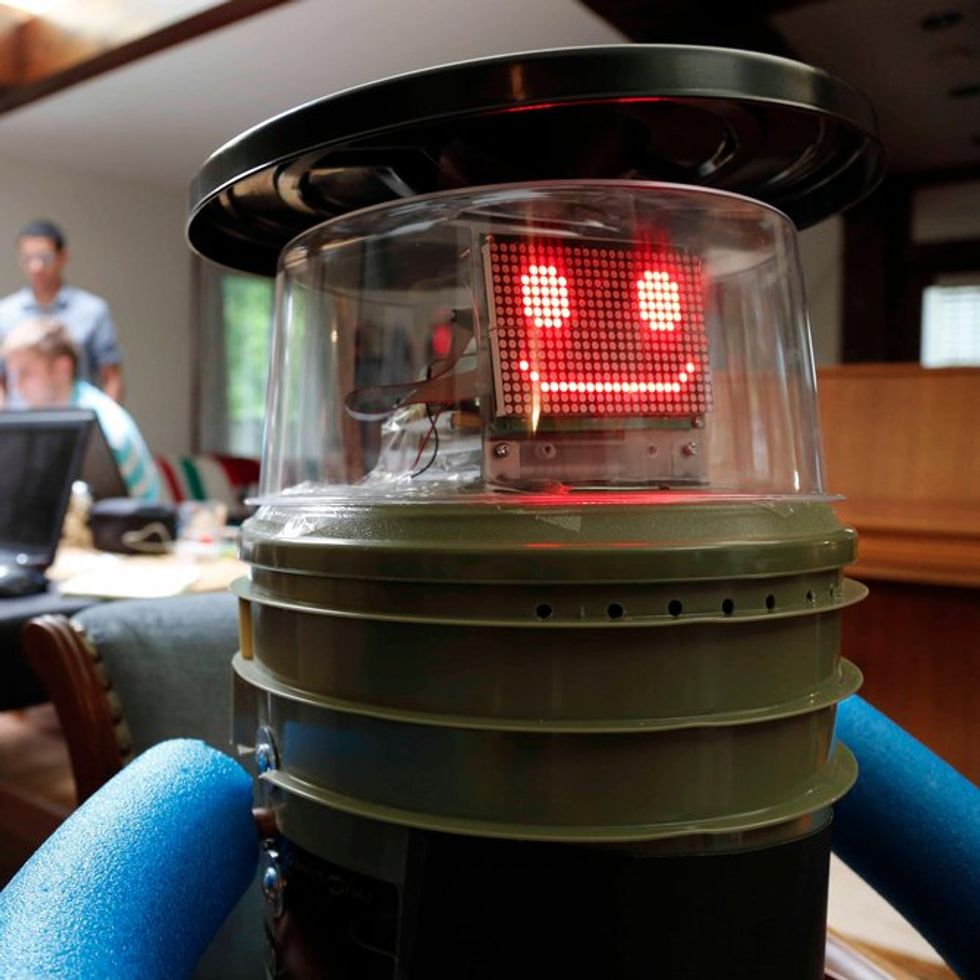
Tweeting, GPS-equipped robot Hitchbot managed it, hitchhiking across Canada this summer from Halifax, Nova Scotia to Victoria, British Columbia. The cylindrical robot, sporting a digital LCD smile and a fetching line in matching yellow rubber gloves and boots, completed the 6,000km journey in around 20 days.
Unlike the robots of the big screen, which tend to come equipped with advanced intelligence and search-and-destroy capabilities, Hitchbot is social, friendly, and entirely human-dependent. It relied only on the kindness of strangers it met along the way to pick it up, put it in their vehicles, and take it as far as they could toward its final destination.
David Harris Smith and I conceived the idea for Hitchbot as an opportunity to set an experimental, technological art project free in the wild. Combining arts and science knowledge (and David’s years of experience as a hitchhiker), we thought a hitchhiking robot would provide a fascinating experience for the public, and would offer some insight on how humans interact with robots. We’re delighted to be receiving a Top 30 Innovation Award at this year’s Silicon Valley Innovation & Entrepreneurship Forum, so it seems others see the same appeal.
It may look like a cake lid for a head, indeed it is a cake lid. But it’s MY cake lid.
Hitchbot
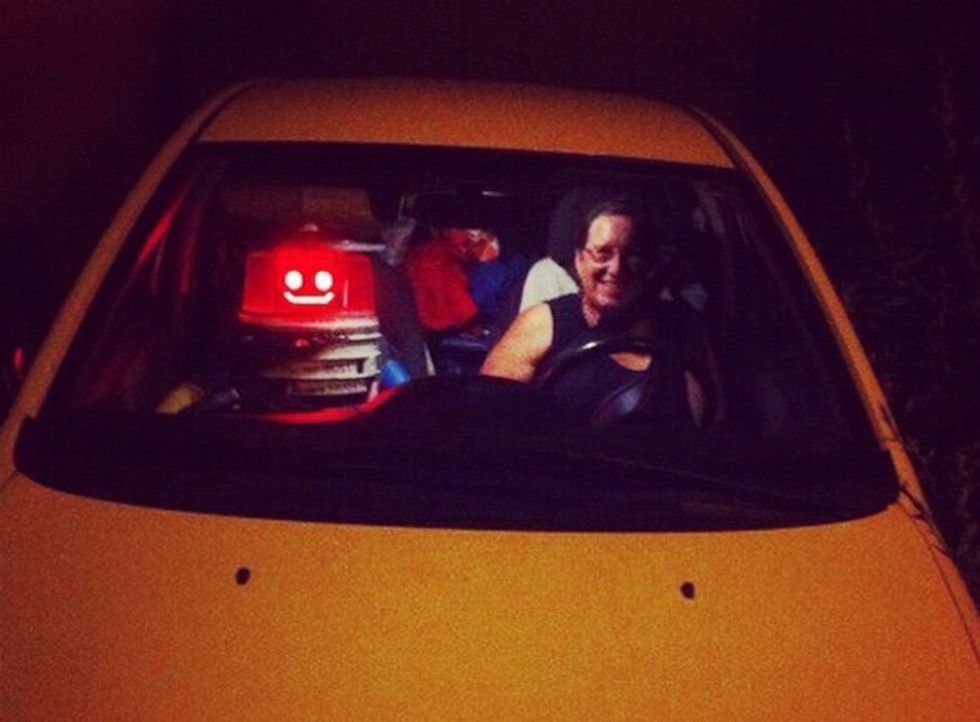
We put the robot down on the side of the highway on July 27, 2014 in Halifax and watched it get picked up by its first travel companions, Anne and Brian Saulnier. Heading to Kouchibouguac National Park in New Brunswick, this was the first of 19 hitches that allowed Hitchbot to traverse the country.
Arriving in Victoria on August 17, the trip was faster and more eventful than we could have imagined. Highlights of the trip included attending a Pow Wow with the Wikwemikong First Nation on Manitoulin Island, doing the Harlem Shake with three travel companions in Saskatchewan, and attending the wedding of Kyle Shepherd and Julie Branch on Kicking Horse Mountain in Golden, BC.
Hitchbot, happy to land a ride.
Hitchbot/Instagram
As Hitchbot’s family we were overwhelmed by the kindness of those who helped the robot cross the country. The willingness to see the project succeed affirmed what people often say about Canadians – that they are warm, polite, and hospitable. Monitoring the journey unfold from Toronto our team never caught wind of anyone attempting to harm Hitchbot. Instead, each participant was charmed by the robot, showed it love, and genuinely wanted to help it reach Victoria.
Of course, the positive media coverage helped. Tens of thousands of people followed the robot’s trip on Facebook, Twitter, and Instagram, sharing hitchhiking advice, personal anecdotes, and suggestions for tourist visits.
The initial question we posed was whether robots can trust human beings – inverting the more common worry of artificial intelligence’s trustworthiness towards humans. While the result shows that the answer seems to be “Yes”, it also demonstrated that by setting the project up as an engaging art and science project, people were eager to get involved. It developed into a participatory event, proving how much interest art and sciences can evoke among the public.
From a scientific point of view, Hitchbot’s progress showed not only the relevance of social media but also that the field of human-robot interaction goes beyond just physical interaction: it is also the personality, communication abilities and ability to actively shape the interaction that seems to invite people to trust a robot and to be willing to engage with it.
This also applies to the design. Whereas Hitchbot’s communication features were more rudimentary compared to high-tech artificial intelligence robots that come at high costs, Hitchbot’s design actually made people want to engage and connect. The design was chosen and intended to instill trust, and also to encourage people to help Hitchbot – so the decision to have it the height of a six-year-old child. The overall design, with matching yellow gloves and boots was meant to be quirky and fun, which turned out to be rather appealing to people.
Many people from around the world have enquired whether Hitchbot will be making trips through the US or Europe – an encouraging sign that a project like this could succeed in places other than Canada. For now, we’re still deciding what trips may come next.
This article was co-authored with Hitchbot family member Alanna Mager.
Frauke Zeller received funding from the European Commission Research Framework (6+7), German Academic Exchange Service, Social Sciences and Humanities Research Council, Canada. She works for Ryerson University, Canada.
David Harris Smith receives funding from GRAND NCE, McMaster University, SSHRC. He is Assistant Professor in the Department of Communication Studies and Multimedia at McMaster University.
The early stages of the process through which birds evolved from dinosaurs was slow and gradual, and there was no single “missing link” separating the two different types of creatures, according to research published in Thursday’s edition of the journal Current Biology. Lead author Dr. Stephen Brusatte, a paleontologist at the University of Edinburgh in Scotland,…
No Single 'Missing Link' Found In Dinosaur-To-Bird Evolution Process
For those involved in and interested in the history of life and its evolution - including the inception of multicellular eukaryotes (organism with cells) - Virginia Tech released some very exciting news recently. According to research conducted by Shuhai Xiao, a Virginia tech professor of geobiology, in conjunction with partners from the Chinese Academy of Sciences,…
Europe's Rosetta spacecraft will attempt on November 12 to land a robot lab on a comet hurtling through deep space in a first for humankind, a statement said Friday.
Ten days after unveiling the preferred landing spot on Comet 67P/Churyumov-Gerasimenko, the European Space Agency (ESA) has now set a firm date for the high-stakes operation more than 450 million kilometres (280 miles) from Earth.
Rosetta will attempt to set down its lander, dubbed Philae, while orbiting the weirdly-shaped comet flying towards the Sun at about 16.79 kilometres per second (10.4 miles per second).
Comet "67P" is made of two lobes joined by a narrow neck -- its silhouette resembling that of a rubber duck.
The ESA has identified "Site J" on the smaller lobe or "head", roughly where the duck's forehead would be, as the preferred landing site. A backup "Site C" is located on the larger lobe.
If all goes according to plan, Rosetta will release Philae at 0835 GMT on November 12 at a distance of 22.5 km from the comet's centre, to land seven hours later.
A delay of 28 minutes and 20 seconds in the one-way signal from Rosetta means that confirmation of landing will arrive on Earth at about 1600 GMT.
If the backup site is used, separation will happen at 1304 GMT, at a distance of about 12.5 km, to land four hours later, said an ESA press statement. In this scenario, confirmation will arrive at about 1730 GMT.
Rosetta is equipped with 11 cameras and sensors that have already yielded astonishing images of the comet.
But experts are hoping for even bigger discoveries from the 10 instruments aboard Philae.
They would like to learn more about comets -- icy bodies that were born along with the Solar System some 4.6 billion years ago, and are credited by at least one theory of bringing life to Earth.
Comet 67P is on a 6.5-year Sun orbit.
Rosetta caught up with it after a six-billion-km trek that required four flybys of Earth and Mars, using the planets' gravity as a slingshot to build up speed.
At their closest approach on August 13, 2015, the comet and Rosetta will be 185 million km from the Sun.
Weighing in at about 100 kg, Philae would use harpoons to anchor itself to the comet before driving screws into the surface for better grip.
Its experiments would include drilling up to 30 centimetres (18 inches) into the comet to extract material for onboard chemical analysis.
Watch out Harry Potter, you are not the only wizard with an invisibility cloak.
Scientists at the University of Rochester have discovered a way to hide large objects from sight using inexpensive and readily available lenses, a technology that seems to have sprung from the pages of J.K. Rowling's Harry Potter fantasy series.
Cloaking is the process by which an object becomes hidden from view, while everything else around the cloaked object appears undisturbed.
"A lot of people have worked on a lot of different aspects of optical cloaking for years," John Howell, a professor of physics at the upstate New York school, said on Friday.
The so-called Rochester Cloak is not really a tangible cloak at all. Rather the device looks like equipment used by an optometrist. When an object is placed behind the layered lenses it seems to disappear.
Previous cloaking methods have been complicated, expensive, and not able to hide objects in three dimensions when viewed at varying angles, they say.
"From what, we know this is the first cloaking device that provides three-dimensional, continuously multidirectional cloaking," said Joseph Choi, a graduate student who helped develop the method at Rochester, which is renowned for its optical research.
In their tests, the researchers have cloaked a hand, a face, and a ruler – making each object appear "invisible" while the image behind the hidden object remains in view. The implications for the discovery are endless, they say.
"I imagine this could be used to cloak a trailer on the back of a semi-truck so the driver can see directly behind him," Choi said. "It can be used for surgery, in the military, in interior design, art."
Howell said the Rochester Cloak, like the fictitious cloak described in the pages of the Harry Potter series, causes no distortion of the background object.
Building the device does not break the bank either. It cost Howell and Choi a little over $1,000 in materials to create it and they believe it can be done even cheaper.
Although a patent is pending, they have released simple instructions on how to create a Rochester Cloak at home for under $100.
(Writing by Frank McGurty; Editing by Sandra Maler)
A strain of genetically modified wheat never approved for sale or consumption in the United States was discovered growing in Montana in July, officials with the U.S. Department of Agriculture said on Friday.
The announcement of a new incident came as USDA's Animal and Plant Health Inspection Service (APHIS) said it had concluded a 10-month probe into a separate unauthorized wheat discovery in Oregon in May 2013, without being able to determine how the GM wheat appeared.
The two incidents were unrelated, since the wheat varieties differed significantly, Bernadette Juarez, APHIS' chief investigator of the 2013 incident, told reporters on a conference call.
Both were engineered to be resistant to Monsanto Co's powerful glyphosate herbicide, commonly known as "Roundup," but they were otherwise different varieties.
USDA said GM wheat was found at Montana State University's Southern Agricultural Research Center in Huntley, where wheat was tested between 2000 and 2003.
The 2013 discovery caused an outcry from U.S. wheat buyers, mostly in Asia. Exports to some destinations were suspended for a time, but resumed when extensive testing of cargoes showed no more evidence of unapproved wheat.
Juarez said USDA "has been in communication with our trading partners" about the latest find.
USDA officials said the U.S. Food and Drug Administration in 2004 determined there is no health risk to humans from GM wheat.
(Reporting by Ros Krasny in Washington and Carey Gillam in Kansas City; Editing by Mohammad Zargham)