Last week, senators put the CEOs of five social media giants each in the hot seat over accusations of their platforms’ negligence toward the sexual exploitation and online safety of children.
The hottest seat of all at a multi-hour Senate Judiciary Committee hearing belonged to Meta CEO Mark Zuckerberg, who a senator asked to stand up and publicly apologize to victims and parents in attendance holding photos of their children they say were sexually abused, bullied or committed self harm — many dying by suicide — related to exploitation on social media platforms.
“Mr. Zuckerberg, you and the companies before us, I know you don’t mean it to be so, but you have blood on your hands,” said Sen. Lindsey Graham (R-SC), the committee’s ranking Republican. “You have a product that’s killing people.”
“With the touch of your finger that smartphone that can entertain and inform you can become a back alley where the lives of your children are damaged and destroyed,” said Sen. Dick Durbin (D-IL), chair of the Senate Judiciary Committee.
“You, as an industry, realize this is an existential threat to you all if we don't get it right?” Sen. Thom Tillis (R-NC) said. “We can regulate you out of business if we wanted to.”
“There is literally no plausible justification, no way of defending this,” Sen. Mike Lee (R-UT) said.
Yet, Graham, Durbin, Lee and Tillis are among more than a dozen senators who grilled Zuckerberg and his tech peers but also took donations from Meta’s political action committee, company executives, lobbyists, or a combination of all three, totaling more than $120,000 combined since 2017, according to a Raw Story analysis of federal campaign records.
Who took donations from Meta?
Raw Story reached out to the offices for 15 senators who spoke at the hearing and received donations from political action committees or leaders at Meta and other social media companies represented at the hearing, including TikTok, Snap, X (formerly Twitter) and Discord.
Raw Story asked: Would the senators return donations from these social media companies or refuse future donations?
Only three responded to Raw Story’s requests for comment.
Between late 2019 and mid-2023, Graham’s campaign committee, Team Graham, received at least $15,800 from the PAC and lobbyists for Meta, the parent company of Facebook, Instagram and WhatsApp, according to Raw Story’s review of records from the Federal Election Commission.
After a Nov. 7 Senate Subcommittee on Privacy, Technology and the Law hearing with a Facebook whistleblower, Graham said he would refund the money his campaign received from Meta companies and other social media platforms, NTD reported.
Team Graham donated $16,000 and his Fund for America’s Future PAC donated $2,500 to the National Center on Sexual Exploitation, said Kevin Bishop, a spokesperson for Graham.
The National Center on Sexual Exploitation confirmed it received Graham’s committed gift, which helped bring survivors to the hearing and “will continue to be used to bring survivors to meet with legislators across the aisle so survivors have a voice to educate policymakers on the impact of sexual exploitation and the scale at which it occurs online,” said Dawn Hawkins, CEO of the National Center on Sexual Exploitation, via an emailed statement.
“We aren't aware of any similar pledges made by other legislators,” Hawkins said, noting that the center supports bipartisan legislation including the Eliminating Abusive and Rampant Neglect of Interactive Technologies Act (EARN IT) Act and the Kids Online Safety Act (KOSA).
“Graham made a pledge and he fulfilled that pledge,” Bishop told Raw Story via email.
Hawkins said Big Tech companies “know the harm they are facilitating” and “continue to shirk responsibility and roll out piecemeal and ineffective solutions,” particularly in relation to vulnerable populations such as those who identify as LGBTQ+.
“These companies continue to put the burden on overwhelmed parents despite having flawed and ineffective parental controls, and they ignore children without the privilege of involved, tech-savvy caregivers, when high-level corporate actions could better protect all children,” Hawkins said.
The social media companies don’t spend enough on child safety protocols either, Hawkins said, calling the CEOs unprepared for the hearing. To them, “investment in child safety is not a priority, but an afterthought,” she said.
Tillis’ campaign committee received at least $27,200 from current and former registered lobbyists for Facebook and Meta Platforms Inc PAC (previously known as Facebook Inc. PAC), between June 2017 and March 2023, FEC records indicate.
Lee’s campaign received at least $16,800 combined in donations from Meta (and formerly Facebook) PAC and a former Facebook lobbyist, as well as from an executive for ByteDance, the parent company of TikTok, between September 2019 and June 2022. The vast majority of the funds were Meta-related, and one $2,500 check from Facebook PAC went uncashed, according to FEC records.
The campaign for Sen. Chris Coons (D-DE) took in at least $17,100 combined from Meta and (formerly Facebook) PAC and Sheryl Sandberg, former COO for Meta, between March 2020 and December 2023, per federal records.
Durbin’s campaign received at least $11,300 between June 2019 and December 2021 from the Facebook and Meta PAC, and Sandberg, according to Raw Story analysis of FEC data.
Sen. Mazie Hirono (D-HI) received at least $7,900 from Facebook PAC and Sandberg between March 2017 and September 2018, per FEC records.
In 2017 and 2018, Facebook PAC and Sandberg combined to donate at least $7,700 to Sen. Amy Klobuchar (D-MN), according to FEC records. Other Facebook lawyers donated to her campaign.
"Senator Klobuchar has long been the leading advocate for bipartisan competition and safety legislation that the tech companies have opposed. Any question of her integrity when it comes to tech can be refuted by the hundreds of millions of dollars they have spent on TV and in lobbying against her and her legislation,” said Ben Hill, a spokesperson for Klobuchar’s campaign, in a statement to Raw Story.
Sen. Jon Ossoff (D-GA) did not receive donations for his campaign from the PACs for the social media companies, but hundreds of individual employees from Snap, Twitter, Instagram, Facebook and ByteDance donated to his campaign, according to FEC records.
In particular, Isaac Bess, an executive at ByteDance, and Jerry Hunter, an executive at Snapchat, each donated $1,000 to him in January 2021. Michael Lynton, Snapchat chairman, donated nearly $2,000 in December 2020 to his campaign committee.
Other individuals who identified themselves in leadership positions such as directors, business leads and attorneys donated more than $35,000 combined to the Jon Ossoff for Senate committee.
“Sen. Ossoff does not accept contributions from corporations, corporate PACs or federal lobbyists,” said Jake Best, an Ossoff campaign spokesperson, who did not address Ossoff's campaign accepting money from individual social media executives.
The campaign for Sen. Sheldon Whitehouse (D-RI) received at least $4,500 from Facebook PAC in 2017 and 2018, per federal campaign records.
Sen. Alex Padilla (D-CA) did not receive PAC donations from the social media companies, but his campaign took in at least $1,250 in donations combined from registered lobbyists for Twitter (now known as X) and TikTok. Other attorneys and leaders in public policy or risk management from ByteDance (the parent company of TikTok), Twitter and Facebook donated at least $3,700 combined, according to FEC records.
Sen. Tom Cotton (R-AR) got $2,000 from Facebook PAC between 2018 and 2019, and Sen. Ted Cruz (R-TX) received at least $1,500 from a Facebook lobbyist between October 2018 and October 2022, according to FEC records.
Sens. Peter Welch (D-VT) — when he was running for the House — Richard Blumenthal (D-CT) and John Kennedy (R-LA) each got $1,000 for their campaigns from Facebook PAC or executives between 2018 and 2021, records show.
Meta did not respond to Raw Story’s request for comment.
Now, there’s a legitimate chance Donald Trump could be running for president, or even serving as commander in chief, from behind bars.
Two overriding factors contribute to this bizarre reality.
Firstly, there’s very little — legally speaking — preventing Trump from doing so.
Secondly, Trump himself has offered no indication he’ll step away. To the contrary, he’s as emboldened as ever to run for and win the presidency he lost in 2020.
Thus far, juries have found Trump civilly liable for the sexual abuse and defamation of writer E. Jean Carroll. He’s been ordered to pay more than $88 million combined in damages.
New York Judge Arthur Engoron also found Trump and associates of his business empire liable for fraudulently inflating the value of the Trump Organization’s assets. Determination of damages in the civil fraud trial are expected this month — and could be well into the hundreds of millions of dollars.
And then there's the felony charges: 91 in total across four cases. If convicted, Trump could face significant prison time — totaling more than 700 years combined.
His trials are scheduled in the midst of the Republican presidential primary.
The indictments:
For the first time in U.S. history, a grand jury on June 8, 2023, federally indicted a former president — Trump — on 37 felony counts related to the alleged willful retention of classified documents and conspiracy to conceal them. District Judge Aileen Cannon set trial to begin May 20, but in February, special counsel questioned whether the FBI missed searching some rooms at Trump’s Mar-a-Lago residence, ABC reported.
Then it happened again on Aug. 1 when Trump was indicted on four separate federal counts related to his alleged efforts to overturn the 2020 election. He was set to be tried starting March 4, but U.S. District Judge Tanya Chutkan delayed the trial's start as Trump — unsuccessfully, so far — petitioned a federal appeals court to rule that he enjoys presidential immunity from such prosecution.
Trump also faces a criminal trial in Georgia related to election interference in the state, with trial requested for Aug. 5. Fulton County District Attorney Fani Willis admitted in February to having a romantic relationship with a special prosecutor overseeing the case but denied any tainting of the case, Raw Story reported.
Separately, Trump is charged in New York with 34 felony counts of falsifying business records in relation to payments the Trump Organization made to adult film actress Stormy Daniels. His trial is slated for March 25.
Such a laundry list of legal woes would seemingly sabotage any politician’s campaign efforts. But the cases haven’t slowed Trump down in his pursuit of a second term as president or slashed his chances — now as good as ever — of winning the 2024 Republican nomination.
Trump, who has handily won in the Republican primaries thus far, is almost certain to become the Republican nominee — and has made it clear he has no intention of dropping out of the race no matter how severe his legal battles become.
“I see no case in which I would do that,” Trump said in June during an appearance on a radio show hosted by political strategist Roger Stone, a longtime confidant. “I just wouldn't do it. I wouldn't do it. I had opportunities in 2016 to do it, and I didn't do it.”
But Allan Lichtman, a professor of history at American University, said campaigning for president and defending himself against criminal charges are two very different endeavors.
“He thinks he can win this case in the court of public opinion, but the truth is, Trump can huff, and Trump can puff, but he can't blow the courthouse down,” Lichtman said. “It’s a very, very different game once you enter a federal courthouse or a state courthouse. You can't just bluster. Anything that you present has to be proven, and you're subject to perjury.”
Still, Trump can continue to run his campaign while facing these charges — and he could even do so from prison in the event he were to be tried, convicted and sentenced before the 2024 election.
“Trump’s legal problems shouldn’t affect his campaign. Many of his supporters believe that he is being treated unfairly, and there is no prohibition against a defendant under indictment or even a convicted felon from serving as president,” said Neama Rahmani, a former assistant U.S. attorney and president of West Coast Trial Lawyers. “Theoretically, Trump could even be president while in prison.”
Indeed, the U.S. Constitution stipulates only that a presidential candidate be a natural-born citizen of the United States, be at least 35 years old and a U.S. resident for 14 years. Trump easily checks all those boxes. And congressional Democrats’ strongest efforts to potentially disqualify Trump from ever again seeking the presidency — convicting him following impeachment trials — failed.
So, what would it take for Trump to run a presidential campaign — or govern the nation — from prison?
Raw Story interviewed historians, legal experts, political operatives and former government leaders who pieced together a playbook for how he could do it — and the peril that he’d face along the way as he stands to secure the GOP nomination ahead of a general election rematch with President Joe Biden in November.
Campaigning from a cell
Each of the charges Trump faces in the classified documents federal indictment carries maximum prison sentences between five and 20 years. Across all four indictments, potential prison time could span hundreds of years.
Being behind bars would, of course, prevent Trump from campaigning in his signature fashion: at big, rowdy MAGA rallies.
But Amani Wells-Onyioha, operations director at Democratic political firm Sole Strategies, envisions Trump still figuring out ways to communicate with potential voters.
“There's no doubt in my mind that he would have some recorded press from the little prison phone. There's no doubt in my mind that he would set up press opportunities whenever he's out on the yard getting his recreational use in, that there would be cameras there,” Wells-Onyioha said. “He would be using every opportunity to campaign. I don't see him stopping at all, and I only see him using this as fuel to make him go harder.”
Keeping up his Truth Social posts from prison might not be such a challenge for Trump, Wells-Onyioha said, as some jails and prisons might allow internet access.
“I do see him using the internet because that's all that he has, and he's great at that already,” Wells-Onyioha said. “He's a huge internet, TV personality type of guy, so it really would just force him to be in a position to do something that he's the best at, which is unfortunate for the country, but as far as he's concerned, I think he thinks that this is political gold for himself.”
Plus, Trump isn’t building a campaign from scratch. His 2024 presidential campaign is flush with staffers. He enjoys the support of super PACs, which may raise and spend unlimited amounts of money on his behalf to promote the former president and attack his opponents.
He also has a roster of high-profile MAGA acolytes — from Reps. Marjorie Taylor Greene (R-GA) and Elise Stefanik (R-NY) to Sen. J.D. Vance (R-OH) and South Dakota Gov. Kristi Noem — who gladly serve as Trump surrogates.
And save for former South Carolina Gov. Nikki Haley, who remains in the race despite losses in the Iowa caucuses and New Hampshire primary, with dim prospects going forward, Trump has already vanquished his other main GOP challengers, including Florida Gov. Ron DeSantis, Sen. Tim Scott (R-SC), former New Jersey Gov. Chris Christie, former Vice President Mike Pence and businessman Vivek Ramaswamy.
Meanwhile, few politicians are as good as Trump at presenting himself as a victim — he’s single-handedly vaulted the terms “witch hunt,” “deep state,” “hoax” and “fake news” into the contemporary political lexicon. As an inmate, Trump could become a martyr to the MAGA cause.
“You’re obviously handicapped to campaign, but in this electronic age, you can certainly campaign virtually, plus Trump's pretty well known. It’s not like he has to introduce himself to the American people,” Lichtman said.
If not prison, maybe jail
Former President Donald Trump arrives for his arraignment at Manhattan Criminal Court on April 04 in New York City. Michael M. Santiago/Getty Images
Although it seems unlikely Trump will be serving an active prison sentence before the November election, it’s conceivable he could wind up in pretrial confinement of some sort while campaigning.
This, several legal experts said, will depend on Trump himself.
“He has to behave himself during a trial, and that's not beyond the realm of possibility that he'll act up, thinking that somehow he can win over the jury, but that would be a mistake,” said Kevin O’Brien, a former assistant U.S. attorney and partner at Ford O’Brien Landy LLP who specializes in white-collar criminal defense.
His social media antics stand to put him in potential violation of pretrial instructions and release terms, raising the question of whether a judge would dare throw the former president in jail. So far, he’s been fined thousands for violating gag orders.
Brazenly defying a judge’s order or attempting to intimidate witnesses are among the more common ways a defendant can get himself thrown in jail or home confinement before or during his trial.
This isn’t merely conceptual, said Mike Lawlor, a criminal justice professor at the University of New Haven and former member of the Connecticut House of Representatives, who helped lead impeachment hearings against then-Gov. John Rowland, who ultimately pleaded guilty in federal court to political corruption.
Knowing Trump’s penchant for cutting outbursts, Lawlor can envision a judge sanctioning Trump for defying directives. Trump not only has one judge with whom to contend, but several, given the multiple legal actions against him.
“The opportunity to engage in contempt of court or witness tampering or obstruction of justice is fraught at this point. I’m not sure he has the self-control to keep himself from doing something that would get him confined pre-trial,” Lawlor said.
The U.S. House Jan. 6 select committee accused Trump of potential witness tampering, and Lawlor says he’s monitoring similar allegations here, especially because so many of the witnesses are GOP staffers of the former president.
“It’s so easy to imagine a situation where someone could be contacted and intimidated,” Lawlor said. “I think the temptation to do that for a guy like Trump is probably irresistible. I’m not sure his attorneys or the advisors he listens to can stop him from doing so. I don’t rule it out. As I said, it’s unlikely, but I can definitely see it happening.”
Using legal danger to fuel fundraising
The Trump campaign wasted no time in exploiting the indictments to raise money, leaning into a familiar claim that the candidate is a victim of a Democratic witch hunt.
Only one day after news broke about Trump’s first federal indictment, a fundraising appeal built around the charges appeared on the campaign website prominently displayed in a column on the left-hand side of the page, suggesting contribution amounts ranging from $24 to $3,300. The message lays out a bill of particulars with the former president at the center of the persecution narrative, beginning with the apocalyptic opener: “We are watching our Republic DIE before our very eyes.”
Trump Save America, the beneficiary, is a joint fundraising committee for Donald J. Trump for President 2024 and the Save America PAC, which supports Trump.
The fundraising appeal contends that a “witch hunt began when the FBI RAIDED my home and then staged it to look like a made-for-TV crime scene with police sirens and flashing red and blue lights.”
Alluding to his previous indictment in New York state, the appeals continued: “So, after a state prosecutor failed to break us, the Deep State sharpened their attacks and unleashed a FEDERAL prosecutor to TRY and take us down.”
Notwithstanding Trump’s claim, the charges in New York state remain pending, and Jack Smith, the special prosecutor appointed by U.S. Attorney General Merrick Garland, was investigating Trump for allegedly mishandling classified documents four months before a grand jury in New Manhattan returned an indictment on the state charges related to the Stormy Daniels affair.
Minutes after the Aug. 1 indictment dropped, Trump started fundraising again, selling "I Stand With Trump" T-shirts featuring the indictment date, and Trump's mugshot from his booking at the Fulton County Jail helped him bring in more than $7 million after the Georgia indictment as he quickly took to selling mugs, shirts and other merchandise with the photo.
At least one prominent surrogate helped retail the fundraising push.
Kari Lake, a fellow election denier who lost her race for governor of Arizona in 2022, joined a Twitter Spaces co-hosted by Dustin Stockton and Jennifer Lynn Lawrence on the night news broke about Trump’s indictment on charges of mishandling classified documents.
Stockton and Lawrence helped organize the rally that provided the springboard for the Jan. 6 insurrection. During her appearance on Stockton and Lawrence’s Twitter Space, Lake, who is now running for U.S. Senate, told more than 1,300 listeners she had just gotten off the phone with Trump shortly after news broke about the indictment on June 8. Lake said it wasn’t enough for Republican voters to just say they stand with Trump or condemn the indictment.
“And if we really stand with him, we need to go to DonaldTrump.com and make a donation tonight,” said Lake, who is herselfpreparing a 2024 U.S. Senate run in Arizona. “Everybody, whether it’s $5, $10, $500 — whatever you can afford. Because if we’re gonna stand with him, we need to put our money where our mouth is tonight.”
The political monetization of Trump’s legal woes grows deeper by the month. Go to Trump’s campaign website and you’ll find several items on sale — a black-and-white ceramic coffee mug is $24 — featuring a fake mugshot of Trump above the words “NOT GUILTY”. Of late, Trump hassuggested that he would “end” his campaign in a deceptive bid to squeeze money from supporters.
The Federal Election Commission, which enforces federal campaign finance laws, would have no grounds to intervene in Trump’s fundraising efforts while facing criminal charges or even time in jail or prison, said Ann Ravel, who served as an FEC commissioner from 2013 to 2017, including one year as the commission’s chairwoman.
Trump's campaign is selling these black-and-white ceramic coffee mugs for $24. (Screen grab)
Trump’s campaign could easily continue sending supporters incessant fundraising emails and text messages in Trump’s name.
“The only problems for him would be if there's failure to disclose, or if people are giving more than the limits, all of the things that are traditional FEC issues, but they don't have the authority to do anything with regard to a person who's been indicted and is still fundraising,” Ravel said. “That in and of itself is not sufficient for the FEC to take any action.”
Lessons of Eugene Debs, incarcerated presidential candidate
Trump wouldn’t be the first candidate to run for president from prison if he were convicted.
In the weeks before the 1920 election, Eugene V. Debs, the Socialist Party candidate for president of the United States and an inmate in federal prison, touched on the significance of the moment.
“Has there ever been anything like it in American history before?” Debs said, as reported by the socialist newspaper Appeal to Reason. “Will there ever be anything like it in American history again? We must impress it upon the people that this scene is symbolic of what has befallen this country.”
There has been one other. Lyndon LaRouche, whom The New Republiccalled “The Godfather of Political Paranoia,” ran from prison in 1992 after being convicted of tax evasion and mail fraud.
His vice presidential running mate, the Rev. James Bevel, did most of the campaigning. This suggests that a jailed Trump could lean heavily on the presence of a charismatic vice presidential candidate — be it someone such as Lake of Arizona, Rep. Marjorie Taylor Greene of Georgia or even banished Fox News host Tucker Carlson.
LaRouche received .02% of the popular vote — 26,334.
Debs, who was serving a 10-year sentence for decrying the United States’ involvement in World War I, received 3.4% of the popular vote — 919,799.
He received 6% of the vote as a candidate eight years earlier, in 1912.
While emphasizing that she’s speaking as an individual, Allison Duerk, director of the Eugene V. Debs Museum, located in Debs’ home in Terre Haute, Ind., said she cringes at comparisons between Debs and Trump. In material ways, the two men are polar opposites.
“I bristle at recent casual references to the 1920 campaign — not because they are inaccurate on the surface, but because these two men and their respective projects are diametrically opposed,” she told Raw Story.
Duerk does believe Debs predicted the emergence of American political leaders such as Trump.
Illustration of Eugene Debs while running for president in prison. Indiana State University archives
“Take this quote from the speech that got him locked up,” she said, quoting Debs: “‘In every age it has been the tyrant, the oppressor and the exploiter who has wrapped himself in the cloak of patriotism, or religion, or both to deceive and overawe the people.’"
In an Appeal to Reason article, Debs said he believed in change “but by perfectly peaceful and orderly means.” He added, “Never in my life have I broken a law or advised others to do so.”
Unlike Trump, who nurses grievances daily, the article said of Debs, “Nothing embitters him. Injustice, oppression, persecution, savagery do not embitter him. It is a stirring, an uplifting thing to find a man who has suffered so much and remains so ardent and so pure.”
The U.S. government and the prison warden made small accommodations to Debs’ candidacy. He was, for one, allowed a single written message per week to voters.
“Where Debs had once stormed the country in a verbal torrent,” wrote Ernest Freeberg, author of Democracy’s Prisoner, “he would now have five hundred words a week.”
Debs still had some of the trappings of a political campaign, including a button that had his photo from prison with the words, “For President - Convict No. 9653.” He had printed material that said, “From Atlanta to the White House, 1920,” a reference to his residency inside the Atlanta Federal Penitentiary.
On election night, Debs received the results in the warden’s office and soon conceded the election to President-elect Warren Harding.
In his book Walls and Bars, Debs wrote that the question came up in the room about his potential ability to pardon himself as president — an action over which Trump has reportedly mused.
“We all found some mirth in debating it,” Debs wrote.
Serving as president from prison
If Trump ran a successful campaign from jail or prison, is there anything stopping him from assuming the Oval Office if he were elected president?
“There is nothing in our traditions or the Constitution that prevents someone who is indicted or convicted or, in fact, serving in jail, from also serving as the president,” said Harold Krent, law professor at the Chicago-Kent College of Law, who formerly worked for the Department of Justice. “Does it make any sense? No. But there is no Constitutional disablement from that happening. So, you could think of a scenario in which the case goes to trial, maybe after the primary and results in a prison time with President Trump and then he is inaugurated, and he gets to serve as president from some prison farm somewhere.”
Lichtman said “of course” Trump would just pardon himself of any federal crimes were he reelected president. There’s also the possibility of Trump attempting to preemptively pardon himself, with then-President Gerald Ford’s pardoning of Richard Nixon serving as an imperfect template.
But if Trump is convicted on any state-level charges, where federal pardons do not apply, that’s a different story.
“That's unprecedented, but the pardon power is pretty absolute,” Lichtman. “He can’t pardon himself for the New York case because that’s a state case. If he's convicted in New York, he's stuck. If ... he's convicted in Georgia, he can’t pardon himself from that either, because that's also a state case.”
Trump’s ability to pardon himself is widely debated in the academic community, Krent said.Federal document listing indictment counts against former President Donald Trump. U.S. District Court, Southern District of Florida
“There's no law on the books that says you can't. You just have to reason from the idea of separation of powers and the Constitution or to think that it doesn't make any sense to have one person aggregate or accumulate so much power,” Krent said. “As a constitutional matter, I think that that would be too much of a conflict of interest to be able to pardon yourself.”
Interestingly, the classified documents federal indictment didn’t include counts related to 18 U.S.Code 2071, which deals with the concealment, removal or destruction of government documents. This would disqualify anyone found in violation of the code from running for office, Rahmani said.
“That particular provision was passed after Nixon as a disqualification provision that prevents anyone convicted of it from holding public office,” Rahmani said. “Trump's lawyers would have said that it's unconstitutional because only the Constitution can place limits on who could be president. You can be a felon. You can be in prison and still theoretically be president of the United States.”
The Constitution could be interpreted — ostensibly by the U.S. Supreme Court — that an imprisoned president wouldn’t qualify as capable of carrying out his duties, preventing him from taking the office, Ravel said.
“There's nothing to stop him from becoming president either because the provisions in the Constitution about the presidency and the requirements for presidency don't reflect any concern if a president has been indicted or is in jail,” Ravel said. “Although if he goes to jail, it would create a problem for him because the Constitution does have concerns about the inability to carry out the obligations of the office, which he certainly wouldn't be able to do in jail.”
Specifically, Section 4 of the Constitution’s 25th Amendment potentially empowers Congress to determine — via a two-thirds vote of both chambers — that a president is “unable to discharge the powers and duties of his office” and thereby transfer presidential powers to the vice president.
But if Trump is elected in November, and trials end up taking place after the general election, some of his legal peril could subside — at least at the federal level.
“There's clear Department of Justice memos and policies. It's pretty clear that a sitting president cannot be prosecuted,” Rahmani said.
If Trump won and was convicted but on appeal, he would “probably” still be able to get inaugurated, Krent said.
“The question is whether they would stop the appeal and let him serve out the presidency before it would continue,” Krent said. “Uncharted waters in terms of how this would go. It's gonna affect the primary. It would affect the general election, and it certainly would affect his ability to conduct a presidency.”
Editor’s note: A version of this article was originally published on June 13, 2023, and has been updated to reflect numerous legal and political developments involving Trump.
WASHINGTON — Ever feel the full weight of the far-right messaging machine — misinformation and all — come down on you?
Welcome to the new world of one of the Republican Party’s own — Sen. James Lankford of Oklahoma.
For the past four months, Lankford has been Senate Republicans lead negotiator on a bipartisan Southern border security bill — a policy Republicans demanded be included in a broader foreign aid package for Ukraine and Israel — that conservatives drove to a screeching halt this week.
In doing so, Republicans ditched the hardfought border compromise, along with Lankford, it’s GOP author.
“How’s it feel to be run over by a bus?” Raw Story asked Lankford Tuesday.
“And backed up [over]?” Lankford finished.
It’s not just that House Speaker Mike Johnson (R-LA) declared the $118 billion package “dead on arrival.’’ Or that Senate Republicans bailed on their party’s point person — only four, including Lankford, voted to advance the measure, which failed to advance in the Senate on Wednesday.
Former President Donald Trump, the head of today’s GOP, also denied ever endorsing Lankford — even though Trump absolutely endorsed him.
“Are they here to block us reporters?” Raw Story inquired about his entourage.
“Oh, no, they’re coming to hear me speak on the floor,” Lankford calmly said. “We want to solve problems. We really do. Status quo is the worst scenario.”
Lankford may be calm, but at least one of his fellow negotiators is enraged.
“Look what they did to James Lankford. It's disgusting what they did to James,” Sen. Chris Murphy (D-CT) told reporters at the Capitol on Tuesday. “They put him out there and asked him on their behalf to negotiate a compromise, and then they didn't even give him the chance to argue the merits. Like, these are not serious people.”
Some of Lankford’s Republican colleagues say the deal is good and that their party just needs time to study the measure.
“They can now see that most of that was misinformation,” Sen. Mike Rounds (R-SD) told reporters Tuesday.
“Senator, that misinformation is now gospel in your party,” Raw Story asked before being cut off, “what is your plan to…”
“I disagree with your assessment on that,” Rounds replied Tuesday before voting against the measure Wednesday. “There's a lot of us that are actually reading the bill, and a lot of the information that James gave us has been misconstrued by other individuals on either side. But it really is something that we've got to work hard to get the correct information out to the public about what's really in the bill.”
The GOP seems to have moved on from the security package, even as most Republicans — Trump excluded — defended Lankford’s honor.
“He got thrown to the wolves,” Sen. Josh Hawley (R-MO) told Raw Story. “He had no leverage. He was given no running room. People who are familiar with the negotiations have described it to me, James was basically told, ‘You have to agree to this. You have to agree to that’.”
“I feel bad for him,” Hawley said. “It’s not his fault.”
Whose fault is it?
Democrats say the answer to that is undeniable.
“It's 100 percent clear what's happening here,” Murphy of Connecticut continued. “The truth is simple, in the end they sided with Donald Trump who wants chaos at the border because it helps him politically, instead of siding with the American people who want the border to be fixed.”
WASHINGTON – Maxwell Frost has not been shy about criticizing Joe Biden’s administration – from climate change to border policy to Israel’s war in Gaza.
But the nation’s first Gen Z congressman has nevertheless seen his profile inside the Democratic Party rise. And despite Frost’s concerns, the 27-year-old Floridian is becoming an increasingly essential surrogate for the 81-year-old Biden.
To Frost, that push and pull is part of any relationship, and he doesn’t know why it should be any different in politics.
“I just refuse to fall for this, ‘I hate you or I love you thing,’” Frost said in an interview. “I'm going to be honest with you. And if I think that our values align, I'm going to work with you. And I think my values align with President Biden.”
That dichotomy between publicly dissing Biden and supporting him, while unusual for a presidential campaign surrogate, reflects how Gen Z broadly feels about a certain Silent Generation commander-in-chief who’s off seeking a second term.
It also helps explain Frost’s appeal among young voters who are wary of Biden but aghast at the prospect of Donald Trump returning to power. Frost stands as a willing bridge to a new and skeptical generation of voters that the president urgently needs for general election success.
Much like Biden, Frost also sees a second term for former President Donald Trump as an “almost existential threat for this country,” one reason he is motivated to reelect Biden.
Florida is “the epicenter of fascism rising in this country,” Frost said of the home state he shares with Trump, and the former president “obviously represents that movement on such a larger scale.”
‘See themselves reflected in this administration’
While backing Biden is an easy decision for Frost, he said he realizes it might not be for other voters.
That’s why he wants to engage with them as he did recently in Southern Nevada, a state that will be a presidential battleground in 2024 — and one where an uptick in youth turnout during the 2022 midterms proved key in the state’s three competitive House contests and pivotal Senate race. The congressman headlined a roundtable with students at the University of Nevada-Las Vegas who had experienced the December 6 mass shooting at the school. He then held a happy hour with other college Democrats, where he spoke about Biden and addressed concerns the students had about the Biden administration.
“He is a symbol for Gen Z that they can see themselves reflected in this administration and in Congress and in Washington,” said a Nevada Democrat who worked with Frost on the trip.
Biden’s age creates an understandable distance with these young voters, the Democrat added, but the people Frost met with came away saying, “If this guy, who is like me, is saying we should get on board, then we should get on board.”
Frost’s ability could become a campaign super-weapon for Biden, the oldest president in American history who, upon serving a complete second term, would be 86 years old the day he leaves soffice in early 2029.
Polls show younger voters are unsure about Biden, citing many of the same critiques – climate change and Gaza, primarily – as reasons to question him. Some are considering third-party candidates, such as Robert F. Kennedy Jr. or Cornel West. Others are open to not voting at all, an outcome that top Democrats think could lead to losses nationwide.
That’s why Frost, who has said he will do whatever he can to re-elect Biden, wants people to understand the effect of non-participation.
“The main opponent here for me is not even Donald Trump,” he said. “As a campaigner, what I'm thinking is, ‘Our main opponent is the couch,’ it is no action at all. And that's how Republicans win, right?”
U.S. Rep. Maxwell Frost (D-FL) gives a thumbs-up outside the Capitol after voting to continue funding the government for 45 days. Philip Yabut/Shutterstock
People who have worked with Frost said he gives younger voters cover for their anti-Biden feelings and demonstrates how you can both criticize a man who is old enough to be your grandfather and support him for four more years in office.
“Maxwell Frost gives younger voters the opportunity to see both sides of the coin,” said Jasmine Burney Clark, founder of Equal Ground Education Fund and Action Fund, a civic engagement organization in Florida that has worked with Frost. “The congressman has been critical of this administration and has applauded this administration at the same time. He has made that complexity available for other folks who are sitting in their [own] complex situations as well around whether to support or not.”
The congressman has “Gen Z gravitas,” added Burney Clark, who has seen Frost campaign with young voters.
Gen Z — four generations removed from Biden’s Silent Generation — is defined by the Pew Research Center as anyone born between 1997 and 2012. When voters elected Frost in 2022, the then-25-year-old became Congress’ first Gen Z member ever.
Frost’s victory, therefore, became a milestone that garnered considerable attention, landed Frost on cable news and led Biden, then president, to call and congratulate him. He was also one of the few bright spots for Florida Democrats in that cycle, which otherwise saw the state’s ranks decimated by Republican Gov. Ron DeSantis’ political operation.
“He is one of the few positive things out of Florida right now,” said a Democratic operative working in Florida who requested anonymity to speak openly about the shabby state of Democrats in the state.
Bashing — and boosting — Biden
But his election was not the first time Frost found himself in the public eye.
Frost grew up as an organizer, volunteering for Barack Obama, Bernie Sanders and Hillary Clinton. He survived his own brush with gun violence in 2016 at a Halloween event in Orlando, eventually leading him to become the national organizing director for March for Our Lives, the gun control organization sparked by the 2018 shooting at Marjory Stoneman Douglas High School that killed 17 people.
And Frost was a Biden critic long before he came to Congress.
In 2019, while working for the American Civil Liberties Union, Frost reportedly filmed a colleague confronting Biden about the Hyde Amendment, which significantly restricts federal funding for abortion.
“The goal of the program is to impact candidates,” Frost reportedly said at the time.
That would not be the last time Frost has confronted Biden.
When the Biden administration approved a large new oil drilling project in Alaska, Frost said he was “very disappointed” and argued that Biden was disrespecting young voters.
“Youth voter turnout was at its highest in 2020 & young folks supported him because of commitments such as no more drilling on federal land,” Frost wrote. “That commitment has been broken. We deserve a livable future.”
When the Biden administration decided to build additional miles of border wall, Frost called the decision “equivalent to sticking our heads in the sand,” adding he was “deeply disappointed in the Biden Administration for this hazardous move as the climate crisis looms and the humanitarian crisis deepens.”
After war between Israel and Hamas broke out in Gaza, Frost called for an “immediate ceasefire,” a position that directly opposes the Biden administration’s support for Israel in the wake of the October 7 terrorist attack by Hamas that killed more than 1,200 people.
It would be hard to imagine a campaign surrogate speaking out against Trump’s positions and remaining on Team MAGA.
But part of the reason Frost said he’ll work to get Biden reelected is that administration officials have “never” asked him to tone down the rhetoric.
“In fact, they’ve said, ‘Talk to us, tell us what's up!’ They've listened to us,” he said. “It hasn't been some sort of House of Cards thing, where it's like you're shunned or you're blacklisted or you're strong-armed.”
In 2023, Biden opened the first-ever White House Office of Gun Violence Prevention, an idea Frost helped spur. In the announcement of the office, Biden thanked Frost for his work as they stood together in the Rose Garden, said he was a “big reason why I’m so optimistic about America’s future” and joked, “I remember when I was young.”
Frost said the office is doing “amazing things” and his city of Orlando received about $1.5 million in federal funds for community violence intervention.
“When I was protesting in Orlando, and I was tear-gassed and I was maced and I went to jail in the district that I represent, one of the things I was protesting for was money to communities to end gun violence, and President Biden has done that,” he said.
While he has disagreed with him on climate policy, he also credited Biden for pausing approvals of liquefied natural gas exports and for signing the Inflation Reduction Act, Biden’s signature law to fight climate change.
“Some of us joke that the Inflation Reduction Act is the downpayment of the Green New Deal,” he said, referring to the preferred climate change proposal of the far-left. “I care about that, and that’s a huge win.”
National Democrats have noted this balancing act, believing that Frost – unlike some other progressive members of Congress – represents the views of America’s youngest voters.
“It is normal to have disagreements. You can’t expect anyone to be with you 100 percent of the time,” said a national Democratic strategist close to the Biden campaign. “What’s important is that you can have these disagreements and still be on board, and that’s reflective of the strength in the diversity of the Democratic Party.”
That ability to balance criticism with help has helped Frost navigate internal Democratic politics. In just a few years as an elected official, top Florida Democrats say, Frost is now seen as a “power center” in Florida Democratic politics.
“He is essential to the party apparatus in the state,” said Nikki Fried, chairwoman of the Florida Democratic Party who unsuccessfully ran for governor in 2022.
“He ran a very grassroots campaign when he first got elected in 2022. And he created an atmosphere of hope,” said Fried, who has been open about how Florida Democrats were in a troubling place when she became chair in early 2023. “He's really important to not only energize our base, but to show the rest of the elected in the state of Florida what it looks like to be a true public servant.”
Former Donald Trump lawyer Michael Cohen was spotted walking into the offices of Manhattan District Attorney Alvin Bragg late last week, a source present there — who requested their name be withheld to speak freely about the scene — told Raw Story.
Cohen's presence at Bragg's office comes amid a swirl of legal action among Donald Trump's four separate criminal trials. And it further fuels speculation that the 34-count Stormy Daniels hush money case, in which Bragg alleges Trump falsified business records, will leapfrog the other cases and go first.
At its core, the hush money case — with its salacious accusations that Trump paid off adult film star Daniels to keep their sexual affair quiet — is about election interference during the 2016 campaign. Cohen has now spoken to New York Attorney General Letitia James and D.A. Bragg several times.
On Friday, U.S. District Judge Tanya Chutkan pulled the March 4 trial date for Trump's 2020 election interference case off her court's calendar. A federal appeals court is considering Trump's assertion that he is immune from charges, brought by Justice Department special counsel Jack Smith, that he worked to illegally overturn the results of the 2020 presidential election. It's a ruling that, when it comes, is expected to be appealed to the U.S. Supreme Court.
Legal analyst Norm Eisen told CNN on Sunday that he expects that while this federal-level election interference case will likely unfold sometime before the 2024 election, the Supreme Court could add further delays. It would be yet another pause that would benefit Trump's ongoing requests to hold off all trials until after the 2024 election, in which he is all but certain to be the Republican presidential nominee running against President Joe Biden in a rematch of their 2020 race.
And in Georgia, allies of Trump dug up information on District Attorney Fani Willis that has allowed for delays in that case as well. While Willis isn't likely to step down from the case, added hearings contribute to a timeline that could mean delays for the ultimate trial date.
It all likely leaves the Bragg case at the front of the line for the time being.
Trump, who faces 91 felony counts across all four cases, says he is innocent.
WASHINGTON — After protecting – and studying – lawmakers at the U.S. Capitol for the past 15 years, Harry Dunn turned his service revolver over to the Capitol Police at the end of 2023.
He then entered the 2024 race to represent residents of Maryland’s 3rd congressional district, which curls through the suburbs south and west of Baltimore, as a Democrat.
Dunn found his life upended during the 2021 Capitol insurrection as he protected then-Speaker Nancy Pelosi’s staffers from militia group the Oath Keepers and other violent attackers.
In the three years since the Capitol attack, Dunn has made it his mission to raise the alarm about what he sees as the greatest threat to American democracy: former President Donald Trump.
He offered gripping testimony about the day to the U.S. House’s select January 6 committee.
“I was distressed, I was angry, and I was scared," Dunn testified to the select committee in 2022. "During the event, it was just about surviving."
He also became a New York Times bestselling author with his book “Standing my Ground.”
In this Raw Story exclusive, Dunn discusses more than his newfound ambitions as a politician – “Don't think of me as one! I’m a public servant.” He also pulls the veil back on how his fellow officers reacted to his accidental activism and what he views as the hypocrisy of former House Speaker Kevin McCarthy.
“I refuse – win or lose this election – to let the story of January 6 and the narrative go in any other direction than the truth. Hell, that's been my mission since I started speaking out three years ago,” Dunn told Raw Story.
The distinguished former Capitol Police officer also discussed his personal interactions with Rep. Marjorie Taylor Greene (R-GA) and other lawmakers – “a lot of the people that are holding those seats shouldn't be there” – including House Republican Conference Chair Rep. Elise Stefanik (R-NY), who has supported imprisoned Jan. 6 attackers and seems to be auditioning to get the vice-presidential nod from Trump.
Raw Story’s conversation with Dunn is lightly edited for length and clarity:
Raw Story: “So now you are running…”
Harry Dunn: “I know. What the hell am I thinking, right?”
RS: “Exactly! You’ve looked at all these politicians from the other side and, to now to be running — how's that change feel?”
HD: “Maybe ‘inspire’ is the right word. I've been up close and personal with them every day of my life for the last 15-plus years, and I feel like I see what they're doing and I'd say, ‘I could do it a little better’ – or not necessarily better but different or more effective. I've watched them. I've heard the things that they said, specifically the MAGA faction of the Republican Party that has kind of downplayed everything since January 6. Now, obviously, Jan. 6 was the catalyst that brought me to this point, but I have a lot of opinions about a lot of things.”
RS: “Even before we jump into January 6, just seeing lawmakers every day, you kind of get a takeaway, like, ‘oh, wait, they're just humans.’”
HD: “I love that part of it, man. Because that's what public servants, to me, are supposed to be: just people – average people that aren't on a pedestal. But my job is to give a voice to the members of the community that I represent, and that's what your job is as an elected official. Your job is to represent those people, and you should be an everyday American because that's what the government should be made up of.”
RS: “Now to get to January 6, especially this year with the anniversary, it just had a different feeling at the Capitol, almost like it never happened.”
HD: “Because that's what Donald Trump wanted. Everything that Donald Trump has said — slowly but surely it starts trickling down into Congress. Everything that Donald Trump has said they are saying – ‘they’ meaning the subordinates of him in Congress parroting his talking points – and that's not how Congress is supposed to work.”
RS: “You'd expect it more – I'd expect it more from someone like MTG – but how is it watching…”
HD: “Do I expect more? At the Capitol, we would see these individuals every day so maybe we expect more from the position that they hold but not necessarily the person. Like, I don't expect more from Donald Trump, I expect more from the presidency. And that's how I was able to do my job. I was able to separate that, the institution of Congress – I marvel at it; I respect it – but a lot of the people that are holding those seats shouldn't be there.”
RS: “I've been with MTG to the D.C. jail for her to advocate for J6 prisoners, and it's been a part of her rhetoric. But now to hear Elise Stefanik – who’s been in Republican leadership – say, ‘January 6 hostages,’ that's new.”
HD: “So what is Elise Stefanik right now? She’s vying for a VP nod, right? So it's anything to stay in Trump's graces. We've seen it all the way from the beginning of January 6 with Kevin McCarthy when later that night he went on the floor and condemned Donald Trump. Few days later, he’s down at Mar-a-Lago changing his tune, right? [Sen.] Lindsey Graham, same thing with him. Elise Stefanik. The list goes on and on and on. He has that much of a hold over the people that it's dangerous and very counterproductive in Congress.”
RS: “We see Trump’s stranglehold on the Republican Party, how would it be serving with those folks?”
HD: “The same way it was for me protecting them. This isn't just something that I'll have to get used to being able to see them and say ‘hi’ to them every day. I did that January 7th – the day we went back after the attack at the Capitol, because I revere the institution. I hold it in high regard. I think the world of it, and I expect great things to come from Congress. The fact that we haven't been able to doesn't mean that we shouldn't still strive to get greatness out of it.”
RS: “Have you been surprised watching the rhetoric of MTG and that faction trickle into the leadership?”
HD: “I'm disappointed. I'm not surprised, because Donald Trump has this stranglehold over these individuals. It's very important to acknowledge, though, what Congress is supposed to do. I believe in it, and maybe that's crazy on me for believing in something that hasn't functioned well for a long time.”
RS: “How important is this election just for the legacy of January 6, because it feels very tied to Donald Trump and his future?”
HD: “It's very important, not necessarily for the legacy of it, so to speak. I refuse – win or lose this election – to let the story of January 6 and the narrative go in any other direction than the truth. Hell, that's been my mission since I started speaking out three years ago. But I think what this election will show is how important the threats to free and fair elections are and holding on to our democracy is to people. Donald Trump said it himself that [he] wants to be a dictator on day one. He said that. So I think what the election will show is how many people think that what we have now is worth preserving and worth fighting for it.”
RS: “When you were on the force, what was the reaction from Capitol Police brass – but then your fellow officers – to you speaking out?”
HD: “That was tough to navigate, because Capitol Police officers aren't allowed to give press conferences or speak to the media. So when I spoke, I was speaking as a citizen. I wasn't representing Capitol Police. So it was difficult to navigate, because those things are tied together – the Capitol Police and January 6 – so I was in a tough bind. I never went rogue or anything like that. I was respectful to the department. I said, ‘Listen, this is what I want to do. I'm not here to bash the department. I'm here to get the people responsible and hold them accountable.’ Period. There were a couple head bumps about me speaking out. I respect the Capitol Police leadership, and they were great. And obviously, when you talk about frontline — my co-workers — a lot of them were indifferent. A lot supported me, and said, ‘keep going.’ And there were a few that hated it – you know, ‘I'm making it about me’ – which kind of sucks, but it’s expected. If you look, the FOP [Fraternal Order of Police], the last few times Donald Trump ran, they endorsed him, so there's a lot of police officers that support Donald Trump, even after January 6. So I expected all types of mixed reactions. But I know what I'm doing, I'm standing up for what I believe in.”
RS: “What do you make of seeing law enforcement come around Trump or, more so, seeing Republicans still try to wear the mantle of law enforcement when they threw y'all literally under the bus?”
HD: “Does that make me dislike Donald Trump more or does that make me have to face the sad reality of what our country is? I don't think that necessarily makes me hate Donald Trump even more, I think it makes me have an awakening to, ‘hey, this faction exists, and it's not a small faction – it's a large population of people.’ We have to figure out how to navigate that, because they're here and clearly aren't going anywhere.”
RS: “When it comes to the lead up of January 6, have your questions been answered? For one, on congressional leaders – Pelosi and [Sen. Mitch] McConnell — for the pre-planning. But then also the agencies. Are you sure we can’t have a repeat?”
HD: “I don't believe in any conspiracy that McConnell or Pelosi wanted to see the Capitol attacked. I don't believe that at all. I believe in incompetence, versus it was a setup or some s— like that. Somebody dropped the ball, and they need to be held accountable. I don't know where that is, but somebody did. But I don't believe it was the leadership. I think they trusted people that they put in positions to answer for those things, and those people need to be held accountable.”
RS: “Seeing groups like Moms for Liberty take root on the right, are you worried about — maybe January 6 not repeating itself in a physical assault but them kind of taking root at the local level and trying to really take control of the reins of democracy at voting stations, etc.?”
HD: “We have to realize this faction – this chokehold that Donald Trump has – it's not just limited to members of Congress. It's triggered all the way down to local school board elections, like Moms for Liberty. And that's why it's so important to have truth tellers, individuals that really understand what is at stake right now. Obviously, we all want, in the long run, the same things, but I don't think that a lot of people realize the dire situation and how urgently we need to fight for it right now. Because it is a clear and present threat right now and we have to take it seriously. I left my job early. Meaning, I was there 15-plus years, four years short of being able to collect a full pension, because it's that important to me. It can't wait.”
RS: “How's that been going? Because it's hard for me to think of you as a politician, but, I guess, technically on paper, you are.”
HD: “Don't think of me as one! I’m a public servant. You saw me at the Capitol every day. You saw me interacting with people, ‘how can I help you?’ My job was to help people, and that's what I did. I've been doing that for the last 15 years of my adult life, and that won't change.”
RS: “But now you gotta dial for dollars and stuff like that. How's the campaigning?”
HD: “That sucks. I hate asking people for stuff. It’s difficult, but it's necessary. It's not like I'm raising money and putting it in my pocket. It’s for messaging, and I want to reach as many people as I can. Obviously, to win the election, but, the bigger picture, to educate and inform people of what is at stake right now.”
RS: “I'm from Chicago, which is very much like Baltimore, you got these old political machines. How's it been navigating Maryland Democratic politics?”
HD: “It's a lot to learn, but I've cared about politics, so it's not like, ‘who is the lieutenant governor?’ I'm engaged. Before I'm a candidate, before I'm a police officer, I'm a proud citizen of Maryland – and I have been my whole life – who wants to see the people and the state thrive. So running for office or not, that is always how I felt. But being a player now, so to speak, I don't want to lose the essence of who I am, which is a public servant.”
RS: “You obviously get a lot of focus from January 6, but what are the other things you're running on that you think – especially coming from law enforcement – that you can really bring to the table?”
HD: “Since you said it, let’s talk about that, law enforcement and police reform. There's been a long time where Cory Booker and Tim Scott, two black senators, were working together to create a bill to address police reform of criminal justice reform. They were unable to come to an agreement through a consensus, so the talks stalled and now it's just tabled. But the change can't wait … I've been very vocal about mental health. I think we need to reallocate funding to fight the war on mental health right now and the stigma that is associated with it. We all are struggling in some capacity every single day, and we need to make accessibility to mental health way more accessible … Lower health care costs. Obviously, I agree with the majority of the Democratic principles: the woman's right to choose, common sense gun reform. That's the stuff that I agree on, and those issues fall under the umbrella of democracy to me, because, you know, if Trump is elected back into the White House, do those issues even matter? They’ll be gone just like that.”
RS: “You have a presence, and it's usually a smiley, happy presence at the Capitol, but knowing that you were one of our boys in blue but then if you're wearing a suit and wearing that congressional pin, what signal would that send to the MTGs, the Matt Gaetzes, the Boeberts, the people trying to whitewash January 6th?”
HD: “That I can't be dismissed. It's easy to dismiss me when I was an officer, right? As just some ‘angry liberal plant,’ right? It's easy to dismiss me as that. But actually, I'm your colleague, now, I'm your equal. You can't dismiss me. You have to listen. I can bring an issue to the table and force it to be addressed.”
RS: “What would the lawmakers tell you like, personally off the record, post January 6?”
HD: “Well, the ones that I got to talk to, the ones who would dare talk to me about it – and that’s how bad it was – a lot of those members aren't in Congress anymore. That’s just a symptom of being a truth teller in a Donald Trump Congress, so to speak. It sucks. It’s unfortunate. But you mentioned MTG, I mean, she was a very friendly person. When I saw her on the Hill, she would always wave. She would always say hello. I don't know if she knew who I was, but she would always say hello. So I don't have anything bad to say about her about that.”
RS: “You get that southern nice but then it seems like some of those policies are very harmful but then they're cloaked in this smile. Like, does that worry you?”
HD: “I think it's disingenuous – smiling without even having your pulse on what's going on.”
WASHINGTON — Arguably the most bipartisan – nonpartisan, really – committee in the Senate is also, arguably, the biggest laughing stock on Capitol Hill.
For at least 17 years and running, the Senate Ethics Committee — tasked with confidentially investigating allegations of misconduct by the chamber’s austere members and staffers — has failed to formally punish anyone at all, a
Raw Story analysis of congressional records indicates.
That amounts to 1,668 complaints alleging violations of Senate rules with exactly zero resulting in disciplinary action.
In 2023 alone, the Senate Ethics Committee on Wednesday
disclosed accepting 145 separate reports of alleged ethics violations. Of them, 19 merited preliminary inquiries by committee staff. Of those, the committee dismissed 12 for “a lack of substantial merit” or because they deemed a violation to be “inadvertent, technical or otherwise of a de minimis nature.”
None resulted in a “disciplinary sanction.”
And senators seem to know it.
“Maybe it's the equivalent of a warning ticket when you're speeding, like the police,” Sen. John Cornyn (R-TX) – the former number two Republican, or whip, in the Senate – told Raw Story through a laugh this week.
The senators who make up the secretive six-member ethics panel will neither confirm nor deny their work.
“We don’t – I don’t discuss that,” Sen. Deb Fischer (R-NE) told Raw Story.
Fischer’s
far from alone, with Senate Ethics Committee Chairman Chris Coons (D-DE) previously declining to comment to Raw Story about the committee’s work.
Senate ethics vs. House ethics
While members of the Senate Ethics Committee refuse to discuss their work — and lack thereof — some members of the House Ethics Committee are aghast at what their senatorial counterparts aren’t doing.
"What's the point of having ethics rules if there's no teeth?" Rep. Veronica Escobar (D-TX) – a member of the House Ethics Committee – told Raw Story.
“Without accountability, we're not going to have compliance,” Escobar said. “If you expect people to abide by ethics rules, there has to be trust in the process and trust that the outcome is fair. But if there's no outcome, then there’s no faith in the system and people will operate with impunity, because there’s no consequences.”
Historically, at least, it would be laughable to look to the House Ethics Committee as a beacon of efficiency — or anything. But in recent months, the committee has changed.
Case in point: Now former-Rep. George Santos (R-NY), who allegedly lied himself both into and out of office.
George Santos yelling at reporters (C-SPAN).
Before Santos was expelled in
December, he survived expulsion votes in May and then November.
But some two weeks later, on November 16, the House Ethics Committee spoke in one loud and bipartisan voice when they dropped their
damning 55-page report that pulled the veil back on the web of lies, greed and corruption they alleged surrounds Santos most anywhere he goes.
The committee interviewed 40 witnesses — after issuing 37 convincing congressional subpoenas — while also thumbing through upwards of 170,000 pages of records, as new nonprofit newsroom
NOTUS pointed out in its helpful historical primer on Senate ethics inaction, which built on a 2023 Raw Story investigation.
By the time the House took up its third Santos expulsion measure on Dec. 1, 2023, the tides had turned even in the full House of Representatives, where Republicans were holding on to a razor thin
222-213 seat majority. While all five GOP leaders in the House voted against expulsion, rank-and-file Republicans voted to oust their camera-loving colleague.
“That was a tough vote for them given the margins that were so small,” Rep. Glenn Ivey (D-MD) – another member of the House Ethics Committee – told Raw Story. “Democrats too, because, I think, there were two votes before but he wasn’t expelled. When the report came out, I think, people were able to look at the body of evidence,”
In the end, based on the ethics report,
73% of the House voted to expel only the sixth member in the storied history of the rowdy chamber.
"At the end of the day, to me, what it did was, it allowed for due process," Rep. Mike Lawler (R-NY) told Raw Story. “It allowed for due process for him, but it gave us the ability to move ahead with the expulsion.”
Lawler and other New York Republicans led earlier efforts to oust Santos — in part because
his constituent’s were calling their offices for assistance — and he says the Ethics Committee report was the gamechanger.
“A lot of people felt that they had enough due process and information,” Lawler said.
The nation’s founders wanted the two separate branches of the legislative branch to police themselves. That’s about it. In the Constitution, the details of said policing were left to be written by future generations of lawmakers themselves.
"Each House [of Congress] may determine the Rules of its proceedings, punish its members for disorderly behavior, and, with the concurrence of two-thirds, expel a member," according to the
Article I, section 5 of the Constitution.
Historic Senate inaction
The House and the Senate are different. And that extends to ethics, too.
In its 235-year history, the U.S. Senate has expelled 15 members. The first came in 1797 — less than a decade since the chamber’s inception — when
Sen. William Blount (R-TN), a founding father who signed the original Constitution before being expelled by a vote of 25 to 1 for committing treason.
The other
14 expulsions came in 1861 and ‘62 when roughly 20 percent of senators were expelled after they joined the Confederate rebellion against the United States of America.
But during the ensuing 162 years, the so-called “
world’s greatest deliberative body” has, when it comes to ethical matters, done a lot of … deliberating.
All of those cases of historic corruption came before the Senate Ethics Committee. Some of those inquiries seem to have scared some senators into resigning early, but not one elicited an expulsion vote. Most senators emerged from these and other tribulations without even receiving a formal punishment.
While Santos was the gadfly of the House, there’s still a senior senator buzzing about that even some members of his own party say should be expelled.
In September, responding to numerous requests for information about freshly indicted Sen. Bob Menendez (D-NJ), the Senate Ethics Committee released a rare statement.
In essence: The Senate Ethics Committee said it wasn’t going to say anything, and that it would let criminal investigators take the lead.
“[T]he Senate Select Committee on Ethics does not comment on matters pending before the Committee or matters that may come before the Committee. Also, absent special circumstances, it has been the long-standing policy of the Committee to yield investigation into matters where there is an active and ongoing criminal investigation or proceeding so as not to interfere in that process.”
The closest the Senate Committee on Ethics got to formally reprimanding one of its own during 2023 came on March 23, when it issued a “
public letter of admonition” to Sen. Lindsey Graham (R-SC) for soliciting campaign contributions in a federal building.
Specifically, Graham in November 2022 asked the public, via Fox News, to contribute money to the U.S. Senate campaign of Republican Herschel Walker, who ended up
losing his midterm race to incumbent Democratic Sen. Raphael Warnock.
In admonishing Graham, the Senate Committee on Ethics noted that Graham had previously violated the prohibition on soliciting campaign donations in federal buildings when he raised money for his own campaign in 2020.
But for all that, Graham’s letter isn’t much more than ink, paper and embarrassment.
Such letters “shall not be considered discipline,” according to the Senate Committee on Ethics’
Rules of Procedure, and they fall well short of actual acts of internal discipline such as censure, denouncement, condemnation, restitution payments or — in the most extreme of cases — expulsion.
The last time the U.S. Senate formally disciplined a senator?
That came on July 25, 1990, when the Senate
voted 96-0 to denounce Sen. Dave Durenberger (R-MN) for “unethical conduct in personal business dealings, Senate reimbursements and using campaign contributions for personal use.”
“I commend the members of the Ethics Committee for their commitment and their dedication to the most difficult task in this place,” Durenberger told his colleagues from the Senate floor following the vote.
Sen. Jon Ossoff (D-GA), currently the Senate’s youngest member, was three years old at the time.
‘Different set of rules’
Senators maintain the two chamber’s ethical standards are on different planes. They say it’s like comparing apples to, well, the House of Representatives.
For starters, the House doesn’t allow outside parties to initiate ethics complaints, while the Senate does, argues Cornyn of Texas.
“So just a different set of rules,” Cornyn said.
Cornyn loves throwing the book at the deserving, he maintains. Before coming to Congress, he served as an
associate justice of the Texas Supreme Court. He also served as the Lone Star State’s attorney general under then-Govs. George W. Bush and Rick Perry.
The Senate Ethics Committee isn’t just about crime — of which there’s been a lot of on Capitol Hill — it also acts as a guide to senators, Cornyn said.
“To keep us ethical, hopefully,” Cornyn said. “Hopefully to provide guidance, so that people don't get in trouble in the first place. That's, I think, one of the roles.”
Raw Story asked Cornyn what its like serving with Menendez, noting that the
allegations against him — fraud, conspiracy to commit bribery, conspiracy to commit extortion — are quite serious.
“I’m a believer that there's a presumption of innocence until proven guilty, so we'll wait and see how that process plays out,” Cornyn said. “I'm sure it's a miserable experience.”
Misery loves company. And, unlike Santos, who’s busy
photobombing Trump victory parties, Menendez remains in office and has lots of Senate colleagues keeping him relatively warm these days.
WASHINGTON — Rep. Elise Stefanik (R-NY) literally ran away from Raw Story's reporter, who was asking her about the comments she made about Jan. 6 attackers.
In a lighthearted conversation with a reporter, Stefanik was asked about being a possible Donald Trump running mate. Her response was silence. The two walked together "awkwardly" through the Capitol tunnel, Raw Story's Matt Laslo relayed.
There was a single vote in the House Thursday and members meandered on and off the floor. Some walked through the Cannon House Office Building tunnel, casually shooting the breeze with reporters.
"Do you think there are still Jan. 6 hostages?" Raw Story asked.
That's when she whipped out her cell phone.
"I'm going to vote. This is about to close," Stefanik complained.
In reality, they were only about halfway through a 15-minute vote.
Stefanik raced away, putting her cell phone away once she fled from the reporter.
Ahead of the vote, about five other lawmakers fearlessly spoke to Raw Story about Taylor Swift, George Santos' ethics questions and even the recent UFO hearings.
"The reality is that most of the alleged rioters, particularly those charged with misdemeanors like parading through the Capitol, have been released pending trial," the NBC report explained after her controversial comments. "The overwhelming majority of those incarcerated have either pleaded guilty to crimes or been found guilty by juries. Others were ordered held pretrial because they presented a threat to the public, violated pre-trial conditions, or are considered a flight risk."
The husband of staunch anti-abortion Rep. Anna Paulina Luna (R-FL) sold up to $15,000 of stock in a biotechnology company that uses human embryonic stem cells for medical treatments — at the same time she and her husband are suing the government over the use of stem cells in developing COVID-19 vaccines, according to a Raw Story analysis of federal financial records.
Luna reported the Jan. 2 sale of stock in Lineage Cell Therapeutics, valued between $1,001 and $15,000, according to a Jan. 29 financial disclosure report.
In June, Raw Story first reported on her husband’s ownership of the stock in the California-based company that uses “specialized, terminally-differentiated human cells,” to treat traumatic injuries, degenerative diseases and cancers, according to its website.
Concurrently, Luna and her husband, Andrew Gamberzky, are alleging in a lawsuit that the government violated their religious beliefs by requiring military members to get COVID-19 vaccines, some of which were developed using fetal cell lines.
Luna’s congressional office did not respond to Raw Story’s request for comment.
Luna spokeswoman Edie Heipel previously toldRaw Story that Luna’s anti-abortion stances are “blatantly clear" and that the congresswoman “has no and has never had affiliation" with Lineage Cell Therapeutics "to include owning stock." Heipel did not respond to several follow-up questions, including why Luna's husband purchased Lineage Cell Therapeutics stock, what she thinks of her husband's stock holding and whether he planned to sell it.
“Hypocrisy is the name of the game for Anna Paulina Luna,” said Lauryn Fanguen, a spokesperson for the Democratic Congressional Campaign Committee, in response to Raw Story’s investigation last month. Time and time again she says one thing and does another, lining her own pockets along the way. It’s hardly shocking how quickly Luna’s supposed deeply-held moral beliefs fall away when there’s a profit to be made.”
The lawsuit against the government
Luna and Gamberzky are suing the National Guard Bureau, Department of Defense, U.S. Air Force and Oregon Department of Military. They allege “significant financial injury” upon Gamberzky’s resignation from the Oregon Air National Guard over his objection to getting the COVID-19 vaccine “based on his sincerely held religious beliefs,” the lawsuit said.
“Plaintiff is unable to receive any of the COVID-19 vaccines due to what they believe and understand is a connection between these vaccines and their testing, development, or production using fetal cell lines,” Raw Story reported from the lawsuit.
The lawsuit continued: “Plaintiffs hold the sincere religious belief that they must not take anything into their bodies that God has forbidden or that would alter their body functions, such as by inducing the production of a spike protein in a manner not designed by God.”
According to UCLA Health, “The COVID-19 vaccines do not contain aborted fetal cells. However, Johnson & Johnson did use fetal cell lines — not fetal tissue — when developing and producing their vaccine, while Pfizer and Moderna used fetal cell lines to test their vaccines and make sure that they work.”
The National Academy of Sciences states that “cell lines are established by culturing fetal cells in such a way that they continue growing and multiplying in laboratory dishes.”
Luna’s pro-life and anti-stem cell stance
Luna called the use of stem cells for research “morally wrong” and “no better than the Nazis” in terms of human testing, Raw Story reported.
Back in 2019, Luna wrote on Facebook that pro-choice and “pro-woman arguments” are “b-------,” and “abortion was never intended for women’s rights,” but rather “born in eugenics.”
WASHINGTON — If the titans of Silicon Valley have blood on their hands — as Sen. Lindsey Graham (R-SC) told Meta CEO Mark Zuckerberg on Wednesday — then how much blood is on federal lawmakers’ hands for congressional inaction on measures to protect the nation’s children online?
Raw Story posed that question to 15 members of the U.S. Senate Judiciary Committee as they exited their high profile hearing with the heads of TikTok, Snapchat, Discord, X (formerly Twitter) and Meta where senators, like Graham, the committee’s top Republican, blamed the CEOs for the issue Congress has yet to address.
“Mr. Zuckerberg, you and the companies before us, I know you don’t mean it to be so, but you have blood on your hands,” Graham said as the room erupted with applause.
Graham's argument: Social media companies have failed to adequately combat online sex predators, bullies and harassers, as well as the proliferation of content that glorifies violence, exacerbates eating disorders and elevates unrealistic beauty standards."
Raw Story caught up with Graham in the hall outside the hearing, and offered his accusation back to him as a question.
“If there’s blood on their hands,” we inquired, “how much blood is on Congress’ hands for inaction?”
“It's fair to say that we need to do better. Yes, absolutely. I think you can say it eventually becomes our problem,” Graham told Raw Story.
Graham says the solution is easy: Pass the legislation he wrote with Sen. Elizabeth Warren (D-MA) to set up a new regulatory commission overseeing Big Tech.
“It’s very simple: Let them be sued,” Graham said. “Pass the bills. Pass a regulatory commission.”
It’s not that easy though, or so it seems from the deafening sound – and empty feeling – of congressional inaction for years on end.
In 2021, Facebook whistleblower Frances Haugen warned Congress “lives were in danger,” while also divulging thousands of pages of internal documents to back up her dire warnings.
Last year, Haugen’s testimony was supported by a second Meta whistleblower, Arturo Bejar, who testified that he warned Zuckerberg and other executives – “they knew and they were not acting on it” – about the pitfalls of the platform to teens and children to no avail.
Congress, however, has taken no significant action.
‘For good or for evil’
In his opening remarks Wednesday, Judiciary Committee Chairman Dick Durbin (D-IL) touted five measures that have passed out of his committee aimed at protecting kids online.
They include slapping an up to $850,000 fine on tech companies that fail to report child sexual abuse content and giving the Department of Justice enhanced prosecutorial tools to go after those who spread child porn online.
But Durbin didn’t mention that the measures have languished, never coming before the entire Senate for a vote.
Blood on Congress’ hands?
“We've tackled this markup a year ago, so this hearing is a follow-up for that,” Durbin – the whip or number two most powerful Democrat in the Senate – told Raw Story.
“But it’s never seen the light of day on the floor?” Raw Story pressed.
“Not yet,” Durbin said.
So, when will it?
Crickets from Durbin.
There will be blood
Many senators on the Judiciary Committee disagreed with Graham’s characterization — at least when the charge of “blood on your hands” was leveled at Congress.
“I don’t necessarily think of it, or express it, in that way,” Sen. Mazie Hirono (D-HI) told Raw Story. “But we all have responsibility, and to the extent we can change the laws that will provide safety for our children, then that’s what we should do.”
It wasn’t just Democrats — who are in the majority and thus control votes on the Senate floor — who took umbrage with the characterization and question of Congress having blood on its hands.
“I don’t think that’s helpful,” Sen. John Cornyn (R-TX) told Raw Story. “As you know, social media can be used for good or for evil, and that’s a huge challenge.”
One member of Graham’s party asked not to be named so he could candidly discuss his colleague.
“It’s very productive for getting attention, but I don't like it,” the senior Republican senator on the Judiciary Committee told Raw Story. “I certainly don't buy the idea that blood is on our hands for not prohibiting something, particularly something that does have legitimate uses.”
“I don’t have anything for you on that,” Sen. John Kennedy (R-LA) told Raw Story before the senator answered a question from a television crew.
Defensiveness aside, many members of the Judiciary Committee admitted Congress’ culpability.
“We’ve got some responsibility,” Sen. Peter Welch (D-VT) told Raw Story.
Blood on Congress’ hands?
“That's a great question,” Sen. Josh Hawley (R-MO) told Raw Story. “We ought to do something … We need to vote.”
Hawley — who’s usually anti-regulation — has been one of the Senate’s most vocal advocates for policing Silicon Valley firms, especially when it comes to children who he’s proposed not be allowed on social media until they hit 16 years old.
Being pro-business, to Hawley, does not mean letting tech titans pave their own digital superhighways.
“Their view is, they’re for regulation, if they can write the regulation,” Hawley said. “I've just become — after working on this now for five years — I've become convinced that the best way to drive change is to allow people to get into a courtroom. That’s the key thing. It's what they hate. That's what they want the least. They would rather a new agency, than have the courtroom doors opened up to private citizens.”
Hawley’s been lonely for much of those five years, but these days — after two Meta whistleblowers in three years have captured Congress’ attention — other Republicans agree Congress is complicit in hurting children and has therefore stained its hands.
“I think through inaction, it’s a shared responsibility,” Sen. Thom Tillis (R-NC) told Raw Story.
Time to un-friend?
While Big Tech has dropped tens of millions of dollars on lobbying efforts to defeat proposed regulations, Tillis is not alone in arguing that the companies need to change their tune before Congress is forced to change it for them.
“The industry needs to stop looking at safety as a competitive advantage and come up with a collaboration that they all use,” Tillis said. “I think the industry needs to realize you, you need to compete on features, you should all be looking for the same norm in terms of community safety.”
Blood on Congress’ hands? Some Republicans say they’re in the minority so don’t look at them.
“At the end of the day, Chuck Schumer controls what goes to the floor, and at least so far, he has not been willing to move this legislation. It should move,” Sen. Ted Cruz (R-TX) told Raw Story.
Schumer’s office didn’t reply to a request for comment on if — or when — measures aimed at protecting children’s privacy online may hit the Senate floor this year. But his rank-and-file believe this – just as last year was and the year before that – is the year.
“Leader Schumer has committed that he will work with us in bringing this bill and others to the floor,” Sen. Richard Blumenthal (D-CT) told Raw Story. “Hopefully as soon as possible but before the election.”
As for whether Congress is covered in the same blood in which Silicon Valley is now — according to Graham — covered?
“Congress has a responsibility to act, and it must act,” Blumenthal said. “I’m not talking about blood on people’s hands, I'm talking about a basic responsibility.”
A thief nabbed a $3,000 check sent by a political committee led by former House Speaker Rep. Kevin McCarthy (R-CA) — the latest instance in an epidemic of thefts involving political committees, according to a Raw Story review of federal campaign records.
The committee paid the photographer, Doug Coulter, the $2,936.38 he was owed on Aug. 9, 2023, and the committee's bank provided reimbursement for the fraudulently cashed check on Oct. 19, 2023, according to the report.
The campaign committee did not respond to Raw Story’s request for comment.
McCarthy, who was ousted as House speaker last year, submitted his resignation from Congress at the end of December 2023.
The McCarthy Victory Fund — a joint fundraising committee that benefits McCarthy’s campaign committee, his leadership political action committee and the National Republican Congressional Committee — still reported more than $950,000 in cash as of Dec. 31.
Political committee theft epidemic
This is hardly the first time thieves ripped off a political fundraising committee.
Over the past year, Raw Story reported that scammers stole millions of donor dollars combined from dozens of political campaign committees — which have experienced varying levels of success in recouping the stolen funds.
The American Israel Public Affairs Committee’s political action committee reported theft of nearly $4,700 due to fraudulent checks in December, and the Oregon Republican Party was the victim of a fake check scam last summer.
Last year, the FEC questioned the campaign of Rep. Marjorie Taylor Greene (R-GA) about the fraudulent use of her campaign credit card by far-right agitator Milo Yiannopoulos, who purchased a campaign website domain for rapper Kanye West using Greene’s donor dollars, Raw Story reported.
In May, Raw Story reported that the Managed Funds Association PAC was targeted more than 20 times between Jan. 1 and March 31, initially losing $147,000 in fraudulent check payments, although it appeared to have since recouped the money, according to filings with the FEC.
The Retired Americans PAC, a super PAC that supports Democrats, recouped more than $150,000 it lost in late 2022 after paying fraudulent bills sent to the committee, according to an April 21 letter to the Federal Election Commission, Raw Story reported.
The FBI got involved when Sen. Jerry Moran (R-KS) was the victim of a cybertheft incident late last year that initially cost his campaign $690,000.
The problem isn’t unique to Republicans: In November 2022, Senate Majority Leader Chuck Schumer’s campaign fell victim to check fraud worth $10,085, Raw Story reported, and President Joe Biden’s 2020 Democratic presidential campaign committee lost at least $71,000, according to Business Insider.
The political action committees of Google, National Association of Manufacturers, Consumer Technology Association, National Air Traffic Controllers Association, International Brotherhood of Teamsters, MoveOn.org, and law firms Akerman LLP and Blank Rome LLP have also experienced theft of various kinds, ranging from cyber theft to forgeries and check tampering, according to Business Insider.
Bikers for Trump, the group Donald Trump once bragged would get “tough” on his political enemies, is looking weak on its balance sheet.
Very.
A news Federal Election Commission filing indicates Bikers for Trump is more than $50,000 in debt with less than $2,900 in available cash, as of December 31.
What began as motorcycle riders supporting a political candidate morphed into bikers serving as a self-styled security force for Trump’s 2016 presidential campaign events.
By 2017, Bikers for Trump established a federal political action committee and began raising money. Trump personally visited with Bikers for Trump as president. Chris Cox, the organization’s founder, has a photo with Trump in the Oval Office featured on his Facebook page.
But today, the Bikers for Trump website is woefully out of date, with a plea on its homepage to “draft” Trump for president in 2024. (Trump announced he was running in November 2022.)
The Bikers for Trump PAC timeline on X, formerly Twitter, hasn’t had a post since September 2022, although the Bikers for Trump page on Facebook features recent posts lauding the former president.
Cox couldn’t be reached for comment. A voicemail message left at a phone number on one of the group’s FEC filings was not immediately returned. The Trump campaign didn’t immediately respond to a request for comment.
According to Wednesday’s FEC filing, Bikers for Trump owes $50,022 to Infocision Inc., of Akron, Ohio, a call center company with a political fundraising service.
Bikers for Trump reported $7,690 worth of income for the second half of 2023.
More than $2,000 of that came from Right Country Lists of Alexandria, Va., a company that sells access to mailing and text lists.
Just two people contributed more than $200 to Bikers for Trump during the second half of 2023, according to the organization’s financial disclosure.
Its biggest single expense during the second half of 2023: $1,600 in salary payments to Cox.
“It’s Josh Hawley. Do you have a second to pray with me?” reads the message sent today from the first-term U.S. senator and Donald Trump loyalist.
Click on the link and it goes to “My prayer for today - January 30th, 2024.”
“... let truth and justice prevail in this land once again,” Hawley’s prayer reads.
“Bless America with Revival!” it continues.
But the Republican from Missouri, who’s up for reelection in November, has an ulterior motive: money.
In bold-faced type highlighted in yellow, Hawley then asks his backers: “Your support means the world to me, can I count on you?”
Listed are a series of suggested donations, ranging from $25 — “Help bring faith back to America” it says next to that figure — to $3,300.
Any contribution will go to Hawley’s reelection campaign, the fine print notes.
“I’m not shy about my strong faith,” Hawley writes. “I’m beyond proud to be a man of God. We need to bring FAITH back into our government and I’m hoping you’ll stand with me.”
Then he hits another hot button: “Woke liberals have already started to attack me.”
Hawley’s prayer is hardly the first time this campaign season that a MAGA-loving politico co-opted God in support of election goals. An extreme example came at a Donald Trump rally during October in Iowa, where pastor Joshua Graber asked God to “silence” critics of the Republican frontrunner for president and that the “horrendous actions against him and his family be exposed and struck down.”
Hawley’s Senate seat is rated “solid Republican” by the Cook Political Report.
His likely Democratic challenger, Lucas Kunce, touted a November poll from a primarily Democratic consulting firm showing him as only 4 percentage points behind Hawley — a gap within the polls margin of error. An October poll from Emerson College gave Hawley a double-digit lead.
Hawley is perhaps best known for pumping his fist in support of Jan. 6 insurrectionists and, when in potential danger from violence, running to safety.
Jared Young, an independent candidate running for Hawley’s Senate seat, wrote in the Kansas City Star that he gives Hawley a pass for running from what Young said was understandable concern.
But, Young added, “To someone like me who voted for Hawley in 2018, it is his actions in the weeksfollowing Jan. 6 that demonstrate he is completely unfit for his office.”
He continued, “For most Americans, Jan. 6 was a shocking and disturbing day. … But it wasn’t a wake-up call for Josh Hawley. … That is not what we heard from our senator. That is not what we heard from our senator. Instead, he doubled down and leaned into his role in the events of that day, believing it would endear him to the Republican primary voters he hopes will one day choose him as their presidential nominee.”




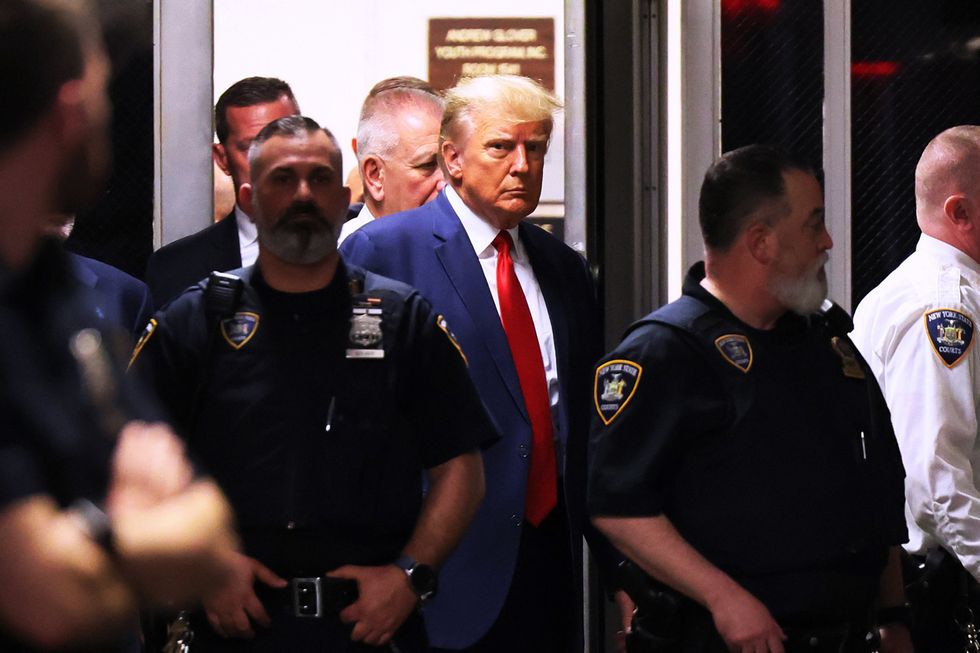 Former President Donald Trump arrives for his arraignment at Manhattan Criminal Court on April 04 in New York City. Michael M. Santiago/Getty Images
 Trump's campaign is selling these black-and-white ceramic coffee mugs for $24. (Screen grab)
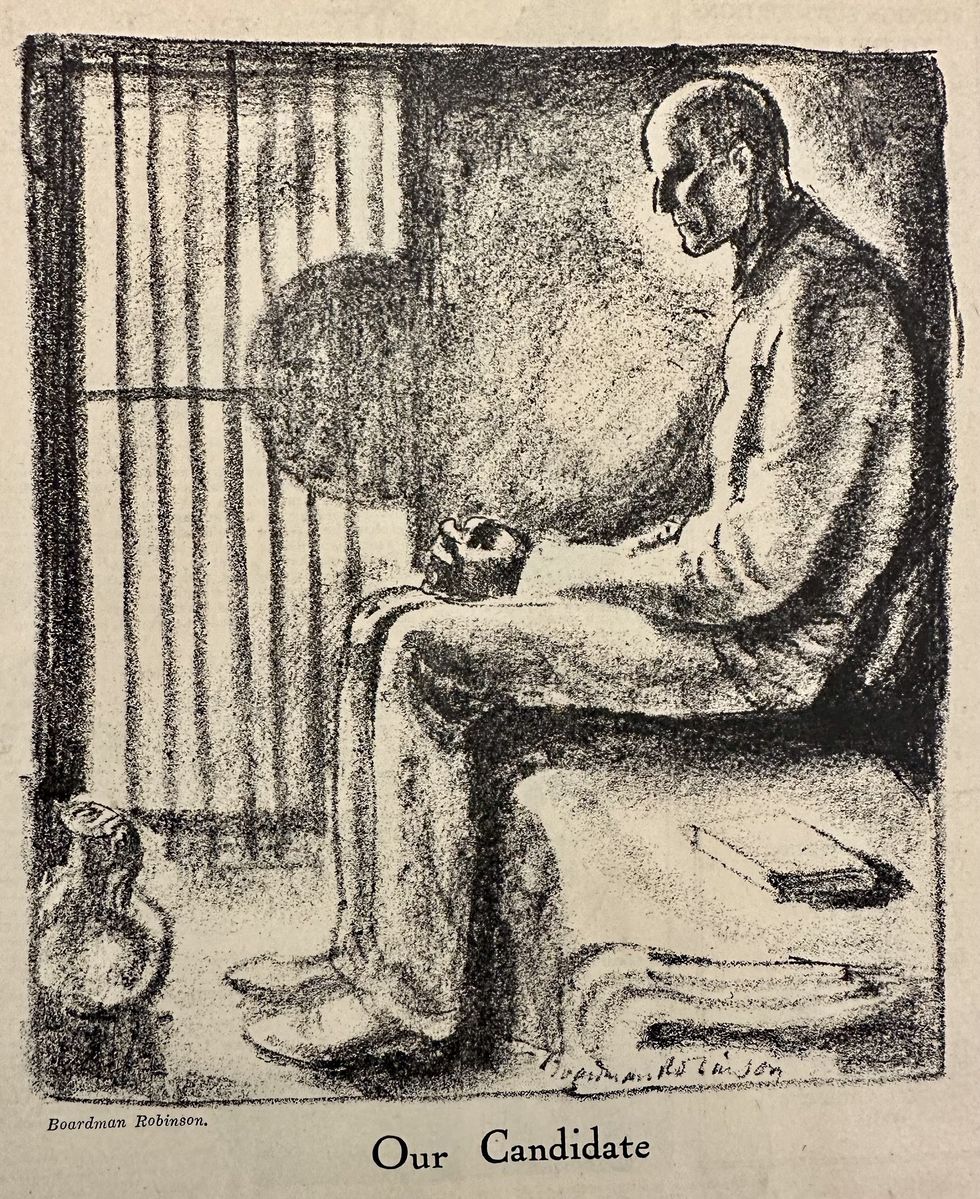 Illustration of Eugene Debs while running for president in prison. Indiana State University archives
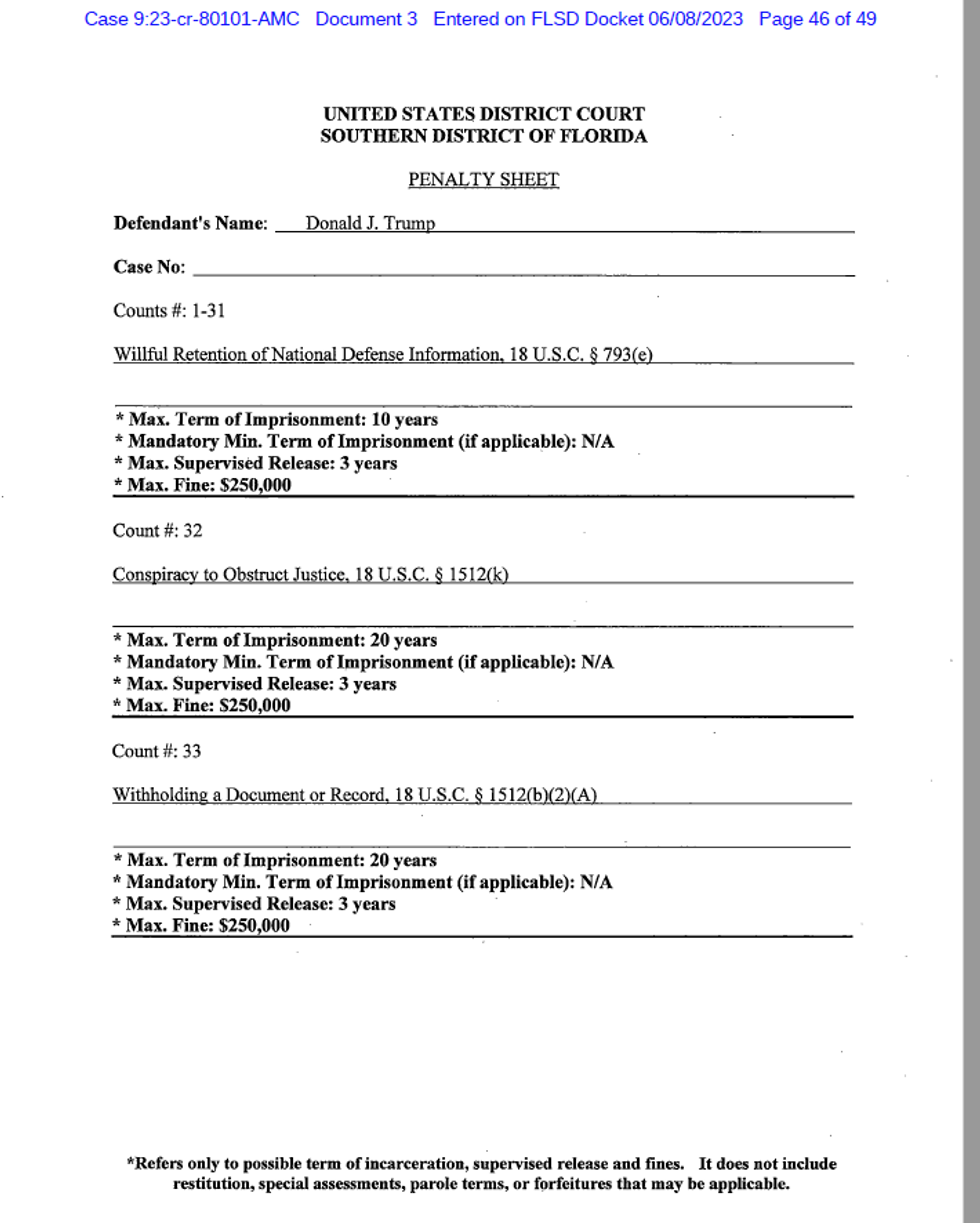 Federal document listing indictment counts against former President Donald Trump. U.S. District Court, Southern District of Florida
 U.S. Rep. Maxwell Frost (D-FL) gives a thumbs-up outside the Capitol after voting to continue funding the government for 45 days. Philip Yabut/Shutterstock
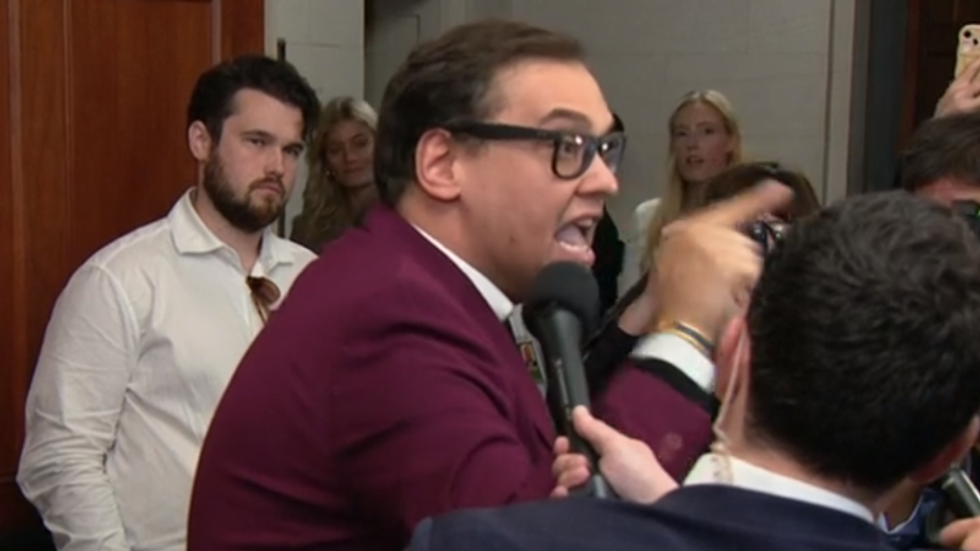 George Santos yelling at reporters (C-SPAN).