WASHINGTON — Raw Story today revealed how a neo-Nazi organization led by teenagers has launched a multi-state campaign of violence aimed at Jews, African Americans, LGBTQ+ people and leftists.
“Green unearthed shocking, essential truths about dangerous extremists at significant personal risk,” said Dave Levinthal, editor-in-chief of Raw Story, the nation’s largest independently owned progressive news website. “His reporting today underscores the power — and peril — of independent, investigative journalism at a time when press freedoms are under constant attack and fascist ideologies creep into the mainstream.”
Extremists’ actions against Green include death threats, online doxxing and visiting his house earlier this month dressed in skull masks and holding burning flares.
As Green writes in “Hunted by Nazis: How extremists stalked me while I reported on their violence,” the threats white supremacists have directed at him “would become ever more extreme — and strange.
“The experience was unsettling, but their efforts at intimidation only confirmed in my mind that we had a story that was worth telling,” Green writes.
Green’s ordeal in exposing a violent neo-Nazi group are emblematic of dangers journalists across the nation face while exposing wrongdoing, from corruption in government to plotting by hate groups.
A second Raw Story article about the Nazi youth network to be published Feb. 21 explores the roles parents play in the lives of 2119 members.
Raw Story celebrates its 20th anniversary this year. The site significantly expanded its investigative and original reporting team in 2023, redoubling its commitment to journalism focused on domestic extremism, political malfeasance and government accountability.
“Violent extremists threaten our freedoms and the very foundation of democracy,” said Raw Story CEO and founder John Byrne. “The nation is a better place because of Jordan Green’s courageous reporting. Raw Story is proud to support journalism that matters.”
In August, Raw Story filed a federal Freedom of Information Act lawsuit against the Navy and U.S. Department of Defense following the agencies’ refusal to release records related to a former U.S. Marine and avowed neo-Nazi.
Green, who joined Raw Story in 2021, reports on extremism full-time and has regularly broken national news stories. Last year, he won a Folio Award from the Fair Media Council for his investigative reporting on extremism in America.
Green revealed that a Marine Corps veteran and former defense contractor facing prosecution for his role in a neo-Nazi terror plot is suspected by the government of mishandling classified documents.
He also reported that a former soldier convicted of distributing bomb-making instructions and advocating for the assassination of former Rep. Beto O’Rourke (D-TX) menaced a drag show at an LGBTQ community center in North Carolina.
Green’s reporting on the January 6, 2021, attack on the U.S. Capitol ranks as among the most incisive in the nation. On the morning of the Jan. 6 attack, Green wrote an article headlined “We’re gonna kill Congress.” As Editor & Publisherlater noted, Green’s story predicted “exactly what would happen on that fateful day.”
Contact: Editor-in-Chief Dave Levinthal, levinthal@rawstory.com
Two rabbis sat down for dinner at Chabad Jewish Center in Pensacola, Fla.
The air on this July evening was warm and tranquil. A sense of peace filled the kitchen where the men shared their meal.
Suddenly, something crashed through the window, sending glass flying. The rabbis rushed over to investigate. Scrawled on the brick that lay on their floor: a swastika and the words “No Jews.”
Within days, local police arrested four white teenagers and collectively charged them with 18 felonies — not only in connection to the brick-throwing incident, but also for bigoted attacks on two area synagogues, a mosque and a Masonic lodge.
The group’s reputed ringleader, 17-year-old Waylon Fowler, initially denied responsibility. But he later admitted to an Escambia County sheriff’s deputy that he threw the brick. Fowler is also accused of throwing another brick — marked with swastikas, “SS” symbols and the words “Death to k----” — through the bathroom window at Temple Beth El.
That could have been the end of Fowler’s hate-filled story — the saga of a misguided boy and his friends who, when caught red-handed, vowed to right their ways.
Instead, the boys began taking an ever-darker path that, in their vision for America, includes a revolution leading to the collapse of the United States and a race war that drives Black people, Jews and LGBTQ+ people out of future whites-only homelands.
It’s a vision that has attracted young neo-Nazis across the country.
Raw Story spent four months investigating the 2119 Blood and Soil Crew, a nationwide network of teenage Nazis. The investigation revealed that Fowler now ranks among the leaders of the network.
In recent months, 2119 members have waged a campaign of targeted terror aimed at Jews, African Americans, LGBTQ+ people and leftists. Their targets include Florida, North Carolina, New Hampshire, Texas and California. In mid-November, 2119’s official Telegram channel suggested the group had expanded to 21 states.
The 2119 gang’s rise as a clandestine network of teenagers who promote and carry out acts of antisemitic and racist violence hasn’t been organic. The group has undertaken a concerted marketing strategy of recruiting children by appealing to their interests, such as online gaming and skateboarding.
Nazi youth associated with 2119 are now under investigation by the FBI, Raw Story has confirmed. The FBI is also actively assisting local police departments as law enforcement pursues crimes committed in the group’s name.
But this legal danger has only emboldened the Nazi teens. They’ve indicated even bigger plans for sowing hate and fear across the country. And they’re recruiting more and more disaffected children to their cause.
The group’s activity comes at a moment when social tension throughout America builds by the day.
Local crime spree, national emergence
Fowler’s neo-Nazi youth group first emerged in 2022 as an under-18 boys auxiliary to the burgeoning “active club” movement — a loose collection of white supremacists united by their interest in fight training, mixed martial arts and white nationalist activism.
After renaming itself Revolutionary White Brotherhood — some bricks that shattered Pensacola windows featured the initials “R.W.B” — the group resurfaced after the arrests of Fowler and his associates as “2119.”
The number is an alphanumeric code. Two represents “B” for “blood,” 1 represents “A” for “and,” and 19 represents “S” for “soil. “Blood and soil” is a slogan dating back to Nazi Germany that invokes a racial claim on land.
Using a newly formed channel on encrypted social media app Telegram, 2119 members gleefully celebrated Fowler’s deeds by circulating an image of the brick used in the Chabad Jewish Center attack. They fashioned Fowler a martyr, circulating a stylized image of him with boyish looks and tousled hair and peppered their communications with the hashtag #FreeWaylon.
The brick quickly became a symbol of action central to the group’s identity. Members in the various Telegram chats associated with 2119 often used the verb “bricking” and referred to themselves as “brickstas.”
A national leadership cadre that had been coalescing since 2022 had now shifted into high gear. Members shared unsettling characteristics: all white boys or young men in their mid- to late-teens who embraced extreme violence against Black people and members of other marginalized groups. They delighted in a catchphrase that encapsulates an extreme aspect of a segment of the hyperviolent, racist internet culture: — “total n— death.”
Other teenage neo-Nazis that gravitated to the 2119 banner steeped themselves in virulent hate and a paramilitary aesthetic that draws as much from the Irish Republican Army and Islamic State of Iraq and Syria (ISIS) as the Third Reich.
A still from an October 2023 propaganda video displays 2119's paramilitary aesthetic. Source: Telegram
The exact size of 2119’s membership is unknown. But a source knowledgeable with the group’s internal dynamics said it numbers in the hundreds. While that figure could not be independently verified, Raw Story has confirmed at least 20 self-identified 2119 members that participate in group activities. They live throughout the country, from California to Texas to New Hampshire.
The white power ethos embraced by members of 2119 draws from a loose collective of extreme Telegram accounts known as Terrorgram. Together, they promote acts of domestic terror and destruction that range from mass murder to attacks on the power grid.
A steady diet of gore videos and images — a photo of nude, Black female body missing her head stands out for its depravity — and instruction manuals for industrial sabotage swirl amid unyielding racist discourse.
But while spectacular and devastating, those modes of violence — by the 2119 members’ own admission — rarely allow the perpetrators to stay on the offensive and effectively network with one another.
The 2119 teenage neo-Nazis have instead embraced what’s for them a more scalable and sustainable — although no less disquieting — model of racist criminal violence.
Considered in isolation, the attacks across several states might be classified as acts of youthful vandalism and criminal mischief. Juvenile perpetrators who police catch might expect lenient punishments — ones that could be expunged as they reached adulthood.
But by 2119’s acknowledgement, these acts are deliberately designed to terrorize Jews and Black people. They offer 2119 members high propaganda value with relatively low risk to themselves.
These attacks also provide 2119 a model for a continuous, insidious feedback loop of documenting crimes, incorporating footage into propaganda videos and recruiting new members. Newly minted 2119 adherents, largely from rural and suburban communities, franchise the brand by committing new crimes in the group’s name. The process repeats and metastasizes.
A post on 2119's Telegram channel in October 2023 documents the network's propaganda efforts in three different states. Source: Telegram
Internal communications reviewed by Raw Story indicate that group members believe their status as children gives them a critical advantage — the impunity to commit acts of targeted terror against innocent people, while laying the groundwork for a future that they hope will allow them to commit murder on a grand scale.
When asked why he wasn’t already killing Black people, one former 2119 member responded, “When the system collapses, that’s the plan.”
Rapid radicalization
The 2119 leaders’ ambitions are chilling and plain in their voluminous online posts.
Their actions preceding prior run-ins with law enforcement speak even more loudly.
Aiden Cuevas, one of 2119’s most enthusiastic promoters, was charged as a juvenile in Alabama with terroristic threatening. He exhorted his peers to assault Black people “to save the white race.”
Aaron Alligood, a longtime member from Georgia, said that he wants “total collapse to happen” and has spoken of this desire to “stick a pistol” in a Black person’s nose, using a racial slur instead of “Black.”
Noah Houran, a 17-year-old from North Carolina described as “a 2119 OG,” distributed the IRA’s guerilla warfare handbook and a sniper training manual on his Telegram channel and expressed approval in response to a news story about a house that was booby-trapped with explosives in anticipation of a police raid.
Mathew David Bair, a 34-year–old Marine Corps veteran who joined 2119 last year, has unapologetically advocated for assassinating judges.
Members of 2119 likewise glorify mass shooters as “saints,” said Emily Kaufman, the associate director for investigative research at the ADL Center on Extremism, an anti-hate organization.
Kaufman noted that 2119 members also display the influences of the most extreme violent faction of the white power movement — what experts call “accelerationism” — “geared towards recruiting youth.”
Accelerationism is a tendency within the white power movement that seeks to hasten the collapse of American society for the purpose of creating conditions favorable to the rise of white ethno-states. Accelerationists reject political methods for achieving the movement’s objectives.
One 2119 member — Alligood — directly endorsed accelerationism on Telegram in December 2022: “I want total collapse to happen.”
Racist and antisemitic intimidation
When the authorities released Fowler on bond around Sept. 1, Georgia-based Aaron Alligood hailed his freedom as a signal that 2119 was on solid ground.
“Good news, Waylon is out on bail,” Alligood wrote in a Telegram chat with an extensive audience of racist skinheads from as far away as Southern California and the Balkans. “And the feds don’t got a case on him.”
Fowler, the reputed 2119 ringleader, awaits trial later this year in Pensacola, having pleaded not guilty to all charges. His freedom appears emboldening.
Since September, 2119 members have allegedly committed at least three additional hate crimes, twicetagging buildings in Laconia, N.H. with antisemitic graffiti and defacing a Martin Luther King Jr. monument in Concord, N.C.
Raw Story has independently confirmed vandalism incidents in at least four different states during the past 12 months that incorporated 2119’s various monikers.
The group makes scant effort to conceal its criminal intent. An “action report” it published online baldly states: “Members/associates of the crew are known to have a militant/violent reputation, and embrace confrontation with political/racial enemies.”
Impatience with standard-issue MAGA activism
When voters elected Donald Trump president in 2016, most of 2119’s members were elementary schoolers.
But they came of age during a time when Trump, as a candidate and president, demonized Muslims, attacked transgender Americans and generally shattered democratic norms.
They watched many Republicans cheer the Jan. 6 attack on the U.S. Capitol and jeer subsequent congressional inquiries and criminal trials. And they have seen multitudes of conservatives, from community agitators to federal lawmakers, fully commit to culture-war attacks on LGBTQ+ people, Black history and even library books.
Raised on internet violence, racism and homophobia, the children who gravitated to 2119 helped build their own, unique communion of hate. They could be as extreme and unmoored as they pleased. They operated free from adult-led, optics-conscious white power groups such as Patriot Front or extreme MAGA movements organized around the cult of Trump.
Patriot Front, for one, “failed to make any change in a matter of 6 years,” Alligood complained on Telegram in December. He dismissed Patriot Front’s activism as indistinguishable from MAGA, adding that he encountered the group’s members at a Trump rally — and he was not impressed.
Now, in 2024, Trump is once again all but guaranteed to become the Republican presidential nominee.
But for 2119 members, it’s not enough to be MAGA. It’s not enough to just support Trump.
The 2119 children aspire to something beyond Trump.
For them, it’s about “activism” that spreads fear, if not outright violence.
National 2119 leadership on FBI's radar
Two 2119 devotees in particular have made direct action their calling card of intimidation.
Eight days before his 16th birthday, in November 2022, the FBI summoned Noah Houran at his high school on the North Carolina coastline.
The agents asked Noah about a video he posted that he claimed showed him burning an LGBTQ+ pride flag. They quizzed him about an online statement he made about plans to attend an unspecified rally.
The agents wanted to know if Noah’s online statements were merely his fantasies, or if he really intended to carry out an act of violence.
Anti-LGBTQ+ violence was cresting at the time. Hysterical rhetoric among conservative politicians and right-wing media personalities braided into a mounting harassment campaign aimed at drag shows. The protests drew far-right groups, sometimes armed, ranging from the Proud Boys to avowed neo-Nazis.
The hostile political climate spilled over into fatal violence on Nov. 19, 2022, when a shooter gunned down five people at Club Q in Colorado Springs, Colo. As an indicator of the legitimate concern about mass shootings targeting the LGBTQ+ community, the Club Q shooting took place only three days after the date Noah Houran reported to Aaron Alligood that he had been questioned by the FBI.
Noah Houran was a hiking enthusiast whose interest in nature extended to eco-terrorism. A Telegram channel Houran created in October 2023 served as a distribution hub for texts written by Ted Kaczynski, who died in prison last year while serving time for the murders of three people during a 17-year bombing campaign carried out from a cabin in rural Montana.
One of Houran’s posts displayed a photo of a shed built from salvaged materials that was captioned, “Here’s my Ted K cabin, built it about 2 years ago.”
A screengrab from Noah Houran's Telegram channel shows his interest in eco-terrorist Ted Kaczynski. Source: Telegram
Less than two months after Houran was questioned by the FBI, Aiden Cuevas announced on Telegram chat that he was in legal trouble, while reassuring his peers that “just in case they get my phone I took off everything affiliating with 2119.”
“I’m on probation for some bulls— charge of terroristic threat (by the FBI of course),” he said.
Cuevas, who in November said he was 18 years old, told his friends he would be serving a sentence at the Mt. Meig’s campus, an Alabama juvenile correctional facility outside of Montgomery.
Raw Story was unable to find any record of Cuevas’ case. It is likely sealed, as he would have been a juvenile at the time of the offense. But in January 2019, WBRC-TV 6 in Birmingham, Ala., reported that a juvenile in Madison County was charged with making a terrorist threat to Thompson High School in Alabaster, Ala..
Cuevas lived in Madison County, which surrounds Huntsville, more than 100 miles to the north.
An Instagram post, made in November 2023, appears to show Noah Houran dressed in camouflage and aiming a rifle. The firearm, with the exception of the scope, is blurred out. Responding to a commenter who said he was “afraid to show his gun,” Noah wrote that he would “rather not repeat 2022” — an allusion to his run-in with the FBI agents.
Raw Story confirmed Cuevas’ identity as a 2119 member who posted on Telegram under the screen name “Bozak” by matching biographical details such as his mother’s birthplace in the Chuvash Republic in Russia, and his father’s U.S. Army assignment in Japan.
'The fascist pipeline'
Mathew David Bair, a 34-year-old Marine Corps veteran from Pennsylvania, meanwhile, came out of the extreme end of the MAGA movement, having been active with the Proud Boys when they stormed the U.S. Capitol in January 2021. He appears to be one of the few members of 2119 older than 18 years old.
After Jan. 6, 2021, Bair increasingly gravitated to an array of far-right groups that embraced national socialism more explicitly than the Proud Boys.
“The fascist pipeline is very real, as you well know,” Bair said. “I was in a direct pipeline chapter.”
A well-publicized fistfight between Proud Boys and neo-Nazis in June 2023 appeared to hasten his transition. By November, he began heavily promoting 2119 on his Telegram channel.
In a phone call with Raw Story, Bair confirmed he is now a 2119 member.
The difference between the Proud Boys and younger groups such as 2119, Bair said, is that the Proud Boys tend to attract older men who join to fulfill a need for friendship. The younger members of 2119 are more ideologically committed and less concerned about concealing their racist beliefs, he said.
He said he admired the 2119 members for their brashness.
“When these young ones, when they’re talking to their peer groups — to take the step and proclaim your viewpoint, even talking surface level, they might not mention Hitler, but they’ll say, “Have you read Mein Kampf?”
Bair described Trump’s supporters as a natural constituency for Nazism, while condescendingly treating them as if they are clinging to outdated political norms.
“Regardless of your opinion on Trump,” he wrote on Telegram, “his MAGA following incorporates a large number of people who would be our guys if they could break the matrix.”
‘An untapped market full of white children'
In recent months, recruiting children to 2119’s hate-filled cause has become a top group priority.
For example, in August, Cuevas praised a Telegram channel called Robloxwaffen Division — a coupling of “Roblox,” a popular online game geared for youth, and “Waffen,” the combat branch of the Nazi Party’s Schutzstaffel, or SS.
Cuevas hailed the teenagers behind Robloxwaffen as “geniuses.”
“They are reaching an untapped market full of white children that could potentially change their worldview and get them into the movement just from some fun on Roblox,” he said.
In January, the creator of Robloxwaffen — a teenager known only by his Telegram nickname “Patrius” — posted a Roblox-generated scene that simulated the 1999 Columbine massacre with two avatars holding assault rifles while striking a pose between rows of bookshelves. While his age is unknown, “Patrius” has said he isn’t old enough to drive.
That hasn’t stopped the violent ideations of “Patrius” from becoming even more acute. Earlier this month he threatened to “bomb” a gathering at a skating rink to raise awareness for National Black HIV/AIDS Awareness Day — adding the obligatory disclaimer, “in Roblox.”
Aiden Cuevas posted a photo of himself in a Telegram chat in early 2023. Source: Telegram
Cuevas, for his part, counseled fellow neo-Nazi teenagers to immerse themselves in subcultures, such as skateboarding, where they can easily make friends.
“I myself choose to target younger whites, still in high school that are lonely and all they want is a tight group of friends to have fun with,” Cuevas wrote.
Cuevas reported that he met a girl who was skateboarding alone after his local skate park had closed, and “she thought the swastikas were cool and had never seen ‘Nazis’ before.”
He boasted that in the past three weeks he had met “4 young white men that have seen my flag and hung out with my friends while we [will] be casually racist and throw up Romans,” referring to Nazi salutes.
‘Death squad'
Since its inception in May 2022, under the moniker “American Columbian Movement,” the 2119 group has made propaganda videos a key recruiting tool — one they consider essential to their growth and the advancement of their long-term goals.
One shows 2119 members marching to an anti-abortion rally.
“Nat soc death squad,” the teenagers chant in a robotic drone, a reference to the “national socialism” of the Nazis. The children occasionally giggle during the bizarre video.
As recently as December 2023, Cuevas and two other young men dressed in skull masks and protested outside a drag show in Albertville, Ala. The event organizer reviewed Cuevas’ Telegrams posts boasting of his involvement in the protest, and confirmed that she saw the men there.
Another early outing for the members of what would become 2119 took place in 2022, when they attempted to disrupt a May Day cookout in Pensacola. The event was co-hosted at a local park by two far-left organizations, the Party for Socialism and Liberation and the Democratic Socialists of America.
“We were cleaning up,” Sarah Brummet, a Party for Socialism and Liberation organizer, recalled in an interview with Raw Story. “Some kids came tearing through the park. They were yelling something. We couldn’t really hear it.”
They only learned later from a video that the boys were yelling, “F— you, you f—ing socialist slimy little s—.” After the socialists left the park, the teenage Nazis left flyers reading, “Commies stay off our street.”
“It was like they were afraid to confront us, and they were making agitation for the Internet,” Brummet told Raw Story.
When the official 2119 Blood and Soil Crew Telegram channel launched in September 2022, the group began churning out content that positioned it as a digital-era Ku Klux Klan teen auxiliary.
An eight-second video clip posted on the channel in November 2022 included the caption: “Pensacola lads out on patrol searching for Antifas! We protect our community!”
In another evocation of the Klan, a 2119-connected X account published a video showing a flier affixed to a front porch support post reading, “Attention! You have been visited by the 2119 Crew. We are pro-white, pro-Christian national socialists; anti-communist, anti-woke, anti-Zionist.”
Aaron Alligood of Georgia has indicated in online chats that he’s been involved with 2119 since at least October 2022. He also immersed himself in the Terrorgram community, as 2119’s on-the-ground activities became more aggressive.
Alligood became close with both co-administrators of the “P.A.W.G. Ops” channel, an acronym for Primal Aryan Warlord Gang.
A cross-country runner whose father was the head football coach at Berrien High School in Georgia until last year, Alligood became particularly close with Skyler Philippi, one of the channel’s co-administrators.
Philippi called Alligood a “little brother.” Raw Story was unable to determine Alligood’s age, but a runner profile indicates that he is currently a sophomore in high school.
“Like I said, keep your spirits high and play s— smart,” Philippi counseled Alligood. “We will prevail. Be the little man to a big man Hitler would be proud of. Go start reading Mein Kampf tonight.”
Like other Terrorgram channels, the Primal Aryan Warlord Gang celebrated racially-motivated mass murder, valorizing the shooters as “saints,” and promoted attacks on the energy grid. When anti-fascist researchers attributed a fatal shooting in Slovakia to a member of the Terrorgram community, participants in the chat congratulated themselves.
An administrator of the Primal Aryan Warlord Gang channel celebrate a mass shooting in Slovakia. Aaron Alligood, a 2119 member, was a frequent contributor to the chat. Source: Telegram
Terrorgram has been publicly credited for spawning one mass shooter, and here was one of the administrators of a channel where Alligood was a frequent commenter claiming victory.
Alligood’s involvement with the channel came to an abrupt end in January 2023, when one of the channel’s co-administrators was arrested at his home in Rustburg, Va. for conspiring with two other white supremacists to commit a bank robbery.
Shortly after the arrest, the FBI seized Aaron Alligood’s cell phone and laptop, he recounted on a Telegram chat with fellow white supremacists several months later. Although there is no public record of the seizure, Alligood confirmed the incident in a recent interview with Raw Story.
Meanwhile, the 2119 members’ online extremism was also manifesting in aggressive behavior on the ground.
In March 2023, a handful of 2119 members showed up to counter-protest a celebration of International Women’s Day hosted by the PSL in Pensacola. There’s no indication that Alligood, who lived in Georgia, was there.
Brummet described the incident as “a marked escalation.”
“They came up and they started standing close over our members and they were yelling racial slurs,” Brummet recalled. “We were speaking to a lot of things we identify as major social problems and the role of the existing capitalist system in that. They were yelling, ‘F the Jews.’”
2119 members disrupt an International Women's Day celebration in Pensacola, Fla. in March 2023.
roar-assets-auto.rbl.ms
‘Sounds like you fear the brick'
Following the arrests of Waylon Fowler and his co-defendants in Pensacola, Fla. for their antisemitic hate spree in late July, a gusher of local news coverage followed.
The brick inscribed with a swastika instantly became the group’s singular totem of power — an implied threat.
It also became a liability.
Alligood turned to a white power activist named David William Fair, who runs a separate white power group that is friendly with 2119, for advice. He confided that his girlfriend was concerned about his involvement in extremist activity.
Fair advised caution.
“I don’t want you in jail just as much as she don’t,” Fair said on Telegram. “Brick through the finance building is fun and all. But not worth your youth.”
Cuevas interrupted the heart-to-heart conversation between Fair and Alligood by posting a cutout of the brick used to vandalize the Chabad Jewish Center from the photo published in the Pensacola News Journal.
“Sounds like you fear the brick,” he quipped.
“I’m angry at the brick bc it got good boys put behind bars,” Fair replied.
“It rooted out the weak,” Cuevas shot back. “The others are out and will get thru it ez.”
Aiden Cuevas, posting under the screen name "Bozak bzk" valorizes an antisemitic attack by fellow 2119 member Waylon Fowler in an October 2023 Telegram message. Source: Telegram
Cuevas was likely referring to the Ferry brothers, Kessler and Nicholas. Kessler Ferry, Fowler’s 18-year-old co-defendant, admitted to a Pensacola police detective that he drove Fowler to Chabad Jewish Center.
Randall Etheridge, who is representing both Ferry brothers, told Raw Story his clients are fully cooperating with law enforcement, and that they were “ordered” to drive the Fowler brothers to the crime scenes.
Fowler and his younger brother have pleaded not guilty to all charges. His grandparents, with whom the boys live, referred Raw Story’s questions to their attorney, who declined to comment.
When another member chat asked about 2119, David Fair felt compelled to vouch for the members while also attempting to shield them from the consequences of the alleged crimes in Pensacola.
In an audio recording obtained by Raw Story, Fair identified “Bozak,” who is Cuevas, and “AllenWrench,” who is Alligood, along with “Constantine,” who remains unidentified, as “guys inside” 2119.
Fair opined that 2119’s critics were “insecure,” adding a homophobic slur. They might be “hooligans” who spray-painted swastikas, he said. But so what?
In the recording, Fair acknowledged the alleged crimes in Pensacola, but attempted to insulate the national 2119 leadership from them.
“You know, that was from a local crew of boys that did something objectively stupid, and it shouldn’t have happened,” Fair said. “But that’s not really something on the crew.”
David Fair, the leader of Southern Sons Active Club, discusses 2119 on a Telegram chat for racist skinheads in late 2023.
roar-assets-auto.rbl.ms
Multiple comments on Telegram show that “Constantine,” Alligood and Noah Houran were involved in assessing prospective members to determine if they were suitable material for 2119.
Chatting online with other extremists in early December, Alligood claimed to be on “house arrest.”
Reached by Raw Story for this story, Alligood initially claimed he quit 2119 after he was partially doxed by anonymous antifascist researchers. The researchers were able to identify Alligood because his mother posted a photo of him on her Facebook page posing with a deer he had killed, and Alligood posted the exact same photo on the official Blood and Soil Crew channel.
A Facbook post by a family member shows Aaron Alligood posing with a buck (left); the same photo, with Alligood's face redacted, identifies him with the "Georgia Chapter" on the Blood and Soil Crew Telegram channel. Sources: Facebook, Telegram
But when Raw Story offered Alligood evidence that he had continued to promote 2119 online and helped members network, he walked back his statement by claiming instead that he never did any “IRL,” or in-real-life, activities after he was doxed.
Alligood admitted to Raw Story that “house arrest” didn’t mean he was legally confined to his house, but rather, it was a way of saying that he had been grounded by his parents.
Commenting on Telegram in early December, Alligood said he was “looking forward to f---ing leaving this house so I can actually meet you n------.
“Oh yeah, it’s gonna be on,” he added. “Thinking about doing a country tour with 2119.”
When contacted by Raw Story in late January for this story, Alligood said he had decided to leave 2119 a couple days earlier.
At one point, Alligood said he would be willing to check in with Raw Story once a month to provide assurances that he continues to avoid any associations with other neo-Nazis.
“I promise you I’ll walk away,” he said. “I’m done with that.”
Antisemitic hate arrives in New Hampshire
The antisemitic vandalism spree in Pensacola had provided 2119 with a degree of notoriety, at least in Florida.
But 2119 members faced a question: How could they extend their brand across the country?
On the weekend of Rosh Hashanah 2023, six weeks after Waylon Fowler and his co-defendants were arrested in Florida, a man ambling down a central New Hampshire walking path discovered antisemitic graffiti on the abandoned Laconia State School building.
The graffiti included the “2-1-1-9” tag, a swastika and a crossed-out Jewish star.
It also said the word “f—,” followed by the name of a specific Jewish person in Laconia whose identity Raw Story has agreed to withhold. Following the person’s name: an antisemitic slur and the words “go to hell.”
Local news reports noted that a year earlier, graffiti depicting Nazi symbols and antisemitic messages had been found at the Laconia Public Library and a local park. A couple months later, police found antisemitic graffiti at the state school property.
The group has had a presence in New England since at least October 2022, when the original 2119 channel displayed a banner described as “a new flag for our folk in New England!”
City Manager Kirk Beattie told the Laconia Daily Sun that the recent graffiti in September 2023 marked an escalation by “calling out a member of the Laconia Jewish community.”
The official 2119 Telegram channel posted a video two weeks later that interspersed images of the graffiti at the Laconia State School and the earlier incident at the public library with images of members stepping on a Black Lives Matter flag and carrying an ammunition box. The video ended with the URL for the Telegram channel and the invitation to “join today.”
Law enforcement struggles
Laconia police have taken note that the graffiti at the state school included 2119’s Telegram address spray-painted onto a nearby water tower. That Telegram channel then displayed a video publicizing the crime.
Detective Eric Benoit, who was assigned to the case, reported that he could not determine who submitted the footage to 2119’s Telegram channel.
Telegram is designed in a way that makes it difficult for law enforcement to investigate user communications. For that reason, Benoit said, Laconia police aren’t putting legal pressure on Telegram to release the information.
Benoit reported that the investigation had so far uncovered no suspects, and he requested that efforts “be suspended pending new information or suspect leads.”
The following month, in October 2023, vandals spray-painted the “2-1-1-9” tag on a Martin Luther King Jr. monument in Concord, N.C. Two days after the vandalism was discovered, the official 2119 Telegram channel posted a link to a local news story, accompanied by the comment, “Hitting the news once again.”
Sgt. Gary Mearite, supervisor of the Concord Police Department’s criminal investigation division, told Raw Story that investigators have struggled to develop leads.
Currently, Mearite said, the Concord police are reviewing Telegram channels that have reposted images of the vandalism “and see if we can work our way back.”
“We’re still investigating,” he said. “It takes a long time.”
Rep. Alma Adams (D-NC), whose district includes Concord, N.C., expressed fury and frustration at the situation. She condemned the vandalism as an act that “shows an appalling absence of basic decency or empathy.”
“I don’t know if it’s social media raising the mirror closer to our faces, the lingering isolation from the pandemic, or something more sinister, but the rise in hatred in this country is apparent,” the congresswoman told Raw Story. “Hate is contagious. Those who catch the illness can only expel it onto others. They seek nothing more than to divide us and then spread their darkness in the void. They want us to hate each other like they hate us. We cannot give in, no matter how we’re provoked.”
In November, 2119 struck again in New England, spray-painting a swastika and the “2-1-1-9” tag on the Belknap County Democratic Party headquarters in downtown Laconia. The perpetrator glued fliers to the windows. One featured a swastika with the slogan, “Save the planet and your race,” while the other featured a quote by American Nazi Party founder George Lincoln Rockwell.
On the same day as the attack on the Democratic Party headquarters, someone placed a bogus order to deliver pizzas to the home of the Jewish community member who was named in the earlier graffiti incident at the state school building.
Elected officials in New Hampshire have also condemned 2119’s attacks.
“The people who did this are domestic terrorists,” Mayor Andrew Hosmer toldTheLaconia Daily Sun. “They want to strike fear in you — not just our Jewish brothers and sisters, but anyone that disagrees with them.”
Rep. Chris Pappas (D-NH) posted on X: “This antisemitic vandalism is part of a surge in hateful attacks on the Jewish community across the country. There is simply no place for bigotry and hate in our society, and we must speak with one voice to condemn it.”
Shortly after the antisemitic harassment in Laconia, 2119 announced that Telegram had deleted its channel.
This hardly deterred them. They simply created a new Telegram channel, and more notably, the 2119 members turned to the broader neo-Nazi community for help promoting the group’s it so they could continue their propaganda push.
“I think the feds ordered our account deleted, with the recent incident in Laconia,” Alligood wrote. “Shout-outs of the channel would be appreciated.”
One member of the chat, unfamiliar with the incident, asked what happened in Laconia.
“Constantine,” the 2119 leader, replied: “2119 Member may or may not allegedly spray-painted the Democrat HQ and left a s— ton of fliers.”
He quickly added: “2119 takes no responsibility for the action taken.”
Feds catching up with 2119?
Tucked into the crevices of their bluster, profanity and grotesque racism, some of the 2119 members have quietly been expressing concern that law enforcement might be catching up to them.
“I’m surprised the feds haven’t been on 2119s ass since the whole Pensacola fiasco,” Alligood remarked to Houran on Telegram in mid-September.
“I’m sure they are,” Houran replied. “We just don’t know it yet.”
Detective Joseph Taschetta told Raw Story that the FBI has assisted the Pensacola Police Department in its investigation of the antisemitic vandalism spree. Likewise, Sgt. Mearite at the Concord Police Department said one of his vice officers contacted an FBI task force officer to obtain information about the 2119 group. And multiple outlets have reported that the FBI is assisting the investigation by the Laconia Police Department.
The FBI declined to confirm or deny that the agency is investigating 2119.
“We would also point out that the FBI investigates individuals who commit or intend to commit violence and other criminal activity that constitutes a federal crime or poses a threat to national security,” a spokesperson for the FBI National Press Office told Raw Story. “Our focus is not on membership in particular groups but on criminal activity. We are committed to upholding the constitutional rights of all Americans and will never open an investigation solely on First Amendment protected activity.”
Bair, for one, is well acquainted with law enforcement.
In 2018, he unsuccessfully sued the city of York, Pa., and its police department for civil rights violations because an officer allegedly assaulted him during an arrest for disorderly conduct.
During his deposition, Bair told the opposing counsel that he had received multiple concussions while playing soccer in high school and while on combat deployment with the Marine Corps in the Middle East — all of which went untreated. He said he was court-martialed out of the Marine Corps for larceny and sale of classified materials during a deployment to Djibouti, and served one year in the Navy brig in Chesapeake, Va.
Following his military service, Bair said he checked himself into a sober living house in Colorado, and has been in and out of prison for domestic violence and burglary.
Bair, who specialized in demolition in the Marine Corps, told Raw Story that he likes Terrorgram for the “aesthetics.”
“It’s like what the Proud Boys did,” he said. “Nobody promotes the acts themselves, but here’s the information. Read it your goddamn self.”
A still from a video published by 2119 member Mathew Bair shows a flier on a chain-link fence that reads "Shoot your local judge." Source: Telegram
Asked about a video he posted showing a flier with the words “Shoot your local judge” that includes a URL to the 2119 Telegram channel, Bair suggested that the “judge” referenced on the flier was a kind of handgun — a Taurus Judge.
He responded with equanimity when asked whether he thought someone might interpret the sign as an endorsement for shooting a judge in a court of law.
“That’s all right,” Bair said.
Bair then volunteered that he lives close to where an anti-feminist extremist went to a federal judge’s home in New Jersey during 2020 and fatally shot her son.
A future for 2119?
In response to Raw Story’s reporting, some 2119 members have gone dark on Telegram.
Others, such as Bair, remain defiant. The recent exposure, which also includes a new reference page by the Anti-Defamation League, might cause 2119 to rebrand once again, or potentially splinter.
Bair told Raw Story he expects 2119 will be leading large Nazi marches ahead of the 2024 election.
That seems unlikely given the group’s philosophy of spreading hate while avoiding public scrutiny. And if evidence were needed that his words should be treated with skepticism, Bair mentioned his interview with Raw Story on his Telegram channel, writing, “There’s a lesson about misinformation and misdirection here.”
But now that 2119 is a known entity, history suggests the individual members could put on new costumes to evade scrutiny from law enforcement, antifascist researchers, the media and communities at large.
So don’t look for the young white boys and men steeped in terror doctrines to march under a banner reading “2-1-1-9.” Next time 2119 members show up on the streets of American cities and towns, it’s plausible they’ll have migrated to completely new neo-Nazi groups. And regardless of what mantle they claim, they’ll likely downplay their group identity while merging with other fledgling groups in a bid to project maximum force.
The 2119 members, however, appear unyielding as they continue to propagate hate, lionize those who attack the power grid and laud racially-motivated mass shooters.
* * *
About this investigation: This is the first in a two-part series about youth neo-Nazi organization 2119. The second part, published here, examines how parents navigate the challenges posed by online youth radicalization. A first-person account about the threats and harassment reporter Jordan Green has received as a result of his coverage of 2119 may be found here.
This project draws upon numerous interviews, primary sources and accounts of 2119’s members and activities, along with information uncovered by Appalachia Research Club, an anonymous antifascist research collective.
I began reporting on 2119 in an effort to expose its actions. As I investigated the group’s leadership and activities, and publication of a two-part project neared, neo-Nazi threats against me escalated. Online harassment led to phone calls and doxxing, which devolved into death threats and, most recently, visits to my home.
My ordeal began in November, when 2119 called me out by name in profane Telegram posts laden with racism, antisemitism and homophobia.
Soon, I began receiving threatening phone calls and voicemails. Someone took pictures of me with a telephoto lens, private investigator-style, and posted them online. A pizza delivery showed up at my doorstep, unrequested, courtesy of 2119. And earlier this month, matters culminated with six avowed white supremacists standing in front of my house, holding burning traffic flares, their arms up in Nazi salutes. One held a sign warning me of “consequences.”
Harassment and even death threats are, unfortunately, an occupational hazard for journalists on this beat. The leader of the neo-Nazi terror group, Atomwaffen, unhappy about being the subject of a ProPublica story, conspired with others to carry out a swatting attack — a tactic in which the perpetrators place bogus calls for the purpose of eliciting a law enforcement response to the victim’s residence — on journalist A.C. Thompson.
Other examples abound: Journalist James LaPorta, for one, learned his name was on a hit list in the possession of a neo-Nazi accused of plotting race war. In another case, a journalist received a death threat from the leader of a Nazi group called Feuerkrieg Division to try to discourage them from reporting on his group.
I first ran across 2119, also known as Blood and Soil Crew, while combing through Telegram chats in December 2022. They’ve been firmly on my radar since the spring of 2023, when I began to tally up racist and antisemitic incidents and attacks made in 2119’s name. Starting in late October 2023, my editor let me spend significant time investigating what — and who — 2119 truly is.
Almost as soon as they became aware of my reporting, the 2119 members responded with hostility and threats in a naked attempt to stop me from reporting on what had become a multi-state campaign of racist, antisemitic and homophobic violence.
Four days before Thanksgiving, an anonymous Telegram channel published my professional headshot, home address and phone number.
This wasn’t the first time such a thing has happened during my many years covering neo-Nazis, and other extremists. Online posts that include my personal information have been a semi-regular occurrence for the past four years. What was notable this time is that 2119 members immediately amplified this doxxing, highlighting it to like-minded extremists on their Telegram channel.
The accompanying note included a complaint from 2119 that “the bastard above” — me — had “been found out to be harassing our boys.”
Over the next two months, their tactics would become ever more extreme — and strange.
‘You're being watched'
Just before New Year’s Eve, I received a phone call from a restricted number at dinner time. Someone identifying himself as “Bozak” warned me that I was “being watched by international bricksters.”
I already knew by that time that “Bozak” was 2119 member Aiden Cuevas, but the caller hung up before I had an opportunity to confront him.
I understood this “bricksters” term as a reference to an antisemitic attack last summer in Pensacola, Fla., where another 2119 member, Waylon Fowler, threw a brick through the window of a Jewish center while two rabbis sat inside having dinner.
Written on the brick: a swastika and the words “No Jews.”
A couple minutes after the “Bozak” phone call, the same person made a transparent attempt at misdirection by calling back and leaving a voicemail. He claimed to be Thomas Rousseau, leader of the white power group Patriot Front, and again warned: “I’m letting you know that we have people on standby. You’re being watched. Quit messing with us.”
In early January, early on a Sunday afternoon, an unidentified 2119 member placed an order for a pizza delivery at my house. It’s clear a 2119 associate was parked down the street with a camera and a telephoto lens because, the following day, a 2119 member posted a photo on Telegram that shows me standing in my doorway.
The experience was unsettling, but their efforts at intimidation only confirmed in my mind that we had a story that was worth telling. Just as any investigative journalist would do in the course of reporting a story, I called the subjects to offer them an opportunity to be interviewed and to ask them questions.
I began calling 2119 members — and their parents. The response was an odd mixture of silence, defiance, confessions and pleas for understanding.
'We'll keep shooting'
But one particular interview — with Mathew Bair, a Marine Corps veteran who, at 34, is roughly twice the age of most of his fellow 2119 members — stood apart.
Bair readily confirmed much of my reporting about 2119’s activities and goals. And unlike some of his younger cohorts, he was unapologetic, even appearing to take pleasure in confirming some of the most unsavory aspects of 2119’s racist and antisemitic intentions.
As we came to the end of the interview, I dropped what I expected to be one of the most difficult questions.
I asked Bair about a video he had posted showing a flier with the words “Shoot your local judge” that includes a URL to the 2119 Telegram channel.
Bair danced around the question. He initially attempted to deflect by suggesting that the reference was to a specific firearm model — a Taurus Judge.
Regardless, he told me he wasn’t concerned about how a potential victim might interpret the message.
He might have left it at that — an ambiguous, vaguely worded threat shrouded in plausible deniability.
But instead he veered back to the more direct interpretation, mentioning that he is “close” to where an anti-feminist extremist went to a federal judge’s home New Jersey, in 2020, and fatally shot her son.
Then, he casually tossed out the phrase “just like you live in the Raleigh/Durham area, right?”
As it so happens, I don’t live in that area. But the implication was clear: I could be a target, too.
A couple of days later, on Jan. 21, Bair forwarded a message from a private Telegram channel complaining about my reporting.
“Jordan Green, you have a healthy respect for a Taurus Judge now, yes?” the message concluded. “Keep phishing for minors and we’ll keep shooting our local Judge.”
A Telegram post forwarded by Mathew Bair on Jan. 21, 2024 contains an implied threat.
One might be tempted to chalk this up as nothing more than online bluster. But gun violence directed at journalists is very real. This became apparent when shots were fired into the home of an online news publisher in Tennessee last April.
Concurrent with Bair’s warning, an anonymous Telegram account patronized by avowed extremists doxxed me again — this time with the photo of me standing in my doorway when 2119 sent a pizza to my home.
A couple weeks later, the account posted more personal information about me, accompanied by a note: “It’s not over, yet. More to come soon.”
They weren’t lying.
Around 5 p.m. on Feb. 10, six Nazis approached my house on a quiet, residential street in Greensboro, N.C. They held burning traffic flares as they raised their arms in Nazi salutes.
Photos show that at least three of the men are subjects of my reporting on extremism.
Among them: Sean Kauffmann, leader of the Tennessee Active Club, stood in the middle holding a sign warning about a “consequence” for exercising freedom of the press. Flanking Kauffmann were David William Fair, leader of the Southern Sons Active Club, and Jarrett William Smith.
The three men have a history of glorifying and pursuing violence.
Kauffmann and Smith met through Terrorgram, a loose collective of Telegram channels that extol mass shooters, while promoting graphic violence and wildly flagrant racism, in 2019.
Smith, then a soldier in the Army, advised Kauffmann on how to hide firearms from law enforcement when Kauffmann was worried that the police would take them due to a custody dispute with an ex-partner.
According to a report by the Southern Poverty Law Center, sheriff’s deputies responding to a domestic violence incident in 2021 encountered Kauffmann waving around an assault rifle and later “received information that Kauffmann stated he was going to get into a shootout with police.”
Smith was arrested and charged with distributing information related to explosives and weapons of mass destruction in 2019, a couple months after his exchange with Kauffmann on Telegram. The government alleged that Smith shared information with others on Facebook about how to make improvised explosive devices and suggested to an FBI informant that then-Rep. Beto O’Rourke (D-Texas) would make a suitable assassination target.
During his prosecution — for which he ultimately pleaded guilty and served 14 months in prison — federal prosecutors presented evidence that Smith stated in a text message that it was on “my bucket list to KO an antifa member” and advised other Telegram users on how to get away with committing arson against a Michigan podcaster.
The channel that helped organize the flash rally in front of my home followed with an eerie sequel. The subsequent post showed some of the protesters posing with a historical marker commemorating the Greensboro Massacre. The sign marks the site where a coalition of neo-Nazis and Ku Klux Klan members fatally shot five civil rights and labor activists near a public housing community in 1979.
The caption in the Telegram post emphasizes the point that the shooters were acquitted during state and federal criminal trials by arguing that they acted in self-defense.
The message to me isn’t subtle.
Jordan Green is a Raw Story investigative reporter who covers domestic extremism.
Planned Parenthood of the Pacific Southwest PAC reported to the Federal Election Commission four “fraudulent transaction(s) under dispute with bank,” totaling $14,156.25 over the course of December.
Planned Parenthood’s national organization and Planned Parenthood of the Pacific Southwest did not respond to Raw Story’s requests for comment.
The FEC sent the super PAC a letter on Feb. 11 requesting “information essential to full public disclosure of your federal election campaign finances.” The letter also noted that financial activity on the PAC’s annual report was incorrectly reported.
“Although the Commission may take further legal action regarding this apparent improper use of Committee funds, any further clarifying information that you can provide will be taken into consideration,” the letter said.
Planned Parenthood of the Pacific Southwest provides “confidential, comprehensive, high-quality medical services” at 20 health centers servicing San Diego, Riverside and Imperial counties in California, according to its website.
Among those services: abortions, birth control, cancer screening, gender affirming care and HIV prevention.
Political committee theft epidemic
This is hardly the first time thieves ripped off a political fundraising committee.
Over the past year, Raw Story reported that scammers stole millions of donor dollars combined from dozens of political campaign committees — which have experienced varying levels of success in recouping the stolen funds.
A thief nabbed a $3,000 check sent by a political committee led by former House Speaker Rep. Kevin McCarthy (R-CA). The July 2023 check intended for a photographer was “stolen during the USPS mail process and fraudulently cashed,” Raw Story reported.
The American Israel Public Affairs Committee’s political action committee reported theft of nearly $4,700 due to fraudulent checks in December, and the Oregon Republican Party was the victim of a fake check scam last summer.
In May, Raw Story reported that the Managed Funds Association PAC was targeted more than 20 times between Jan. 1 and March 31, initially losing $147,000 in fraudulent check payments, although it appeared to have since recouped the money, according to filings with the FEC.
The Retired Americans PAC, a super PAC that supports Democrats, recouped more than $150,000 it lost in late 2022 after paying fraudulent bills sent to the committee, according to an April 21 letter to the Federal Election Commission, Raw Story reported.
The FBI got involved when Sen. Jerry Moran (R-KS) was the victim of a cybertheft incident late last year that initially cost his campaign $690,000.
The problem isn’t unique to Republicans: In November 2022, Senate Majority Leader Chuck Schumer’s campaign fell victim to check fraud worth $10,085, Raw Story reported, and President Joe Biden’s 2020 Democratic presidential campaign committee lost at least $71,000, according to Business Insider.
One-time Democratic presidential candidate and congresswoman Tulsi Gabbard and West are among others who reported money stolen from their political accounts.
The political action committees of Google, National Association of Manufacturers, Consumer Technology Association, National Air Traffic Controllers Association, International Brotherhood of Teamsters, MoveOn.org, and law firms Akerman LLP and Blank Rome LLP have also experienced theft of various kinds, ranging from cyber theft to forgeries and check tampering, according to Business Insider.
WASHINGTON – House Republicans are divided over what to do about their internal divisions – or even whether anything’s the matter at all.
Welcome to Speaker Mike Johnson’s Capitol.
After a string of recent tactical blunders – from a failed impeachment vote to pulling the Foreign Intelligence Surveillance Act (or FISA) reauthorization measure he put on the floor this week – some Republicans in the House of Representatives are reassessing the successor to deposed Speaker Kevin McCarthy.
Johnson, Republicans’ replacement speaker, has now been on the job 114 days. Yet the GOP still feels rudderless. He is hardly a phoenix, but the GOP is covered in plenty of ashes from the house fire that is the 118th Congress' Republican conference.
“We're wounded. I'm not saying that's because of Mike Johnson. It’s because of the situation we put ourselves in, no matter who came out of that,” Rep. Doug LaMalfa (R-CA) told Raw Story. “There's a lot of things that are out of his immediate control with the suddenness of this happening.”
The Republican unrest with Johnson (R-LA) is starting to become undeniable, even to his allies such as LaMalfa.
“It feels like there’s a little more unrest. Or that the unrest is now bubbling to the surface?” Raw Story asked.
“I think there’s some underground bubbling going on,” LaMalfa said.
The Republican Party still hasn’t healed since members ran McCarthy out of the speaker’s chair — and right out of Congress. While Johnson hasn’t had his speakership challenged by the gang of eight Republicans who ousted McCarthy, he’s constantly under pressure from every faction of his fractious conference.
“In fairness, I think the problem changes every day, depending on where he's got to focus,” Rep. Chuck Fleischmann (R-TN) told Raw Story in front of the Capitol this week. “Sometimes it's just the issue of the day. It's just a tough, tough time.”
Johnson’s job is only getting more complicated now that the 2024 election has fully engulfed the U.S. Capitol. Campaign considerations helped derail a bipartisan Senate border security compromise and cast a broadly bipartisan foreign aid package – and U.S. allies Ukraine, Israel and Taiwan – in limbo.
Speaker in empty suit only?
Looming over everything, including Johnson’s speakership, is former President Donald Trump.
Trump, for example, single-handedly killed the border bill before lawmakers even finished drafting it.
That’s begged the question: Who’s running the show on Capitol Hill?
“Is Donald Trump calling the shots here, Mr. Speaker?” Meet the Press host Kristen Welker asked Johnson a couple Sunday’s ago.
“He’s not calling the shots. I am calling the shots,” a defensive Johnson replied.
The reserved speaker was animated, if not entirely believable.
“Certainly, Trump has influence on people. I don’t want to say he’s in charge. We do a lot of things that Trump disagrees with,” Rep. Ken Buck (R-CO) told Raw Story just off the House floor.
Johnson is known as a staunchly conservative Christian nationalist, but lawmakers still don’t know how to define his leadership style.
As Raw Story revealed in January, Johnson came to Congress in 2017 with big dreams of bipartisanship and civil discourse among lawmakers. Those dreams dashed, he’s embraced the MAGA mantle, ever-evolving – or devolving – as it is.
“He’s just trying to figure out some things,” Rep. Cathy McMorris Rodgers (R-WA) told Raw Story Thursday.
The speaker is getting pulled in most every direction, and he doesn’t seem to tell anyone ‘No.’
That hurt Johnson last week when he stepped in a political dogpile.
Basically, Johnson backed fringe-right Rep. Matt Rosendale (R-MT) in Montana’s U.S. Senate GOP primary. Within hours of that news dropping, the speaker reversed course. The pressure came from old guard Republicans in the House and the National Republican Senatorial Committee who, along with Trump, are backing retired Navy SEAL Tim Sheehy in the race against Sen. Jon Tester (D-MT).
Rosendale was one of the eight GOP lawmakers who ousted McCarthy, making him anathema to the majority of House Republicans who remain bitter over last year’s speaker battle. After formally announcing his Senate bid last Friday, Rosendale reversed course — and withdrew. Johnson’s highly publicized reversal seems to have led to the demise of the Freedom Caucus member’s longshot bid – the opposite of what he set out to do.
Johnson’s a leadership novice, and everyone seems to know it.
“You got some advice for Speaker Johnson?” Raw Story asked former Senate Majority Leader Trent Lott (R-MS) – who served as House minority whip during the 1980s – as he strolled past the House floor Wednesday.
“Every now and then,” Lott, now a lobbyist, said with a laugh — and without detailing what that advice is. “I spent a little time over here in leadership. I still stay in touch with them.”
When not crying, Democrats are laughing at the dysfunction.
“Tell them to keep up the good work!” Rep. Bill Pascrell (D-NJ) told Raw Story as he was entering the Capitol on Wednesday, the day after Democrats won the special election in New York to replace expelled former Rep. George Santos (R-NY).
Despite Democratic chiding, many Republicans say there’s still time to salvage the least productive Congress in recent decades.
‘I wish we did less’
With Democrats recapturing Santos’ seat, Republicans are now down to a mere two-seat advantage on floor votes. House Republicans aren’t calling to reverse course — rather the loudest voices in the conference this week have been bemoaning the bipartisan ouster of Santos, a demonstrated liar and credibly accused fraudster who faces numerous federal charges and potential prison time.
"I voted against expelling George Santos. He wasn’t convicted of anything, and I don’t think he should have been expelled. And I think it was a very bad strategy from our conference to expel a member of Congress who hasn’t been convicted," Rep. Marjorie Taylor Greene (R-GA) told Raw Story at the Capitol. “We shouldn't have lost that seat to begin with.”
Johnson was also back in the headlines this week when he pulled a FISA – think warrantless wiretapping – reauthorization from the House floor after it became clear Republicans were prepared to kill the measure.
“Pulling the FISA bill – doesn't that make y'all look like you can't govern?” Raw Story asked Rep. Bob Good (R-VA), the new head of the far-right Freedom Caucus.
“Well, what you guys call ‘not governing’ is not doing more bad stuff, not doing more of what Democrats want to do, not doing more what the D.C. swamp wants us to do, not doing more of what the status quo is,” Good said while walking through a tunnel leading to the Capitol Thursday. “What is it you want us to do more of that would show we could govern?”
“Even when it comes to unwinding the administrative state, you guys are historically a piss poor Congress,” Raw Story replied. “Like, you can't even unwind what you want to unwind, right?”
“Well, I would argue, we are historical in the sense that we have not worsened the administrative state, and we have not done more harm to the American people on the level that most congresses have done,” Good said.
“I wish we did less. Unless we had absolute control of government, and we could truly undo all the harm. At least we're not layering it on and adding to it,” Good said. “Just take FISA, if it weren't for the Freedom Caucus conservatives, FISA would already have been reformed in a way that totally trampled on and expands upon the harm being done to the citizens.”
The House has now joined the Senate on an extended President’s Day recess.
When the two chambers return to town in two weeks, they’ll have just a handful of legislative days to fund the government before federal funding starts clicking off on March 1.
Can Democrats solve Johnson’s problems?
Everything’s not fine in the GOP, and rank-and-file Republicans know it. That has some conservatives now calling on Johnson to do what’s become anathema in today’s GOP: Work across the aisle.
“He’s got a tough job. He’s got the toughest job in America, so he's got to reach out to Democrats to get things done,” Rep. Troy Nehls (R-TX) told Raw Story on his way to vote on the House floor this week. “He doesn’t really have much of a choice.”
Johnson was no one’s first choice to be speaker. In fact, he wasn’t the GOP’s second, third or fourth choice, either.
Over three long weeks last year, Republican speaker-designates Reps. Steve Scalise (R-LA), Jim Jordan (R-OH) and Tom Emmer (R-MN) all quit after failing to solidify enough GOP support to win the gavel on the House floor.
The party needed someone – anyone, really – to replace McCarthy as speaker.
In that environment, many of the party’s proven leaders refused to run, and thus Speaker Mike Johnson was born.
“This was all made difficult by the unnecessary purging of McCarthy,” LaMalfa of California told Raw Story. “In some cases, the cream of the crop of who would be the ideal leader, weren't presenting themselves – and this is not a personal knock to any individual – so Mike kind of evolved from those different pools.”
Since he was anointed, Johnson’s had to host fundraisers, travel to member’s districts and run the House. He’s proven a quick study in fundraising from GOP donors, and Republican members have been happy to host him in their districts. It’s the whole running the House of Representatives that Johnson seems to be struggling with most these days.
That’s largely because of the same far-right Republicans who seem to hijack most every measure that hits the House floor. The new boss seems to have the same problem as the old boss.
“They’re not going to be happy with anything,” LaMalfa said. “They don't give a s—. They don't care.”
A federal agency fined a Democratic senator’s campaign committee $27,000 for the untimely resolution of excessive contributions, according to a Raw Story review of federal campaign records.
The campaign committee for Sen. Jon Ossoff (D-GA) must pay the civil penalty by March 8 related to the issue of “failing to remedy excessive, prohibited and other impermissible 2020 general and runoff election contributions, totaling $363,272.43, within the permissible timeframe,” according to a Feb. 14 letter from the Federal Election Commission.
The negotiated settlement and letter addressed to attorney Graham M. Wilson, representing Jon Ossoff for Senate and its treasurer, Steven Mele, stated that the campaign resolved all donation issues by issuing refunds — just not by federal deadlines.
"Last year the FEC notified the campaign committee that following the unprecedented 2.8 million donations received in the historic runoff election, the campaign’s compliance vendor had failed to refund contributions, as they were contractually obligated, within 30 and 60 day requirements because of the obvious logistical challenges associated with the high volume of contributions,” Jake Best, a spokesperson for Ossoff’s campaign, said in a statement to Raw Story.
“As the settlement makes clear, all contributions discussed were refunded, just not within 30 and 60 days, and the compliance vendor has taken full responsibility for the delay, is covering the total FEC penalty, and will participate in additional mandatory training to ensure they do not make this mistake again," Best said.
Contributions to a candidate’s committee could not exceed $2,800 total during the 2019-2020 election cycle, as noted in the negotiated settlement letter.
The committee said it “has a strong commitment to compliance” with the Federal Election Campaign Act of 1971, according to the letter.
In addition to paying the civil penalty, “in effort to avoid similar errors in the future,” Ossoff’s committee agreed to “develop and certify” a policy document for its external compliance vendor within 30 days and to “retain an outside consultant to review all compliance procedures and conduct a training with those responsible for preparing and filing its reports” within 90 days, the letter said.
“The Committee states it has facilitated conversations with its compliance vendor reiterating the Committee's internal policies for identifying and remedying excessive, prohibited and other impermissible contributions,” the letter said.
Ossoff beat the Republican incumbent, former. Sen. David Perdue, in a 2020 runoff with 50.6 percent of the vote, according to CNN. At 37, Ossoff is the youngest member of U.S. Senate and one of the few millennial or Gen Z members of Congress.
These are nicknames for Donald Trump offered up by author and criminologist Gregg Barak, who portrays the 45th president’s history of legal troubles as those of a mobster who has long evaded justice for his crimes.
But now, as Trump contends with 91 felony charges across four criminal cases and bears civil liability for the sexual abuse and defamation of a writer, as well as fraudulently inflating the value of his business empire, Trump must face the legal consequences of his actions.
Raw Story got an exclusive first look at the book, which is scheduled for public release on April 1.
Book cover (Rutledge/Gregg Barak)
Trump’s alleged white collar crimes date as far back as 1973, and the former president has been involved in more than 4,000 legal cases in that time, Barak writes. Yet, Trump has evaded major consequences for his alleged malfeasance because “crimes of the powerful and the crimes of the powerless” and “suite and street crime” are treated differently in the United States, Barak told Raw Story in an exclusive interview about his new book.
As Barak writes, there are “two contradictory standards of justice” in the United States, and Trump benefited from “social realities of justice in America” that are “already stacked in favor of the powerful perpetrators of crime.”
“So long as Trump believes that he can prevail to fight another day to retain and/or regain his former power, then the amoral and corrupt racketeer and wannabe dictator will unapologetically continue to transcend democratic norms and to resist the authority of the state even if it means destroying American society in the process,” Barak writes. “Something that he has been working on since he was sworn into office in 2017.”
Barak paints a comprehensive picture of how he says Trump exerts his “legal and political power” and uses his “mob-boss tendencies” to intimidate politicians, citizens and law enforcement agencies who challenge him.
“While most non-revolutionary outlaws would have cut a deal to stay out of prison, Trump behind the scenes and on social media platforms had been trying to stoke his base and threatening harm and violence to prosecutors and judges and other law enforcement personnel,” Barak writes. “Like a mafioso boss and Mussolini’s blackshirts or storm troopers, Trump had been fomenting hate, scapegoats and violence toward the ‘enemies-others’ since his campaign rallies began in late 2015.”
The irony of this, Barak said, is that the Republican Party historically identifies as the “party of law and order.” Yet, the party — particularly its far-right wing — defends Trump’s lawlessness and spreads falsehoods about election fraud and other conspiracy theories on his behalf, he argues.
That, coupled with Trump’s ability to project his troubles onto his opponents, keeps his base loyal to him despite his legal peril, Barak said.
“Everything that he is accusing everyone else of doing is precisely what we've all witnessed him do for as long as we've been observing him,” Barak told Raw Story in a phone interview. “That is just an amazing ability to invert the narrative, and even though the majority of people think it's all poppycock and BS, there's 40 percent of the country who's all in.”
Why are those 40 percent in?
For “psychological reasons, Barak told Raw Story. In a society that is increasingly disconnected, “the cult of personality satisfies that need,” he said.
Among Barak’s greatest concerns: Trump’s threat to democratic institutions, particularly the press, as well as his political weaponization of government agencies. But Barak said he also doesn’t “believe for a minute that Donald Trump will win in 2024.”
Barak predicted Trump will “meet his Waterloo, sooner or later after all these years,” particularly as a judge denied on Thursday his attempts to delay the March 25 start of his New York criminal trial.
“This will be the first but not last time that Trump finally gets his well overdue comeuppance, some time in early May 2024,” Barak said.
Barak’s book outlines the constitutional and democratic reforms needed to avoid an “authoritarian or autocratic regime” now and in the future, ranging from making the House of Representatives’ size more reflective of the population to reforming the outsize influence of wealthy corporations and the electoral process.
In short, a “tyranny of the majority,” not a “tyranny of the minority” is needed, Barak writes.
Barak said he ultimately wants readers to understand Trump and his associates’ threat to democracy — and how to save it.
“It's not to be snookered, to understand what the GOP and Trump are all about,” Barak told Raw Story. “It's that they want to contract rather than expand the rights of people.”
WASHINGTON — Rep. Marjorie Taylor Greene (R-GA) told Raw Story that the biggest mistake the Republican Party made was not choosing a candidate firmly behind former President Donald Trump to run in the New York Third District special election.
Disgraced former Rep. George Santos (R-NY) was expelled, and a new election was called, which Greene called their first mistake. It's a bad precedent to set to expel a member of Congress, she said.
"We shouldn't have lost that seat to begin with," she told Raw Story, meaning Santos.
She then claimed, "redistricting turned that district over to a D+8." Redistricting happened in 2020 and Santos was elected in 2022 after redistricting. There are new maps being drawn using a bipartisan commission, but those haven't yet been decided, much less implemented.
"Number three, they picked the worst possible candidate," Greene said, bashing Republican candidate Mazi Pilip. "She was a registered Democrat but, um, didn't like President Trump. And, uh, why would we pick a Democrat to run as a Republican? That's the dumbest thing they could have done. All of those reasons there — that's not an indicator of the election as a whole."
Rep. Glenn Thompson (R-PA) explained that newly elected Tom Suozzi was basically an incumbent because he'd previously held the seat.
"So, he had name recognition," said Thompson.
When asked whether Trump was right, if she was more of a MAGA candidate and had his endorsement, she would have won, Thompson said "no." He blamed it all on name identification for Suozzi. There's "nothing in my opinion to take away."
Rep. Ken Buck (R- CO) agreed that Suozzi had the overall advantage of name recognition after spending so much time in office previously there.
"He's a moderate Democrat who does work across the aisle. He had accomplishments he could point to, um, the weather was a factor," Buck said, citing the several inches of fluffy snow that fell on the Long Island congressional district.
"Either way it was going to be a wake-up call," said Buck. "When a party in power loses something, they say, 'Well, politics is local.' When you win something, you say, 'See what a great job I'm doing?' So, it's a mixed bag."
Buck's comments were almost a premonition of Rep. Joe Wilson (R-SC), who said, "To me, every election has a local geographic point to it, and it's been a Democrat district. We were fortunate to flip it. I equate it to the district in Charleston. They flipped it forever but they flipped it back. So, that was perceived as a huge Democrat (sic) victory. There was a fluke — a huge divide in the Republican party that got a Democrat elected."
He was optimistic about Pilip, calling her "an attractive candidate background, gosh."
When asked if she should have asked for his support, Wilson said that his endorsement has always helped in his South Carolina race.
"We've gotta stick to what we're doing," Wilson said.
Buck went on to tell Raw Story that while Trump certainly has a lot of influence over members of the conference, he doesn't believe that the ex-president is fully running things from Mar-a-Lago.
WASHINGTON — Republican lawmakers now want the border security deal that they turned down after reports that Donald Trump ordered the leadership he didn't want another "win" under Joe Biden's presidential belt.
Senate Minority Leader Mitch McConnell (R-KY) is now calling on Speaker Mike Johnson to take up the Ukraine/Israel funding bill, but several GOP House members told Raw Story that they "need" border security in the bill.
Last week, it was so toxic that Republican Sen. James Lankford (OK) became a huge target on the right for helping to negotiate the legislation.
“It’s obvious to me they don’t want to do anything,” said Rep. Frank Pallone (D-NJ). "I mean, they had a great deal that included border security and all the funding for Israel, Ukraine, Taiwan, the humanitarian system which most of the Republican senators were willing to support. Now, they have 70 members, including a significant number of Republican senators who want to pass this package. They (the House GOP) want to scuttle that. They wanted only Israel aid, they couldn't pass that. It's just a do-nothing Republican leadership."
He said that they are simply following Trump's demands.
"He says do nothing. So they do nothing, and they're willing to do nothing," said Pallone. "Now, I don't know.... it's actually embarrassing. It's dangerous. It's all of the above."
Rep. Darrell Issa (R-CA) said that he doesn't want to vote on the aid package.
"I think you have to look at, [Rep. Steve] Scalise is back," he said of the Louisiana lawmaker who was in the hospital for cancer.
"So, it's a leadership requirement not just a Speaker, but the floor is typically controlled by the [Majority] Leader. So, I guess what I'd answer is I want to continue to push back on Russia and whatever vehicle does that I'm for," said Issa. "I certainly think we shouldn't take anything that comes from the Senate at face value. They don't take ours at face value."
He went on to say that the funding bill would pass with a majority and not just from one party. He encouraged Speaker Johnson to find out if he had a majority of Republicans or Democrats for the bill. What he is describing is "whipping" the votes, the job of the GOP Whip, who finds out where a vote stands.
"As Speaker of the whole House I think he has a responsibility," Issa continued.
Rep. Andy Harris (R-M.D.) joked that the Senate must have a lot of C.O.D.E.L.s (Congressional Member Delegations) heading out of Andrew's Air Force Base because the lawmakers were gone as of Tuesday morning.
When asked about the foreign aid funding bill, Harris said it was "D.O.A. baby, D.O.A."
His reasoning is that "it has no border control," the measure that Republicans said they wouldn't vote on.
It puts the country in a quandary because Republicans won't pass a foreign aid bill without border security but are refusing to pass any border security measures at all.
"You know Speaker Johnson said, or one of the senators said, in fact, Mitch McConnell said it has to have the border in it. It doesn't have the border in it. So, I guess we're going to see."
Harris went on to say that he opposed the Lankford compromise because it allowed for "illegal immigration."
Harris said that they should pass a bill that "chops it up," as they do with continuing resolutions, instead of providing a defense budget for over a year.
President Joe Biden explained in a press conference on Tuesday that the bill doesn't send a blank check to Ukraine, rather it sends a check to American companies that are crafting weapons that are then sent to Ukraine.
Raw Story caught up with Rep. Gary Palmer (R-A.L.) and asked what he thought about the early morning Senate vote of 70 to support the foreign aid funding bill. He said he didn't even know it happened and demanded the Senate take up their far-right border bill, which is expected to fail or be held up with a filibuster.
WASHINGTON — Barring something monumental — a health crisis, a debilitating legal development — Donald Trump is all but guaranteed to become the 2024 Republican presidential nominee.
And potential Trump running mates seem to be working overtime this month to audition for the part.
In doing so, many are contrasting their philosophies and MAGA fealty to that of former Vice President Mike Pence, who Trump long ago dumped from consideration.
On January 6, 2021, Pence refused calls from Trump and his allies to overturn the results in crucial swing states during a congressional joint session to certify the 2020 election — won by President Joe Biden and Vice President Kamala Harris.
So what would any of Trump’s current vice presidential suitors do differently, given the same chance as Pence to certify the 2020 presidential election?
The answer: it depends.
Rep. Elise Stefanik (R-NY)
Just last week, Stefanik was asked by CNN’s Kaitlan Collins about what she would have done had she been the vice president that day.
Her response, which contained multiple falsehoods, was notable.
“I would not have done what Mike Pence did. I don’t think that was the right approach. … There was unconstitutional overreach in states like Pennsylvania, and I think it’s very important that we continue to stand up for the Constitution and have legal and secure elections, which we did not have in 2020.”
Stefanik, 39, was one of Trump’s most vocal supporters in the House in the midst of his attempts to overturn the election. Even after the attack on the Capitol, she voted against certifying the results in Pennsylvania, a state that Biden won by just over 80,000 votes.
South Dakota Gov. Kristi Noem
Noem, who has campaigned for Trump during the primary, has not definitively said whether she supported Pence’s decision to not block or attempt to overturn the results of the 2020 presidential election.
Instead, she’s used a common tactic among Republicans in the aftermath of the attack on the Capitol: condemn the riots, while emphasizing the need for election reform.
“What happened on January 6 was horrible and should never happen again in this country,” she said in January of 2021. “What I want to do is look forward and make sure that we continue to have fair and transparent elections that people can trust.”
Businessman Vivek Ramaswamy
Six days after the Jan. 6 attacks, Ramaswamy posted on X (formerly Twitter) that “what Trump did last week was wrong. Downright abhorrent. Plain and simple.”
Since then, though, he has changed his tune, defending Trump’s role in the attack.
During an appearance on NBC News’ Meet the Press in August, the entrepreneur said he would have handled the situation differently than Pence did, although he didn’t offer many specifics.
“I think that there was a historic opportunity that he missed to reunite this country in that window,” said Ramaswamy, who himself ran for president but suspended his campaign after the Iowa Caucuses. “What I would have said is, ‘This is a moment for a true national consensus,’ where there's two elements of what's required for a functioning democracy in America. One is secure elections, and the second is a peaceful transfer of power.”
Former Housing and Urban Development Secretary Ben Carson
In the years since, Carson has not said much regarding the events of January 6, or Pence’s role in the certification of the election.
The day of, though, he condemned the attacks on the Capitol, posting on X that “violence is never an appropriate response regardless of legitimate concerns. Please remember: if a house be divided against itself, that house cannot stand.”
Shortly after, he told the Washington Examiner that while Trump should have toned down his rhetoric on January 6, he was “not sure that we can say that all this was all one person’s fault.”
Sen. Tim Scott (R-SC)
Scott, despite his South Carolina ties, endorsed Trump over Haley last month. It marked a surprising pivot from the 58-year-old, but one that has been seen from a number of Congressional Republicans since Trump announced his initial campaign for president in June of 2015.
But at the time, Scott did not object to the certification of election results, and said in a town hall in July of last year that he did “not believe the election was stolen.”
During the first Republican debate in Milwaukee last August, Scott defended Pence’s actions on January 6, saying “absolutely, he did the right thing.”
Haley has been steadfast on the matter. The 52-year-old has consistently defended Pence, making it unlikely that she will be on the ticket — despite it being a move that would unite the party in advance of the general election.
“Mike Pence is a good man. He’s an honest man. I think he did what he thought was right on that day,” she said in February of 2022.
“The fact that he wanted to change what the states did, the fact that he wanted to overturn the elections in D.C. — those votes happen at the state level," she said last month. "You don’t ever allow in D.C. for those votes to be changed at the federal level. States’ rights matter.”
Of course, Haley remains in the presidential race, running against Trump in the Republican primary. Both candidates have incessantly trashed one another. Trump selecting Haley seems implausible.
But for years, Trump and Haley have found themselves in a political make up/break up cycle, and Trump has long shown a willingness to welcome outcasts back into his orbit — if it suits his needs.
North Dakota Gov. Doug Burgum
Burgum condemned the violence at the Capitol on January 6, and told ABC News’ George Stephanopoulos in August of last year that the party “had to move on to the future.”
The 67-year-old governor, who suspended his own presidential campaign last December, endorsed Trump last month and has been on the campaign trail for the former president.
Arkansas Gov. Sarah Huckabee Sanders
Sanders, who endorsed Trump in November, said in announcing her Arkansas gubernatorial candidacy in January of 2021 that the events of January 6 were “not who we are as Americans.” A former White House spokesperson for Trump, she has not directly commented on Pence’s role in certifying the election.
Sanders has long touted her time in the Trump White House, and while a longshot for the vice presidential position, could be in line for some Trump administration post in the event the then-78-year-old Trump wins the presidency in November.
Kari Lake
Lake was one of the most vocal backers of Trump’s plot to overturn the election, and even sought to overturn her loss to Katie Hobbs in the 2022 Arizona Gubernatorial race.
In December, she promoted a far-right conspiracy that the events of January 6 were partially staged.
“All that January 6 was, was a staged riot to cover up the fact that they certified a fraudulent election,” she said in August, during longtime Trump advisor Steve Bannon’s War Room podcast. “And frankly, if [Pence’s] got a problem with what happened on January 6th, he should … talk to the folks in the FBI who planted a bunch of you know, rabble rousers in the crowd to cause trouble.”
Lake is currently running for the U.S. Senate in Arizona.
Vance, who has gone from self-proclaimed “Never Trump” conservative to staunch Trump backer, was asked by Stephanopoulos on Feb. 4 what he would have done if in Pence’s position on Jan. 6, outlined an approach that would have differed heavily from that of the then-vice president.
“If I had been Vice President, I would have told the states, like Pennsylvania, Georgia and so many others, that we needed to have multiple slates of electors and I think the U.S. Congress should have fought over it from there,” said Vance, who became a senator in 2023. “That is the legitimate way to deal with an election that a lot of folks, including me, think had a lot of problems in 2020.”
Vance, 39, is — along with Scott — the most likely vice presidential choice from the Senate. His conversion to Trump’s wing of the party could pay off come this summer in the form of a spot on the ticket.
It’s hard to imagine anything wearing down the bravado of Donald Trump, but will his legal troubles play poorly in a general election, leading him to lose again in November 2024?
Or might the current Republican front runner go out a different way?
At present, Trump stands accused of 91 charges in four felony cases, testing his political death-defying ability.
So far, the primary campaign has been a display of Trump’s political impunity, with the former president having dispatched all major challengers, except for Nikki Haley, who’s running 32 points behind him in South Carolina, her home state. That’s the next primary, on Feb. 24.
“He is a tank. He is a boulder. I don't think there is literally anything that can happen to this man that would make him lose because he has such a chokehold on the Republican Party,” said Amani Wells-Onyioha, operations director at Democratic political firm Sole Strategies.
But others still consider him vulnerable to defeat — just not exactly in the way you might think.
“There's a very real possibility that he gets convicted of one of these and is looking at prison time,” said Nicholas Creel, assistant professor of business law at Georgia College and State University. “When we get to the hypothetical point of him needing to take office, we've got to figure out now, is he actually above the law. The Supreme Court will have to step in.
“There is a very, very real possibility that a Supreme Court majority — probably a five-four ruling — could say you still have to face the music, Mr. President, and if we enter political paralysis, that's because we have chosen that you would be the president in prison,” Creel continued.
Here are 11 other scenarios where Trump fails for a second straight time to get back to the White House — without losing the 2024 general election:
The other 13 states and a territory use a different system, which favors Trump.
“The remaining states use some sort of winner take all or winner take most system,” she wrote. “For instance, in delegate rich California, if a candidate wins 50 percent of the vote, they get all the delegates. If not, the delegates are awarded proportionally. In a two-person race Trump is likely to win many delegates.”
Then what is Haley doing?
“In the months before the convention Trump may be convicted of one or more crimes,” she wrote. “It’s hard to predict how his loyal base will react. So far Trump’s indictments have only made them more loyal and there’s no reason to believe that convictions would change their minds. Nonetheless a conviction would certainly play into Haley’s critique of him as the chaos candidate. And she may be thinking she’d be the last person standing.”
Or she’s laying the groundwork for a run in 2028.
Trump loses the GOP nomination in a floor fight
Republicans are saying there’s no chance of this, according to NBC News. Morton Blackwell, a member of the Republican National Committee’s convention rules committee since 1988, said convention rules can be changed but it won’t happen — “absent a cement truck coming around the corner and killing the nominee.”
But James Long, professor of political science at the University of Washington, has said Trump supporters might have to ask themselves some tough questions amid the various indictments and Trump’s increasinglyerraticbehavior.
“Everyone saying they’re going to support Trump is going to have to face the reality that this is going to get worse and worse for him, and they’re going to have to think about whether or not he’s a credible winner in the (general) election,” Long said. “And they’re going to have to decide if they care more about him as a person, or they care more about winning.”
A recent CNN poll, however, showed Trump ahead of President Joe Biden by four percentage points.
Trump flees the country
As George Washington University law professor Jonathan Turley wrote, Trump “is one of the most recognized figures in the world. He would have to go to Mars to live incognito. It is facially absurd.”
As outlandish as it may sound, Trump could theoretically find refuge from legal threats in a country that’s not so friendly to the United States — but potentially friendly to Trump.
Think Russia. China. Saudi Arabia. Even — dare one say it — North Korea. Unlike most people in legal peril, Trump has massive amounts of money and the physical means — specifically, his own “Trump Force One” Boeing 757 — to get to a place beyond the reach of special counsel Jack Smith, Fulton County District Attorney Fani Willis or the U.S. justice system, writ large.
Trump ally Tucker Carlson, it’s worth noting, was welcomed by Russia to interview President Vladimir Putin at a time when the Russian government has for months detained two American journalists — the Wall Street Journal’s Evan Gershkovich and Radio Free Europe-Radio Liberty editor Alsu Kurmasheva. News organizations and press freedom advocates have roundly condemned the detentions as unjust, with the Wall Street Journal saying that Russia has arbitrarily and wrongfully detained” Gershkovich “for doing his job as a journalist.”
And in addition to the Russias and Chinas of the world, there are dozens of other nations that don’t have extradition treaties with the United States, which makes it extremely difficult for the U.S. law enforcement officials to spirit a wanted man into custody and back to American soil.
Of course, such a drastic move by Trump would all but guarantee that he could never again return to the United States as a free man.
But Trump has well-established business ties in numerous foreign countries and could ostensibly live like a fugitive king in a welcoming nation.
And in October 2020, days before the election he wouldn’t win, Trump himself floated the idea of becoming an ex-pat: “Could you imagine if I lose? I’m not going to feel so good. Maybe I’ll have to leave the country, I don’t know.”
Said Wells-Onyioha: “If he doesn't want to face charges, I can see him attempting to flee. Trump genuinely feels like the rules don't apply to him, so I think that there's nothing that he won't do. I don't think he wants to face any accountability or any repercussions for any of the things that he's done thus far, so I can see him trying to flee.”
In actuality, it’s much more likely that Trump’s legal team will just try to delay the court proceedings as long as possible, John Geer, dean of the college of arts and science and professor of political science and public policy and education at Vanderbilt University, has said.
“(Trump) can tie the legal system up for a long time, so that’s what I suspect he'll end up doing,” Geer said.
Last month, Trump was hit with an $83.3 million verdict by a jury that found Trump liable for defaming a woman — for a second time — about what a previous jury determined was sexual assault.
Trump faces a potentially much larger verdict for what a judge has ruled was fraud involving his business interests in New York. The judge has delayed a verdict on damages after a report that a Trump finance executive planned to plead guilty to perjury.
Trump is scheduled to go on trial March 25 in New York on charges that he falsified financial records to hide payments — prior to being elected President in 2016 — to porn performer Stormy Daniels for staying quiet about an alleged affair.
A March 4 trial date on federal election subversion charges against Trump was delayed for courts to consider Trump’s claim of presidential immunity. A federal appeals court unanimously found no such privilege. The next step is the Supreme Court, which could choose not to take the case and let the appeals court ruling stand.
The start date is uncertain for Trump’s federal trial on charges of illegally retaining classified documents after he left the White House. The judge set a trial date for May but has suggested she might move that back as Trump’s lawyers say they need more time to review “voluminous” evidence.
A Georgia election interference case against Trump is delayed by allegations that the Fulton County District Attorney had a relationship that created a conflict of interest. A hearing is scheduled Feb. 15 on Trump’s motion to dismiss the case over the relationship and alleged financial improprieties.
Trump falls gravely ill or dies of natural causes
When Americans discuss age and the presidency, it’s usually about President Joe Biden, the nation’s first octogenarian commander-in-chief who will be 82 years old on Inauguration Day 2025.
But Trump, 77, is not a young man, either.
Trump turns 78 in June. If elected president this year, Trump would become the oldest president in history at the time he took office, surpassing Biden.
The average age of death for a man who’s served as president of the United States is about 72 years old, according to Statista, and only 12 out of the 45 U.S. presidents have lived to celebrate their 80th birthday.
So while the topic itself is grim, even uncouth, the odds of Trump falling gravely ill or dying before Election Day 2024 are not insignificant.
What would happen next upon either scenario would largely be a function of the point in time Trump stopped running.
Kamarck has written that state election officials are allowed to adjust filing deadlines for new candidates if the frontrunner dies or is incapacitated. For some of the states that haven’t yet conducted their nominating contests, they could also move back their primaries.
If Trump couldn’t continue after winning enough primary votes to become the presumptive 2024 presidential nominee, the nation would almost certainly gird for a brokered Republican National Convention, which is scheduled for mid-July in Milwaukee, Wis.
And if Trump officially secured the GOP nomination, but couldn’t stand for election in November 2024, a select group of Republican Party bigwigs would likely convene to choose a replacement — whether that was Trump’s vice presidential running mate, or someone else.
Trump dies from assassination
Even more grim is the specter of assassination, an ever-present specter for presidents and presidential candidates alike.
Four presidents — John F. Kennedy, William McKinley, James Garfield and Abraham Lincoln — died after being shot.
Ronald Reagan, in 1981, could have been the fifth assassinated president but for the quick reactions of law enforcement and medical personnel.
Last August, while attempting to serve a warrant, FBI agents shot and killed a Utah man who had allegedly made “credible” threats against Biden.
High-profile presidential candidates also come under threat. The most notable modern example is that of Robert F. Kennedy, who died in 1968 after being shot at a campaign event. (Kennedy’s son, Robert F. Kennedy Jr., is now running for president as an independent, and he has publicly stated that he believes his father’s convicted killer isn’t the man who committed the crime.)
Trump, like every past president and many presidential candidates, receives U.S. Secret Service protection and will ostensibly be entitled to such protection even if he’s convicted of a crime and sent to prison or home detention.
Trump agrees to quit the race before Election Day
Scott Galloway made this prediction on the popular podcast Pivot, which he hosts with journalist Kara Swisher:
Trump, Galloway said last year, "has a very nice life, and his life can be going back to golf and sycophants and having sex with porn stars. … Or he can live under the threat of prison. The [political] momentum he has is real leverage and power. And I think he’s going to cash that leverage and power in for a plea deal that includes no jail time.”
With Trump is facing state charges in Georgia and New York, he wouldn’t be able to escape by pardoning himself as president — something he could attempt to do for the federal-level charges he faces. Therefore, Trump’s calculus may change.
Creel noted Spiro Agnew’s resignation from the vice presidency in 1973 after facing the threat of jail for his corruption while governor of Maryland.
“One of the parts of the agreement was [to] resign, get out of politics forever, and we will not pursue this,” he said. “So with a more rational defendant, that would absolutely be something that's on the table. That's something Jack Smith would be bringing to Trump, but for one, we're not dealing with a particularly rational individual. Two, this scenario is significantly different in that we have state-level charges also facing him. And so because they can't really immunize him against that at the state level, the incentive to take that sort of a deal is greatly diminished.”
Wells-Onyioha said Trump maybe – maybe – would come to the realization that prison, and the potential life-long loss of his freedom, is a real and unpalatable possibility.
“I can see them coming up with some sort of like plea agreement, where in exchange for dropping out of the race, they will let him be on probation or something like that,” she said. “I can see that happening. But even so, I'm not even sure if he would take that deal.”
Trump is removed via the 25th Amendment
The Constitution’s 25th Amendment spells out the succession plan if a president dies or is removed from office, which means the vice president takes over.
If the vice president and his cabinet determine that the president is unable to discharge his duties as president — say, being in prison — Congress will have 48 hours to convene and 21 days to decide if the president is fit to hold office. It can remove him by a two-thirds vote.
“You can even see his cabinet exercising the 25th Amendment, saying, look, you're incapacitated. You're not capable because you're needing to go to prison or are in prison. You're not capable of fulfilling the oath of office, therefore, we're invoking [the] 25th Amendment and removing you from office that way, and so you would see whoever his vice president elect is [at] that point stepping up,” Creel said.
If Trump wins the 2024 election, the Supreme Court will ultimately need to decide if a sitting president is immune from state-level prosecution in Georgia and New York, and the Court might rule against his ability to serve as president.
Supreme Court 2022, Image via Fred Schilling, Collection of the Supreme Court of the United States
“Functionally this would mean Trump is the legitimate president but would still be forced to carry out a sentence in a state prison,” Creel said. “In that scenario, it’s difficult to see how he wouldn’t be either impeached and convicted or otherwise removed via the 25th Amendment due to his ‘incapacity.’”
But with a third of the Supreme Court being Trump appointees, Svante Myrick, president of People For the American Way and former mayor of Ithaca, N.Y., said he could see the Court ruling in Trump’s favor and allowing him to serve any legal consequences at a later time.
“Uncharted legal territory with stakes this high means questions like that usually get kicked up to the Supreme Court. Given that, Donald Trump appointed three members of the Supreme Court on a six-person ultra conservative majority, I think the most likely scenario is that he's allowed to stand for office, and if he wins, he could avoid or at least delay paying his debt to society,” Myrick said.
The 25th Amendment could also be used for a president’s mental competence. While Trump attacks Biden for being “cognitively impaired,” Trump is 77 years old and isn’t always sharp himself. He said last year Biden would lead the U.S. into “World War II” and, in the same speech, said he was leading former President Barack Obama in polls for the 2024 election.
Amid Trump’s continued gaffes this year, Haley has called him “confused” and has tried to use the issue to bait him into appearing with her in a debate.
Trump has the 14th Amendment applied to him
The U.S. Supreme Court heard arguments Feb. 8 on whether the Constitution’s 14th Amendment and its “insurrectionist ban” makes Trump disqualified from holding office because of his actions on Jan. 6, 2021.
Colorado’s Supreme Court held in a 4-3 decision in December that the ban does apply to Trump.
Maine’s secretary of state came to the same conclusion, but a court has ordered that the issue be reconsidered after the U.S. Supreme Court decision.
Some other states rejected legal intervention on procedural grounds.
“Donald Trump cannot be president — cannot run for president, cannot become president, cannot hold office — unless two-thirds of Congress decides to grant him amnesty for his conduct on Jan. 6,” William Baude, a professor of law at the University of Chicago, has said.
The 14th Amendment originally intended to prevent Confederate officials from gaining power after the Civil War, but how the disqualification clause would be applied is unclear to legal experts, especially since it’s never been used in the case of a president before, FindLaw, a Reuters company, reported.
Trump is impeached for a third time, then convicted and disqualified from serving as president
If the Supreme Court does say “nobody's above the law, and that includes the president” and lets the criminal justice system do its work, Creel said, Trump could still be disqualified from the presidency via the political system.
“We have a blueprint for how to do that. Impeachment. Conviction. Removal. That's how you could do it, and so you can see him taking office and having that avenue, where he's president for a day and then they just kind of have this perfunctory removal,” Creel said.
Trump was twice impeached while in office, but was acquitted on all counts by the Senate in both cases.
Congress could technically impeach Trump now with the goal of simply disqualifying him from running for elected office. Recall that Trump’s second impeachment trial took place several weeks after he left the White House.
But with Republicans currently controlling the House, where any impeachment proceeding would begin, such a scenario is exceedingly remote.
Trump accepts pardon promise with the understanding that he’ll quit the race
An exotic and unlikely scenario is Biden pardoning Trump with the understanding that Trump will quit the presidential race.
Biden, who has recently stepped up his criticism of Trump, has never spoken of such an idea.
A most imperfect historical parallel would be President Gerald Ford’s pardoning of President Richard Nixon after Nixon resigned amid the Watergate scandal. But there’s no evidence Ford’s pardon involved either an overt or secret quid pro quo, according to the National Constitution Center, and came only after Nixon had officially stepped down.
Also: Could Trump serve as president while set to serve time?
There’s precedent that presidents don’t have full legal immunity — look at the 1997 Supreme Court ruling in Clinton v. Jones, Creel says — but Trump could be still allowed to serve any prison time post-presidency if convicted and sentenced for any of the 91 charges.
That would require the Supreme Court ruling that Trump couldn’t have his presidential duties interfered with by state level charges.
“We have to just set them aside to the point where he could realistically, in that scenario if that's what the Supreme Court says, be told January 20, at 12:01 p.m., 2028, report for incarceration in the state of Georgia,” Creel said. “That's an actual realistic possibility that could go his way.”
WASHINGTON — U.S. senators are doing something rare this weekend: Actually working.
Well, at least, some senators are. On Friday night only 83 of the Senate’s 100 members showed up for a late night vote, which is only compounding the tangible frustration at the Capitol as lawmakers have seen their schedules upended — including one senator who had to scrap her plan to attend the Super Bowl — over an internal GOP debate that’s now boiled over into public view.
Sen. Rand Paul (R-KY) is forcing his colleagues to stay in town this weekend and battle over a now $95.3 billion foreign aid package that includes funding for Taiwan, Israel and Gaza — a measure that included border security funding and reforms last weekend until the GOP killed that compromise measure — because Paul opposes the $60 billion in the measure earmarked for Ukraine.
Party leaders hoped to work out a time agreement to speed up debate, but Paul has employed his senatorial right to delay — a filibuster, of sorts — telling the press corps he won’t allow that until “hell freezes over.”
“So hell hasn’t frozen over yet?” Raw Story asked Paul as he left the Capitol on Friday evening.
“Nope,” Paul told Raw Story. “We're still waiting.”
“So we can expect Sunday?”
“I think it'll be Monday or Tuesday until we're finished,” Paul said. “I don't think we should easily allow people to send money to protect someone else's border when we're not willing to protect our own border.”
The Senate isn’t even scheduled to be in session this coming week — let alone this weekend — but senators' planned two-week long President’s Day recess is now delayed indefinitely because of Paul’s protest.
Paul’s last stand is a farce to many of his colleagues, including many of the 17 Republican senators who have advocated for the same isolationist — a.k.a. America first — agenda as Paul but didn’t even bother to show up to the Senate’s Friday night vote.
The Senate’s technically in session today, with some senators giving floor speeches to an empty chamber. But no votes are scheduled, so the Capitol’s quiet.
Senators are slated to come back to the Capitol Sunday afternoon for another procedural vote to keep the foreign aid measure moving, albeit slowly. It’s unclear if those 17 Republicans plan to play hooky from their duties, again, especially after at least one of the party’s private meetings this week devolved into a shouting match that left at least one senator reporting she was “pissed off.”
The GOP has been in disarray since House Speaker Mike Johnson and other prominent Republicans rejected a bipartisan border security compromise that took four grueling months to negotiate after Republicans demanded border funding be a part of any foreign assistance measure.
Johnson torpedoed the initial $118 billion measure with border funding, and on Tuesday the House defeated a $17.6 billion measure that would have only funded Israel after Johnson put it on the floor without measuring its support within his divided conference.
Since then, Speaker Johnson's failed to offer his party an alternative. That’s left his Republican allies in the Senate divided over how the party should proceed, because anything they pass has to be approved by the House eventually. That has Democratic senators all but rolling their eyes.
“We’re starting to look more like the House,” Sen. Martin Heinrich (D-NM) complained to Raw Story as he was getting in his car Friday evening.
While Senate Minority Leader Mitch McConnell supported rank-and-file Republicans' initial calls for border funding, he’s now been left overseeing an internal GOP brawl as Republican senators fight over which measures the party wants to formally offer on the Senate floor as amendments to the broader aid package.
“There’s a division there. This is not about McConnell and his grip on the leadership. This is about a faction of new Republicans who think disrupting is progress,” Sen. Peter Welch (D-VT) told Raw Story after casting another procedural vote on the foreign aid package Friday.
Democrats complain 2024 presidential politics have now engulfed the Capitol at the behest of the party’s presumptive nominee, former President Donald Trump.
“I’m sorry that we have Republicans that are standing with Donald Trump,” Sen. Debbie Stabenow (D-MI) told Raw Story while walking to her car Friday evening.
“He doesn't want to make a deal on the border, but he also wants to get [Ukrainian] President [Volodymyr] Zelensky. Remember his first impeachment was because of what happened with Zelensky — that ‘perfect’ phone call?” Stabenow said. “So he could get Zelensky and help his buddy [Russian President Vladmir] Putin who he wants to help him in the election, again. And he gets all of that if this bill goes down.”
“Do you think that's part of it?” Raw Story inquired.
“I think it’s not ‘part of it’ — of the people holding this up, it’s like almost all of them. Almost all of them. It really is,” Stabenow said. “Everything they’re doing is for an audience of one: Donald Trump.”
The far-right, spurred on by Trump, is now targeting GOP senators who are voting with Democrats to send more assistance to Ukraine, which is rankling congressional Republicans who support American allies in Eastern Europe.
“It's unfortunate that they are not recognizing the challenges that the United States is facing right now — and that our friends and our allies are,” Sen. Lisa Murkowski (R-AK) told Raw Story. “These are hard times that require, oftentimes, difficult decisions that can be complicated and complex. And so a knee jerk reaction, like calling people ‘traitors’ for trying to understand the full extent of what we have in front of us as a nation, nothing is that simple.”
Murkowski says she doesn’t personally blame Sen. Rand Paul of Kentucky.
“I don't know. The way things have been going around here, if it wasn't Rand, it's probably gonna be somebody else,” Murkowski said. “To me, we ought to be able to figure out pathways forward on significant measures, like the one we have in front of us.”
It’s the Senate, so, of course, Paul and others have their defenders.
“Every senator’s got a right,” Sen. Cory Booker (D-NJ) told Raw Story. “You don’t get far in this place if you hold bitterness.”
“Are you mad at Rand Paul at all?” Raw Story asked on the Capitol’s steps.
“Well,” Sen. Jacky Rosen (D-NV) replied through a deep breath and slight senatorial grimace.
Rosen has been an outspoken advocate of Las Vegas tourism, including the tens of millions of dollars the city is expected to rake in from hosting this weekend’s Super Bowl, which Rosen has a ticket for.
“So if there are votes on Sunday are you coming back?”
“I’m not leaving. You can’t get to Las Vegas and come back,” Rosen told Raw Story after voting on Friday evening. “Nope. We’re here.”
“Oh, so you can't even go?”
“No,” Rosen said through a laugh. “My husband's gonna have a great time.”
In 2014, states were required to begin reporting how many children die, are injured or abused in child care. Some still aren’t. For parents who have lost children, it’s proof that the system isn’t working.
Doubts swirled from the start.
After Cynthia King’s baby Wiley Muir died suddenly at a home-based day care in Honolulu, she fixated on the things that seemed off. The medical examiner said he died of pneumonia, but Wiley hadn’t been sick that morning. King wondered how sickness could take him so suddenly — how they could have missed that.
But most of all, there was the notebook, which King began keeping just four days earlier, when Wiley started at the day care. On the morning of February 6, 2014, King had jotted down what time her 4-month-old had woken up and what he’d eaten. That notebook had gone with Wiley to day care that morning and was returned to King at the police department days after his death.
The page she’d started the day he died was gone, ripped out. Instead, there was a new page rewritten in the day care owner’s handwriting.
“That freaked me out. Why on Earth, on the day he died, would the day care provider rip out the page and rewrite what I had already started writing?” King said.
A year and a half later, on what would have been Wiley’s second birthday, King and her husband ran into Therese Manu-Lee, the provider caring for Wiley when he died. She was wearing scrubs and appeared to be working with an elderly person. King wondered what happened to the day care.
Later, King looked her up online. The day care had been shut down by the state.
Right away, King called the Department of Human Services, which oversees the state’s child care office. Manu-Lee’s license was suspended while police investigated Wiley’s case but reinstated when the case was closed. It was shut down again a year later in 2015 when a surprise inspection of Manu-Lee’s home found her with 14 children in her care, eight of them infants — four times the legal number of infants for a home-based provider.
The doubts rushed back.
“That sort of overwhelming feeling of, ‘Oh my God, I knew she was lying to us about something, but I didn’t know what’” took over, King said.
That revelation set in motion years of battles: first with the police department to reopen Wiley’s case, and then with the state’s child care agency and the Hawaii legislature to push for new legislation that could make child care safer.
Beginning in 2016, King, an entomologist, sat on a Hawaii child care working group in the legislature and advocated for about a dozen regulation bills. But she could get only one new law through — an update requiring day cares to take on liability insurance. The Wiley Kaikou Muir Act passed in 2017.
Cynthia King reads to her son Dexter Muir at their home in Honolulu, Hawaii, in 2016. (CORY LUM/CIVIL BEAT)
Among King’s larger priorities was passing a law requiring Hawaii to post child care inspection violations online and track serious incidents, creating a window into the state’s child care safety efforts. But King was told at the time by state officials that Hawaii didn’t need that law — a child care safety movement at the federal level was about to do just that.
In 2014, the same year Wiley died, the country’s central funding mechanism for child care, the Child Care and Development Block Grant (CCDBG), was reauthorized by Congress with new requirements. CCDBG sends money to states to subsidize care for low-income children, and because every state takes CCDBG money, they all have to comply with its rules.
Until 2014, the block grant had paltry health and safety requirements. States didn’t have to run background checks on child care providers or collect data on deaths or serious incidents.
So no one knew, really, how many kids were getting hurt at child care across the country — how many were dying.
Although child care was and still is very safe, cases of children dying in day cares from preventable causes started to gain national attention in the early 2000s. That helped advocates launch what would become a nearly decade-long campaign in Congress to weave better health and safety guidelines into CCDBG.
New requirements passed into law with broad bipartisan support in 2014. Among them: For the first time, states would be required to start collecting and posting data around the numbers of deaths, serious injuries and substantiated abuse cases at day cares. Databases also needed to go online, allowing parents to search providers and see inspection reports and violations in their state. A series of federal, state and interstate background checks were also made mandatory. States had until October 2018 to come into compliance.
Ten years after those rules around health and safety were put in place, over a dozen states are failing to fulfill all the reporting requirements, an in-depth analysis from The 19th found.
After an inquiry from The 19th, the Office of Child Care, the federal regulatory agency that oversees states’ child care systems, confirmed that eight states are out of compliance. The 19th found an additional eight states that are missing data or have outdated information online. Six states updated their reports when The 19th pointed out errors or missing data.
In the process of reporting this story, The 19th reached out to more than 40 advocates, experts and organizations in the child care and child welfare space. Few knew anything about where the states stood on the reporting requirements in CCDBG. Some didn’t know about the requirements at all.
Linda Smith, a child care expert who was instrumental in getting the regulations passed, said states have been given too much latitude to comply. Neither the Office of the Inspector General for the Department of Health and Human Services nor the Government Accountability Office have audited the states to ensure they were following the reporting provisions, both offices confirmed.
“For the most part, they are sort of operating outside of the traditional system and accountability,” said Smith, now the director of the early childhood development initiative at the Bipartisan Policy Center, a nonpartisan think tank.
Systems like background checks and data tracking are key safety mechanisms in any industry. Food service inspection violations are posted online and in restaurants. Accidents with airlines are also posted online, even though, like in child care, they are also fairly rare.
Overall, the number of deaths at day cares is very low, often in the single digits annually in each state, and some states haven’t had any at all for the past several years. Among the 30 states and Washington, D.C., that published 2023 data, California had the highest number of deaths last year: 10; one child died at a child care center and nine died at in-home day cares. The two states with the next highest numbers last year were Texas at six deaths and Montana with five.
Data on injuries and abuse is murkier. States can decide how they define these cases — some count any instance that requires medical attention, others count only injuries that cause permanent damage — leading to widely different numbers. Georgia, for example, had zero serious injuries in 2022; Ohio, which also counts serious “incidents,” had nearly 19,000.
There is also no federal reporting requirement, meaning the data lives at the state level, in reports that are difficult to find and, in some cases, difficult to understand.
Celia Sims, a former senior staffer for Sen. Richard Burr, the North Carolina Republican who spearheaded the changes to CCDBG, said they took on the issue more than 10 years ago because tallying cases is one of the only ways to ensure safety for really young kids.
“You can’t count on your 6-month-old to tell you that something is wrong when you pick them up in the evening,” Sims said. “That’s why it’s even more important that things, when they are substantiated, get reported.”
The intent behind the requirements was also to create transparency for parents. But Sims said she’s been surprised to discover just how hard it is to even find the information. Most reports are buried in state websites, under titles like “aggregate report” or “federal reporting,” and hyperlinked in the middle of a paragraph. It’s not the easily accessible, plain language vision that was laid out in CCDBG.
“I was a little taken aback,” said Sims, who went on to found The Abecedarian Group, a child care and education consulting agency. “Wow, I couldn’t find any of them.”
The reporting requirements aren’t the only issue. More than half of states are also out of compliance with the law’s new background check requirements, which called for five checks and three interstate checks that have to be completed within 45 days for all child care staff. For home-based day cares, that also includes adults living in the house who may come in contact with children. According to a 2022 report to Congress from an interagency task force convened to study the issue, 11 states are not conducting any interstate checks and 19 states are allowing child care staff to be hired before background checks were completed. Those numbers remain current, the Office of Child Care confirmed.
The 19th also analyzed if states had fulfilled a third requirement of creating online databases of all the state’s child care providers with inspection and violation data.
Only one state was out of compliance on all three categories: Hawaii.
Hawaii hasn’t posted any data at all from the past seven years on serious injuries and abuse at day cares. The last year it reported was 2016, making it the only state with a reporting gap that wide. The online database of violations King advocated for a decade ago — the one she was told was coming soon in 2016 — is still not up. Hawaii is also one of the states not running interstate background checks on child care providers.
The reasons why are various, but underpinning Hawaii and the other states’ compliance issues is a difficult reality. The child care system in the United States has been described by the Treasury Department as a “textbook example of a broken market.” It is losing day cares to financial constraints and a lack of federal investment. To ensure safety, day cares have to stick to strict ratios of children to teachers. That means staffing costs make up a huge portion of the budget, but that also means the staff is paid close to minimum wage, leading to high turnover. Raising wages would mean raising fees for parents, many of whom are paying more than their rent or mortgage on child care.
But when CCDBG was reauthorized, Congress did not substantially increase the program’s budget to help states implement the new safety requirements. Some of what ultimately happened was that states didn’t make safety improvements right away, Smith said. And now a decade later, some still haven’t.
None of the states have been penalized for it, the federal Office of Child Care confirmed. In Hawaii, where an extraordinarily high cost of living meets an extraordinarily low child care supply, parents don’t always report all the red flags they see at a center for fear it’ll close down and they’ll have nowhere to take their kids, King said.
That is a challenge that needs a solution, but it shouldn’t mean accountability is lost, King said. And it shouldn’t now be up to the parents whose children have already been lost to push for a better system.
“It’s so inappropriate that the onus is on the families of victims, when this should be coming from the state or federal level,” King said. “There’s something that’s really very difficult about being a group of people where everybody is not whole. That’s why nothing is happening. Because everyone is hurting tremendously.”
Until the early 2000s, very little was known at a national level about incidents at child care centers. A 2005 report by researchers at the City University of New York Graduate Center put together the first — and so far only — comprehensive national study of deaths in child care, cobbling together reports published in media outlets, legal cases and some state records.
They found 1,362 fatalities in child care from 1985 through 2003, 75 percent of them in home-based care, both licensed and unlicensed.
“Key to any effort aimed at reducing risks is gathering consistent, reliable data on fatalities, serious injuries, and near misses in child care,” they wrote.
Child Care Aware, a national child care advocacy group, then took the issue on, releasing an analysis of state rules and regulations around safety every year from 2007 to 2013. Their work paved the way for Congress to act in the 2014 reauthorization — the new rules all came from the organization’s recommendations.
Smith was the executive director of Child Care Aware at the time, and she and Grace Reef, the chief of public policy, led that effort.
“You think that licensing means something, but what we were exposing at the time was: not really,” Reef said. “There were states that did an inspection once every 10 years — are you kidding me?”
The CCDBG requirement ultimately shaped up like this: States must produce data every year on the number of deaths, serious injuries and cases of substantiated abuse at child care. The numbers for death and serious injury were to be broken down by the type of program incidents took place in — center-based or home-based, for example— and the data had to be published online and easily accessible.
Here’s where we stand, 10 years later.
As of 2024, California is the only state that still doesn’t post serious injury or abuse data online at all.
Alaska and Wisconsin don’t provide breakdowns by the type of child care facility serious injuries took place in. Vermont didn’t either for serious injuries and deaths until The 19th asked about it and, realizing an error that occurred with a change of staff, the state updated its website the next day.
Wisconsin, which failed to include data on four deaths in its 2021 report, updated it after The 19th’s questions. Wyoming, which wasn’t posting data on substantiated abuse cases, added the figures when The 19th inquired. Alaska provided additional data to The 19th via email, though it hasn’t yet made it public.
The 19th also found one state with outdated statistics: South Dakota’s most recent data is from 2021. New Hampshire hadn’t published data since 2020, but after The 19th inquired, the state posted 2023 data in January.
Delaware, Kansas and New Jersey have all been flagged by the Office of Child Care for not posting complete data on license-exempt providers. The 19th’s own analysis found that Arkansas, Nebraska and Oklahoma are not reporting data on those providers. Delaware, Kansas, Missouri and Oregon have also failed to include totals for the number of kids in child care, another required part of the regulation. Illinois was also missing that data but added it after The 19th asked.
The federal office marked Mississippi and New York as out of compliance as of the end of 2023, but both states updated most of their data online, though Mississippi still appears to be missing annual data. The federal office also flagged West Virginia for posting incomplete data on in-home providers, but the state said it hadn’t received such a notice and that it would be updating its data this month.
Even in states that are reporting data, some of it is confusing and contradictory. In Nevada, the child care division is in the process of changing departments, and that has led to two different reports online: In one published by the welfare division, the abuse cases in 2020 numbered above 3,000. In the 2020 report from the licensing department, the number of abuse case referrals is 48.
When The 19th asked about the discrepancy in Nevada’s data, Karissa Loper Machado, the state’s agency manager for child care, said she wasn’t sure how the first report was calculated. After the state looked into it, it said the data it had been publishing as its child care numbers also included cases in private homes and foster care, leading to the higher figures. The state expects to have its data updated in the next six months to a year.
Nevada also doesn’t report how many of its abuse cases turn out to be substantiated. The licensing department doesn’t keep track of it, so the state doesn’t report it.
“We are working to come into compliance,” Loper Machado said.
In the 10 years since the CCDBG reporting requirements were created, states have been given a lot of autonomy in deciding what gets counted as serious injury and abuse and what doesn’t. In 2018, the Office of Child Care told state child care agencies to consider changing their definitions so that only programs with the most egregious cases were penalized. Some states changed their definitions, and others did not.
In Georgia, cases are put on a scale — low, medium, high or extreme harm or risk — and only extreme cases now get reported, said April Rogers, the child care services director of policy and enforcement at the Georgia Department of Early Care and Learning.
Georgia lists two serious injuries in 2023, and both of those programs lost CCDBG and state funding as a result of that determination, said Ira Sudman, the department’s general counsel, and programs with “high”-level injuries can still potentially incur penalties.
By contrast, in Ohio, the state counts all serious injuries and incidents, covering everything from deaths (which get double counted) to COVID-19 cases. There were 18,788 serious injuries or incidents in Ohio in 2022, the most recent year for which there is data. Even without including COVID cases, the number is still 4,762 — at least 10 times what many other states are reporting. In early 2017, the state put in an automated reporting system that allowed day care owners to report serious incidents quickly online.
Reef said that over the years, state legislatures have battled over what they should count in the numbers. But for the data to be tracked well, there need to be requirements of day care owners, too, state child care agencies said.
All of the data on deaths, serious injuries and abuse is self-reported by the day care providers themselves typically through forms they submit to the states. The states do inspections of the providers to make sure they are following safety requirements, but several states, including Georgia and Missouri, told The 19th they don’t know how accurate those reports are because they’re relying on the day cares to submit them.
What’s missing is “political will around forcing private business to give us data they clearly do not want to give us,” said Pam Stevens, Georgia’s deputy commissioner for child care. “We would love to know everything because it would help everybody.”
In Missouri, Nancy Scherer, the administrator of the state’s Office of Childhood, said getting day cares to report is the highest hurdle they face.
“I think they’re afraid: ‘If I report that, I’m going to have a violation, they’re going to shut me down,’” Scherer said.
And those are the providers the state knows about.
In 2021, eight children died in Missouri day cares. Seven of those deaths took place in unlicensed child care, which the office isn’t tracking because it doesn’t license them. Deaths are tallied instead through tips that come in.
“We don’t know about it, until we know about it,” Scherer said.
After King learned that her son’s provider had been shut down by the state of Hawaii, she asked to see his full police case file. For the first time, she also brought herself to read his autopsy in its entirety.
Those files contained numerous inconsistencies — vindication that King had been right to have her doubts.
Manu-Lee told police Wiley was in her arms when he died, but she told the ambulance crew that she’d put him down for a nap and later found him unresponsive. And in the autopsy, Wiley’s cause of death was not pneumonia, but bronchiolitis, which affects a different part of the lungs than pneumonia.
The autopsy findings helped King push the police to reopen the case, but ultimately prosecutors told her there wasn’t really an avenue to pursue. Detectives didn’t have any evidence of abuse or trauma.
The 19th reached out to Manu-Lee via phone and email, but she did not respond to requests for comment. In 2016, she told Civil Beat that, “the child was ill. It was not my fault.”
King was, however, able to have other pediatric forensic pathologists examine Wiley’s autopsy, who determined he could not have died from bronchiolitis or pneumonia. In Honolulu, the medical examiner admitted to King, she said, that he’d put that cause of death to give her a sense of closure.
The cause of death was ultimately changed to “undetermined.”
“It was hard emotionally to have to justify to people again and again why having an incorrect cause of death provided to us was so damaging and counterproductive toward finding out what really happened,” King said. “When the cause of death was changed, in some ways it was sort of a relief.”
After her son’s untimely death, King focused on legislation. (COURTESY OF CYNTHIA KING)
King refocused on legislation, but while she waited for Hawaii to implement the requirements of the federal law, she became disheartened. By 2017, the new requirements were still not in place, and King, still pushing for new laws, pleaded with the state.
“I am asking you to change this shockingly broken system and instill real accountability,” she testified at a hearing for what would go on to be another failed child care accountability bill.
In 2019, past the deadline for states to come into compliance with federal regulations, Hawaii still hadn’t implemented the changes. King still hadn’t had more luck with legislation. And she was pregnant. By the time COVID-19 shut the world down, King realized there was no hope in pushing for changes in an industry that was being decimated by the pandemic. Nothing would pass. So she moved on.
She hadn’t looked back into whether the state had kept its promise of publishing data and creating its day care database until The 19th called her near the end of 2023.
Hawaii is now the state most behind in implementing the federal child care safety requirements.
The state told The 19th it is struggling to do so with a child care regulation department made up of only three people. The entire Human Services Department has a vacancy rate of about 25 percent.
Dayna Luka, the child care regulation program administrator in the Hawaii Department of Human Services, told The 19th that the state isn’t posting recent data because it has not finalized its definitions of serious injury and abuse. Without a definition, Hawaii can’t track the data, and it’s not posting it online. It’s the only state that doesn’t have its definitions finalized, The 19th’s analysis of the states’ child care plans found.
The process of creating definitions is long and requires public hearings and comments. The last time Hawaii had a public hearing for child care regulations was in 2021, Luka said.
“We may not be reporting that data because we don’t have the definition, but we are definitely investigating any kind of allegation of injury, any kind of violation of our licensing rules,” Luka said.
The state said it is asking the federal office for technical assistance to begin reporting serious injuries and abuse, but it didn’t provide a timeline for when it will begin doing so. It hopes to have its day care provider dashboard, as well as inspection reports, online by the summer. For now, it contracts with the state’s child care resource and referral agency for its child care provider database, but that dashboard doesn’t include inspection reports.
On a national level, it is impossible to know how many cases are not getting reported or investigated in child care because there is so much that falls into a gray area, said Christopher Greeley, a professor of pediatrics at the Baylor College of Medicine who has spent more than two decades studying pediatric abuse and neglect. And those investigations are further complicated because of their charged, emotional nature, leading to inaccurate recollections, as well as witnesses who may not be verbal.
“The narrower question of, ‘Is this injury abuse versus not?’ becomes quite fraught with difficulty because we all may agree the child has a broken bone, but now I’m adding a value judgment of whether that was done intentionally or not and some of that information may not be available,” Greeley said. That’s in part because some states don’t even have the capacity to thoroughly investigate those cases.
Advocates have been calling for more funding for the child care system, which could help states finally meet all of the safety requirements in CCDBG. A national effort to inject $400 billion over 10 years into child care failed in 2022, and other proposals haven’t found traction. It’s a hard truth in child care: A system that has been under-resourced for its entire existence can’t solve the big problems if it’s fighting to exist in the first place.
“One of the reasons that we talk about the need for a comprehensive system is that we understand then that the data would also be easier to track,” said Nina Perez, the early childhood national campaign director at MomsRising, a national network of moms pushing for child care and other family policies. “Any parent would tell you that they absolutely want reporting and transparency, particularly in instances of neglect and harm. This is a situation where the government needs to step up and resource that, including state governments.”
Anne Hedgepeth, the current chief of policy and advocacy at Child Care Aware, said states and child care providers “understand the seriousness or importance of the work they’re doing.” But “ultimately, licensing is complex and not every state system is sufficiently funded to do this work. Until we fix that problem, reporting won’t be as robust or transparent as it needs to be.”
When the country considers what another reauthorization of CCDBG might look like in the coming years, more support for compliance on health and safety could be areas marked for improvement, said Smith, who crafted the 2014 reauthorization. She wants to see the Government Accountability Office audit the states. And it could be a time to revisit whether the data needs to be reported at the federal level.
Through her own work, King understands the complexities of data collection. She worked at a state agency and knows what it means to be under-resourced, for things to take time. But she also carries the burden of being a parent who has lived through the death of a child that happened — at least in part, she feels — because the accountability wasn’t there.
A recent photo of Cynthia King and her family in Hawaii. (COURTESY OF CYNTHIA KING)
A decade after her son’s death, she is still often struck by how many of the systems that are in place for other industries aren’t yet standard in child care. King, who this week marked the 10-year anniversary of her son’s death, said she was shocked to learn Hawaii was still so behind.
“I have been chronically disappointed in the level of response,” King said. “I understand that everybody is overtasked and under-resourced but I do think it’s such an important issue. It’s been devastating to not see progress made.”
Since Wiley died, King has had two more children, a boy and a girl — children she’s had to leave at the door of a provider after her trust was shattered.
“My husband and I are both lucky that we came out on the other side of Wiley’s passing away,” King said, but when it came time to decide where to put their children, they put their trust somewhere else.
They found a day care provider who they felt was taking all the safety precautions necessary, who was keeping the number of children they cared for low and who let the families into their space. A person who did everything possible to ensure they weren’t reported.
Ultimately, King turned away from the system that was built to ensure safety. The system that failed her.




 A still from an October 2023 propaganda
  A post on 2119's Telegram channel in October 2023 documents the network's propaganda efforts in three different states. Source: Telegram
 A screengrab from Noah Houran's Telegram channel shows his interest in eco-terrorist Ted Kaczynski. Source: Telegram
 Aiden Cuevas posted a photo of himself in a Telegram chat in early 2023. Source: Telegram
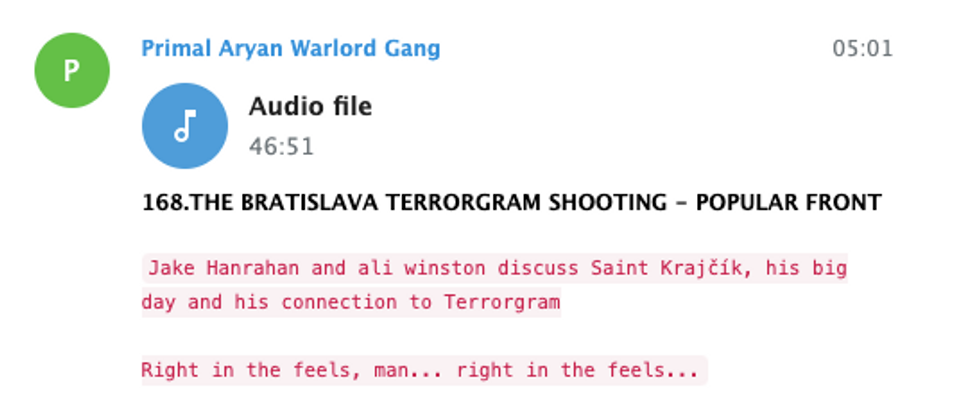 An administrator of the Primal Aryan Warlord Gang channel celebrate a mass shooting in Slovakia. Aaron Alligood, a 2119 member, was a frequent contributor to the chat. Source: Telegram
 Aiden Cuevas, posting under the screen name "Bozak bzk" valorizes an antisemitic attack by fellow 2119 member Waylon Fowler in an October 2023 Telegram message. Source: Telegram
 A Facbook post by a family member shows Aaron Alligood posing with a buck (left); the same photo, with Alligood's face redacted, identifies him with the "Georgia Chapter" on the Blood and Soil Crew Telegram channel. Sources: Facebook, Telegram
 A still from a video published by 2119 member Mathew Bair shows a flier on a chain-link fence that reads "Shoot your local judge." Source: Telegram
 A Telegram post forwarded by Mathew Bair on Jan. 21, 2024 contains an implied threat.
 Book cover (Rutledge/Gregg Barak)
 Supreme Court 2022, Image via Fred Schilling, Collection of the Supreme Court of the United States
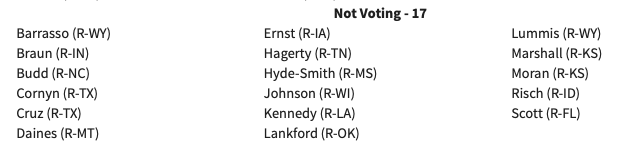
 Cynthia King reads to her son Dexter Muir at their home in Honolulu, Hawaii, in 2016. (CORY LUM/CIVIL BEAT)
 A recent photo of Cynthia King and her family in Hawaii. (COURTESY OF CYNTHIA KING)