



Money erodes trust
Good to see Oregon's Jeff Merkley among the first to call for his opponent to return his $39,000 in Stevens money. (via D-Day.)
I met Merkley (well, shook his hand, anyway) at Netroots Nation, and it's another Netroots Nation event that comes to mind when I read this story: Lawrence Lessig's keynote address.
In discussing the presentation, Darcy made the prediction that the actual initiative would suffer by comparison to the announcement. Trying to simply navigate the site, let alone figure out which candidates agreed to what, lends support to his theory.
Let's hope it picks up. I've been reading political theory lately, not that you'd know it from my blog posts, and it strikes me that James Madison's Federalist #10 implies a fine argument against money in politics. I doubt he meant it so - he was too busy arguing against paper money's existence to worry about its direct effect on politics - but his argument that a republic has an advantage, and a large republic a larger one, in the restraint of special interests is short-circuited by the ability of money to tip the scales.
A landed interest, a manufacturing interest, a mercantile interest, a moneyed interest, with many lesser interests, grow up of necessity in civilized nations, and divide them into different classes, actuated by different sentiments and views. The regulation of these various and interfering interests forms the principal task of modern legislation, and involves the spirit of party and faction in the necessary and ordinary operations of the government...Men of factious tempers, of local prejudices, or of sinister designs, may, by intrigue, by corruption, or by other means, first obtain the suffrages, and then betray the interests, of the people. The question resulting is, whether small or extensive republics are more favorable to the election of proper guardians of the public weal; and it is clearly decided in favor of the latter by two obvious considerations:
In the first place, it is to be remarked that, however small the republic may be, the representatives must be raised to a certain number, in order to guard against the cabals of a few; and that, however large it may be, they must be limited to a certain number, in order to guard against the confusion of a multitude. Hence, the number of representatives in the two cases not being in proportion to that of the two constituents, and being proportionally greater in the small republic, it follows that, if the proportion of fit characters be not less in the large than in the small republic, the former will present a greater option, and consequently a greater probability of a fit choice.
In the next place, as each representative will be chosen by a greater number of citizens in the large than in the small republic, it will be more difficult for unworthy candidates to practice with success the vicious arts by which elections are too often carried; and the suffrages of the people being more free, will be more likely to centre in men who possess the most attractive merit and the most diffusive and established characters.
Barred by republican theory from undue influence over the government, the moneyed interests decided to simply sponsor the government instead. The very basis of Madison's argument, and indeed of the constitutional republic he thought he was forming, was that, given a choice, the people would trend towards those public servants who serve the public interests. Not all elections would be successful in this goal - but enough of them. So it's sad to reflect that none of the elections in this country - with rare exceptions - even offer the people a choice.
And as this 2008 Democratic supporter closes an argument which sounds suspiciously like Ralph Nader's in 2000, I'll just say that Lessig's idea for public financing is far more important than third parties: As long as the best-funded candidates continue to win elections, third parties will remain an irrelevancy. As soon as money (especially corporate money) is taken out of the equation, the need for third parties will be far less pressing. Either way, taking care of the money issue is paramount.

 So what, exactly, do these bigots object to? Isn't that the intent of the measure -- to limit the right to marry to heterosexual couples? The only way to do that is to
  I've been noticing lately that more and more of the Wingnutteria is beginning to clue into the fact that there's a serious contradiction between claiming to be all about "family values" and not valuing your very own children enough to want to leave them a planet to live on.
 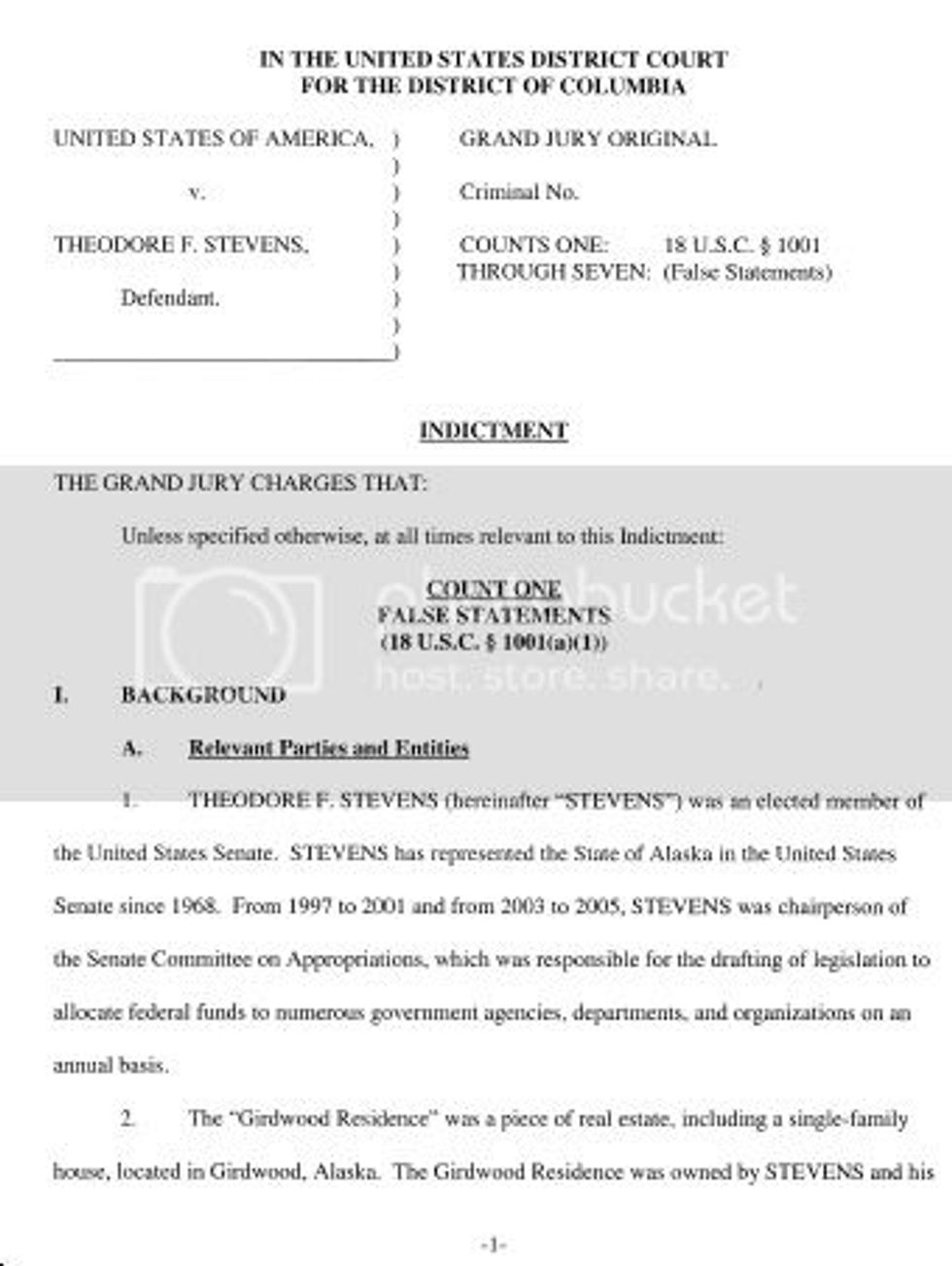 Senator Ted Stevens of Alaska, the longest serving Republican in the U.S. Senate, was indicted by a federal grand jury in Washington on charges of hiding hundreds of thousands of dollars in gifts he received. Stevens, 84, was charged with seven counts of making false statements on his Senate financial disclosure forms from 1999 to 2006 about gifts and renovations on his house.
 Gah, sorry this is up so late. I misread the date on it.
 A Vancouver woman had a


 I'm shocked, too.