Increased armed guards at U.S. Postal Service facilities may signal an effort by President Donald Trump to control the mail before the midterms, scholars and union leaders warn.
USPS plans to deploy more contracted armed security officers at 18 mail facilities across the country this month, according to internal agency communications reviewed by Raw Story.
The federal agency approved more than 12,000 hours per week of work for the security officers at those facilities combined, adding tens of millions of dollars in labor costs annually while USPS continues to bleed money — clocking $2 billion in net losses in the last financial quarter alone.
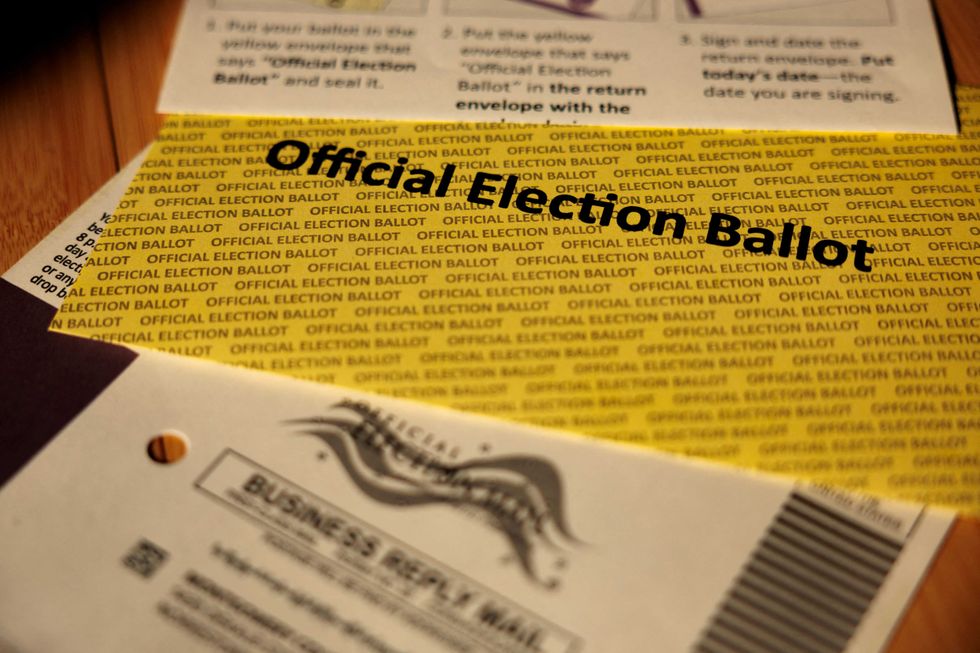
The Supreme Court dealt Trump a loss last month when it ruled states may count late mail-in ballots postmarked by Election Day. Trump countered by pressuring a federal judge to lift a halt on his executive order that would give USPS greater authority to determine who can vote by mail.
“Screening mail ballots for eligibility would amount to an unprecedented, potentially unconstitutional, involvement of the federal government in the administration of elections,” said James O’Rourke, emeritus professor of management at the University of Notre Dame’s Mendoza College of Business, who studies the postal service.
“It's clear that the White House is pressing ahead.”
Hiring contracted security guards is “similar” to the hiring of private security firms by U.S. Immigration and Customs Enforcement (ICE), O’Rourke said.
Have a tip? I want to hear it.
I'm an investigative reporter covering politics and government accountability. If you have information the public should know — inside government, a campaign or anywhere power operates with too little scrutiny — I want to hear from you."
I protect sources and can communicate securely and confidentially.
Alexandria Jacobson
Investigative Reporter, Raw Story
alexandria@rawstory.com
“If they put their own guys in, then they can do anything they want with the ballots,” he said.
The increased hiring of security officers comes as the Postal Police Officers Association (PPOA) union remains embroiled in a six-year battle with USPS after the agency effectively benched its own uniformed police officers — limiting them to only working on postal properties, instead of patrolling the streets where letter carriers experienced violence and mail robberies occurred.
“They couldn't replace us with armed security guards if we're out in the street protecting the mail and letter carriers,” said Frank Albergo, PPOA president and a retired postal police officer.
“If they bring us back to the facilities, take away our authority, they figure, ‘OK, we can replace them with armed security guards,’ but look at the damage that has been caused because of it.”
Letter carrier robberies skyrocketed 543 percent over a three-year period, including some robbed at gunpoint or killed on the job, a Raw Story investigation found in 2024.
The USPS Office of Inspector General reported in May that the law enforcement arm of USPS, the U.S. Postal Inspection Service (USPIS), made some improvements in its response to a spike in mail theft but had many of the same deficiencies identified in reports since 2023.
Albergo said the union has been notified of about 39,000 work hours per week approved for the hire of 972 full-time armed guards across 54 USPS facilities — including 18 that didn't have any before.
Jonathan Smith, president of the American Postal Workers Union (APWU) took issue with the hiring of private armed security guards who “do not have a postal patch,” saying that some postal managers are prone to using security guards as “personal Gestapo to intimidate the employees.”
“We've already got an arm to secure the safety of the employees, and I don't see the need to bring any outside resources about, outside hiring more postal police officers,” Smith said.
‘Ticking time bomb’
The number of postal police officers exceeded 2,600 in the 1970s and dwindled to about 450 by 2020. Now, there are 314 postal police officers in the bargaining unit as of May 1, Albergo said.
The officers undergo 1,440 hours of training over the course of nine months, including active shooter response, use of force and CPR/AED training, Albergo said.
By contrast, an investigation by CNN and the Center for Investigative Reporting found that armed security guards lack consistent training and oversight.
“They're basically just giving guns to armed security guards with minimum training,” Albergo said. “No training from the federal government, and they're letting them loose on the workroom floor. It's crazy.”
Training standards for armed guards vary by state. In California, for instance, armed guards receive authorization after 54 hours of training, 14 hours of which are firearms training. Armed security guards do not need firearms training in 15 states, according to the investigation.
“The whole thing, it's basically a ticking time bomb,” Albergo said.
A fourth death within two years at a 1-million-square-foot USPS warehouse in Palmetto, Georgia, prompted outrage from Smith and the postal worker community.
The Palmetto facility was approved for at least 1,344 hours per week of security guard services in March 2024, according to an internal memo reviewed by Raw Story. Postal police officers are not present at the Palmetto facility, Albergo said.
Smith called out a lack of emergency phones at the facility where the latest employee, Demarcus Little, Sr., 45, died after a medical emergency in June. Protocol requires security personnel to respond before emergency services are contacted, he said.
“We're trained in that sort of first responder type care, and we would have tried our best,” Albergo said. “Whether or not we would have been able to save the person, who knows? But at least there would have been a chance.”
‘Who's pushing back?’
Arlus Stephens, an attorney who has represented the PPOA in its legal battle with USPS, called the 2020 statute reinterpretation of the postal police officers’ authority “a nuclear weapon” in order to “finally ‘win’ this argument with postal police about whether they should be paid like police officers or paid like security guards.”
“As a further kind of FU to the union and to the officers, [USPS is] actually going to try to contract them out, but they're not going to save any money,” Stephens said. “They're going to pay an absolute fortune to this private security guard company to get these armed security guards.”
Stephens said the union has an arbitration decision that says USPS is supposed to “recognize our judicial authority, but we can't seem to get it enforced by a court.” He called the arbitration process for the collective bargaining unit “the most disappointment I've had in the judiciary in 30 years of practice.”
“[USPS] would rather burn their own house down than admit they're wrong and to have to send postal police back out there to try to regain public confidence in the security of the mail,” Stephens said. “They would rather burn it all down, and it's just insane to me.”
Privatization of the postal service has been debated for decades, and Trump has entertained the idea during both of his presidential terms.
A memo from the chief postal inspector about a meeting with the now-defunct Department of Government Efficiency set off alarms with experts about the potential of privatization in USPS’s future, Raw Story exclusively reported.
“They are literally privatizing the security of the postal service, and who's pushing back? It's nobody, really,” Albergo said.
“This is a test case of how much pushback are they going to get when we privatize a part of the postal service, and right now they're not getting much pushback at all.”
O’Rourke said “privatization of the postal service may ultimately happen if Trump thinks it's in his best interest,” but really the president’s bigger concern is “control” of the mail.
“If I get rid of the watchdog, the security, I can appoint anybody I want,” O’Rourke said. “This is a flat-out attempt to steal the next election.”
USPS and USPIS did not immediately respond to Raw Story’s questions.