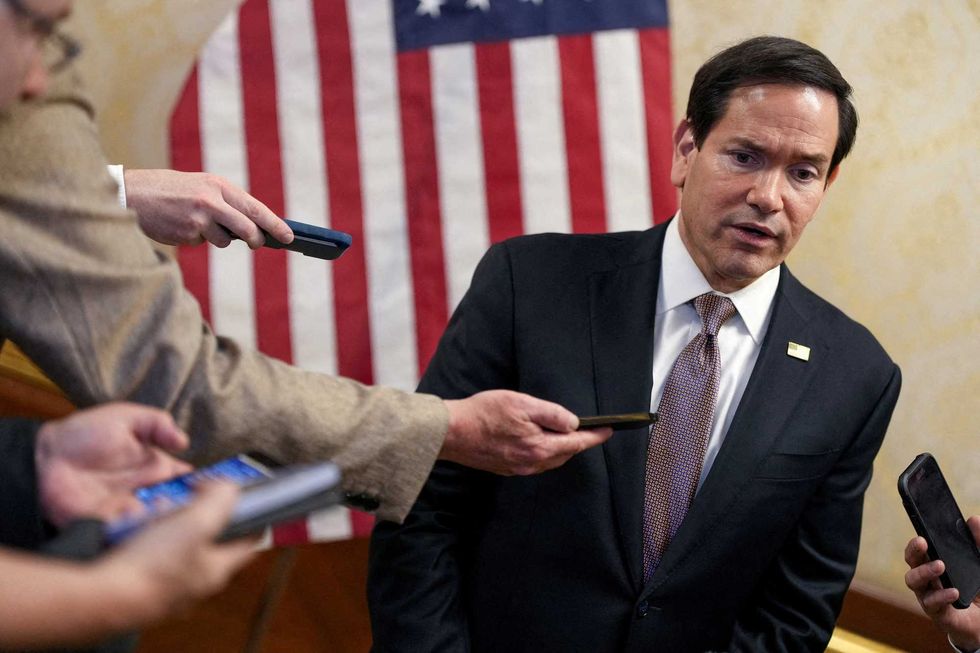
U.S. Secretary of State Marco Rubio speaks to members of the media in Kuwait City, Kuwait, June 24, 2026. REUTERS/Eric Lee/Pool/File Photo

A tranche of newly obtained emails revealed widespread "internal confusion" among senior State Department officials over a warehouse full of reproductive health products, with some officials apparently unable to distinguish contraceptives from abortion-inducing medications.
The internal State Department emails were obtained by the Center for Reproductive Rights, which sued the Trump administration over its decision to destroy at least $10 million worth of reproductive health products being stored at a warehouse in Belgium.
The products were earmarked for distribution under the U.S. Agency for International Development before the agency was gutted early on in the second Trump administration, and under the guidance of then-billionaire Elon Musk.
“There is no one here that knows definitively what is in the warehouse,” wrote a diplomat working at the U.S. Embassy to Belgium to a State Department official, according to an internal email reviewed by The Washington Post.
According to the Post, a “chaotic picture” ensued as State Department officials attempted to identify what exactly was housed at the warehouse amid Musk’s spearheading of USAID cuts across the globe. The emails also showed "that [Secretary of State Marco] Rubio was kept aware of the fate of the contraceptives."
And, while the Trump administration ultimately didn’t follow through with its plans to destroy the reproductive health products stored at the warehouse – instead allowing them to perish – the scramble to identify the warehouse’s contents resulted in some revealing exchanges, as revealed in a report Tuesday from the Post.
“In one email, a senior official from the State Department incorrectly described several contraceptives as abortifacients. On Aug. 8, [2025], an unnamed State Department official emailed Jeremy Lewin, a political appointee who oversaw foreign assistance at the State Department, with a list of what is described as ‘Current Viable Abortifacients’ being housed at the warehouse,” the Post’s report reads.
“The unnamed official listed two different contraceptive devices – a subdermal implant and an intrauterine device – and the daily oral contraceptive Levonorgestrel. None of the three items are classified by the U.S. Food and Drug Administration as abortifacients used to induce abortions in pregnant women.”
Liz McCaman Taylor, a lawyer with the Center for Reproductive Rights – which sued the Trump administration in part to force the sale of the products – offered a blistering rebuke of the administration's decision to let $10 million worth of reproductive health products perish rather than sell them.
“This administration talks a lot about waste, fraud and abuse, and trying to root it out, but this is waste, fraud and abuse,” Taylor told the Post.
Report typos and corrections to corrections@rawstory.com.
For customer support contact support@rawstory.com.