Florida Republicans do not want to make voting easy for college students — a demographic that leans heavily Democratic.
Former GOP Secretary of State Ken Detzner, an appointee of Gov. Rick Scott, took that to the extreme in 2014, with an order banning county election officials from setting up any early voting sites on college campuses. Last year, following a lawsuit by the League of Women Voters, federal District Judge Mark Walker struck down that order as an unconstitutional burden on students' voting rights. As a result, some 60,000 people were able to vote early on 11 college campuses in Florida in 2018.
But the GOP has not given up. According to the Tampa Bay Times, a new elections bill under consideration by the legislature and Gov. Ron DeSantis, SB 7066, would effectively accomplish the same thing, making it impossible to set up early voting sites on most college campuses.
At issue, activists say, is the bill's requirement that any early voting site "must provide sufficient nonpermitted parking to accommodate the anticipated amount of voters." Most colleges in Florida do not offer free parking, let alone enough free parking to accommodate every voter. And the limitation doesn't even make sense for sites on college campuses, which are often either walkable or in the heart of cities with public transportation.
The plaintiffs in the lawsuit have filed an emergency motion with Judge Walker, saying that the bill "is aimed with laser-like precision at undoing this court's standing preliminary injunction order, and again imposing an elections regime in which supervisors of election are effectively prohibited from offering early voting on Florida's college and university campuses."
This is not the first time the Florida GOP has moved to overrule expansions of voting rights. After the bipartisan passage of Amendment 4, a voter referendum restoring rights to most ex-convicts, the legislature passed, and DeSantis signed, a bill requiring people pay back all court fines and restitution to be re-enfranchised, a de facto poll tax that prevents the amendment from applying to hundreds of thousands of people.
For the past couple of decades, proponents of vouchers for private schools have been pushing the idea that vouchers work.
They assert there is a consensus among researchers that voucher programs lead to learning gains for students – in some cases bigger gains than with other reforms and approaches, such as class-size reduction.
As researchers who study school choice and education policy, we see a new consensus emerging — including in pro-voucher advocates’ own studies — that vouchers are having mostly no effects or negative effects on student learning. As a result, we see a shift in how voucher proponents are redefining what voucher success represents. They are using a new set of non-academic gains that were not the primary argument to promote vouchers.
How success is defined is particularly important now in light of the fact that Florida and Tennessee – which are both controlled by Republicans – have created new publicly funded voucher programs in May 2019.
In addition to states, Republicans are pursuing vouchers at the federal level as well. For instance, U.S. Secretary of Education Betsy DeVos – along with Republican Sen. Ted Cruz of Texas and eight of his fellow Republican senators – are pushing for a voucher-like plan to establish what they refer to as Education Freedom Scholarships. The US$5 billion proposal would enable individual taxpayers and businesses to get dollar-for-dollar tax credits for contributions to “scholarship” organizations. Those organizations would then pass the money to families to use for private schools or other education related expenses for their children.
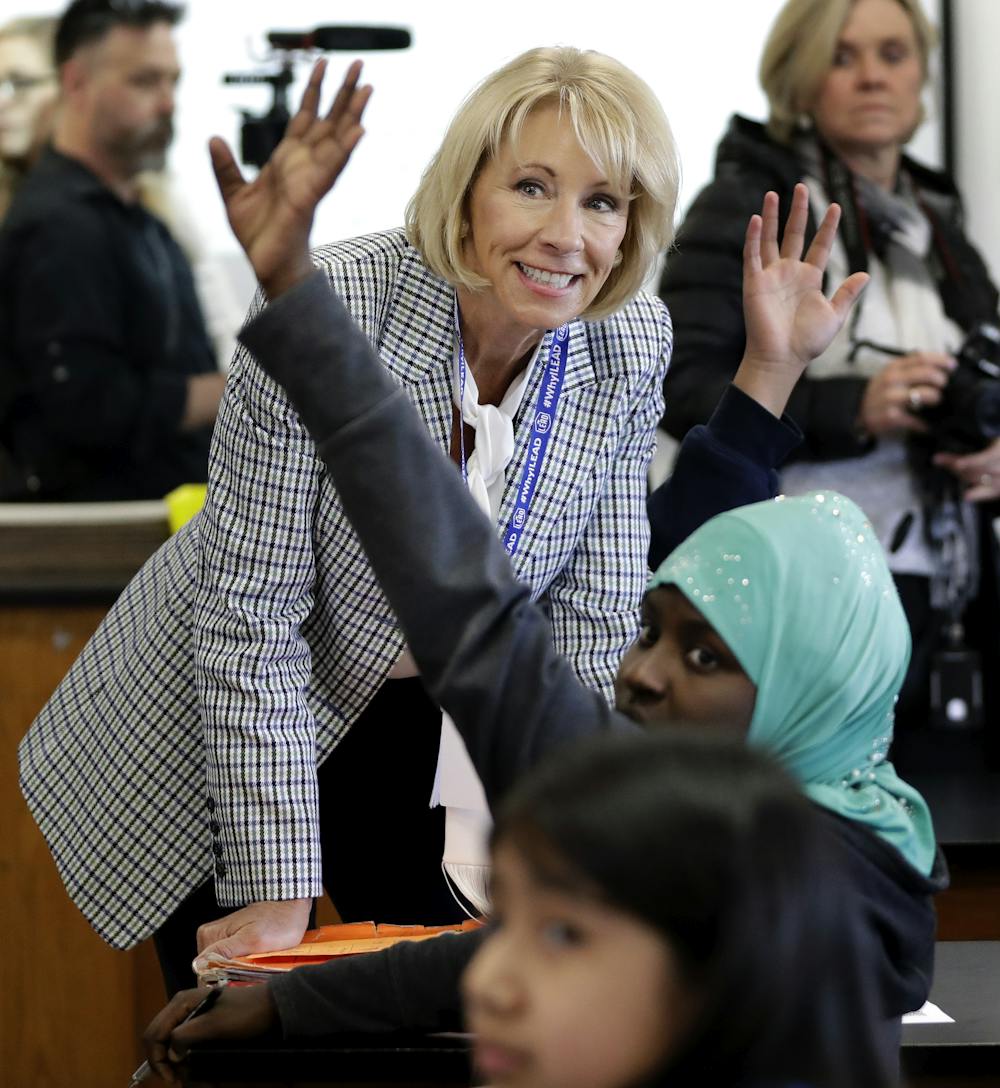
U.S. Education Secretary Betsy DeVos talks with students in Nashville, Tenn., in April, as lawmakers voted to expand school vouchers.
Given all the political interest in vouchers, it pays to revisit how there came to be such as disconnect between what the research shows about the negative impacts of vouchers and their popularity with policymakers.
Starting in the early 1990s, a voucher-advocacy movement emerged to promote the idea that vouchers help students learn. Funded largely by pro-voucher philanthropies such as the Walton Family Foundation, think tanks, such as Cato Institute and The Heritage Foundation, and advocacy organizations, such as EdChoice, made concerted efforts to promote proof of the effectiveness of vouchers. The proof came in the form of a small set of studies of voucher programs for poor children in a select set of cities. The studies were conducted by a group of pro-voucher scholars often funded by those same philanthropies.
For example, a Harvard center funded by pro-voucher organizations, disputed the official state evaluations of voucher programs in Milwaukee and Cleveland to argue that there were small but discernible achievement gains for voucher students.
More recently, teams from the University of Arkansas have been claiming that their studies show that vouchers almost always lead to learning gains for at least some students, do little if any harm to students, and provide all sorts of other benefits. Among other things, they say that vouchers reduce crime and lead parents to become more involved in civic life. The media then pick up these studies.
But the latest research about vouchers calls into question the original, primary claims about their effectiveness.
New evidence emerges
Rigorous research on state-wide programs in Ohio, Indiana and Louisiana, as well as in Washington, D.C., shows large, negative impacts on academic achievement of students using vouchers compared to their peers who stayed in public schools.
Now that there is evidence that vouchers harm student learning, voucher advocates have changed their argument. They say test scores are not that important. Instead, they say policymakers should focus on other measures such as “attainment,” which entails things like the rate at which voucher students enroll in college.
While some advocates downplay the importance of test scores, others, such as DeVos make the argument that vouchers are worthy simply because they give students and families expanded choice.
We believe student learning, the original reason vouchers were promoted, should remain the measure of success. While imperfect, few measures are as readily available to policymakers as test scores in evaluating education reforms. Moreover, advocates should be accountable for the results they said would occur regarding learning gains. But instead, it appears they want to “move the goalposts” they themselves had set up.
Science, according to a Trump appointee at the Department of the Interior, is "a Democrat thing." Those words were reportedly used to justify the abrupt 2017 cancellation of a study into the health effects of mountaintop removal for coal-mining. At the time, then-Interior Secretary Ryan Zinke claimed that the study was canceled after a careful review of the grant process.
"I was deeply offended," Lowenthal told Salon when asked about Davis's comment. “Without independent science, evidence, facts and expertise, policy is made in the dark and special interests can lie to the public and rewrite the rules for their own benefit."
"If the administration dismisses science as a ‘Democrat thing,’ the results will speak for themselves: worse public health, environmental degradation and more and more misguided policy," he added.
Of course it's no surprise to hear that Trump officials think this way. But it is at least a little surprising that an administration official would be willing to say so out loud, even in a private interview. Typically, the Trump administration's strategy on scientific issues is to rely on gaslighting, in this case by claiming that it cares about science, public health and the environment, while focusing all possible actions in the opposite direction.
In January, the Union of Concerned Scientists released a report outlining the evident contempt the Trump administration has for actual science. The report found "that the administration has interfered with or sidelined science in 80 separate incidents over the past two years."
Instead of science, which is apparently a "Democrat thing," the Trump administration is guided more by right-wing ideology and, of course, the interests of its rich benefactors.
"Comments like these barely scratch the surface of the rampant disregard for standards that protect our nation's land and water at Donald Trump's Department of Interior," Chris Saeger, director of the Western Values Project, told Salon. "The corruption that has taken hold at Interior has rendered meaningless the distinction between the employees there and the lobbyists that seek to profit from America's natural resources."
The Department of the Interior did not offer comment on this story when asked by Salon.
Trump's administration is so devoted to prioritizing the desires of oil and coal company executives over public welfare that it's even willing to tangle with other Republicans to do so. As Politico reported on Wednesday, Trump and his Interior appointees are trying to implement a sneaky plan to open up offshore drilling off the Florida coast, even though both Republican and Democratic leaders in the state oppose the idea, largely out of fear it will damage the tourist industry. Even newly elected Florida Gov. Ron DeSantis, a loyal Trump acolyte, opposes offshore drilling. But Interior is so beholden to the polluting industry that his opinion doesn't matter.
Team Trump's plans to address the unpopularity of their anti-environmental agenda involve, unsurprisingly, a whole bunch more gaslighting. Bloomberg reports that Trump plans to "tout his environmental credentials" on the campaign trail, while of course presiding over an administration that cuts regulations so fast you have to wonder whether it actively hates the planet and wants to destroy it.
Zinke peaced out of office in December, no doubt realizing that with the newly-elected Democratic majority in the House of Representatives, his days of avoiding aggressive investigations were over. Trump didn't even bother pretending to care about the environment when picking his replacement, acting secretary David Bernhardt, a longtime industry lobbyist who specialized in attacking environmental regulations and who apparently continued to do that for months after he filed legal paperwork claiming he had ceased.
Unfortunately, with all the corruption in the Trump administration, it's been difficult for environmentalists to highlight the dire situation within both the Interior Department and the EPA. But one intrepid soul named Irene Kim managed to go viral for a day by wearing a swamp-creature mask during Bernhardt's recent confirmation hearing.
But while slashing environmental regulations on behalf of polluters is a major focus, it's only part of the larger anti-science agenda of the Trump administration. At least 14 studies have been suppressed or canceled over the past two years, including one on how to prevent teen pregnancy and another on the positive social and economic impact of admitting refugees to the U.S. Economists were barred from even starting a study on the long-term economic impact of Trump's tax cuts for the richest Americans.
If it's no surprise that Trump administration officials are hostile to science they find ideologically threatening, the level of shamelessness is sometimes stunning. The administration has repeatedly censored any acknowledgment of climate change from documents and scrubbed mentions of this scientific reality from websites. Zinke even brought the superintendent of Joshua Tree National Park, David Smith, into his office to berate him for tweets acknowledging the reality of climate change.
The open hostility suggests that this anti-science attitude is, in many cases, about something bigger than specific facts that undermine conservative arguments. It's also rooted in a distinctively Trumpian -- and distinctively Republican -- hostility toward education and knowledge. Trump has repeatedly indicated that he's personally insulted by the idea that he should or could learn things, as he seems to believe he was born as the consummate authority on everything.
"It appears this administration is treating science the same way coal miners deal with mountains: Blow it up and throw it away," Lowenthal said during Tuesday's hearing.
Of course, Republicans don't want to have a broader debate in which they openly argue for giving less weight to facts and evidence in policy considerations. That's a debate they know they'd lose. Instead we see this sneaky, underhanded nonsense, like canceling studies and lying about the reasons. Unfortunately, the damage done by this reckless opposition to science will likely far outlast the Trump administration itself.
The News Service of Florida reported Tuesday that DeSantis made comments defending Scott Rivkees, a physician and the former chairman of the Department of Pediatrics at the University of Florida College of Medicine, as his surgeon general nominee.
"My thing is, if we have a public health issue, I want somebody that is going to be able to protect the people of Florida," the governor said Tuesday morning.
"He’s been dinged for making a comment or two, which to me I don’t think rises to that level,” DeSantis said after claiming he wasn't aware of any "harassment" allegations against his nominee. “I think this is a guy who has earned great plaudits from the University of Florida."
In 2014, the University of Florida investigated Rivkees after he repeatedly "joked" to colleagues during disputes that "if we can’t agree on this we’ll all have to get naked in a hot tub and work it out."
Rivkees admitted to making the comment and told university investigators that he "may have said it more than once." He added that the pediatric ICU he worked in was in "disarray" and that he was joking.
Along with the harassment investigation, the News Service of Florida reported last week that the nominee was separately "found by a university auditor to have not properly filed financial-disclosure information."
Bill Galvano, the Republican president of the Florida Senate, said last week after the investigations were revealed that the legislative body would not vote on Rivkees' confirmation before their session ends on May 3 because they'd not had time to vet him.
"The very serious allegations against Dr. Rivkees are troubling to say the least,” Galvano said in a statement. “The confirmation process will provide the opportunity for the Senate to gather additional information, but certainly with what we know at this time, I am very concerned, as are other senators.”
The report noted that Rivkees can, however, serve as Florida's surgeon general because state law "allows two legislative sessions to expire before an agency secretary who hasn’t been confirmed must step down."
If one word can capture the sentiment of rural and small-town dwellers in recent years, it is “resentment.”
I am a scholar who studies politics at the state and local level. Residents of rural and small-town communities believe they are not getting their fair share of government attention and vital resources compared to urban dwellers. They believe that America is moving away from them.
As the 2020 presidential campaign gears up, these resentful Americans will play a key role. How strong supporters of Donald Trump in the 2016 election vote in 2020 will depend on whether the president has delivered on the promises he made to help them out.
Will this growing divide affect American politics beyond Trump?
Given their intensifying feelings of resentment for being ignored and left behind, rural and small-town dwellers were particularly receptive to the slogan touted by Trump in his campaign – “Make America Great Again!”
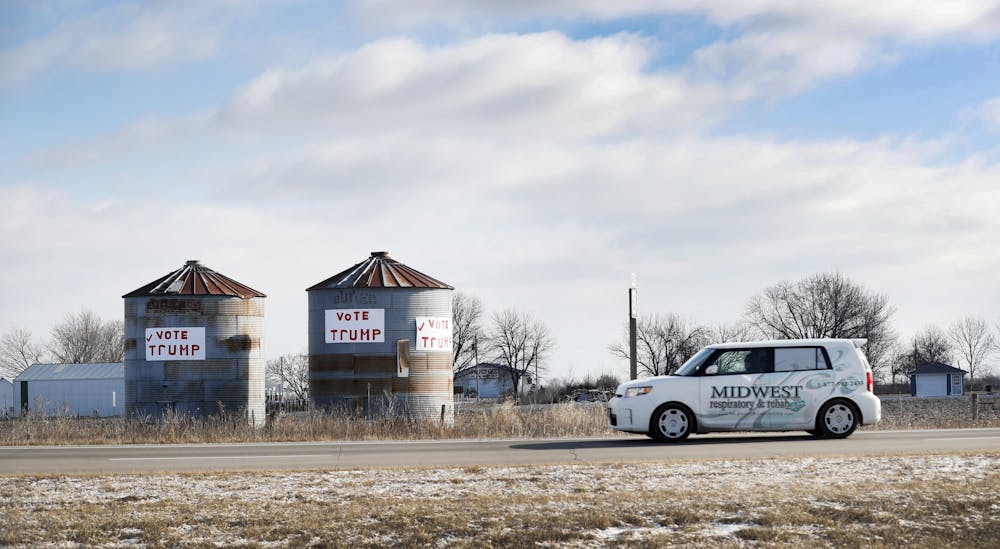
Trump won the country’s small town and non-metropolitan areas by 63.2 percent to 31.3 percent, with his largest vote shares coming from the most rural areas.
Like other Republican presidential candidates over the last 10 years, Trump garnered a large majority of the vote in traditional rural areas like Appalachia, the Great Plains and parts of the South.
This evidently buoyed the hope of Trump supporters in these areas that they would be getting something closer to their fair share of government attention and resources.
Voting implications
There is ample evidence of voting patterns in recent years – even before the 2016 election – that suggest that voters in rural areas and small towns were increasingly voting for Republican candidates in national and state elections. This trend was quite visible from Republican and Democratic vote proportions in the 2000, 2004, 2008 and 2012 elections.
In 2008, 53 percent of rural voters cast ballots for the Republican presidential candidate; 59 percent did in 2012; and 62 percent did in 2016.
This was most clear in the 2016 election in the 2,332 counties that make up small-town and rural America, where Trump swamped Hillary Clinton by winning 60 percent as opposed to 34 percent of the vote.
Trump’s 26-point advantage over Clinton in rural America was much greater than had been the case for Republican presidential nominees in the four previous elections.
Those included immigration, tax cuts, eliminating regulations on businesses, making better trade deals, targeting more infrastructure projects and federal government services to rural areas and small towns, and appointing more conservative judges to the federal courts.
But, did this trend of strong support from rural voters for Republican candidates, including Trump, continue into the 2018 midterm election?
About half of Trump’s ideas and policy proposals have been accomplished, with the others yet to gain traction in Congress, two years after his election. So his record of delivering for these rural voters is mixed.
Nevertheless, they stuck with Trump in the 2018 election.
While not totally surprising, the Trump camp did not know what to expect going into the midterm election, given the numerous investigations of the president and his low public approval rating.
Somewhat more surprising is what has been happening in a purple state like Florida, where Republicans have improved on both their turnout and overall performance in rural areas for several elections in a row.
Results show that residents of small towns and rural areas are much more supportive of the Republican Party and its candidates than people in urban and suburban areas.
In addition, the most ardent supporters of Republicans are among those small-town and rural dwellers who are white and male, have less than a college education and vote on a regular basis.
I believe that the urban-rural/small-town divide will continue to act as a major force in politics for the remainder of the Trump era – and probably longer.
This article has been updated to correct a reference to Arlie Russell Hochschild’s book.
Andrew Gillum has set up a voter registration group aimed at thwarting President Donald Trump's chances to take Florida again in next year's election.
The former Tallahassee mayor and Democratic gubernatorial candidate will formally announce Bring It Home Florida, which takes its name from his signature phrase, after registering the organization last week with the state election division, reported Politico.
Gillum lost his election to Republican Ron DeSantis in November, but his political action committee Forward Florida still has nearly $3.9 million available that he will pour into efforts to increase the number of voters in his home state rather than joining the Democratic presidential field.
“In this period of time," Gillum said in January, "whatever resources that I raise and time and energy I spend in this state is going to be around voter registration and deep-level engagement, so that when we have a nominee, we have an apparatus we can turn on."
Trump's re-election campaign is heavily focused on Florida, which holds 29 of the 270 electoral votes needed to win, and Democrats are hoping to overcome their turnout problems in the state by increasing the number of voters on the rolls.
Republicans, on the other hand, have introduced a new bill aimed at undercutting the new right to vote by felons, which was given back in November after 64 percent of voters approved an amendment to the state's constitution.
State Rep. James Grant (R-Tampa) is sponsoring the measure, which would require ex-felons to clear up financial obligations, including court costs, fees and fines before restoring their voting rights.
It has seemed odd from the very beginning that New England Patriots owner Robert Kraft, a billionaire several times over, would patronize a massage parlor called the Orchids of Asia for a little quickie on his way to the AFC championship game. After all, men like Kraft can easily hire high end escorts and they often have mistresses on the side. Why go to a cheap strip mall?
But Kraft wasn't the only vastly wealthy john who got caught in the sting that has put him in the headlines. Private equity mogul John Childs and former Citigroup president John Havens were also arrested. There is obviously more to this sordid story of Chinese sex trafficking to come out in the days to come. With the recent re-evaluation of the extremely disturbing Jeffrey Epstein case from the previous decade, it seems that an illegal sex trade has been thriving in the ultra-rich enclaves of South Florida.
A woman named Cindy Yang founded the "day spa" where all these wealthy powerful men went to release their ... stress. Although Yang no longer owns the specific business where Kraft was videotaped receiving oral sex, it was known for offering the same "services" in her time. Her family still operates several similar enterprises that are also under suspicion for sex trafficking and prostitution. And wouldn't you know it, Yang is a big-time Republican who now owns a company that sells access to another wealthy and powerful man with a big presence in South Florida: the president of the United States.
The Miami Herald first reported that Yang had attended a Super Bowl gathering at Mar-a-Lago, and produced a selfie of Yang and President Trump posing together at the party. The Herald also published pictures of other events showing Yang and Trump's adult sons, along with a trio of Florida Republicans -- Sen. Rick Scott, Gov. Ron DeSantis and Rep. Matt Gaetz -- as well as onetime vice-presidential nominee Sarah Palin and Republican National Committee chair Ronna McDaniel.
According to the Herald, Yang had shown no interest in politics prior to 2016 -- she never even voted -- but "has now become a fixture at Republican political events up and down the East Coast." These gatherings all charge big donations to attend, although much of the money collected at Mar-a-Lago affairs goes straight into Trump family coffers to pay for the event. It's a tidy form of double dipping -- and, at least in general terms, not illegal.
Yang and her family have been generous to Trump and the GOP, giving more than $42,000 to the Super PAC Trump Victory and more than $16,000 to the Trump 2020 campaign in 2017 alone. As David Corn, Dan Friedman and Daniel Schulman of Mother Jones reported last Saturday, that's just the cost of doing business for Yang's company, which was started a year into Trump's presidency. Yang and her husband, Zubin Gong, started GY US Investments LLC, which they describe as an international consulting firm, in 2017. Displaying pictures of Mar-a-Lago, it openly markets access to Trump to Chinese business representatives.
For obvious reasons, national security experts were alarmed by this report. This startling combination of sex trafficking, prostitution and politicians presents a perfect opportunity for espionage and blackmail. In an explosive follow-up report on Sunday, the Mother Jones reporters make clear that these observers were right to be concerned:
Yang is an officer of two groups with ties to China’s Communist government. And she founded a Miami-based nonprofit that promotes “economic and cultural exchange” between China and the West in coordination with “senior … Chinese leaders” in the United States, according to a profile of Yang posted on a Chinese social media platform ... .
[A] cursory examination of the organization’s leadership structure reveals that [Yang's nonprofit] is directly subordinate to the Communist Party’s United Front Work Department. In July, the Daily Beast reported, “‘Peaceful reunification associations’ — the term refers to Beijing’s intent to obtain sovereignty over Taiwan—have a close relationship with the [Communist Party’s] United Front Work Department, in some cases functioning almost as an extension of its Overseas Chinese Affairs Office.”
If you were following politics in the 1990s, you might be getting a little feeling of déjà vu. Chinese fundraising scandals were a staple of political investigations during the Bill Clinton years. Perhaps you remember the names Johnny Chung, Yah-Lin "Charlie" Trie, John Huang, James Riady and Maria Hsia. These were all major Democratic Party and Clinton donors who were investigated for campaign finance law violations and, in a couple of cases, connections to Chinese intelligence and other Chinese government officials.
The Justice Department first started investigating all this in 1996, right after that year's presidential campaign. Congress soon took it up and the matter escalated into a major scandal that continued for years. Republicans repeatedly demanded an independent counsel but were rebuffed by Attorney General Janet Reno, who insisted the Department of Justice was capable of handling this investigation. It did. The probes resulted in several guilty pleas, large fines and probation. There was no evidence of any collusion with the Clinton administration or the DNC, and the campaigns returned the money.
The Republican majority in Congress made fools of themselves, as they are wont to do in these situations, and turned the congressional hearings and investigations into a circus. The House Oversight Committee, chaired at the time by the slightly daft Rep. Dan Burton, R-Ind., spent more than $7 million on its investigation, at the time the most expensive congressional probe in U.S. history.
Congressional expert Norm Ornstein said at the time:
Barring some dramatic change, I think the Burton investigation is going to be remembered as a case study in how not to do a congressional investigation and as a prime example of investigation as farce.
The Clinton campaign finance scandals were messy and damaging. But there was no sex trafficking or prostitution involved, and those foreign donors weren't putting cash into the president's personal bank account, as Yang and company are doing with big parties at a private club owned by the president. This is blackmail just waiting to happen -- if it hasn't happened already.
Presidents divest themselves of their businesses not just to avoid the "appearance" of conflict of interest, but to avoid the possibility of compromise. This president seems to have a peculiar fetish for putting himself in as many compromising positions as possible.
A former sheriff in Florida who was suspended over the heavily criticized police handling of a 2018 mass shooting that left 17 people dead at a high school sued the state’s governor on Thursday in an effort to reclaim his job.
Governor Ron DeSantis, a Republican, in January suspended Democrat Scott Israel just days after taking office, saying the massacre at Marjory Stoneman Douglas High School might “never have happened” if the Broward Sheriff’s Office had been better led.
Israel has said DeSantis suspended him because his outspoken gun control stance angered the National Rifle Association, which endorsed DeSantis in his campaign for governor last year.
A state-appointed commission, in a report on the mass shooting issued shortly before DeSantis suspended Israel, found some Broward County sheriff’s deputies held back too long, instead of rushing toward the gunfire.
Israel’s lawsuit, which was filed in Broward County where he was first elected sheriff in 2012, acknowledged DeSantis has the authority under the Florida Constitution to suspend a public official, but said that in the sheriff’s case the action was unwarranted.
“Governor DeSantis exceeded his constitutional authority in suspending Sheriff Israel for political reasons not within the scope of the constitutional suspension prerogative,” the lawsuit said.
The lawsuit added that Israel, who has faced criticism from parents of students killed at the high school, is “entitled to reinstatement as Broward County sheriff.”
Reuters could not immediately reach Israel’s attorney, Ben Kuehne, by phone on Thursday.
DeSantis, aside from rebuking Israel after the shooting at the high school in Parkland, about 40 miles (60 km) north of Miami, has also criticized his handling of a 2017 mass shooting at a Fort Lauderdale airport by a gunman who killed five people.
“It is lamentable that Scott Israel refuses to be held accountable for his actions and continues to hold disregard for the law,” DeSantis spokeswoman Helen Aguirre Ferre said in a statement.
The filing of the lawsuit could set the stage for the political battle over Israel’s suspension to play out in court instead of the state legislature, which has authority to review the governor’s action.
A hearing had been expected in the state Senate on DeSantis’ suspension of Israel. But Florida Senate President Bill Galvano, a Republican, told reporters on Thursday that process is likely to be put on hold because of the lawsuit.
Reporting by Alex Dobuzinskis in Los Angeles; Editing by Lisa Shumaker
Florida Governor Ron DeSantis on Wednesday called for a state grand jury to investigate the 2018 school massacre in Parkland in which 17 people died, pledging accountability for any local failures that led to the deadliest U.S. high school shooting.
DeSantis, a Republican elected last fall after campaigning on the issue, petitioned the Florida Supreme Court for the investigation the day before the first anniversary of the Valentine’s Day massacre at Marjory Stoneman Douglas High School. He said the panel would review school safety statewide.
“They are going to have the power - subpoena and otherwise - to be able to get to the facts and get the truth,” DeSantis said at a news conference, flanked by the parents of slain students.
DeSantis said a grand jury would have broader authority than a state-appointed commission that also reviewed the shooting. Earlier this year, that panel issued a report finding cascading errors, from law enforcement officers holding back as shots were fired to lax school security enabling a former student with an AR-style semi-automatic rifle access to the campus.
Families in the Parkland community have raised concerns about how Broward County Public Schools prepared for student safety, as well as the district’s response to the shooting.
“When your child is murdered in school, you expect to get some answers,” said Andrew Pollack, whose daughter Meadow was killed at the school, speaking at the press conference.
DeSantis said he lacked the authority to remove Broward’s appointed schools superintendent. He noted that he did not find it appropriate to remove school board members who were recently re-elected after safety issues were raised during the campaigns.
Broward school superintendent Robert Runcie said he welcomed any review that could lead to improved school safety across the state.
“I agree with Governor DeSantis for wanting to know how all school districts in Florida manage money and security issues that impact school safety,” he said in a statement.
Last month, DeSantis suspended the Broward County sheriff who was also criticized for the law enforcement response to the shooting.
Reporting by Letitia Stein; Editing by Frank McGurty and James Dalgleish
"I live in Virginia. I follow Virginia politics. He was—you want to talk about a politician that had a bad week, you kind of didn't exactly report what happened this week when I think it was quoted as relaxed abortion restrictions," said Moore. "This was a bill that he supported that literally -- almost allows an abortion up until you cut the umbilical cord. He's under assault for that. That was an worse offense than this picture."
The entire panel shook their heads about Moore's comments.
Panelist Keith Boykin stepped up to confront him.
"Steve we're here to talk about the issue of racism," he said. "I know you would like to divert the issue to a conversation more comfortable to you about abortion or something. The reality is contemptible."
"Let's focus on the issue, please," said panelist April Ryan, White House correspondent for American Urban Radio Networks.
"As I said before, Roy Moore was out there defending slavery and the Confederate flag. You have Ron DeSantis in Florida saying racist things. Democrats have been critical of Republicans for things they have said presently and in the past that have been racist and offensive. I think we have to speak with moral clarity and one voice and say this is wrong. We don't have double standards. I said the same thing we're talking about other issues in the past," said Boykin.
Florida Gov. Ron DeSantis' Secretary of State has resigned after a photo emerged of him in blackface pantomiming a Hurricane Katrina victim, reports The Tallahassee Democrat.
The photo, taken at a private event 14 years ago, shows Michael Ertel with fake breasts and black paint on his face, presumably to mock a black woman struggling in the aftermath of the Hurricane.
Approximately 1,833 lost their lives during Hurricane Katrina, with a large majority being people of color. The delayed response is widely seen as one of the biggest failures of the Bush administration.
Four black men wrongly accused of raping a white teenager 70 years ago were pardoned by top Florida officials on Friday, a long-sought step in a case seen as a historic racial injustice.
While none of the men known as the “Groveland Four” remain alive, family members and supporters appealed their innocence to the Florida Clemency Board, composed of the state’s governor, attorney general, chief financial officer and agriculture commissioner.
The board, meeting at the state capitol in Tallahassee, voted unanimously to pardon Charles Greenlee, Walter Irvin and Samuel Shepherd and Ernest Thomas.
Republican Governor Ron DeSantis, elected to the office in November and sworn in earlier this week, called the case a “miscarriage of justice” in which the nation’s judicial ideals were “perverted time and time again.”
The men were accused of abducting and sexually assaulting a 17-year-old girl in 1949 near Groveland, Florida.
The alleged victim maintained on Friday that she was not a liar and opposed the pardons before they were granted.
Thomas was hunted down by a posse of over 1,000 men and killed as he was shot 400 times days later. The three others were beaten in custody and convicted. Of those, one was shot dead on the way to a retrial.
Renewed interest in the Groveland Four was sparked by the book, “Devil in the Grove: Thurgood Marshall, the Groveland Boys and the Dawn of a New America” by Gilbert King that won a Pulitzer Prize in 2013.
Florida legislators passed resolutions in 2017 apologizing to the families of the four men and recommended their posthumous pardons.
Reporting by Letitia Stein; editing by Colleen Jenkins and Tom Brown
Florida Governor Ron DeSantis on Friday suspended the local sheriff criticized for the police response to last year’s mass shooting that left 17 dead at Marjory Stoneman Douglas High School in Parkland.
DeSantis said Broward County Sheriff Scott Israel showed leadership failures in the shooting that left 14 students and three adults dead at the hands of a lone gunman on Feb. 14, 2018.
“The massacre might never have happened had Broward had better leadership in the sheriff’s department,” DeSantis said during a news conference in Fort Lauderdale.
In a report released last week, a state-appointed commission identified multiple failings in Israel’s agency’s response to the shooting.
Israel, a Democrat, has served as the elected sheriff of the agency with 5,800 employees since 2013. Despite criticism of the shooting response, he has said he would continue to serve in his elected capacity, according to the South Florida Sun Sentinel.
DeSantis, a Republican elected to the office in November and sworn in earlier this week, criticized the sheriff during his campaign and had signaled that he would have likely removed Israel from office.
Some parents of students at the high school have criticized Israel and called for his removal.
Some Broward County sheriff’s deputies held back too long as shots were fired at the school in the massacre, instead of rushing toward the gunfire, according to a 439-page report released last week by a state-appointed commission.
Broward County Sheriff’s Office training on active shooters was inadequate, according to the report, which also recommended arming teachers and spending more on school security and mental health to prevent similar mass shootings.
“My daughter would have lived if somebody could have just given her one more second,” said Fred Guttenberg, whose 14-year-old daughter, Jaime, was among the mass shooting victims.
Additional reporting by Sharon Bernstein; Editing by Tom Brown