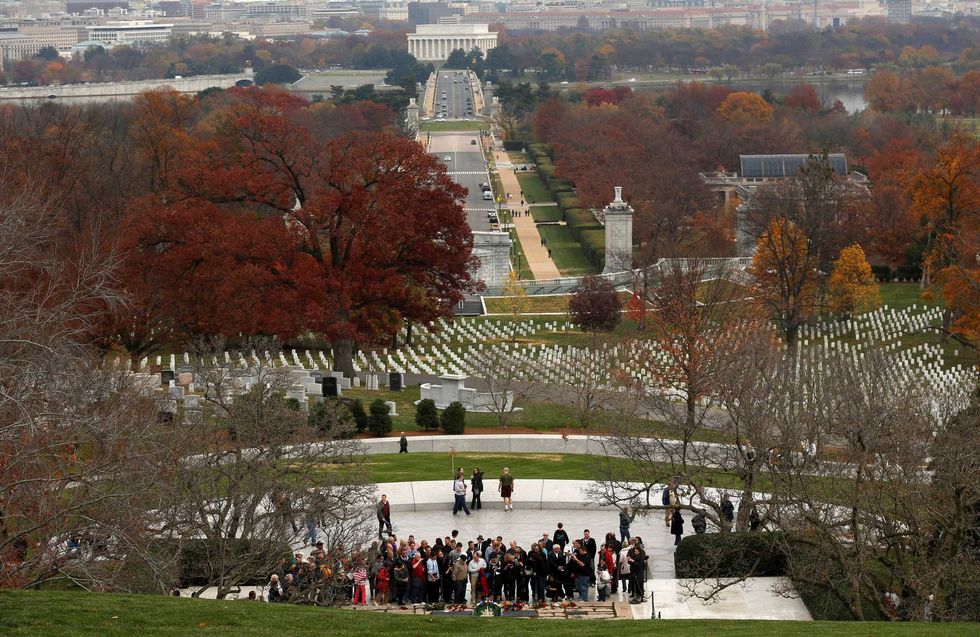
FILE PHOTO: Visitors stand before the grave of President John F. Kennedy at Arlington National Cemetery in Virginia November 22, 2013. REUTERS/Kevin Lamarque/File Photo

The Justice Department told a federal judge that the Supreme Court's ballroom ruling requires her to throw out a lawsuit against President Donald Trump's planned triumphal arch.
The argument came in a five-page notice filed Thursday with U.S. District Judge Tanya Chutkan, who is deciding whether to dismiss a suit brought by three Vietnam War veterans and an architectural historian.
The same day, Interior Secretary Doug Burgum announced that excavation for the 250-foot monument would begin within two weeks.
"National Park Service mandates that the Court grant Defendants' Motion to Dismiss … and deny Plaintiffs' Motion for Summary Judgment," the filing said, using the short name of the Supreme Court's ballroom decision.
The department argued that the case is "squarely controlled" by the ballroom decision, which turned on standing, the legal requirement that someone show a real, personal harm before a court will hear the case.
"Plaintiffs cannot establish standing based on desires to view Arlington House or the Lincoln Memorial," the department wrote. "Plaintiffs' distaste for the perceived symbolism of the proposed arch does not establish a concrete and particularized injury."
The Supreme Court granted the government's request on Aug. 31 in a 5-4 decision that allowed the construction of the ballroom to continue. The majority held only that the preservation group challenging the project had likely failed to show a real, personal harm.
"Mere offense, disagreement, or distaste does not qualify as a concrete and particularized injury," the majority wrote. "Today, we do not pass upon the legality of the government's East Wing project."
Michael Lemmon, Shaun Byrnes and Jon Gundersen, all Vietnam War veterans, sued in February along with retired architectural historian Calder Loth, their complaint shows. Public Citizen Litigation Group represents them.
The complaint argues that the Commemorative Works Act and a second federal law bar any structure on federal parkland in the District of Columbia without express congressional approval.
Congress has passed no law authorizing the arch, according to the complaint.
The arch would rise at Memorial Circle, National Park Service parkland at the western end of Arlington Memorial Bridge, the complaint says.
At 250 feet, it would stand more than twice the height of the Lincoln Memorial and sit directly on the axis between that memorial and Arlington House, blocking a view designed nearly a century ago to symbolize the nation's reunion after the Civil War, the complaint says.
The Justice Department's filing quotes Chief Justice John Roberts three times, borrowing his description of the majority's decision.
It leaves out the opening of his dissent, where he took up whether the ballroom is legal at all.
"That construction is likely unlawful," Roberts wrote, pointing to a 2002 law that bars building on federal park grounds in the District of Columbia without express authority from Congress.
That statute is one of the two the veterans are relying on to stop the arch, according to their complaint.
"The dissent is correct," wrote Michael Dorf, a Cornell Law School professor, in an analysis published two days after the ruling.
Dorf argued that the majority invented a requirement that plaintiffs use a place rather than simply look at it, and that the reading cannot be squared with the Court's own precedent.
"We're frankly befuddled," Nicolas Sansone, an attorney with Public Citizen Litigation Group, told CNN, saying he could not identify the legal authority the government has to begin construction.
The National Capital Planning Commission, which must approve the design, has given the project only preliminary clearance, according to CNN.
Its next meeting is on Oct. 1, the earliest date final approval could be granted.
Report typos and corrections to corrections@rawstory.com.
For customer support contact support@rawstory.com.