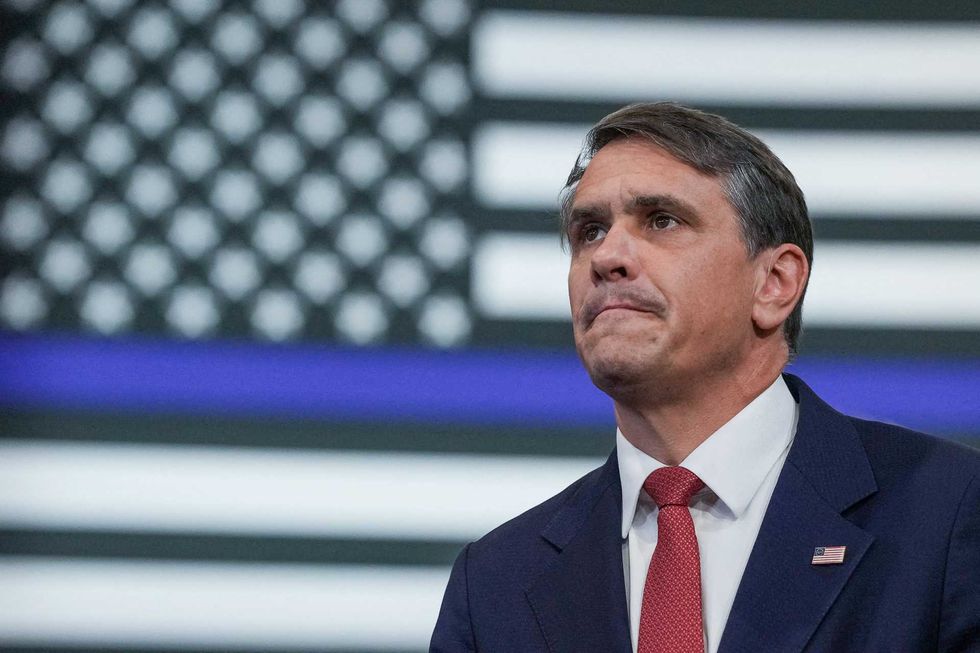
U.S. Attorney General Todd Blanche listens to President Donald Trump's remarks at David S. Mack Center for Training and Intelligence in Garden City, New York, U.S., August 14, 2026. REUTERS/Ken Cedeno

Attorney General Todd Blanche, President Donald Trump's former criminal defense lawyer, was named by a court-ordered brief as the key reason a federal judge stripped Trump's IRS settlement of its power in court.
Court-appointed attorneys filed the memorandum last week in U.S. District Court for the Southern District of Florida, responding to a judicial order directing them to evaluate Trump's request to pause sanctions while he appeals.
Trump filed suit against the IRS and Treasury Department on Jan. 29, seeking $10 billion over the leak of his tax returns.
The case produced a $1.776 billion settlement — one a federal judge later ruled was collusive — and issued sanctions.
Blanche had represented Trump in three criminal cases before joining the Department of Justice, according to ABC News, making him the first acting attorney general in American history to have served as a sitting president's personal criminal defense lawyer.
Despite that prior relationship, the brief noted, Blanche did not recuse himself — and signed the settlement on behalf of the government, resolving claims brought by his former client.
The court-appointed attorneys pointed out that Trump acknowledged the unusual nature of the arrangement with Blanche two days after the suit was filed, saying, "I'm supposed to work out a settlement with myself."
During the entire 109-day run of the lawsuit, the brief noted, no Department of Justice attorney entered an appearance and no defense was asserted — conduct that was described as highly unusual.
Under Blanche's leadership, the DOJ also passed on defenses it had routinely raised in comparable cases, according to the brief, including standard arguments under the federal tax code and statute of limitations.
"Had the DOJ entered an appearance (as it virtually always does when an Executive Branch agency is sued), raised available defenses that it has pressed in comparable circumstances, or entered into a settlement proportional to Plaintiffs' claims and the United States's likely exposure, there would have been little reason to question adversity," the brief noted.
The court-ordered report named Blanche for his personal role in unilaterally renouncing the settlement's Anti-Weaponization Fund in early August, under pressure from Republican senators blocking his confirmation as attorney general — with no documented consent from the Trump plaintiffs.
"Then-Acting Attorney General Blanche unilaterally renounced the Anti-Weaponization Fund, without any indication of Plaintiffs' consent," the brief said, which the court found demonstrated "his confidence that he could speak for, and bind, both sides of this matter."
The judge declined to rule on whether the settlement could be enforced as a private contract — which is the only reason the deal retains any practical effect.
The audit shield Blanche created in a separate May 19 order remains active, according to Time — a protection that a separate lawsuit, reported by The Hill, is now seeking to overturn.
Report typos and corrections to corrections@rawstory.com.
For customer support contact support@rawstory.com.