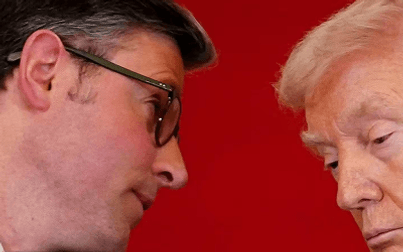
President Donald Trump is doing what few politicians would attempt in a hostile midterm environment – making himself impossible to avoid.
Next week he will headline two full nights of the Republican Party's Dallas convention, even as his approval ratings sit at historic lows and Republican House candidates outpace him by six points in national polling. Meanwhile, the Washington Post reported that his super PAC, MAGA Inc., is preparing ads starring the 80-year-old president and highlighting his record for use in competitive congressional races.
"It is a risky strategy two months before Election Day," the Post reported. "Vulnerable Republicans cannot afford to antagonize Trump because they need his help to turn out his base and tap into the $400 million war chest he controls. And he is not extending the leeway past presidents have for candidates to run their own races, even if that means keeping their distance."
The approach breaks from how presidents have traditionally handled a difficult midterm. George W. Bush limited his 2006 campaigning to places where his presence still helped. Barack Obama, in 2014, watched vulnerable Democrats keep him at arm's length without objection. Trump has signaled he will not offer that same latitude.
"Trump doesn't want people distancing themselves from him. He sees it as a personal insult," said Tevi Troy, a presidential historian and former domestic policy adviser to Bush. "His greatest power is his ability to destroy a Republican who goes against him."
That dynamic puts vulnerable Republicans in a bind heading into Dallas – attend and risk validating Democratic attempts to nationalize the race around Trump, or skip it and risk his retaliation. None of the party's most endangered Senate candidates would say whether they plan to attend.
Some skeptical donors are hesitant to give more money to Trump's super PAC without knowing how it would use the funds, a GOP strategist told the Post, and the president's self-centered strategy might be effective in Republican-leaning states but a possible hindrance in suburban districts.
"Distancing yourself from Trump isn't going to help you win a Republican state like Texas or Ohio," said Republican strategist Alex Conant, noting that many of the Senate races that will decide the chamber are unfolding in states where Trump remains popular enough to drive turnout.
Trump has another incentive to claim credit for Republican election wins.
“I think he views a disloyal Republican as just as useless as a Democrat,” Conant said, "and if he’s looking at what the next two years hold, it’s probably going to be impeachment fights and a lot of other big fights. He’s probably not looking to have anybody there who’s not loyal.”