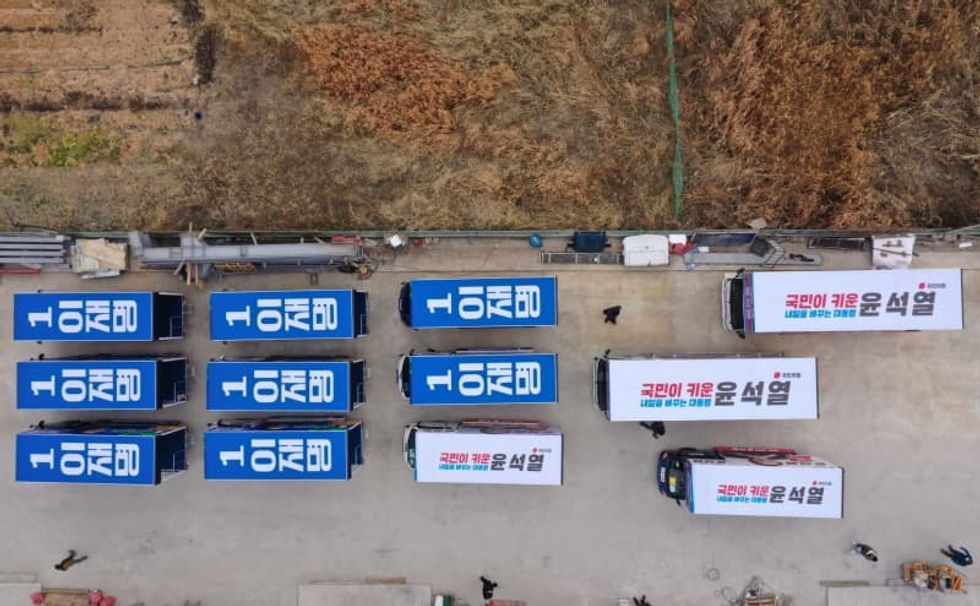
Presidential campaign trucks can be seen parked in a parking lot in Gwangju, two days ahead of the start of the official campaign for the 09 March presidential election. -/YNA/dpa
Campaigning officially kicked off in South Korea on Tuesday some three weeks before the presidential election.
On March 9, South Koreans will elect a successor to social-liberal President Moon Jae In, who cannot stand for re-election after five years in office.
According to recent polls, it could be a close race between the candidate of the ruling Democratic Party of Korea (DPK), Lee Jae Myung, and the conservative candidate of the opposition People Power Party (PPP), Yoon Suk Yeol.
A total of 14 candidates have registered for the election.
For Asia's fourth-largest economy, the presidential election has enormous significance.
Under the country's presidential system, almost all important decisions go through the head of state. In principle, the president could even rule against a majority of the opposition in parliament.
The DPK currently has a majority in the National Assembly.
The next president is due to take office in May.
At the start of his official street campaign, former provincial governor Lee stressed the importance of establishing "national harmony" and reconciling conflicting opinions and ideals.
His main opponent, former attorney general Yoon, called on citizens to pass judgement on the "incompetent liberal government" and bring about a change of power.
During the official campaign period, advertising in newspapers or on television is allowed, as well as campaign speeches on radio and television, among other things.
The election comes during another tense period on the Korean peninsula. South Korea's isolated neighbour conducted a series of missile tests in January, including the launch of a medium-range missile capable of carrying nuclear weapons.
UN resolutions prohibit North Korea from testing such missiles.
Russian figure skater Kamila Valieva told her doping hearing at the Beijing Olympics that she tested positive because of "contamination" from her grandfather's medicine, a senior IOC member said on Tuesday.
"I was not in the hearing but her argument was this contamination which happened with a product her grandfather was taking." Denis Oswald told reporters after an IOC media briefing in Beijing.
Russian media said Valieva allegedly drank from the same glass that her grandfather, who has a heart condition, had used.
Valieva will skate in the Olympic women's singles competition later Tuesday after the Court of Arbitration for Sport ruled the 15-year-old could take part despite failing a drugs test.
She tested positive in December for trimetazidine, a drug used to treat angina but which is banned by the World Anti-Doping Agency (WADA) because it can increase blood flow efficiency and help endurance.
Oswald, a lawyer who oversaw the International Olympic Committee's sanctions stemming from mass Russian doping at the 2014 Sochi Games, said the substance was not one a girl of Valieva's age would take.
"It's true the product is a bit strange, especially for a girl of her age," he said.
"But again, as long as we don't know exactly how it happened, it's hard to make a judgement."
Russian bobsleigh athlete Nadezhda Sergeeva tested positive for trimetazidine during the 2018 Pyeongchang Winter Olympics, but CAS later cancelled her suspension because it ruled the positive test was caused by a contaminated supplement.
American swimmer Madisyn Cox had her two-year ban cut to six months in September 2018 after proving that the trimetazidine found in her system had come from a tainted multivitamin supplement.
Oswald also said the entourage around Valieva -- her coaches and advisors -- would be investigated.
"It is a wish to examine all aspects of this case, including the entourage of the girl," he said at the media briefing.
"Of course you can imagine a girl of 15 does not do something wrong alone.
A new trial against jailed Kremlin critic Alexei Navalny began Tuesday inside the penal colony outside Moscow where he is held, in a case that could see his jail time extended by more than a decade.
A video link showed Navalny in a prison uniform at the hearing, an AFP journalist reported.
It showed him embracing his wife, Yuliya Navalnaya, while guards stood on either side of them. She had demanded access to the close-door proceedings a day earlier.
Navalny, who has spent a year behind bars after surviving a poison attack that he blames on the Kremlin, is accused of fresh fraud charges.
He is currently serving a two-and-a-half year sentence, but the new charges could see his time behind bars significantly extended.
The hearing of Moscow's Lefortovsky district court is taking place inside the maximum security prison where he is being held in Pokrov, some 100 kilometres (60 miles) east of Moscow.
The new fraud case against Navalny was launched in December 2020, while the 45-year-old was recovering in Germany after narrowly surviving a nerve agent poisoning.
Investigators accuse Navalny of stealing for personal use more than $4.7 million of donations that were given to his political organizations. The charges carry a maximum penalty of 10 years in prison.
'Sham trial'
Amnesty International described the hearing as a "sham trial, attended by prison guards rather than the media."
"It's obvious that the Russian authorities intend to ensure that Navalny doesn't leave prison any time soon," it said in a statement Monday.
The start of the trial comes during a week of intense talks between Russia and the West over Ukraine, with German Chancellor Olaf Scholz the latest Western leader due in Moscow for talks with Putin.
Navalny allies have called on Scholz to bring up the fate of the politician in his talks with Putin Tuesday.
"Germany stands for peace and justice," Navalny's spokesperson Kira Yarmysh said on Twitter. "And now its stance on this is more important than ever."
"The trial directly in jail of the number one political prisoner says everything about the Putin regime and the prospects of negotiations with him,” she said.
Maria Pevchikh, another key Navalny ally, suggested that the trial was "purposefully scheduled to coincide with the most tense week of the Ukrainian crisis."
"They are planning to extend his sentence for another 15 years while everyone's distracted with something bigger," she said on Twitter.
Navalny also faces up to six months in prison for contempt of court during one of his hearings last year when he was jailed on old fraud charges.
Navalny's poisoning and arrest sparked widespread condemnation abroad as well as sanctions from Western capitals.
After his arrest, Navalny's political organizations across the country were declared "extremist" and shuttered, while many key aides fled Russia fearing prosecution.
Astronomy experts say they originally misread the secrets of the night sky last month: it turns out that a rocket expected to crash into the Moon in early March was built by China, not SpaceX.
A rocket will indeed strike the lunar surface on March 4, but contrary to what had been announced, it was built not by Elon Musk's company, but by Beijing, experts now say.
The rocket is now said to be 2014-065B, the booster for the Chang'e 5-T1, launched in 2014 as part of the Chinese space agency's lunar exploration program.
The surprise announcement was made by astronomer Bill Gray, who first identified the future impact, and admitted his mistake last weekend.
"This (honest mistake) just emphasizes the problem with lack of proper tracking of these deep space objects," tweeted astronomer Jonathan McDowell, who advocates for greater regulation of space waste.
"The object had about the brightness we would expect, and had showed up at the expected time and moving in a reasonable orbit," he wrote in post.
But "in hindsight, I should have noticed some odd things" about its orbit, he added.
NASA said in late January that it would attempt to observe the crater that will be formed by the explosion of this object, thanks to its probe that orbits around the Moon, the Lunar Reconnaissance Orbiter (LRO).
The agency called the event an "exciting research opportunity."
Canadian Prime Minister Justin Trudeau on Monday invoked rarely used emergency powers to bring an end to trucker-led protests against Covid health rules, after police arrested 11 people with a "cache of firearms" blocking a border crossing with the United States.
It marked only the second time in Canadian history such powers have been invoked in peacetime, and came as hundreds of big rigs still clogged the streets of the capital Ottawa, as well as two border crossings.
"The federal government has invoked the Emergencies Act to supplement provincial and territorial capacity to address the blockades and occupations," Trudeau told a news conference.
The prime minister said the military would not be deployed at this stage, but that authorities would be granted more powers to arrest protesters and seize their trucks in order to clear blockades, as well as ban funding of the protests.
"We cannot and will not allow illegal and dangerous activities to continue," Trudeau said.
"This is about keeping Canadians safe, protecting people's jobs and restoring confidence in our institutions," he added, noting that the scope of the measures would be "time-limited" and "geographically targeted," but without providing specifics.
As the threat of violence lingered, federal police said they arrested 11 protesters with rifles, handguns, body armor and ammunition at the border between Coutts, Alberta and Sweet Grass, Montana, just a day after another key US-Canada border crossing was cleared in Ontario.
"The group was said to have a willingness to use force against the police if any attempts were made to disrupt the blockade," the Royal Canadian Mounted Police said in a statement.
The protests by Canadian truckers and their supporters -- opposed to mandatory coronavirus vaccines and pushing a wider anti-establishment agenda -- have triggered copycat movements from France to New Zealand, with US truckers mulling similar rallies.
Under pressure to act, Trudeau on Sunday convened a special federal response group on efforts to end the occupation of Ottawa and the remaining, economically damaging, blockades of border crossings in Alberta and Manitoba.
The Emergencies Act was previously used by Trudeau's father, former prime minister Pierre Trudeau, during the October Crisis of 1970.
It saw troops sent to Quebec to restore order after the kidnappings by militant separatists of a British trade attache and a Quebec minister, Pierre Laporte, who was found strangled to death in the trunk of a car.
Protests spreading
Canada's so-called "Freedom Convoy" started with truckers protesting against mandatory vaccines to cross the border with the United States.
But its demands now include an end to all Covid-19 health measures and, for many of the protesters, for the toppling of Trudeau's Liberal government -- only five months after he won re-election.
The truckers have found support among conservatives and vaccine mandate opponents across the globe, even as Covid-19 measures are being rolled back in many places.
In Paris on the weekend, police fired tear gas and issued hundreds of fines in an effort to break up convoys coming from across France.
The Netherlands, Switzerland and Austria have also seen copycat movements, and Belgian authorities said Monday they had intercepted 30 vehicles as police scrambled to stop a convoy of trucks.
Truckers dig in
Canadian police over the weekend cleared a blockade on the Ambassador Bridge, which handles an estimated 25 percent of trade with the United States, and had disrupted business in the world's largest economy.
But Monday morning in Ottawa, as a deep freeze rolled in, protesters remained defiant despite threats of jail and fines of up to Can$100,000 (US$80,000).
Leaving "is not in my plans," Phil Rioux, behind the wheel of a large truck, told AFP before Trudeau's announcement.
"It's by maintaining the pressure that we have a better chance of achieving our goal," the 29-year-old explained.
"There are other customs checkpoints that are blocked, more will be blocked elsewhere," he added.
Protest organizer Tamara Lich also told a news conference, "We are not afraid... We will hold the line."
Earlier Ontario Premier Doug Ford announced the lifting of vaccine passport requirements by March 1 in the province -- following in Alberta and Saskatchewan's footsteps.
Ontario, Canada's most populous province, had reimposed at the end of December among the most restrictive health measures in the world.
Residents of the capital, meanwhile, have grown increasingly frustrated, saying the protest has made them prisoners in their own homes.
Most businesses downtown are also closed or have had almost no customers after officials warned residents to stay clear.
"It's a little quieter now, there are less honking but it's annoying... (because) there's no other way to get to work than by walking" past the demonstrations, said Haley, a young woman on her way to work who declined to give her last name.
Like thousands of counter-protesters who blocked more trucks from entering the downtown this weekend, she'd been looking to the prime minister to end the crisis.
DUBLIN (Reuters) - Ireland's trade with Northern Ireland grew rapidly in 2021 with imports up 65% and exports to the British-run region 54% higher, helping to offset a 13% fall in imports from Britain during the first year of Brexit checks, data showed on Tuesday. The fall in the value of British imports to 15.4 billion euros ($17 billion) from 17.7 billion meant goods coming into Ireland from its larger neighbour represented 15% of the value of total imports last year compared to 21% in 2020. Overall imports jumped 18% to 102 billion euros, including a 1.6 billion euro uplift from Northern Ir...
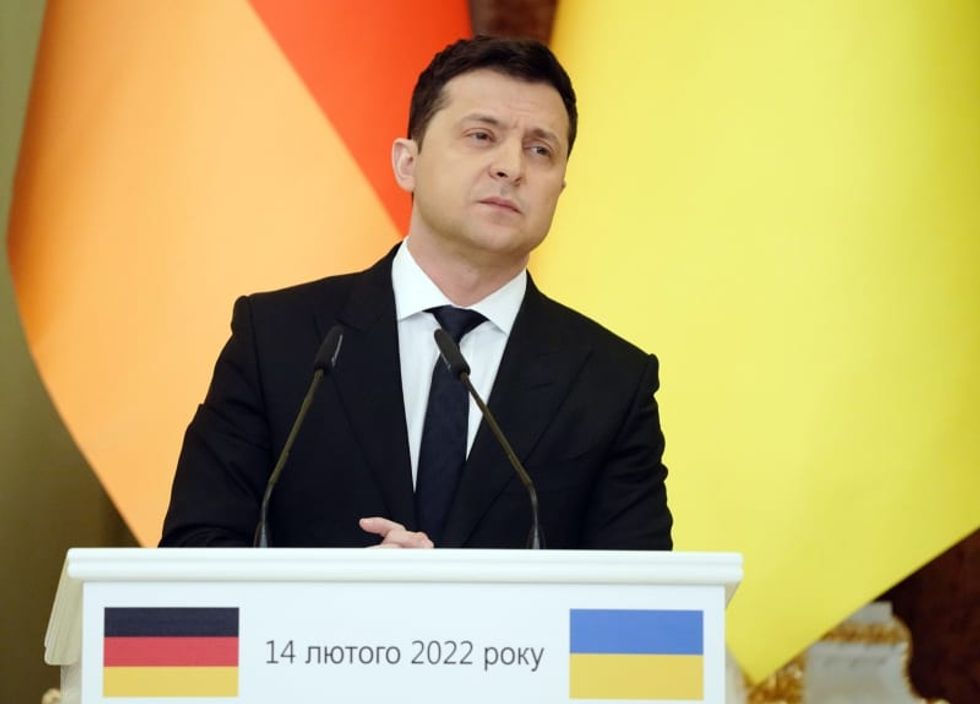
Ukrainian President Volodymyr Zelensky attends a joint press conference with German Chancellor Olaf Scholz, following their meeting at St. Mary's Palace. Kay Nietfeld/dpa
Amid US warnings of a possible imminent invasion of his country by Russian troops, Ukrainian President Volodymyr Zelensky has declared February 16 a day of unity by decree.
The US government recently warned that it considered a Russian invasion possible before the end of the Winter Olympics in China on February 20. According to media reports, US intelligence information mentioned February 16 as a possible date for Russian military action.
"We are told that February 16 will be the day of the invasion, we will make it the day of unity," Zelensky said in a video on Monday evening.
Ukrainians are expected to raise flags across the country and sing the anthem at 10 am (0800 GMT). "Let's show the whole world our unity," the 44-year-old leader said.
In his speech, Zelensky again rejected Russian accusations that Ukraine was making preparations for an offensive against the breakaway territories of Luhansk and Donetsk in eastern Ukraine, collectively known as Donbas.
"The Donbas and Crimea will return to Ukraine exclusively through diplomatic channels," the president stressed. Russia had annexed the Crimean peninsula on the Black Sea in 2014 and subsequently also supported the pro-Moscow separatists in eastern Ukraine.
The speech came as the US announced that it was moving its embassy operations from the capital Kiev to the city of Lviv near the border with Poland.
US Secretary of State Antony Blinken called it a temporary precautionary measure.
"The embassy will remain engaged with the Ukrainian government, coordinating diplomatic engagement in Ukraine," he said.
"We are also continuing our intensive diplomatic efforts to deescalate the crisis," he added. "Our commitment to Ukraine’s sovereignty and territorial integrity is unwavering."
Zelensky had earlier criticized the recent relocation of some embassy staff during a press conference with German Chancellor Olaf Scholz in Kiev: "It is a big mistake that some embassies are moving to Western Ukraine, because there is no Western Ukraine, there is Ukraine."
"If, God forbid, something happens, it will be everywhere," Zelensky said.
Large-scale Russian military exercises were being held off the southern coast of Ukraine on Monday, with aircraft, helicopters and more than 30 warships gathering in the Black Sea.
Russia says the training is aimed at locating and destroying submarines. Ukraine calls the drills, which are expected to last through Saturday, a provocation that will severely impede navigation in the Black Sea and the adjacent Sea of Azov.
The Kremlin has rejected accusations that merchant ships would be impacted by the manoeuvres and said they pose no security threat. Nevertheless, Ukraine has advised airlines to avoid airspace over the area.
The naval exercises are overlapping with large-scale military drills under way between Russia and and its close ally Belarus, which shares a border with Ukraine.
The US says there are 130,000 troops amassed on Russian territory near the border, meaning Russian forces are built up on three sides of Ukraine.
The US and its NATO allies charge that Russia is preparing a renewed attack on Ukraine, following the 2014 annexation of the Black Sea peninsula of Crimea, an accusation that Russia rejects and calls "scaremongering."
Top US officials said in recent days that intelligence suggests Russia could be planning to invade Ukraine "at any time," including before February 20.
Belarusian leader Alexander Lukashenko said on Monday that the decision to stage the joint exercises with Russia was made before the current "hysteria" had broken out.
On the question of when Russian troops would leave Belarus again, he said: "We will decide that with Vladimir Putin."
The West fears that troops will not leave Belarus once the 10-day drills, which started late last week, conclude.
According to the Kremlin, Putin is scheduled to talk to Lukashenko sometime this week. Previously, the Kremlin had made statements that Russian troops would be withdrawn.
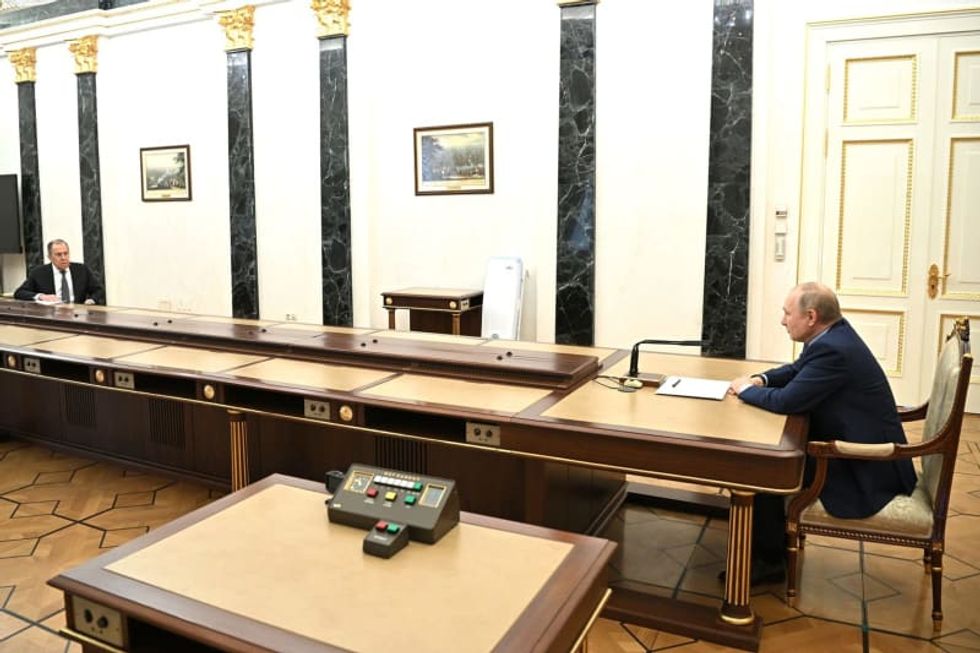
Russian Foreign Minister Sergei Lavrov has advised President Vladimir Putin to continue negotiations with NATO on security guarantees.
"There is always a chance," Lavrov said he told Putin. But they can not drag on indefinitely, he said.
Blinken stressed in comments to France24 Monday that "the path to diplomacy remains open."
"We're doing everything we possibly can to convince Russia that it should take the diplomatic path, the path of dialogue to resolve whatever differences exist peacefully," he said.
Finance ministers from the Group of Seven (G7) nations said on Monday they are prepared to impose "massive" economic sanctions on Russia should it attack Ukraine.
Western leaders have been scrambling to defuse the crisis but their conversations with Putin - including US President Joe Biden's on Saturday - have failed to make progress.
In a show of deterrence and solidarity, NATO allies have been sending more forces and equipment into Eastern Europe and putting other troops on standby.
The first German troops have arrived in Lithuania to reinforce the Bundeswehr-led NATO battalion there.
Lithuania borders the Russian exclave of Kaliningrad and Russia's ally Belarus.
UN Secretary General Antonio Guterres said Monday he was "deeply worried" about the situation while urging diplomatic efforts to be intensified and offering the UN's support.
He said he had spoken with the foreign ministers of Russia and Ukraine on Monday morning and reiterated to them that there is no alternative to diplomacy.
"The price in human suffering, destruction and damage to European and global security is too high to contemplate. We simply cannot accept even the possibility of such a disastrous confrontation," he said.
Russian President Vladimir Putin (R) meets with Foreign Minister Sergei Lavrov. -/Kremlin/dpa
Zachary Horwitz promised healthy returns on investments, but was running a giant ponzi scheme and using the cash to fund a lavish lifestyle
Los Angeles (AFP) - An American actor who swindled $650 million in a huge Hollywood ponzi scheme, using it to finance a lavish lifestyle of yachts, jets and fast cars, was jailed Monday for 20 years.
Zachary Horwitz created fake contracts that he told investors were with HBO and Netflix to trick them into handing over vast sums of money, which he splurged on private flights, top-of-the-range autos and a luxury Los Angeles mansion, complete with a wine cellar.
"Horwitz portrayed himself as a Hollywood success story," prosecutors said, according to the Department of Justice.
"He branded himself as an industry player, who... leveraged his relationships with online streaming platforms like HBO and Netflix to sell them foreign film distribution rights at a steady premium.
"But, as his victims came to learn, (Horwitz) was not a successful businessman or Hollywood insider. He just played one."
Horwitz, who acted in small-time horror films under the name Zach Avery, told investors he was buying foreign distribution rights for US movies, and then selling them to streaming platforms.
The 35-year-old gave each victim a note promising a handsome profit six or 12 months later.
Over seven years he kept the scheme going by using new investors' money to repay the old ones.
By the time it all fell apart, more than $230 million had vanished.
He admitted security fraud in October, and acknowledged that he had never bought any film rights, or secured any distribution contracts.
It would be "difficult to conceive a white-collar crime more egregious," prosecutors said in a memo to the judge, noting he started his life of crime by swindling university friends, according to the Los Angeles Times.
"He began by betraying the trust of his own friends, people who lowered their guard because they could not possibly imagine that someone they had known for years would unflinchingly swindle them and their families out of their life savings," they wrote.
Horwitz was jailed for 20 years, and ordered by Judge Mark Scarsito to repay $230 million to his victims.
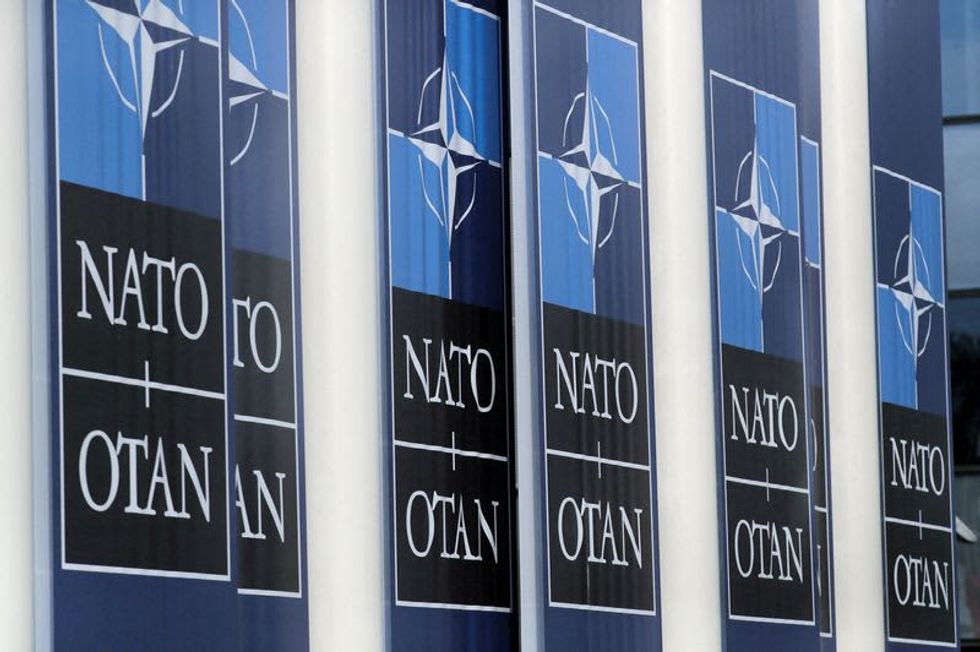
BRUSSELS (Reuters) - NATO defence ministers are expected this week to set in motion a plan that could establish four multinational battlegroups in southeastern Europe in response to Russia's military build-up in Ukraine, three diplomats said.
Allied ministers meeting on Wednesday and Thursday will decide whether to order their military commanders to draw up plans to deploy battlegroups of some 1,000 troops each to Bulgaria and Romania, and possibly to Slovakia and Hungary.
With NATO meeting as the United States warns of an imminent Russian invasion of Ukraine, diplomats told Reuters that ministers are likely to agree to the first step of directing commanders to come up with a detailed plan for the four battlegroups on land.
"There will be a tasking that allows us to escalate but also to de-escalate if Russia pulls back its military," a senior NATO diplomat said, stressing that any new battlegroups would be on top of recent allied offers by Britain, the United States and others of ships and planes to reinforce NATO's eastern flank.
Ukraine is not a NATO member and the alliance is under no treaty obligation to defend it. Reinforcements in the Black Sea would show resolve in the strategically important region, and in countries such as Hungary and Slovakia that border Ukraine.
Any final decision on deployments would come later on, although both France and Bulgaria have offered to lead the battlegroups in Romania and Bulgaria respectively.
The move would be NATO's biggest shift in force posture since it set up its "Enhanced Forward Presence" battlegroups in Estonia, Lithuania, Latvia and Poland - backed by tanks, air defences and intelligence and surveillance units - in response to Russia's annexation of Crimea in 2014.
Any deployments would go against Moscow's security demands for the alliance to withdraw troops from eastern Europe.
HUNGARY, SLOVAKIA RELUCTANT
NATO insists that the battlegroup format used in the Baltics is not a permanent stationing of troops, rather a "persistent" presence of rotating soldiers to serve as a tripwire for a larger response force should Russia invade NATO territory.
NATO Secretary-General Jens Stoltenberg has hinted at the possibility of more battlegroups.
On Feb. 7 he said: "We are considering more longer-term adjustments to our posture, our presence in the eastern part of the alliance. No final decision has been made on that but there is a process now going on within NATO."
A French presidency official said French troops will deploy to Romania only after a NATO decision and that the designing and arming the battlegroups would still take time because allies must come forward to participate.
"There will be a debate within the North Atlantic Council and we are basically aiming for a deadline of a few months," the official said.
However, with Slovakia and Hungary wary of provoking Russia, diplomats said the alliance may avoid a carbon copy of the Baltic battlegroups' model in the south east.
Instead, NATO could consider a multinational force led by France in Romania that would coordinate allied exercises in eastern Europe and allow troops to flow in and out of the region without establishing a formal presence.
(Additional reporting by John Irish in Paris; Editing by Angus MacSwan)
Sens. Ted Cruz (R-TX), Josh Hawley (R-MO) and Rand Paul (R-KY) have prompted the truckers protesting the vaccine mandates for their industry. Over 80 percent of the truckers are vaccinated, so the protesters are part of not just the minority, but the fringe of a minority. In Canada, however, these truckers are radically unpopular, even among conservatives.
Speaking to MSNBC on Monday, Canadian reporter Stephen Marsh explained that the conservative politicians dipped their toes in the debate, but quickly pulled out because Canadians are furious with the truckers clogging their streets and creating noise all through the night.
The emergency measures that the leaders are enforcing now came from a 1970 response to Quebec terrorism and hasn't been used since.
"It's extremely severe," Marsh explained. "The government is going to suspend people's accounts without court orders. You're going to be able to use the military, and it is a very dramatic moment where essentially the powers that be are saying the police and the ordinary course of democracy require backing up by the military. That's not something you ever want to see happen in your country."
Meanwhile, in the United States, far-right conservative anti-vaccine activists have been aghast that somehow the rights of these truckers are being violated. However, with the overwhelming majority of Canadians, it's their own rights that are being trampled by these truckers, like the right to get to work or the right to sleep without people laying on their car horns all night outside your window.
Marsh said that after speaking to the protesters, he learned that they have no real organizational structure or political program.
"It's just disruption for its own sake," he said. "I think it is nothing more than a temper tantrum. Their political goals is the end of all public health mandates and Canada. It's never going to happen. The resignation of Justin Trudeau. I saw a lot of impotent rage. And of course, it's become very clear, recently, that a lot of this is just political spillover from the United States and the toxicity of American discourses sort of taken a foothold in Canada. It's very ugly."
Trudeau may be the villain of the far-right in the U.S. but in Canada, Marsh said he'd be elected in a landslide.
"What's become very clear recently is just how foreign this is," he continued. "Less than 30 percent of the funding for this has come from Canadian sources. The border guards have been turning away truckers from the United States that are coming in. A huge amount — obviously the rhetoric is largely American. It really did get to a point where you are seeing foreign interference in Canadian domestic politics and crippling economies. But also destroying the lives of ordinary citizens in neighborhoods in Ottawa, who've been unable to put their children to sleep for two weeks. The Canadian people's tolerance is over. The patience has worn thin. It's over now."
He explained that a "very few" conservatives "flirted" with the idea of supporting the truckers in the way that Cruz, Hawley and Paul have. They have now all backed away from it.
"It is massively unpopular. Also, I think that is sort of unfair. I think Canadian conservatives have really kept their integrity and kept their decency and they do not want disorder for disorder's sake. Certainly, it is definitely true that -- Ted Cruz is way more insidious than any Canadian conservative politician, certainly, someone like Doug Ford in Ontario has taken very firm steps to disrupt the financial networks of this group. I think it would be fair to say that Canadian conservatives are opposed to this. In a broad sense. I think that's something that actually is very important for our country. Very important."
See the discussion below:
Canadian conservatives want nothing to do with the trucker protest
www.youtube.com
On Monday, following Canadian Prime Minister Justin Trudeau's activation of the Emergencies Act to clear the far-right demonstrators blockading a critical international road to oppose vaccine mandates, BuzzFeed News D.C. bureau chief Paul McLeod reported that communications between the protesters are currently in chaos.
According to McLeod, the protesters were forced to abandon their first method of communication, the app Zello, after counterprotesters flooded their channels "with the gay cowboy anthem Ram Ranch," a song with incredibly explicit homoerotic lyrics.
But the problem was that the person moderating the channel jumped ship and turned out to be a double agent who disrupted their communications to help police catch them.
One anti-vax trucker cited by McLeod described this experience as a "morale blow."
The Ambassador Bridge reopened Sunday night after right-wing protests over vaccine mandates halted international traffic at the essential border crossing for nearly a week.
While protests continue in other parts of Canada, including the country’s capital, police cleared the blockade at the Ambassador Bridge after a court injunction went into effect Friday ordering truckers and their supporters to leave the area.
Windsor Police Sgt. Steve Betteridge said that between 25 and 30 people had been arrested before the bridge reopened Sunday. Police also towed seven vehicles Saturday and five vehicles Sunday.
“Let me be crystal clear: it is illegal and punishable to block and impede the movement of goods, people and services along critical infrastructure,” Ontario Premier Doug Fordtweeted Sunday. “Fines for noncompliance will be severe, with a maximum penalty of $100,000 and up to a year imprisonment.”
Demonstrations first began more than a week ago by truckers who oppose a mandate requiring drivers entering Canada to either be fully vaccinated or face a testing and quarantine requirement.
Gov. Gretchen Whitmer on Thursday called for Canada to “take all necessary and appropriate” steps to reopen the bridge.”
On Monday morning, Whitmer said the reopening was “a win for Michigan’s working families who are just trying to do their jobs and for businesses who can get back to shipping their products and produce. It’s time to get traffic and trade moving across North America’s busiest land border crossing again. I will always stand with every hardworking Michigander and do whatever it takes to ensure that our businesses can keep humming along.”
More than a quarter of trade between the United States and Canada relies on the privately owned Ambassador Bridge. According to the Michigan Department of Treasury, an estimated 10,000 commercial vehicles cross the bridge with around $325 million worth of goods each day.
According to the Anderson Economic Group, the auto industry lost $51 million in wages by Thursday as some factories shut down when needed parts for new vehicles could not reach factories due to the bridge closure.
Republican gubernatorial candidate James Craig, a former Detroit police chief who led the department during Black Lives Matters protests that resulted in the department firing rubber bullets and tear gas at protestors and arresting hundreds, released a statement of support for the Canadian protestors.
“I stand with the truckers. I support all working people who are standing up for personal freedom,” Craig said. “Instead of focusing on the protestors and demonizing the truckers, these career politicians should be focused on how their irresponsible pandemic response is hurting our economies.”
Other GOP hopefuls have backed the right-wing protesters, including chiropractor Garrett Soldano and businessman Kevin Rinke.
Thirty Republican members of the Michigan House of Representatives sent a letter to Whitmer last week urging her to work with the federal and Canadian governments to end the vaccine mandate.
“As you are aware, both Canada and the United States announced in 2021 that all individuals seeking to cross the border, including truckers, are required to be fully vaccinated. This controversial policy – which forces working men and women to choose between providing for their family and making a personal medical choice – is now the heart of the problem shutting down truck traffic at the Ambassador Bridge,” the legislators wrote.
“In the last 24 hours, we have watched with consternation as automotive plants began to cancel shifts and cut hours due to reduced trucking shipments arriving at their destination. We are confident that more shutdowns will take place if you do not work with your federal and Canadian partners to end vaccine mandates at the border.”
House Minority Leader Donna Lasinski (D-Scio Twp.) said in a statement that the letter is “absolutely unconscionable.”
“Every day this reckless disruption continues is a crushing blow to our industry and our workers as critical elements of our economy and infrastructure are held hostage by international agitators, who have now unbelievably found 30 new spokespeople in the ranks of the Republican majority,” Lasinski said. “It is absolutely unconscionable that the 30 Republican legislators who signed onto this letter are calling upon our Governor to deliver the bridge’s ransom to the international protesters strangling our auto industry and vital supply chains throughout Michigan. It is time to stand with Michigan industry and not the time to sell-out our values and sovereignty to those peddling anti-vaccine propaganda across the border.”
Canadian Public Safety Minister Marco Mendicino previously denounced foreign officials weighing in on the protests after former President Donald Trump, Florida Gov. Ron DeSantis, U.S. Sen. Ted Cruz (R-Texas) and Texas Attorney General Ken Paxton praised the protestors.
Mendicino responded that “it is certainly not the concern of the Texas attorney general as to how we in Canada go about our daily lives in accordance with the rule of law,” Time reported.
“We need to be vigilant about potential foreign interference,” Mendicino said. “Whatever statements may have been made by some foreign official are neither here nor there. We’re Canadian. We have our own set of laws. We will follow them.”
Ottawa Mayor Jim Watson previously said in a letter to Prime Minister Justin Trudeau that “what was initially described as a peaceful protest has now turned into a siege of our downtown area.”
Facebook groups have been promoting similar “trucker convoy” protests in the U.S. Company officials told NBC News that many are being run by fake accounts tied to content mills in countries including Vietnam, Bangladesh and Romania, similar to pro-Trump efforts during the 2016 election and previous right-wing efforts protesting COVID-19 health protocols.
There have been similar protests across the world, the Washington Post reported, including at the Champs-Élysées in Paris and an area outside New Zealand’s Parliament.
Reuters reported that police are investigating threats against public figures jointly with the U.S. Federal Bureau of Investigation and have charged four people with hate crimes.
Some Conservative lawmakers in Canada have met with and taken selfies with the protestors, and the party recently ousted Erin O’Toole as their leader, which Reuters reported was in part because he wasn’t initially supportive enough of the protesters.
Michigan Advance is part of States Newsroom, a network of news bureaus supported by grants and a coalition of donors as a 501c(3) public charity. Michigan Advance maintains editorial independence. Contact Editor Susan Demas for questions: info@michiganadvance.com. Follow Michigan Advance on Facebook and Twitter.
Brazilian President Jair Bolsonaro launched a plan Monday to expand gold mining in the Amazon rainforest, drawing criticism from environmentalists for bolstering an industry accused of rampant deforestation, pollution and attacks on indigenous peoples.
Bolsonaro signed a decree creating a program to support the development of artisanal mining, a controversial activity known as "garimpo" that occupies something of a legal gray area in Brazil.
The decree says the aim is to "propose public policies and stimulate the development of artisanal and small-scale mining, fostering sustainable development for the region and the nation."
It also creates an inter-ministerial commission on artisanal mining, whose "priority region" will be the nine states that make up Brazil's 60-percent share of the Amazon.
Artisanal miners, or "garimpeiros," are divisive in Brazil.
Bolsonaro, whose father was once a "garimpeiro," defends wildcat miners as hardscrabble frontiersmen.
Critics paint a different picture.
Mining destroyed a record 125 square kilometers (nearly 50 square miles) of the Brazilian Amazon last year -- more than twice the size of Manhattan.
Much of the destruction was on protected indigenous reservations.
The use of mercury to separate gold dust from soil has also left toxic pollution in rivers.
Prosecutors say illegal gold miners have links to organized crime, and there have been deadly clashes between armed miners and indigenous groups opposed to them.
Artisanal mining is legal in Brazil, provided miners have environmental licenses and work on authorized land.
But many don't.
The government estimates there are 4,000 illegal miners operating on indigenous territory in the Amazon. Activists say the figure is much higher.
"What (the government) should be doing is proposing and supporting environmental licensing of this activity and monitoring its implementation," said Suely Araujo of the Climate Observatory, a coalition of environmental groups.
"Instead... the Bolsonaro administration looks set to defend the sector's 'historical values,' which is to say, environmental destruction," she said in a statement.
Bolsonaro, who has pushed to expand agribusiness and mining in the Amazon, has faced international outcry over the destruction of the world's biggest rainforest.
Deforestation in the Brazilian Amazon has surged since the far-right leader took office in 2019, to a 15-year high of 13,235 square kilometers from August 2020 to July 2021.