Music lovers in India have paid glowing tributes to the classical maestro Pandit Jasraj, who has died at the age of 90.
The vocalist suffered cardiac arrest late Monday in New Jersey, bringing an end to a pioneering musical career spanning eight decades.
Jasraj had stayed with his children in the United States after India imposed an international flight ban in March as part of a coronavirus lockdown, according to the Press Trust of India news agency that quoted a family member.
Born into a family of musicians in the northern Indian city of Hisar in 1930, Jasraj started performing on stage at the age of 11.
He received his initial training in classical music from his father, who performed in royal courts.
Jasraj is credited with bringing niche Indian classical music to the masses with his innovative style that enthralled audiences across the world.
He won scores of awards for his contribution to music, including India's second-highest civilian honor.
Jasraj also performed in Bollywood movies and contributed vocals to the soundtrack of the acclaimed 2012 Hollywood film "Life of Pi", but remained focused on stage performances.
His fans, Bollywood artists and India's Prime Minister Narendra Modi tweeted their condolences.
Bollywood music superstar Lata Mangeshkar said she was "extremely saddened" by the news, according to PTI.
Grammy- and Academy Award-winning musician A.R. Rahman tweeted that Indian classical music had "lost one of its shining stars".
Once the preserve of men and consumed in ritualistic ceremonies by villagers and chiefs alike, Fijian traditional drink kava is attracting a new market as coronavirus restrictions prompt more women to sample the mildly narcotic brew.
Kava, known in Fiji as yaqona, is an essential part of South Pacific culture, used throughout the region for relaxation and stress relief.
The root of the kava plant is ground, mixed with water and then strained to produce a gritty grey liquid. First-time users sometimes liken the taste to muddy water but the drink's effect is undeniable, a mild numbing of the mouth and a general feeling of calmness.
"We drink it because our grandfathers drank it, our great-grandfathers drank it," said Kaiava Davui, a gardener who regularly has kava on the weekends.
"We talk, share ideas. It takes away stresses."
It is ubiquitous in all layers of Fijian society -- visiting dignitaries such as Britain's Prince Harry sup at ceremonies alongside chiefs, while in rural villages groups of men can often be seen gathered around a bowl of "grog".
But for the most part it has been a custom for men only.
Now, most of the traditional, male-dominated kava ceremonies have been curtailed because of the coronavirus pandemic.
They typically go into the early hours but Fiji is currently under a 11pm-4am curfew, as it seeks to continue its success in preventing community transmission of the virus and keeping active cases down to single figures.
To minimise the risk of transmission, there was also a temporary ban on sharing the bilo, the communal cup from which the kava is sipped.
But the restrictions have encouraged new methods of imbibing -- and brought new consumers to the drink.
- Hipster favourite -
Kava bars -- inspired by outlets in the United States, where some hipsters have turned to kava as a soothing substitute to booze -- have popped up in Fiji.
Weta Coffee, in the capital Suva, features a kava bar at one of its cafés, offering bowls of instant kava made from a powder that readily mixes with water.
Weta director Mue Bentley-Fisher said the bars offered an alternative to the masculine culture around kava in Fiji.
"Groups of young women are coming in. They feel safe drinking kava here," she said.
At Mauri Kava Dealers, owner Keti Suli Hannah Balenacagi said the beverage was an important part of her social circle's gatherings.
"To me, kava is something that I do when I'm so stressed, I need to relax or I''m socialising with my friends," she told AFP.
"It just helps me to relax and to enjoy the moment with my friends."
At Westa, each person gets his or her own bilo, instead of sharing the cup. The cafe closes at 9pm, well before curfew.
Bentley-Fisher said her business launched just before lockdown in March and kava sales initially fell, but recovered strongly.
"We're exceeding opening levels," she said.
"We've seen that there's higher demand for kava from Wednesday through Friday, with all sorts of customers choosing kava as an alternative to alcohol and to unwind at the end of the week."
Uncertainties in the domestic market because of the pandemic have also seen growers accelerate moves to establish kava as a "wellness" product in overseas markets.
Fiji Kava, which has its headquarters in Australia but grows its product in Fiji, has established a scientifically accredited laboratory to develop a premium variety of kava for export.
- 'Rest and relaxation' -
The firm has developed capsules for global consumers seeking anxiety relief and is partnering with the Fiji Rugby Union to promote the benefits of the product.
Fiji Rugby Union chief executive John O'Connor said kava helped players cope with the "significant physical and mental challenges" of playing elite sport.
"We have found an ideal partner to provide our teams with safe, premium-quality kava supplements and relaxation tablets which will assist them with muscle relaxation, restful sleep and recovery," he said when the deal was announced in March.
Kava users say the drink, particularly the cheaper varieties, can cause a hangover, and the UN Food and Agriculture Organisation says excessive use can lead to skin rashes, nausea and indigestion.
The UN notes concerns it can cause long term liver damage but says the limited studies on the subject do not back that up.
The most recent available figures show that in 2018 Fiji exported about 160 tonnes (176 tons) of kava to the United States and 80 tonnes to New Zealand
Australia currently allows in a limited amount of kava for medicinal use, but last year announced it will trial commercial imports.
The nation is seen as a huge potential market, but the pandemic has forced the trial to be postponed until next year.
Despite this, Fiji-based Green Gold Kava said its export volumes remained strong.
Company owner Praveen Narayan is so confident about kava's appeal in a world gripped with virus-induced anxiety that he has commissioned a new manufacturing facility and is expanding his product line to include kava-infused fruit drinks.
"The future is bright," he told AFP. "Kava is going to become big."
With the race on to find a coronavirus vaccine, the biotech sector -- from an investor's point of view -- appears to be the new gold rush, promising often giddy returns, but analysts warn that the exuberance could be exaggerated.
According to the World Health Organization, some 168 potential vaccines are currently in development, with countless billions of dollars both public and private money being pumped into the research.
As a result, the share prices of small, innovative biotech startups -- competing with pharmaceutical giants to develop a substance that will inoculate the world against COVID-19 and allow life for billions of people across the globe to return to some semblance of normality -- have reached dizzying heights in recent months.
US company Moderna, for example, whose vaccine candidate is in so-called Phase III of clinical trials -- the last stage before regulatory approval -- has seen its shares soar by 250 percent since the start of the year.
Other, less well-known names such as Inovio or Novavax are doing even better, with their shares rocketing by a dizzying 350 percent and even 3,500 percent respectively.
A small company like Germany's CureVac, which made its debut on the US Nasdaq stock exchange last week, has seen its valuation balloon to currently more than $10 billion.
But analysts warn that such investments remain high risk and, like other stock market bubbles before them, could soon burst.
"When you buy biotech, you buy a kind of lottery ticket," said Gregori Volokhine, portfolio manager for Meeschaert Financial Services in New York.
"There will always be investors who try to win big. It was the same thing with the internet bubble, with solar power, with electric cars, and now with COVID," he said.
- Overheated expectations? -
With more than 21 million infections worldwide, 770,000 dead and the global economy turned upside down, the stakes for finding a vaccine could not be higher.
And as governments plough billions into smaller biotech companies and the reservation of advance doses of potential vaccines, it is little wonder that investors see the pharmaceuticals sector as some sort of El Dorado.
Nevertheless, analysts warn that the market is in danger of overheating.
Many share prices "have gone above where they should be," said Chris Redhead, healthcare analyst at Goetzpartners.
Daniel Mahony, healthcare fund manager at Polar Capital, agreed.
"What I worry about for the moment is that the market implies a really high percentage rate of success and each of these companies are going to sell billions of dollars worth of products," the expert said.
"That just seems unlikely to me."
Adam Barker, analyst with Shore Capital, pointed out that, on average, a drug costs $2-3 billion to develop and bring to market.
And "the chance of any drug or any vaccine to be successful from Phase I all the way to the end of Phase III is about 10 percent," he said.
The shares of pharmaceutical majors such as Pfizer, Sanofi or GlaxoSmithKline have also performed well since coronavirus first emerged in China at the end of last year.
But they have not risen quite as fast as those of their smaller rivals.
That is because of the pharmaceutical sector's commitment to distribute an eventual vaccine at cost price and not to make a profit out of a global tragedy, analysts said.
- Market distortion -
The current appetite for biotech stocks is also attributable to the changed dynamic of vaccine development, analysts said.
"Historically, it would take 10 to 15 years to develop a new vaccine and now you have companies in Phase III (trials) six months after the pandemic hit the US," said Andy Acker, a biotech specialist with Janus Henderson.
Analysts suggested that government cash could be distorting the market.
"What the governments have done by putting all the money is that they make the small companies... able to compete with the big ones, they begin to manufacture risk," said Mahony at Polar Capital.
In Moderna's case, the US government has stumped up nearly $2.5 billion to support its research and to reserve vaccine doses.
Barker Shore Capital agreed.
"If the government comes and gives $100 million, it sort of makes it more feasible for small ones to compete with the big ones," he said.
Nevertheless, Chris Redhead at Goetzpartners also saw positive aspects.
The injection of public money into smaller, innovative companies would not only help in the development of coronavirus programmes, he said.
It would "also support other programmes for infectious disease, or the next-generation vaccines. They will get more experience on how to produce vaccines for other diseases," he said.
An international team of marine scientists have discovered 30 new species of invertebrates in deep water surrounding the Galapagos, the Ecuadoran archipelago's national park authorities announced Monday.
The deep-sea experts discovered fragile coral and sponge communities including 10 bamboo corals, four octocorals, one brittle star and 11 sponges -- as well as four new species of crustacean known as squat-lobsters -- the Galapagos National Park (GNP) said in a statement.
"These discoveries include the first giant solitary soft coral known for the Tropical Eastern Pacific, a new genus of glass sponge that can grow in colonies of over one meter in width and, colorful sea fans that host a myriad of associated species," the archipelago's Charles Darwin Foundation (CDF) said in a separate statement.
Scientists from the CDF, in collaboration with the National Park Directorate and the Ocean Exploration Trust, probed deep-sea ecosystems at depths of up to 3,400 meters using state-of-the-art Remote Operated Vehicles (ROVs).
The two ROVs, Argus and Hercules, were operated from the 64-meter exploration vessel Nautilus, which carried out the deep-sea probe in 2015.
"The deep sea remains as earth's last frontier and this study provides a sneak-peek into the least known communities of the Galapagos Islands," said CDF marine scientist Pelayo Salinas de Leon, who led the study and announced its findings Monday.
The expedition explored for the first time three steep-sided underwater mountains, or seamounts, located near the islands of Darwin and Wolf in the archipelago's north. The area is home to the world's largest shark population.
"These pristine seamounts are within the Galapagos Marine Reserve and are protected from destructive human practices such as fishing with bottom trawls or deep-sea mining that are known to have catastrophic impacts upon fragile communities. Now it is our responsibility to make sure they remain pristine for the generations to come," Salinas de Leon said.
"The many discoveries made on this expedition showcase the importance of deep-sea exploration to developing an understanding of our oceans," said Dr Nicole Raineault, Chief Scientist of the Ocean Exploration Trust.
"Since we never know what we're going to find, we utilize land-based scientists who watch the ROV dives from home and communicate directly with the shipboard team in real time, to help determine what is truly new and worthy of further investigation or sampling.
"Scientists studying the resulting video, data, and specimens make an astonishing number of discoveries, reminding us how little we know about the deep sea," said Raineault.
The Galapagos archipelago, located 1,000 kilometers (620 miles) west of Ecuador, is a fragile ecosystem that harbors the largest number of different animal species on the planet.
Hong Kong's leader says using her credit cards had been "hampered" by the United States slapping sanctions on her in response to a sweeping new security law in the financial hub.
Chief Executive Carrie Lam was personally targeted, along with 10 other senior city officials, in the toughest US action on Hong Kong since Beijing imposed the new law on the territory in late June.
The move by Washington freezes the American assets of the 11 officials and criminalizes any financial transactions in the US.
The US Treasury Department said Lam was sanctioned because she is "is directly responsible for implementing Beijing's policies of suppression of freedom and democratic processes".
Lam told Chinese state media that although the measures are "really meaningless" for her, she now has problems paying by plastic.
"Of course it will have a little bit of inconvenience here and there, because we have to use some financial services and we don't know whether that will relate back to an agency that has some American business -- and the use of credit cards is sort of hampered," she told state broadcaster CGTN in an interview posted late Monday.
Following the announcement of the sanctions on August 7, US Secretary of State Mike Pompeo said they sent a "clear message" that the actions of the authorities in Hong Kong were "unacceptable".
Pompeo said China's security law violated promises made by China before Britain handed back the territory in 1997.
But Lam said in the interview: "All this is part of a ploy of the US administration for their self-serving interest."
The embattled 63-year-old on Saturday said she had returned her honorary fellowship to Wolfson College in Cambridge following a row over whether the Hong Kong's academic freedoms are being suppressed.
Lam said she was "deeply disappointed by the college smearing a person on the basis of hearsay instead of facts" after the English college started looking into the state of academic liberty in Hong Kong.
TikTok on Monday stepped up its defense against US accusations that the popular video app is a national security threat, denouncing what it called "rumors and misinformation" about its links to the Chinese government.
The video-snippet sharing service launched an online information hub as its Chinese parent firm faced a deadline set by President Donald Trump to divest TikTok before the app is banned in the United States.
On a web page titled "The Last Sunny Corner of the Internet," TikTok maintained it was setting the record straight about the platform.
"TikTok has never provided any US user data to the Chinese government, nor would it do so if asked," the company said in the post.
"Any insinuation to the contrary is unfounded and blatantly false."
US user data is stored here, with a backup in Singapore, according to TikTok.
The company, owned by China-based ByteDance, also launched a new @tiktok_comms Twitter account to address issues in real time.
As tensions soar between the world's two biggest economies, Trump has claimed TikTok could be used by China to track the locations of federal employees, build dossiers on people for blackmail, and conduct corporate espionage.
The US leader early this month also ordered a ban on the messaging app WeChat which is used extensively in China.
On Friday, Trump signed a separate executive order for ByteDance to sell its interest in Musical.ly, the app it bought and merged with TikTok in 2017, citing national security.
TikTok said the US action "risks undermining global businesses' trust in the United States' commitment to the rule of law, which has served as a magnet for investment and spurred decades of American economic growth."
TikTok also repeated its intention to "pursue all remedies available to us in order to ensure that the rule of law is not discarded."
China meanwhile Monday slammed Washington for using "digital gunboat diplomacy" in the TikTok case.
Chinese foreign ministry spokesman Zhao Lijian on Monday said TikTok had done everything required by the US, including hiring Americans as its top executives, hosting its servers in the US and making public its source code.
But the app has been "unable to escape the robbery through trickery undertaken by some people in the US based on bandit logic and political self-interest," Zhao said at a regular press conference.
TikTok separately Monday announced an alliance with music distribution platform UnitedMasters, playing to budding artists and their fans despite US steps to bar the popular app.
The deal to integrate UnitedMasters into TikTok promised to build on a trend of the platform being way for musicians to be discovered by posting short-clip videos.
Alexander Yuk Ching Ma was a 15-year veteran of the CIA, but on Monday he was charged with selling U.S. secrets to China.
What was the most shocking, however, is how prosecutors said they were able to get Ma to confess to espionage. According to court documents, 12 years after Ma retired, he met with at least five officers with the Ministry of State Security in a Hong Kong hotel room.
"He 'disclosed a substantial amount of highly classified national defense information,' including facts about the CIA's internal organization, methods for communicating covertly, and the identities of CIA officers and human assets," said the court filings.
Ma was given a job as a Chinese linguist in the FBI's Honolulu field office where he used his security clearance to copy classified documents about guided missile and weapons systems.
"When the FBI became aware of Ma's activities, prosecutors said, an undercover FBI employee arranged a meeting, posing a representative of the Chinese government," NBC News said.
The court documents reveal that the undercover operative claimed to be doing an investigation "into how Ma had been treated, including the amount he had been compensated."
"A video recording showed Ma counting $2,000 in cash provided by the undercover operative, who said it was to acknowledge his work on behalf of China," the report claimed. "Investigators said Ma, who was born in Hong Kong, explained that he 'wanted 'the motherland' to succeed' and admitted that he provided classified information to the Ministry of State Security and continued to work with some of its same representatives who were at the 2001 meeting."
Ma isn't the only one in his family caught spying, however. He has an 85-year-old relative who worked for the CIA but later was found to have been a Chinese spy. He wasn't charged because he has "an advanced and debilitating cognitive disease."
It was just last year that former CIA officer Jerry Chun Shing Lee was sent to prison for 19 years after confessing to conspiring with China after working for the CIA.
"The best way to tackle the problem is to massively reduce the amount of plastic that's being made and used."
Bolstering activists' demands to reduce plastic pollution worldwide, Arizona State University scientists on Monday presented their research on finding micro- and nanoplastics in human organs to the American Chemical Society.
Greenpeace U.K. responded to the reporting on the study by calling to "massively" reduce the amount of plastic produced and used worldwide.
Microplastics are plastics that are less than five millimeters in diameter and nanoplastics are less than 0.001 millimeters in diameter. Both are broken down bits of larger plastic pieces that were dumped into the environment. According to PlasticsEurope.org, 359 million tons of plastic was produced globally in 2019.
The Arizona State University scientists developed and tested a new method to identify dozens of plastics in human tissue that could eventually be used to collect global data on microplastic pollution and its impact on people. To test the technique, the scientists used 47 tissue samples from lung, liver, spleen, and kidney samples collected from a tissue bank. Researchers then added particles to the samples and found they could detect microplastics in every sample.
These specific tissues were used because these organs are the most likely to be exposed to, filter, or collect plastics in the human body. Because the samples were taken from a tissue bank, scientists also were able to analyze the donors' lifestyles including environmental and occupational exposures.
"It would be naive to believe there is plastic everywhere but just not in us," Rolf Halden, a scientist on the team, toldThe Guardian. "We are now providing a research platform that will allow us and others to look for what is invisible—these particles too small for the naked eye to see. The risk [to health] really resides in the small particles … This shared resource will help build a plastic exposure database so that we can compare exposures in organs and groups of people over time and geographic space."
The researchers found bisphenol A (BPA) in all 47 samples and were also able to detect polyethylene terephthalate (PET)—a chemical used in plastic drink bottles and shopping bags. They also found and analyzed polycarbonate (PC) and polyethylene (PE). These particles can end up in human bodies through the air or by consuming wildlife like seafood that has eaten plastic; or by consuming other foods with trace amounts of plastic from packaging.
The team also developed a computer program that converts the collected data on plastic particle count into units of mass and area.
"In a few short decades, we've gone from seeing plastic as a wonderful benefit to considering it a threat," Charles Rolsky, a member of the team, said in a press release. "There's evidence that plastic is making its way into our bodies, but very few studies have looked for it there. And at this point, we don't know whether this plastic is just a nuisance or whether it represents a human health hazard."
Brandishing bows and arrows, dozens of indigenous protesters blocked a main highway through the Brazilian Amazon Monday, demanding help against the new coronavirus and an end to illegal mining and deforestation.
Members of the Kayapo Mekranoti ethnic group set up a road block across highway BR-163, the main artery connecting Brazil's mid-western agricultural heartland to the river ports of the Amazon, AFP correspondents said.
The blockade caused a long line of semi-trucks hauling corn and soybeans to form outside the town of Novo Progresso, in the state of Para.
Wearing traditional feather headdresses and body paint, the protesters blocked the road with tires, wielding sticks, machetes and bows to discourage drivers from attempting to go around.
The coronavirus pandemic has hit especially hard among indigenous people in the region, who have a history of vulnerability to outside diseases.
In Brazil, 21,000 have been infected and 618 have died, according to the Brazilian Indigenous Peoples' Association (APIB), which accuses far-right President Jair Bolsonaro of turning a blind eye to the problem.
"This sickness is getting worse by the day," chief Beppronti Mekragnotire said at the roadblock, through an interpreter.
"That's why we are protesting, so that the government will look at indigenous people, not just here but across Brazil."
Brazil has the second-highest number of infections and deaths in the pandemic, after the United States: more than 3.3 million and 107,000, respectively.
The Kayapo Mekranoti live on two reservations, the Bau and Menkragnoti, that together span 6.5 million hectares (more than 25,000 square miles), an area larger than Croatia.
Of the 1,600 inhabitants in their 12 villages, around 400 have caught the virus and four have died, according to the rights group Kabu.
The virus is believed to have arrived in the region with illegal miners operating on the reservations.
The protesters demanded the government act to stop such encroachments by gold miners and deforestation in the Amazon, blamed mainly on illegal farming and ranching.
Facebook is in the eye of a political storm in India after claims it failed to take action against hate speech posts by a Hindu nationalist lawmaker out of fear for its business interests.
India is US-based Facebook and its messaging service WhatsApp's biggest market in terms of users, and the firm is under pressure worldwide about how to police hate speech.
But a huge row has now erupted in India after the Wall Street Journal reported that Facebook stopped short of banning a ruling party MP even after he posted comments and made speeches saying Rohingya Muslim immigrants should be shot, Muslims were traitors, and threatened to raze mosques.
The lawmaker in question, T. Raja Singh, on Monday claimed his account had been hacked, the New Indian Express reported.
The Wall Street Journal report last week said Facebook's top public-policy executive in India had opposed applying hate-speech rules to the lawmaker and other Bharatiya Janata Party (BJP) individuals and allied groups who had been flagged internally.
The executive, Ankhi Das, told staff members that punishing violations by politicians from India's ruling party would damage the company's business prospects in India, the newspaper reported.
This was even after employees concluded Singh had violated its rules, the Journal said, citing current and former Facebook staff.
The main opposition Congress party on Sunday claimed there was "bias and alignment" of the Facebook India team in favor of the BJP and its allies.
"They spread fake news and hatred through it and use it to influence the electorate," tweeted senior party figure Rahul Gandhi.
Without commenting directly on the Journal report, Facebook said Monday it would always prohibit "hate speech and content that incites violence", and would "enforce these policies globally without regard to anyone's political position or party affiliation".
"While we know there is more to do, we're making progress on enforcement and conduct regular audits of our process to ensure fairness and accuracy," a spokeswoman added.
Lawmaker Raja Singh insisted Monday that his Facebook account had been hacked and someone was "deliberately trying to project me as a dangerous person all over the world."
"Many pages and IDs are being run on my name on social media platforms without my consent," he told the New Indian Express.
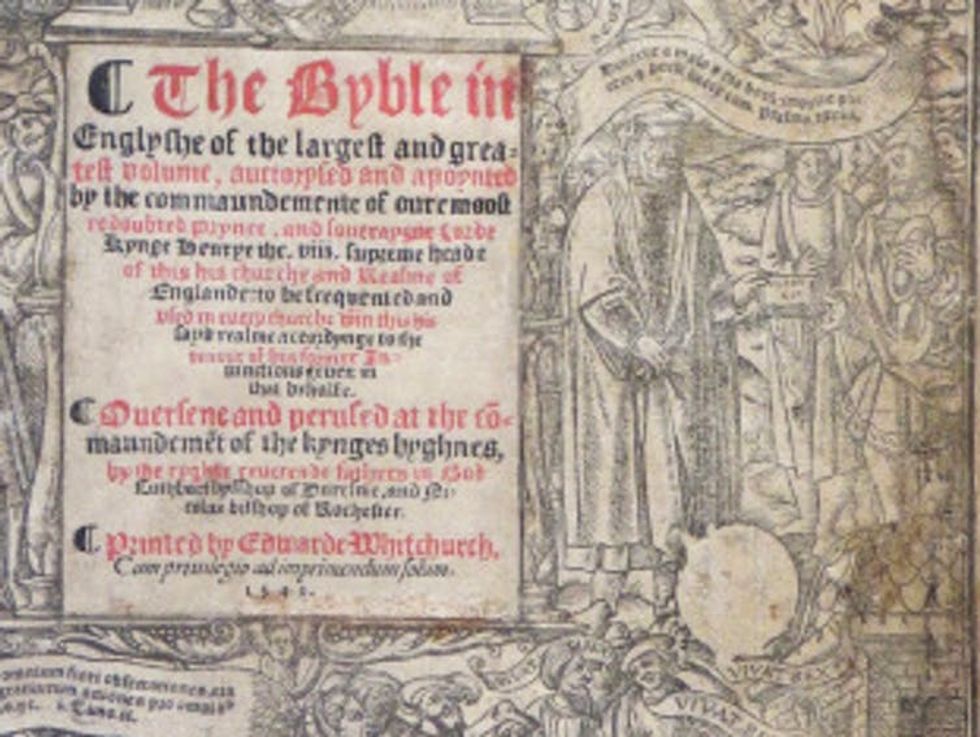
The Great Bible is often seen as a monument of English reform – but could it also contain the first known example of political photoshopping in early modern England? Printed in 1538-9, it was to be purchased by every parish church in the realm. Its creation was overseen by Henry VIII’s chief minister, Thomas Cromwell. The Great Bible ushered in the English parish Bible and its large size and meticulous printing set the bar for centuries to come. Nowhere is its iconic appearance more evident than in a unique presentation copy made for the Tudor court. This copy was printed on vellum and hand-coloured by highly skilled illuminators.
I encountered this lavish copy while carrying out an in-depth study of the production and use of Bibles in late medieval and early modern England. Researchers have long known about the Great Bible and used its striking title page for illustration. But little or no scientific analysis has ever been carried out on it. So I asked Paola Ricciardi, scientist in residence at the Fitzwilliam Museum in Cambridge, to help me with a new investigation which utilised the latest technology to study the Bible in forensic detail. The results blew us away.
Our analysis revealed a new – and hitherto unknown – plot by Cromwell to literally change the balance of power on the Bible’s front page, just one year before his execution for high treason. We plan to publish our research results in full later this year.
This article is part of Conversation Insights
The Insights team generates long-form journalism derived from interdisciplinary research. The team is working with academics from different backgrounds who have been engaged in projects aimed at tackling societal and scientific challenges.
As Lord Privy Seal and Vicegerent in Spirituals (Henry’s deputy in matters relating to the church), Cromwell was the most powerful man in Henry VIII’s court. Henry’s break from the Catholic Church and the dissolution of the monasteries became an opportunity for Cromwell to advance religious reform. For Cromwell, support for a vernacular Bible (translated into English for the general population) was linked with obedience to the King. But he had to counter a strong opposition and a substantial conservative faction in court and within the church. Henry’s support for religious reform was always limited. His stance on religion was influenced more by his political aims, rather than faith, so his support for a vernacular Bible was hesitant from the start.
Cromwell thought that the best way to ensure royal support was to produce a Bible worthy of royal patronage – both in its content and in its material grandeur. Such a Bible would combine Cromwell’s own evangelical leanings with the political aim of consolidating Henry’s control over the English church. Production began in Paris. English printers were simply not equipped to produce a book of the magnitude sought by Cromwell.
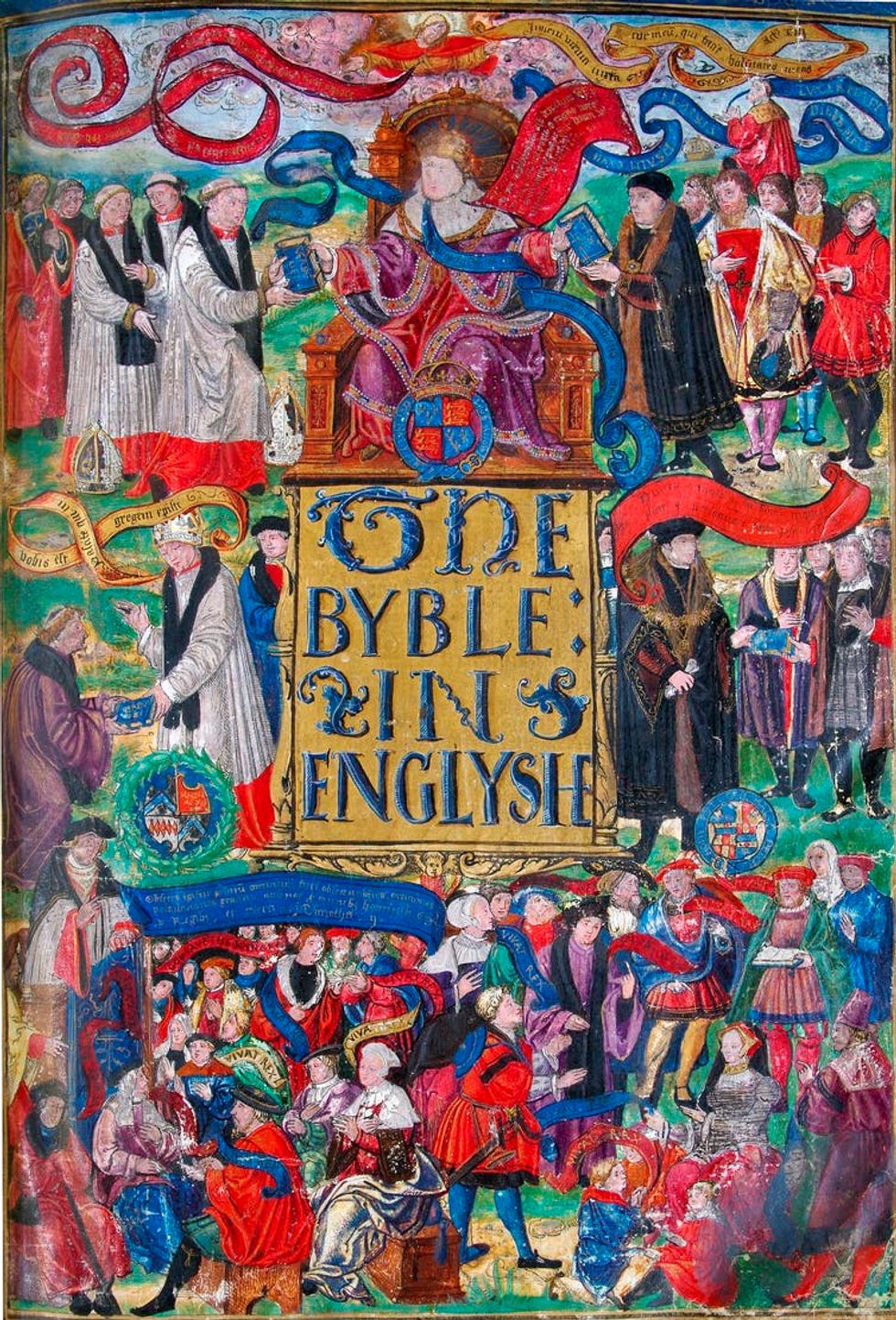
The title page of the Great Bible, which has yielded its secrets after more than four centuries.
Ian McKee/St John’s College., Author provided
A letter to Cromwell from the production team in Paris dated June 23, 1538, reveals that two luxurious vellum copies of the Bible were being prepared. It reads: “We have here sent unto your lordship two examples, one in parchment, wherein we intend to print one for the King’s grace, and another for your lordship.”
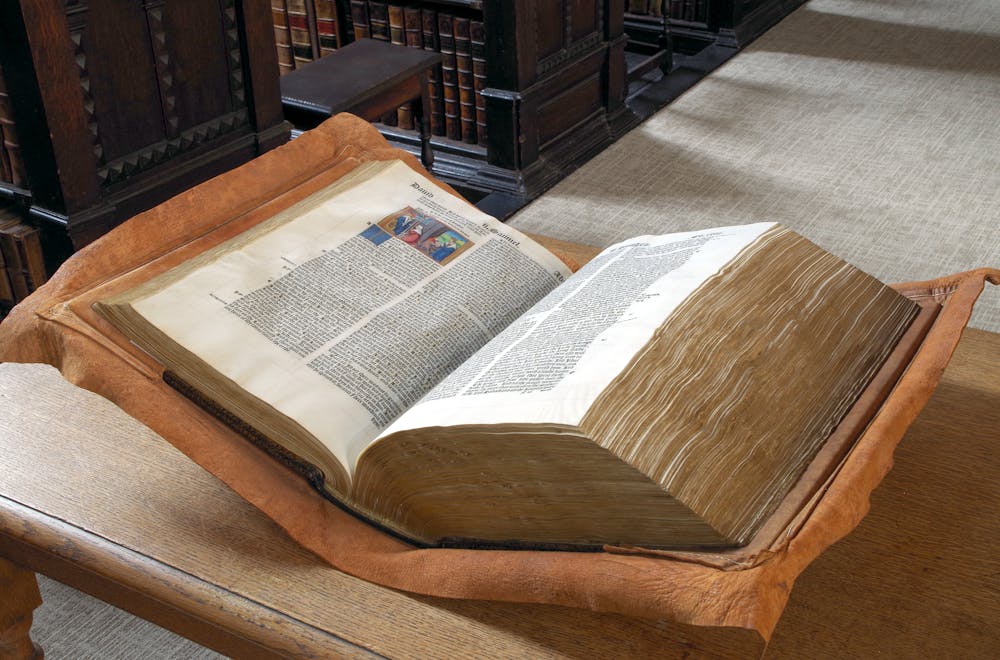
The Great Bible in the Old Library of St John’s College, Cambridge.
Ian McKee/St John's College, Author provided
Printed on parchment and meticulously hand-coloured, these copies have survived – one at the National Library of Wales and the other in St John’s College, Cambridge. In November 2019, with the kind assistance of St John’s College, we engaged in a technical and scientific investigation of their copy of the Great Bible.
Scientific analysis
We employed various non-invasive analytical techniques to examine the St John’s Bible, including X-ray fluorescence (XRF) spectroscopy, reflectance spectroscopy (in the ultraviolet, visible and near-infrared range), high-resolution digital microscopy and advanced technical imaging. Scientific investigation of works of art has much to offer and is more reliable for material identification than visual analysis (historically the primary identification method for painting materials and techniques).
The focus of our technical examination of the Bible was the decoration. Knowledge of the painting materials and techniques used to decorate books can provide a wealth of information on production methods and artists’ skills –and, occasionally, on their identity. All of the hundreds of black-and-white images printed in the Bible were painstakingly hand-coloured by a group of talented artists for this special presentation Bible. In some cases, the artists did not simply colour in the print, but made significant changes to the black-and-white printed images used in the regular editions of the Bible.
Our investigation focused on 14 images, spread out across the volume. First, we used a range of spectroscopic methods to analyse a selection of small areas in each image, allowing the identification of individual pigments. The pigments identified throughout the volume were consistent with what is known about the materials used by Continental painters and illuminators during the 16th century. One of the most interesting results of this investigation was the fact that different “palettes” can be identified in different images, which suggests the presence of no less than six (and quite possibly more) artists at work on the decoration of this Bible.
The spectroscopic analysis was followed by high-magnification digital microscopy (in direct as well as raking and transmitted light). The close-up images captured using these methods not only provided greater insight into the stylistic preferences and working methods of the artists, but were also crucial in revealing the extent to which the printed images were modified at the painting stage.
From black and white to colour
We paid special attention to the Bible’s title pages. Each of the book’s five parts is preceded by a full, illustrated and meticulously hand-coloured title page. The title pages depict scenes from the parts of the Bible they precede (historical books, the words of the prophets, or the New Testament). We discovered that the St John Bible’s main front page was actually a hand-coloured adaption of the printed black-and-white version which would have been present in all the mass-produced Bibles. But this luxurious front page – meant for the eyes of King Henry VIII – contained some key differences, as the slider image below illustrates.
The main black-and-white title page depicts an ideal scenario in which the majestic Henry VIII distributes bibles to lay and religious subjects, assisted by two of his faithful ministers – Thomas Cranmer, Archbishop of Canterbury, and Cromwell. Renowned art historian Tatiana String believes the printed title page was the visual manifestation of Henry’s authority. Henry reigns at the top of the page, distributing bibles to laypeople and clerics, aided by Cromwell to his left and Cranmer to his right (each identified by his coat of arms). The Word of God then reaches the general public in the lower part of the page, who duly proclaim “vivat rex” and “God save the king” (apart from those in prison, who are seen on the bottom right and shout nothing).
This black-and-white title page of the Bible masterminded by Cromwell, distilled his theory of scripture and obedience. The dissemination of the Bible was from top to bottom (literally), resulting in greater submission to the monarch. Its details reveal, however, that it moves away from the more radical reformation ideal of putting the Bible “in the ploughboy’s hands”. The laity at the bottom of the page do not hold the Bible, they simply listen to the Word of God preached from the pulpit. This was a nuanced and hierarchical way to disseminate the book and it reflected the unease Henry had with common people reading the Bible.
In the St John’s copy, the printed title pages were carefully hand painted, with the original print at times peeping through. For example, in the hand-coloured version the prison was obliterated and replaced by a dedication scene. The original brick background is still visible through the red stockings of the green-clad figure.
Cut and paste politics
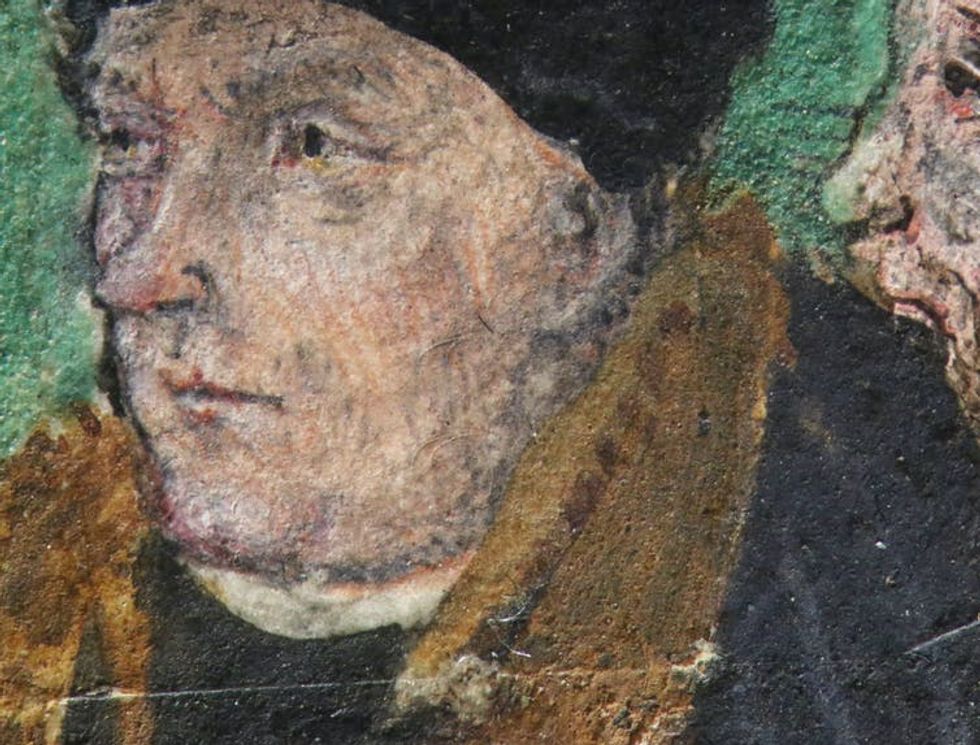
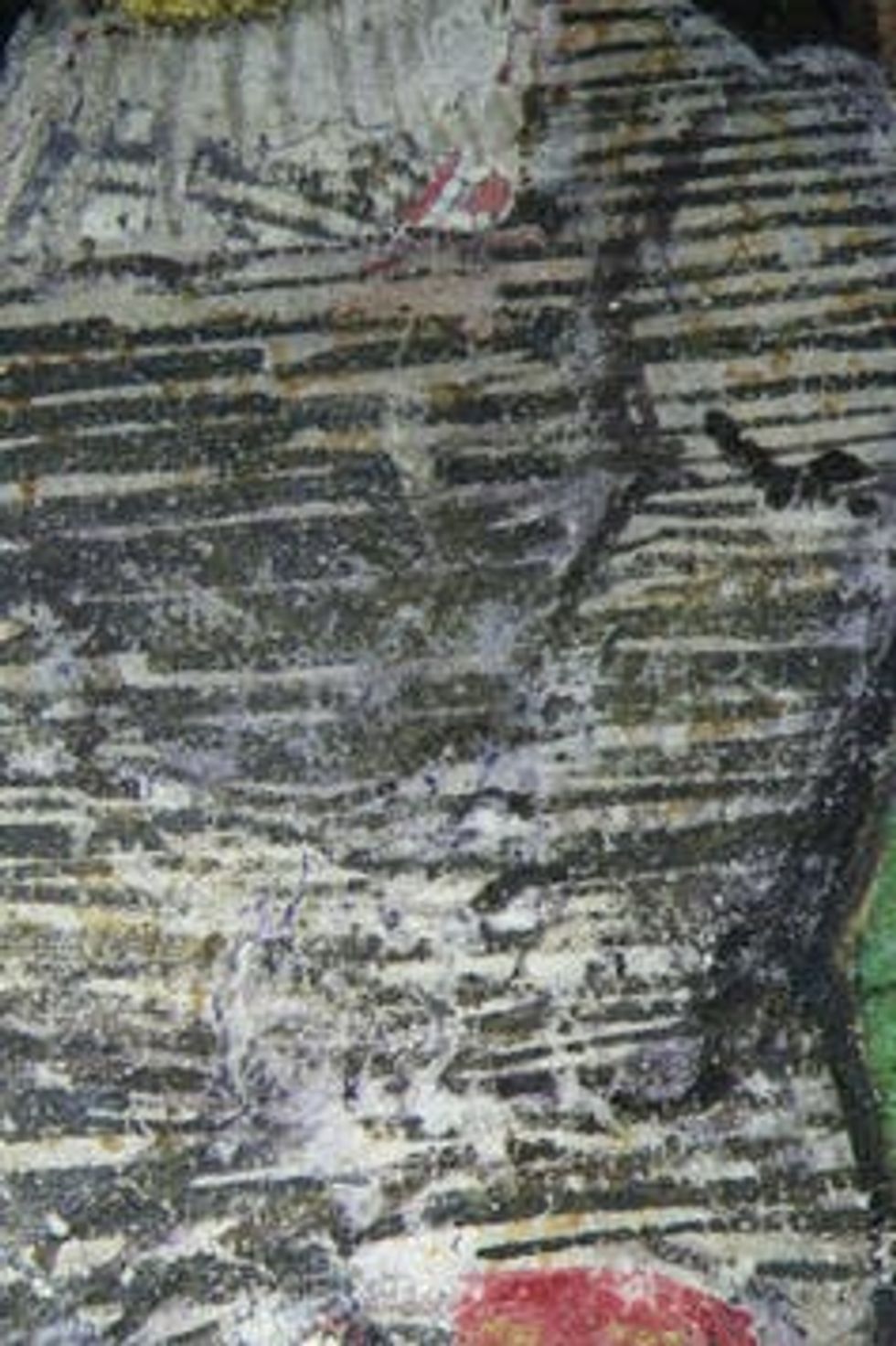
The most striking modification we found has so far been hidden from scholars working on this Bible. Under a microscope with raking light, it becomes evident that some of the faces were painted on separate pieces of vellum and pasted over the existing page. A thin line can be seen under Cromwell’s face where the image was pasted in. This was done in a highly professional manner, covering much of the border area with paint overlapping the edges and creating the impression of a single image. This major modification applied to Cromwell and another key figure.
The edges of Cromwell’s portrait are barely noticeable but reveal it was painted separately and glued on to the vellum page.
St John's College, Author provided
We believe that the instigator of this modification was Cromwell himself and the change had much to do with his representation on the page – a page which illustrates Henry’s complex attitude towards the lay readership of scripture, wavering between distribution and retraction. The same phenomenon, more nuanced but equally powerful, is evident in this careful modification. The pasting of Cromwell’s portrait had reshuffled political powers and affinity to the monarch.
In the original black-and-white design, Cromwell is affiliated with distributing the Bible to the laity – his coat of arms is in the middle of the page, below the figure whose features resemble Cromwell, handing the Bible (inscribed verbum dei, or “the Word of God”) to lay nobility. He mirrors Cranmer’s image, on the other side of the page, distributing a similar book to the clergy. This accorded with Cromwell’s central role in lay administration, as with his reformed leaning and his support for the printing of the Great Bible. In this image, then, Cromwell is on the level below the King and positioned in the middle of the page.
In the painted version of the title page, on the other hand, Cromwell is moved up a level and transformed into the person receiving the book from Henry’s left hand. This serves two purposes. It enhances the affinity between Cromwell and Henry, placing them next to each other. It also renders Cromwell in a more passive position, receiving the book from Henry rather than actively distributing it. Given Henry’s ambivalence towards the lay readership, this was a much less hazardous position. The careful and extensive modifications of the title page demonstrate Cromwell’s political prowess and his ability to read the political map and manipulate the visual image accordingly.
This transformation was both careful and premeditated. A back-light exposure reveals that the faces underneath the pasted elements had not been previously painted in, but rather left blank – anticipating the subsequent pasting. The scientific analysis reveals that the two faces were painted at the same time, most likely in a setting different from the painting of other features in the Bible. Very similar pigment mixtures were used across the two faces and they differ from those employed for flesh tones in the rest of the Bible.
Similarly, the pigments used in the uppermost sections of the fur garments in which the two figures are cloaked (those closest to the faces) differ from those identified in the lower portions of the garments. The same is true for the green brushstrokes surrounding the faces, painted with posnjakite (a copper sulphate mineral) unlike the rest of the grassy landscapes, which were painted in a different sulphate of copper.
This all suggests a targeted campaign. The separation between the painting of the other elements of the presentation copy and the faces reveals that the latter was carried out in a different location and at a later time – most likely in England – after the Bible had arrived from Paris. Reallocating the painting of the faces to London ensured greater accuracy, especially for those whose likeness was less well known outside of England.
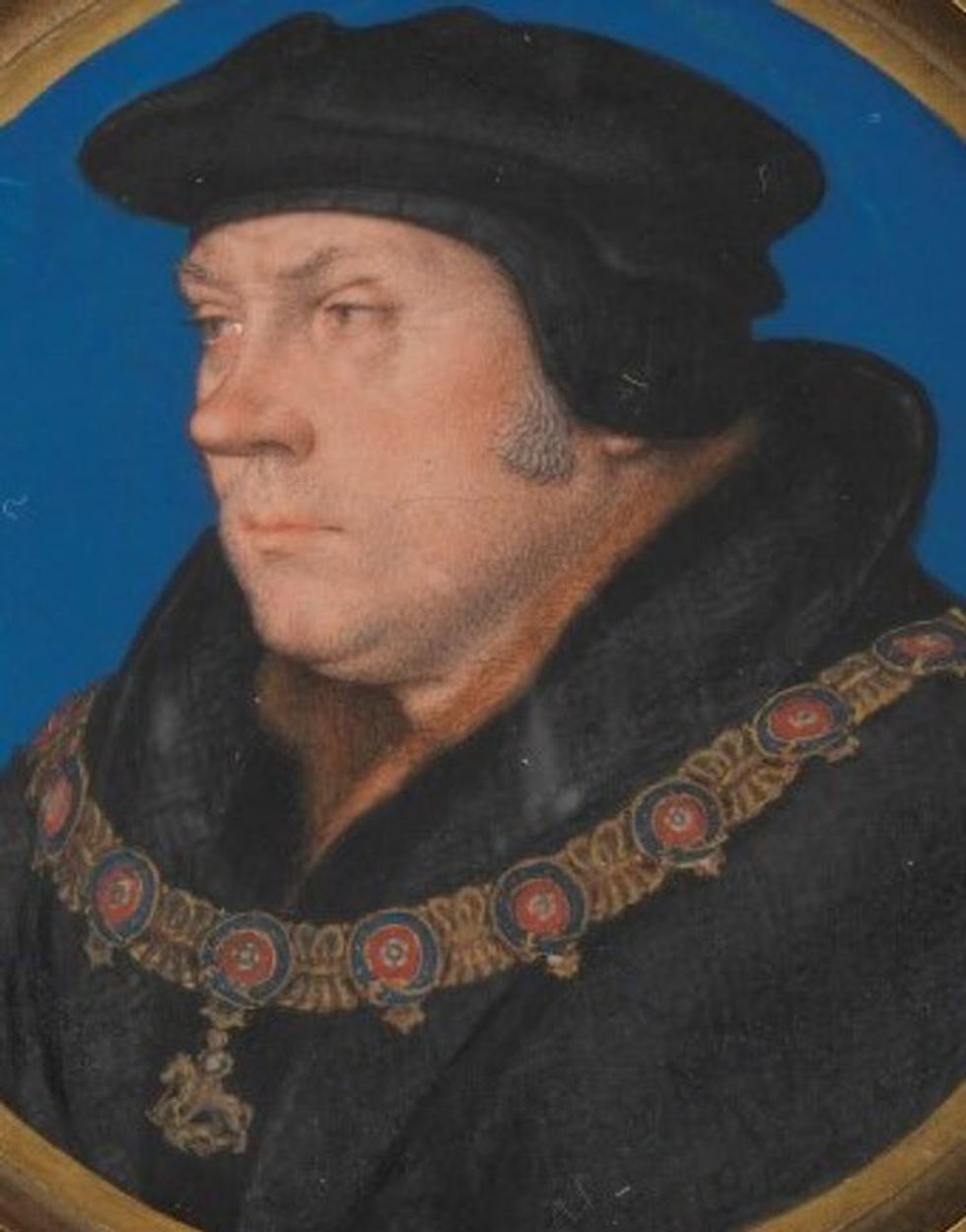
In London, very few artists were capable of such skilled and intricate work. The workshops of either Lucas Horenbout or Hans Holbein are the likely location where these portraits were painted and inserted into the title page. The involvement of artists with such close ties to Henry’s court (Horenbout was King’s Painter and court miniaturist from 1525 until his death in 1544, and Holbein was also painting for the court by the mid-1530s) would have guaranteed great accuracy in the depiction of key people. The features of the upper pasted face on the title page closely resemble known depictions of Cromwell. The image of him in the hand-coloured title page is probably his last accurate portrait.
Thomas Cromwell, Earl of Essex – watercolour on vellum by Hans Holbein, 1537.
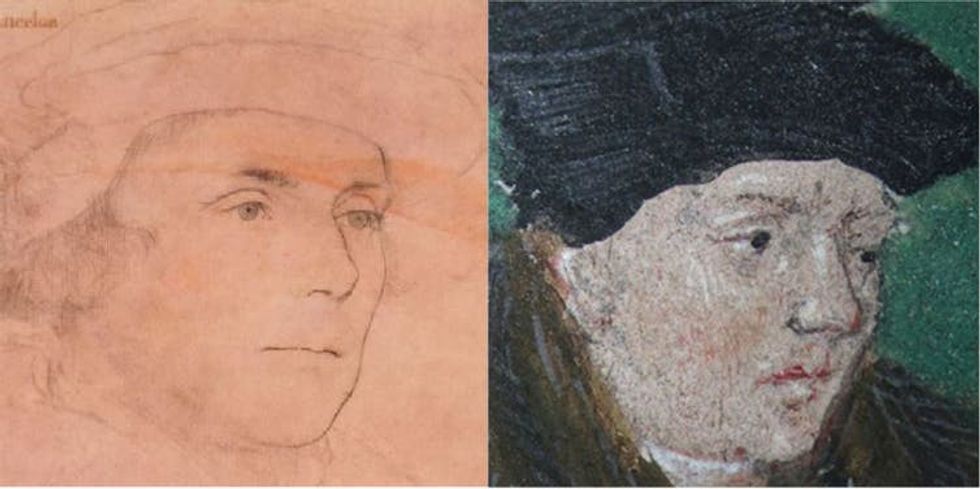
But who was the second person, distributing Bibles below Cromwell? There is no obvious answer. Based on court politics at the time, and the iconography of the portrait, we believe that this could be Richard Rich, Chancellor of the Court of Augmentations (responsible for dissolving English monasteries) and Speaker of the House of Commons. A comparison between Rich’s known portrait and the pasted face supports this hypothesis.
Hans Holbein’s portrait of Richard Rich compared to a pasted in face in The Great Bible.
This would demonstrate, once again, Cromwell’s political manoeuvring. Rich, once an affiliate of Cromwell and a leading politician at the court, would have been a natural ally in the dissemination of the Bible to the laity. By placing him underneath, further removed from Henry and closer to the more tricky endeavour of empowering the lay readership, Rich was presented as subordinate to Cromwell (which was not the case at the time) and with a clearer evangelical stance (again, this was not the case).
Rich was instrumental in facilitating the execution of Cromwell soon after and this may attest to Cromwell’s distrust of him. A few years earlier, Rich’s testimony was key in the executions of John Fisher and Thomas More.
Jane Seymour
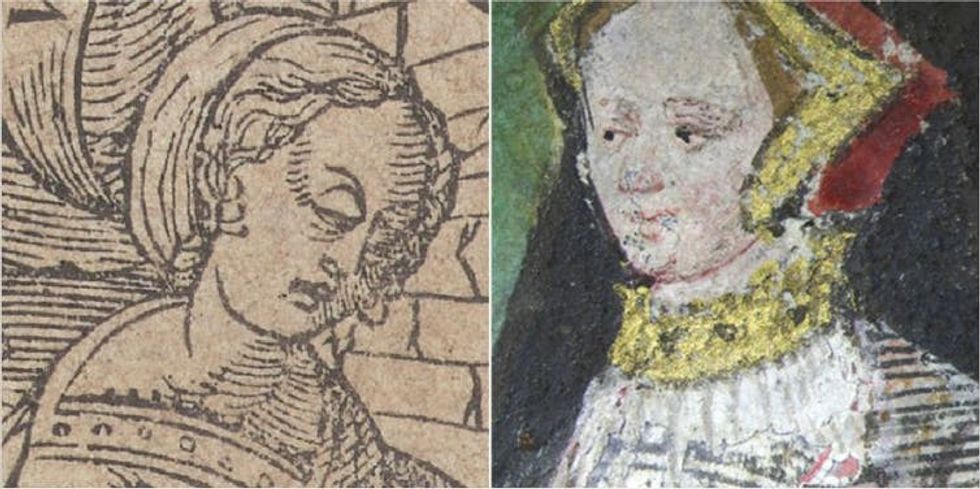
The image of the woman on the bottom right of the page (and in front of the prison in the black-and-white page) was also changed in the painted copy. In the printed image, a woman is sitting next to a group of children, her hair in curls, possibly with a white undercap. Her hands instruct the children, while she is facing the man on her left (who appears to be the prison warden).
The female image believed to represent Jane Seymour evolved from black-and-white into a more ornate figure decorated in gold leaf.
Cambridge University Library/St John’s College, Author provided
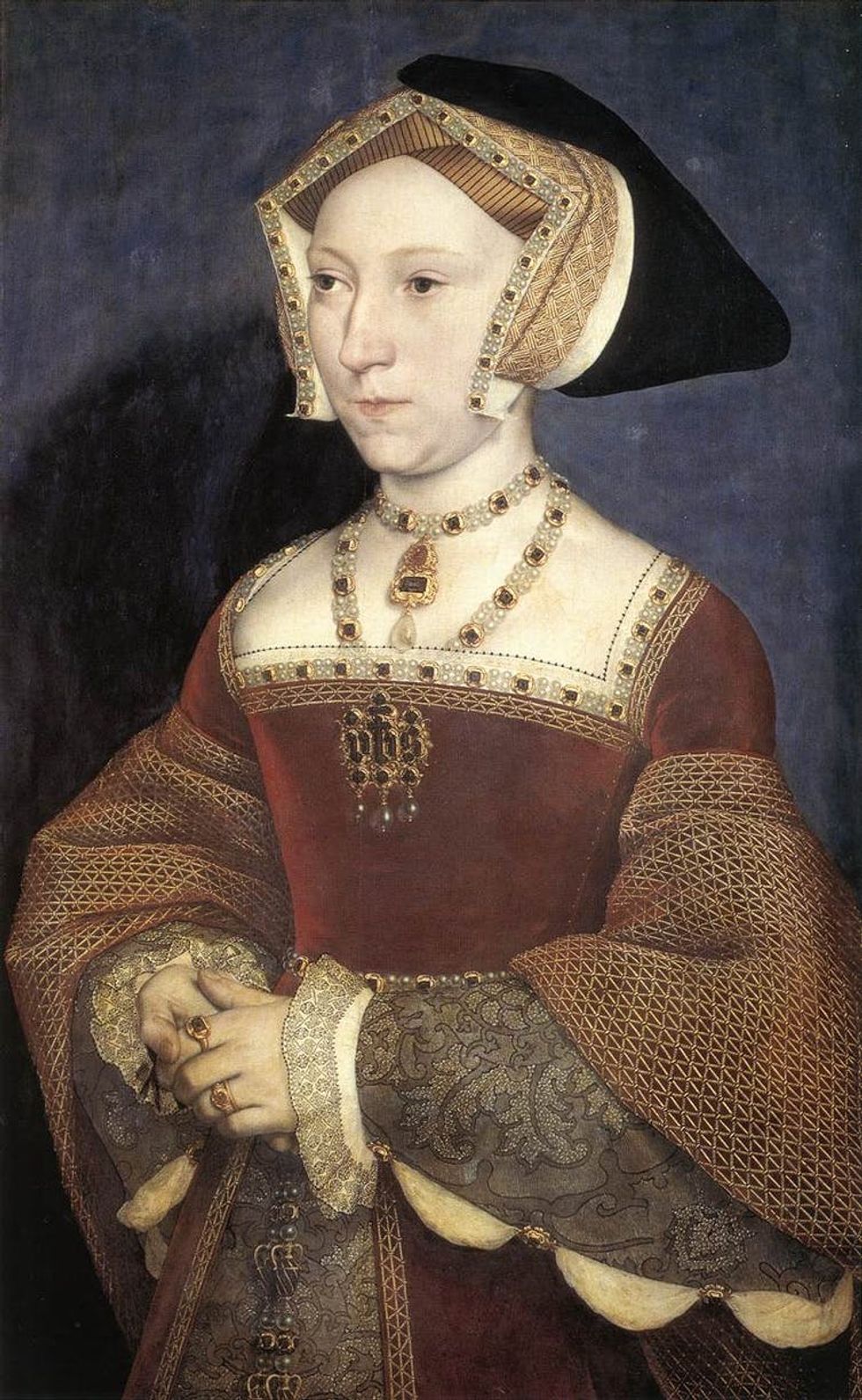
In the painted image, however, this was completely transformed. The woman now faces the children and her features are more distinct and more subtle. Her headgear has been turned into a lavish gable hood, worn by nobility and royalty. This sumptuous gable, trimmed in gold and possibly jewelled, together with the distinctive facial features are reminiscent of Holbein’s portrait of Jane Seymour, painted in 1536.
The portrait was well known at the time and served to inspire other depictions of Jane Seymour, who was Queen of England from 1536 to 1537 as Henry’s third wife. One such portrait was made in 1539 – the same year as the hand-painted title page. The importance of this figure is revealed when looking at the materials used for its creation.
The woman’s headdress and collar are the only instances where gold leaf was used on the page. Every other gilded area was decorated using “shell” (or powdered) gold. Pigment analysis also reveals the dress, which appears white with dark grey lines, contained tarnished silver. This combination of dazzling gold and silver makes the woman a truly spectacular addition to the colour title page.
Cromwell and Cranmer had previously used the King’s affinity to Seymour to elicit his support for the English Bible. In 1537, they evoked her pregnancy in the dedication to Henry which prefaced the Matthew Bible. The title page of that Bible proclaimed: “Set forth with the King’s most gracious licence.” Seymour’s pregnancy led to the birth of the future Edward VI – Henry’s much sought-after male heir. It is little wonder then that the woman in the painted title page is instructing a group of children, with her gaze directed to them – unlike the turned head of the woman in the original image.
The ‘Jane Seymour’ figure’s dress under a microscope.
Ian McKee/St John’s College, Author provided
Seymour died shortly after labour on October 24, 1537. Henry grieved for her and cherished her memory. Her loss permeated throughout the remainder of his life and he was subsequently buried at her side at Windsor Castle. A further change of mind about this female portrait is evident in the hand-painted title page. The analysis of the woman’s dress reveals an additional layer of modification, which attests to a later transformation of the figure. Under a microscope, it becomes evident that the white of the upper part of the dress conceals a red layer of paint.
The dress was therefore originally red with a low neckline, mirroring the dress worn by Seymour in the Holbein portrait and was later modified. The motivation for this later transformation is not yet known.
Political upheaval and betrayal
The importance of this presentation copy of the Great Bible – and its sister copy held in Wales – should not be underestimated. These copies were most likely the first ones seen by Henry and his court.
The modifications we have uncovered provide a unique insight into Cromwell’s thought process. Between the design of the printed title page and the hand-colouring, he has grown more cautious and more weary of Henry’s support of the English Bible and reform in general. As a result, he wished to distance himself from the role of distributing Bibles and instead put in his place the person who was to play a key role in his downfall and execution.
The Great Bible was reprinted in six subsequent editions, all produced in quick succession between 1539 and 1541. Henry approved of the printed title page, which was kept in all editions – and later even replaced the title page to the New Testament. However, further transformations to the title page reveal the political upheavals which were to come and the ultimate fate of Cromwell.
Shortly after the appearance of the Great Bible, Cromwell devised Henry’s ill-fated marriage to Anne of Cleves in January 1540. The conservative faction in court used this opportunity to move against Cromwell, leading to his execution in July 1540 – in which the perfidious testament of Rich was instrumental.
The printers of subsequent editions of the Great Bible faced the problem of retaining the image of a convicted traitor. The solution was not to replace the woodcut used for printing altogether (a cumbersome and very costly endeavour). Instead of erasing Cromwell’s image entirely, they erased his coat of arms from the fourth edition of November 1540 and all subsequent editions thereafter.
Image shows how Cromwell’s coat of arms was erased.
University of Pennsylvania
Rather than completely obliterating Cromwell’s memory, the blank circle reminded readers of the fate of traitors to the Crown. Henry also grew disillusioned with the dissemination of bibles to the laity. He came to realise that reality was different to the ideal of the printed title page, and that reading the Bible did not necessarily lead people to shout “long live the king”, but rather to think for themselves.
Cromwell’s fear, leading him to rejig the images, became a reality. Henry’s distrust of lay reading led to legislation in 1543, prohibiting lay women and men of the lower classes from accessing the Bible. Our analysis reveals how key players reacted to political and religious changes. The image modifications have laid bare the truth of the English Reformation period and illustrated just how dangerous and political 16th-century England was – especially in the court of King Henry VIII.
To hear about new Insights articles, join the hundreds of thousands of people who value The Conversation’s evidence-based news. Subscribe to our newsletter.
Mining the ocean floor for submerged minerals is a little-known, experimental industry. But soon it will take place on the deep seabed, which belongs to everyone, according to international law.
Seabed mining for valuable materials like copper, zinc and lithium already takes place within countries’ marine territories. As soon as 2025, larger projects could start in international waters – areas more than 200 nautical miles from shore, beyond national jurisdictions.
Today countries are working together on rules for seabed mining. In our opinion, there is still time to develop a framework that will enable nations to share resources and prevent permanent damage to the deep sea. But that will happen only if countries are willing to cooperate and make sacrifices for the greater good.
To mine the seafloor, ships will lower collector vehicles into the depths to vacuum up nodules containing valuable minerals.
An old treaty with a new purpose
Countries regulate seabed mining within their marine territories. Farther out, in areas beyond national jurisdiction, they cooperate through the Law of the Sea Convention, which has been ratified by 167 countries and the European Union, but not the U.S.
The treaty created the International Seabed Authority, headquartered in Jamaica, to manage seabed mining in international waters. This organization’s workload is about to balloon.
Under the treaty, activities conducted in areas beyond national jurisdiction must be for “the benefit of mankind as a whole.” These benefits could include economic profit, scientific research findings, specialized technology and recovery of historical objects. The convention calls on governments to share them fairly, with special attention to developing countries’ interests and needs.
The United States was involved in negotiating the convention and signed it but has not ratified it, due to concerns that it puts too many limits on exploitation of deep sea resources. As a result, the U.S. is not bound by the treaty, although it follows most of its rules independently. Recent administrations, including those of Presidents Bill Clinton, George W. Bush and Barack Obama, sought to ratify the treaty, but failed to muster a two-thirds majority in the Senate to support it.
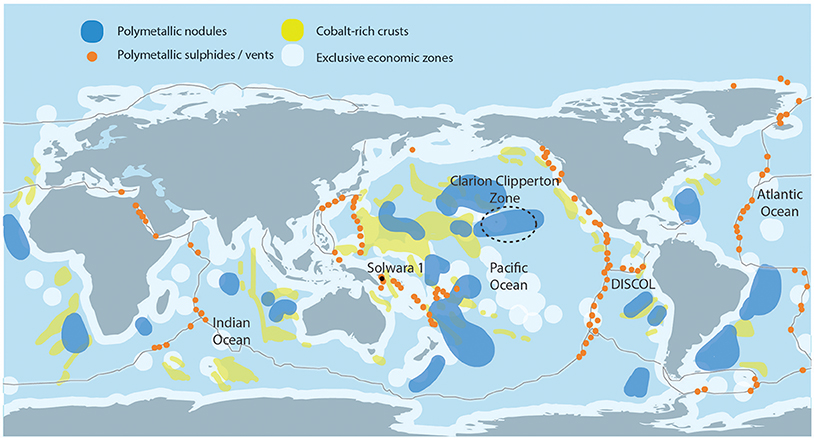
Locations of three main types of marine mineral deposits: polymetallic nodules (blue); polymetallic or seafloor massive sulfides (orange); and cobalt-rich ferromanganese crusts (yellow).
Scientists and industry leaders have known that there are valuable minerals on the seafloor for over a century, but it hasn’t been technologically or economically feasible to go after them until the past decade. Widespread growth of battery-driven technologies such as smartphones, computers, wind turbines and solar panels is changing this calculation as the world runs low on land-based deposits of copper, nickel, aluminum, manganese, zinc, lithium and cobalt.
These minerals are found in potato-shaped “nodules” on the seafloor, as well as in and around hydrothermal vents, seamounts and midocean ridges. Energy companies and their governments are also interested in extracting methane hydrates – frozen deposits of natural gas on the seafloor.
Mining the deep ocean requires permission from the International Seabed Authority. Exploration contracts provide the right to explore a specific part of the seabed for 15 years. As of mid-2020, 30 mining groups have signed exploration contracts, including governments, public-private partnerships, international consortiums and private multinational companies.
Two entities hold the most exploration contracts (three each): the government of Korea and the China Ocean Mineral Resources R&D Association, a state-owned company. Since the U.S. is not a member of the Law of the Sea treaty, it cannot apply for contracts. But U.S. companies are investing in others’ projects. For example, the American defense company Lockheed Martin owns UK Seabed Resources, which holds two exploration contracts.
Once an exploration contract expires, as several have since 2015, mining companies must broker an exploitation contract with the International Seabed Authority to allow for commercial-scale extraction. The agency is working on rules for mining, which will shape individual contracts.
Unknown ecological impacts
Deep-sea mining technology is still in development but will probably include vacuuming nodules from the seafloor. Scraping and vacuuming the seafloor can destroy habitats and release plumes of sediment that blanket or choke filter-feeding species on the seafloor and fish swimming in the water column.
Mining also introduces noise, vibration and light pollution in a zone that normally is silent, still and dark. And depending on the type of mining taking place, it could lead to chemical leaks and spills.
Many deep-sea species are unique and found nowhere else. We agree with the scientific community and environmental advocates that it is critically important to analyze the potential effects of seabed mining thoroughly. Studies also should inform decision-makers about how to manage the process.
This is a key moment for the International Seabed Authority. It is currently writing the rules for environmental protection but doesn’t have enough information about the deep ocean and the impacts of mining. Today the agency relies on seabed mining companies to report on and monitor themselves, and on academic researchers to provide baseline ecosystem data.
We believe that national governments acting through the International Seabed Authority should require more scientific research and monitoring, and better support the agency’s efforts to analyze and act on that information. Such action would make it possible to slow the process down and make better decisions about when, where and how to mine the deep seabed.
Footage from an expedition to the Ningaloo Canyons off Western Australia in spring 2020 that discovered up to 30 new species.
We also believe that the U.S. should ratify the Law of the Sea treaty so that it can help to lead on this issue. The oceans provide humans with food and oxygen and regulate Earth’s climate. Choices being made now could affect them far into the future in ways that aren’t yet understood.
Dr. Rachel Tiller, Senior Research Scientist with SINTEF Ocean, Norway, contributed to this article.
The opening of a new biopic of Tesla provides a timely opportunity to review the life of a man who came from nowhere yet became world famous; claimed to be devoted solely to discovery but relished the role of a showman; attracted the attention of many women but never married; and generated ideas that transformed daily life and created multiple fortunes but died nearly penniless.
Early years
Tesla was born in what is now Croatia on a summer night in 1856, during what he claimed was a lightning storm – which led the midwife to say, “He will be a child of the storm,” and his mother to counter prophetically, “No, of the light.” As a student, Tesla displayed such remarkable abilities to calculate mathematical problems that teachers accused him of cheating. During his teen years, he fell seriously ill, recovering once his father abandoned his demand that Nikola become a priest and agreed he could attend engineering school instead.
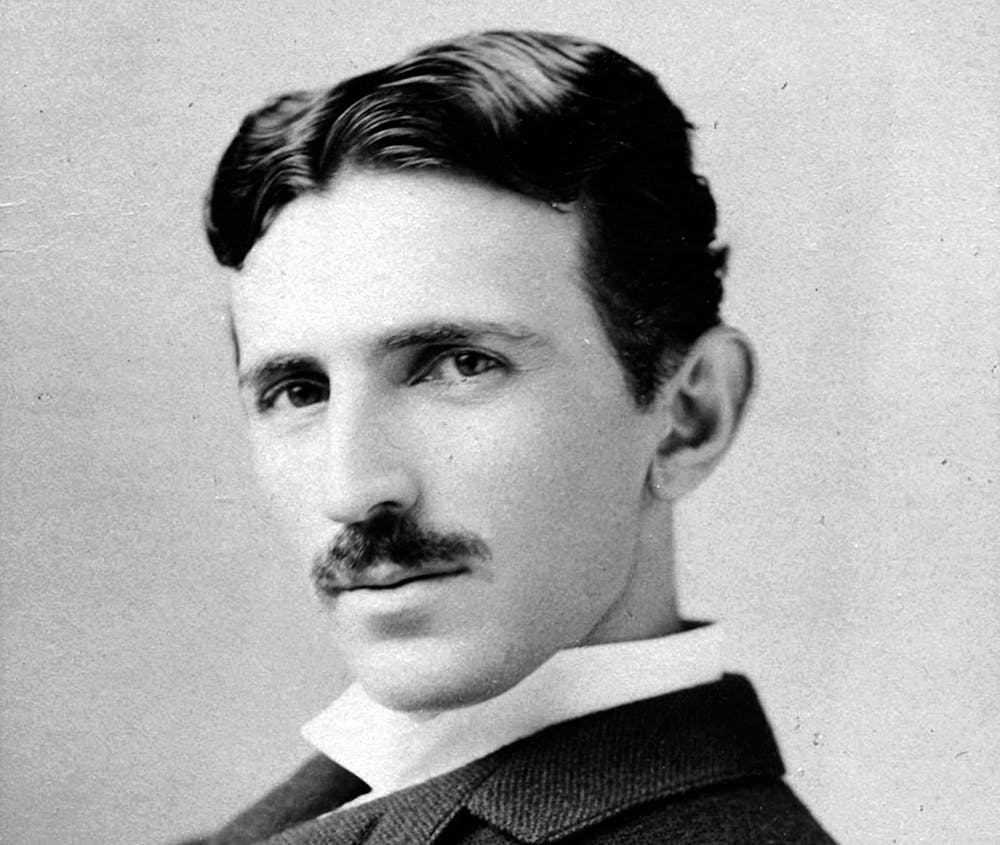
Nikola Tesla, electrical entrepreneur, circa 1893.
Although an outstanding student, Tesla eventually withdrew from polytechnic school and ended up working for the Continental Edison Company, where he focused on electrical lighting and motors. Wishing to meet Edison himself, Tesla immigrated to the U.S. in 1884, and he later claimed he was offered the sum of US$50,000 if he could solve a series of engineering problems Edison’s company faced. Having achieved the feat, Tesla said he was then told that the offer had just been a joke, and he left the company after six months.
Tesla then developed a relationship with two businessmen that led to the founding of Tesla Electric Light and Manufacturing. He filed a number of electrical patents, which he assigned to the company. When his partners decided that they wanted to focus strictly on supplying electricity, they took the company’s intellectual property and founded another firm, leaving Tesla with nothing.
Tesla reported that he then worked as a ditch digger for $2 a day, tortured by the sense that his great talent and education were going to waste.
Success as an inventor
In 1887, Tesla met two investors who agreed to back the formation of the Tesla Electric Company. He set up a laboratory in Manhattan, where he developed the alternating current induction motor, which solved a number of technical problems that had bedeviled other designs. When Tesla demonstrated his device at an engineering meeting, the Westinghouse Company made arrangements to license the technology, providing an upfront payment and royalties on each horsepower generated.
The so-called “War of the Currents” was raging in the late 1880s. Thomas Edison promoted direct current, asserting that it was safer than AC. George Westinghouse backed AC, since it could transmit power over long distances. Because the two were undercutting each other’s prices, Westinghouse lacked capital. He explained the difficulty and asked Tesla to sell his patents to him for a single lump sum, to which Tesla agreed, forgoing what would have been a vast fortune had he held on to them.
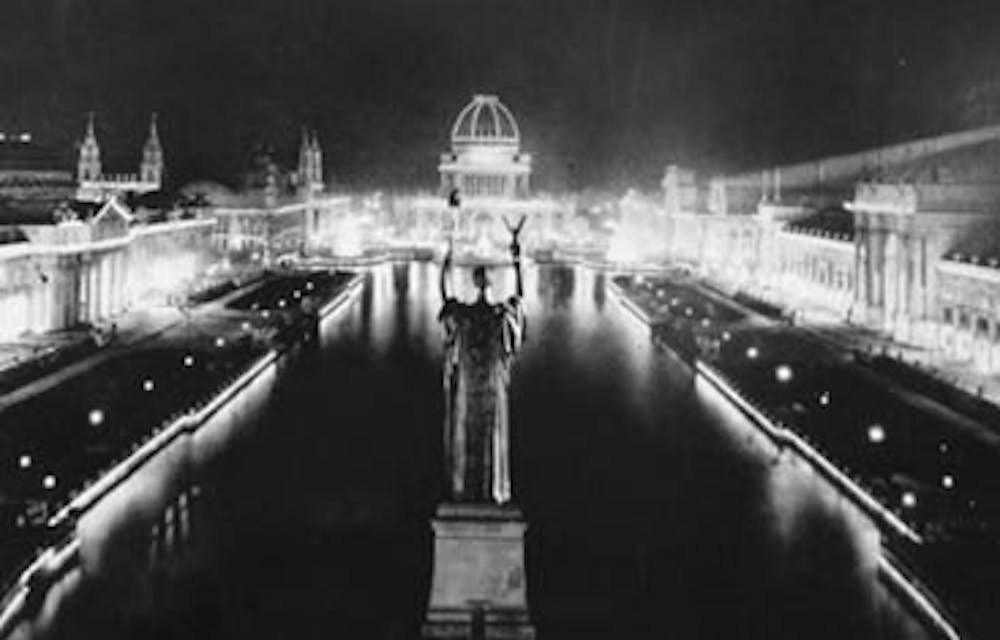
AC electric lights lit up the night at the Chicago World’s Fair.
With the World’s Columbian Exposition of 1893 looming in Chicago, Westinghouse asked Tesla to help supply power; they’d have a huge platform for demonstrating the merits of AC. Tesla helped the fair illuminate more light bulbs than could be found in the entire city of Chicago, and wowed audiences with a variety of wonders, including an electric light that required no wires. Later Tesla also helped Westinghouse win a contract to generate electrical power at Niagara Falls, helping to build the first large-scale AC power plant in the world.
Challenges along the way
Tesla encountered many obstacles. In 1895, his Manhattan laboratory was devastated by a fire, which destroyed his notes and prototypes. At Madison Square Garden in 1898, he demonstrated wireless control of a boat, a stunt that many branded a hoax. Soon after he turned his attention to the wireless transmission of electric power. He believed that his system could not only distribute electricity around the globe but also provide for worldwide wireless communication.
Seeking to test his ideas, Tesla built a laboratory in Colorado Springs. There he once drew so much power that he caused a regional power outage. He also detected signals that he claimed emanated from an extraterrestrial source. In 1901 Tesla persuaded J.P. Morgan to invest in the construction of a tower on Long Island that he believed would vindicate his plan to electrify the world. Yet Tesla’s dream did not materialize, and Morgan soon withdrew funding.
In 1909, Marconi received the Nobel Prize for the development of radio. In 1915, Tesla unsuccessfully sued Marconi, claiming infringement on his patents. That same year, it was rumored that Edison and Tesla would share the Nobel Prize, but it didn’t happen. Unsubstantiated speculation suggested their mutual animosity was the cause. However, Tesla did receive numerous honors and awards over his life, including, ironically, the American Institute of Electrical Engineers Edison Medal.
A singular man
Tesla was a remarkable person. He said that he had a photographic memory, which helped him memorize whole books and speak eight languages. He also claimed that many of his best ideas came to him in a flash, and that he saw detailed pictures of many of his inventions in his mind before he ever set about constructing prototypes. As a result, he didn’t initially prepare drawings and plans for many of his devices.
The 6-foot-2-inch Tesla cut a dashing figure and was popular with women, though he never married, claiming that his celibacy played an important role in his creativity. Perhaps because of his nearly fatal illness as a teenager, he feared germs and practiced very strict hygiene, likely a barrier to the development of interpersonal relationships. He also exhibited unusual phobias, such as an aversion to pearls, which led him to refuse to speak to any woman wearing them.
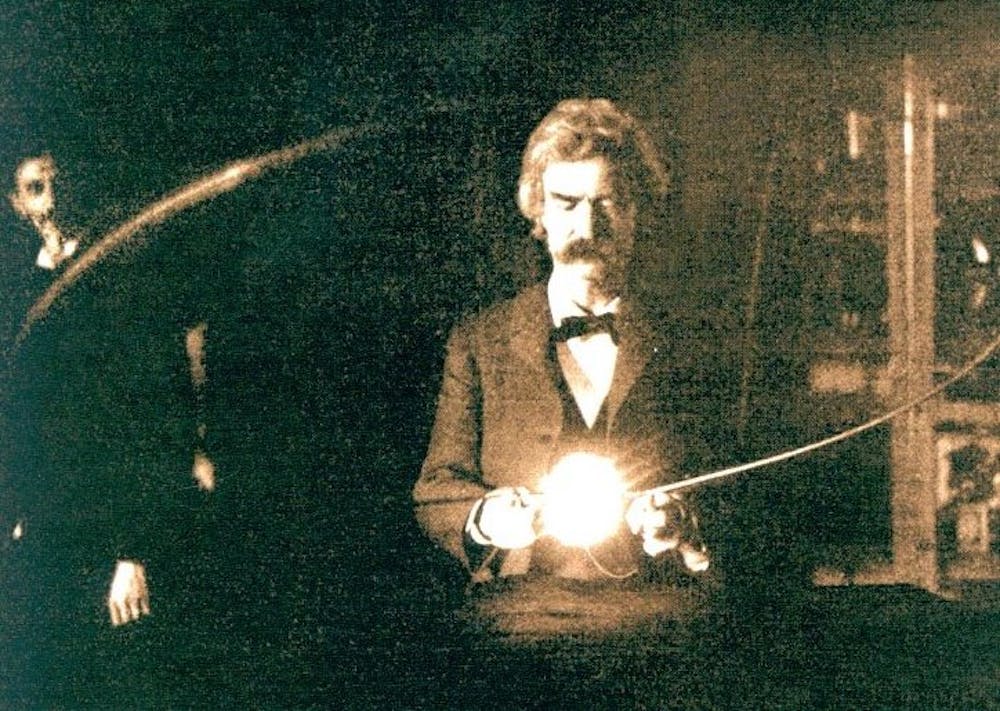
Mark Twain holding Tesla’s experimental vacuum lamp, 1894.
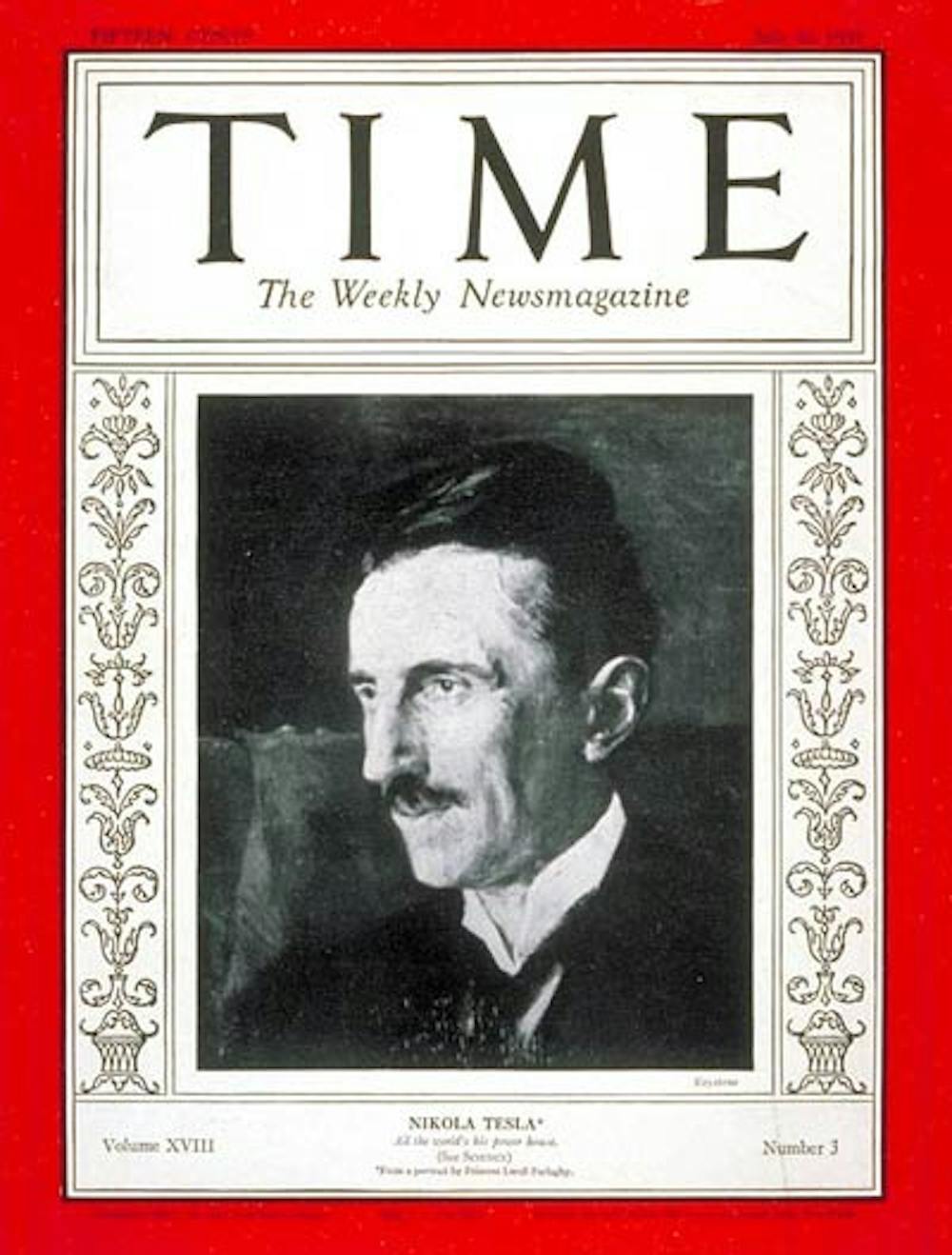
Tesla held that his greatest ideas came to him in solitude. Yet he was no hermit, socializing with many of the most famous people of his day at elegant dinner parties he hosted. Mark Twain frequented his laboratory and promoted some of his inventions. Tesla enjoyed a reputation as not only a great engineer and inventor but also a philosopher, poet and connoisseur. On his 75th birthday he received a congratulatory letter from Einstein and was featured on the cover of Time magazine.
Tesla’s last years
A renaissance man of sorts, on the occasion of his 75th birthday.
In the popular imagination, Tesla played the part of a mad scientist. He claimed that he had developed a motor that ran on cosmic rays; that he was working on a new non-Einsteinian physics that would supply a new form of energy; that he had discovered a new technique for photographing thoughts; and that he had developed a new ray, alternately labeled the death ray and the peace ray, with vastly greater military potential than Nobel’s munitions.
His money long gone, Tesla spent his later years moving from place to place, leaving behind unpaid bills. Eventually, he settled in at a New York hotel, where his rent was paid by Westinghouse. Always living alone, he frequented the local park, where he was regularly seen feeding and tending to the pigeons, with which he claimed to share a special affinity. On the morning of Jan. 7, 1943, he was found dead in his room by a hotel maid at age 86.
Today the name Tesla is still very much in circulation. The airport in Belgrade bears his name, as does the world’s best-known electric car, and the magnetic field strength of MRI scanners is measured in Teslas. Tesla was a real-life Prometheus: the mythical Greek titan who raided heaven to bring fire to mankind, yet in punishment was chained to a rock where each day an eagle ate his liver. Tesla scaled great heights to bring lightning down to earth, yet his rare cast of mind and uncommon habits eventually led to his downfall, leaving him nearly penniless and alone.
This article has been updated to correct Tesla’s birthplace. Though he was of Serbian ethnicity, he was born in present day Croatia.