At least 107 people died from lightning strikes in northern and eastern India Thursday, officials said, during the early stages of the annual monsoon season.
Some 83 people were killed in the impoverished eastern state of Bihar after being struck by lightning, and another 24 died in northern Uttar Pradesh state.
Dozens more were injured, officials said.
Lightning strikes during the June-September annual monsoon are fairly common in India.
But Bihar's Disaster Management Minister Lakshmeshwar Rai told AFP this was one of the highest daily tolls from lightning the state had recorded in recent years.
More than half of the deaths were from the flood-prone northern and eastern districts of Bihar, he added.
Rai warned the death toll could rise further as his government was still waiting on casualty reports from the interior parts of the state.
Heavy rain is forecast to hit Bihar on Friday and Saturday, according to the local India Meteorological Department office.
In neighboring Uttar Pradesh, most of the deaths were reported in Deoria district close to the Nepal border, and the holy city of Prayagraj, authorities said.
Prime Minister Narendra Modi late Thursday tweeted his condolences to the victims' families, adding that both state governments were carrying out urgent relief work.
More than 2,300 people were killed by lightning in India in 2018 according to the National Crime Records Bureau, the most recent figures available.
The monsoon is crucial to replenishing water supplies in South Asia, but also causes widespread death and destruction across the region each year.
Panamanian Roberto "Hands of Stone" Duran, six-time boxing world champion, was hospitalized in non-life-threatening condition Thursday with the novel coronavirus, his children said on the same day that Panama hit a new record of daily cases.
"Test results have just arrived for my dad, and they confirm he is positive for COVID-19," the legendary fighter's son Robin Duran said on Instagram.
"Thank God for now he doesn't have symptoms beyond a cold. He is not in intensive care nor on a respirator, just under observation," he added.
Robin Duran had posted hours before that the 69-year-old had been hospitalized as a precaution for a "respiratory virus," which turned out to be COVID-19.
"We just spoke to the doctor who told us that his lungs are fine and there are no indications of severe (illness)," Robin Duran said. "We continue to have faith that everything will be ok."
Duran boxed 119 fights between the ages of 16 and 50 -- with 103 wins and 16 losses. He was knocked out four times, but did the same to his opponents 70 times, earning him the "Hands of Stone" nickname.
Duran is a national hero in Panama as one of the country's most famous athletes along with former New York Yankees baseball player Mariano Rivera, former Olympic long-jump champion Irving Saladino and former soccer players the late Rommel Fernandez and Julio Dely Valdes.
India acknowledged for the first time Thursday that it has matched China in massing troops at their contested Himalayan border region after a deadly clash this month.
But India's foreign ministry accused China of causing the tensions by starting military deployments, and warned relations between the world's two most populous nations could be undermined if the standoff continues.
The neighbors have blamed each other for a June 15 battle in the Ladakh region in which 20 Indian soldiers were killed while China suffered an unknown number of casualties.
While each has said it wants to de-escalate the territorial showdown, India's foreign ministry spokesman Anurag Srivastava said "both sides remain deployed in large numbers in the region, while military and diplomatic contacts are continuing".
Srivastava said "Chinese actions" on the unofficial border, known as the Line of Actual Control (LAC), led to this month's deadly fight with rocks and batons. No shots were fired.
"At the heart of the matter is that since early May, the Chinese side has been amassing a large contingent of troops and armaments along the LAC," the spokesman charged.
He added that China had obstructed India's patrols in contravention of accords made to avoid skirmishes between their armies, who fought a border war in 1962 and have regularly clashed since.
Srivastava said Chinese forces had built "structures" on the Indian side of their demarcation line in the Galwan Valley in Ladakh where the high-altitude battle was fought.
"While there have been occasional departures in the past, the conduct of Chinese forces this year has been in complete disregard of all mutually agreed norms," the spokesman said.
India had "to undertake counter deployments" because of the Chinese buildup, he said.
Military commanders have held talks and their foreign ministers have also discussed ways to end the showdown.
"Peace and tranquility in the border areas is the basis of our bilateral relationship," said Srivastava, demanding that China follow up on its pledge to cool tensions.
"A continuation of the current situation would only vitiate the atmosphere for the development of the relationship."
China has accused Indian forces of causing the June 15 battle by attacking its troops.
Beijing has also called on India "to immediately stop all infringing and provocative actions."
Netflix is being sued by the estate of Sherlock Holmes creator Arthur Conan Doyle for alleged breach of copyright after a new film portrayed the famous detective as having feelings and respecting women.
The movie, "Enola Holmes" -- starring "Stranger Things" actor Millie Bobby Brown -- is a Netflix adaptation of a series of Nancy Springer novels that imagines the detective has a teenage sister.
Although a separate court case established early Holmes novels are in the public domain, the lawsuit alleges the detective only developed feelings in the last 10 books, which remain under the control of Arthur Conan Doyle estate.
"Holmes became warmer. He became capable of friendship. He could express emotion. He began to respect women," the suit, filed in New Mexico federal court on Tuesday, claimed.
The suit alleges Holmes only shows his feelings in the final novels, arguing that as a result Springer's depiction and Netflix's adaptation would violate their copyright.
The lawsuit notes that when he wrote the later novels, Doyle had lost both his brother and his eldest son in the First World War: "It was no longer enough that the Holmes character was the most brilliant rational and analytical mind. Holmes needed to be human."
The suit says that as well as using publicly available characters, Springer's "novels copy Conan Doyle's original additions in the Copyrighted Stories.
"Among other copied elements, the Springer novels make extensive infringing use of Conan Doyle's transformation of Holmes from cold and critical to warm, respectful, and kind in his relationships."
In addition to Netflix, the lawsuit also targets Springer, her publisher Penguin Random House and the producer of the latest film Legendary Pictures.
Sheets of braille were scattered around Jetro Gonese as he sat hunched over his mattress in a dilapidated building in downtown Johannesburg, punching away at the keys of his special typewriter.
Sightless since childhood, 60-year-old Gonese, a Zimbabwean immigrant in South Africa, has been confined to the tiny room he shares with another visually-impaired man since the start of an anti-coronavirus lockdown in March.
In a new world where people must keep their distance and avoid contact with surfaces, the blind have found themselves deprived of their compass.
"Touch is what we call the queen sense," Gonese explained.
"It enables us to recognize and identify most things... the texture of surfaces, your skin or your hand. It is very central in our lives."
None of the building's 200-odd residents can afford sanitizer or face masks. Most are the families of disabled immigrants like Gonese, who scrape a living by begging on the streets.
Strict confinement measures and vulnerability to the virus have forced these sightless breadwinners to remain indoors.
"It is dangerous for us to shake hands or touch any surfaces because you might contract the disease," Gonese said, adding that police enforcing lockdown rules had chased him home the few times he ventured outdoors.
"So communication has been very difficult for us... because we are afraid to touch things."
- No 'voice tune' -
Further along the dark graffiti-filled corridor, Enok Mukanhairi occupies a cramped two-bedroom flat with his wife Angeline Tazira, 50, and four grown children.
The couple met at a school for the visually impaired in the southeastern Zimbabwean city of Masvingo and migrated to South Africa in 2007 -- driven away from their home country by economic collapse blamed on ex-president Robert Mugabe.
Mukanhairi, 57, went back to his usual begging spot last week, encouraged by a gradual easing of lockdown restrictions since the start of May.
He struggled to find his bearings around people who spoke through face masks and kept a distance.
"If you are putting a mask at times we cannot hear your voice properly," Mukanhairi said.
"Some of them cannot even release the voice tune which we are used to," he added. "So it affects how quickly I can identify (a person)."
Mukanhairi said fewer drivers rolled down their car windows as he stood by the traffic light.
Those that extended a coin did so hastily, without exchanging a word.
"I am very worried about catching coronavirus, but not as much as getting food."
Tazira nodded as she stared up at the ceiling, knitting a white scarf without missing a single stitch.
She has not yet dared to resume her own begging.
"Before it was easier," Tazira said in Zimbabwe's Shona language.
- 'Not like anyone' -
Another Zimbabwean immigrant, Siwachi Mavhaire, who is a volunteer for the African Diaspora Forum -- a local charity, has grown close to the blind community.
"They are not like anyone," Mavhaire noted. "Myself, even if they lock me down, I can go out and run away and come back."
"They are the ones who observe it (lockdown) more than anybody," he added. "They are scared."
Gonese has used the long days indoors to type out memories from the past on his Braille writer.
Despite losing his sight to measles at the age of two, he completed his education and trained as a teacher for visually-impaired children.
None of those qualifications were recognized in South Africa, forcing him into 12 long years of street begging.
"I thought I would come up with a short story of my life," he told AFP, as a slight breeze drifted into the stuffy room and rustled the papers on his mattress.
The fight for control of drug kingpin Joaquin "El Chapo" Guzman's legacy spilled into the open on Thursday after a gun battle between rival Mexican gangs left 16 dead, authorities said.
The 16 men, heavily armed and wearing bullet-proof vests, died in a six-hour running shootout near the rural town of Tepuche in northwestern Sinaloa province.
"A van with seven bodies was located" after an initial clash, while nine bodies were discovered following a second exchange, Sinaloa's state security minister Cristobal Castaneda told reporters.
Castaneda said Wednesday's clash near Tepuche, 25 kilometers (16 miles) from Sinaloa capital Culiacan, was "part of a struggle between two organized crime gangs in the area."
Local media reported the conflict involved members of the Sinaloa cartel -- pitching a part of the gang run by the sons of ex-leader "El Chapo" Guzman against a faction led by Ismael "El Mayo" Zambada, long considered the group's number two.
The reports pointed to a deep split in what remains one of Mexico's most powerful drug cartels, despite El Chapo's 2016 capture and subsequent extradition to the United States, where he is serving a life sentence.
Castaneda said the rival groups had clashed on eight separate occasions in the area since May 29.
In the aftermath of the shootings, police confiscated 40 high caliber weapons, 10 grenades, 36,000 rounds of ammunition and 24 vehicles, the official said.
Seven of the victims were identified as residents of Tepuche.
- Locals flee violence -
An AFP reporter who drove through the town on Thursday found several houses left abandoned by families who had fled the area in fear of escalating violence.
"Most of the people are gone," said a local resident who gave her name as Modesta. "But we stayed, because we have animals here we have to look after," the 63-year-old woman said. "But if the government tell us we have to leave, we'll leave."
Mike Vigil, former head of international operations for the US Drug Enforcement Agency (DEA), said Guzman's three sons -- known as the "Chapitos," or little Chapos -- were engaged in a fight for control of the cartel.
"It's a matter of inheritance. Since their father founded the Sinaloa cartel, they believe they should manage it," Vigil told AFP.
After Guzman's capture, his sons Ivan, Jesus and Ovidio agreed that Zambada would take over in the interim while they "learned the business," said Vigil.
"They only knew how to spend the money, but now they know how the cartel operates and they want to take control, and that's why these disputes are happening."
Vigil said the Chapitos are worried about the future of the cartel if Zambada, a 72-year-old with diabetes, dies and his lieutenants take over.
- El Chapo's legacy -
"The cartel is not yet divided, but it is on that path. Many respect "Mayo" because he is the oldest capo in Mexico, but there is another group that is with the Chapitos because they know that Zambada could die," the former DEA agent said.
A split in the group would likely aggravate Mexico's gang violence because it would strengthen the rival Jalisco Nueva Generacion (New Generation) cartel.
"The Jalisco cartel is the bloodiest cartel, the consequences for Mexico would be unimaginable, and with this government I don't know how it could be faced down," said Vigil.
President Andres Manuel Lopez Obrador favored appeasement when previously challenged by the cartel in October 2019, after Mexican federal forces arrested Ovidio Guzman in Culaican.
Guzman was later released on Obrador's orders after five hours of clashes in Culiacan between the Sinaloa drug cartel and security forces.
Lopez Obrador faced sharp criticism for Ovidio Guzman's release but defended his decision on the grounds that it would avoid widespread bloodshed.
Organized crime has remained active in Mexico, despite confinement due to the coronavirus pandemic.
Specialists and human rights defenders attribute Mexico's drug-related violence to a controversial military crackdown on organized crime launched in late 2006 by then president Felipe Calderon.
According to official data, since then there have been more than 287,000 murders in the country, though it is not clear how many cases are linked to organized crime.
President Donald Trump wants so desperately to sell bombs to Saudi Arabia that he's willing to kill Congressional oversight of arms sales to do it. Trump is so furious that both parties are holding up his arms sales, that he's considering making things even worse.
"If adopted, the change would effectively end congressional oversight over the sale of American weapons and offers of training to countries engaged in wars with high civilian casualties or human rights abuses, and would certainly widen rifts between the administration and Congress," said the New York Times in a Thursday report.
In 2002, Congress added to the Arms Export Control Act of 1976 to ensure that any sale or export of US weapons or bombs to foreign countries would be closely scrutinized by congressional oversight. Now the president is trying to find a way to stop that.
There continues to be frustration by officials over the murder and dismemberment of a Washington Post reporter by men with ties to the Crown Prince.
In 2019 the Senate issued a rare rebuke of Trump's support of the Saudi's actions in the bloody war in Yemen, where thousands of civilians have been killed.
"In May of 2019, Secretary of State Mike Pompeo declared an emergency to bypass Congress and fast-track more than $8 billion in bombs and other weapons to Saudi Arabia, the United Arab Emirates and Jordan — citing Iranian aggression in Yemen as the reason," the Times report said.
The Senate invoked the 1973 War Powers Resolution to tell the president to stop military engagements in the war including arming the Saudis. They also passed a measure saying the Senate “believes Crown Prince Mohammed bin Salman is responsible for the murder” of journalist and U.S. resident Jamal Khashoggi.
"If the administration scraps the informal notification process, it would tell Congress of proposed arms sales only through the formal process," said the Times. "That framework allows members of Congress to introduce and vote on resolutions to disapprove of certain sales. But to actually block a deal, a measure would require support from two-thirds of both chambers to overcome an inevitable presidential veto."
The whole scandal comes at a different time for the State Department, because Secretary Mike Pompeo just fired Inspector General Steve A. Linick, who was investigating his use of the State Department to host his personal social engagements and handle his wife's personal affairs.
“In terms of the policy, it has two contradictory effects,” said former State Department official Andrew Miller. “On one hand, it could circumvent congressional oversight and lead to more reckless sales. On the other hand, it deprives the administration of an early opportunity to adjust sales to reflect congressional concerns, which could actually lead to delays.”
The coronavirus pandemic, suspected of originating in bats and pangolins, has brought the risk of viruses that jump from wildlife to humans into stark focus.
These leaps often happens at the edges of the world’s tropical forests, where deforestation is increasingly bringing people into contact with animals’ natural habitats. Yellow fever, malaria, Venezuelan equine encephalitis, Ebola – all of these pathogens have spilled over from one species to another at the margins of forests.
More than half of the world’s tropical deforestation is driven by four commodities: beef, soy, palm oil and wood products. They replace mature, biodiverse tropical forests with monocrop fields and pastures. As the forest is degraded piecemeal, animals still living in isolated fragments of natural vegetation struggle to exist. When human settlements encroach on these forests, human-wildlife contact can increase, and new opportunistic animals may also migrate in.
The resulting disease spread shows the interconnectedness of natural habitats, the animals that dwell within it, and humans.
Yellow fever: Monkeys, humans and hungry mosquitoes
Yellow fever, a viral infection transmitted by mosquitoes, famously halted progress on the Panama Canal in the 1900s and shaped the history of Atlantic coast cities from Philadelphia to Rio de Janeiro. Although a yellow fever vaccine has been available since the 1930s, the disease continues to afflict 200,000 people a year, a third of whom die, mostly in West Africa.
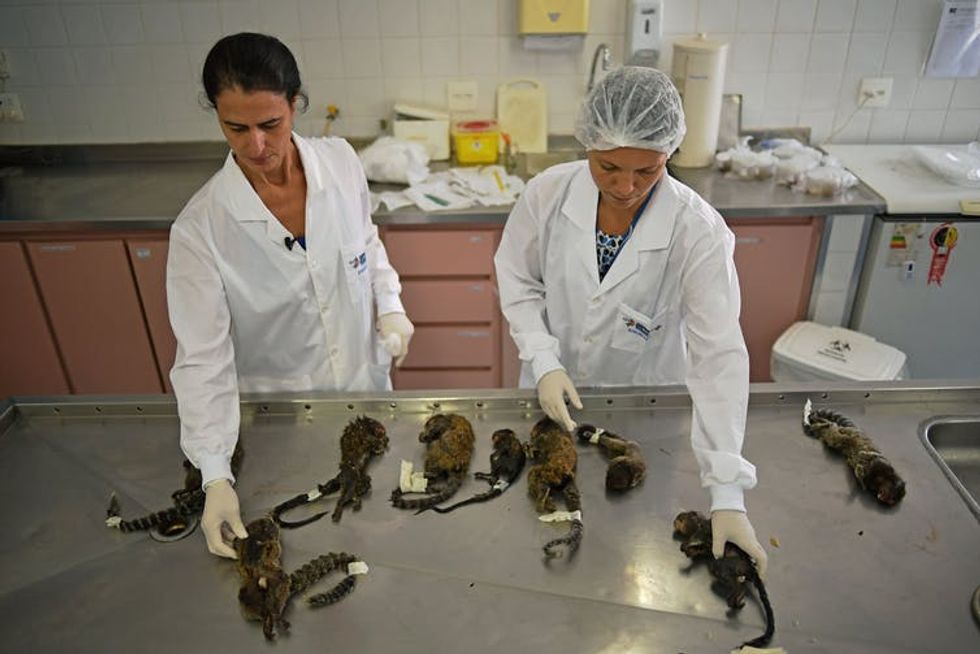
The virus that causes it lives in primates and is spread by mosquitoes that tend to dwell high in the canopy where these primates live.
Deforestation resulted in patches of forest that both concentrated the primate hosts and favored the mosquitoes that could transmit the virus to humans.
Malaria: Humans can also infect wildlife
Just as wildlife pathogens can jump to humans, humans can cross-infect wildlife.
Falciparum malaria kills hundreds of thousands of people yearly, especially in Africa. But in the Atlantic tropical forest of Brazil, we have also found a surprisingly high rate of Plasmodium falciparum (the malaria parasite responsible for severe malaria) circulating in the absence of humans. That raises the possibility that this parasite may be infecting new world monkeys. Elsewhere in the Amazon, monkey species have become naturally infected. In both cases, deforestation could have facilitated cross-infection.
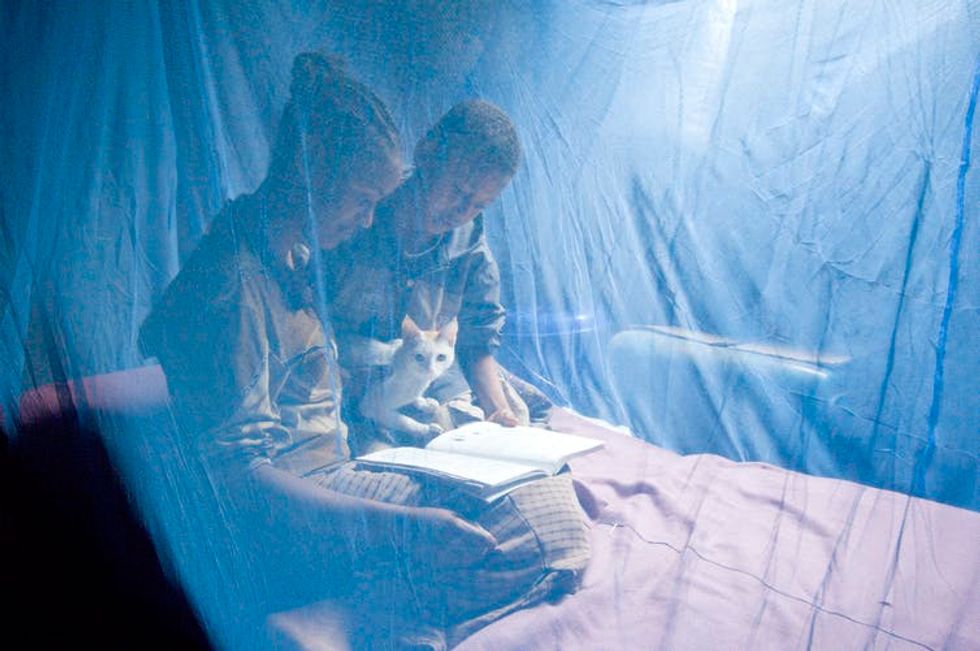
Another type of malaria, Plasmodium knowlesi, known to circulate among monkeys, became a concern to human health over a decade ago in Southeast Asia. Several studies have shown that areas sustaining higher rates of forest loss also had higher rates of human infections, and that the mosquito vectors and monkey hosts spanned a wide range of habitats including disturbed forest.
Venezuelan equine encephalitis: Rodents move in
Venezuelan equine encephalitis is another mosquito-borne virus that is estimated to cause tens to hundreds of thousands of humans to develop febrile illnesses every year. Severe infections can lead to encephalitis and even death.
In the Darien province of Panama, we found that two rodent species had particularly high rates of infection with Venezuelan equine encephalitis virus, leading us to suspect that these species may be the wildlife hosts.
One of the species, Tome’s spiny rat, has also been implicated in other studies. The other, the short-tailed cane mouse, is also involved in the transmission of zoonotic diseases such as hantavirus and possibly Madariaga virus, an emergent encephalitis virus.
As deforestation in this region progresses, these two rodents can occupy forest fragments, cattle pastures and the regrowth that arises when fields lie fallow. Mosquitoes also occupy these areas and can bring the virus to humans and livestock.
Ebola: Disease at the forest’s edge
Vector-borne diseases are not the only zoonoses sensitive to deforestation. Ebola was first described in 1976, but outbreaks have become more common. The 2014-2016 outbreak killed more than 11,000 people in West Africa and drew attention to diseases that can spread from wildlife to humans.
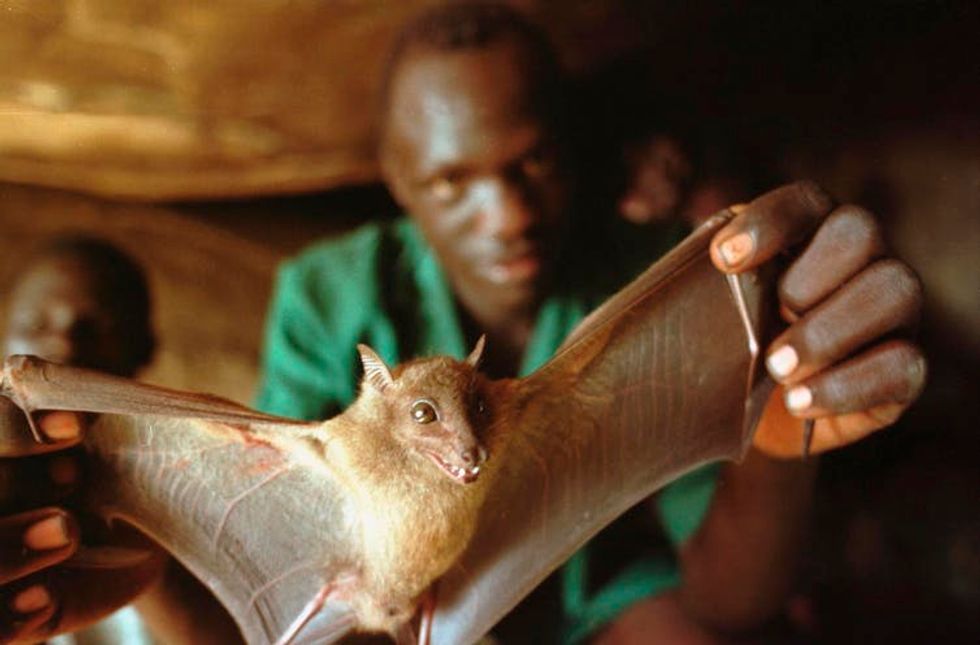
The natural transmission cycle of the Ebola virus remains elusive. Bats have been implicated, with possible additional ground-dwelling animals maintaining “silent” transmission between human outbreaks.
Bats, sometimes eaten as food, have been suspected of spreading Ebola.
While the exact nature of transmission is not yet known, several studies have shown that deforestation and forest fragmentation were associated with outbreaksbetween 2004 and 2014. In addition to possibly concentrating Ebola wildlife hosts, fragmentation may serve as a corridor for pathogen-carrying animals to spread the virus over large areas, and it may increase human contact with these animals along the forest edge.
The range of the Sunda pangolin – which is critically endangered – overlaps with the intermediate horseshoe bat in the forests of Southeast Asia, where it lives in mature tree hollows. As forest habitat shrinks, could pangolins also experience increased density and susceptibility to pathogens?
In fact, in small urban forest fragments in Malaysia, the Sunda pangolin was detected even though overall mammal diversity was much lower than a comparison tract of contiguous forest. This shows that this animal is able to persist in fragmented forests where it could increase contact with humans or other animals that can harbor potentially zoonotic viruses, such as bats. The Sunda pangolin is poached for its meat, skin and scales and imported illegally from Malaysia and Vietnam into China. A wet market in Wuhan that sells such animals has been suspected as a source of the current pandemic.
Preventing zoonotic spillover
There is still a lot that we don’t know about how viruses jump from wildlife to humans and what might drive that contact.
Forest fragments and their associated landscapes encompassing forest edge, agricultural fields and pastures have been a repeated theme in tropical zoonoses. While many species disappear as forests are cleared, others have been able to adapt. Those that adapt may become more concentrated, increasing the rate of infections.
Given the evidence, it is clear humans need to balance the production of food, forest commodities and other goods with the protection of tropical forests. Conservation of wildlife may keep their pathogens in check, preventing zoonotic spillover, and ultimately benefiting humans, too.
Russians go to the polls Thursday to cast early votes in a nationwide ballot on constitutional reforms that could see President Vladimir Putin remain in power until 2036.
Election officials say they are opening polls ahead of the official July 1 vote to avoid overcrowding that could spread coronavirus infections.
Masks and disinfectant gels are being made available to 110 million voters across 10 time zones, from the Kaliningrad exclave on the Baltic Sea to Petropavlovsk-Kamchatsky on the Pacific Ocean.
The Kremlin reluctantly postponed the vote scheduled for April 22 as COVID-19 infections increased and officials imposed restrictions to slow the pandemic.
Putin introduced the reforms to the 1993 constitution in January this year, and they were hastily adopted by both houses of parliament and regional lawmakers.
He has insisted that Russians vote on the changes even though a referendum is not legally required, arguing that a plebiscite would give them legitimacy.
Putin 'for life'
Opposition campaigner Alexei Navalny has slammed the vote as a populist ploy designed to give Putin the right to be "president for life".
"It is a violation of the Constitution, a coup," he said this month on social media.
Among other changes, the reforms would reset Putin's presidential term-limit clock to zero, allowing him to run two more times and potentially stay in the Kremlin until 2036.
Under current rules, 67-year-old Putin's current term in the Kremlin would expire in 2024.
The opposition's campaign against the reforms failed to gain momentum.
Rallies scheduled in the Russian capital in April were barred under virus restrictions against public gatherings.
The "No" website, which collected signatures of Russians opposed to the reforms, was blocked by a Moscow court, forcing it to relaunch under another domain name.
Senior political officials meanwhile have stressed the importance of giving Putin a chance to remain in power.
Moscow Mayor Sergei Sobyanin described the reforms as necessary if the country wanted to "guarantee stability, remove uncertainty".
The Russian leader said last week he had not decided whether to seek another term after 2024, but that it was essential he have the option of extending his term.
"Otherwise, I know that in two years, instead of working normally at all levels of the state, all eyes will be on the search for potential successors," he said. "We must work and not look for successors."
With the revised constitution already on sale in Moscow bookstores, the ballot is largely seen in Russia as a foregone conclusion.
Yet it comes as Putin is suffering historically low approval ratings over his handling of the coronavirus pandemic and the economy, including hugely unpopular changes to the pension system.
Traditional values
In May, the independent polling group Levada published findings from April that showed Putin's approval ratings were at an all-time low of 59 percent.
But on top of resetting Putin's term limits, the reforms would consolidate presidential powers by allowing him to nominate top judges and prosecutors, for approval by the upper house of parliament.
The reforms also enshrine economic changes that guarantee the minimum wage will be no less than the minimum subsistence level while the state pension will be adjusted annually to inflation.
They include a mention of Russians' "faith in God" despite a long history as a secular country, and a stipulation effectively banning gay marriage.
These principles are at the heart of the conservative and patriotic value system regularly touted by Putin.
The Kremlin hopes they will resonate with voters and attract a large turnout.
Ballot leaflets, posters, and billboards throughout the city do not mention Putin or the clause that would allow him to stay in power for more than a decade longer.
Instead the campaign centres around social imagery like a child kissing her grandmother under the slogan "For a guaranteed retirement".
Another poster features a Russian family that wants to "safeguard family values".
The death toll from a powerful earthquake that struck southern Mexico has risen to ten, the federal government said Wednesday.
The 7.4-magnitude quake, which was followed by more than 1,500 aftershocks, was felt in Mexico City, some 700 kilometers (430 miles) away from the epicenter in Oaxaca.
It sent people fleeing their homes and workplaces, and forced the closure of an oil refinery.
Oaxaca Governor Alejandro Murat said in an interview with Milenio TV earlier in the day that 2,000 homes had been damaged.
First responders were still working to remove debris from a highway, he added.
Earlier, the national civil protection coordinator, David Leon, said 23 people had been injured in the quake.
Mexican Oil said its refinery in Salina Cruz in Oaxaca had been shut down as a precaution after a fire broke out at the plant "that was immediately stifled."
One of the dead from the earthquake was a worker at the refinery, who was killed after falling off a high structure.
North and South Korea on Thursday separately marked the 70th anniversary of the start of the Korean War, a conflict that killed millions of people and has technically yet to end.
Communist North Korea invaded the US-backed South on June 25, 1950, as it sought to reunify by force the peninsula Moscow and Washington had divided at the end of the Second World War.
The fighting ended with an armistice that was never replaced by a peace treaty, leaving the peninsula and millions of families split by the Demilitarized Zone.
In the South, the remains of nearly 150 soldiers repatriated from Hawaii after being excavated in the North were to be formally received at a government ceremony on Thursday evening, themed "Salute to the Heroes".
It was scheduled to include video messages from the leaders of the 22 foreign nations that made up the UN coalition defending the South, starting with President Donald Trump of the United States, which led the UN alliance.
Earlier, Seoul and Washington's defence ministers reaffirmed their commitment to defending "the hard-fought peace".
"On this day in 1950, the US-ROK military alliance was born of necessity and forged in blood," said US Secretary of Defence Mark Esper and his South Korean counterpart Jeong Kyeong-doo.
Up to three million Koreans died in the conflict, the vast majority of them civilians.
Nearly 37,000 Americans were among the more than 40,000 UN soldiers killed, and Western estimates say China, which backed the North, saw 400,000 fatalities, while Chinese sources put it at about 180,000.
The North has a different history of the period, which it knows as the Victorious Fatherland Liberation War, and insists that it was assaulted first, before it counter-attacked.
In Pyongyang, citizens and soldiers attended a war heroes' cemetery on the outskirts of Pyongyang to lay flowers before the graves and bow.
"Cede not an inch of ground!" read an inscription on a statue of a machine-gunner.
The official Rodong Sinmun newspaper carried more than 10 stories on the war, including an editorial asserting that a US invasion had turned "the entire country into ashes" but that it had forced the "aggressors" to sign a "surrender document".
"A ceasefire is not peace," it said. "The enemy is aiming for the moment that we forget about June 25 and lower our guard."
The nuclear-armed North, which is subject to multiple international sanctions over its banned weapons programmes, says it needs its arsenal to deter a US invasion.
Negotiations between Pyongyang and Washington have been deadlocked for months, leaving inter-Korean relations in a deep freeze despite a rapid rapprochement in 2018 that brought three summits between North Korean leader Kim Jong Un and the South's President Moon Jae-in.
- White doves -
At the site of one of the key battlefields in Cheorwon county near the Demilitarized Zone a handful of surviving South Korean war veterans marked the anniversary.
"It is our misfortune that the South and North had to live for nearly 70 years in confrontation because of the war," a veteran said, before releasing white doves as a symbol of their hopes for a final peace settlement.
Kim on Wednesday suspended plans for military moves aimed at the South, after the North raised tensions last week by demolishing a liaison office on its side of the border that symbolised inter-Korean cooperation.
Seoul's relationship with Washington has also been strained by the Trump administration's demands that it pay more towards the cost of keeping 28,500 US troops on the peninsula to protect the South from its neighbour.
Recent events showed that inter-Korean relations "can turn into a house of cards at any time", the South's JoongAng Daily said in an editorial.
Tourists and Parisians ready for a workout gathered at the Eiffel Tower on Thursday as the iron monument reopened after its longest closure since World War II, a highly symbolic move as France emerges from its coronavirus lockdown.
Journalists from around the world outnumbered about 50 people, mainly French, who began the steep climb by stairs to the first two levels, as elevators and the top observation deck will remain closed because of social distancing concerns.
"I'm tearing up, but they're tears of joy. It's an emotional moment after these difficult months," said Therese, visiting from the southern French city of Perpignan.
"I'm going to climb, but slowly," said the 60-year-old, wearing the obligatory face mask. "And if I don't make it, it's no big deal!"
"It's very special to be here," said Manuel Mehl, who came "spontaneously" from Pfaffenhofen in Germany with his American wife Shanique Chintsanya.
Patrick Branco Ruivo, director general of the site's operating company SETE, said the top would reopen on July 15, though just eight people will be allowed into the elevators at a time, instead of the usual 45.
The 104-day closure cost the company 27 million euros ($30 million) in lost sales, he said, adding that visitor numbers will be tightly limited for now.
The Eiffel Tower usually receives about seven million visitors per year, some three-quarters from abroad.
The absence of crowds was no problem for Iris Wang, a 25-year-old from China. "It's more peaceful and quiet," she told AFP.
Alex, 15, visiting with his mother from the Netherlands, said: "It's my first time in Paris and it's really great to be here -- we saw the Eiffel Tower was opening today so we thought we should come."
- 'Now is the time!' -
Ground markings were made to enforce social distancing, and SETE has promised "daily cleaning and disinfection of public spaces at the tower."
France is one of the world's most visited countries, and its tourism industry has taken a hard hit under the lockdown to halt the COVID-19 pandemic, with hotels, restaurants, museums and theaters closed for three months.
France lifted restrictions at European borders on June 15, and the tourism industry hopes that foreign visitors will start pouring in again as the summer season kicks off.
At the Eiffel Tower, ticket prices for children have been halved for July and August.
"Parisians and French, now is the time to come to the Eiffel Tower, you won't have to stand in line!" Branco Ruivo said.
While some of the tower's eateries have reopened, the Michelin-starred Jules Verne, which has its own elevator to a dining room perched 125 meters (410 feet) above the ground, will open on June 30.
The Louvre museum hopes to transform itself and shake off its intimidating image before the Paris Olympics in four years' time, its director said Wednesday.
The Louvre, the world's most visited museum, is working on a major overhaul of how its vast collections are presented and explained, Jean-Luc Martinez told reporters.
"We need to be ready in 2023/2024 for the Olympic Games, with longer hours and more rooms open," he said.
To counter its elitist image, the museum will strive for a "cultural democratization" to make its treasures more accessible with improved presentation, labelling and curating.
Martinez, who comes from a working-class background, said he wanted to build on the outreach success of the Louvre's outpost museum in Lens, a poor former mining town in northern France.
He said sometimes the former royal palace in the heart of Paris can "intimidate" certain demographics and the museum needs to reassure people that its collections are also for them.
40 million euro losses
Traffic on the museum's website has jumped tenfold, Martinez said, adding that the site "will be completely overhauled next year... with all collections going online".
There will be more storytelling and scene-setting in both French and English, Martinez added.
Visitors under age 26 already have free access to the Louvre, but Martinez is introducing a free 20-minute mini-visit this summer in an attempt to lure Parisians back inside.
The museum -- which reopens after the lockdown on July 6 -- wants to attract more French visitors after losing more than 40 million euros ($45 million) at the box office since the coronavirus struck.
Three-quarters of the Louvre's visitors are from abroad. With tourism at a standstill, "we are losing 80 percent of our public," Martinez said.
The next three years are likely to be less than spectacular, he predicted.
"We are going to be at best 20 to 30 percent down on last summer -- between 4,000 and 10,000 visitors a day," he estimated.