Because COVID-19 is a relatively new strain of a coronavirus, there has not been any research published about whether people with pets are less likely to die from contracting the virus.
Research shows that pet owners recover faster from serious health conditions than non-pet owners.
A brief history of pets
Evidence of people keeping pets, or companion animals, has been linked all the way back to early Egyptian times, some 5,000 years ago. One study found evidence of companion dogs going back to over 16,000 years ago in Belgium.
People at greater risk of becoming infected with and suffering complications from the coronavirus include those with conditions such as heart disease or high blood pressure. Regularly walking a pet dog, playing with a cat or engaging in the daily care of a companion animal can help to increase healthy behaviors, increasing the likelihood of recovering from serious illness.
One policy that has significantly affected people during the COVID-19 pandemic has been the social isolation, or “stay-at-home” orders, throughout the world. The majority of these orders encourage people to limit their contact with other people.
During stay-at-home periods, people are taking their dogs for walks, riding their horses, training their rabbits for agility tasks and generally building stronger emotional relationships with their pets. This may help reduce stress, anxiety and depression, especially during a global crisis.
So, having a pet may make people healthier – and being healthier may help them recover. And having a pet may also make stressful times a little easier to get through.
Hello, curious kids! Do you have a question you’d like an expert to answer? Ask an adult to send your question to CuriousKidsUS@theconversation.com. Please tell us your name, age and the city where you live.
And since curiosity has no age limit – adults, let us know what you’re wondering, too. We won’t be able to answer every question, but we will do our best.
Following the coronavirus’s spread through the population – and anticipating its next move – is an important part of the public health response to the new disease, especially since containment is our only defense so far.
Just looking at an infected person doesn’t tell you where their version of the coronavirus came from, and SARS-CoV-2 doesn’t have a bar code you can scan to allow you to track its travel history. However, its genetic sequence is almost as good for providing some insight into where the virus has been.
An organism’s genome is its complete genetic instructions. You can think of a genome as a book, containing words made up of letters. Each “letter” in the genome is a molecule called a nucleotide – in shorthand, an A, G, C, T or U.
Mutations can occur every time the virus replicates its genome, so that over time mutations accumulate in the viral genome. For example, in place of the “word” CAT, the new virus has GAT. The virus carries these minor modifications as it moves from one person to the next host.
These mutations behave like a passport stamp. No matter where you go next, previous stamps in your passport still show where you’ve been.
Molecular geneticistslike us can use this information to construct family trees for the coronavirus. That allows us to trace the routes the virus has traveled through space and time and start to answer questions like how quickly and easily does it spread from one person to another?
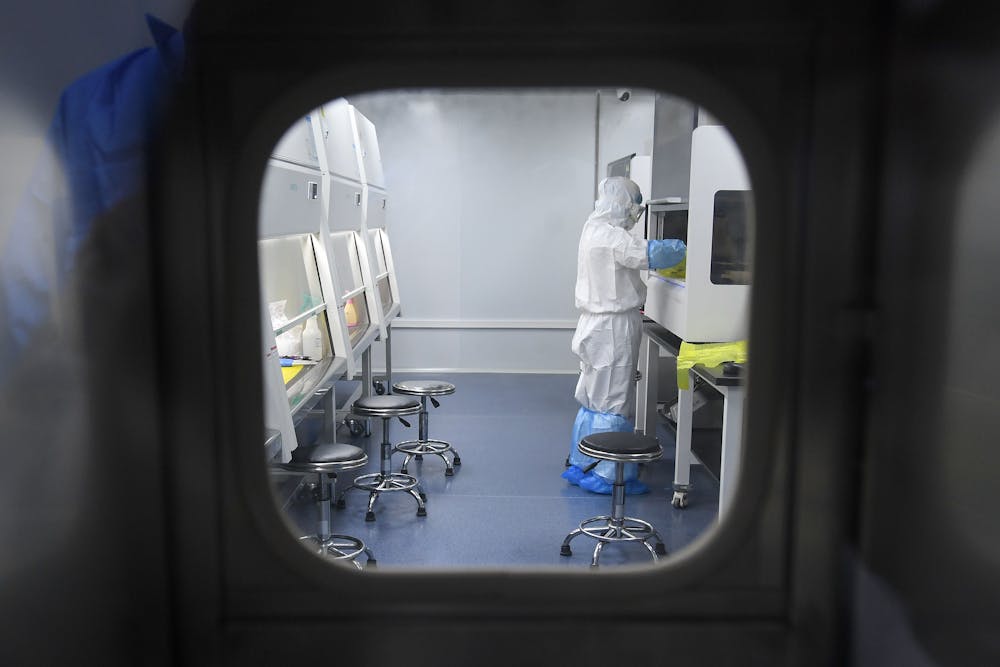
In early February, a laboratory technician works on virus samples from patients sick in Wuhan, China.
Online databases have been collecting SARS-CoV-2 genomic nucleotide sequences since mid-December. Whenever a patient tests positive for SARS-CoV-2, a lab can determine the genome sequence of the infecting virus and upload it. As of late April, more than 1,500 genome sequence samples have been deposited in GenBank, a publicly available database run by the National Institutes of Health, and more than 3,000 are in GISAID, the open-access Global Initiative on Sharing All Influenza Data.
Since each sequence is from a patient who is in a specific place in the world, these viral genome sequences allow scientists to compare them and track where the virus has been. The more similar the sequences from two particular viruses are, the more closely related they are and the more recently they’ve shared a common ancestor. The first SARS-CoV-2 genomic sequence uploaded to the GISAID’s website was collected from a patient in early December 2019.
Of course, the viral mutations themselves do not tell researchers which country they happened in. But since the databases record where particular patterns of mutations have been observed, scientists can determine the route that each viral strain has taken. The global map tracks the movement of the virus around the world.
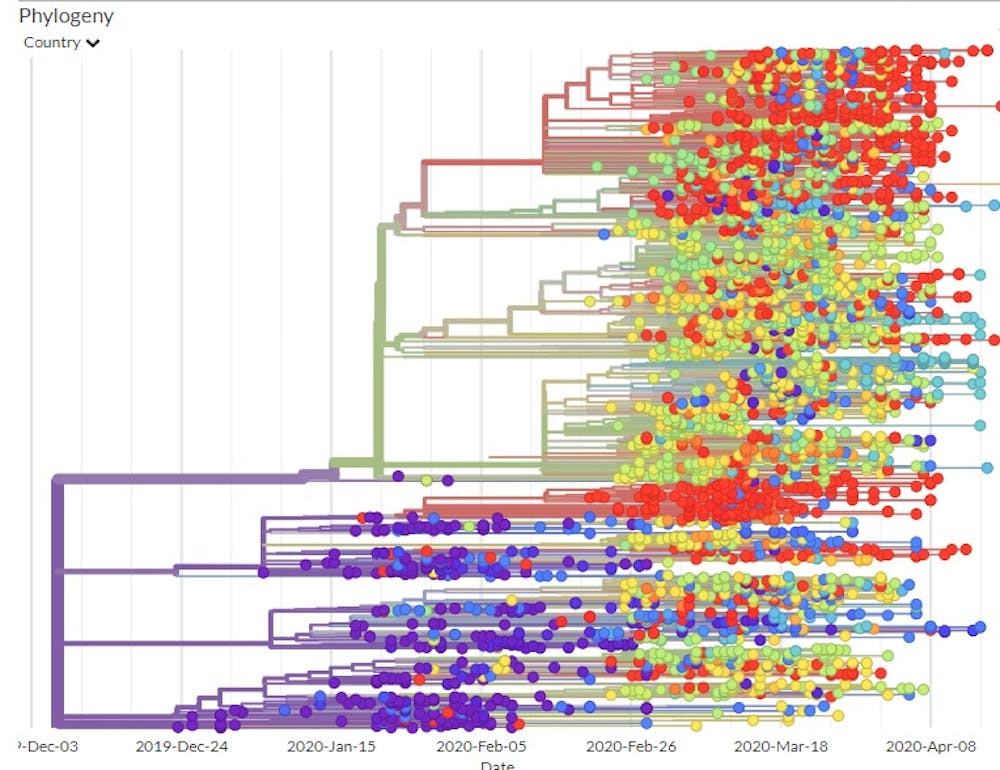
The SARS-CoV-2 phylogenetic tree – the family tree that connects all the sequenced coronavirus samples worldwide. The colors denote regional ‘branches’ of the tree.
On Feb. 28, scientists sequenced a virus sample from an American patient in Seattle and found its mutation signature matched that of the virus from the Wuhan traveler, plus three new mutations. GISAID has estimated the mutation rate at about 0.45 mutations per genome per week – so three mutations between the Jan. 20 case and the Feb. 28 case fits that rate.
Based on the three new mutations, this version of the virus had been multiplying undetected for about five weeks in the Seattle area. Since each infected person can infect several other peoplewithout experiencing any symptoms themselves, the virus could have spread to more than 100 people in five weeks.
Using the genome sequences to link the virus from the Jan. 15 traveler from Wuhan with the Washington-based patient from the end of February alerted Washington state officials that the virus was silently spreading through the population. This undetected spreading of the virus in Seattle and elsewhere is one of the primary reasons public health officials are calling for the public to stay home as much as possible.
Another study detailed the path the virus took as it moved from Wuhan to Shanghai to Germany to Italy to Mexico, stowing away in infected travelers. This study tracked infected individuals and compared their viral genomic sequences. Since researchers could compare the viral mutations to those in known locations at specific times, they were able to map out the phylogenetic tree – the family tree that shows how the various virus genome sequences are related.
Using the GISAID estimated mutation rate and the phylogenetic tree, scientists think the first time the coronavirus infected a person likely occurred in Wuhan in November or early December 2019.
If the virus had been around much longer, the viruses of the first known patients would have had a larger variety of mutations than they did.
The coronavirus can travel the world by hitching a ride in an infected traveler.
The analysis of viral genomic sequences will continue to be a valuable tool for tracking and containing the spread of SARS-CoV-2.
For instance, sequencing the genome of a virus from a newly infected patient could tell you if it is a virus that has been circulating in the area for a while, or if it is a new introduction from elsewhere.
Someone who’d been in northern Italy before travel restrictions were in place brought the virus to Iceland. That initial outbreak was contained fairly quickly, but then new forms of the virus were introduced from elsewhere in Europe.
A new study pending peer-review indicates that California also had multiple introduction events with distinct viral lineages. For California, knowledge of the frequency of new introductions would be an important factor to consider as officials devise ways to contain the virus.
Viral genome sequences can be informative in other ways as well. Eventually, researchers may find that some forms of the virus are more virulent than others. In that case, the sequence of the viral genome could help physicians decide which treatment would be best for a particular patient.
Three Beijing-based internet activists have disappeared and are believed to be detained by police for archiving censored coronavirus news stories online, according to a relative.
China has faced criticism over its handling of the outbreak, including punishing whistleblowers who tried to warn about the new virus.
Chen Mei, Cai Wei and his girlfriend surnamed Tang -- who contributed to the crowd-sourced project on the software development platform GitHub -- went missing on April 19, according to Chen's brother Chen Kun.
The volunteer-driven project, named Terminus2049, preserved articles that were blocked or removed from mainland news outlets and social media by China's aggressive online censorship.
Two of the volunteers, Cai and Tang, were charged with "picking quarrels and provoking trouble" and are currently under "residential surveillance at a designated location", according to a notice from Beijing's Chaoyang District police received by their families, and seen by AFP.
Chen Kun said that he is still waiting on official confirmation from Chaoyang police that his younger brother, aged 26, has been detained.
"I understand that Cai and Tang disappeared around the same time as Chen Mei," Chen told AFP.
"Given that both Chen and Cai were contributors to the Terminus2049 project, we suspect their disappearance was related and relevant to the project."
The online project included many sensitive coronavirus stories published in recent months, such as personal narratives by Wuhan citizens and an infamous interview with Wuhan Central Hospital doctor Ai Fen, one of the earliest virus whistleblowers.
The article, published by "People" magazine in March, was widely circulated by Chinese netizens in a number of languages and formats -- including Morse code -- to evade censorship after it was abruptly pulled from the internet.
As China tries to control the domestic narrative surrounding the chaotic initial months of the outbreak, similar crowd-sourced initiatives have flourished on GitHub, which is used by an increasing number of tech-savvy Chinese as a last frontier against ever-tightening internet censorship.
Owned by Microsoft, the US-based website remains accessible in China although the Terminus2049 page is blocked.
News of the Terminus2049 trio's disappearance made a stir online in Chinese activist circles.
"What quarrels were they picking, and what troubles were they provoking? Show me legal proof," said the outspoken Tsinghua University sociology professor Guo Yuhua on Twitter Sunday, referring to Cai and Tang's charges.
"Picking quarrels and provoking trouble" is a vaguely defined charge often used by Chinese authorities to target activists and dissidents, which carries a prison sentence of up to five years.
The administrators of 2019nCoVMemory -- another GitHub coronavirus archive -- made the "protective" move to restrict access to its site to members only, according to an email sent to subscribers that was circulated on Weibo.
Chaoyang public security bureau and the administrators of 2019nCoVMemory have not responded to requests for comment.
After six weeks of being stuck in their homes, a growing number of Parisians appear unable to wait for the May 11 lifting of the nationwide lockdown, venturing out even as officials warn of a new surge in COVID-19 cases if people let down their guard too early.
The city's parks may be closed, but spring sunshine drew throngs of strollers to canals and other promenades over the weekend, despite strict social distancing decrees.
Joggers packed sidewalks and paths of public lawns that could not be blocked off, in particular at the forested Boulogne and Vincennes parks at opposite ends of the city, before the daytime jogging ban came into effect.
And social media was abuzz with a video of a few dozen people dancing in a Montmartre square to the tune of Dalida's "Laissez-moi Danser" (Let me Dance) on Saturday night.
Police showed up nearly immediately to disperse the crowd, and the DJ reportedly promised to no longer blast songs from his window.
But a police source told AFP that no tickets were handed out for breaching the confinement rules, which can see people without a valid reason to be out fined 135 euros ($146).
"Overall, Parisians are being civic-minded," said Pierre-Yves Bournazel, a city council member for the 18th arrondissement where the impromptu disco took place.
"But if we want to avoid new contagions, we're going to have to respect the measures in place," he said.
Overall, police have carried out more than 1.1 million checks in Paris alone since the lockdown was imposed on March 17, issuing around 69,000 fines, officials said Saturday.
But as Prime Minister Edouard Philippe prepares to lay out post-confinement plans Tuesday, more Parisians could be tempted to get out of cramped apartments before May 11, when some stores and schools are set to reopen.
- 'It's not easy' -
Mickael, one of the hundreds of Parisians along the Ourcq canal, told AFP that "from a humane perspective, it's not easy staying cooped up in a house all day long. Humans aren't designed to live like that, isolated like that."
Eric, wearing a bandanna over his mouth and nose, admitted that he had been going out every day "to walk around the block and get some exercise".
"You can put a cross for fitness, so there you go," he said, referring to one of the seven allowed reasons for leaving on the self-signed document everyone must carry when going out.
Emmanuel Latil, one of the dozens of public safety officers deployed across Paris, spent the weekend urging people hanging out in the Bois de Vincennes on the eastern edge of the city.
"The security ribbons forbidding access were torn down, so people didn't realise they weren't allowed in," he said.
He later told two women in the park: "Be careful. I can see you've touched the benches, so wash your hands well before touching your faces."
North Korean leader Kim Jong Un has not been seen in public for more than two weeks, missing commemorations for a key political anniversary, and reports he underwent a cardiovascular procedure have spiraled into speculation he could be incapacitated or even dead.
Both Seoul and Washington have played them down, but there has been no concrete proof of life in Pyongyang's state media, beyond reports of messages sent in his name.
AFP looks at some questions and answers on what could happen if Kim, the third generation of his family to lead the North, died.
How would the world learn of his death?
The North is extremely secretive, and doubly so about its leadership. Kim's father and predecessor Kim Jong Il had been dead for two days before anyone outside the innermost circles of North Korean leadership was any the wiser.
On past precedent, the first indication will be an announcement of a special broadcast on state television. If the camera cuts to a woman in a black dress, Kim is dead.
Ri Chun Hee, the North's veteran newsreader, has for decades announced key milestones in the North, with her voice brimming with joy for successes and tears flowing for bad news.
When she declares a successful nuclear test or missile launch, she wears a pink joseon-ot, a traditional Korean dress known as hanbok in the south.
But she wore black to reveal the deaths of both Kim Jong Il in 2011 and his father and predecessor, the North's founder Kim Il Sung in 1994.
Will there be another Kim?
The North is officially known as the Democratic People's Republic of Korea but has been ruled by members of the same family since its foundation in 1948.
The claim to legitimacy of the Workers' Party is founded in Kim Il Sung's fight against Korea's Japanese occupiers and later the US-led United Nations forces during the Korean War.
The party maintains extensive control of society -- "Single-Minded Unity" is one of the North's most enduring slogans -- and no-one expects any kind of popular uprising in the event of Kim's death.
"North Korean generals and top politicians will not start fighting for power or it will be a limited fight for power and they will accept a new leader who is likely to be somebody of the Kim family," said Andrei Lankov of Korea Risk Group.
Who are the contenders?
Kim is said to have three children -- only the gender of the second one, a girl, is known -- but they are far too young to take over.
His sister Kim Yo Jong is one of his closest advisers, acting as his envoy to the South's Winter Olympics in the South, accompanying him on his diplomatic forays and recently issuing political statements in her own name.
She is an alternate member of the politburo of the ruling Workers' Party, and currently the most prominent of Kim's relatives, but the North is socially conservative and has never had a woman leader.
Kim's eldest half-brother Kim Jong Nam -- who could traditionally have expected to inherit -- was brazenly assassinated in 2017, smeared with a deadly nerve agent at Kuala Lumpur's international airport in a killing most analysts say could only have come from Pyongyang.
Kim has an elder full brother, Kim Jong Chol, who is known to be an Eric Clapton fan and has shown no political ambition.
There is also Kim's wife Ri Sol Ju, who has enjoyed a higher public profile than her predecessors and was given the title of First Lady in 2018.
Any other notables?
Kim Pyong Il, his father's half-brother -- the Kim family tree is complicated by several of its members having a series of wives or consorts -- was the North's ambassador to several eastern European countries for decades.
But he was recalled to Pyongyang last year from the Czech Republic, his most recent posting, and has not been heard of since.
What about candidates from outside the family?
Kim is not known to have designated a successor but officially his number two is Choe Ryong Hae, a member of the ruling party's top decision-making body -- the Presidium of the Political Bureau -- and first vice-chairman of the State Affairs Council, the country's top government body.
He is hugely powerful, and he may also be related to the Kim family by marriage: it has never been confirmed whether Kim Yo Jong is married, but South Korean media have previously reported, citing unnamed sources, that her husband is Choe's son.
What would happen to the body?
Both Kim's father and grandfather lie embalmed in the Kumsusan Memorial Palace of the Sun, a sprawling mausoleum complex of marble-collonnaded halls on the outskirts of Pyongyang.
Kim would probably be similarly preserved before Pyongyang put on a state funeral with all the pomp and circumstance it could muster, around 10 days after his death.
China's ambassador in Australia has warned that demands for a probe into the spread of the coronavirus could lead to a consumer boycott of Aussie wine or trips Down Under.
Australia has joined the United States in calling for a thorough investigation of how the virus transformed from a localised epidemic in central China into a pandemic that has killed more than 200,000 people, forced billions into isolation and torpedoed the global economy.
In a thinly veiled threat, ambassador Cheng Jingye warned the push for an independent inquest into the origins of the outbreak was "dangerous".
"The Chinese public is frustrated, dismayed and disappointed with what Australia is doing now," he claimed in an interview with the Australian Financial Review published on Sunday.
"If the mood is going from bad to worse, people would think 'why should we go to such a country that is not so friendly to China?' The tourists may have second thoughts," he added.
"It is up to the people to decide. Maybe the ordinary people will say 'Why should we drink Australian wine? Eat Australian beef?'"
Cheng also threatened the flow of Chinese students to Australian universities, a key source of revenue that is already under threat from pandemic travel restrictions.
"The parents of the students would also think whether this place which they found is not so friendly, even hostile, whether this is the best place to send their kids here," he said.
The comments mark a significant escalation in tensions between Beijing and Canberra, whose relations are already strained.
They also reflect the willingness of a new generation of Chinese diplomats to aggressively and publicly push Communist Party interests, using Chinese economic might as leverage if necessary.
Experts have said a full investigation into the coronavirus outbreak could prompt scrutiny of China's rulers and their response to the crisis, and open the door for the type of criticism of the Party that is rarely tolerated.
Cheng also accused Australia of echoing talking points from the United States.
"Some guys are attempting to blame China for their problems and deflect the attention," he said.
"It's a kind of pandering to the assertions that are made by some forces in Washington."
Spanish children ventured outside for the first time in weeks on Sunday, and Italy and New York laid out partial reopening plans as marked decreases in deaths from the global coronavirus pandemic stirred hopes.
Even as confirmed virus infections around the world approached three million, governments were increasingly itching to revive shuttered economies -- although there was intense debate on how quickly to move forward.
In one sign of the turnaround, British Prime Minister Boris Johnson returned to his Downing Street official residence, a month after he tested positive for the virus and later went into intensive care.
On the streets of hard-hit Spain, children hopped on bicycles and scooters -- some wearing small masks and gloves -- as the government allowed children outside for the first time since mid-March.
"They are super excited, very, very impatient. They were up at 6:30 am, saying 'We are going out, We are going out!'," Inmaculada Paredes said in Madrid, readying to take her seven- and four-year-old children outdoors.
AFP / Hector RETAMAL A Shanghai bar patron waits for his drink while wearing a mask to guard against the COVID-19 coronavirus
One six-year-old, Ricardo, said it felt "very good" to be able to run around with his younger sister in the city.
"We played hide and seek, we raced. We found a ladybug that was lost," he said.
Under the revised rules, children are allowed out once per day between 9:00 am and 9:00 pm, but cannot venture more than one kilometre (0.6 miles) from home.
With more than 23,000 fatalities, Spain has the third highest death toll in the world after Italy's 26,000. The United States has the highest death toll, which on Sunday neared 55,000.
- 'If you love Italy...'-
AFP / MARCO BERTORELLO Women wait for distribution of bread traditionally considered to be blessed on the Feast of San Giorgio in the northern town of Caresana in virus-hit Italy
Italy, which shut down in March as the disease's devastation became clear, gave the green light for wholesale stores and restaurants to resume business on May 4 and for people once again to stroll in parks and visit relatives.
Other shops will open three weeks later as will Italy's many museums -- just in time for summer, when in ordinary times tourists would swarm the country.
But Prime Minister Giuseppe Conte told Italians that they would still have to wear face masks in public and rigorously observe social distancing.
"If you love Italy, keep your distance from others," Conte said in a national address.
In New York, where the signature bustle has been reduced to an eerie halt, Governor Andrew Cuomo said that a first stage of a reopening would start on May 15 if hospitalizations decrease.
Only construction and manufacturing would resume at first and solely in the north of the state rather than New York City, with a two-week delay and checks for new contagion before office-workers return.
AFP / Simon MALFATTO The global spread of the coronavirus
The pandemic has forced more than half of humanity into lockdown, upending life as we know it and tipping the global economy toward a recession not seen in decades.
More than 205,000 people have died from the virus since it first emerged in China in December -- well over half in Europe -- and more than 2.9 million cases have been recorded, according to an AFP tally.
But Europe's worst-hit countries -- Italy, Spain, France and Britain -- all reported drops in daily fatality rates Sunday, a sign the peak of the weeks-long crisis may have passed.
Britain's daily tally was the lowest since March 31, while Italy and Spain's were the lowest in a month. France's toll was a drop of more than a third on the previous day's figures.
In Switzerland, hairdressers, massage parlours, florists and garden centres were among some businesses allowed to reopen come Monday.
"It's super," said Florian, a barbershop manager in Lausanne who was asking customers to wait their turn outside.
AFP / ANDY BUCHANAN The United Kingdom has resisted calls to ease lockdown restrictions
"We have to start paying the bills," he said.
Millions of Muslims are under restrictions as they begin Ramadan, the month of dusk-to-dawn fasting that in happier times involves large family meals.
Saudi Arabia said it would partially lift its curfew, allowing malls and retailers to open their doors for certain hours, but would maintain a round-the-clock lockdown in the Muslim holy city of Mecca.
AFP / BANDAR ALDANDANI Millions of Muslims are celebrating Ramadan at home
In a reversal, Sri Lanka extended its lock down another week, scrapping reopening plans after a spike in infections.
- How quickly back to normal? -
AFP / TIMOTHY A. CLARY A lone person in mask walks down the steps at the Bethesda Terrace in Central Park in New York City
Rejecting the advice of top disease experts, the US state of Georgia allowed thousands of businesses to resume operations, from hairdressers to bowling alleys.
"How long are we supposed to imprison ourselves?" said bikini-clad Mackenzie Scharf said as she enjoyed the return to the beach.
Oklahoma, another conservative-led state, will let restaurants, movie theatres and other public places reopen from May 1.
"People are still going to get it. But Oklahomans are safe and we're ready for a measured reopening," Governor Kevin Stitt told Fox News.
President Donald Trump, bracing for November elections, has been impatient to resume business.
AFP / CHANDAN KHANNA Beachgoers in the US state of Georgia flocked to the shore after the government lifted lockdown orders
The US leader faced a fresh volley of criticism after suggesting that coronavirus could be treated by shining ultraviolet light inside patients' bodies, or with injections of household disinfectant.
He lashed out Sunday at the media, threatening lawsuits and asking the "Noble Committee" to rescind awards -- a reference to the Nobel Prize, which has no journalism category -- in a tweet he later deleted.
- Immunity warning -
While cases and deaths plateau, the world remains in wait as scientists race to develop treatments and, eventually, a vaccine for the virus.
AFP / LAKRUWAN WANNIARACHCHI A Sri Lankan Navy officer wearing a facemask holds a stop sign at a checkpoint during a government-imposed nationwide lockdown in Colombo
Some governments are studying measures such as "immunity passports" as one way to get people back to work.
The World Health Organization warned that people who survive infection cannot be certain they will not be hit again by the respiratory disease.
Deborah Birx, the doctor who coordinates the White House's coronavirus response, said that the WHO was being "very cautious".
Several countries, including France and Germany, are planning to introduce coronavirus tracing apps to alert users if they are near someone who has tested positive.
The technology has already rolled out in Australia, sparking privacy concerns, and has been widely used in Singapore.
Prime Minister Jacinda Ardern on Monday claimed New Zealand had scored a significant victory against the spread of the coronavirus, as the country began a phased exit from lockdown.
"There is no widespread, undetected community transmission in New Zealand," Ardern declared. "We have won that battle."
After nearly five weeks at the maximum Level Four restrictions -- with only essential services operating -- the country will move to Level Three late on Monday.
That will allow some businesses, takeaway food outlets and schools to reopen.
But Ardern warned there was no certainty about when all transmission can be eliminated, allowing a return to normal life.
Everyone wants to "bring back the social contact that we all miss", she said, "but to do it confidently we need to move slowly and we need to move cautiously."
"I will not risk the gains we've made in the health of New Zealanders. So if we need to remain at Level Three, we will."
The easing of restrictions came as New Zealand, a nation of five million people, reported only one new case of COVID-19 in the past 24 hours, taking the total to 1,122 with 19 deaths.
Saudi Arabia on Sunday ended the death penalty for crimes committed by minors after effectively abolishing floggings as the kingdom seeks to blunt criticism over its human rights record.
The reforms underscore a push by de facto ruler Crown Prince Mohammed bin Salman to modernize the ultra-conservative kingdom long associated with a fundamentalist strain of Wahhabi Islam.
The death penalty has been eliminated for those convicted of crimes committed while they were minors, Human Rights Commission president Awwad Alawwad said in a statement, citing a royal decree.
"Instead, the individual will receive a prison sentence of no longer than 10 years in a juvenile detention facility," the statement said.
The decree is expected to spare the lives of at least six men from the minority Shiite community who are on death row.
The were accused of taking part in anti-government protests during the Arab Spring uprisings while they were under the age of 18.
United Nations human rights experts made an urgent appeal to Saudi Arabia last year to halt plans to execute them.
"This is an important day for Saudi Arabia," said Awwad Alawwad.
"The decree helps us in establishing a more modern penal code."
High rate of execution
The kingdom has one of the world's highest rates of execution, with suspects convicted of terrorism, homicide, rape, armed robbery and drug trafficking facing the death penalty.
Saudi Arabia executed at least 187 people in 2019, according to a tally based on official data, the highest since 1995 when 195 people were put to death.
Since January 12 people were executed, according to official data.
Human rights groups have repeatedly raised concerns about the fairness of trials in the kingdom, an absolute monarchy governed under a strict form of Islamic law.
On Saturday, the HRC announced Saudi Arabia had effectively abolished flogging as a punishment, which have long drawn condemnation from human rights groups.
The most high-profile instance of flogging in recent years was the case of Saudi blogger Raif Badawi who was sentenced to 10 years in prison and 1,000 lashes in 2014 on charges of "insulting" Islam.
But "hudud" or harsher punishment under Islamic law such as floggings are still applicable for serious offenses, a Saudi official said.
"Hudud", which means "boundaries" in Arabic, is meted out for such sins as rape, murder or theft.
But "hudud" punishments are rarely meted out as many offenses must be proved by a confession or be verified by several adult Muslim witnesses, the official added.
Prime Minister Giuseppe Conte promised Italians on Sunday they would soon be allowed to stroll in parks and visit relatives as the country emerges from the world's longest coronavirus lockdown.
The Italian leader also vowed to reopen schools by September and most other businesses over the next three weeks.
But he warned that people would have to wear face masks in public places and rigorously observe social distancing measures when the current restrictions are lifted on May 4.
Hugs and handshakes will still be discouraged and a decision to restart Italy's beloved Serie A football championship has been postponed.
Italy was entering an era "of responsibility and coexistence with the virus", Conte told the nation in a televised address.
"If you love Italy, keep your distance from others."
'Irreversible damage'
Conte's announcement followed a frantic weekend of talks with regional and business leaders aimed at deciding how the nation of 60 million will come out of its most traumatic experience since World War II.
Italy's official coronavirus death toll of 26,664 is Europe's highest and only second globally to the United States.
But the number of cases has been ebbing and Italy believes its contagion rate -- reported at between 0.2 and 0.7 -- is low enough below the key threshold of 1.0 to try and get back to work.
Its 260 new deaths reported on Sunday were the lowest single-day toll since March 14.
"We cannot continue beyond this lockdown -- we risk damaging the country's socioeconomic fabric too much," said Conte.
"The damage could be irreversible," he warned.
Back to school
Italy gradually closed everything over the first half March as it became increasingly clear that an initial crop of cases in northern areas around Milan was spreading.
Scientists now believe that Italy's infections probably began in January -- if not earlier -- and that the virus was running rampant by the time the first official COVID-19 death was recorded on February 21.
But Italy's health care system held the line and Conte now appears to feel safe enough to focus on mending an economy that his team expects to shrink by eight percent this year.
Conte said his government will allow a select group of "strategic" companies to resume operations on Monday.
Restaurants can open for takeout and wholesale stores can resume business on May 4.
All other shops will follow three weeks later -- as will Italy's numerous museums.
Restaurants will be allowed to offer dine-in service and barber shops will return on June 1.
Italy's schools were closed before most other businesses and will now be among the last features of daily life allowed to resume.
Conte said the return to school was filled with peril because many teachers were older and at greater risk of catching the virus.
"Schools are at the center of our attention and will reopen in September," the premier said.
Conte explained that resuming tuition before then would involve "a very high risk of contagion".
50 cent masks
Many Italians appeared most concerned about when they would finally be able to walk in parks and jog without being stopped and fined by the police.
Italy's stay-at-home orders were announced nationally on March 9 and require everyone to stay within about a block of their front door.
Some have turned their roofs into improvised gyms and even tennis courts in a collective effort to avoid going stir crazy.
Conte explained that walks in the park and outdoor exercise will be permitted starting May 4.
Italians will also be allowed to visit their relatives -- but with conditions.
"We will allow people to visit relatives, but only if they respect distance and wear masks," said Conte.
"And there will be no (large) family gatherings," he said.
Conte said his government would cap face mask prices at 50 cents.
Britain's Prime Minister Boris Johnson, back at work after recovering from COVID-19, said on Monday it was still too dangerous to relax a stringent lockdown hammering the economy as that may cause a deadly second outbreak.
Speaking outside his Downing Street residence a month and a day since testing positive for the virus which threatened his life, Johnson compared the disease to a street criminal that the British people had wrestled to the floor.
Stressing it was still a time of maximum risk, he said he understood the concerns of business and would consult with opposition parties - but he made clear that there was to be no swift lifting of the lockdown.
"We simply cannot spell out now how fast or slow or even when those changes will be made, though clearly the government will be saying much more about this in the coming days," Johnson said, looking healthy again.
"If we can show the same spirit of unity and determination as we've all shown in the past six weeks then I have absolutely no doubt that we will beat it."
Johnson's government, party and scientific advisers are divided over how and when the world's fifth largest economy should start returning to work, even in limited form.
"We must also recognise the risk of a second spike, the risk of losing control of that virus and letting the reproduction rate go back over one because that would mean not only a new wave of death and disease but also an economic disaster," he said.
"I ask you to contain your impatience because I believe we are coming now to the end of the first phase of this conflict and in spite of all the suffering we have so nearly succeeded."
The United Kingdom is one of the worst-hit nations, with more than 20,732 hospital deaths reported as of Saturday.
But the most stringent lockdown in peacetime has left the economy facing possibly the deepest recession in three centuries and the biggest debt splurge since World War Two.
Criticism
At the start of the outbreak, Johnson initially resisted imposing a draconian lockdown but then changed course when projections showed a quarter of a million people could die.
Since the lockdown was imposed on March 23, his government has faced criticism from opposition parties and some doctors for initially delaying the lockdown, limited testing capabilities, and lack of protective equipment for health workers.
Opposition Labour Party leader Keir Starmer urged Johnson to set out when and how an economic and social lockdown might be eased - as did some Conservative Party donors.
"Simply acting as if this discussion is not happening is not credible," Starmer wrote in a letter to Johnson.
Johnson is expected to announce plans for how the lockdown could be eased as early as this week, the Daily Telegraph reported.
Latest data on Sunday showed deaths related to COVID-19 in hospitals were up by 413 in the previous 24 hours, the lowest daily rise this month. A total of 29,058 tests were carried out on April 25.
Based on those statistics, the United Kingdom has the fifth worst death toll in the world, after the United States, Italy, Spain and France.
But the full British toll is much higher as statistics for deaths outside hospital - for example in care homes - are slower to be published.
However, Stephen Powis, medical director of the National Health Service in England, said the "very definite" downward trend in coronavirus cases in hospital demonstrated that social distancing was reducing virus transmission and spread.
North Korean leader Kim Jong Un is "alive and well", a top security adviser to the South's President Moon Jae-in said, downplaying rumours over Kim's health following his absence from a key anniversary.
"Our government position is firm," said Moon's special adviser on national security Moon Chung-in, in an interview with CNN on Sunday. "Kim Jong Un is alive and well."
The adviser said that Kim had been staying in Wonsan -- a resort town in the country's east -- since April 13, adding: "No suspicious movements have so far been detected."
Conjecture about Kim's health has grown since his conspicuous absence from the April 15 celebrations for the birthday of his grandfather Kim Il Sung, the North's founder -- the most important day in the country's political calendar.
Kim has not made a public appearance since presiding over a Workers' Party politburo meeting on April 11, and the following day state media reported him inspecting fighter jets at an air defence unit.
His absence has unleashed a series of unconfirmed media reports over his condition, which officials in Seoul previously poured cold water on.
"We have nothing to confirm and no special movement has been detected inside North Korea as of now," the South's presidential office said in a statement last week.
Daily NK, an online media outlet run mostly by North Korean defectors, has reported Kim was recovering after undergoing a cardiovascular procedure earlier this month.
Citing an unidentified source inside the country, it said Kim, who is in his mid-30s, had needed urgent treatment due to heavy smoking, obesity and fatigue.
Soon afterwards, CNN reported that Washington was "monitoring intelligence" that Kim was in "grave danger" after undergoing surgery, quoting what it said was an anonymous US official.
US President Donald Trump on Thursday rejected reports that Kim was ailing but declined to state when he was last in touch with him.
On Monday, the official Rodong Sinmun newspaper reported that Kim had sent a message of thanks to workers on the giant Wonsan Kalma coastal tourism project.
It was the latest in a series of reports in recent days of statements issued or actions taken in Kim's name, although none has carried any pictures of him.
Satellite images reviewed by 38North, a US-based think tank, showed a train probably belonging to Kim at a station in Wonsan last week.
It cautioned that the train's presence did not "indicate anything about his health" but did "lend weight" to reports he was staying on the country's eastern coast.
Reporting from inside the isolated North is notoriously difficult, especially on anything to do with its leadership, which is among its most closely guarded secrets.
Previous absences from the public eye on Kim's part have prompted speculation about his health.
In 2014 he dropped out of sight for nearly six weeks before reappearing with a cane. Days later, the South's spy agency said he had undergone surgery to remove a cyst from his ankle.
President Donald Trump seemed confused about the Pulitzer Prize and the Nobel Prize and doesn't appear to know who the Nobel Prize is named after.
"Does anybody get the meaning of what a so-called Noble (not Nobel) Prize is, especially as it pertains to Reporters and Journalists? Noble is defined as, 'having or showing fine personal qualities or high moral principles and ideals.' Does sarcasm ever work?" Trump tweeted.
The Nobel Prize is named after Alfred B. Nobel, a chemist, engineer, inventor, businessman and philanthropist from Sweden. He signed over the majority of his fortune to establish the Nobel Prize.
There is no Nobel Prize for Journalism or "noble prize," either. What Trump appears to be thinking of is the Pulitzer Prize, which is an "award for achievements in newspaper, magazine and online journalism, literature, and musical composition in the United States," according to their site. It's named after Joseph Pulitzer and has nothing to do with Alfred Nobel.
President Barack Obama was prematurely given a Nobel Prize for Peace upon entering the presidency. Trump has asked many international allies to nominate him for the Nobel Prize, but he has yet to win. Trump also has yet to win an Emmy, Oscar or Grammy, all of which Obama has also won.
It's unknown if Trump has access to Google on his phone from which he typically tweets so that he could look for additional information before he tweets it.






 AFP / Hector RETAMAL
  AFP / MARCO BERTORELLO
  AFP / Simon MALFATTO
  AFP / ANDY BUCHANAN
  AFP / BANDAR ALDANDANI
  AFP / TIMOTHY A. CLARY
  AFP / CHANDAN KHANNA
  AFP / LAKRUWAN WANNIARACHCHI