On Monday, The New York Timesreported that conspiracy theorists in Britain are setting fire to 5G cell towers, out of a paranoid belief these towers are responsible for the novel coronavirus pandemic.
"Across Britain, more than 30 acts of arson and vandalism have taken place against wireless towers and other telecom gear this month, according to police reports and a telecom trade group. In roughly 80 other incidents in the country, telecom technicians have been harassed on the job," wrote Adam Satariano and Davey Alba. "The attacks were fueled by the same cause, government officials said: an internet conspiracy theory that links the spread of the coronavirus to an ultrafast wireless technology known as 5G. Under the false idea, which has gained momentum in Facebook groups, WhatsApp messages and YouTube videos, radio waves sent by 5G technology are causing small changes to people’s bodies that make them succumb to the virus."
"The false theory linking 5G to the coronavirus has been especially prominent, amplified by celebrities like John Cusack and Woody Harrelson on social media," continued the report. "It has also been stoked by a vocal anti-5G contingent, who have urged people to take action against telecom gear to protect themselves." Cusack and Harrelson have since deleted their tweets, but the conspiracy theory continues to spread.
"The idea has deep internet roots," said the report. "An analysis by The New York Times found 487 Facebook communities, 84 Instagram accounts, 52 Twitter accounts, and dozens of other posts and videos pushing the conspiracy. The Facebook communities added nearly half a million new followers over the past two weeks. On Instagram, a network of 40 accounts nearly doubled its audience this month to 58,800 followers."
"After the British government issued shelter-in-place orders on March 23, some conspiracy theorists commented that it was a trick to secretly build 5G masts out of public view," said the report. "On April 2, in one of the first 5G-coronavirus incidents, telecom equipment in a neighborhood of Belfast in Northern Ireland was set ablaze, according to local officials."
British politicians have roundly condemned the attacks, and police in several cities are investigating.
President Donald Trump on Friday said he will make an announcement next week on US funding to the World Health Organization, which he has recently threatened to cut.
"As you know, we have given them approximately $500 million a year, and we are going to be talking about that subject next week. We'll have a lot to say about it," Trump told a news conference at the White House.
He said he would make the announcement "sometime next week."
Trump has gone on an offensive against the WHO, where Washington is the principal funder, accusing it of pro-China bias during the aftermath of the coronavirus pandemic, which began in Wuhan, China, last year.
The US State Department has homed in on what it says was the world health body's failure to pursue an early lead on coronavirus out of Taiwan.
Taiwan, which has succeeded in limiting the virus to just five deaths despite the island's proximity and ties with China, warned the WHO on December 31 of human-to-human transmission, Vice President Chen Chien-Jen has said.
China claims sovereignty over Taiwan, which rules itself, and has pressured international organizations like WHO around the world not to allow the island membership.
On Friday, China's foreign ministry said the US comments were "fact-distorting" and politically motivated to shift blame for the pandemic, according to state-run news agency Xinhua.
WHO denies that it ever got an early warning from Taiwan about human-to-human transmission of the COVID-19 virus.
France on Friday reported 987 more COVID-19 deaths registered in hospitals and nursing homes over the last 24 hours, although the number of patients in intensive care fell for the second day in a row.
The new deaths – including 554 in hospitals and 433 in nursing homes – brought the total toll in France to 13,197 since the epidemic began, top health official Jerome Salomon told reporters.
A child aged under 10 infected with COVID-19 died, but Salomon said that the causes of the death were “multiple”. In better news, Salomon said there were now 62 fewer people in intensive care, continuing a trend first seen on Thursday.
Deaths from the COVID-19 epidemic in Italy rose by 570 on Friday, down from 610 the day before, and the number of new cases also slowed modestly to 3,951 from a previous 4,204.
The latest tallies broadly confirm what experts describe as a plateau of new cases and deaths, which are no longer accelerating but are still not falling steeply.
The total death toll since the outbreak came to light on Feb. 21 rose to 18,849, the Civil Protection Agency said, the highest in the world.
The number of officially confirmed cases climbed to 147,577, the third highest global tally behind those of the United States and Spain.
There were 3,497 people in intensive care on Friday against 3,605 on Thursday—a seventh consecutive daily decline.
A Yanomami indigenous boy has died after contracting the coronavirus, authorities in Brazil said Friday, raising fears for the Amazon tribe, which is known for its vulnerability to imported diseases.
The 15-year-old boy, the first Yanomami to be diagnosed with the virus, was hospitalized a week ago at an intensive care unit in Boa Vista, the capital of the northern state of Roraima, officials said.
"He died Thursday night. The cause of death has not yet been confirmed," the Brazilian health ministry said in a statement.
Indigenous peoples in the Amazon rainforest are particularly vulnerable to diseases that are foreign to them, because they have been historically isolated from germs against which much of the world has developed immunity.
Brazil is home to an estimated 800,000 indigenous people from more than 300 ethnic groups.
The Yanomami, who are known for their face paint and intricate piercings, number around 27,000.
Largely isolated from the outside world until the mid-20th century, they were devastated by diseases such as measles and malaria in the 1970s.
Health Minister Luiz Henrique Mandetta had called the case of the Yanomami boy "very worrying."
"We have to be triply cautious with (indigenous) communities, especially the ones that have very little contact with the outside world," he said Wednesday.
The boy is the third indigenous person in Brazil to die after contracting the novel coronavirus, according to the newspaper Globo.
The others were from the Borari and Muru ethnic groups.
At least eight indigenous patients from five ethnicities in three states have tested positive for the virus so far, according to Globo.
Brazil is the country hit hardest by the coronavirus pandemic in Latin America, with 941 deaths so far.
In the emergency rooms of virus hotspots around the world, medical staff are seeing a greater number of men than women suffering severe symptoms of COVID-19, with obesity emerging as another potentially aggravating factor. But experts are still unsure why.
What first began to appear as a pattern in China, where the virus emerged at the end of last year, has echoed through hospitals in Europe and the United States as the pandemic spreads.
"More men than women have serious problems, and patients who are overweight or have previous health problems are at higher risk," said Derek Hill, Professor of Medical Imaging Science at University College London.
Early statistics from Britain's independent Intensive Care National Audit and Research Centre on people treated in intensive care for the virus confirm this phenomenon: 73 percent are men and 73.4 percent are classed as overweight.
According to preliminary data of outcomes for those patients who had either recovered or died of COVID-19 in the period before April 3, obese patients were also less likely to recover after receiving critical care.
Some 42.4 percent of people with a body mass index (BMI) over 30 were able to go home after successful treatment, compared with 56.4 percent of patients with a BMI of less than 25.
French emergency rooms have seen "a very large proportion of overweight or obese patients," ICU doctor Matthieu Schmidt at the Pitie-Salpetriere hospital in Paris told broadcaster France 2, adding that "three quarters" of all patients were men.
In New York there is a similar picture emerging.
"I'm in the emergency room, and it's remarkable -- I'd estimate that 80 percent of the patients being brought in are men," Hani Sbitany, a reconstructive surgeon at Mount Sinai Health System who has been treating COVID-19 patients in Brooklyn.
"It's four out of five patients," he told the New York Times.
But why are so many men affected? Just months after the new coronavirus appeared, experts say it is too early to tell for certain.
The high incidence of men presenting with more severe symptoms is for now "an observation", said Jean-Francois Delfraissy, who leads the coronavirus science council advising the French government.
While he said there was "no clear explanation", he raised the theory that men had a higher frequency of multiple pathologies.
"I am very humble vis-a-vis this virus. I did not know it three and a half months ago. There are lots of question marks," he told France Info radio.
- Biology and behavior -
Some experts say that it might not be men's vulnerability that makes the difference, but women's immune strength.
"Innate immunity is better in women, especially before menopause," said Pierre Delobel, head of the infectious diseases department at the Toulouse University Hospital
James Gill, a locum doctor and honorary clinical lecturer at Warwick Medical School, said one idea was that women "may have a more aggressive immune system, meaning a greater resilience to infections".
Another, he said was that "the assumption that simply men don't look after their bodies as well, with higher levels of smoking, alcohol use, obesity", adding that the answer may be a mixture of both biology and environmental factors.
Obesity adds to health risks in general, with an increase in the incidence of diabetes and hypertension -- both identified as aggravating factors of COVID-19 in Italian and Chinese studies, along with age and to a lesser extent heart cardiovascular and cerebrovascular disease.
This raises a particular concern for the United States, where some 42 percent of adults are obese, according to the US Centers for Disease Control and Prevention, which has warned people with a BMI over 40 could be at higher risk of severe illness from COVID-19.
"We are worried about our American friends. They will probably have more problems because of obesity," said Delfraissy.
Hundreds of Christians in the German city Duesseldorf found a creative way to celebrate Good Friday while respecting social distancing rules imposed to slow the coronavirus, coming together for a "drive-in" service on a massive car park.
Most worshippers followed the mass -- conducted on a small stage by a skeleton crew of Catholic and evangelical clergy -- from behind the windscreen.
But a few keen heads could be seen poking out of open roofs into the spring sunshine, while other members of the congregation lowered the tops of their convertibles to perch on the backs of the seats.
"Of course it was a sad feeling at first, because I would have liked to be in my church... (but) with this car service we're trying to create a little bit of community," Catholic priest Frank Heidkamp told AFP.
"When people are praying and singing together in their cars, that can be an encouraging sign for them that they're not alone."
From compact city runarounds to flashy SUVs and even the odd scooter, the vehicles of the faithful lined up side-by-side in parking spaces usually reserved for visitors at the Duesseldorf convention grounds.
People booked free tickets online in advance, offering them up for scans through the closed windows of their cars.
Even city mayor Thomas Geisel and his wife could be spotted among the glass-and-metal ranks.
"We wanted to make the most of the opportunity and participate in an Easter service, when you're here in person it's very different from watching on the internet," said attendee Dana Baerwald.
- 'Living with the virus' -
Germany has been in lockdown for almost three weeks, with many businesses and schools closed and gatherings of more than two people banned.
Chancellor Angela Merkel asked citizens for "patience" Thursday, saying COVID-19 "will not disappear before we have a vaccine to immunise the population: and that means living with this virus."
The veteran leader is due to review the unprecedented nationwide restrictions -- currently planned until April 19 -- with regional premiers next week.
"This is a time like none of us has seen before," said evangelical pastor Heinrich Fucks.
"We don't know what's going to become of us. That makes it all the more important to have a moment of community, all the more important to find some hope here together."
Stepping down from the stage, whose altar covered in a white cloth supported a small cross and weighty Bible, priest Heidkamp moved among the rows of cars after mass to exchange a few words with members of his flock through their car windows -- maintaining a safe distance.
"You miss personal contact, the service and also the ceremonial side, communion and so on. I miss those in everyday life," said 53-year-old attendee Reinold Welbers.
"We're used to things being different, but maybe it can work like this," he mused.
At least in this western city the next drive-in services are already planned, with a mass lined up for Easter Sunday and a protestant celebration on Monday.
Elsewhere, online streams or radio and television broadcasts and even loudspeakers mounted on cars have been spreading the Easter message.
Although still damaged and scarred by fire, Notre-Dame cathedral came back to life as a centre for prayer in a Paris locked down against the coronavirus.
Just days before the first anniversary of the April 15, 2019 inferno that ravaged the beloved Paris landmark, the French capital's archbishop led Good Friday celebrations unlike any others that have gone before inside the centuries-old jewel of Gothic architecture.
Archbishop Michel Aupetit was to venerate a crown of thorns that survived the flames that brought down the cathedral's roof and spire and horrified Parisians and people across the world.
Prayers, readings and music were to be part of the Friday morning ceremony, but no crowds. With the cathedral closed to the public, only a tiny handful of people took part in the proceedings that were broadcast live.
The plans for the altered ceremony reflect the ways Christians are commemorating Jesus's crucifixion without the larger church services or emotional processions of past years, marking Good Friday in a world locked down by the coronavirus pandemic.
Faint echoes inside Jerusalem church
The chanting of a small group of clerics inside Jerusalem's Church of the Holy Sepulchre echoed faintly through the heavy wooden doors, as a few people stopped and kneeled outside to pray. The centuries-old church, built on the site where Christians believe Jesus was crucified, buried and rose from the dead, is usually packed with pilgrims and tourists.
Later, three monks in brown robes and blue surgical masks prayed at the stations of the cross along the Via Dolorosa, the ancient route through the Old City where Jesus is believed to have carried the cross before his execution at the hands of the Romans. It runs past dozens of shops, cafés, restaurants and hostels, nearly all of which are closed.
In ordinary times, tens of thousands of pilgrims from around the world retrace Jesus's steps in the Holy Week leading up to Easter. But this year, flights are grounded and religious sites in the Holy Land are closed as authorities try to prevent the spread of the virus.
James Joseph, a Christian pilgrim from Detroit dubbed “the Jesus guy” because he wears robes and goes about barefoot, lives near the Church of the Holy Sepulchre year-round. On Friday morning he had the plaza outside to himself. He said Good Friday has special meaning this year.
“The crucifixion is the saddest thing possible, and [Jesus] felt what we feel right now,” he said. “But thanks be to God ... He rose from the dead and changed the world on Easter.”
Ten people in Rome procession
In Rome, the torch-lit Way of the Cross procession at the Colosseum is a highlight of Holy Week, drawing large crowds of pilgrims, tourists and locals. It's been cancelled this year, along with all other public gatherings in Italy, which is battling one of the worst outbreaks of the coronavirus.
Instead of presiding over the Way of the Cross procession, Pope Francis will lead a Good Friday ceremony in St. Peter’s Square without the public.
Ten people – five from the Vatican’s health office and five from a prison in Padua, in northern Italy, where infections are particularly widespread – will participate in the procession, which will circle several times around the obelisk in St. Peter’s Square.
The coronavirus has killed more than 18,000 people in Italy and over 95,000 worldwide, according to data gathered by Johns Hopkins University.
Masses and rituals on hold in Philippines
In the Philippines, Asia’s bastion of Catholicism, masses and other solemn gatherings have been put on hold, including folk rituals that feature real-life crucifixions and usually draw thousands of tourists and penitents. The annual procession of the “Black Nazarene”, a centuries-old statue of Jesus, through downtown Manila, has also been cancelled.
Churchgoers have been told to stay home and remember Jesus's suffering through family prayers, fasting and by watching masses and religious shows on TV or online.
For 30-year-old Catholic missionary Josille Sabsal, it’s a test of faith. She tried to replicate an altar in her Manila home by setting up a laptop, a crucifix and small statues of Jesus and the Virgin Mary on a table.
“It’s different, because the priest is on a screen," she said. "When the internet lags, the mass suddenly gets cut off and you have to look for another YouTube video.
“I miss that moment in church when you say, 'Peace be with you,’ to complete strangers and they smile back."
The Reverend Flavie Villanueva, a former drug addict who ministers in Manila's slums, got special permission to celebrate Mass on Thursday for 73 homeless people in a college basketball court. They wore masks, stayed more than an arm’s length apart and there was no singing.
Villanueva said he's sad to see the churches emptied out, but hoped it would help people to renew their faith: "We are asked to go back and rediscover where the church in our lives first started, and that’s in the family.”
Fifty years ago, when Paul McCartney announced he had left the Beatles, the news dashed the hopes of millions of fans, while fueling false reunion rumors that persisted well into the new decade.
In a April 10, 1970, press release for his first solo album, “McCartney,” he leaked his intention to leave. In doing so, he shocked and betrayed his three bandmates.
The Beatles had symbolized the great communal spirit of the era. How could they possibly come apart?
Few at the time were aware of the underlying fissures. The power struggles in the group had been mounting at least since their manager, Brian Epstein, died in August of 1967.
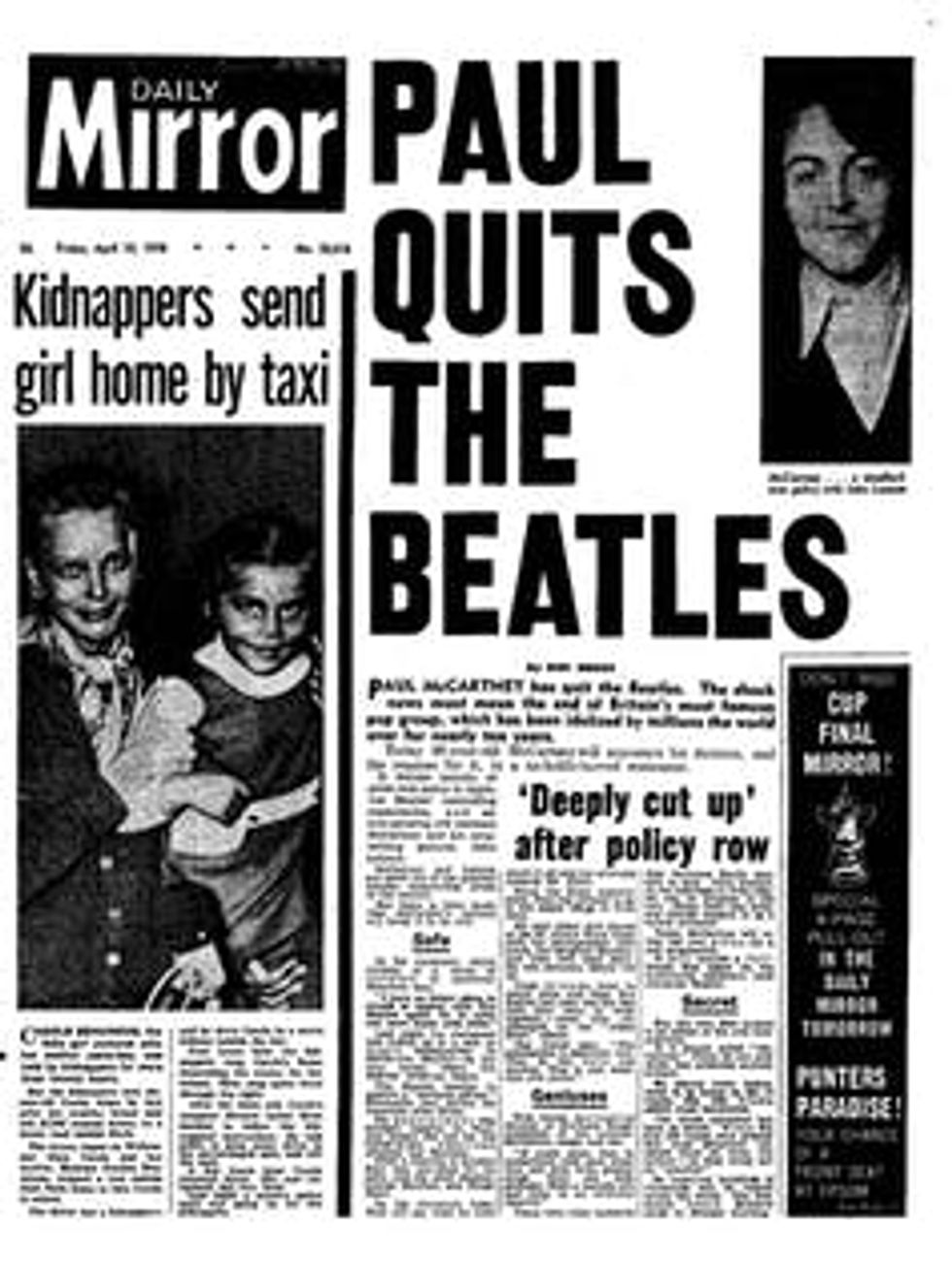
‘Paul Quits the Beatles’
Was McCartney’s “announcement” official? His album appeared on April 17, and its press packet included a mock interview. In it, McCartney is asked, “Are you planning a new album or single with the Beatles?”
His response? “No.”
The Daily Mirror took McCartney at his word.
Source.
But he didn’t say whether the separation might prove permanent. The Daily Mirror nonetheless framed its headline conclusively: “Paul Quits the Beatles.”
The others worried this could hurt sales and sent Ringo as a peacemaker to McCartney’s London home to talk him down from releasing his solo album ahead of the band’s “Let It Be” album and film, which were slated to come out in May. Without any press present, McCartney shouted Ringo off his front stoop.
Lennon had kept quiet
Lennon, who had been active outside the band for months, felt particularly betrayed.
The previous September, soon after the band released “Abbey Road,” he had asked his bandmates for a “divorce.” But the others convinced him not to go public to prevent disrupting some delicate contract negotiations.
Still, Lennon’s departure seemed imminent: He had played the Toronto Rock ‘n’ Roll Festival with his Plastic Ono Band in September 1969, and on Feb. 11, 1970, he performed a new solo track, “Instant Karma” on the popular British TV show “Top of the Pops.” Yoko Ono sat behind him, knitting while blindfolded by a sanitary napkin.
In fact, Lennon behaved more and more like a solo artist, until McCartney countered with his own eponymous album. He wanted Apple to release this solo debut alongside the group’s new album, “Let It Be,” to dramatize the split.
By beating Lennon to the announcement, McCartney controlled the story and its timing, and undercut the other three’s interest in keeping it under wraps as new product hit stores.
Ray Connolly, a reporter at The Daily Mail, knew Lennon well enough to ring him up for comment. When I interviewed Connolly in 2008, he told me about their conversation.
Lennon was dumbfounded and enraged by the news. He had let Connolly in on his secret about leaving the band at his Montreal Bed-In in December, 1969, but asked him to keep it quite. Now he lambasted Connolly for not leaking it sooner.
“Why didn’t you write it when I told you in Canada at Christmas!” he exclaimed to Connolly, who reminded him that the conversation had been off the record. “You’re the f–king journalist, Connolly, not me,” snorted Lennon.
“We were all hurt [McCartney] didn’t tell us what he was going to do,” Lennon later told Rolling Stone. “Jesus Christ! He gets all the credit for it! I was a fool not to do what Paul did, which was use it to sell a record…”
It all falls apart
This public fracas had been bubbling under the band’s cheery surface for years. Timing and sales concealed deeper arguments about creative control and the return to live touring.
In January 1969, the group had started a roots project tentatively titled “Get Back.” It was supposed to be a back-to-the-basics recording without the artifice of studio trickery. But the whole venture was shelved as a new recording, “Abbey Road,” took shape.
When “Get Back” was eventually revived, Lennon – behind McCartney’s back – brought in American producer Phil Spector, best known for girl group hits like “Be My Baby,” to salvage the project. But this album was supposed to be band only – not embroidered with added strings and voices – and McCartney fumed when Spector added a female choir to his song “The Long and Winding Road.”
“Get Back” – which was renamed “Let it Be” – nonetheless moved forward. Spector mixed the album, and a cut of the feature film was readied for summer.
McCartney’s announcement and release of his solo album effectively short-circuited the plan. By announcing the breakup, he launched his solo career in advance of “Let It Be,” and nobody knew how it might disrupt the official Beatles’ project.
Throughout remainder of 1970, fans watched in disbelief as the “Let It Be” movie portrayed the hallowed Beatles circling musical doldrums, bickering about arrangements and killing time running through oldies. The film finished with an ironic triumph – the famous live set on the roof of their Apple headquarters during which the band played “Get Back,” “Don’t Let Me Down,” and a joyous “One After 909.”
The Beatles played their last live show in a January 1969 concert staged for the documentary ‘Let It Be.’
The album, released on May 8, performed well and spawned two hit singles – the title track and “The Long and Winding Road” – but the group never recorded together again.
Their fans hoped against hope that four solo Beatles might someday find their way back to the thrills that had enchanted audiences for seven years. These rumors seemed most promising when McCartney joined Lennon for a Los Angeles recording session in 1974 with Stevie Wonder. But while they all played on one another’s solo efforts, the four never played a session together again.
At the beginning of 1970, autumn’s “Come Together”/“Something” single from “Abbey Road” still floated in the Billboard top 20; the “Let It Be” album and film helped extend fervor beyond what the papers reported. For a long time, the myth of the band endured on radio playlists and across several Greatest Hits compilations, but when John Lennon sang “The Dream is over…” at the end of his own 1970 solo debut, “John Lennon/Plastic Ono Band,” few grasped the lyrics’ implacable truth.
Fans and critics chased every sliver of hope for the “next” Beatles, but few came close recreating the band’s magic. There were prospects – first bands like Three Dog Night, the Flaming Groovies, Big Star and the Raspberries; later, Cheap Trick, the Romantics and the Knack – but these groups only aimed at the same heights the Beatles had conquered, and none sported the range, songwriting ability or ineffable chemistry of the Liverpool quartet.
We’ve been living in the world without Beatles ever since.
Prime Minister Boris Johnson was recovering in a hospital ward Friday after ending three days in intensive care for COVID-19, as his government urged Britons to stay at home over Easter.
The 55-year-old leader left intensive care at London's St Thomas' Hospital on Thursday evening and will now be monitored closely during what Downing Street called "the early phase of his recovery".
"He is in extremely good spirits," a No. 10 spokesman said.
Johnson's improving condition came as the government continues to impose an unprecedented nationwide lockdown to try to stem the spread of the deadly coronavirus.
It announced another 881 deaths on Thursday, taking the UK total to 7,978, with more than 65,000 cases so far confirmed.
That is thought to reflect only a fraction of the actual number of people infected.
Despite the grim tolls, there were indications the stringent social distancing regime introduced on March 23 could be starting to have a positive impact.
"We are beginning to see the benefits of this social distancing," said Stephen Powis, medical director of England's state-run National Health Service (NHS).
"We do believe the virus is spreading less," he told the BBC.
But Powis stressed it was "critical" that people keep obeying the social distancing measures over the long Easter weekend, when fine weather in forecast.
"It's still too early to really be confident that we are turning the corner," he added.
"We need to completely and utterly make sure that we all comply with the instructions we have been given."
- 'Period of readjustment' -
Johnson is the most high-profile world leader to suffer from the coronavirus.
He was hospitalized Sunday over concerns he still had a cough and high temperature after spending 10 days in self-isolation in a flat above his Downing Street office.
While in intensive care the Conservative leader received "standard oxygen treatment" and did not require a ventilator.
But his transfer there Monday, unprecedented for a prime minister during a national emergency in modern times, rattled Britain and sent shockwaves around the world.
US President Donald Trump called Johnson's release from intensive care "a very positive development".
His father Stanley Johnson said on Saturday he must now "rest up", after last week trying to keep working during his self-isolation.
"He has to take time," the elder Johnson told BBC radio.
"I cannot believe you can walk away from this and get straight back to Downing Street and pick up the reins without a period of readjustment."
Foreign Secretary Dominic Raab has been deputizing for Johnson in his absence.
He led an emergency meeting of senior ministers on Friday, which discussed a formal review of the lockdown measures set for next week.
Implemented for an initial three weeks, the measures are widely expected to remain for at least the rest of the month.
But he cautioned more evidence the spread of the disease was being reduced would be needed before they could be relaxed.
"There is some preliminary evidence... that we have seen even larger reductions in normal behavior, contact, than we would have dared hope," he told BBC radio.
"That is good news but we have still got to see that reflected in case numbers coming down."
French pharmaceutical giant Sanofi said Friday it would offer 100 million doses of hydroxychloroquine, a treatment for rheumatoid arthritis and lupus, to governments worldwide if studies show it can safely to be used to treat COVID-19 patients.
Both hydroxychloroquine, which Sanofi sells under the brand name Plaquenil, and the related compound chloroquine, an anti-malarial drug, are being studied worldwide as potential weapons in the coronavirus fight.
But proposals to put them to use immediately for more patients have proven highly controversial, with many experts warning there is not yet enough evidence of their safety or effectiveness against COVID-19.
A French doctor in particular, Didier Raoult, has raised hopes by treating patients with a combination of hydroxychloroquine (HQC) and the antibiotic azithromycin, an initiative that many health officials refuse to endorse in the absence of more rigorous studies.
On Thursday, French President Emmanuel Macron met Raoult and his team in Marseille to discuss their latest findings, though the president did not comment publicly on the meeting afterward.
Sanofi acknowledged that "interpretations of the available preliminary data on hydroxychloroquine in the management of COVID-19 differ widely.
"While hydroxychloroquine is generating a lot of hope for patients around the world, it should be remembered that there are no results from ongoing studies, and the results may be positive or negative."
But chief executive Paul Hudson said in a statement, "If the trials prove positive, we hope our donation will play a critical role for patients."
Other companies have also pledged to offer the drugs, with Switzerland's Novartis proposing 130 million doses of chloroquine, and Israeli generic producer Teva promising 10 million doses of HQC for US hospitals.
Sanofi is also working on a potential vaccine for the new coronavirus, which has killed more than 94,000 people worldwide since cases were first reported in China last December.
When The Beatles went their separate ways in the early 1970s, few thought that half a century later the pioneering band would still influence pop music culture.
But, with Friday marking 50 years since their unofficial break-up, the so-called "Fab Four" are still popular and present, in spirit if not in the flesh.
"The Beatles were said to have been the 20th century's greatest romance, but no one then could have foreseen that such an already phenomenal accomplishment would extend into the next century," band historian Mark Lewisohn told AFP.
"50 years now after breaking up, The Beatles remain an artistic ultimate, leading creative people everywhere to the limitless playing field, open to all," said the ardent author of "Tune In", the first instalment in a trilogy, "The Beatles: All These Years".
Flashback to the April 10, 1970, release of an interview with Paul McCartney, in which he suggested The Beatles were done making records together, and the band's legacy seemed far less certain.
Given shortly before the release of his first solo album, McCartney stopped short of announcing the formal break-up of the band in the brief and ambiguous Q&A.
AFP/File / - By the late '60s, with the band "more popular than Jesus" -- as the late Lennon once quipped -- so-called Beatlemania was taking its toll
But asked if he foresaw a time when his prolific songwriting partnership with fellow Beatle John Lennon would restart, his blunt reply -- "no" -- spoke for itself.
"McCartney Breaks Off With Beatles", The New York Times headlined.
A British High Court case later that year to dissolve the business partnership made it official.
- 'Indestructible' -
The band's acrimonious split left fans inconsolable, recalled Philip Norman, who has written several books on The Beatles, including the official 2016 Paul McCartney biography.
"A whole generation had grown up with The Beatles... they had a Beatles album for every important stage in their life," he said.
"A lot of people thought it's just dreadful... it's just a bleak future without them. It truly did feel that way."
But the band's bountiful catalogue has aged well.
AFP/File / MYCHELE DANIAU
They remain the best-selling music artists of all time, with enduring hits from "I Want to Hold Your Hand" and "Hey Jude" to "Yesterday" and "Let It Be" familiar to at least four generations of fans.
"They're not over," Norman told AFP. "They're still everywhere. They're still in our language. They're in our headlines... quoted all the time, their music is still played.
"The charm is just indestructible."
- 'No off-switch' -
After busting out of Liverpool, England in 1960, The Beatles -- Lennon, McCartney, drummer Ringo Starr and lead guitarist George Harrison -- became a social phenomenon.
But by the late '60s, with the band "more popular than Jesus" -- as the late Lennon once quipped -- so-called Beatlemania was taking its toll.
He confessed in a recently discovered interview that the 1965 song "Help!" was a cry for exactly that.
"It was real. I was singing 'Help!' and I meant it," he said. "There is no off-switch. You are on 24 hours a day... everyone wants a bit of you."
Meanwhile, relations within the band, especially between Lennon and McCartney, had frayed.
By the time of McCartney's announcement, they had not played live in four years. Starr and Harrison had solo records as well, while Lennon and his Japanese artist wife Yoko Ono had formed the Plastic Ono Band.
McCartney formed Wings, which included his wife Linda, in late 1971 and despite initial criticism, it eventually prospered.
He, Harrison and Starr had fruitful solo and collaborative careers, while Lennon and Ono increasingly devoted their attention to pacifist activism.
- 'Giant talents' -
The Beatles almost got back together in the mid-1970s, but issues involving rights could not be resolved, according to Norman.
Then, in 1980, Lennon was shot dead in New York by Mark David Chapman, believed to suffer from mental illness.
McCartney said in 2016 that he had fortunately patched things up with his former bandmate before tragedy struck.
In 1982 he wrote "Here Today", and later explained it was his way of saying "I love you" to Lennon.
The pair's relationship had been The Beatles' main creative force.
"Lennon and McCartney were giant talents and produce an absolutely magical product together," said Norman.
"Very different individuals but (they) just combined perfectly like virgin olive oil and vinegar -- the perfect dressing."
For Lewisohn, The Beatles continue to shine in today's more manufactured pop music climate.
"There's a universe of difference between shallow celebrity... and the true artistry with which The Beatles and other creative talents nourish the soul and inspire joy," he declared.
Japan's sumo association on Friday confirmed its first coronavirus case, in a new blow for the ancient sport, which has already been forced to move one tournament behind closed doors and postpone others.
One low-ranking wrestler who had a fever last week has tested positive for the virus, the association said, declining to name the man or give details of his stable.
The association said no other wrestlers or officials had symptoms and those who belong to the infected wrestler's stable will stay home or at the stable and follow advice from health officials.
The outbreak in Japan has been smaller than in many countries, with more than 5,300 cases and 88 deaths confirmed so far, but the government this week declared a state of emergency in seven regions, and the sumo association said it was adapting too.
The association has not called off daily training but new instructions include requiring wrestlers to take their temperatures twice a day.
The "tokoyama" responsible for styling wrestlers' hair into their signature oiled topknots have been asked to avoid public transportation when coming to stables, a spokesman said.
A young wrestler at a Tokyo stable confirmed daily training was continuing as usual but said activities were limited.
JIJI PRESS/AFP/File / STR Sumo stables have cut back training and put in place other restrictions to limit the spread of the coronavirus
"We wear masks where possible, wash hands, disinfect hands... We have been taking normal prevention measures," he told AFP, speaking on condition of anonymity.
"We don't visit other stables to practice. We have been practicing in our stable only."
"We go out only for (grocery) shopping... Stressk is building up in many people," he added.
News of the infected wrestler came a week after the association postponed two sumo tournaments scheduled for later this year.
The next sumo "basho" or tournament, scheduled to open on May 10 in Tokyo, has been delayed by two weeks. The July basho in Nagoya suffered the same fate.
Tokyo's basho is expected to begin on May 24 but tickets have yet to go on sale over concerns about a further postponement or cancellation.
The spring basho, held last month in Osaka, took place without spectators, with wrestlers surrounded by just a handful of judges in the empty arena.
But it was broadcast live on national TV, where viewers could hear sounds normally drowned out by the crowd, including wrestlers slapping their bellies and scraping their feet on the clay ring.
Some rituals were amended, including the traditional ladle of water that a winning wrestler offers to the next in the ring.





 AFP/File / -
  AFP/File / MYCHELE DANIAU
 JIJI PRESS/AFP/File / STR