A Cypriot court on Tuesday handed a British teenager a four-month suspended prison sentence after convicting her of falsely accusing a dozen Israeli tourists of gang rape.
The 19-year-old, who could have faced up to a year in jail, smiled and hugged family at the end of a trial that sparked protests in Britain and calls for tourists to boycott the island.
Lawyers for the woman say the case was littered with investigatory and legal mistakes and issues, including repeated refusals by the judge to consider whether she was raped.
The sentencing took place to loud shouts from protesters outside the court room, including dozens of Israelis -- mainly women, but some men -- who travelled to Cyprus to offer moral support to the teenager.
As the judge delivered his sentencing, shouts of "Cyprus justice, shame on you" were audible in the court, despite police ordering journalists to close windows and blinds.
AFP / Tolga AKMEN Demonstrators call for a boycott on Cyprus in support of a British teenager convicted of lying about being raped by Israeli tourists
Other shouts from outside included "Judge, shame on you, don't you have a daughter too?" and "Blaming the victim is a second rape!"
Lawyers for the woman, whom AFP is not naming, say she was raped in the seaside resort of Ayia Napa by 12 Israeli teenagers in their hotel room on July 17.
She fled in distress to her own hotel and was examined by an in-house doctor, who called the police.
A group of Israeli teenagers were arrested and appeared in court, but 10 days after making a complaint of rape she was interviewed again by police and signed a retraction.
The Israelis, aged 15 to 18, were released without charge, allowed to return home and not called as witnesses.
- 'Gaping chasm' -
Britain's Foreign Secretary Dominic Raab has said he has "firmly and categorically registered" concerns with Cypriot officials about the case.
Judge Michalis Papathanasiou had told the young woman "statements you have given were false", as he convicted her on December 30 of "public mischief".
He said during the trial that her account was beset by "contradictions, confusion, lack of logic and exaggeration".
AFP / Iakovos HATZISTAVROU Activists protested outside the court in support of the British teenager as the sentence was handed down
Lewis Power, a British lawyer who is part of the woman's legal team, said she would leave Cyprus by the end of the day.
An appeal to the Supreme Court "will begin in the next few days", but it is not clear when any case will be heard, because the "wheels of justice move very slowly in Cyprus," he said.
The case has highlighted "a gaping chasm in the treatment" of victims of sexual assault in Cyprus relative to other jurisdictions, Power added.
The convicted British woman's mother and legal team say she has been suffering Post Traumatic Stress Disorder.
The teenager's legal team say she was questioned by police in the absence of a translator or lawyer acting on her behalf and there was no transcript or video recording of the process.
More than 50 Israelis flew to Cyprus to stand by the woman at the sentencing, partly out of disgust that the boys were welcomed home as heroes, they said.
"I am happy that she is going home, but her conviction still stands," said Namaa Morell, a 20-year old mother.
"I see it as a success for today, but it doesn't change the conviction and that's the main problem," especially since at least one of the boys is seeking to sue the British woman, she added.
"You can speak with American people from Tehran too and we will do that," said Iran's Foreign Minister Javad Zarif.
Iranian Foreign Minister Javad Zarif on Tuesday confirmed reports that the Trump administration has denied him a visa to enter the U.S. for a United Nations Security Council meeting in New York this week, a move the diplomat said was motivated by a desire to suppress facts about the assassination of Gen. Qasem Soleimani.
"This is because they fear someone will go there and tell the truth to the American people," Zarif told reporters from Tehran. "But they are mistaken. The world is not limited to New York. You can speak with American people from Tehran too and we will do that."
"Pompeo doesn't want Zarif to have a platform for making his case."
—Mark Fitzpatrick, former U.S. State Department official
Zarif's remarks came after Foreign Policy, citing three anonymous diplomatic sources, reported Monday that the Trump administration had decided to bar the foreign minister from entering the U.S., "violating the terms of a 1947 headquarters agreement requiring Washington to permit foreign officials into the country to conduct U.N. business."
The U.N. meeting Thursday would have been Zarif's first address to the international community since the U.S. assassination of Soleimani, which the Iranian foreign minister condemned as an "act of terrorism."
According to Foreign Policy, Iran was "awaiting word on the visa Monday when a Trump administration official phoned U.N. Secretary-General António Guterres to inform him that the United States would not allow Zarif into the country."
Larry Johnson, a former U.N assistant secretary-general, said the U.S. is "absolutely obligated" to let Zarif into the country under the terms of the 1947 U.N. headquarters agreement.
"Any foreign minister is entitled to address the Security Council at any time and the United States is obligated to provide access to the U.N. headquarters district," Johnson told Foreign Policy.
Former U.S. State Department official Mark Fitzpatrick said the decision to bar Zarif shows Secretary of State Mike Pompeo—the driving force behind the Trump administration's hawkish Iran policies—"doesn't want Zarif to have a platform for making his case."
As Common Dreamsreported in August, the Trump administration imposed sanctions on Zarif amid escalating tensions over a series of oil tanker attacks in the Strait of Hormuz. The U.S. ultimately allowed Zarif to enter the country at that time to visit U.N. headquarters, despite grumblings of disapproval from Pompeo.
Jamal Abdi, president of the National Iranian American Council (NIAC), warned in a statement following the imposition of sanctions against Zarif that "Trump is ensuring that there will be no serious negotiations with Iran during his tenure."
"Once again, without a clear line to Zarif or any other Iranian officials to de-escalate tensions," said Abdi, "the next crisis that the U.S. or Iran precipitates will once again risk war."
A few months ago a group of NASA exoplanet astronomers, who are in the business of discovering planets around other stars, called me into a secret meeting to tell me about a planet that had captured their interest. Because my expertise lies in modeling the climate of exoplanets, they asked me to figure out whether this new planet was habitable – a place where liquid water might exist.
These NASA colleagues, Josh Schlieder and his students Emily Gilbert, Tom Barclay and Elisa Quintana, had been studying data from TESS (Transiting Exoplanet Survey Satellite) when they discovered what may be TESS’ first known Earth-sized planet in a zone where liquid water could exist on the surface of a terrestrial planet. This is very exciting news because this new planet is relatively close to Earth, and it may be possible to observe its atmosphere with either the James Webb Space Telescope or ground-based large telescopes.
Habitable zone planets
The host star of the planet that Gilbert’s team discovered is called TESS of Interest number 700, or TOI-700. Compared to the Sun, it is a small, dim star. It is 40% the size, only about 1/50 of the Sun’s brightness and is located about 100 light-years from Earth in the constellation Dorado, which is visible from our Southern Hemisphere. For comparison, the nearest star to us, Proxima Centauri, is 4.2 light-years away from Earth. To get a sense of these distances, if you were to travel on the fastest spacecraft (Parker Solar Probe) to reach Proxima Centauri, it would take nearly 20,000 years.
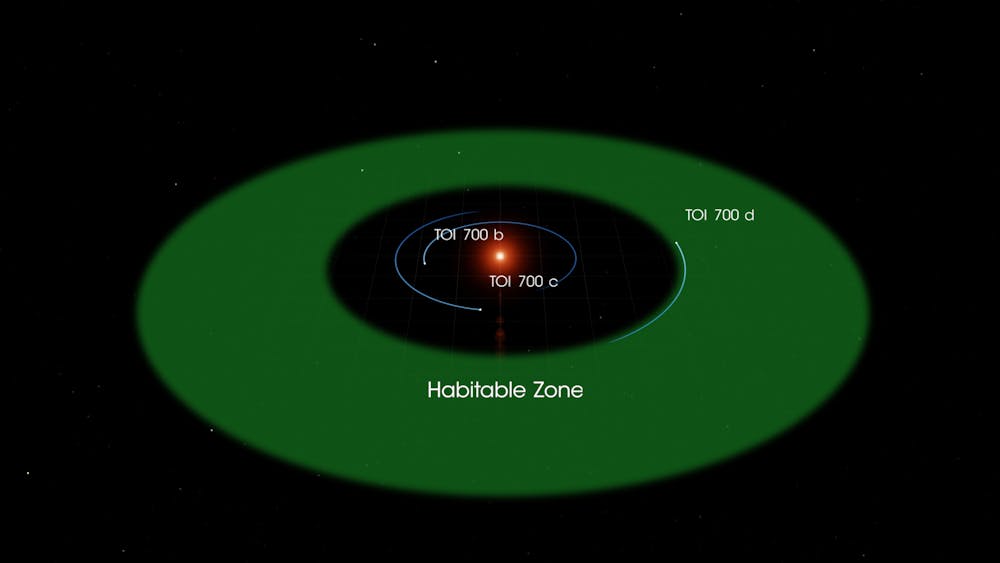
There are three planets around TOI-700: b, c and d. Planet d is Earth-size, within the star’s habitable zone and orbits TOI-700 every 37 days. My colleagues wanted me to create a climate model for Planet d using the known properties of the star and planet. Planets b and c are Earth-size and mini-Neptune-size, respectively. However, they orbit much closer to their host star, receiving 5 times and 2.6 times the starlight that our own Earth receives from the Sun. For comparison, Venus, a dry and hellishly hot world with surface temperature of approximately 860 degrees Fahrenheit, receives twice the sunlight of Earth.
Until about a decade ago, only two habitable zone planets of any size were known to astronomers: Earth and Mars. Within the last decade, however, thanks to discoveries made through both ground-based telescopes and the Kepler mission (which also looked for exoplanets from 2009 to 2019, but is now retired), astronomers have discovered about a dozen terrestrial-sized exoplanets. These are between half and two times larger than the Earth within the habitable zones of their host stars.
Despite the relatively large number of small exoplanet discoveries to date, the majority of stars are between 600 to 3,000 light-years away from Earth – too far and dim for detailed follow-up observation.
TESS has discovered its first Earth-size planet in its star’s habitable zone, the range of distances where conditions may be just right to allow the presence of liquid water on the surface.
Why is liquid water important for habitability?
Unlike Kepler, TESS’ mission is to search for planets around the Sun’s nearest neighbors: those bright enough for follow-up observations.
Between April 2018 and now, TESS discovered more than 1,500 planet candidates. Most are more than twice the size of Earth with orbits of less than 10 days. Earth, of course, takes 365 days to orbit around our Sun. As a result, the planets receive significantly more heat than Earth receives from the Sun and are too hot for liquid water to exist on the surface.
Liquid water is essential for habitability. It provides a medium for chemicals to interact with each other. While it is possible for exotic life to exist at higher pressures, or hotter temperatures – like the extremophiles found near hydro-thermal vents or the microbes found half a mile beneath the West Antarctic ice sheet – those discoveries were possible because humans were able to directly probe those extreme environments. They would not have been detectable from space.
When it comes to finding life, or even habitable conditions, beyond our solar system, humans depend entirely upon remote observations. Surface liquid water may create habitable conditions that can potentially promote life. These life forms can then interact with the atmosphere above, creating remotely detectable bio-signatures that Earth-based telescopes can detect. These bio-signatures could be current Earth-like gas compositions (oxygen, ozone, methane, carbon dioxide and water vapor), or the composition of ancient Earth 2.7 billion years ago (mostly methane and carbon dioxide, and no oxygen).
We know one such planet where this has already happened: Earth. Therefore, astronomers’ goal is to find those planets that are about Earth-size, orbiting at those distances from the star where water could exist in liquid form on the surface. These planets will be our primary targets to hunt for habitable worlds and signatures of life outside our solar system.
The three planets of the TOI 700 system orbit a small, cool M dwarf star. TOI 700 d is the first Earth-size habitable-zone world discovered by TESS.
NASA's Goddard Space Flight Center
Possible climates for planet TOI-700 d
To prove that TOI-700 d is real, Gilbert’s team needed to confirm using data from a different type of telescope. TESS detects planets when they cross in front of the star, causing a dip in the starlight. However, such dips could also be created by other sources, such as spurious instrumental noise or binary stars in the background eclipsing each other, creating false positive signals. Independent observations came from Joey Rodriguez at Center for Astrophysics at Harvard University. Rodriguez and his team confirmed the TESS detection of TOI-700 d with the Spitzer telescope, and removed any remaining doubt that it is a genuine planet.
My student Gabrielle Engelmann-Suissa and I used our modeling software to figure out what type of climate might exist on planet TOI-700 d. Because we do not yet know what kind of gases this planet may actually have in its atmosphere, we use our climate models to explore possible gas combinations that would support liquid oceans on its surface. Engelmann-Suissa, with the help of my longtime collaborator Eric Wolf, tested various scenarios including the current Earth atmosphere (77% nitrogen, 21% oxygen, remaining methane and carbon dioxide), the composition of Earth’s atmosphere 2.7 billion years ago (mostly methane and carbon dioxide) and even a Martian atmosphere (a lot of carbon dioxide) as it possibly existed 3.5 billion years ago.
Based on our models, we found that if the atmosphere of planet TOI-700 d contains a combination of methane or carbon dioxide or water vapor, the planet could be habitable. Now our team needs to confirm these hypotheses with the James Webb Space Telescope.
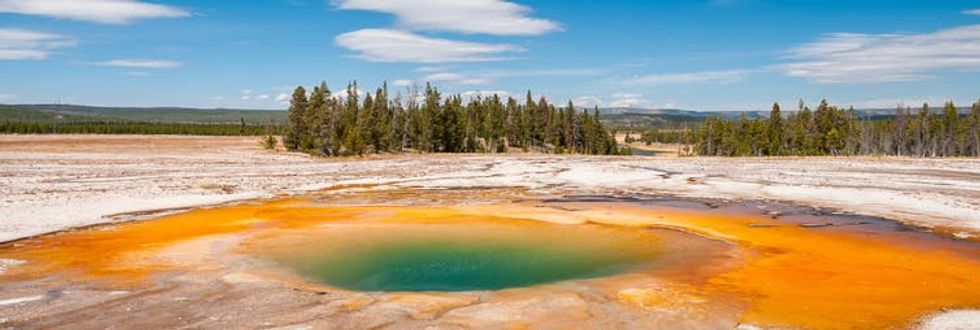
Bacteria living in harsh conditions like this geothermal basin in Yellowstone National Park provide clues about habitable zones on other planets.
The climate simulations our NASA team has completed suggest that an Earth-like atmosphere and gas pressure isn’t adequate to support liquid water on its surface. If we put the same quantity of greenhouse gases as we have on Earth on TOI-700 d, the surface temperature on this planet would still be below freezing.
Our own atmosphere supports a liquid ocean on Earth now because our star is quite big and brighter than TOI-700. One thing is for sure: All of our teams’ modeling indicates that the climates of planets around small and dim stars like TOI-700 are very unlike what we see on our Earth.
The field of exoplanets is now in a transitional era from discovering them to characterizing their atmospheres. In the history of astronomy, new techniques enable new observations of the universe including surprises like the discovery of hot-Jupiters and mini-Neptunes, which have no equivalent in our solar system. The stage is now set to observe the atmospheres of these planets to see which ones have conditions that support life.
Highlighting the "strong scientific consensus that the decline of insects, other arthropods, and biodiversity as a whole, is a very real and serious threat that society must urgently address," 73 international scientists on Monday published a roadmap to battle the world's "bugpocalypse."
"Most importantly, we hope that end-users and land managers now can use this roadmap in, for instance, farming, habitat management, and urban development as a template for true insect recovery."
—Jeff Harvey, lead author
The roadmap, published in the journal Nature Ecology and Evolution, explains that a mounting body of research shows "a suite of anthropogenic stressors—habitat loss and fragmentation, pollution, invasive species, climate change, and overharvesting—are seriously reducing insect and other invertebrate abundance, diversity, and biomass."
The scientists note that in September 2019 the German government announced a €100 million ($111.9 million USD) "action plan for insect protection" that includes safeguarding key habitats, restricting pesticides, reducing light pollution, and investing in research.
"This funding should act as a clarion call to other nations across the world—especially wealthier ones—to follow suit," the letter says of the German initiative, calling for "the immediate implementation of several 'no-regret' measures" on a global scale.
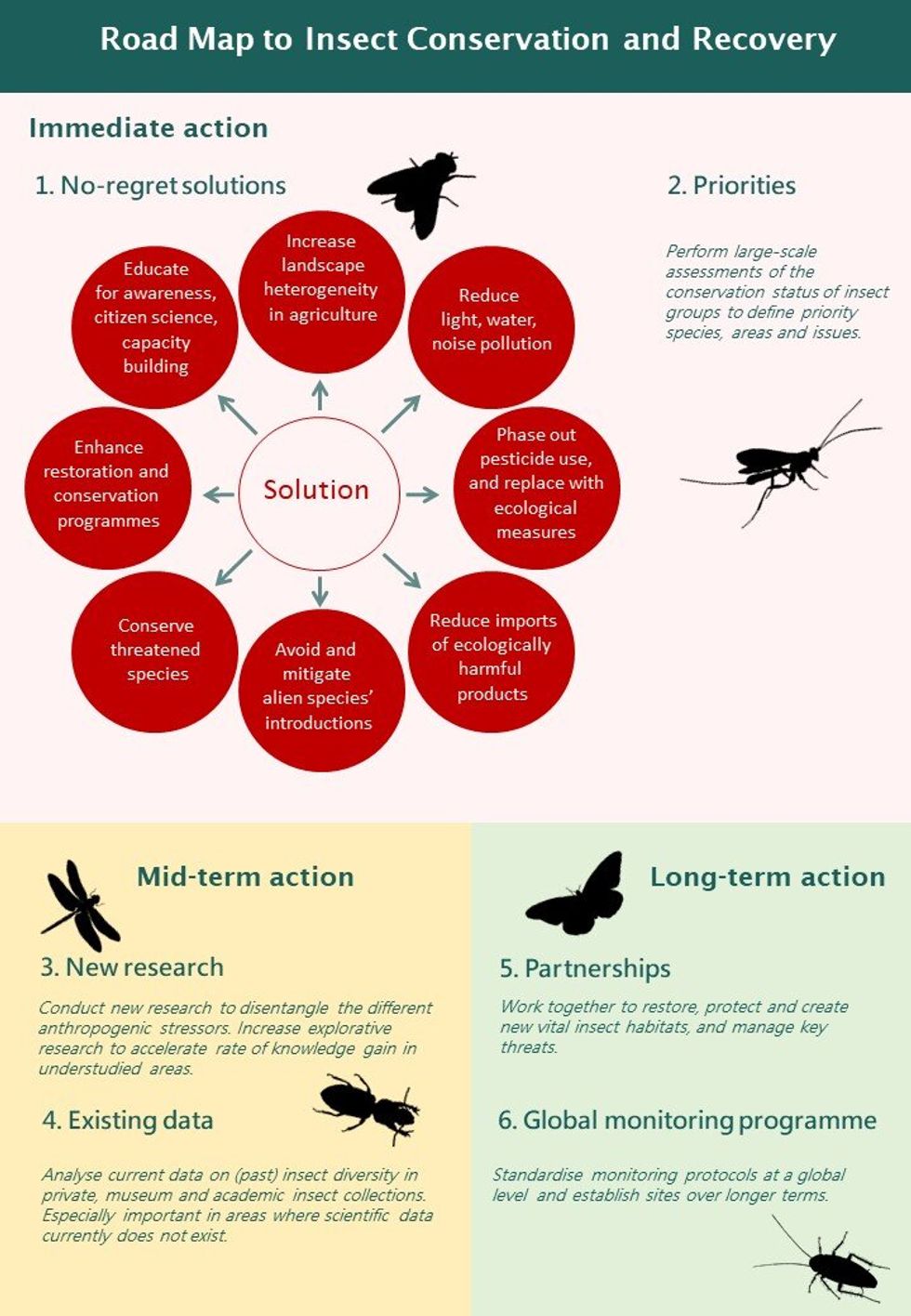
Among the immediate steps that the scientists propose to protect bugs worldwide are:
Aggressively curbing planet-heating emissions;
Cutting back on the use of synthetic pesticides and fertilizers;
Limiting light, water, and noise pollution;
Preventing the introduction of invasive and alien species;
Pursuing conservation efforts for vulnerable, threatened, and endangered species; and
Funding programs targeted at the public, farmers, land managers, policymakers, and conservation workers.
The roadmap for insect conservation and recovery also features mid-term and long-term actions as well as a call for large-scale assessments to monitor the status of insects groups.
Those proposals include establishing an international body, perhaps under the United Nations Environment Program (UNEP) or the International Union for Conservation of Nature (IUCN), "that is accountable for documenting and monitoring the effects of proposed solutions on insect biodiversity in the longer term."
"We're calling for action because insects are key to our own survival, and we ignore their decline at our peril."
—Tara Cornelisse, CBD
"As scientists, we want to gather all available knowledge and put it to action together with land managers, policymakers, and everyone else involved," said Jeff Harvey, a professor at the Netherlands Institute of Ecology and Vrije Universiteit Amsterdam who initiated the letter.
"Most importantly," Harvey added, "we hope that end-users and land managers now can use this roadmap in, for instance, farming, habitat management, and urban development as a template for true insect recovery."
The roadmap's co-authors are experts at academic institutions and advocacy organizations around the world—Australia, Austria, China, Colombia, Finland, Germany, Indonesia, Mexico, the Netherlands, New Zealand, Panama, Papua New Guinea, Portugal, Serbia, South Africa, Sweden, Thailand, Turkey, the United States, the United Kingdom, and Vietnam.
Among them is British biologist and author Dave Goulson. As Common Dreamsreported in November 2019, Goulson produced a report detailing the human-caused insect "apocalypse" and the "profound consequences for all life on Earth" if humanity fails to pursue bold enough action to address the declines.
Co-author Tara Cornelisse, an entomologist at the U.S.-based Center for Biological Diversity (CBD), pointed out in a statement Monday that under President Donald Trump, the U.S. government has taken steps that studies show are driving insect declines.
"The United States needs to step up and help save insects by protecting habitat and reducing pesticide use," said Cornelisse. "Instead the Trump administration has dangerously weakened regulation of pesticides like the neonicotinoid sulfoxaflor and highly toxic pyrethroids."
"We're calling for action because insects are key to our own survival, and we ignore their decline at our peril," she added. "Study after study confirms that human activities have decimated insects, from butterflies to bees to beetles. We can save these crucial species, but the world has to get moving."
Cornell professor John Losey, another co-author and chair of IUCN's Ladybird Specialist Group, explained that "we depend on insect predators like ladybugs to protect our crops from pests while birds, bats, and fish depend on insects as food."
"We can't survive without all these different insects, and they are all going through alarming losses in both numbers and diversity," Losey warned. "Ignoring this issue places all our food security at risk."
See the infographic included in the scientists' letter below:
Editor’s note: We pulled four before-and-after-images from NASA’s Worldview application, and asked bushfire researcher Grant Williamson to reflect on the story they tell. Here’s what he told us:
I’ve been studying fires for more than a decade. I use satellite data to try to understand the global and regional patterns in fire – what drives it and how it will shift in the future as our climate and land use patterns change.
When I look at these images I think: this is a crisis we have seen coming for years. It’s something I have been watching unfold.
Look at the sheer scale of it. Seeing this much fire in the landscape in such a broad area, seeing so much severe fire at once, this quantity and concentration of smoke – it is astonishing. I haven’t seen it like this before.
November 1, 2019 and January 3, 2020
@media only screen and (max-width: 450px) {
iframe.juxtapose { height: 400px; width: 100%; }
}
@media only screen and (min-width: 451px) and (max-width: 1460px) {
iframe.juxtapose { height: 590px; width: 100%; }
}
In this comparison, you can see November last year versus now. In the present picture (on the right hand side) you can see a vast quantity of intense fires currently burning right down the eastern seaboard and a huge amount of smoke. It’s been blowing out across toward New Zealand for weeks now.
The scale of the current fires is definitely unusual. In a typical year, you might see, for example, a large fire in the alps (near Mount Kosciuszko) or in the Blue Mountains – but they would be isolated events.
What’s striking here is that there is so much going on at once. I have never seen it like this before.
Black Saturday smoke, Feburary 8, 2009 and the 2019-2020 bushfires smoke, January 3, 2020
This one is comparing two smoke events: one from Black Saturday and one from the current fires. In both cases, huge quantities of smoke was released. Both times, the sort of forest burning is very dense, there is a lot of wet eucalypt forest here which naturally has a high fuel load and that’s creating all that smoke. This type of forest only burns during extreme weather conditions.
Simply due to the scale of it and the fact that it’s been going on so long, I would say the current event is worse than Black Saturday, in terms of the quantity of smoke.
East Australia, 10 years ago vs today
In this image, we can the impact of drought. A decade ago, on the left hand side, it was clearly quite green along eastern Australia. That green shows there is a lot of growing vegetation there: pasture crops, grasses and a very wet environment.
If you compare that to the current year, on the right hand side, you can see it’s now extremely brown and extremely dry. There’s not much in the way of vegetation. That’s a result of drought and high temperatures.
Kangaroo Island, 2 months ago vs today
In this image, you can see Kangaroo Island two months ago on the left hand side, versus today.
The main thing I note here is the drying. The “before” image is so much greener than the “after” image. So there’s a real lack of rainfall that’s driving fire severity in this area. You can really see how much the island has dried out.
This has been an extraordinary year for climate and weather, and that’s manifesting now in these unprecedented bushfires. It’s not over yet.
But what’s important is the lessons we draw from this crisis and doing as much as we can to reduce the risk in future.
Former Ambassador to the United NationsNikki Haley received harsh criticism along for an attack against Democrats running for president in 2020 during a Monday appearance on Fox News.
Haley, the former Republican governor of South Carolina, was interviewed by Sean Hannity.
“The only ones mourning the loss of Soleimani are our Democrat leadership and our Democrat Presidential candidates," Haley argued.
The comments came on the same day that hundreds of thousands of Iranians took to the streets to mourn the assassinated Iranian general.
Haley was harshly criticized for her attack.
"Exactly which members of the Democratic leadership and exactly which Democratic Presidential candidates have mourned the "loss" of Soleimani?" asked historian Kevin Kruse. "Be specific, ma'am, with exact quotes. Show your work."
Former Republican Party chairman Michael Steele warned his own party that they should be careful about their blind allegiance to President Donald Trump when it comes to military actions against Iran.
In a Washington Post interview, Steele cautioned the GOP to think twice before they willingly volunteer to carry another albatross of war.
"The Republican Party is going to own this and they need to be careful. You can cheerlead the president, but do you really know what he wants to do here, in the middle of a 17-year narrative, and how it’ll play out? No, you don’t," he said.
Meanwhile, on Capitol Hill, Republicans seemed confused about what to say. Sen. Lindsey Graham (R-SC) was almost giddy while Sen. Rand Paul (R-KY) was not happy the U.S. was potentially entering another costly war.
“Great nations avoid endless wars by becoming LESS involved in the turmoil of the Middle East, which would mean less troops not more," Paul said.
Senate Majority Leader Mitch McConnell (R-KY) took to the floor Monday to attack Democrats, saying they “rushed to downplay Soleimani’s evil while presenting our own president as the villain.”
He went on to say, “Can we not maintain a shred, just a shred of national unity for five minutes, for five minutes before deepening the partisan trenches?”
It was an ironic claim coming from the man who has refused to hold a vote on any legislation passed by Democrats.
During his vacation at Mar-a-Lago, Trump was metaphorically patted on the back by Vice President Pence and Secretary of State Mike Pompeo, who promised Trump that Republicans would stand with him in supporting military action. The discussion proves that Trump and his team knew what they were doing would necessitate approval by Congress.
According to The Post, House Minority Leader Kevin McCarthy (R-CA) had dinner with Trump Thursday evening, did the same, promising the president House Republicans were behind him.
“Ask George W. Bush about how these things go,” former Sen. Jeff Flake (R-AZ) said. “It’s all fraught with danger.”
In a piece for The Atlantic this Monday, Yasmeen Sethan argues that the 2010s was the decade where populism surged around the world and predominantly far-right parties “permeated the political mainstream.” But according to Sethan, the 2020s will the decade there people see the consequences of those policies.
"The decade brought us the election of Donald Trump in the United States and the Brexit vote in Britain," Sethan writes. "It witnessed the rise of the Alternative for Germany—the first far-right party to enter the country’s national parliament in decades—as well as the ascent of populist parties in countries such as Austria, Brazil, Italy, India, Indonesia, and Poland. By 2018, as many as 20 populist leaders held executive office around the world."
"If the 2010s were the years in which predominantly far-right, populist parties permeated the political mainstream, then the 2020s will be when voters 'are going to see the consequences of that,' Daphne Halikiopoulou, an associate professor of comparative politics at the University of Reading, in England, told me," she continued. "In some ways, they already have. In Britain, the 2016 vote to leave the European Union—and the political fallout it caused—is likely to be fulfilled at the end of January, following Prime Minister Boris Johnson’s resounding victory in last month’s general election. Elsewhere, populist parties have already made their impact—if not through passing legislation at the head of government, then by applying pressure in opposition."
"Whereas much of the past decade revolved around arguments over issues of immigration and sovereignty, the 2020s could be dominated by a new, more pressing narrative: climate change," writes Sethan.
Defense Secretary Mark Esper tried to tamp down reports that U.S. forces are pulling out of Iraq on Monday afternoon, but he only served to foster widespread confusion.
Multiple outlets initially reported on a letter from Marine Corps Brig. Gen. William H. Seely to the Iraqi Ministry of Defense, informing the country that the U.S. and its allies “will be repositioning forces over the course of the coming days and weeks to prepare for onward movement.” It concluded by saying: “We respect your sovereign decision to order our departure.”
This was interpreted to mean that, following a weekend vote of the Iraqi parliament to expel U.S. forces in response to the killing of a top Iranian leader, the American military would be pulling out of the region. But Esper quick tried to rebut these claims, saying: “There’s been no decision whatsoever to leave Iraq. Period.”
Esper said he’s not sure where the letter came from but it is “inconsistent with where we are right now,” reported BBC News’ Paul Danahar. The Chairman of the Joint Chiefs of Staff Mark Milley then told reporters that the letter was a “draft” and releasing it was a “mistake.” He also said that it was “poorly worded” and noted that it had not been signed.
The Washington Post reported had already reported: “A U.S. military official confirmed the letter’s authenticity.”
Many noted that the letter seemed to conflict with Trump’s own stated position on the issue. He lashed out after the Iraqi parliamentary vote, saying: “If they do ask us to leave, if we don’t do it on a very friendly basis, we will charge them sanctions like they’ve never seen before.”
But the parliament vote, for which many members were not present, was non-binding, and it remains unclear if the tumultuous Iraqi government even has the capacity in its current state to expel the United States’ forces.
The cloud of smoke caused by raging bushfires in Australia has been spotted more than 12,000 kilometers (7,400 miles) away in Chile and Argentina, weather authorities in the South American countries said on Monday.
In the early hours "the effect was seen in the sun through red tones. This effect was produced by a cloud of smoke that comes from the fires," Chile Meteorology chief, Patricio Urra, told AFP.
The cloud has risen to 6,000 meters (6,500 yards) above sea level and there is no meteorological reason for it to fall back to earth, said Urra.
It poses no threat to Chileans.
The Argentine Meteorological Service published satellite images of the cloud saying it had been "transported by frontal systems that move from west to east."
However, it added that all that would be visible was "a sun that's a little redder."
Regional meteorological company Metsul said the cloud could even reach Rio Grande del Sur state in Brazil.
Catastrophic bushfires have turned swathes of Australia into smouldering, blackened hellscapes and destroyed an area about the size of the island of Ireland, according to official figures.
They have left 25 people dead and authorities warn the disaster still has weeks or months to run.
The U.S. Army has just sent an “official letter” to Iraq, notifying that nation it is preparing to “move out,” according to AFP. That statement contradicts its Commander-in-Chief’s statement that the U.S. will not leave Iraq until the country pays for the military base U.S. Armed Forces built there.
“We have a very extraordinarily expensive air base that’s there. It cost billions of dollars to build. Long before my time,” Trump said Sunday night while returning from a three-week long vacation at Mar-a-Lago. “We’re not leaving unless they pay us back for it.”
Al Jazeera and France 24 are also reporting the same news in breaking news alerts on their website.
Conservative Washington Post columnist Max Boot unleashed on President Donald Trump for possibly starting another war based on ignorance and arrogance.
Boot previously supported the Iraq war but has since denounced the lies that motivated the Bush administration to invade. As the United States moves to attack Iran, he's noticing some similarities that make things far worse.
Over the weekend, Secretary of State Mike Pompeo appeared on the political talk shows to spin the decision to kill Maj. Gen. Qasem Suleimani. He made it clear that the decision ignored all possible blowback Americans and allies may face as a result. Pompeo also lied that Iraqis were "dancing in the streets" after Suleimani was "no more." In fact, there were massive protests in the streets with people chanting "death to America."
"If we have learned anything from the past 17 years, it is that killing a bad guy doesn’t necessarily make the situation any better," wrote Boot. "Saddam Hussein was as bad as a guy can get, but his ouster and execution only unleashed chaos. That’s why I regret my support for the Iraq War; Pompeo clearly does not. He and Trump (who supported the Iraq invasion before he opposed it) seem to have learned nothing from that fiasco. They are sucking the United States into another Middle East conflict with a surfeit of arrogance and a deficit of strategy."
Boot posed that Iran may be deterred by Suleimani's death, but he doubts it, as the fallout grows more negative. Iraq has now voted to expel American troops after nearly two decades of occupation, something Iran has long wanted. Iranian Foreign Minister Javad Zari tweeted in March that the leading source of instability in the Middle East is the United States.
"Trump seems determined to unify the whole region against the United States, because he just threatened to attack Iranian cultural sites and to blackmail Iraq into paying for a U.S. air base built after an invasion that Iraqis did not ask for," Boot continued.
Out of the loop, Pompeo told reporters that the United States would abide by all norms and follow international laws, which conflicts with what Trump has said and then doubled down on.
“They’re allowed to kill our people. They’re allowed to torture and maim our people. They’re allowed to use roadside bombs and blow up our people. And we’re not allowed to touch their cultural site? It doesn’t work that way,” said Pompeo.
As Boot explained, it actually does work that way, because the United States is a country that operates under the rule of law, nationally and internationally. Iran, by contrast, is a rogue state.
He called it "laughable" that Pompeo would say that “We have developed a strategy to attempt to convince the Iranian regime to behave like a normal nation.”
"Normal nations don’t threaten to blackmail other countries or destroy their cultural sites," wrote Boot.
Boot walked through the slow march to war with Iran that Trump began in 2018 when Trump broke the nuclear treaty. What followed has been predictable, he wrote.
"It is for such reasons that previous administrations refused to kill Suleimani. Did Trump realize what would happen? Did he hear from opponents of the decision and carefully weigh all of the ramifications? The questions are rhetorical; we all know the disturbing answers," he said.
Under a clear blue sky in Tel Aviv, Nisan Katz vowed Monday he was "not afraid" of a threat by an Iranian official to turn the Israeli city "to dust".
The warning followed a war of words between Washington and Tehran, after the US assassinated top Iranian military commander Qasem Suleimani on Friday.
"If America takes any measure after our military response, we will turn Tel Aviv and Haifa to dust," said Mohsen Rezai, who heads Iran's Expediency Council, a top state body.
But in the coastal city of Tel Aviv, Katz doubted Tehran would follow through with the threat.
"There shouldn't be any confrontation or war between Israel and Iran, we don't have a common border," he told AFP.
"I am not afraid of the Iranian threat, Israel is much stronger, Iran will be the main loser."
Rezai's threat against Israel, a key ally of Washington, comes after President Donald Trump said the US would hit dozens of Iranian sites if Tehran attacked American personnel or assets.
But after years of warnings from Israel's arch enemy, in Tel Aviv an attack was seen as unlikely.
"I assume they will not attack us because their business is mainly with the Americans," said Benny, who did not give his surname.
"Although they've hated us for years, they have huge troubles. We have our defense abilities," he told AFP on the seafront.
- 'A great provocation' -
Israeli Prime Minister Benjamin Netanyahu cut short a foreign visit and security chiefs held emergency talks after the killing of Suleimani.
Preparing for "a variety of scenarios" was advisable, the Institute for National Security Studies (INSS) in Tel Aviv said in a report released Monday.
They include an "escalation of events up to a confrontation with the US, in which Israel could also be involved."
Orna Mizrahi, a senior research fellow at the institute, said she doubted Tel Aviv or Haifa would be the main targets of Iran's response.
"A lot of the time they are talking about (how) they are going to destroy Israel... but they are very careful not to do it," she told AFP.
Attacking Israeli cities would represent "a great provocation which can cause a very large-scale military conflict with Israel. I don't think this is what they would like now."
Hezbollah chief Hassan Nasrallah said the US military would "pay the price" for Suleimani's killing, but did not call for attacks on the group's foe Israel.
"The only just punishment is (to target) American military presence in the region," he said on Sunday.
The Israeli government has remained tight-lipped in recent days, with Netanyahu saying Friday that both Israel and the US have "the right of self-defense".
Rachel Suissa, a research fellow at the National Security Studies Center at the University of Haifa, said the silence over Rezai's threat was deliberate.
"The Israeli government is staying quiet to the threat as a calculated flexible strategic policy, depending not only on the American decision-making," she told AFP.
With world leaders calling for calm, in Tel Aviv Katz remained confident neither Washington nor Tehran would seek further conflict.
"Personally, I think in war, there are only losers and eventually everybody will be smart, and nothing will happen," he said.




 AFP / Tolga AKMEN Demonstrators call for a boycott on Cyprus in support of a British teenager convicted of lying about being raped by Israeli tourists
 AFP / Iakovos HATZISTAVROU Activists protested outside the court in support of the British teenager as the sentence was handed down