Human Rights Watch on Monday vowed to continue fighting the violation of Palestinians' human rights by the Israeli government as the organization's director for the region was expelled from Israel.
Omar Shakir was forced out of the country three weeks after the Israeli Supreme Court upheld the government's decision to revoke his work visa on the grounds that he supports a boycott of Israel.
Neither Shakir nor Human Rights Watch (HRW) endorses a boycott of the country; they do oppose businesses which operate in Israeli settlements in the West Bank, as the settlements violate the 1949 Geneva Conventions.
"Today, Israel deports Shakir because Human Rights Watch urges businesses to shun illegal settlements. Who's next—someone who calls for the International Criminal Court to examine possible crimes in Israel and Palestine or correctly calls the West Bank 'occupied' rather than 'disputed'?"
—Kenneth Roth, Human Rights Watch"This decision shows why the international community must reboot its approach to Israel's deteriorating human rights record," Kenneth Roth, HRW's executive director, said in a statement. "A government that expels a leading human rights investigator is not likely to stop its systematic oppression of Palestinians under occupation without much greater international pressure."
In an editorial at Common Dreams, journalist Juan Cole rejected the Israeli government's reasoning for deporting Shakir.
"It is the slow ethnic cleansing of the Palestinians and the settling on their property of Israeli squatters that Tel Aviv did not want Human Rights Watch to observe," Cole wrote.
The organization argued that Israel joined dictatorships like Egypt in expelling human rights workers.
"But it, too, will not succeed in hiding its human rights abuses," Roth said.
"Human Rights Watch's work on human rights abuses committed by Israel, the Palestinian Authority, and Hamas will continue under Shakir's direction," the organization said. "He will be based in another Human Rights Watch office in the region."
Roth added that Shakir's expulsion could be just the first of many deportations as the Isreali government continues its attacks on Palestinians' human rights and its efforts to silence dissent.
"Today, Israel deports Shakir because Human Rights Watch urges businesses to shun illegal settlements," said Roth. "Who's next—someone who calls for the International Criminal Court to examine possible crimes in Israel and Palestine or correctly calls the West Bank 'occupied' rather than 'disputed'?"
As Shakir left the country, he told reporters, "I'll be back."
"I'll be back when the day comes that we have succeeded in dismantling the system of discrimination impacting Israelis and Palestinians," Shakir said at a press conference.
"If we measure the wrong thing," warns Joseph Stiglitz, "we will do the wrong thing."
Nobel Prize winning economist Joseph Stiglitz is warning the world that unless the obsession many world leaders have with gross national product (GDP) comes to end, there will be little chance of adequately fighting back against the triple-threat of climate destruction, the scourge of financial inequality, and the crises of democracy now being felt around the globe.
In an op-ed publish Sunday in the Guardian, Stiglitz says that these interrelated crises of environmental degradation and human suffering have solidified in his mind the idea that "something is fundamentally wrong with the way we assess economic performance and social progress."
"Something is fundamentally wrong with the way we assess economic performance and social progress."—Joseph StiglitzDefining GDP as "the sum of the value of goods and services produced within a country over a given period," Stiglitz points to the financial crash of 2008—and the so-called "recovery" which has taken place in the decade since—as evidence that the widely-used measurement is not up to the task of providing an accurate assessment of the economy, let alone the state of the world or the people living in it.
"It should be clear that, in spite of the increases in GDP, in spite of the 2008 crisis being well behind us, everything is not fine," writes Stiglitz. "We see this in the political discontent rippling through so many advanced countries; we see it in the widespread support of demagogues, whose successes depend on exploiting economic discontent; and we see it in the environment around us, where fires rage and floods and droughts occur at ever-increasing intervals."
A central argument of his new book—co-authored by fellow economists Jean-Paul Fitoussi and Martine Durand and titled "Measuring What Counts: The Global Movement for Well-Being"—Stiglitz says that studying the last ten years of the global economy has showed him with increasing clarity why governments "can and should go well beyond GDP," especially with the climate crisis knocking down the planet's door. He writes:
If our economy seems to be growing but that growth is not sustainable because we are destroying the environment and using up scarce natural resources, our statistics should warn us. But because GDP didn't include resource depletion and environmental degradation, we typically get an excessively rosy picture.
These concerns have now been brought to the fore with the climate crisis. It has been three decades since the threat of climate change was first widely recognized, and matters have grown worse faster than initially expected. There have been more extreme events, greater melting of glaciers and greater natural habitat destruction.
Everything is not fine, Stiglitz argues, but says economists have been working hard on providing new ways to measure economic health. Embraced more broadly, new economic measures that include accounting for human happiness and environmental well-being could help change the course of humanity.
As he notes in the op-ed, "If we measure the wrong thing, we will do the wrong thing."
Rudy Giuliani offered a quid pro quo to an indicted Ukrainian oligarch as part of an apparent extortion campaign currently under congressional investigation.
Dmytro Firtash, a Kremlin-linked energy baron who's facing extradition to the U.S. on bribery and racketeering charges, told the New York Times that he met with Giuliani associates Lev Parnas and Igor Fruman in June to discuss his legal case.
The pair, who have since been indicted on campaign finance violations, told Firtash they could help with his Justice Department problems if he hired pro-Trump attorneys Joseph diGenova and Victoria Toensing.
Parnas and Fruman also asked Firtash to help Giuliani dig up dirt on Joe Biden's activities regarding Ukraine, where his son Hunter Biden sat on the board of an energy company.
An attorney for Parnas has confirmed that his client met with Firtash at Giuliani's request and offered a quid pro quo linking his extradition matter to Trump's re-election campaign.
“Without my will and desire,” Firtash told the Times, “I was sucked into this internal U.S. fight.”
Global coal-fired power, a key driver of climate change, is set to fall a record 3.0 percent this year, largely led by developed countries although much-criticised China and India play their part too, analysis showed Monday.
This "historic" drop would be equal to 300 Terawatt hours (TWh), or more than the combined coal-based electricity output of Germany, Spain and Britain last year, the UK-based Carbon Brief website said.
The turnaround is largely due to "record falls in developed countries, including Germany, the EU overall and South Korea, which are not being matched by increases elsewhere."
"The largest reduction is taking place in the US, as several large coal-fired power plants close," it added.
For 2017-2918, falls in the US and the European Union were "offset by increases elsewhere, particularly in China," Carbon Brief said.
"This year, however, the fall in developed economies is accelerating, while coal generation in India and China is slowing sharply, precipitating a global reduction."
In the past 35 years, there have been only two overall coal power declines -- 148 TWh in 2009 in the wake of the global financial crisis and 217 TWh in 2015 as China slowed.
- China still dominant -
In China, coal tends to fill the gap between clean energy growth and rising demand, Carbon Brief said.
"This means that when electricity demand is growing strongly, coal dependence comes to the fore."
The study noted that Chinese firms have continued to add new coal-fired power plants at a rate of one large facility every two weeks, even as average plant utilisation rates tumble to record lows below 50 percent.
The result is that China "still dominates the global picture" in coal-fired electricity generation which "peaked unexpectedly" in 2014 when the world's second largest economy began to cool off.
In the US, coal-fired power generation was down 13.9 percent through to August this year while in the first six months of 2019, European Union output tumbled 19 percent.
For the full year, the EU could drop as much as 23 percent, Carbon Brief said.
- Key climate change factor -
The future of coal-fired electricity "has significant implications for global efforts to tackle climate change," it noted.
Last year, a three percent increase in CO2 emissions from coal-fired power generation was responsible for half the global increase in emissions from fossil fuels.
For 2019, a three percent reduction could imply zero growth in global CO2 output, if emissions changes in other sectors mirror those during 2018.
These changes are significant but the study still noted that this year's projected 3.0 percent fall would be only half the 6.0 percent drop the International Energy Agency says is necessary each year to 2040 to bring about its "Sustainable Development Scenario" aimed at limiting global warming to below 2C.
The World Meterological Organization said Monday that greenhouse gas emissions hit a new all-time high in 2018.
London's transport authority on Monday refused to renew an operating license for ride-hailing giant Uber because of safety and security concerns.
"Transport for London (TfL) has concluded that it will not grant Uber London Limited (Uber) a new private hire operator's license in response to its latest application," it said in a statement.
The American giant, which has 3.5 million customers and 50,000 drivers in London, described the move as "wrong" and added that it will appeal.
The TfL rejection is the latest set-back to the firm's London operation, which has suffered previous license suspensions in addition to protests from traditional black cab drivers.
In September, Uber was granted a two-month extension to its license following the expiry of a previous 15-month agreement. The extension was conditional on passenger safety improvements.
- 'Pattern of failures' -
TfL on Monday said there were a "pattern of failures", including the use of unauthorized drivers on other drivers' accounts, allowing them to pick up passengers.
The transport authority said this happened at least 14,000 times, endangering users, as it invalidated insurance. Some trips took place with unlicensed, suspended or dismissed drivers.
TfL said it recognized steps the company had taken to address such issues but was concerned about the ease with which its checks and balances could be manipulated.
"Despite addressing some of these issues, TfL does not have confidence that similar issues will not reoccur in the future, which has led it to conclude that the company is not fit and proper at this time," said the transport body charged with regulating the capital's taxi services.
Uber has 21 days to appeal, during which time it can continue to operate.
"We think this decision is wrong and we will appeal," Uber said in a brief statement emailed to all of its customers.
"You and the 3.5 million riders who rely on Uber can continue to use the app as normal. We remain 100 percent committed to your safety."
Uber would have to demonstrate on appeal that it has put in place sufficient measures to eliminate risks to passengers.
Mayor of London Sadiq Khan insisted companies needed to play by the rules.
"Keeping Londoners safe is my absolute number-one priority, and TfL have identified a pattern of failure by Uber that has directly put passengers' safety at risk.
"I know this decision may be unpopular with Uber users, but their safety is the paramount concern."
Unite, Britain's biggest trade union, welcomed the announcement and called for a level-playing field to allow traditional taxi services to compete.
"There remains fundamental problems in the way the company operates, particularly issues around passenger safety," said Unite official Jim Kelly.
“Uber’s DNA is about driving down standards and creating a race to the bottom which is not in the best interests of professional drivers or customers."
- 'Hammer blow' to drivers -
However, the Independent Workers Union of Great Britain -- which represents gig economy workers -- criticized TfL's decision.
"The mayor’s decision to once again deny Uber a license will come as a hammer blow to its 50,000 drivers working under precarious conditions," said James Farrar, chair of the union's United Private Hire Drivers branch.
"We are asking for an urgent meeting with the mayor to discuss what mitigation plan can now be put in place to protect Uber drivers."
President Donald Trump's personal attorney considered representing a state-owned Ukrainian bank this summer while leading an apparent extortion scheme against the foreign country.
Rudy Giuliani confirmed that he held discussions with Privatbank about assisting in a civil suit to recover assets linked to a former owner with ties to Ukraine's president, reported Bloomberg News.
The former New York City mayor ultimately decided not to take on the case, but the episode illustrates how willing Giuliani was to engage in foreign business despite potential conflicts of interest.
Ukraine's previous administration nationalized Privatbank in 2016 and accused previous owner Igor Kolomoisky and his co-founder of stealing billions of dollars.
Giuliani met with lawyers at Quinn Emanuel to discuss the case at the same time he was helping the president pressure Ukraine to open an investigation into Joe Biden and his son Hunter Biden, which has become the subject of an impeachment inquiry.
Greenhouse gases levels in the atmosphere, the main driver of climate change, hit a record high last year, the UN said Monday, calling for action to safeguard "the future welfare of mankind".
"There is no sign of a slowdown, let alone a decline, in greenhouse gas concentration in the atmosphere despite all the commitments under the Paris Agreement on Climate Change," the head of the World Meteorological Organization (WMO) Petteri Taalas said in a statement.
The WMO's main annual Greenhouse Gas Bulletin listed the atmospheric concentration of CO2 in 2018 at 407.8 parts per million, up from 405.5 parts per million (ppm) in 2017.
That increase was just above the annual average increase over the past decade.
CO2 is responsible for roughly two-thirds of Earth's warming.
The second most prevalent greenhouse gas in the atmosphere is methane -- emitted in part from cattle and fermentation from rice paddies -- which is responsible for 17 percent of warming, according to WMO.
Nitrous oxide, the third major greenhouse which is gas caused largely by agricultural fertilisers, has caused about six percent of warming on Earth, the UN agency said.
Atmospheric concentration levels of both methane and nitrous oxide both hit record highs last year, the UN said.
"This continuing long-term trend means that future generations will be confronted with increasingly severe impacts of climate change, including rising temperatures, more extreme weather, water stress, sea level rise and disruption to marine and land ecosystems," WMO said.
- 'More hopeful'? -
AFP / Simon MALFATTO, Paz PIZARRO Increase in atmospheric concentrations of carbon dioxide, methane and nitrous oxide
Emissions are the main factor that determine the amount of greenhouse gas levels but concentration rates are a measure of what remains after a series of complex interactions between atmosphere, biosphere, lithosphere, cryosphere and the oceans.
Roughly 25 percent of all emissions are currently absorbed by the oceans and biosphere -- a term that accounts for all ecosystems on Earth.
The lithosphere is the solid, outer part of the Earth while the cyrosphere covers that part of the world covered by frozen water.
The UN's Intergovernmental Panel on Climate Change (IPCC) has said that in order to keep warming below 1.5 degrees Celsius, net CO2 emissions must be at net zero, meaning the amount being pumped into the atmosphere must equal the amount being removed, either though natural absorbtion or technological innovation.
While Taalas made clear that the world was not on track to meet UN targets, he did highlight some reasons for cautious optimism.
"The visibility of these issues is the highest (it has) ever been," he told reporters in Geneva, noting that the private sector was increasingly investing in green technology.
Even in the United States, where President Donald Trump's administration this month began the process of formally withdrawing from the Paris agreement, "plenty of positive things are happening," Taalas said.
While Washington may have renounced its Paris agreement commitments, "we have plenty of states and cities who are proceeding in the right direction," he added.
"Personally, I am more hopeful than I used to be 10 years ago but of course we have to speed up the process," Taalas said.
Rescuers were struggling Sunday to save 14,600 sheep loaded on a cargo ship that capsized in the Black Sea off the coast of Romania, they said.
The Queen Hind bound for Saudi Arabia overturned for yet unknown reasons shortly after leaving Romania's Midia port.
The crew of 20 Syrians and one Lebanese were rescued, together with 32 sheep, two of which were pulled from the water, said Ana-Maria Stoica, a spokeswoman for the rescue services.
"The rescue operation is ongoing... We hope that the sheep inside the ship's hold are still alive," she told AFP.
Rescuers supported by the military, police and divers were trying to right the Palau-flagged ship and pull it to the port, she said.
Romania's main livestock breeder and exporter association, Acebop, called for an urgent investigation.
IGSU Romania/AFP / -"The rescue operation is ongoing," a spokeswoman for the rescue services said. "We hope that the sheep inside the ship's hold are still alive"
"Our association is shocked by the disaster," Acebop president Mary Pana said in a statement. "If we cannot protect livestock during long-distance transports, we should outright ban them."
Gabriel Paun of NGO Animals International alleged that the ship had been overloaded. He added that the Queen Hind had already had engine problems last December.
"An investigation must be opened without delay," he told AFP.
Romania, which joined the EU in 2007, is one of its poorest members.
It is the bloc's third-largest sheep breeder, after Britain and Spain, and a top exporter, primarily to Middle Eastern markets.
Activists have labelled the livestock transport vessels -- about 100 of which leave Midia every year -- "death ships", saying sheep risk being cooked alive on board during the hot summer months.
In July, Vytenis Andriukaitis, then European commissioner in charge of health and food safety, demanded that Bucharest stop the transport of 70,000 sheep to the Gulf, citing animal welfare.
He has asked the European Commission to investigate Romania's practices.
"What is happening in Bolivia is highly undemocratic and we are witnessing some of the worst human rights violations at the hands of the military and the police since the transition to civilian government in the early 1980s."
More than 800 academics, activists, and public figures published an open letter Sunday demanding that the United States and the international community end its support for the right-wing, anti-Indigenous regime in Bolivia that seized power following the military's ouster of former President Evo Morales.
"What is happening in Bolivia is highly undemocratic and we are witnessing some of the worst human rights violations at the hands of the military and the police since the transition to civilian government in the early 1980s," reads the open letter, which was signed by renowned linguist Noam Chomsky, activist and academic Angela Davis, journalist John Pilger, and other prominent human rights advocates.
"We are outraged by the Áñez regime's violations of Bolivians' political, civil, and human rights, and by the deplorable use of deadly violence that has led to a mounting death toll."
See the full list of signatories and read the letter here.
"We condemn the violence in the strongest terms, and call on the U.S. and other foreign governments to immediately cease to recognize and provide any support to this regime," the letter continued. "We urge the media to do more to document the mounting human rights abuses being committed by the Bolivian state."
The open letter, first published in The Guardian, came hours after the Bolivian legislature passed a bill to annul the results of the October 20 presidential election—which Morales won in the first round—and set the stage for new elections.
The academics and activists raised alarm at the authoritarian and racist behavior of Jeanine Añez, who declared herself president just days after Morales—Bolivia's first indigenous president—was ousted by the military on November 10.
In an interview with The Guardian Sunday, Añez's interior minister Arturo Murillo threatened to jail Morales for the rest of his life. Morales is currently in Mexico, where he was granted asylum amid fears for his safety.
"Añez represents the radical-right sector of the Bolivian opposition, which has taken advantage of the power vacuum created by Morales' ouster to consolidate control over the state. Áñez appears to have full support of Bolivia's military and police," the letter states. "Equally disturbing has been a resurgence of public anti-Indigenous racism over the course of the last week."
As Common Dreamsreported last week, observers on the ground in Bolivia have voiced fears that the military's ongoing repression of Indigenous anti-coup protesters could spark a full-blown civil war. More than 30 people have been killed and hundreds more injured since Morales was overthrown earlier this month.
"The military has guns and a license to kill; we have nothing," cried a mother whose son was shot during a massacre in El Alto last week. "Please, tell the international community to come here and stop this."
Read the full open letter:
Evo Morales—President of Bolivia from the MAS party (Movimiento al Socialismo, Movement Towards Socialism)—was forced to resign on November 10, in what many observers view as a coup. In the wake of Morales' resignation, there has been mounting chaos and violence. What is happening in Bolivia is highly undemocratic and we are witnessing some of the worst human rights violations at the hands of the military and the police since the transition to civilian government in the early 1980s. We condemn the violence in the strongest terms, and call on the U.S. and other foreign governments to immediately cease to recognize and provide any support to this regime. We urge the media to do more to document the mounting human rights abuses being committed by the Bolivian state.
On November 10, Morales' vice president and the heads of both chambers of Congress also resigned in the face of threats of violence against top MAS officials unless they left office. The pressure campaign included the burning of MAS officials' houses and kidnapping of relatives. This paved the way for the ascension to the presidency of Jeanine Áñez (a conservative Roman Catholic opposition leader from northeastern Bolivia, widely accused of holding racist views) on Tuesday November 12.
The circumstances surrounding the rapid-fire resignations makes Áñez's assumption of power highly questionable. There are serious doubts about the constitutional legitimacy of her succession. Without the forced resignations by MAS officials, Áñez would not have had even a minimally plausible constitutional path to the presidency, as she was serving as Vice-President of the Senate, a position that is not in the line of presidential succession within the constitution. Additionally, Áñez, whose party received only 4% of the vote in the most recent October 20 election, declared herself President in a Senate session lacking quorum, with MAS senators who make up the legislature’s majority boycotting partly due to fears for their physical safety.
Áñez represents the radical-right sector of the Bolivian opposition, which has taken advantage of the power vacuum created by Morales' ouster to consolidate control over the state. Áñez appears to have full support of Bolivia's military and police. Over the course of the last week the military and police have engaged in significant and increasing repression against protests, which have been largely, though not entirely, peaceful. By the night of November 13, La Paz and Cochabamba city center streets were empty of anyone but the police, military, and self-appointed neighborhood militias. There has been ongoing looting, burning of buildings, and violence on the streets and protesters have been met with much repression. In a highly disturbing move, Áñez issued an executive order on November 15 exempting the military from criminal responsibilities related to the use of force. Áñez has said Morales will face prosecution if he returns to Bolivia. And she has also floated the idea of banning the MAS party—which is undoubtedly still Bolivia's largest and most popular political force—from participation in future elections.
Equally disturbing has been a resurgence of public anti-Indigenous racism over the course of the last week. Shortly after Áñez was declared President, she thrust a massive Bible into the air and proclaimed "The Bible has returned to the palace!" Three days earlier on the day of Morales' ouster, Luis Fernando Camacho, a far-right Santa Cruz businessman and ally of Áñez, went to the presidential palace and knelt before a Bible placed on top of the Bolivian flag. A pastor accompanying him announced to the press, "The Pachamama will never return to the palace." Opposition activists burned the wiphala flag (an important symbol of Indigenous identity) on various occasions. These are extremist views that threaten to reverse decades of gains in ethnic and cultural inclusion in Bolivia.
Despite increasing violence and repression, diverse social forces have been demonstrating around the country to condemn the government of Áñez. It is important to note that they include not only MAS supporters but also a broad swath of popular sectors that repudiate the rightwing seizure of the state. Thousands of largely unarmed protesters, mostly coca-leaf growers, gathered peacefully in Sacaba, a town in the department of Cochabamba, on the morning of November 15. After unsuccessful negotiations to march to the town square, protesters tried to cross a bridge into the city of Cochabamba, heavily guarded by police and military troops. Soldiers and police fired tear gas canisters and live bullets into the crowd. During the two-hour confrontation, nine protesters were shot dead, and at least 122 were wounded. Most of the dead and injured in Sacaba suffered bullet wounds. Guadalberto Lara, the director of the town's Mexico Hospital, told the Associated Press it is the worst violence he has seen in his 30-year career. Families of the victims held a candlelight vigil late Friday in Sacaba. A tearful woman put her hand on a casket and asked, "Is this what you call democracy? Killing us as if we counted for nothing?"
We denounce the repressive state violence unfolding in Bolivia. We also voice our concern that the international media have not been able to effectively cover the human rights violations in Bolivia as they too have been met by the violence of the military. On November 15, an Al Jazeera journalist covering protests in La Paz was gassed by the police in the streets and could no longer hold her microphone or camera. Although she later backed down, Áñez's new minister of communications told the press that the government will not tolerate "seditious" media. This environment, in which freedom of the press is not only not guaranteed, but threatened by the government, has resulted in an alarming lack of coverage of the gross human rights violations being committed by the armed forces against civilian unarmed protesters.
We are outraged by the Áñez regime's violations of Bolivians' political, civil, and human rights, and by the deplorable use of deadly violence that has led to a mounting death toll of protesters and countless serious injuries. We call upon the international community to immediately and publicly condemn these acts of violence. We ask international human rights bodies and organizations to impartially investigate and document the acts of violence committed by government agents. We demand that the international community ensure that this de facto regime, which is at best highly dubious and viewed by many as lacking any legitimacy, protect the lives of peaceful protesters, respect the rights of all to freedom of assembly and speech, and strictly abide by international norms on the use of force in situations of civilian violence. We demand that the U.S. and other foreign governments cease all support to this regime and withhold international recognition until free and fair elections—including all political parties—are held, repressive violence ceases, and the fundamental human rights of all Bolivians are respected.
Thousands of Venetians took to the streets of the Renaissance city on Sunday to vent anger over frequent flooding and the impact of giant cruise ships.
Braving heavy rain, between 2,000 and 3,000 people answered the call of environmental groups and a collective opposed to the boats.
Critics say the waves cruise ships create are eroding the foundations of the lagoon city.
Chanting slogans such as "Venice resist" and calling for Mayor Luigi Brugnaro's resignation, the marchers also appealed for a massive project, MOSE, to be mothballed.
The multi-billion euro infrastructure project has been under way since 2003 to protect the city from flooding, but it has been plagued by cost overruns, corruption scandals and delays.
The protest follows unprecedented flooding earlier this month that devastated the city, submerging homes, businesses and cultural treasures.
"Venetians have just endured a deep wound. The flooding... brought this city to its knees and revealed its extreme fragility to the world," activist Enrico Palazzi told AFP.
Venice saw yet another "acqua alta" (high water) event on Sunday, with levels reaching 130 centimetres (over four feet).
The UNESCO World Heritage city is home to some 50,000 people, while some 36 million people visit it each year.
Prince Charles called on the Solomon Islands to better protect its forests Monday, saying embracing the "bio-economy" was vital to the Pacific nation's future prosperity.
Environmental groups warn the Solomons' lush forests are being stripped by logging, with fears the devastation will intensify after Honiara switched its diplomatic allegiance in September from Taiwan to resource-hungry China.
Charles did not directly address the issues in the logging sector but said the Solomons -- where less than 50 percent of the population have access to electricity -- was rich in "natural capital" such as trees and fisheries.
He said this meant the Pacific island nation could lead the world in environmental sustainability, attracting ethical green investment from offshore and boosting tourism.
"It is becoming apparent that the bio-economy is going to be of enormous importance," the first in line to the British throne said.
"Your precious forests, smartly managed, offer a rich and durable source of income as a uniquely sustainable supply of biodiversity for the new technologies that are already emerging.
"At the same time, they play an indispensable role in improving our shared resilience to climate change."
A report from environmental campaigners Global Witness last year said forests in the Solomons were being cut down at a rate 19 times higher than sustainable levels, with most logs going to China.
It said the dense jungle that covers many of the archipelago's coral atolls could be gone by 2036.
Charles has been outspoken on environmental issues during his trip, telling an audience in Christchurch that the world was reaching a "tipping point" on climate change.
He will return to Britain this week, where the royal family are still reeling from the outcry over Prince Andrew's television interview in which he discussed his friendship with the late convicted sex offender Jeffrey Epstein.
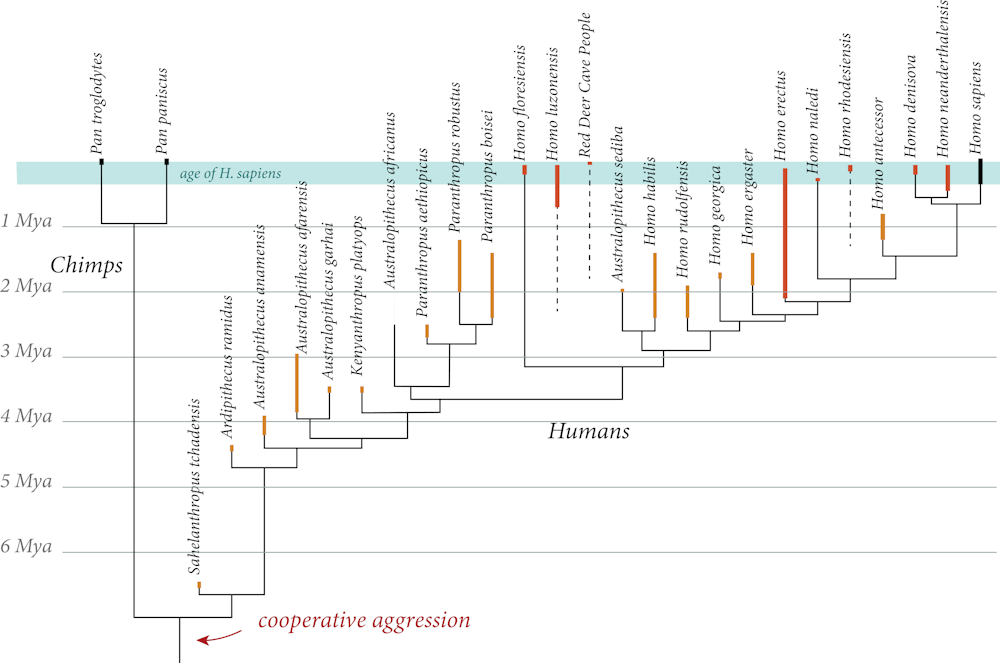
Nine human species walked the Earth 300,000 years ago. Now there is just one. The Neanderthals, Homo neanderthalensis, were stocky hunters adapted to Europe’s cold steppes. The related Denisovans inhabited Asia, while the more primitive Homo erectus lived in Indonesia, and Homo rhodesiensis in central Africa.
Several short, small-brained species survived alongside them: Homo naledi in South Africa, Homo luzonensis in the Philippines, Homo floresiensis (“hobbits”) in Indonesia, and the mysterious Red Deer Cave People in China. Given how quickly we’re discovering new species, more are likely waiting to be found.
By 10,000 years ago, they were all gone. The disappearance of these other species resembles a mass extinction. But there’s no obvious environmental catastrophe – volcanic eruptions, climate change, asteroid impact – driving it. Instead, the extinctions’ timing suggests they were caused by the spread of a new species, evolving 260,000-350,000 years ago in Southern Africa: Homo sapiens.
The spread of modern humans out of Africa has caused a sixth mass extinction, a greater than 40,000-year event extending from the disappearance of Ice Age mammals to the destruction of rainforests by civilisation today. But were other humans the first casualties?
Human evolution.
Nick Longrich
We are a uniquely dangerous species. We hunted wooly mammoths, ground sloths and moas to extinction. We destroyed plains and forests for farming, modifying over half the planet’s land area. We altered the planet’s climate. But we are most dangerous to other human populations, because we compete for resources and land.
History is full of examples of people warring, displacing and wiping out other groups over territory, from Rome’s destruction of Carthage, to the American conquest of the West and the British colonisation of Australia. There have also been recent genocides and ethnic cleansing in Bosnia, Rwanda, Iraq, Darfur and Myanmar. Like language or tool use, a capacity for and tendency to engage in genocide is arguably an intrinsic, instinctive part of human nature. There’s little reason to think that early Homo sapiens were less territorial, less violent, less intolerant – less human.
Optimists have painted early hunter-gatherers as peaceful, noble savages, and have argued that our culture, not our nature, creates violence. But field studies, historical accounts, and archaeology all show that war in primitive cultures was intense, pervasive and lethal. Neolithic weapons such as clubs, spears, axes and bows, combined with guerrilla tactics like raids and ambushes, were devastatingly effective. Violence was the leading cause of death among men in these societies, and wars saw higher casualty levels per person than World Wars I and II.
Old bones and artefacts show this violence is ancient. The 9,000-year-old Kennewick Man, from North America, has a spear point embedded in his pelvis. The 10,000-year-old Nataruk site in Kenya documents the brutal massacre of at least 27 men, women, and children.
It’s unlikely that the other human species were much more peaceful. The existence of cooperative violence in male chimps suggests that war predates the evolution of humans. Neanderthal skeletons show patterns of trauma consistent with warfare. But sophisticated weapons likely gave Homo sapiens a military advantage. The arsenal of early Homo sapiens probably included projectile weapons like javelins and spear-throwers, throwing sticks and clubs.
Complex tools and culture would also have helped us efficiently harvest a wider range of animals and plants, feeding larger tribes, and giving our species a strategic advantage in numbers.
The ultimate weapon
But cave paintings, carvings, and musical instruments hint at something far more dangerous: a sophisticated capacity for abstract thought and communication. The ability to cooperate, plan, strategise, manipulate and deceive may have been our ultimate weapon.
The incompleteness of the fossil record makes it hard to test these ideas. But in Europe, the only place with a relatively complete archaeological record, fossils show that within a few thousand years of our arrival , Neanderthals vanished. Traces of Neanderthal DNA in some Eurasian people prove we didn’t just replace them after they went extinct. We met, and we mated.
Elsewhere, DNA tells of other encounters with archaic humans. East Asian, Polynesian and Australian groups have DNA from Denisovans. DNA from another species, possibly Homo erectus, occurs in many Asian people. African genomes show traces of DNA from yet another archaic species. The fact that we interbred with these other species proves that they disappeared only after encountering us.
But why would our ancestors wipe out their relatives, causing a mass extinction – or, perhaps more accurately, a mass genocide?
13,000-year-old spear points from Colorado.
Chip Clark, Smithsonian Institution
The answer lies in population growth. Humans reproduce exponentially, like all species. Unchecked, we historically doubled our numbers every 25 years. And once humans became cooperative hunters, we had no predators. Without predation controlling our numbers, and little family planning beyond delayed marriage and infanticide, populations grew to exploit the available resources.
Further growth, or food shortages caused by drought, harsh winters or overharvesting resources would inevitably lead tribes into conflict over food and foraging territory. Warfare became a check on population growth, perhaps the most important one.
Our elimination of other species probably wasn’t a planned, coordinated effort of the sort practised by civilisations, but a war of attrition. The end result, however, was just as final. Raid by raid, ambush by ambush, valley by valley, modern humans would have worn down their enemies and taken their land.
Yet the extinction of Neanderthals, at least, took a long time – thousands of years. This was partly because early Homo sapiens lacked the advantages of later conquering civilisations: large numbers, supported by farming, and epidemic diseases like smallpox, flu, and measles that devastated their opponents. But while Neanderthals lost the war, to hold on so long they must have fought and won many battles against us, suggesting a level of intelligence close to our own.
Today we look up at the stars and wonder if we’re alone in the universe. In fantasy and science fiction, we wonder what it might be like to meet other intelligent species, like us, but not us. It’s profoundly sad to think that we once did, and now, because of it, they’re gone.
Tesla’s new “Blade Runner-inspired” electric cybertruck has the world turning its head.
The internet has had a field day since the vehicle’s launch on Thursday, with users finding creative ways to ridicule the truck’s eccentric design.
This isn’t the first time Tesla chief executive Elon Musk has invoked science fiction in his product designs. In 2017, his space agency SpaceX introduced a new type of sleek, form-fitting space suit – in contrast with NASA’s bulky astronaut attire.
Whether or not this is the case, Tesla’s newest product proves it is possible to go too far on the sci-fi fantasy train.
A sparkling finish, but not a sparkling reception
When it comes to technologies of the future, vehicles and transportation are in the limelight.
In a 2014 Pew Research Centre survey, Americans were asked to describe “futuristic inventions they themselves would like to own”. One of the most common answers was “travel improvements like flying cars and bikes”.
Similarly, if you consult real estate blogs, you’ll come across debates regarding the merits of upgrading to stainless steel or mirror finish appliances before selling a house. Those on the pro side argue the futuristic look will inspire purchases by projecting a more modern image.
So why did the same stainless steel aesthetic fail Tesla completely?
But a more important element at play here is the fact that many customers’ purchasing habits reflect Tesla products as being symbols of self-identity.
When cast in this light, the fact that the cybertruck has been labelled “ugly” goes a long way towards explaining why fans of the brand have shunned the newest family member.
Before Thursday’s reveal, Musk said he “doesn’t care” if people aren’t interested in buying his “futuristic-like cyberpunk, Blade Runner pickup truck”. But from a business perspective, that seems an unlikely opinion for a chief executive to hold.
On Sunday, Musk tweeted claiming the truck had received 187,000 orders (not the same as sales) since the unveiling, up from 146,000 announced in a tweet on Saturday.
According to Raphael Zammit, who heads a transportation design program at Detroit’s College for Creative Studies, the Tesla cybertruck’s design “failed” because it focused on style rather than consumer perception.
Zammit says the roof doesn’t “look stable” to a consumer’s non-specialist eye. It’s not that the structure isn’t expected to be sound, it’s that it goes against the standard design principles intended to instil public trust.
Another factor that may have contributed to the truck’s critical reception is the botched “transparent metal” window demonstration during the unveiling. The vehicle’s glass was visibly damaged after being hit with a steel ball.
Nothing undermines consumer confidence like a supposedly armoured window being smashed in the middle of a product launch.
Tesla’s sci-fi-inspired cybertruck design is making the headlines, but draws attention away from the greatest contribution sci-fi cinema makes to society. That is, it provides a safe space to explore the possible harms and benefits of new developments, before they become reality.
Sci-fi worlds “test” potential futures for us. Utopian and dystopian sci-fi, in particular, raise questions around ethical and legal structures we might want to pursue or avoid, to achieve the future we want.
Science fiction professor Sherryl Vint notes the genre occupies a unique position, by allowing us to work through our anxieties about our rapidly changing world.
She provides the example of Orphan Black as a sci-fi show that discusses fears associated with human cloning, while also considering the complexities of medical patenting and personalised medicine.
Even if Orphan Black doesn’t end up shaping the technical future of gene technology (let’s hope not), it has certainly made many people think about its possible impact.
Orphan Black is a science fiction thriller television series which focuses on genetic tinkering, among other technology-related themes.
And this is probably where the true value of sci-fi lies: in raising questions around the consequences of our emerging technologies, rather than inspiring their designs.
The chicken and egg dilemma
One could even argue it’s problematic to say futuristic technologies are inspired by sci-fi at all.
It may just as easily be the case that such technologies were inspired by early scientific thought, which simply didn’t receive as much attention as the resulting products.
After all, many early sci-fi authors were themselves scientists and engineers, and described possible future developments that were an extension of what they were working on in real life.
It could be argued that real science inspires sci-fi, rather than the other way around.
In either case, sci-fi should be a shared language through which we can discuss technological change, rather than a marketing ploy for companies looking to capitalise on people’s love of futurism.
Plus, as Musk’s cybertruck demonstrates, styling your vehicles on cyberpunk visions of the future may not be the soundest business strategy anyway.




 AFP / Simon MALFATTO, Paz PIZARRO
  IGSU Romania/AFP / -