The award-winning head of a Philippine news website known for its tough scrutiny of President Rodrigo Duterte was arrested on Wednesday on libel charges, the latest in a series of legal cases against perceived adversaries of the government.
Maria Ressa, chief executive of Rappler, is accused of cyber libel over a 2012 article, updated in 2014, that linked a businessman to murder and trafficking of humans and drugs, citing information contained in an intelligence report from an unspecified agency.
National Bureau of Investigation officers escorted Ressa through a phalanx of media that poured into the Manila office of Rappler when news of the agents’ arrival went viral on social media.
“People should know that the line has been crossed,” Ressa told reporters, adding she would seek bail.
The justice ministry filed the case on behalf of the businessman, who denies any wrongdoing.
Ressa was among several people named “Person of the Year” by Time Magazine in 2018 for leading what it said was Rappler’s “fearless reporting on President Rodrigo Duterte’s propaganda machine and extrajudicial killings”, referring to his bloody war on drugs.
Rappler has borne the brunt of what activists say is a state-sponsored campaign to intimidate Duterte’s opponents by hitting them with legal measures, or subjecting them to a torrent of online hate whipped up by social media “influencers”, some of whom held government posts.
Presidential spokesman, Salvador Panelo, said a crime had been committed, a court had found probable cause and Rappler was not being penalized for its reporting.
“This is nothing to do with freedom of expression or freedom of the press,” he told news channel ANC.
London-based right group Amnesty International said the charges were trumped up and “brazenly politically motivated”.
Ressa’s arrest is the latest problem Rappler has faced.
Its operating license was rescinded in 2018 over alleged ownership violations, and it is also dealing with a case involving alleged tax evasion. Both cases are going on.
“These cases are intended to intimidate us,” Chay Hofilena, Rappler’s investigative editor, told media.
“We know that’s the intent, we are not buckling.”
Rappler’s reporters are regularly threatened by elements of Duterte’s online support base, part of what Rappler’s investigations say is an organized “weaponizing” of the internet by the government. The government denies that.
For his part, Duterte has said he does not need help from online trolls, and insists he has never punished anyone for criticizing him.
He has called Rappler a “fake news outlet”, and even suggested it might be linked to the U.S. Central Intelligence Agency.
The National Union of Journalists of the Philippines called Ressa’s arrest “a shameless act of persecution by a bully government”.
Writing and additional reporting by Martin Petty; Editing by Robert Birsel
A man accused of pulling the trigger in the 2010 killing of a U.S. Border Patrol agent in Arizona was convicted of murder on Tuesday in a case tied to an ill-fated U.S. government gun-running sting known as “Fast and Furious”.
A U.S. federal jury found Heraclio Osorio-Arellanes guilty of murdering agent Brian Terry, 40, during a firefight on Dec. 14, 2010, the U.S. Justice Department said in a statement.
Osorio-Arellanes was the sixth of seven defendants convicted in connection with the killing in a rural area north of Nogales.
He was part of a “rip crew” looking to rob smugglers transporting drugs from Mexico into the United States. The group confronted Terry and three other Border Patrol agents in a shootout.
Osorio-Arellanes was convicted of nine counts, including first degree murder and attempted robbery. He will be sentenced on April 29.
Terry was shot to death and one gang member was wounded in the gun battle. The rip crew were carrying four loaded AK-47 assault weapons, an AR-15 semiautomatic assault weapon and 180 rounds of ammunition, according to the Justice Department.
Two AK-47 rifles found at the scene were later traced back to the bungled gun-running investigation of the U.S. Bureau of Alcohol, Tobacco, Firearms and Explosives (ATF) that embarrassed the administration of former President Barack Obama and strained relations with Mexico.
In that investigation, the ATF aimed to trace weapons bought legally in the United States by “straw” buyers and then resold into the black market, but federal agents lost track of some weapons, many of which ended up in the hands of drug traffickers.
Four other members of the rip crew involved in the lethal gunfight, and a fifth man charged with conspiracy, were ultimately convicted in U.S. federal court and sent to prison.
A further defendant is pending extradition to the United States and will be tried in Tucson, Arizona, the Justice Department said.
The year was 376. What the Romans did in response to the arrival of the Goths would have profound effects on the history of the vast and powerful Roman Empire.
Roman border security was historically effective, not because of massive barriers, but because they knew how to manage the flow of migration.
This flow didn’t lead to the collapse of the empire by marauding Germans. Rather, the flow of migration transformed the Roman Empire into what became medieval society.
Yet the arrival of the Goths in 376 shows what happens when good border policy is ignored.
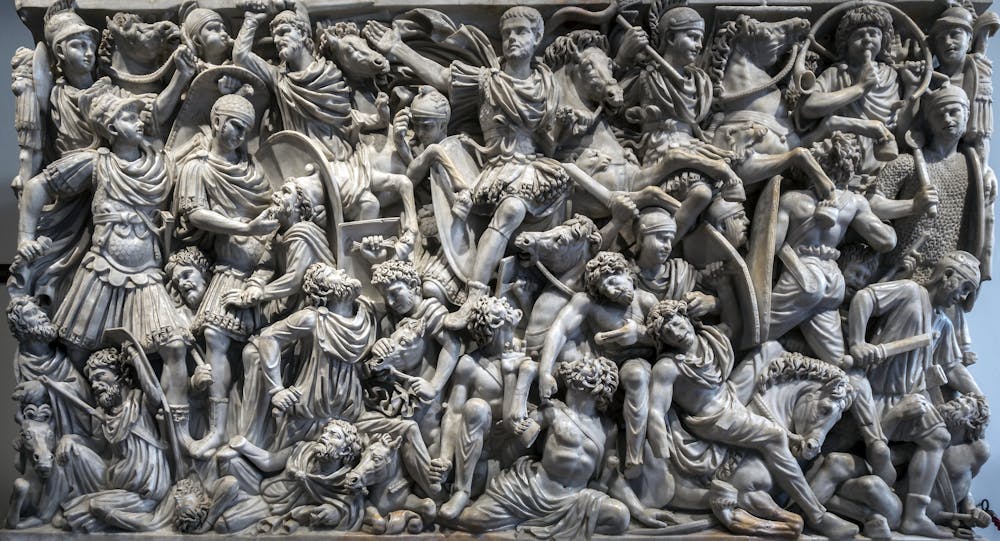
The Ludovisi sarcophagus, which depicts a battle between Romans and Goths in the third century CE.
To understand how the arrival of these Gothic tribes created a crisis for the late Roman Empire, we have to first start with how the Romans traditionally handled the migration of new tribes into their territory.
The borders of the Roman Empire were constantly in flux and always flexibly managed, owing to the difficulties of policing a huge border without modern technology.
Roman border control rarely made use of massive walls, but depended on natural barriers in the landscape. This was particularly true on the northern border, which heavily relied on the Rhine and Danube rivers. Rome’s borders were gradual transitions more than hard and fast lines.
When migrating tribes asked to be admitted to the empire, the Romans tended to follow a fairly standard policy. Tribes were broken up into smaller groups and sent to underpopulated regions. They were forced to surrender their weapons, renounce their loyalty to their tribal leaders, and commit a certain number of fighting men to the Roman legions.
These policies had served the empire well for centuries. By diluting tribal loyalty and disarming the newcomers, the Romans strengthened their economy, increased tax revenue, and swelled the ranks of the army.
Goths at the border
Let’s return to the Goths waiting on the north side of the Danube. One of our main historical sources about this event is the fourth-century Roman historian Ammianus Marcellinus, whose account is used in this description.
According to Ammianus, one of the Gothic tribes (the Thervingi) sent envoys to the eastern Roman Emperor Valens to ask for admission to the empire. They wanted their people to settle in nearby Thrace, adding the promise that they would contribute soldiers to the Roman army.
This offer pleased the emperor and the local population. The Thervingi would offer a strong buffer against other potentially unfriendly tribal groups and would provide soldiers and new tax revenue.
Valens welcomed them to cross over.
That fall, huge numbers of Thervingi crossed the river, which was swollen from recent rains. They made the journey in whatever boats could be found.
At this point, things went badly for the Thervingi. Many died during the dangerous crossing. The Romans allowed more Thervingi to cross than they could supply with food. The local Roman military commanders, Lupicinus and Maximus, withheld supplies the emperor had earmarked for the Thervingi and sold them at massively inflated prices.
Ammianus says the situation became so desperate that even the families of Thervingi chieftains sold their sons into slavery for dog meat.
The Romans saw these migrants from the north as uncivilized and irrational. It is likely that the Roman commanders felt justified in their bad behavior toward the Goths because of Roman prejudice against “barbarians.”
Bad treatment, bad outcome
The Romans ignored all their usual protocols for admitting new tribes into the empire.
For some reason, the newly arrived Thervingi were not forced to hand over their weapons, nor was the tribe broken up into smaller units to be dispersed to different regions. This may have been because the Romans allowed too many Thervingi to cross, leaving Roman military forces vastly outnumbered.
The other Gothic tribe massed at the Danube, the Greuthungi, were in a different position. Valens had rejected their envoys’ request for admission to the empire.
They were as desperate to cross into Roman territory as the Thervingi. Seeing that the Romans were overwhelmed, the Greuthungi crossed the Danube on their own, further to the east.
As conditions among the Thervingi continued to deteriorate, Lupicinus made a desperate play to keep them in line: He invited their leaders, Alavivus and Fritigern, to a dinner party and promptly took them hostage.
When the Thervingi began to riot in response, Fritigern was able to convince Lupicinus to let him go to calm the situation down.
But having gained his freedom, Fritigern reneged on his promise to Lupicinus and mobilized the Thervingi, who then allied themselves with the Greuthungi.
The result was a unified and massive Gothic army that was now loose and armed in Roman territory.
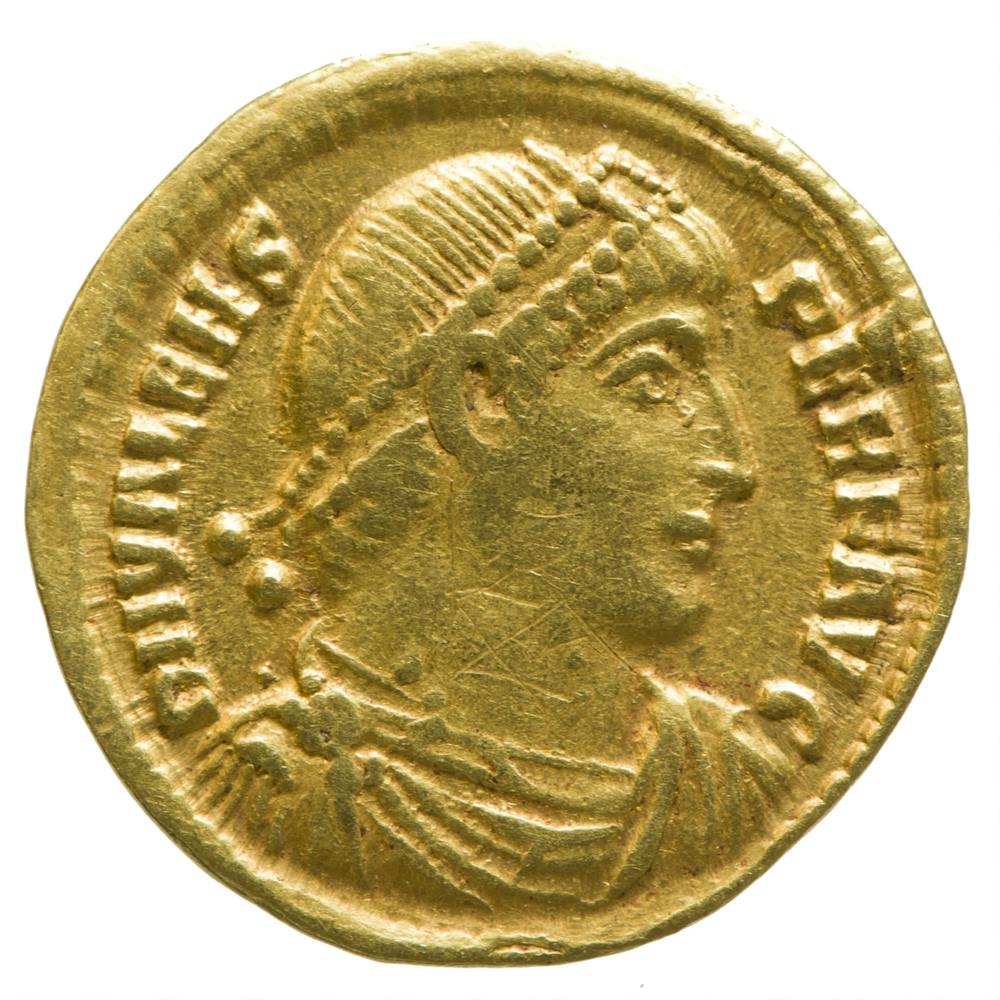
Roman Emperor Valens died fighting the Goths at Adrianople.
Thus began six years of war that would devastate the region and leave countless dead, including the Emperor Valens, who died fighting the Goths at the Battle of Adrianople in 378.
The eventual peace brokered with the Goths in 382 by Theodosius I allowed them to settle in Roman territory as a self-governed federation between the Danube and Balkan mountains.
But as an independent state within Roman territory, the Goths never integrated into Roman society and remained a source of political instability.
The failure of Roman border policy in the period leading up to the Battle of Adrianople is a reminder that the forces that drive human migration cannot be stopped with military force or a border wall.
Instead, they require a smart and careful policy that manages the flow rather than trying to hold it back.
The events of 376 are in some ways similar to today.
As political instability persists and the climate continues to warm, more and more migrants will be arriving on the U.S. border.
The Roman policy of resettlement may not be a viable solution to our current immigration debate.
But looking at what went wrong when the Romans ignored what worked for them in the past demonstrates one unsettling consequence of failed border policy.
The meeting begins on Feb. 21 and will last four days. It is likely to produce a new round of public apologies, expressions of concern for victims and pledges of reform.
But recent statements by leading bishops and the pope suggest that church officials are not ready to take what I believe is an essential step in ending the scandal: providing a full and detailed accounting of their own role in concealing credible allegations of sexual abuse.
I’m a legal scholar who has written a book on clergy sexual abuse in the Catholic Church, and it appears to me that the church’s latest response, so far, is part of a familiar pattern that has persisted for nearly three decades.
Recent revelations
In 2018, the scandal of clergy sexual abuse in the Catholic Church once again made headlines around the world.
In August, a Pennsylvania grand jury that investigated abuse in six dioceses over a period of 70 years found that bishops in the state failed to report credible sexual abuse allegations against 300 priests involving 1,000 children.
No indictments have been issued by that grand jury. Most of the abuse occurred decades ago, and the statute of limitations has expired on almost all of these allegations.
Later that month, Archbishop Carlo Maria Vigano, a former top Vatican official and a long-time critic of Pope Francis, issued a press release alleging that senior Vatican officials and Pope Francis had covered up abuse allegations against Cardinal Theodore McCarrick of Washington, D.C.
Vigano claimed that he personally told Pope Francis in 2013 of sanctions imposed on McCarrick by Pope Benedict XVI in the late 2000s – but that Pope Francis repealed them and made McCarrick a trusted counselor.
Although Pope Francis vigorously denies Vigano’s allegations, which remain unsubstantiated, bishops and Vatican officials had received reports for decades of Cardinal McCarrick’s transgressions. The New Jersey dioceses where he served as bishop
paid legal settlements, the details of which remain sealed, to two of his alleged victims in 2005 and 2007.
In December of 2018, another investigation by the Illinois attorney general concluded that bishops in that state withheld the names of more than 500 priests accused of molesting minors. More than a dozen similar probes are currently underway by attorneys general in other states.
Revelations like these have not been limited to the U.S. Similar investigations, spanning the globe from Chile to Germany to Australia, have exposed sustained efforts by church officials to conceal sex crimes.
A familiar pattern
Although the scandal of sex abuse by clergy did not come to light in media reports until the 1980s, personnel files in dioceses around the U.S. contain allegations of sexual misconduct against priests dating back to the 1930s.
The issue was openly discussed in biannual meetings of the National Conference of Catholic Bishops in the 1970s. During this time, the organization funded a treatment program specifically for Catholic priests who sexually abused minors, and issued directives regarding the retention and destruction of treatment reports provided to bishops.
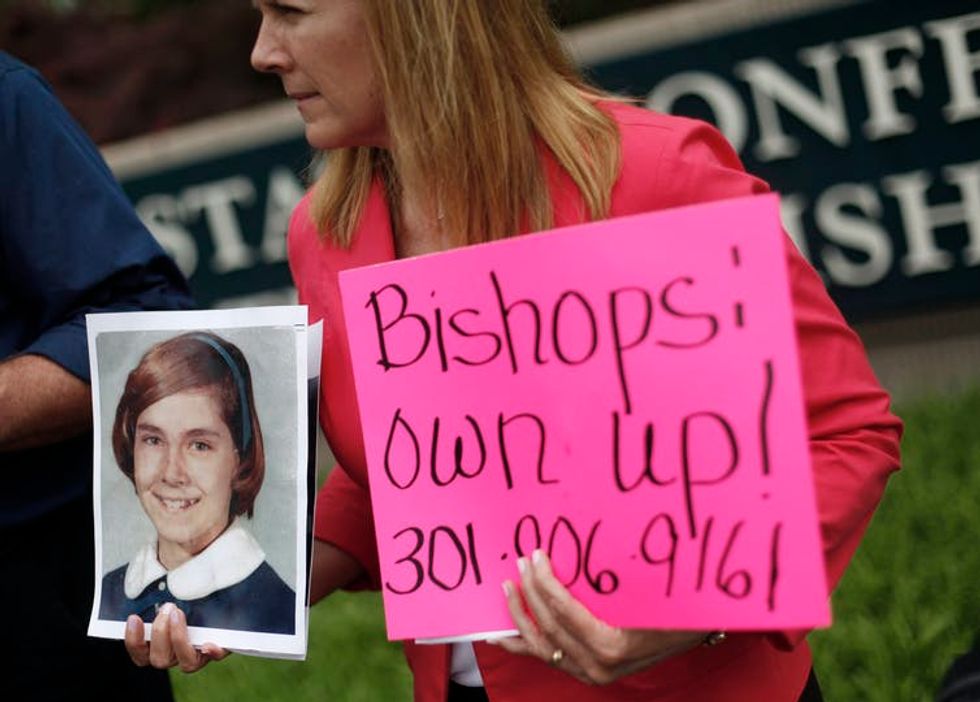
A victim of abuse holds a photograph of herself as a young girl during a protest in Washington in 2011.
Every U.S. bishop involved in these meetings and who referred priests for treatment during this time knew of the problem.
However, public acknowledgment by church officials of clergy sexual abuse did not begin until 1984, when the case of Father Gilbert Gauthe made national headlines.
Gauthe, a popular parish priest in rural Louisiana, sexually abused dozens of prepubescent boys. His crimes were finally exposed when victims and their families sued the diocesan officials who knew of the abuse but had failed to remove Gauthe from ministry.
The local bishop issued a public apology and expressed sympathy for the victims. The National Conference of Catholic Bishops issued recommendations to dioceses in 1987 for preventing and reporting abuse.
Eight years later, in 1992, sexual abuse victims publicly exposed Father James Porter, who molested more than 100 known victims between the ages of 6 and 14 while serving as a priest in parishes in Massachusetts, Minnesota and New Mexico. His predatory behavior was well-known among his colleagues and superiors within the church.
These included conducting prompt investigations, removing accused priests in face of credible evidence, reporting allegations to civil authorities where required by law, extending pastoral care to victims and their families, and seeking treatment for offenders.
Nonetheless, the scandal resurfaced in 2002. The most egregious offender in this round of revelations was Father John Geoghan, who reportedly abused more than 800 victims over a 33-year period in Boston parishes.
Geoghan’s crimes were concealed by no fewer than six bishops, including Cardinal Bernard Law, the archbishop of Boston and arguably the most powerful figure in the U.S. Catholic Church.
For a third time, in 2002, the bishops issued apologies, acknowledged the suffering of victims and published new reforms in the Charter for the Protection of Children & Young People, including “zero tolerance” for clergy sexual abuse within the church.
Lack of accountability
For more than three decades, in the face of intense media coverage and public outrage, the bishops have attempted to deflect blame for the crisis.
One strategy has been to blame the crisis on contemporary attitudes toward sexuality.
Take the example of Bishop Edward Scharfenberger of Albany, New York. He issued a recent statement in response to the Pennsylvania grand jury investigation explaining that,
“I do not see how we can avoid what is really at the root of this crisis: sin and a retreat from holiness, specifically the holiness of an integral, truly human sexuality. In negative terms, and as clearly and directly as I can repeat our Church teaching, it is a grave sin to be sexually active outside of a real marriage covenant.”
He went on to lament that “contemporary culture in our part of the world now holds it normative that sex and sexual gratification between any consenting persons for any reason that their free wills allow is perfectly acceptable,” and he called for “a culture of chastity” to “drive the evil behaviors among us from the womb of the church.”
Pope Francis echoed this sentiment when he told reporters recently that “we have to deflate expectations” about just how much the church can do “because the problem of abuse will continue, it is a human problem.”
A focus on prevention
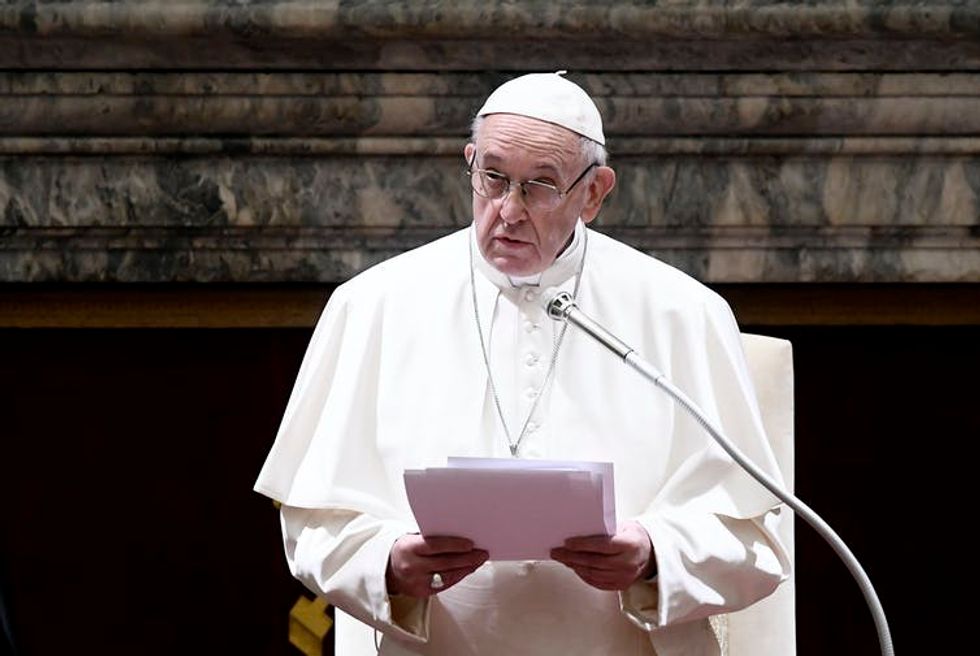
Pope Francis delivers his speech during the traditional greetings to the Roman Curia at the Vatican in December 2018. He vowed that the Catholic Church will ‘never again’ cover up clergy sex abuse.
It is true that church officials have made efforts to reduce the incidence of clergy sexual abuse.
For example, bishops have implemented training programs within most dioceses throughout the U.S. for those who work with children. Initial efforts began in the mid-1980s and expanded rapidly after 2002.
A comprehensive study by researchers at the John Jay College of Criminal Justice suggests that the incidence of clergy abuse has been steadily declining since the 1980s. These researchers speculated that the bishops’ efforts may have contributed to this decline.
Yet, despite diocesan reforms and the declining rate of abuse, the scandal persists.
The missing ingredient
Pope Francis recently told reporters that the upcoming Vatican summit will include a “penitential liturgy to ask forgiveness for the whole Church,” testimony from victims to make bishops “become aware” and the establishment of new “protocols” for handling abuse cases.
This agenda for the upcoming summit fits the now-familiar pattern of apologizing, expressing concern for victims and pledging reform.
The pope also indicated in his remarks that the summit would focus on the need for sex education that adheres to church doctrine. In other recent remarks to the media, the pope demanded that priests who have raped and molested children turn themselves in, and he vowed that the Catholic Church will “never again” hide their crimes. He pledged that “the church will spare no effort to do all that is necessary to bring to justice whosoever has committed such crimes.”
This plan for reform – promoting church doctrine on sexuality, calling out priests who have perpetrated abuse and pledging to clean house in the future – is missing a key ingredient necessary to quell the crisis: Until church officials provide a full accounting of their concerted efforts over decades to hide crimes from civil authorities, parishioners and the public, the clergy sexual abuse scandal, I believe, will not go away.
Congress on Wednesday was up against a tight deadline to pass a bipartisan accord to avert another partial U.S. government shutdown, but President Donald Trump could still torpedo the deal that denied him funds for his U.S.-Mexico border wall.
The Democratic-controlled U.S. House of Representatives could vote as soon as Wednesday evening, a senior aide said, despite not yet having produced a written copy of the agreement reached by congressional negotiators on Monday night.
The measure’s fate in the chamber was far from certain given the risk of conservatives and liberals opposing the compromise for different reasons.
The accord must also be passed by the Republican-controlled Senate and signed by Trump by the midnight Friday expiration of a stopgap measure that ended the longest federal shutdown in U.S. history.
Trump said on Tuesday he was not happy with the deal and did not rule out vetoing the legislation. But he added he did not expect another shutdown.
Congressional sources said the deal includes $1.37 billion for new border fencing, about the same as last year - along 55 miles (90 km) of the border, but not the $5.7 billion Trump has demanded to help build his promised border wall.
In a tweet on Tuesday night, Trump repeated his insistence that if Congress did not provide the funding, he would press forward with building a wall, writing: “Regardless of Wall money, it is being built as we speak!”
Senior congressional Republicans, showing little appetite for another shutdown after being heavily criticized for the previous one, urged Trump to support the agreement.
Trump surprised lawmakers when he withdrew support for a previous deal in December and demanded the $5.7 billion in wall funding, opposed by congressional Democrats. That triggered the 35-day shutdown of about a fourth of the federal government that left 800,000 federal workers furloughed or working without pay.
The president previously threatened to declare a “national emergency” if Congress did not provide money specifically for the wall, an action under which he might redirect other funds already provided by Congress to pay for wall construction.
Fellow Republicans have told Trump such a step would almost certainly draw opposition, both in Congress and in the courts.
Trump made the wall a central 2016 campaign promise, calling it necessary to combat illegal immigration and drug trafficking. He said Mexico would pay for it, but Mexican officials rejected that. Democrats have called a wall expensive, ineffective and immoral.
Reporting by Richard Cowan and Susan Cornwell; Additional reporting by Amanda Becker; Writing by Ginger Gibson; Editing by Peter Cooney
A hand-drawn map of constellations and planetary orbits shows Thailand in the throes of a "gateway" year of change, says astrologer Pinyo Pongcharoen -- one of a legion of fortune tellers sought out by politicians in chaotic and unpredictable times.
"The stars are all in place," the president of Thailand's International Astrological Association told AFP.
"There will be a big change, a big confrontation, a big negotiation."
His forecast might lack precision but it carries weight for Thais, who have long turned to fortune tellers for a hint of what lies in store at school, in business, love and politics.
And politics is currently dominating conversations, following a series of dramatic events which have lit up the political landscape ahead of elections set for March 24.
Thailand's King Maha Vajiralongkorn on Friday slapped down the unprecedented prime ministerial candidacy of his sister Princess Ubolratana, which brought the revered monarchy into frontline politics, as a "highly inappropriate" move.
AFP / Lillian SUWANRUMPHA Thais have long turned to fortune tellers for a hint of what lies in store for them
She was proposed for premier by the Thai Raksa Chart party, which is aligned with the powerful Shinawatra clan and is now waiting to see if it will be censured for the bold, perhaps foolish, move.
The upheaval triggered rumours of a possible counter-coup to oust junta leader Prayut Chan-O-Cha, speculation he denies.
Pinyo -- who has read the fortune of a former prime minister, though he declined to say who -- refused to be drawn into unpicking what it all means, saying only that there will be a showdown between "liberal and conservative" forces.
"It's a fight between the people who have a new thinking and the people who keep the old way of thinking," he said cryptically.
- Aligning with the cosmos -
Thailand's history is steeped in astrology, with every twist in the country's volatile history of coups, protests and short-lived civilian governments informed by the stars, said Edoardo Siani, a cultural anthropologist of Thailand at Kyoto University.
AFP / Lillian SUWANRUMPHA Pinyo says Thailand will see a showdown between "liberal and conservative" forces
It is common for Thais to discern meaning in everyday symbolism and they are conscious of auspicious dates, places and colours.
Politicians capitalise on this fluency, he added.
Thai Raksa Chart, the party which proposed the princess' ill-fated bid for prime minister, announced her candidacy at 9:10 am last Friday – with the timing rumoured to symbolise her connection with her father, the late King Rama IX, and her brother, current King Rama X.
"It is about aligning the individual with the greater cosmos," said Siani.
Uncertainty in politics feeds the fortune-telling industry as people are unable to discuss rival sides openly because of legal controls and the country's sharp divisions.
"You don't know what's going to happen, so you become interested in prophecies and it gives you answers that you can't even ask about," Siani said.
- 'Their time is up' -
While astrology is often favoured by the elite, tarot cards have gained popularity among ordinary people.
AFP / Lillian SUWANRUMPHA Uncertainty in politics feeds the fortune-telling industry
They provide more definitive answers than complex astrological maps.
Dao Dao, a fortune teller in a central Bangkok district, flips over a tarot card featuring "The Wheel of Fortune".
"Yes, (junta leader Prayut) will come back as prime minister," she said.
Her premonition of Prayut's evolution from junta chief to civilian leader matches the prediction of Warin Buaviratlerd, a renowned army astrologer who has known the gruff former general for 20 years.
"The group of people who are serving the country now will come back and serve again," Warin told AFP, adding that he believes the Shinawatra clan is done.
Thai politics has revolved around billionaire ex-premier Thaksin Shinawatra for almost two decades, and his party and its proxies have won every election since 2001.
But analysts say the recent upheaval linked to Ubolratana's fleeting tilt for office has seriously undercut Thaksin's position and if Thai Raksa Chart is dissolved, it would deal a serious blow to his affiliated parties' electoral chances.
"Their time is up," said the astrologer.
- 'Results will stun us' -
Fongsanan Chamornchan, a former journalist who switched to fortune-telling a year ago, is less certain about Thailand's political fate.
AFP / Lillian SUWANRUMPHA Fongsanan says the number one question asked of her is whether elections will be held this year
"Many" politicians have sought her out because of her previous job, she said, and the number one question asked is whether elections will be held this year.
Despite recent rumours of an impending coup -- Thai generals have a penchant for coups and have grabbed power 12 times since the end of absolute monarchy in 1932 -- Fongsanan remained steadfast.
"No coup," she told AFP. "We are headed to an election and coronation."
But the presence of "Uranus in Aries" means the details of who will come out on top remain in flux.
"I can't dare to predict who will be prime minister.... All I know is that the results of the election will stun us."
US space agency NASA will make one final attempt to contact its Opportunity Rover on Mars late Tuesday, eight months after it last made contact.
The agency also said it would hold a briefing Wednesday, during which it will likely officially declare the end of the mission.
Opportunity landed on Mars in 2004 and covered 28 miles (45 kilometers) on the planet, securing its place in history after lasting well beyond its expected 90-day mission.
But a giant dust storm last year blocked sunlight from Mars, stopping Opportunity's solar-powered batteries from being able to recharge.
AFP / Adrian Leung Nasa's Opportunity on Mars
Despite NASA engineers' best efforts to get a response via radio channels, its last communication was on June 10, 2018.
In August, NASA caused an outcry after setting a 45-day deadline before it would declare "Oppy" dead. In October, it extended the deadline to January to reevaluate the situation.
Of 43 missions launched toward Mars, only 18 have made it intact -- a success rate of around 40 percent. All those that made it came from the United States.
Robotic rover missions are an important part of human space exploration because these tools also help inform NASA's efforts to send people to the surface of Mars sometime in the coming decades.
NASA has vowed to send people to Mars by the 2030s, but industry experts say it could take longer -- at least 25 years from now -- before humans could survive on the Red Planet.
Unlike these news agencies, the Kremlin-controlled outlet posts a fair amount of fluff on Al-Ahram, such as a call by the Syrian Researchers network to “boycott” the use of makeup or news about the excavation and restoration of a former Egyptian president’s iconic 1958 Chevy.
Those articles help Al-Ahram by boosting the site’s overall online traffic. For Kremlin propagandists their mere presence achieves a major strategic objective: neutralizing the distinction between outlets like Reuters and Sputnik and leveling the playing field between journalism and fake news.
This collaboration is part of a long-running Russian campaign to build influence in Egyptian media and elsewhere around the world – including in the U.S.My research, including that in a forthcoming book, offers more information on Moscow’s efforts to counter democracy-promoting efforts in the Arab world through media. It’s part of Russia’s global campaign to bolster nationalist movements and politicians that are sympathetic to Russian interests.
Reality makeover
The prevalence of Russian disinformation in Egypt is not as surprising as it might seem to a Western audience. Since at least 1961, Al-Ahram has served as the government mouthpiece in Egypt. Russia has long sought influence in a key Arab state.
Simultaneously, there has been a Russian information campaign that has found a sympathetic audience in the leadership of one of the Arab world’s foremost newspapers. As Al-Ahram’s managing editor said of the agreement with Sputnik: Egyptian-Russian relations are closer than ever and the new “protocol” for media cooperation “supports that relationship.”
The culture at al-Ahram echoes Russia’s state-run media culture. Reality as it appears in the pages of Al-Ahram echoes the government line. When the facts don’t fit the official story, editors may simply alter the image of reality – as in 2010 when Al-Ahram published a doctored White House press release photo showing Egyptian President Hosni Mubarak walking in front of a group of international leaders, when really he was behind them.
Diverting the public’s attention
In 2011, when the anti-government protests known as the Arab Spring spread to Egypt, Al-Ahram began its coverage of events with Russian-style disinformation tactics, including one journalist Peter Pomerantsev called “hook and distract.”
On Jan. 25, 2011 – the day protests were scheduled to begin in Egypt – Al-Ahram’s front page featured an article about the bombing of a Coptic church in Alexandria three weeks earlier. It was a big story, but also a distracting one given what was happening that day in Cairo.
By contrast, Al-Shorouk, a prominent opposition paper in Egypt, began its coverage of protests on Jan. 25 with an article highlighting “online demonstrations” between government and opposition forces.
On Jan. 26, Al-Ahram continued the strategy of misdirection by running an article announcing that protests (“ihtijajat”) and riots (“idtirabat”) had intensified – in Beirut. The other lead stories that day were a recap of the church-bombing story and plans by the Ministry of Foreign Trade and Industry to reject a major trade agreement with the U.S.
Again in contrast, Al-Shorouk’s Jan. 26 coverage began with the headline “A volcano of rage sweeps through the streets of Cairo and explodes in Tahrir Square.”
A second diversion
As I observed while living and researching in Cairoat the time and document in my book, various parties from inside and outside the country worked furiously at this time to shape public opinion about the protests. Al-Ahram got a helping hand from WikiLeaks.
On Jan. 28, as news organizations around the world were preparing to cover Egypt’s “Friday of Rage,” a massive demonstration that would feature for the first time the full manpower of the Muslim Brotherhood, WikiLeaks released a string of documents from a cache of U.S. State Department cables stolen the previous year. That batch of leaks provided useful fodder for Al-Ahram’s efforts to counter popular support for the protests.
London’s Daily Telegraph, which had just signed a deal with Julian Assange to publish portions of the leaks, ran a story with the headline “America’s secret backing for rebel leaders” in Egypt. Along with the article, the Telegraph published a “confidential” memo describing a 2009 meeting in Washington at which “several opposition forces agreed to support an unwritten plan for a transition to a parliamentary democracy, involving a weakened presidency and an empowered prime minister and parliament, before the scheduled 2011 presidential elections.”
Other leaked cables in that batch revealed the allocation of millions of dollars by the U.S. State Department for “pro-democracy groups” in Egypt. As American Ambassador to Egypt Margaret Scobey told me, U.S. support for democratic activism in Egypt and elsewhere was not a secret.
Egyptian President Hosni Mubarak addresses his nation on Jan. 28, 2011.
Continuing influence
WikiLeaks’ and Russian media operations continued to influence public debate in Egypt after Mubarak stepped down.
Independent numbers are hard to come by. But one recent study shows that traffic to the RT website far outpaces competing news organizations, like Al-Jazeera, Al-Arabiya or the U.S.-sponsored Al-Hurra.
And since its first story appeared on Bawaba Al-Ahram in April 2016, Sputnik has published nearly 700 articles, far more than other contributing services. These articles often push stories conducive to the Russian narrative that it’s winning the fight against terrorism in the region and countering forces of instability.
Egyptian politics are reverting to the days of dictatorship, with President Abdel-Fattah el-Sisi having just won the right to govern until 2034. This, combined with the increasing prevalence of Russian-controlled information, is likely to pull Egypt, along with Syria, Libya, the UAE, Saudia Arabia and others, deeper into the geopolitical sphere of Russia and China and farther away from the dream of democratization that was Tahrir Square.
A young couple with matching expressions stare nervously into the camera with deep brown eyes. He, a Vietnamese student, has just met the love of his life. She, a North Korean, is forbidden to love him back.
It was 31 years after Pham Ngoc Canh, 69, took that first photo of Yong Hui, before the two were finally allowed to get married in 2002 when North Korea took the rare step of allowing one of its citizens to marry a foreigner.
“From the moment I saw him, I was so sad because I felt it would be a love that could never be realized,” said Ri, 70, speaking from the small Soviet-era apartment she and Canh share in the Vietnamese capital, Hanoi.
Now enjoying freedoms in Vietnam that would be impossible in North Korea, Canh and Ri are hoping the upcoming summit between U.S. President Donald Trump and North Korean leader Kim Jong Un in Hanoi will help end hostilities with Pyongyang.
“If you’re a North Korean, you want to see this resolved. But politics is complicated,” Ri said. “When people first heard Kim Jong Un decided to meet Trump, they expected reunification to happen soon. But that’s hard to realize in just one or two days. I hope things work out well.”
Today one of Asia’s fastest growing economies and integrated into the international community, Vietnam has been touted as a model for isolated and impoverished North Korea to follow.
Back in 1967, as Vietnam and the United States were locked in war, Canh was one of 200 Vietnamese students sent to North Korea to gain the skills the state needed to rebuild itself once the war was over.
Several years later, during a chemical engineering apprenticeship at a fertilizer factory on North Korea’s east coast, Canh spotted Ri working in a laboratory.
“I thought to myself, ‘I must marry that girl’,” said Canh, who eventually plucked up the courage to approach Ri and ask her for her address.
Ri obliged: Her friends had told her one of the “Viet Cong” working at the factory looked just like her, and she was curious.
“As soon as I saw him, I knew it was him,” said Ri. “He looked so gorgeous”.
“Until then, when I had seen so-called handsome guys I hadn’t felt anything, but when he opened the door, my heart just melted”.
But there were challenges. Until this day in North Korea, and in Vietnam at the time, relationships with foreigners are strictly forbidden.
GUERRILLA ACTION
After the couple exchanged several letters, Ri agreed to let Canh visit her at home.
He had to be careful. A Vietnamese comrade had been beaten when he had been found with a local girl.
Dressed in North Korean clothes, Canh embarked on the three-hour bus journey and two km walk to Ri’s home - a trip he repeated monthly until he returned to Vietnam in 1973.
“I went to her house secretly, just like a guerrilla,” said Canh.
Upon his return to Hanoi, Canh felt disillusioned. The son of a high-ranking cadre, Canh refused to join the Communist Party, forgoing the bright future the state had planned for him.
“I just couldn’t agree with a socialism that stops people from loving each other,” Canh said.
Five years later, in 1978, the Vietnamese chemical engineering institute Canh was attached to organized a trip to North Korea.
He asked to join, and managed to meet Ri. But every time they saw each other, Ri said, she became more heartbroken at the thought that they might never meet again.
He had brought with him a letter he had written to the North Korean leadership, begging for permission for them to marry.
“When she saw the letter, she asked: ‘Comrade, do you intend to persuade my government?”, said Canh, who never sent the letter and instead asked Ri to wait for him.
THE WEDDING
Later that year, Vietnam invaded Cambodia, triggering a border war with China. With North Korea on the side of Beijing and Phnom Penh, the couple stopped writing.
“My mother was crying while caring for me,” said Ri. “I think she knew that I was lovesick.”
In 1992, Canh again managed to get himself on a trip to North Korea as a translator with a Vietnamese sporting delegation, but couldn’t meet Ri. When he returned to Hanoi, found Ri had sent him a letter.
She still loved him.
In the late 1990s, North Korea was gripped by a devastating famine and a desperate delegation from Pyongyang visited Hanoi to ask for rice. Vietnam, which by then had undertaken major economic and political reforms and re-engaged with the West, refused.
Canh was so concerned for Ri and her people that he raised seven tonnes of rice in donations from friends to send to North Korea.
It was an act of generosity which finally paved the way for he and Ri to reunite: The North Koreans learned of Canh’s act and agreed he could marry Ri and live in either country - provided Ri maintained her North Korean citizenship.
In 2002, the two finally married in the Vietnamese embassy in Pyongyang, and settled into their new life together in Hanoi, where they still live today.
“In the end, love beat socialism,” said Canh.
(This story was refiled to include dropped quotation mark in par 3)
Reporting by James Pearson, Kham Nguyen and Khanh Vu.; Editing by Lincoln Feast.
British Foreign Secretary Jeremy Hunt on Tuesday condemned an attack on a BBC cameraman by a supporter of U.S. President Donald Trump at a campaign rally in El Paso, Texas.
Asked on Tuesday by Sky News whether it was acceptable for Trump to whip up his fans to the point that a cameraman was attacked, Hunt said: “It is never acceptable when journalists and cameramen are attacked just for doing their job.”
Wearing a “Make America Great Again” cap, a man was seen shoving BBC cameraman Ron Skeans before being pulled away on Monday, according to a BBC video.
Trump has frequently attacked the news media for what he views as unfair coverage, decrying some outlets as peddlers of “fake news” and “enemy of the people.”
News outlets have pushed back, with New York Times publisher A.G. Sulzberger joining others in saying that Trump’s language has increased the prospect of journalists facing violence, both in the United States and abroad.
“There is a broader issue here which is that last year 80 journalists were killed across the world just for doing their job,” Hunt said. “We are very worried about this.”
The White House News Photographers Association condemned the attack and said the White House, the Secret Service and local law enforcement should do more to protect journalists at Trump events. Skeans is a member of the association.
“Furthermore, given that the president’s rhetoric about journalists is too often false and derogatory, we ask that he refrain from unnecessarily targeting journalists with his speech since such rhetoric may be inciting violent acts such as this one,” the group said in a statement.
White House spokeswoman Sarah Sanders said in a statement that Trump “condemns all acts of violence against any individual or group of people - including members of the press. We ask that anyone attending an event do so in a peaceful and respectful manner.”
The BBC reported that the Trump supporter pushed Skeans and cursed at him during the rally. It published video of the encounter that ends with the supporter being restrained and moved away from the media area.
“Are you alright?” Trump asked after seeing the encounter, giving a thumbs up to the cameraman. “Everything OK?”
The BBC said it wrote a letter to the White House asking for a “review of security arrangements” for media covering Trump’s rallies. Skeans suffered no lasting harm, the BBC said.
The Committee to Protect Journalists also criticized Trump. “It’s outrageous that a journalist was attacked while covering a presidential speech,” Alexandra Ellerbeck, the nonprofit organization’s North America program coordinator, said in a statement. “We call on President Trump to moderate his rhetoric against the press and to state clearly that physically attacking media personnel is not acceptable.”
Reporting by James Davey; additional reporting by Jonathan Allen in New York and Roberta Rampton and Jim Bourg in Washington; editing by Stephen Addison, Jeffrey Benkoe and Dan Grebler
Special counsel Robert Mueller, the former CIA director noted to MSNBC host Nicolle Wallace, has been tasked with figuring out if Trump's seemingly-public "collusion" with Russia "rises to the level of criminal conspiracy" and "whether [the Trump campaign] violated the law."
"I know the Senate Intelligence Committee came out and said they found no direct evidence of criminal conspiracy," Brennan said, "but that's not the Senate Intelligence Committee's [job]."
The former CIA director said he hoped the Senate Intelligence Committee would have figured out the logistics of the collusion he said "happened in plain sight."
"How did the government respond?" Brennan said, listing off potential questions the committee should have answered. "The intelligence community, the law enforcement community, what can we do to better prepare ourselves in the future to prevent the Russians from interfering in the election?"
"These are the things that our congressional committees should be doing," he added, "but criminal investigations should be left to the Department of Justice, the FBI and the special counsel."
"The Senate Intelligence Committee does not have the investigative tools and capabilities and powers in the subpoenas and being able to pull financial records and other types of things that the special counsel has," Brennan responded. "So, yes, they interviewed a number of witnesses. Yes, they looked at a lot of documents. Yes, they talked to the intelligence community. But that doesn't mean that they conducted a criminal investigation. Again, that's what the special counsel and the FBI is doing. We need to separate the two."
U.S. President Donald Trump said on Tuesday that he could see letting the March 1 deadline for reaching a trade agreement with China slide a little, but that he would prefer not to and expects to meet with Chinese President Xi Jinping to close the deal at some point.
Top U.S. officials arrived in the Chinese capital on Tuesday before high-level trade talks, as the world’s two largest economies attempt to hammer out the deal and avoid another escalation of tariffs after March 1.
If they are coming close to a complete deal, Trump said he could see pushing off that deadline.
“We’re doing very well over in China,” Trump told reporters at a cabinet meeting, adding that the negotiating team is big.
The United States and China took a 90-day break from their ongoing trade war to try to come to an agreement, with the threat of tariffs hanging over their negotiations.
If the two sides cannot reach a deal by March 1, U.S. tariffs on $200 billion worth of Chinese imports are scheduled to increase to 25 percent from 10 percent. China would likely respond by raising tariffs on $60 billion worth of U.S goods that it announced last year in retaliation.
Reporting by Steve Holland and Makini Brice; Writing by Doina Chiacu and Lisa Lambert; Editing by Chizu Nomiyama and Bill Berkrot






 AFP / Lillian SUWANRUMPHA
  AFP / Lillian SUWANRUMPHA
  AFP / Lillian SUWANRUMPHA
  AFP / Lillian SUWANRUMPHA
  AFP / Adrian Leung

