U.S. President Donald Trump said without evidence on Thursday Arizona “is bracing for a massive surge” of immigrants along part of the border that has no protective fence, reiterating his call for Democrats to back funding for his proposed border wall.
“Arizona, together with our Military and Border Patrol, is bracing for a massive surge at a NON-WALLED area. WE WILL NOT LET THEM THROUGH,” Trump wrote in a post on Twitter, appearing to maintain pressure on lawmakers seeking to approve legislation to keep the government open through to Sept. 30 next year.
Representatives for the White House, the Department of Homeland Security and the Pentagon did not respond immediately to requests for comments.
It was unclear if Trump had a specific group of migrants in mind.
On Wednesday, the U.S. Customs and Border Protection said that border agents in Arizona had apprehended two groups of families from Honduras and Guatemala comprising a total of 124 migrants who had crossed into the United States.
The U.S. Congress approved a stopgap two-week spending bill on Thursday but lawmakers still need to agree on a longer-term funding measure to fund government agencies until the end of the fiscal year in September.
Trump, who has made the construction of the wall a foundation of his presidency, has demanded $5 billion this year from Congress for the boundary and has threatened to shut down the government if lawmakers do not accede.
Democrats have argued the wall would be ineffective at ending illegal migration and stemming the flow of illicit drugs across the border.
Reporting by Makini Brice; Editing by Tim Ahmann and Simon Cameron-Moore
The top U.S. general said on Thursday that it was “inexplicable” that technology giants like Alphabet Inc’s Google did not want to work with the Pentagon even as they seek out business with China, where companies have less freedom than in the United States.
“We are the good guys and it’s inexplicable to me that we would make compromises in order to advance our business interests in China where we know that freedoms are restrained, where we know that China will take intellectual property from companies,” Marine General Joseph Dunford, chairman of the Joint Chiefs of Staff, said during an event.
A Google spokeswoman for China issues did not immediately respond to a request to comment. Google Chief Executive Sundar Pichai has previously said the company has invested in China for years and plans to continue to do so, but that the company also was continuing to work with the U.S. government on projects in health care, cybersecurity and other fields.
Earlier this year Google said it was no longer vying for a $10 billion cloud computing contract with the U.S. Defense Department, in part because the company’s new ethical guidelines do not align with the project.
In June, Google said it would not renew a contract to help the U.S. military analyze aerial drone imagery when it expires, as the company sought to defuse internal uproar over the deal.
The defense program, called Project Maven, set off a revolt inside Google, as factions of employees opposed Google technology being used in warfare.
At the same time, Google is developing a censored search engine for Chinese users, which it says is experimental and not close to launching.
Google has long sought to have a bigger presence in China, the world’s largest internet market. It needs government approval to compete with the country’s dominant homegrown internet services.
Current and former employees, human rights activists and U.S. lawmakers have criticized Google for not taking a harder line against the Chinese government’s policy that politically sensitive results be blocked.
“I’m not sure that people at Google will enjoy a world order that is informed by the norms and standards of Russia or China,” Dunford said, without mentioning any other tech companies by name during his remarks.
Reporting by Idrees Ali and Phil Stewart; Additional reporting by Paresh Dave in San Francisco; Editing by Lisa Shumaker
Financial markets in particular have been signaling that trouble is brewing. The Standard & Poor’s 500, which tracks the biggest U.S. companies, has plunged as much as 6 percent since Dec. 4 because of worries about trade and slowing global growth. And a key bond metric that has presaged every recession since 1960 is warning another may be on the way.
One major issue is the ongoing trade war between the U.S. and China.
The U.S. has imposed tariffs on about US$250 billion of Chinese imports – almost half of all trade with the country – in what I consider a misguided effort to get Beijing to buy more American goods and grant greater market access to U.S. companies. U.S. President Donald Trump has threatened to apply duties to all imports if his demands aren’t met.
In turn, China has put tariffs on $60 billion of American goods.
This is bad for the U.S. economy because tariffs tend to reduce trade, slowing growth and making goods more expensive for consumers. A just-released study from the right-leaning Tax Foundation, for example, found that Trump’s tariffs have so far lowered incomes by an average of $146 a year for taxpayers who earn $27,740 to $43,800 and have reduced U.S. hiring by the equivalent of 94,300 full-time jobs.
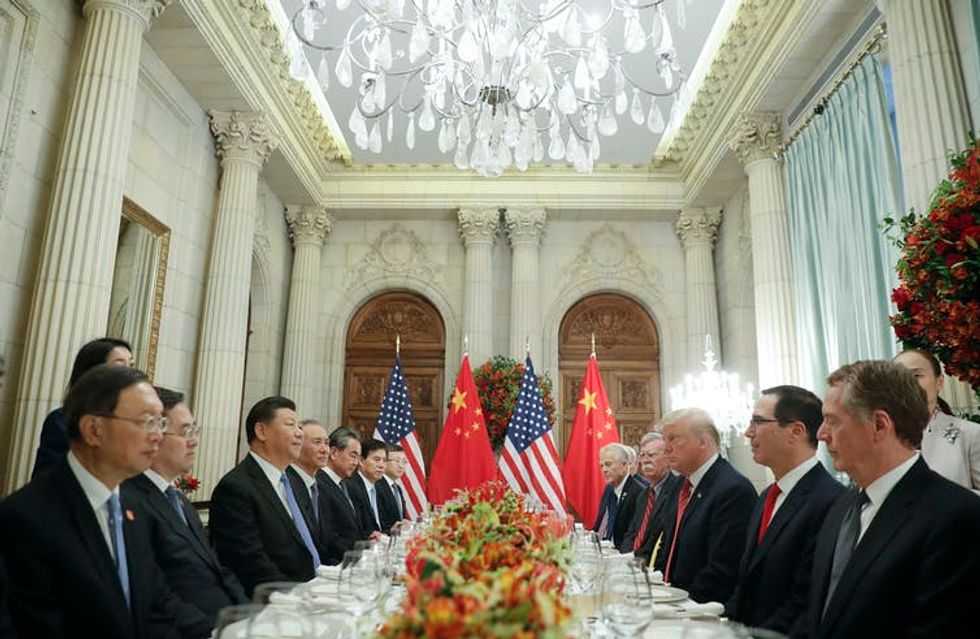
On Dec. 1, markets initially breathed a sigh of relief after Trump and Chinese President Xi Jinping reached a 90-day truce in the war, giving the two countries time to try to work through their differences. The optimism faded quickly, however, after conflicting reports emerged about what the two leaders actually agreed to and Trump called himself a “tariff man” in a threatening tweet.
The arrest of a Huawei official in Canada on a U.S. request further risked disrupting the tentative ceasefire, showing how fragile the Trump-Xi deal is and how easily the situation could return to a war footing.
Global headwinds
A second worry is slowing global growth.
In Europe, the combined economies of the 19 countries that use the euro barely grew in the most recent quarter – the lowest in four years – and economists are warning recession may be coming to the continent. At the same time, Britain’s impending and potentially chaotic exit from the European Union is expected to hammer its economy.
And Trump’s trade war and tariffs – which are not only squeezing the Chinese economy but many other countries such as Canada, Mexico and members of the EU – are making matters worse.
All these challenges convinced the International Monetary Fund to lower its global growth forecast for 2019 from 3.7 percent to 3.5 percent and warn of increasing “downside risks” as a result of the tariffs and other problems.
A global growth slowdown means foreigners will buy less American-made stuff, which ultimately hurts the U.S. economy.
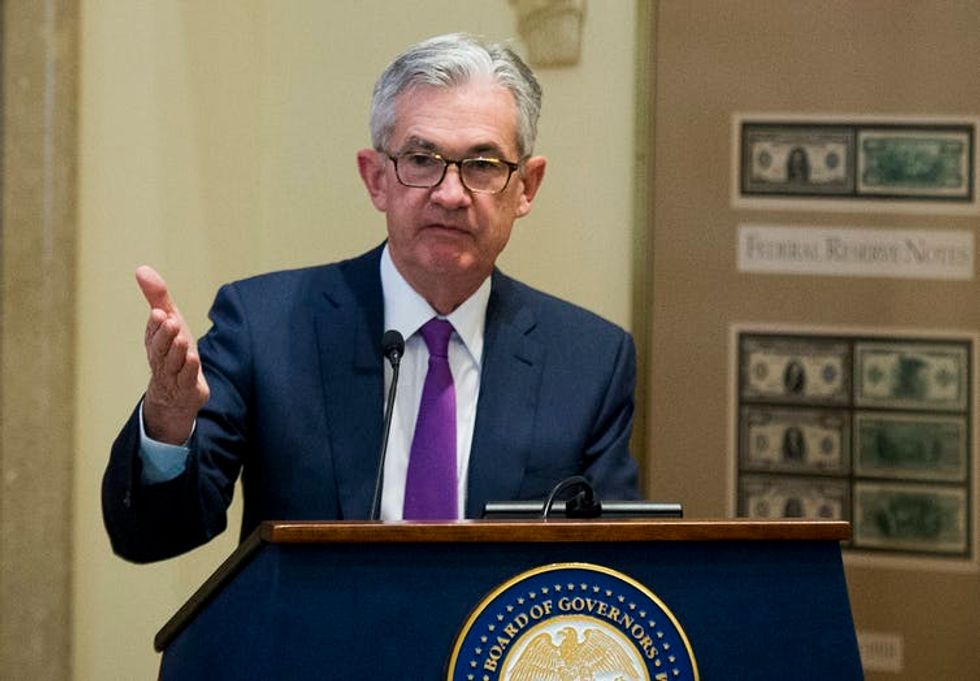
Fed Chair Jerome Powell may slow the pace of interest rate hikes.
These problems are serious enough that they’re even rattling the Federal Reserve.
Until now, the U.S. central bank has been on a deliberate path of gradually raising interest rates on the premise that the American economy was fundamentally strong and would continue to grow. As recently as October, Fed Chair Jerome Powell described the economy’s low unemployment and subdued inflation as sustainable and “not too good to be true.”
That may no longer be the case. Wall Street traders, who previously had some faith that the Fed will follow through on its plan to raise rates several times in both 2019 and 2020, increasingly don’t expect even a single rate hike next year. Since the central bank typically raises rates when the economy is strong, that suggests they believe it has serious concerns about its trajectory.
The resulting unpredictability over what the Fed’s going to do next has shaken investors and markets and contributed to fears about an impending recession, which is typically defined as two straight quarters of declines in overall economic activity. We may learn more on Dec. 19, when the Fed is expected to raise interest rates for the ninth time since 2015.
So is a recession imminent?
The current expansion has lasted since the official end of the Great Recession in June 2009, or almost nine and a half years. If it lasts seven months more, it’ll be the longest expansion in at least 160 years.
Because of the cyclical nature of business activity, there is no question that a recession will inevitably occur at some point in the future. Whether it’ll happen next year or further down the road is hard to predict. But you could argue, perhaps we’re due.
In demonising orcs, the ugly, monstrous enemy of the elves, did JRR Tolkien betray a belief that “some races are worse than others”? That’s the debate that has been at the heart of claims in the British press recently accusing the Lord of the Rings author of harbouring racist views.
The subject of Tolkien and race is not new; it has been discussed comprehensively by scholars, including my own study. What’s more, it has already been explored extensively in the media. The last burst of this media debate was in 2002, prompted by Peter Jackson’s Lord of the Rings movie trilogy.
Why now?
The latest media interest was triggered by a Wired podcast with fantasy fiction author Andy Duncan in which he discussed his 2002 short story Senator Bilbo, whose main character shares a name with Tolkien’s Hobbit hero, Bilbo Baggins. In it, Duncan imagines the real Senator Theodore G Bilbo – the early 20th-century, white supremacist senator of Mississippi – opposing the immigration of orcs in Tolkien’s Shire in a post-Lord of the Rings era.
This fictional senator is against any foreigner who may “contaminate” the purity of the Shire. The story is a clever, well-written parody in which orcs are portrayed as misunderstood and discriminated against. But in the podcast, Duncan spoke of the “repeated notion in Tolkien that some races/peoples are worse than others” and how this idea can lead to dangerous outcomes.
Is he right? Well, yes and no.
Tolkien’s world
Tolkien’s Middle-Earth is hierarchical, employing the medieval “chain of being”, a powerful visual metaphor that ranked all life forms according to their proportion of “spirit” and “matter”. God and the angels are at the top, human beings below, animals further down, and so on.
Similarly, Tolkien’s elves are at the top of the Middle-Earth hierarchy, while orcs are at the bottom, because of their corresponding moral and spiritual qualities (or lack of). In Tolkien’s mythology, orcs are traditionally “monstrous”; they represent corrupted, twisted versions of elves and men, made by Morgoth (the original Dark Lord of Tolkien’s world).
Theologically, this works. And it still worked as long as Tolkien was writing a mythology, that is, the cycle of elvish myths and legends that make up The Silmarillion (begun before Lord of The Rings, never finished, and published after Tolkien’s death).
But in writing The Lord of the Rings, Tolkien switched narrative modes. He was now writing a novel, with different demands of characterisation, dialogue, and so on. The orcs became more rounded characters. They acquired a clearer physical appearance, humour and personality. They became people.
At around the same time, Tolkien started rethinking the origin of the orcs. “Corrupted” versions of elves and men made sense theologically, because the evil Morgoth wouldn’t have had the power to create new beings but only twist existing ones. But in that case, did these orcs have free will? Could they be redeemed?
Tolkien agonised over this, and the idea that these monstrous creatures could once have been lofty elves. He tried out several explanations about their origin, even the possibility that orcs were automata with only echoic speech, like parrots.
He never completed The Silmarillion, so there is no final “solution” to the question of their origin. Yet, the orcs in The Lord of the Rings undoubtedly have racial characteristics which are problematic: we never get a detailed description in the text, but recurring traits include slanted eyes and swarthy complexions. These elements sound straight out of Victorian anthropology, linking mental qualities and physique.
Does intention matter?
Tolkien wasn’t the first to make evil and monstrous fantasy beings seem racially “other”. George MacDonald’s goblins in The Princess and the Goblin are equally (and uncomfortably) a product of 19th-century anxieties about race and evolutionary degeneration. As award-winning black fantasy author NK Jemisin has commented, “Orcs are fruit of the poison vine that is human fear of ‘the Other’.” Does that mean that Tolkien was racist? Well, it’s more complicated than that.
Literary texts are not created in a vacuum. They are part of a tradition. They respond to other texts and their expectations. Tolkien’s early work was an attempt to write a mythology, so monstrous beings would be very much expected. George MacDonald had already taken goblins from European folklore and made them the enemy of his “good” characters, and Tolkien borrowed the term “orc” from demonic beings in Beowulf.
That Tolkien’s monsters (like MacDonald’s) also responded to anxieties, concerns, and even “scientific” debates of his time about racial characteristics is not unexpected, but adds a layer of complexity to the orcs. Though Tolkien denounced “racialist” theories, refused to declare Aryan origin to secure a German translation of The Hobbit, and railed against Nazi Germany, it doesn’t mean that some prejudices bequeathed by his late-Victorian/early-Edwardian upbringing didn’t creep into the worldview we see in Middle-Earth.
Ideology is a powerful thing and its role in literature is complicated. There are authors who write with a social or political agenda. And there are authors who don’t, but their worldview, beliefs and values are implicit in the texts they produce. I believe Tolkien’s racial prejudices are implicit in Middle-Earth, but his values – friendship, fellowship, altruism, courage, among many others – are explicit, which makes for a complex, more interesting world.
In The Lord of the Rings, Middle-Earth is a place where different “races” and peoples need to come together and cooperate to triumph over what is predominantly a moral foe. The scene where Sam Gamgee is looking at a dead foe, wondering whether he was truly evil, or just a fellow being coerced into war, is far from demonising the enemy or dehumanising the “other”. Such complexities are the reason some literary works continue to be read and have different meanings for new generations.
President Donald Trump did not know about a U.S. request for the extradition of Huawei’s chief financial officer from Canada before he met with Chinese President Xi Jinping over dinner last weekend, a White House official said on Thursday.
Huawei Technologies Ltd’s CFO Meng Wanzhou, the daughter of the company’s founder, was arrested in Canada on Dec. 1 and faces extradition to the United States. The United States has been looking since at least 2016 into whether Huawei violated U.S. sanctions against Iran.
(Reporting by Roberta Rampton; Writing by Makini Brice)
Vanity Fair reported the speech was part of the United Nations Correspondents Association Awards where she was honored with the 2018 Global Citizen of the Year award. She said that the American president has given license for anyone to attack or kill journalists around the world.
“The U.S. president has given such regimes a green light and labeled the press in this country the ‘enemy of the people,’” she said, referencing the torture and assassination of a Washington Post reporter.
“And, of course, two months ago a Washington Post journalist, Jamal Khashoggi, walked into a consulate in Istanbul and was brutally tortured to death," she continued. "In many of the cases that I have worked on, too, I have seen journalists and opposition figures ruthlessly targeted so that they can no longer criticize leaders.”
She honored “journalists being recognized for groundbreaking reporting" in the past year despite many overcoming significant opposition.
“You are being jailed at a higher rate than ever,” she continued. “And you are dying while covering wars, not just because you walk, unarmed, into some of the most dangerous places on earth. But because you are being targeted for exposing crimes committed in war. For speaking the truth that perpetrators find the most difficult to hear.”
Clooney hasn't come out so overtly against Trump in the past but VF noted she hasn't held back her disdain for him in the past.
“The president of a country should not publicly ridicule a woman who has come forward to allege abuse,” she told attendees at the Pennsylvania Conference for Women in October, after Brett Kavanaugh's confirmation hearing.
Clooney married a famous American actor in 2014, who was also in attendance.
There are no direct offsets – known as "PAYGO" – in the legislation to pay for a wall many consider both unnecessary and racist. But the bill would attempt to squeeze $25 billion from immigrant and low-income parents and workers, including those who receive federal benefits like food stamps.
Instead of taking the funds directly from elsewhere in the federal budget, according to a statement from Senator Cruz, the wall would be funded by tightening requirements of government programs for low-income workers.
Among them, the Child Tax Credit and the Earned Income Tax Credit (EITC). Other federal programs, like food stamps, would require recipients to prove citizenship.
Those who cannot prove they meet the new standards, namely, that they are U.S. citizens or legally permitted to receive benefits, would be kicked out of the programs. Others who are eligible but fearful of the new regulations may also neglect to collect them. And some may not learn they need to produce proof.
Cruz says additional funding would come by increasing "the minimum fines on illegal border crossers" and establishing a "minimum penalty for visa overstays."
Senator Cruz provided no proof these federal welfare programs are being abused by non-citizens or ineligible workers, or that increasing fines would net $25 billion.
"Currently only the child needs a SSN, not the parent benefiting from the refundable child tax credit. The WALL Act would require the parent to have a valid work-eligible social security number," Cruz says. "Before 2003, the Social Security Agency did not distinguish between work-eligible and non-work eligible SSNs. Therefore, there are individuals benefiting from the EITC they are not authorized to receive because they are non-work eligible."
Cruz's bill could prevent legal child citizens from being able to access government programs like food stamps.
HuffPost reports the claim that undocumented immigrants are "are stealing benefits from Americans" is "divorced from reality."
But legal immigrants who are eligible for programs like food stamps are refusing to sign up, for fear they will be deported. That means some children are not getting the food they need. The WALL Act feeds those fears, not the children who need help the most.
“I have long called for building a wall as a necessary step in defending our border and stopping the flow of illegal immigration into our country,” Cruz says in his statement. “The overwhelming majority of Texans and Americans want to see the border secured."
Meanwhile, in a separate statement announcing the WALL Act, Senator Inhofe took the opportunity to advocate for his bill, the Asylum Abuse Reduction Act. Sen. Inhofe's statement is riddled with falsehoods.
"Currently, migrants who cross the border illegally and declare asylum are released pending credible fear screenings and other legal procedures, but rarely show up for proceedings – never completing the asylum process," he claims.
Inhofe also claims, "most migrants don’t show up for their court date."
Both claims are 100% false.
According to PunditFact, a fact-checking offshoot of PolitiFact, an Obama-era program for asylum seekers that President Trump has since killed, boasted a 100% attendance record at court hearings. It also had a 99% show rate of check-ins and appointments with ICE.
"Around 60-75 percent of non-detained migrants have attended their immigration court proceedings, according to Justice Department data from the last five available years," PunditFact reports, expanding their review to all migrants. "Some limited data suggests rates may be higher for asylum-seekers."
Inhofe's bill would also turn local police departments and court systems into arms of ICE, forcing them to issue "a criminal bench warrant for immigrants that have failed to appear for immigration court."
Legally, that's at best problematic, and possibly unconstitutional.
The other two GOP Senators introducing the bill are Mike Rounds of South Dakota and John Kennedy of Louisiana.
President Trump for over a year promised voters Mexico would pay for the wall. He then said it would be paid for by some sort of tariff system, and ultimately insisted U.S. taxpayers fund it so he could keep his campaign promise.
The percentage of Americans who do not identify with any religious tradition continues to rise annually. Not all of them, however, are atheists or agnostics. Many of these people believe in a higher power, if not organized religion, and their numbers too are steadily increasing.
The history of organized religion is full of schisms, heresies and other breakaways. What is different at this time is a seemingly indiscriminate mixing of diverse religious traditions to form a personalized spirituality, often referred to as “cafeteria spirituality.” This involves picking and choosing the religious ideas one likes best.
At the heart of this trend is the general conviction that all world religions share a fundamental, common basis, a belief known as “perennialism.” And this is where the unlikely figure of Meister Eckhart, a 14th-century Dominican friar famous for his popular sermons on the direct experience of God, is finding popular appeal.
Who was Meister Eckhart?
I have studied Meister Eckhart and his ideas of mysticism. The creative power that people address as “God,” he explained, is already present within each individual and is best understood as the very force that infuses all living things.
He believed this divinity to be genderless and completely “other” from humans, accessible not through images or words but through a direct encounter within each person.
The method of direct access to the divine, according to Eckhart, depended on an individual letting go of all desires and images of God and becoming aware of the “divine spark” present within.
Seven centuries ago, Eckhart embraced meditation and what is now called mindfulness. Although he never questioned any of the doctrines of the Catholic Church, Eckhart’s preaching eventually resulted in an official investigation and papal condemnation.
Significantly, it was not Eckhart’s overall approach to experiencing God that his superiors criticized, but rather his decision to teach his wisdom. His inquisitors believed the “unlearned and simple people” were likely to misunderstand him. Eckhart, on the other hand, insisted that the proper role of a preacher was to preach.
He died before his trial was complete, but his writings were subsequently censured by a papal decree.
Since then, he has attracted many religious and non-religious admirers. Among the latter were the 20th-century philosophers Martin Heidegger and Jean-Paul Sartre, who were inspired by Eckhart’s beliefs about the self as the sole basis for action. More recently, Pope John Paul II and the current Dalai Lama have expressed admiration for Eckhart’s portrayal of the intimate relationship between God and the individual soul.
During the second half of the 20th century, the overlap of his teachings to many Asian practices played an important role in making him popular with Western spiritual seekers. Thomas Merton, a monk from the Trappist monastic order, for example, who began an exploration of Zen Buddhism later in his life, discovered much of the same wisdom in his own Catholic tradition embodied in Eckhart. He called Eckhart “my life raft,” for opening up the wisdom about developing one’s inner life.
Richard Rohr, a friar from the Franciscan order and a contemporary spirituality writer, views Eckhart’s teachings as part of a long and ancient Christian contemplative tradition. Many in the past, not just monks and nuns have sought the internal experience of the divine through contemplation.
Among them, as Rohr notes were the apostle Paul, the fifth-century theologian Augustine, and the 12th-century Benedictine abbess and composer Hildegard of Bingen.
In the tradition of Eckhart, Rohr has popularized the teaching that Jesus’ death and resurrection represents an individual’s movement from a “false self” to a “true self.” In other words, after stripping away all of the constructed ego, Eckhart guides individuals in finding the divine spark, which is their true identity.
Eckhart and contemporary perennials
Novelist Aldous Huxley frequently cited Eckhart, in his book, ‘The Perennialist Philosophy.’
This subjective approach to experiencing the divine was also embraced by Aldous Huxley, best known for his 1932 dystopia, “Brave New World,” and for his later embrace of LSD as a path to self-awareness. Meister Eckhart is frequently cited in Huxley’s best-selling 1945 spiritual compendium, “The Perennialist Philosophy.”
More recently, the mega-best-selling New Age celebrity Eckhart Tolle, born Ulrich Tolle in 1948 in Germany and now based in Vancouver, has taken the perennial movement to a much larger audience. Tolle’s books, drawing from an eclectic mix of Western and Eastern philosophical and religious traditions, have sold millions. His teachings encapsulate the insights of his adopted namesake Meister Eckhart.
The cautionary note, however, is in too simplistic an understanding of Eckhart’s message.
Eckhart, for instance, did not preach an individualistic, isolated kind of personal enlightenment, nor did he reject as much of his own faith tradition as many modern spiritual but not religious are wont to do.
The truly enlightened person, Eckhart argued, naturally lives an active life of neighborly love, not isolation – an important social dimension sometimes lost today.
Meister Eckhart has some important lessons for those of us trapped amid today’s materialism and selfishness, but understanding any spiritual guide – especially one as obscure as Eckhart – requires a deeper understanding of the context.
Facebook Chief Executive Mark Zuckerberg questioned the business case for giving millions of outside software developers wide access to customer data before endorsing the practice in 2012, according to internal emails published on Wednesday.
The decision made it possible for a quiz app to gather data on about 87 million Facebook users the following year, and later share the information with the now-defunct British political consulting firm Cambridge Analytica, which worked on Donald Trumps’ presidential campaign.
Zuckerberg lamented his choice in a Facebook post on Wednesday, saying that cracking down a year earlier could have helped the company avoid a privacy scandal that has tarred its reputation.
The CEO’s 2012 emails, obtained by a British government panel investigating Facebook, provide an unusual window into the internal deliberations over the critical strategic question of how much customer data the social network should share.
Facebook had recently gone public and was counting on third-party apps such as games to help drive growth.
But Zuckerberg questioned whether such apps and the data they sent back to Facebook were producing sufficient increases in usage and revenue.
“In theory, we want information, but are the posts developers are giving us actually valuable?” Zuckerberg wrote in response to a lengthy email from a lieutenant. “They don’t seem to be for targeting (content) and I doubt they drive meaningful increases in engagement either.”
A proposed alternative was charging apps for access to Facebook user data, though such a move would have likely limited the number of apps that worked with Facebook, Zuckerberg wrote in one message.
Facebook stayed the course, with Zuckerberg rejecting fees in late 2012.
“The purpose of the platform is to tie the universe of all the social apps together so we can enable a lot more sharing and still remain the central hub,” he said in an email to several top executives. “This finds the right balance between ubiquity, reciprocity and profit.”
By 2014, Facebook had moved to restrict the free promotion and wide data access from which outside developers benefited. Though the tools and data remained free, they became less valuable to many app makers.
Facebook did not immediately respond to a request for comment.
SHIFTING GEARS
The deliberations in the late 2012 emails focused on profit rather than privacy.
Zuckerberg and senior leaders debated how data-exchange deals with companies like Spotify and Pinterest could generate revenue, believing that Facebook was getting less benefit from the arrangement than its partners.
Zuckerberg loosely proposed the idea of charging apps 10 cents for every user data request, a fee he estimated would cost Spotify and Pinterest about $3 million annually, according to one email.
In another thread, he and Sam Lessin, a director of product management, weighed the consequences.
Facebook had “maximized profit” from games integrating with Facebook by charging them a fee, Zuckerberg said.
But charging had led the best games to abandon Facebook’s services, Lessin said, and he was “not proud” of those that remained. Lessin did not respond to a request to comment.
Ultimately, Zuckerberg in the emails stuck with the goal he had set when launching the developer tools years earlier: Get people to share more items on Facebook.
In its IPO filing, the company said working with other apps was “key” to increasing usage of Facebook and had improved its ability to personalize news feeds.
If Facebook made it easy for more apps to integrate social features, Zuckerberg wrote months later, “we should be able to unlock more sharing in the world and on Facebook.”
Reporting by Paresh Dave; Editing by Jonathan Weber and Neil Fullick
A US museum has vowed to fight a decision by Italy's highest court which this week ordered that a prized bronze statue at the center of an epic legal dispute be returned to Italy.
In a statement, the J. Paul Getty Museum said the more than 2,000-year-old statue named "Victorious Youth" was found in international waters in 1964 and was legally purchased by the museum in 1977.
"We will continue to defend our legal right to the statue," Lisa Lapin, vice president for communications at the Getty Trust, said in a statement issued on Monday.
"The law and facts in this case do not warrant restitution to the Italian government of a statue that has been on public display in Los Angeles for nearly a half century."
She added that any forfeiture order "is contrary to American and International law."
The decision handed down on Monday by Italy's supreme court came after a decade-long legal battle over the sculpture, also known as the Getty Bronze or by the name of its presumed sculptor Lysippos, one of the most prized antiquities on display at the Getty Villa, located on the outskirts of Los Angeles.
"Now we hope the US authorities will act as soon as possible to favor restitution of the Lysippos to Italy," Culture Minister Alberto Bonisoli told the ANSA news agency following the court's decision.
- 'Final word from Italy' -
GETTY IMAGES NORTH AMERICA/AFP/File / Stefanie Keenan The Getty Villa on October 11, 2018
The Getty, however, said it was not ready to surrender the relic.
Lapin said the museum had extensively researched the origins of the prized statue before purchasing it from an antiques dealer in Germany for $3.95 million, years after Italy's highest court had concluded there was no evidence the object belonged to Italy.
"The statue is not and has never been part of Italy's cultural heritage," Lapin said. "Accidental discovery by Italian citizens does not make the statue an Italian object.
"Found outside the territory of any modern state, and immersed in the sea for two millennia, the Bronze has only a fleeting and incidental connection with Italy."
Italian officials dispute Getty's arguments and maintain that the life-size statue was found off Italy's Adriatic coast by Italian fishermen and as such rightfully belongs to the state.
They say the statue was sold to an Italian art dealer after its discovery and was subsequently sold several times before it was smuggled illegally out of the country and eventually purchased by the Getty.
Last June, a judge in Pesaro, a coastal town on the Adriatic Coast, ruled that the statue be confiscated. The Getty museum had appealed the decision and Italy's supreme court rejected the appeal on Monday.
Pesaro prosecutor Silvia Cecchi told local media that the court's decision "was the final word from the Italian justice" system and that the statue must be returned.
"It must be very clear that the order is effective immediately and we will apply this principle by notifying the American authorities," Cecchi said.
In 2007, following long negotiations, The Getty agreed to return more than 40 works of art to Italy after questions were raised about their provenance.
The likely incoming Democratic chairman of the congressional panel overseeing the U.S. census said on Tuesday he aims to pressure the Trump administration into removing a question about citizenship from the 2020 census questionnaire.
Representative Gerald Connolly said that when Democrats assume leadership of the House of Representatives in January, they plan to call Commerce Secretary Wilbur Ross to testify about the citizenship question, which has spurred criticism and lawsuits.
Ross earlier “lied to Congress” about why the question was added to the census, Connolly told Reuters in an interview.
“My hope is we get this question removed from the actual census,” Connolly said in an interview with Reuters, saying he would seek to bring that about by calling the public’s attention to the issue.
“It’s not too late ... we have until June before the forms are finalized,” he said.
Evidence produced by the committee could also be cited by courts investigating the matter, he said.
Ross announced the citizenship question in March, billing it as a way to help enforce the Voting Rights Act, which requires a tally of citizens of voting age to protect minorities against discrimination.
Critics have said the question could depress the response to the census from immigrants, who often live in Democratic-leaning areas. If undercounted, areas with high immigrant populations could lose seats in the House.
Numerous U.S. states and cities have sued the administration to have the question removed, calling it unconstitutional.
U.S. congressional elections last month gave Democrats control of the House starting in January. Connolly is expected to chair the government operations subcommittee, part of the House Oversight Committee.
Connolly and Representative Elijah Cummings, likely chairman of the full Oversight Committee, earlier this year questioned Ross’ contention that the Commerce Department added the citizenship question at the request of the Justice Department, saying court documents indicated Commerce initiated the idea.
“Wilbur Ross has a problem. ... He told Congress previously that (the Justice Department) kind of made him do it. We now know that’s not true. ... That means you (Ross) lied to Congress about this,” Connolly said Tuesday. “Why? If you are so confident in the importance of this question, why would you feel compelled to lie about it?” he said.
A Commerce Department spokesman said Ross had explained his rationale in March for including the citizenship question, and that nothing in the court documents subsequently produced “changes the sound rationale he articulated.”
Reporting by Susan Cornwell; Editing by Peter Cooney
Murtaza Ahmadi moved the world with his love for footballer Lionel Messi in 2016. His dream of meeting the Argentinian came true, but now the seven-year-old boy is living a nightmare as one of thousands of Afghans displaced by war.
Murtaza and his family abandoned their home in southeastern Ghazni province in November, along with hundreds of others fleeing intense fighting after the Taliban launched an offensive in the previously safe area.
Now they are among the thousands of similarly uprooted people struggling to get by in Kabul, and also living with the fear that the Taliban are hunting for their famous son.
AFP / STR Murtaza Ahmadi's brother made him a makeshift jersey out of a blue and white striped plastic bag, with Messi's name and famous number 10 written carefully on the back in felt-tip pen
The image of Murtaza sporting a makeshift Messi jersey -- made of a blue and white striped plastic bag and with Messi's name and famous number 10 written carefully on the back in felt-tip pen -- flooded media and social networks in 2016.
The media hype drew the football superstar's attention, and that year Murtaza met his idol in Qatar, where he walked out onto the pitch clutching Messi's hand as a mascot for a Barcelona friendly.
Messi, a UNICEF goodwill ambassador, also gave his tiny fan an autographed jersey and a football.
But the moment of happiness has quickly dissipated.
AFP met with the family recently in the cramped room in Kabul they are renting from another impoverished family, where Murtaza's mother Shafiqa told how they had fled their home district of Jaghori in the night after hearing gunshots.
"We couldn't take any of our belongings, we left only with our lives," she said, her face half hidden by a scarf.
AFP/File / KARIM JAAFARAfter images of his plastic Messi jersey went viral, Murtaza met his idol in Qatar
The family belongs to the Shiite-denominated Hazara ethnic group, who were targeted by the Sunni Taliban in their November operation in Ghazni.
The UN says up to 4,000 families fled, with witnesses describing "absolute terror" to AFP. Hundreds of civilians, soldiers, and insurgents were killed in the fighting.
The fear felt by the Ahmadi family was ratcheted up when they learned that the Taliban were searching for the small Murtaza by name.
"(They) said if they capture him, they will cut him into pieces," Shafiqa said, her eyes horrified.
Sports were rarely tolerated under the 1996-2001 Taliban regime, and the Kabul football stadium was a well-known venue for stonings and executions.
Shafiqa said she hid her famous son's face with a scarf to prevent him from being recognised as they fled.
They took refuge first in a mosque in Bamiyan, before arriving in Kabul six days later. Among their belongings left behind are the football and jersey signed by Messi.
- 'I miss Messi' -
Although Afghan security forces have beaten back the Taliban in Jaghori, the family says it no longer feels safe.
AFP / NOORULLAH SHIRZADAThe family lives under precarious conditions, with inadequate shelter, food, water or sanitation available to the refugees
"The danger of the Taliban coming back is high, going back is not an option," Shafiqa said.
The attention they received as a result of Murtaza's fame has added to their fears, she continued.
"Local strongmen were calling and saying, 'You have become rich, pay the money you have received from Messi or we will take your son'," she said.
"At night we would sometimes see unknown men, watching and checking our house, and then the calls. During the days, we wouldn't dare let him outside home to play with other children."
The family have already fled once before, to Pakistan in 2016, where they sought asylum in "any safe country".
They returned reluctantly to Jaghori after their money ran out, Shafiqa said.
AFP / NOORULLAH SHIRZADAThey are among the more than 300,000 Afghans who have fled their homes due to violence since the beginning of this year alone
Murtaza's father Arif remains in Jaghori working as a farmer while his family lives in Kabul under precarious conditions, with inadequate shelter, food, water or sanitation available to the refugees.
They are among the more than 300,000 Afghans -- 58 percent of whom are under the age of 18 -- who have fled their homes due to violence since the beginning of this year alone, according to the most recent tally by the UN's agency for humanitarian affairs.
Homayoun, Murtaza's eldest brother who made him his plastic jersey, says that even in Kabul he is afraid. "We are worried something bad will happen if they know who Murtaza is," he said.
Little Murtaza, meanwhile, says he misses his football and his jersey from Messi.
"I want them back so I can play," he told AFP.
"I miss Messi," he added.
"When I meet him, I will say, 'Salaam' and 'How are you?' Then he will reply saying thank you and be safe, and I will go with him to the pitch where he will play and I will watch him."
Five U.S. Marines were missing after two Marine Corps aircraft collided in mid-air and crashed into the sea off the coast of Japan during an air-to-air refueling exercise on Thursday, Japanese and American officials said.
Japan’s defense ministry said its maritime forces had so far found two of the seven Marines who were aboard the aircraft - an F/A-18 Hornet fighter jet and a KC-130 Hercules - at the time of the incident.
One was in a stable condition at Marine Corps Air Station Iwakuni, while the second had been found about 10 hours after the collision and brought aboard a Japanese military vessel, the ministry said. No other details about the second Marine were known, a ministry spokesman said.
Search-and-rescue efforts for the remaining five continued, Japan’s highest-ranking military officer said.
“We plan to keep at it all through the night,” Katsutoshi Kawano, chief of the Japanese Self-Defence Forces’ Joint Staff, told a news conference.
The incident adds to a growing list of U.S. military aviation accidents around the world in recent years, prompting hearings in Congress to address the rise.
The Military Times reported earlier this year that aviation accidents jumped nearly 40 percent from fiscal years 2013 to 2017. At least 133 service members were killed in those incidents, it said.
Congressional leaders have called the rash of accidents a “crisis” and blamed it on continuous combat operations, deferred modernization, lack of training and ageing equipment.
U.S. military accidents are a sensitive topic in Japan, particularly for residents of the southern prefecture of Okinawa, which is home to the bulk of the U.S. presence in the country. A series of emergency landings and parts falling from U.S. military aircraft have highlighted safety concerns.
People in a Tokyo hospital waiting room fell silent as news of the crash came on television, with one woman whispering to another, “This is so scary.”
“The incident is regrettable, but our focus at the moment is on search and rescue,” Japanese Defence Minister Takeshi Iwaya told a news conference. “Japan will respond appropriately once the details of the incident are uncovered.”
U.S. Ambassador William Hagerty thanked Japan’s military for their search-and-rescue efforts and confirmed the incident occurred during a refueling exercise.
“My heart goes out to the families and colleagues of Marines involved in this tragedy,” Hagerty said at an event at Waseda University in Tokyo.
“They risk their lives every day to protect Japan and to protect this region and sometimes they pay the greatest costs. So I want to emphasize this security alliance that we have is critical and it is moving forward to the right direction,” he said.
The Marine Corps said in a statement the incident occurred around 2 a.m. local time in Japan (1700 GMT Wednesday) about 320 km (200 miles) off the Japanese coast.
The two aircraft had launched from Marine Corps Air Station Iwakuni and were conducting regular training when the incident occurred, it said.
Reporting by Phil Stewart and Idrees Ali in Washington, Kaori Kaneko, Tim Kelly, Elaine Lies and Mayuko Ono in Tokyo; Writing by Chang-Ran Kim; Editing by Peter Cooney, Rosalba O'Brien and Michael Perry








 GETTY IMAGES NORTH AMERICA/AFP/File / Stefanie Keenan
  AFP / STR
  AFP/File / KARIM JAAFAR
 AFP / NOORULLAH SHIRZADA
 AFP / NOORULLAH SHIRZADA
_BW_Meister_Eckhart_(Skulptur).JPG)