Lauren Southern, a far-right Canadian activist best known for her attacks on refugees and her promotion of bogus "white genocide" narratives, has been denied entry into Australia because she filled out the wrong visa form.
Australia's SBS News reports that Southern this week was denied a visa ahead of what had been a planned speaking tour in Australia.
According to the Australian government, Southern applied for an Electronic Travel Authority (ETA) visa, which SBS News says allows for "short-term business or travel stays for events like conferences."
However, the visa does not cover the kind of lengthy speaking tour that Southern planned to engage in, and she's been told that she will have to fill out a different visa application to gain entry to the country.
"The individual has a visa application before the Department which remains under consideration," a spokesman for Australia's Department of Homeland Affairs tells SBS News. "For visitors who may hold controversial views, any risk they may pose will be balanced against Australia’s well-established freedom of speech and freedom of beliefs, amongst other relevant considerations."
She also recently recorded a video warning Australians that they may soon fall prey to the dangers of "multiculturalism."
"Do you want to retain your culture, do you want to retain your borders, family, identity, or will the boats keep coming?" she asked in the video. "Will the no-go zones keep growing, and will you become another victim of multiculturalism?"
Movie producer Harvey Weinstein pleaded not guilty on Monday to charges of sexually assaulting a woman in 2006, the third criminal sex assault case brought against him, and his attorney said he expects further charges to follow.
More than 70 women, mostly young actresses and other women employed in the movie business, have accused Weinstein of sexual misconduct, including rape, in a series of incidents dating back decades.
The accusations against Weinstein sparked the #MeToo movement that has seen hundreds of women publicly accuse powerful men in business, politics and entertainment of sexual harassment and abuse, lifting a shroud that had long shielded such behavior.
Dressed in a dark suit and tie on Monday, the 66-year-old co-founder of the Miramax film studio was brought handcuffed into a Manhattan courtroom to face the latest charges.
New York state Supreme Court Justice James Burke rejected prosecutors’ request to order house arrest for Weinstein, allowing him to remain free on the $1 million bail that has been in effect since he pleaded not guilty in June to charges he assaulted two other women, one in 2004 and one in 2013.
Weinstein was subdued throughout the hearing, pleading “not guilty” and responding “yes, sir” when the judge told him to stay away from his accusers. He walked to the courthouse with a copy of “A Talent for Trouble,” the 1997 biography of “Ben-Hur” film director William Wyler, according to CNN.
“Mr. Weinstein is not a predator, he is not a rapist and I believe when this case is over we will ultimately see him to be exonerated,” defense attorney Benjamin Brafman told journalists after Monday’s hearing.
Brafman said that prosecutors may file additional charges against Weinstein.
Prosecutor Joan Illuzzi said the number of Weinstein accusers “shows the breadth of the criminality here.”
Prosecutors contend Weinstein forcibly performed oral sex on the woman in 2006. The latest charges carry a maximum life sentence.
Earlier charges included two counts of rape and one count of criminal sexual act. Weinstein was charged after a months-long investigation by the New York Police Department.
After Weinstein was accused, his eponymous company Weinstein Co fired him and filed for bankruptcy, and he was expelled from the Academy of Motion Picture Arts and Sciences.
Through his company and Miramax, Weinstein won plaudits and awards for movies including “Shakespeare in Love,” “Pulp Fiction,” “Sex, Lies and Videotape,” “The Crying Game” and “The King’s Speech.”
Reporting By Tea Kvetenadze; Editing by Scott Malone, Jeffrey Benkoe and Jonathan Oatis
U.S. President Donald Trump again assailed fellow NATO members on Monday for not contributing enough to the alliance while maintaining a trade surplus with the United States, keeping up a drumbeat of criticism before meeting European leaders this week in Brussels.
On the eve of his departure for the two-day NATO summit Wednesday and Thursday, Trump linked two well-worn gripes: funding for the North Atlantic Treaty Organization and other countries’ trade practices.
“The United States is spending far more on NATO than any other Country. This is not fair, nor is it acceptable. While these countries have been increasing their contributions since I took office, they must do much more,” Trump wrote on Twitter.
In another tweet, the Republican president complained about Europe’s trade surplus with the United States. Trump has slapped tariffs on billions of dollars worth of steel and aluminum imports from China, the European Union, Canada and others, prompting retaliation against U.S. products. He is considering extending the levies to the auto sector.
Trump has been a harsh critic of NATO since the 2016 presidential campaign. After taking office, he affirmed the U.S. commitment to the defense of NATO allies but kept up complaints about Washington shouldering the financial burden.
By current standards, Washington funds about 70 percent of NATO spending. NATO members have agreed to spend 2 percent of economic output on defense every year by 2024, but Germany and Spain are among the countries not expected to meet the target.
At the first NATO summit he attended last year, Trump denounced Europe’s low defense spending and called for NATO to be on the front line against Islamic militants. He also surprised many NATO leaders by urging them to focus on illegal immigration.
This year, trade is on his mind.
“I’m going to tell NATO: You’ve got to start paying your bills. The United States is not going to take care of everything,” Trump said at a rally last week. “They kill us on trade.”
Founded to deter the Soviet threat in 1949, NATO is based on deep cooperation with the United States, which provides for Europe’s security with its nuclear and conventional arsenals.
NATO has found renewed purpose since Russia’s 2014 annexation of Crimea, sending battalions to the Baltics and Poland to deter potential Russian incursions.
Reporting by Doina Chiacu; editing by David Gregorio and Jonathan Oatis
As the conservative Tory government of the United Kingdom appears to be collapsing shortly before President Donald Trump's first visit to Britain, a whistleblower at the center of investigations into Russian meddling in the 2016 presidential campaign is sounding the alarms that the same tactics were used by President Vladimir Putin to sow political instability on both sides of the Atlantic.
Whistleblower Christopher Wylie, who worked for SCL, the England-based parent company of Cambridge Analytica, reminded of the impropriety that caused him to come forward.
“The company learned that there were segments of the population that responded to messages like ‘drain the swamp’ or images of border walls or indeed paranoia about the ‘deep state’ that weren’t necessarily reflected in mainstream polling or mainstream political discourse that Steve Bannon was interested in to help build his movement,” Wylie told the Senate Judiciary Committee in May.
“You have to remember,” Wylie testified before a British parliamentary committee, “part of the brilliance of Cambridge Analytica is it doesn’t need to make money because it’s Robert Mercer’s project. Robert Mercer is a billionaire. He doesn’t need to make money.”
“If you, as an investor of a company, put money into that company, that’s not classed as a political donation,” he explained. “You can continue to invest purposefully in a company so that it can also work for particular entities at a subsidized rate or, indeed, in some cases for free.”
"To the Americans, a discernible pattern of behaviour occurred during Brexit. Foreign contractors outside the jurisdiction of domestic authorities were used to manage major aspects of the campaign," Wylie explained. "The Americans want to understand what happened in the UK because similar operations appear to have occurred in their own elections."
"Together with two other whistleblowers, I reported Vote Leave to the Electoral Commission, the Information Commissioner’s Office and Metropolitan Police for breaches of electoral and data protection law," he continued. "I reported Leave.EU’s dealings with the Russian embassy to the National Crime Agency and intelligence services."
"Cheating is banned in elections because it creates undue influence on the electorate," Wylie noted. "If there are no consequences, why would any future campaign bother following the law?"
In an interview with CNN's Kate Bolduan, Sen. John Kennedy (R-LA) said he went to Russia to tell the Kremlin to "stop screwing with American elections," and to get out of Ukraine, Crimea and Syria.
The Louisiana senator went on to say that he "exchanged words" with Russian Foreign Minister Sergei Lavrov, who he called a "bully" and a "wise-ass."
"It got testy at times," Kennedy said later in the interview. "They, of course, deny everything. And I expected them to."
Russia struck the senator as an oligarchy focused on one man: President Vladimir Putin.
"They don't have a political philosophy," Kennedy said. "I mean, what's the political philosophy of the mafia?"
"The last time that the Russian government embraced Western values and democracy was never," he said. "We're not going to convert their political leadership. We're going to have to contain them. And the only way to contain them, you don't have to be ugly about it, but you've got to be very, very firm."
"Dealing with Putin is like hand-feeding a shark," the Louisianan Republican continued. "You can do it, but you have to do it very, very carefully."
Bolduan asked Kennedy if he left the meeting with Lavrov and other Kremlin officials "any more confident that the upcoming [American] election will happen free of Russian interference" — and the senator responded with an earnest "I don't know."
British police rushed to solve a murder mystery on Monday after a woman died following exposure to the nerve agent Novichok, four months after the same toxin nearly killed a former Russian spy in an attack that Britain blamed on Moscow.
Prime Minister Theresa May said she was "appalled and shocked" by the death of Dawn Sturgess, a 44-year-old mother of three who had been living in a homeless hostel in Salisbury in southwest England.
Sturgess and Charlie Rowley, 45, fell ill last weekend in the town of Amesbury, near Salisbury, the city where former double agent Sergei Skripal and his daughter Yulia were attacked with Novichok in March. They have since recovered.
The British government has called a meeting of its COBRA emergencies committee for 1:00pm (1200 GMT).
The Kremlin said it would be "absurd" to suggest Russia was involved in the death of Sturgess.
"We don't know that Russia has been mentioned or associated with this," President Vladimir Putin's spokesman Dmitry Peskov said.
"We consider that in any case it would be quite absurd."
Russia is "deeply concerned by the continuing appearance of these poisonous substances on British territory," which "present a danger not just for the British but for all Europeans," Peskov added.
Britain and its allies accused Russia of trying to kill the Skripals, prompting angry denials and sparking an international diplomatic crisis.
- 'No guarantees' -
Police said they could not yet say whether the nerve agent in the Amesbury case was linked to the Salisbury attack -- but it was their main line of inquiry.
The head of Britain's counter-terror police also said he could not rule out further contaminations.
"I simply cannot offer any guarantees," said Assistant Commissioner Neil Basu, who is leading the investigation.
He said people in Salisbury should not pick up strange items such as needles, syringes or unusual containers.
Whilst 21 other people have come forward with health concerns, they have been screened and "all been given the all-clear", he said.
Police and public health officials insist the risk to the wider public remains low.
Police said that given the deadly dose, the British couple were believed to have become exposed to Novichok by handling a "contaminated item", with speculation that it could have been the container used to administer the nerve agent to the Skripals.
Christine Blanshard, medical director at Salisbury District Hospital, where Sturgess and Rowley were being treated and where the Skripals were hospitalised, told The Daily Telegraph newspaper that staff had "worked tirelessly to save Dawn".
"This latest, horrendous turn of events has only served to strengthen the resolve of our investigation team as we work to identify those responsible for this outrageous, reckless and barbaric act," said Basu.
He said Rowley remained critically ill in hospital.
- 'Praying for Charlie' -
Residents of the homeless hostel in Salisbury where Sturgess lived, which was evacuated after the couple fell ill, expressed their devastation at the news of her death.
"It could easily have happened to anyone, to me or my partner," 27-year-old Ben Jordan told AFP. "We are really, really sad. I am praying for Charlie."
Around 100 counter-terrorism officers are helping in the investigation, which police said Friday could take "weeks and months".
So far, there is no evidence that the couple visited any of the sites involved in the Skripal case.
"Detectives will continue with their painstaking and meticulous work to gather all the available evidence so that we can understand how two citizens came to be exposed with such a deadly substance that tragically cost Dawn her life," Basu said.
Sturgess collapsed on the morning of June 30 and was taken to hospital. That afternoon, Rowley fell ill at the same address in Amesbury and was also hospitalised.
On Wednesday, the government's Defence Science and Technology Laboratory at Porton Down confirmed their exposure to Novichok.
Police said Sunday they were not yet able to say whether the nerve agent was from the same batch that the Skripals were exposed to.
The Skripals have been released from hospital but the investigation into the attack on them continues. No arrests have been made.
The U.S. dollar recovered from a 3-1/2 week low on Monday as the pound dived following the announcement that UK Foreign Secretary Boris Johnson resigned from the government.
Sterling fell to a daily low of $1.324 after Johnson quit in protest over Prime Minister Theresa May’s plans to leave the European Union. His was the second resignation in a day, leaving the British leader’s Brexit plans in tatters.
Johnson decided to walk just hours after May’s Brexit minister, David Davis, did the same over her EU plans. The pound rose half a percent earlier in the European session as traders focussed on the increased likelihood of a “soft Brexit” in which the UK and EU retain close trade ties. But the second exit provoked a risk-off response in the market.
The dollar index rose 0.4 percent against a basket of six major currencies to a daily high of 94.068. Other safe-haven currencies also benefited.
Against the pound, the Swiss franc strengthened to a daily low of 1.312. The sterling/Japanese yen cross rate also fell to a daily low of 146.56.
Earlier in the trading day, the dollar index had fallen 0.4 percent from Friday to 93.713, its lowest since June 14, after U.S. wages indicators disappointed dollar bulls while boosting risk appetite.
In spite of the dollar’s recovery on the back of the pound, the Chinese yuan maintained its gains after it rebounded as investors bought riskier assets following favorable U.S. jobs data last week and evidence that global trade tension has not yet slowed economic momentum.
Friday’s data showed average U.S. hourly earnings gained five cents, or 0.2 percent, in June after rising 0.3 percent in May. This suggested moderate inflation pressures, creating doubt that the Federal Reserve would raise interest rates a total of four times in 2018.
Nonfarm payrolls rose by 213,000 in June, more than expected, the data showed.
Investors appear to be ignoring the worsening trade conflict between the United States and China after the two countries imposed tariffs on $34 billion worth of each others’ goods on Friday
“There was nothing really surprising” in Friday’s trade announcement, said Omer Eisner, chief market analyst at Commonwealth Foreign Exchange Inc. “China’s response was measured and as a result I think we’ve seen the overall risk sentiment in markets improve.”
The yuan rose more than half a percent in offshore markets to 6.614 against the dollar, putting it on course for its biggest one-day rise in more than three months and further away from June’s lows - its biggest-ever monthly decline.
Reporting by Kate Duguid; Additional reporting by Tommy Wilkes and Saikat Chatterjee; editing by Larry King and Dan Grebler
President Donald Trump lashed out at China as his "handshake" agreement with North Korea appears to be falling apart -- and Twitter users mocked his bungled attempts at foreign policy.
Trump claimed he and Kim Jong-un had ended nuclear hostilities between the U.S. and North Korea last month after a meeting in Singapore, but a follow-up meeting over the weekend with Secretary of State Mike Pompeo went poorly.
"I have confidence that Kim Jong Un will honor the contract we signed &, even more importantly, our handshake," Trump tweeted. "We agreed to the denuclearization of North Korea. China, on the other hand, may be exerting negative pressure on a deal because of our posture on Chinese Trade-Hope Not!"
A Russian billionaire former associate of Donald Trump's ex-campaign manager won $16,000 damages in a lawsuit Monday against a model and a self-styled "sex coach" over a politically compromising video.
Anastasia Vashukevich and Alexander Kirillov were ordered to pay 500,000 rubles ($8,000) each to the plaintiff, Oleg Deripaska, said a spokeswoman for a court in Ust-Labinsk, southern Russia.
It also ordered them to delete all of Vashukevich's online videos and pictures showing Deripaska, the spokeswoman Oksana Shareiko told AFP.
Aluminium tycoon Deripaska had sought two million rubles in damages. He had accused Vashukevich of violating his privacy.
He sued the self-styled model Vashukevich and Kirillov over a video she apparently shot on his yacht.
It appeared to show Sergei Prikhodko, an influential Russian deputy prime minister at the time, vacationing on Deripaska's yacht.
Prikhodko had formerly been President Vladimir Putin's foreign policy advisor.
The video raised new questions about Russia's alleged meddling in the 2016 presidential election that brought Trump to power.
Deripaska was once an associate of Trump's former campaign director Paul Manafort.
Russian opposition figure Alexei Navalny published the video in an investigation into corruption among top government officials.
In a rare statement to the press, Prikhodko called Deripaska "my friend" and added that he did not know Manafort personally.
The state media watchdog earlier this year threatened to block Instagram and YouTube if the two sites did not delete the videos and pictures of Deripaska and Prikhodko.
Vashukevich is a national of ex-Soviet Belarus. She goes by the nickname Nastya Rybka.
She, Kirillov and several others were detained in Thailand in February when police raided their "sex training course" in the seaside city of Pattaya.
The two defendants were not present at the Russian ruling on Monday. They are awaiting trial in Thailand.
A pre-trial hearing in Pattaya is scheduled for July 19.
In Thailand, the model has made cryptic offers to reveal secrets about alleged Russian meddling in the 2016 US election.
She has penned a book about how to seduce an oligarch.
She has 130,000 followers on Instagram where she has posted snaps of herself scantily-clad or naked and a video of her apparently having sex with a man.
China’s Premier Li Keqiang warned on Monday of unforseeable consequences if a nuclear non-proliferation deal with Iran were torn up, adding that the nuclear deal should be upheld.
He was speaking at a news conference alongside German Chancellor Angela Merkel in Berlin. Merkel also expressed her support for the deal, which has been rejected by U.S. President Donald Trump.
Reporting by Thomas Escritt; Editing by Michelle Martin
The United Kingdom's government was thrown into further turmoil on Monday after UK foreign minister Boris Johnson suddenly announced his resignation.
Johnson's resignation comes amid outrage from anti-European U.K. officials who are angered by the "Brexit" plan adopted by Conservative Prime Minister Theresa May.
As the BBC reports, Johnson's resignation is the second one to hit May's cabinet on Monday, as Brexit Secretary David Davis also resigned earlier in the day.
According to BBC political editor Laura Kuenssberg, Johnson's departure from May's cabinet has turned an "embarrassing and difficult situation for the PM into potentially a full-blown crisis."
May is scheduled to address Parliament about the state of her Brexit plan later on Monday.
In an interview with Fox & Friends, candidate Jason Emert said building Donald Trump's wall to keep Mexican immigrants out "is the most important issue our country faces."
"Enforcing the rule of law and our border integrity and our national security depends on having a wall built," the candidate told Fox News host Pete Hegseth. "I think President Trump is right and I wanna let people know where I stand."
When the host asked him how he would be different from elected members of Congress who have "dragged their feet" on funding the wall and making sure it gets built, Emert didn't have an answer. He instead chose to attack his "career politician" opponents for their experience working in legislative bodies.
"Why does the left hate the wall so much?" Hegseth asked the candidate, interrupting him.
"You should see some of the hate I've received on Twitter just from posting this [campaign ad]," Emert responded. "I've been called everything under the sun."
He went on to say that he doesn't know why people oppose Trump's wall.
"It really is astonishing to me," Emert said. "It's about national security."
When I learned Justice Anthony Kennedy would retire, my thoughts went immediately to the confirmation of the newest justice, Neil Gorsuch.
The Senate’s confirmation of Gorsuch was unprecedented in the history of the country. Never before had a “minority president” named a “minority justice.”
I’m a scholar of the presidency and the Supreme Court. I will soon publish an article in the Chicago-Kent Law Review that considers the concepts of a “minority president” and a “minority justice” in relation to presidential appointments to the High Court for much of American history.
Here’s what I mean by these terms.
Court out of step with America?
Since Donald Trumplost the popular vote in the 2016 election, he is, by definition, a minority president, elected by a minority of the voters.
Similarly, I define a “minority justice” as a nominee who won confirmation with the support of a majority of senators, but senators who did not represent a majority of voters.
Consider Gorsuch. He was supported by a majority of senators – 51 Republicans and three Democrats. But the votes earned by those 54 senators only added up to a total of 54,098,387.
The 45 senators who opposed Gorsuch, all Democrats, collected 73,425,062 votes in their most recent elections – a nearly 20 million-vote difference.
There are now three Supreme Court justices – Clarence Thomas, Samuel Alito and Gorsuch – that fit the description of a “minority justice.” And they are the only three in the nation’s history.
Now, there is a possibility of a fourth “minority justice” – the second appointed by a “minority president.”
That raises a question that goes to the heart of the Supreme Court’s legitimacy in our democracy: Will this be a court out of line with America?
If so, what might that mean for the country’s politics and law? Indeed, for the nation itself?
Seldom far from the mainstream
To be sure, the framers of the Constitution purposely decided to provide each state with two senators, knowing that those senators from states with smaller populations would represent fewer – at times far fewer – citizens than those with larger ones. Today, for example, California’s population is close to 40 million while Wyoming’s is less than 600,000. Yet both states have two senators.
This arrangement was a central aspect of the Great Compromise, which helped convince representatives from sparsely populated states — fearful of being ignored by an alliance of the heavily populated states — to back the new Constitution.
Nevertheless, since the popular vote began to matter in the election of 1824, a minority president had never succeeded in appointing a minority justice. Indeed, until this century, even for presidents who won the popular vote by a large margin, significant Senate resistance more often than not doomed a nominee to the court.
This might help to explain why political scientist Robert McCloskey concluded in 1960 that the court had rarely “lagged far behind nor forged far ahead of America” and that the justices had “seldom strayed very far from the mainstreams of American life.”
Might politics and the courts collide?
Things are different today. We live in a period of deep political polarization. This shift in American politics raises some important questions about the Supreme Court’s legitimacy in our democracy.
In the past, political majorities at the polls have supported significant doctrinal shifts by the court, even if the specific rulings have been controversial.
In other words, as McCloskey and fellow political scientist Robert Dahl observed, since one party typically dominated during an extended period of time, the justices – because they were products of that enduring regime – generally advanced the regime’s interests in the long term. To put it simply, for much of American history, the court followed the election returns.
For example, the 1905 decision of Lochner v. New York, which struck down state legislation designed to protect workers via the court’s freedom of contract doctrine, was a product of the Republican regime that dominated American politics at the time.
Similarly, the New Deal Democratic regime ushered in by the landslide election of Franklin D. Roosevelt in 1932 ultimately provided the political basis for another divisive decision, Brown v. Board of Education, which found that supposedly “separate-but-equal” segregated schools were unconstitutional.
Today, no such majority exists.
The popular vote for president and the Electoral College results have twice in the last five presidential elections been out of alignment. And the Democratic presidential nominee has won the popular vote in six of the last seven presidential elections (from 1992 to 2016), yet Republican presidents have appointed a majority of the sitting justices.
Given this recent divide between the popular vote and the electoral vote, it seems reasonable to consider the possibility of the alternative to McCloskey’s conclusions – of a court that consistently diverges from American majorities on the most pressing issues of the day.
After all, Supreme Court justices have lifetime appointments and typically stay on the bench for many years, even decades. Their imprint on the law can be enduring and their legitimacy, conferred in part by the confirmation process, helps ensure their place in our democracy.
With the addition of a second Trump justice, many court observers suspect the 1973 ruling, known popularly as the “Roe” case, which affirms women’s right to terminate an unwanted pregnancy, will be a prime target of the conservative majority.
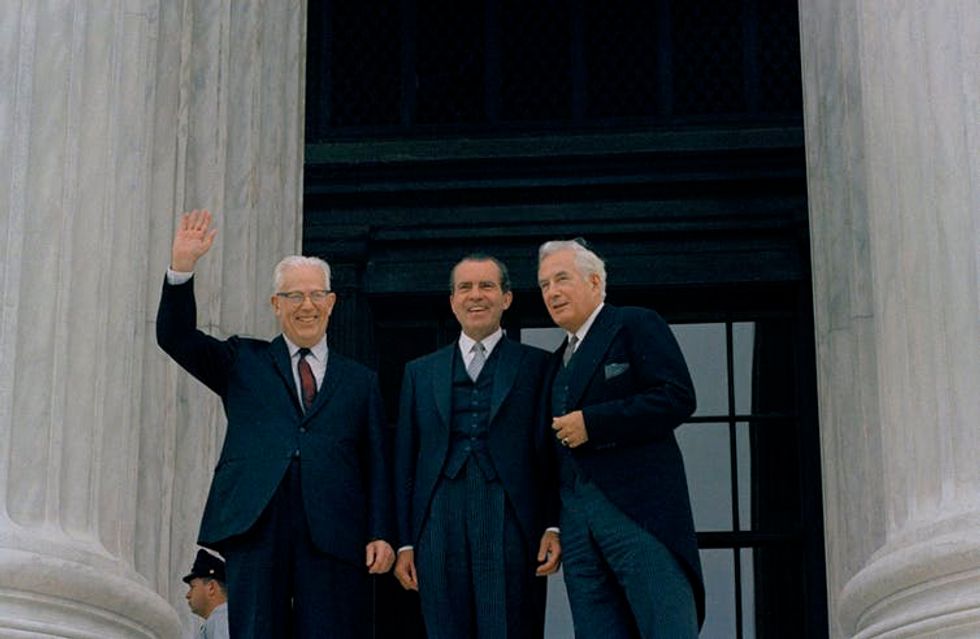
President Nixon, flanked by outgoing Chief Justice Earl Warren, left, and incoming Chief Justice Warren Burger, right.
AP Photo
Of course, Nixon’s Republican successor, Ronald Reagan, oversaw a Justice Department that repeatedly asked the Court to reverse itself on Roe. But ultimately a majority of the justices refused to go along, including two of Reagan’s three additions to the court, Sandra Day O'Connor and the now departing Anthony Kennedy.
Today, polls show significant opposition to overturning the decision.
For example, according to a recent Kaiser Family Foundation poll, 67 percent of Americans are opposed to the Court doing so, including 43 percent of Republicans. A Quinnipiac poll supported this conclusion, finding 63 percent of respondents agreed with Roe while just 31 percent did not.
It would be best if a court making a determination on the future of Roe could do so with the utmost legitimacy. But given the state of our politics today, that is a near impossibility.
According to the same Quinnipiac poll, a majority of Americans already believe that the court reaches its rulings based mainly on politics rather than law – 50 versus 42 percent.
A conservative court that quickly discards Roe will likely further that belief, given the central role opponents of the decision have played in mobilizing voters to support Republican candidates like Donald Trump. The result may be a further erosion of the court’s legitimacy, and a deepening of the partisan divide in America.




 A conservative court that quickly discards Roe will likely further that belief, given the central role opponents of the decision have played in mobilizing voters to support Republican candidates like Donald Trump. The result may be a further erosion of the court’s legitimacy, and a deepening of the partisan divide in America.