U.S. President Donald Trump said he expects a second tax overhaul to be unveiled in October or a bit earlier, and he is considering cutting the corporate tax rate to 20 percent from 21 percent.
In an excerpt of a Fox Business Network interview to be broadcast on Sunday, Trump said: “We’re doing a phase two. We’ll be doing it probably in October, maybe a little sooner than that.”
“One of the things we’re thinking about is bringing the 21 percent down to 20, and for the most part the rest of it would go right to the middle class,” he said.
Reporting by Eric Beech; Editing by Mohammad Zargham
The video, released by Fresno's FOX26 news station shows an unnamed white man speaking on his phone shortly after the alleged accident with a Latino shipping truck driver at a North Fresno shopping center. The driver's daughter, Nicole Gonzalez, told the station that after the incident (which has not yet been corroborated by FOX26), the white man had already begun insulting her dad when he decided to pull his phone out and start recording.
"I ought to ship your f*cking ass back home where ever you're from," the white man says to the Latino man filming.
"You're a f*cking beaner, motherf*cker," the man is heard telling the person recording, who he then calls a "stupid f*cking Mexican."
When the man filming asks the other man if he's racist, he replied that he's "racist against you" before continuing to hurl expletives.
"Even if an accident did occur," Gonzalez told FOX26, "that doesn't give him the right to talk to someone like that."
You can watch the aftermath of the alleged fender bender and the white man's racist tirade below:
Canada struck back at the U.S. administration over its steel and aluminum tariffs on Friday, vowing to impose punitive measures on C$16.6 billion ($12.63 billion) worth of American goods until Washington backed down.
The announcement by Foreign Minister Chrystia Freeland marks a new low in ties between the two neighbors and trading partners which have become increasingly strained since U.S. President Donald Trump took power in January 2017.
The tariffs will come into effect on July 1 and largely target U.S. steel and aluminum products, as well as foodstuffs like coffee, ketchup and whiskies.
“We will not escalate and we will not back down,” Freeland told reporters at a Stelco Holdings Inc plant in the Ontario steel city of Hamilton.
Officials say the measures are designed in part to pressure Trump by focusing on goods from states where his political allies hold sway.
Canada’s Liberal party government said last month it would retaliate after Trump moved against steel and aluminum imports from Canada and other nations, citing security grounds.
“We are acting very much in sorrow, not in anger,” said Freeland, stressing the closeness of the overall relationship. Bilateral trade is worth around C$2 billion a day.
Ottawa also unveiled an aid package for affected industries and workers worth up to C$2 billion, consisting mainly of up to C$1.7 billion in commercial financing and insurance for firms in the steel and aluminum sectors and related industries.
The head of the Teamsters Canada union welcomed the announcement and said Ottawa should consider expropriating American pharmaceutical patents if necessary.
The Trump administration is now studying whether to put tariffs on Canadian autos, which economists say would help plunge the economy into a recession. Freeland called the idea “absolutely absurd”.
The U.S. embassy in Ottawa said it had no immediate comment.
In Washington, the National Cattlemen’s Beef Association said the tariffs would hit $170 million worth of U.S. beef products.
“We believe that cooperation is a better path forward than escalation,” said Kent Bacus, the association’s director of international trade and market access.
U.S. officials have linked the tariffs to slow progress in talks to modernize the North American Free Trade Agreement, which Trump says is a disaster and must be changed.
Freeland said she expected the negotiations would enter an intensive phase after a Mexican presidential election on July 1.
Reporting by David Ljunggren; Editing by Chris Reese and Dan Grebler
Iowa’s Supreme Court on Friday rejected a 72-hour waiting period for abortions signed into law last year, ruling it was unconstitutional.
Iowa, which separately in April passed the nation’s strictest abortion limit known as the “fetal heartbeat” law, had placed the waiting period law on hold during the court challenge.
“We conclude the statute enacted by our legislature, while intended as a reasonable regulation, violates both the due process and equal protection clauses of the Iowa Constitution because its restrictions on women are not narrowly tailored to serve a compelling interest of the state,” Chief Justice Mark Cady wrote in the ruling.
Lawyers defending the waiting period, which was signed into law by then-Governor Terry Branstad, argued it would give women greater decision-making time when considering abortion, and that could lead to more women choosing to give birth.
Planned Parenthood of the Heartland and the American Civil Liberties Union of Iowa, which sued over the waiting period requirement, said it served no medical purpose and violated women’s due process and equal protection rights.
In a subsequent move to limit abortion, Iowa’s Republican-controlled legislature passed the most restrictive ban in the United States, outlawing the procedure after a fetal heartbeat is detected, often at six weeks and before a woman realizes she is pregnant.
Signed into law by Republican Governor Kim Reynolds, it also been challenged in court and was put on hold while the lawsuit proceeds.
Some sponsors of the ban hope to trigger a challenge to Roe v. Wade, the U.S. Supreme Court’s 1973 decision that established that women have a constitutional right to an abortion.
This week’s announcement that U.S. Supreme Court Justice Anthony Kennedy will retire has put a spotlight on abortion rights as his successor will be picked by President Donald Trump, who has promised to put anti-abortion justices on the nation’s top court.
Reporting by Barbara Goldberg in New York; Editing by Franklin Paul and Bill Trott
U.S. President Donald Trump may nominate a replacement for Supreme Court Justice Anthony Kennedy before July 10, when Trump is scheduled to depart for a trip to Europe, a White House official said on Frid
The vacancy on the Supreme Court, due to Kennedy’s retirement, will allow Trump to make his second appointment of a Supreme Court justice and deepen the conservative imprint he has already made on the nation’s highest court.
Trump has said he will select a nominee from a list of 25 conservative contenders.
The Supreme Court nomination will set up another U.S. Senate confirmation showdown in an election year, with all seats in the House of Representatives and a third of the Senate up for grabs.
Republicans now hold majorities in both congressional chambers.
Kennedy had been the swing vote on the deeply divided court. While he voted with conservatives on most cases, on several contentious social issues, such as abortion and gay rights, he sided with court’s liberals.
Senate Republican leader Mitch McConnell said there would be a vote on a Trump nominee in the fall.
Senate Democratic leader Chuck Schumer said it would be hypocritical to move forward on a Trump nomination during an election year after the Senate refused to act on former Democratic President Barack Obama’s selection, Merrick Garland, to fill an empty top court seat before the 2016 election.
Reporting by Steve Holland; Writing by Makini Brice; Editing by Kevin Drawbaugh
U.S. Energy Secretary Rick Perry said on Thursday that bailing out struggling coal and nuclear power plants is as important to national security as keeping the military strong, and that the cost to Americans should not be an issue.
“You cannot put a dollar figure on the cost to keep America free,” he told reporters at a press conference in Washington, when asked about the administration’s effort to extend the lives of the facilities. When asked about the cost of a potential bailout, he said he did not yet know.
“We look at the electricity grid as every bit as important to (national security) as making sure we have the right number of ships, aircraft and personnel,” he said. “What is your freedom worth?”
President Donald Trump ordered the Department of Energy (DOE) to take emergency measures to slow the retirements of coal and nuclear power plants, arguing those kinds of facilities can store months of fuel on site and therefore withstand supply disruptions that could be caused by storms, hacks, or physical attacks.
The effort fits neatly with the administration’s broader agenda to boost U.S. fossil fuels production and to save the coal industry, but has been criticized by an unusual alliance of drillers, renewable energy advocates, environmentalists, regulators and grid operators who say it is unnecessary and unfair.
Aging coal and nuclear facilities have been shuttering at a rapid pace in recent years, pushed out by cheaper natural gas as well as renewable energy sources like wind and solar - a driving factor in declining U.S. emissions of greenhouse gases.
The Trump administration considers natural gas and renewable energy vulnerable, however, because gas-fired plants rely on pipelines that can be disrupted, and solar and wind facilities only produce energy under certain weather conditions.
Perry pointed out that nearly all U.S. military bases rely on power from the civilian grid.
The DOE is currently studying ways to bail out coal and nuclear facilities, including potentially by mandating grid operators to purchase power from them.
Perry said the DOE is examining the costs now.
Federal energy regulators rejected a previous effort by Perry to require them to subsidize nuclear and coal plants for providing “resilience” to the grid.
That did not stop the coal industry from making new requests for help from the administration. In late March, FirstEnergy’s (FE.N) FirstEnergy Solutions unit - which runs coal and nuclear power units - called on the U.S. energy secretary to use the emergency powers to lift the sectors.
Coal company CEO Robert Murray of Murray Energy, also called for Perry to use emergency powers to save at-risk coal plants.
Writing by Richard Valdmanis; Editing by David Gregorio and Diane Craft
U.S. Treasury Secretary Steve Mnuchin said on Friday a report by the Axios news website, that cited sources as saying President Donald Trump wanted the United States to withdraw from the World Trade Organization, was wrong.
“There’s no breaking news here ... it’s not right,” Mnuchin told Fox Business Network, calling the report “fake news.”
Axios reported earlier on Friday, citing people who were involved in discussions with the president, that Trump frequently told advisers he wanted the United States to quit the WTO, a move with potentially disastrous implications for global commerce.
“This is an exaggeration,” Mnuchin said. “The president has been clear, with us and with others, he has concerns about the WTO, he thinks there’s aspects of it that are not fair, he thinks that China and others have used it to their own advantage, but we are focused on free trade. That’s what we’re focused on - breaking down barriers.”
One person who has discussed the subject with Trump, according to Axios, said the president frequently told advisers: “I don’t know why we’re in it. The WTO is designed by the rest of the world to screw the United States.”
The 164-member WTO is the only international organization that deals with the rules of trade between countries and states its key purpose as opening trade “for the benefit of all.”
A U.S. withdrawal from it would require an act of the U.S. Congress, and Trump was unlikely to persuade lawmakers to carry out his wish, the Axios report said.
“Sources with knowledge of the situation say the Trump administration will continue to call attention to various ways in which the U.S. encounters what some Trump advisers perceive is unfair and unbalanced treatment within framework of the WTO,” the report said.
The White House did not immediately respond to a request for comment.
Last Friday, the United States told the Geneva-based WTO that appeals rulings in trade disputes could be vetoed if they took longer than the allowed 90 days.
The statement by U.S. Ambassador Dennis Shea threatened to erode a key element of trade enforcement at the 23-year-old WTO: binding dispute settlement, widely seen as a major bulwark against protectionism.
It came as Trump, who has railed against the WTO judges in the past, threatened to levy a 20 percent import tax on European Union cars, the latest in an unprecedented campaign of threats and tariffs to punish U.S. trading partners.
Mnuchin was asked earlier on Friday if new trade tariffs the United States has imposed or threatened might wipe out gains from major tax cuts passed into law six months ago.
“I can assure you that we are not going to do anything that wipes out all those benefits or does anything that has a significant risk on growth,” he told Fox Business Network.
Reporting by Tom Miles in Geneva; Additional reporting by Eric Walsh and Doina Chiacu in Washington; Editing by Bernadette Baum
Member states of the United Nations migration agency on Friday rejected President Donald Trump's nominee for director general, repudiating historic American control of the organisation.
The International Organization for Migration (IOM) had been led by an American throughout the agency's 67-year history with one exception from 1961 to 1969.
But Trump's pick Ken Isaacs, an executive with the Christian charity Samaritan's Purse who faced serious charges of anti-Muslim bigotry, proved to be an untenable choice.
Isaacs was eliminated after three rounds of voting, according to multiple sources with direct knowledge of the vote.
Portuguese politician and former commissioner EU Antonio Vitorino has emerged as the front-runner and will face off against and current IOM deputy chief Laura Thompson in the upcoming ballot.
Diplomats speaking on condition of anonymity said that Vitorino's bid has been helped by the European Union's painstaking effort to forge a common response to migration challenges and the strategic advantage of having one of their own as the IOM chief.
Trump's hardline stance on migration -- from the so-called Muslim ban to his "zero tolerance" policy on the southern US border that led to separating parents and children -- undermined Washington's traditional right to choose the world's top migration official.
Trump's "America First" administration has also levelled ferocious attacks against multilateral bodies and undermined IOM's core global function -- refugee resettlement.
Analysts had warned that voters might stick with Isaacs to avoid punishing US fundings cuts, but Trump's posture on migration and Isaacs's personal history appeared to sway the room.
Isaacs published numerous tweets describing Islam as an inherently violent religion, including one after the 2016 attack in the French city of Nice that said "Islam is not peaceful".
He has also retweeted xenophobic material, such as a post last year from Robert Spencer, the director of Jihad Watch, which argued "peaceful Muslims" and "Jihadis" were indistinguishable.
Isaacs made his Twitter account private amid the uproar that followed his nomination in February, but he has not denied responsibility for any of his inflammatory comments.
The US nominee also refused to definitively recognise the causal link between human activity and climate change.
IOM has 172 member-states but only 143 were on hand to vote by secret ballot at the conference centre in Geneva.
The candidates are vying to replace veteran US diplomat William Lacy Swing, who held senior State Department and UN posts over a career spanning half a century.
Around sunrise on Feb. 15, 2013, an extremely bright and otherworldly object was seen streaking through the skies over Russia before it exploded about 97,000 feet above the Earth’s surface. The resulting blast damaged thousands of buildings and injured almost 1,500 people in Chelyabinsk and the surrounding areas. While this sounds like the first scene of a science fiction movie, this invader wasn’t an alien spaceship attacking humanity, but a 20-meter-wide asteroid that had collided with the Earth.
What is worrisome is that no one had any idea this 20-meter asteroid existed until it entered the Earth’s atmosphere that morning.
As an astronomer, I study objects in the sky that change in brightness over short time scales – observations that I use to detect planets around other stars. A large part of my research is understanding how we can better design and run telescopes to monitor an ever-changing sky. That’s important because the same telescopes I’m using to explore other star systems are also being designed to help my colleagues discover objects in our own solar system, like asteroids on a collision course with with Earth.
Near-Earth objects
A meteor is any chunk of matter that enters the Earth’s atmosphere. Before the Chelyabinsk meteor met its demise on Earth, it was orbiting our sun as an asteroid. These rocky objects are normally thought to be restricted to the asteroid belt between Mars and Jupiter. However, there are many asteroids throughout the solar system. Some, like the Chelyabinsk meteor, are known as near-Earth objects (NEOs).
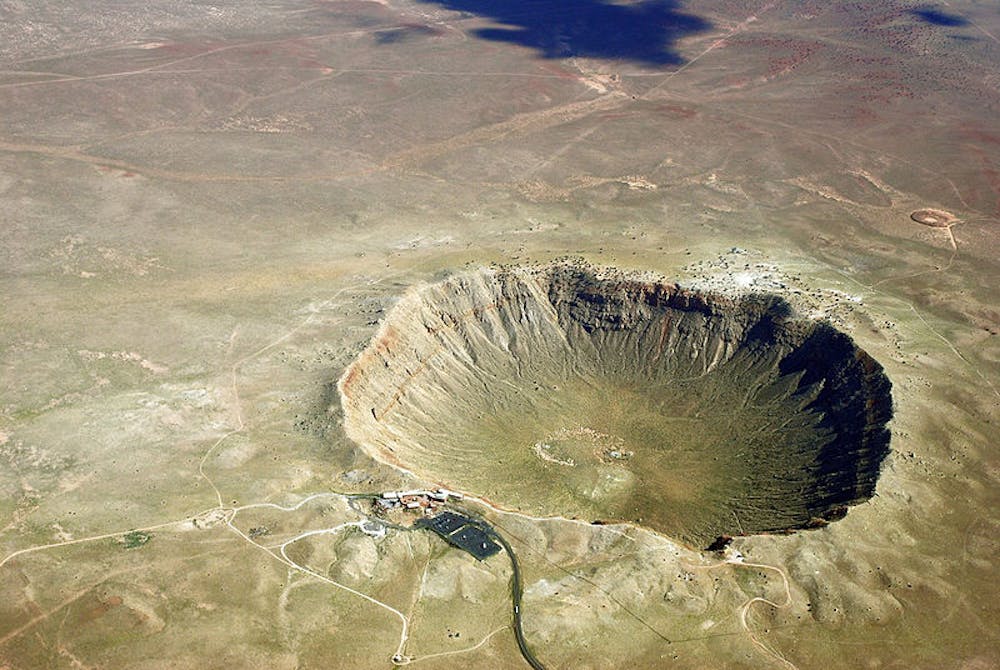
Aerial view of Arizona Meteor Crater, September 2010.
The Chelyabinsk meteor likely came from a group of NEOs called Apollo asteroids, named after the asteroid 1862 Apollo. There are more than 1,600 known Apollo asteroids logged in the JPL Small-Body Database that have orbits that may cross the Earth’s path, and are large enough (over 140 meters), that they’re considered potentially hazardous asteroids (PHAs) because a collision with Earth would devastate the region hit.
The scars of these past collisions are prominent on the moon, but the Earth also bears the marks of such impacts. Chicxulub crater on Mexico’s Yucatan Peninsula was created by the Chicxulub asteroid that drove the dinosaurs to extinction. The Barringer Crater in Arizona is just 50,000 years old. The question is not if a dangerously large asteroid will collide with the Earth, but when?
Searching for threats
The U.S. government is taking the threat of an asteroid collision seriously. In Section 321 of the NASA Authorization Act of 2005, Congress required NASA develop a program to search for NEOs. NASA was assigned the task of identifying 90 percent of all NEOs greater than 140 meters in diameter. Currently, they estimate that three-quarters of the 25,000 PHAs have yet to be found.
To reach this goal, an international team of of hundreds of scientists, including myself, is completing construction of the Large Synoptic Survey Telescope (LSST) in Chile, which will be an essential tool for alerting us of PHAs.
Exterior view of the Large Synoptic Survey Telescope, which is still under construction.
With significant funding from the U.S. National Science Foundation, LSST will search for PHAs during its 10-year mission by observing the same area of sky at hourly intervals searching for objects that have changed position. Anything that moves in just one hour has to be so close that it is within our solar system. Teams led by researchers at the University of Washington and JPL have both produced simulations showing that LSST on its own will be capable of finding around 65 percent of PHAs. If we combine LSST data with other astronomical surveys like Pan-STARRS and the Catalina Sky Survey, we think we can help reach that goal of discovering 90 percent of potentially hazardous asteroids.
A photograph and a baseline design rendering mix, showing a view of the completed exterior building from the road leading up to the site.
Both the Earth and these asteroids are orbiting the sun, just on different paths. The more observations taken of a given asteroid, the more precisely its orbit can be mapped and predicted. The biggest priority, then, is finding asteroids that may collide with the Earth in the future.
If an asteroid is on a collision course hours or days before it occurs, the Earth won’t have many options. It’s like a car suddenly pulling out in front of you. There is little that you can do. If, however, we find these asteroids years or decades before a potential collision, then we may be able to use spacecraft to nudge the asteroid enough to change its path so that it and the Earth don’t collide.
This is, however, easier said than done, and currently, no one really knows how well an asteroid can be redirected. There have been several proposals for missions by NASA and the European Space Agency to do this, but so far, they have not passed early stages of mission development.
The B612 Foundation, a private nonprofit group, is also trying to privately raise money for a mission to redirect an asteroid, and they may be the first to attempt this if the government space programs don’t. Pushing an asteroid sounds like an odd thing to do, but when we one day find an asteroid on a collision course with Earth, it may well be that knowledge that will save humanity.
President Donald Trump will be advised by a small group of deeply conservative lawyers, some inside the White House and at least one from outside, on choosing a nominee to the U.S. Supreme Court to replace Justice Anthony Kennedy, said several sources familiar with the process. Kennedy announced his retirement on Wednesday.
White House Counsel Don McGahn will be Trump’s lead adviser on the pick, having successfully guided the nomination of Justice Neil Gorsuch through the selection and confirmation process last year, White House sources said.
Leonard Leo, an outside legal activist, will be another key member of the president’s advisory team, sources said.
Leo is on leave from his position as executive vice president of the Federalist Society, an influential conservative legal group that regularly gathers like-minded lawyers and judges at conferences and on law school campuses nationwide. He helped compile a 25-person list of likely nominees from which Trump has said he will make his selection.
Also central to the vetting and interviewing process will be two associate counsels to the president: Rob Luther and David Morrell, said former Justice Department lawyer John Malcolm, now an analyst at the Heritage Foundation, a conservative think tank in Washington.
“They’re smart and tapped into the conservative legal community,” he said. “They’re very skilled at what they do.”
Like-minded advocacy groups are expected to mount efforts to assure the nominee is confirmed, and the Judicial Crisis Network has said it will spend at least a million dollars in the effort.
The group’s campaign will urge voters to pressure their senators to ensure confirmation. The group has already produced a new TV advertisement calling Trump’s list of 25 potential candidates the “best of the best” and warning that his opponents will lie and attack the nominee.
Trump met on Thursday with a group of six senators - three Republicans and three Democrats - to discuss the court vacancy, the White House said in a statement.
The Democrats - Joe Manchin of West Virginia, Joe Donnelly of Indiana and Heidi Heitkamp of North Dakota - are running for re-election in November in states Trump won in 2016. Two of the Republicans - Lisa Murkowski and Susan Collins - are abortion-rights supporters and could balk at voting for a Trump nominee who would overturn the 1973 Roe v. Wade landmark abortion decision.
The other senator who met with Trump, Republican Charles Grassley, is chairman of the Judiciary Committee, which will consider any Trump choice.
People familiar with the selection process said the front- runners on Trump’s list at this point are all current federal appeals court judges: Brett Kavanaugh, a judge on the District of Columbia U.S. Court of Appeals; Thomas Hardiman, who serves on the Philadelphia-based 3rd U.S. Circuit Court of Appeals; Raymond Kethledge of the 6th U.S. Circuit Court of Appeals; Amul Thapar, whom Trump named to the 6th Circuit; and Amy Coney Barrett, whom Trump named to the 7th U.S. Circuit Court of Appeals.
All five have spoken at Federalist Society events.
Two sources close to the process said Trump has also expressed interest in Utah Senator Mike Lee, who has the support of Texas Senator Ted Cruz. Both senators are Republicans.
The complication for a Lee nomination is that if he joined the court, a Republican Senate seat would be vacated at a time when Republicans hold only a narrow 51-49 Senate majority.
Trump could be reluctant to take Lee out of the Senate because of past experience. When he tapped Alabama Senator Jeff Sessions to be attorney general, Sessions’ replacement in the Senate ended up being a Democrat, despite Alabama’s traditional conservatism.
Trump “likes Mike, and Mike would do it. But the problem you face is, you have to make sure you have the Senate,” one source said.
Reporting by Andrew Chung and Steve Holland; Additional reporting by Lawrence Hurley; Editing by Kevin Drawbaugh, Sue Horton and Peter Cooney
A science fiction-inspired robot hardwired to assist astronauts will launch from Florida early Friday morning to become the first personal, artificial intelligence-powered companion in space.
The Crew Interactive Mobile Companion, or CIMON, is an English-speaking droid roughly the size of a basketball that will help German astronaut Alexander Gerst conduct experiments on the International Space Station.
“What we’re trying to do with CIMON is to increase the efficiency of the astronaut,” Matthias Biniok, an engineer for chip maker IBM and one of the lead architects behind CIMON’s artificial intelligence, told Reuters.
CIMON will verbally communicate step-by-step instructions to Gerst during three planned science experiments on the space station’s European module. Currently, astronauts read these instructions from a laptop, which Biniok says is an arduous process that a responsive, hands-free companion like CIMON can replace.
“Right now our main mission is to support the astronauts with their daily tasks to save time, because time is the most valuable and most expensive thing on the ISS,” Biniok said.
SCIENCE FICTION COMIC
The German Aerospace Center plans for CIMON to undergo three one-hour sessions to demonstrate how well the robot can help with experiments, like a crystal growth study, a test for its eight on-board cameras and an exercise to help Gerst solve a Rubik’s cube.
CIMON will return to Earth on Dec. 13.
Biniok said the concept of CIMON was inspired by a 1940s science fiction comic series set in space, where a sentient, brain-shaped robot named Professor Simon mentors an astronaut named Captain Future.
Philipp Schulien, a German engineer for CIMON’s hardware contractor, Airbus, said extending astronauts’ abilities in space is imperative for future space exploration journeys, like the crewed missions to Mars that are scheduled to take off as early as 2020.
“There are certain effects that might appear during long-term missions like the so-called groupthink effect,” Schulien said, citing a behavioral phenomenon in which humans that spend lengthy periods of time in isolation are driven to make irrational decisions. “Long, isolated groups tend to stop communicating with the ground,” he said.
A robot like CIMON with human-like personalities could help mitigate the disorientation astronauts may feel in space, Schulien said.
CIMON is among 5,900 pounds of cargo launching to the International Space Station on Friday, atop a SpaceX Falcon 9 rocket.
Reporting by Joey Roulette; editing by Bill Tarrant and Leslie Adler
French Holocaust survivor and women's rights icon Simone Veil will be given the rare honour of burial at the Pantheon in Paris on Sunday, a year and a day after her death at age 89.
Veil's death prompted an outpouring of emotion across the country, with thousands signing a petition asking President Emmanuel Macron to bury her alongside France's most illustrious dignitaries.
She will be only the fifth woman inhumed at the monument on the Left Bank of the River Seine, and will be accompanied by her husband Antoine, a high-ranking civil servant who died in 2013.
"Mum never thought she would be placed in the Pantheon. The only one in the couple who imagined she would enter the Pantheon was our father," said Jean Veil, the oldest of their three sons.
"He would often say jokingly... that it was out of the question to separate them after 67 years of living together," he told CNews television.
Simone Veil was 16 when she was deported in 1944 to Auschwitz during the Holocaust, when her mother, father and brother were killed.
After her return she became a tireless crusader for women's rights as well as European reconciliation, securing her biggest political victory in 1974 by convincing parliament to legalise abortion despite fierce opposition.
She also became the first elected president of the European Parliament in 1979, a post she held for three years.
A model of composure, Veil was considered by many a secular saint for her unwavering stance on moral issues.
Polls consistently showed her to be one of France's most popular and trusted figures.
"The fact that we have built Europe has reconciled me with the 20th century," despite living with the trauma of the Holocaust, Veil once said in a television interview.
- 'Light within' -
The transfer of Veil's remains to the Pantheon begins Friday, when her casket and that of her husband will be exhumed at the Montparnasse cemetery.
Their coffins will then be displayed for two days in the crypt of the Holocaust Memorial in central Paris, which Veil helped found.
On Sunday morning the funeral cortege will be escorted by Republican Guards over the Seine and through the Latin Quarter.
Pallbearers will carry the caskets up the Rue Soufflot, walking on a blue carpet, "the colour of peace, of the United Nations and of course of Europe," the presidency said.
They will pause three times to sing, including the "Song of the Deported".
President Emmanuel Macron, attending with his wife Brigitte and dozens of French officials, will give a speech followed by a minute of silence.
"You brought into our lives that light that burned within you and which nobody could ever take away," Macron said at her funeral last year.
The "Marseillaise" national anthem will then by sung by the American soprano Barbara Hendricks.
The caskets will lie in state until Monday, and admission to the Pantheon will be free from July 1 to 8.
Veil was already given a state funeral, and commemorative two-euro coins will enter circulation in July along with postage stamps bearing her image.
Last month Paris renamed a Metro stop "Europe - Simone Veil" in her honour.
California state lawmakers on Thursday unanimously passed a data privacy bill aimed at giving consumers more control over how companies collect and manage their personal information, a bill that Google parent Alphabet Inc and other big companies have opposed.
Governor Jerry Brown has 12 days to sign the measure into law or veto it, though the legislature can override a veto with two-thirds support. Under the proposal, large companies, such as those with data on more than 50,000 people, would be required starting in 2020 to let consumers view the data they have collected on them, request deletion of data and opt out of having the data sold to third parties.
Each violation would carry a $7,500 fine. The law would apply only in California.
Google executives have warned that the measure could have unintended consequences but have not said what those might be. The Internet Association, which also represents Facebook Inc and Amazon.com Inc has also opposed the bill, as have the California Chamber of Commerce and the Association of National Advertisers.
CTIA, a wireless industry trade group, called on Congress to pass legislation instead.
“State-specific laws will stifle American innovation and confuse consumers,” CTIA said.
Ali Bay, the governor’s deputy press secretary, declined to comment. (Reporting by Paresh Dave; Editing by David Gregorio)






 The
The 