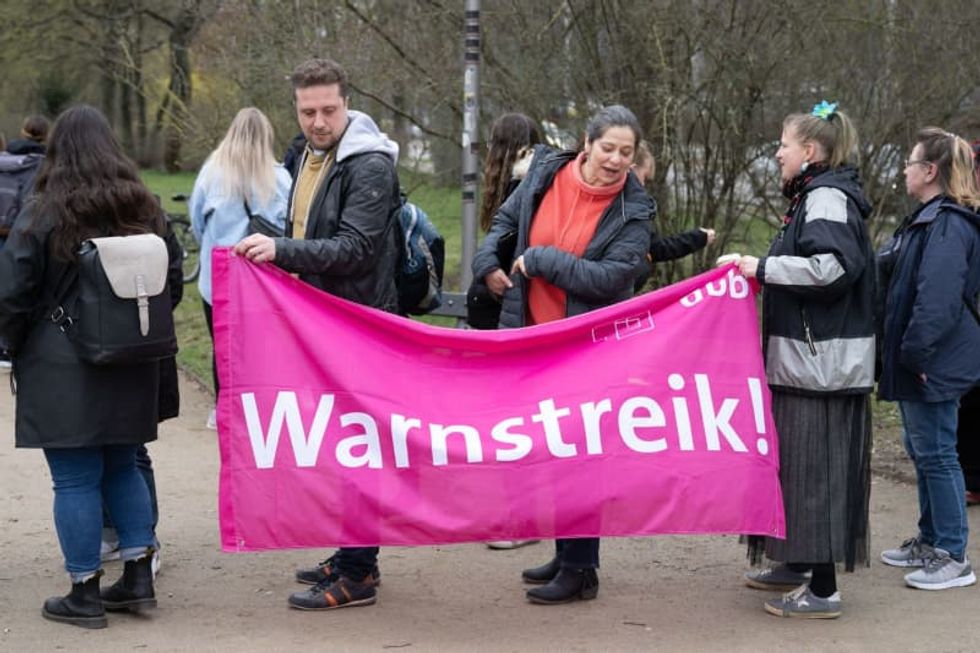
Two major German trade unions announced a strike for Monday hitting public transport across the country, including long-distance and local trains, as well as motorways and airports.
The trade unions EVG and Verdi on Thursday announced the joint industrial action, which comes after numerous previous strikes that have hit all parts of the German economy in recent months.
"There will be severe delays and even disruption of transport services in all the affected areas across the country," it said.
Verdi called on its members in seven German states to walk out from airports and from their jobs in local public transport.
The strike is intended to increase the pressure on the government and local authorities for a third round of negotiations starting on Monday.
The Verdi union is demanding a 10.5% pay rise and at least €500 more per month for public sector workers.
Passengers wait in line for the security check at a terminal in Munich Airport during a warning strike called by Verdi trade union. Sven Hoppe/dpa
A luggage cart with a vest of GöD (Public Service Union) can be seen at Munich Airport during a warning strike called by Verdi trade union. Sven Hoppe/dpa
Public sector workers participate in a rally as part of a warning strike called by the Verdi trade union. Sebastian Kahnert/dpa
Orange smoke billows over the public sector workers during a rally as part of a warning strike called by the Verdi trade union. Marcus Brandt/dpa
Public sector workers participate in a rally as part of a warning strike called by the Verdi trade union. Marcus Brandt/dpa
Passengers are seen during a warning strike called by the Verdi trade union. Sven Hoppe/dpa
A flag of the trade union Verdi flies at a streetcar stop of the Leipziger Verkehrsbetriebe (LVB), where the trade union Verdi has called a warning strike that would cause substantial interruptions in bus and streetcar services till Friday morning. Hendrik Schmidt/dpa
A view of a board displayed at the Leipziger Verkehrsbetriebe (LVB) reading "Will be on strike today," where the trade union Verdi has called a warning strike that would cause substantial interruptions in bus and streetcar services till Friday morning. Hendrik Schmidt/dpa
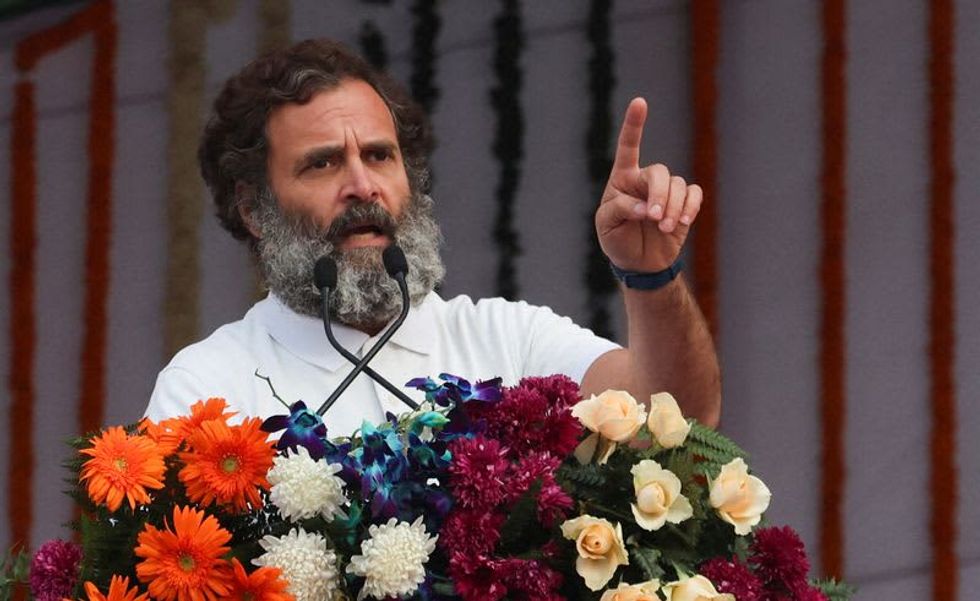
AHMEDABAD, India (Reuters) -A lower court in India sentenced opposition leader Rahul Gandhi on Thursday to two years in jail on charges of defamation for a 2019 speech in which he referred to thieves as having the surname Modi.
Gandhi will appeal against the order in a higher court, but any jailing for him or his disqualification from parliament would be a blow to his Congress party ahead of the 2024 general election, which Prime Minister Narendra Modi's party is widely expected to win.
The judgment was passed by a magistrate's court in the city of Surat, located in Modi's home state of Gujarat. The case was brought by a Gujarat lawmaker from Modi's Bharatiya Janata Party (BJP).
Gandhi, the 52-year-old scion of the Nehru-Gandhi political dynasty, was present at the Surat court, which gave him bail immediately and suspended the sentence for a month.
"Accused Rahul Gandhi is held guilty ... and sentenced to two years simple imprisonment," Harish Varma, the chief judicial magistrate of Surat, said in his order.
Ketan Reshamwala, an advocate for complainant Purnesh Modi, said the court had found Gandhi's comment defamatory.
An adviser to the federal government, Kanchan Gupta, said Gandhi could face immediate disqualification from parliament following the conviction, in line with a 2013 order of the country's highest court.
"So while it appears from reports that Mr. Gandhi's sentence has been suspended by the court that convicted him, he would have to soon obtain a stay on the conviction from an appellate court to save himself from disqualification," said lawyer Vikram Hegde.
In the speech ahead of the last general election in 2019, Gandhi referred to the prime minister and two fugitive Indian businessmen, all surnamed Modi, while talking about alleged high-level corruption in the country.
On Thursday, Gandhi, a former Congress president who is currently an influential MP, told the court that his comment was not against any community.
Congress members rallied behind Gandhi, with many state units planning protests later in the day and on Friday.
"The Modi government is a victim of political bankruptcy", Congress president Mallikarjun Kharge said on Twitter. "We will appeal in the higher court."
Gandhi also received support from the Aam Aadmi Party (AAP) that rules Delhi and two of whose top leaders are in jail on what they call trumped-up charges.
"A conspiracy is being hatched to eliminate non-BJP leaders and parties by prosecuting them," AAP chief and Delhi Chief Minister Arvind Kejriwal wrote on Twitter.
"We have differences with the Congress, but it is not right to implicate Rahul Gandhi in a defamation case like this. It is the job of the public and the opposition to ask questions. We respect the court but disagree with the decision."
Gandhi's once-dominant Congress controls less than 10% of the elected seats in parliament's lower house and lost badly to the BJP in the last two general elections.
Modi remains India's most popular politician by a substantial margin and opinion polls have shown he is expected to win a third victory at the election next year.
Unlike in many countries, where defamation is a civil offence, Indian law also has provisions which classify it as a criminal offence punishable with a jail term of up to two years.
(Reporting by Sumit Khanna in Ahmedabad and Arpan Chaturvedi and Y.P. Rajesh in New Delhi; Writing by Shilpa Jamkhandikar and Krishna N. Das; Editing by Raju Gopalakrishnan, William Maclean)
A new species of orchid with delicate, glass-like blooms has been discovered by Japanese scientists, who found the pink and white plant hiding in plain sight.
Despite its presence in Japan's parks and gardens, it took researchers at Kobe University a decade to confirm that the plant -- dubbed the "Spiranthes hachijoensis" -- was a previously unknown species.
"It was a surprise to discover a new species of spiranthes, which is so common that you can see it in parks, gardens and among potted plants," lead researcher Kenji Suetsugu told AFP Thursday.
Some of the samples were "from potted plants and gardens", including ones kept at a high school in Japan's central Gifu region, the phytology professor said.
"From its curious look and dainty blooms that resemble glasswork, this flower has long been loved by people," the university said in a press release.
The plant, with its spiralling blossoms, was even mentioned in Japan's oldest anthology of poems, the eighth-century "Manyoshu".
The discovery of the new type of spiranthes, sometimes known as "ladies' tresses", was announced last week in the Journal of Plant Research. It was given the name "hachijoensis" because many samples were found on Tokyo's Hachijojima island.
After more than three decades in the classical music industry, British double bassist Chi-chi Nwanoku began grappling with the question that had troubled her for years: Why was she consistently the only Black musician onstage?
"Why did I never ask anyone about it? Why did we never talk about it?" she describes wondering. "Was I being tolerated, or were people just completely unaware?"
"Or were people okay with the status quo?"
In 2015 Nwanoku took a leading role in creating a more diverse future for classical music, which, from musicians to conductors to repertoire, traditionally skews heavily white.
She founded Chineke!, Europe's first majority Black and ethnically diverse professional orchestra, which this week played at the prestigious New York Philharmonic's David Geffen Hall in Manhattan's Lincoln Center.
The performance was part of their long-awaited North American debut tour -- it was among the many performances the pandemic pushed back -- which included stops in New York, Ottawa, Toronto, Boston, Worcester and Ann Arbor.
The New York show featured the pioneering composer Florence Price's Symphony No. 1, along with a rendition of Mozart's Clarinet Concerto featuring the New York Phil's principal clarinet Anthony McGill.
'Door-opener'
The London-headquartered Chineke! echoes similar efforts in the United States, including the Detroit-based Sphinx organization that promotes representation of Black and Latino artists in classical music.
Yet the League of American Orchestras, which represents professional and amateur symphonies across the United States, found in a 2014 study on diversity that just 1.4 percent of orchestra musicians were Black -- and there's little reason to believe much has changed.
"Because the great majority of American orchestras are not individually transparent with racial and ethnic data on their artists, we do not know the percentage of Black orchestral artists in our orchestras today," writes the Black Orchestral Network, a collective of Black musicians from more than 40 orchestras launched in 2022.
"From our vantage point, however, we have seen little meaningful progress."
It's mind-boggling to Nwanoku, who told AFP during a rehearsal break that "it seems to me that the only colleagues of color that I see who have a job in an orchestra in this country are those who are exceptional."
"We have to be that much better to actually be given a job."
Nwanoku believes that especially for young people, seeing more diverse faces onstage is "an immediate door-opener."
"It's the most incredibly winning thing to feel represented on a stage," she said. "Even if when you walk through the front of house to buy a ticket, if you don't see anyone who looks like you, that is immediately uncomfortable."
"But when you see people that look like you in any place -- in the supermarket, at the train station, at the concert hall, at the cinema -- you immediately feel that is a place that I can walk into with confidence," Nwanoku continued.
By John Irish and Ingrid Melander PARIS (Reuters) -Train services were disrupted and some schools shut while garbage piled up on the streets of France on Thursday as part of a ninth nationwide day of strikes against a deeply unpopular bill to raise the pension age. Protesters blocked a highway near Toulouse in southwestern France in the early morning and a bus depot in the west, in Rennes, Le Parisien newspaper said. Protest rallies were scheduled across the country later in the day. President Emmanuel Macron on Wednesday said the legislation - which his government pushed through parliament wi...
SYDNEY (Reuters) - Australia took a step on Thursday towards a historical referendum to give Aboriginal and Torres Strait Islanders recognition in the constitution and, for the first time, a voice on matters that affect their lives.
In an emotional address, Prime Minister Anthony Albanese revealed the question the government wants to set in the referendum later this year, urging Australians to back what he described as a long overdue vote.
"For many ... this moment has been a very long time in the making," Albanese said, choking up during a televised press conference, standing alongside several Indigenous leaders supporting the proposal.
"Yet they have shown such patience and optimism through this process, and that spirit of cooperation and thoughtful, respectful dialogue has been so important at arriving at this point in such a united fashion."
The referendum question to be put to Australians will be: "A Proposed Law: to alter the Constitution to recognise the First Peoples of Australia by establishing an Aboriginal and Torres Strait Islander Voice. Do you approve this proposed alteration?".
Making up about 3.2% of Australia's near 26 million population, the Aboriginal people were marginalised by British colonial rulers and are not mentioned in the 122-year-old constitution. They were not granted voting rights until the 1960s and track below national averages on most socio-economic measures.
Albanese urged Australians, who will be asked to vote between October and December, to amend the constitution to create a consultative committee in parliament called the Aboriginal and Torres Strait Islander Voice.
"If not now, when?," he asked.
The committee would provide non-binding advice to parliament on matters that affect First Nations people.
The government will introduce the bill next week, hoping to pass it in the parliament by the end of June. Any constitutional alterations require a national referendum.
OPPOSITION SEEKS DETAILS
Opposition leader Peter Dutton said the government still had not responded to his queries on how the consultative panel would function and he needed more details.
"We will decide in due course whether we support the Voice or oppose it," Dutton told reporters.
The rural-based National Party, the junior partner in the opposition coalition, has said it would oppose the Voice, while the left-wing Greens party and some independent lawmakers have promised support.
A Guardian poll out on Tuesday showed public support for the referendum was down 5% but was still backed by a majority, with 59% in favour.
Albanese has staked significant political capital on the referendum. Since Australian independence in 1901, there have been 44 proposals for constitutional change in 19 referendums, and only eight have been approved.
In the last referendum in 1999, Australians voted against changing the constitution to create a republic and replace the British monarch as head of state with a president.
Opponents criticised the wording of that referendum, and Albanese has said he would aim to frame the current question as simply and clearly as possible.
The opposition conservative coalition had been demanding funding for campaign groups who support and oppose the referendum but the government has made no promise.
The federal government said the 'Yes-No' pamphlet, containing arguments on both sides, will be sent to all households.
(Editing by Cynthia Osterman, Lincoln Feast and Raju Gopalakrishnan)
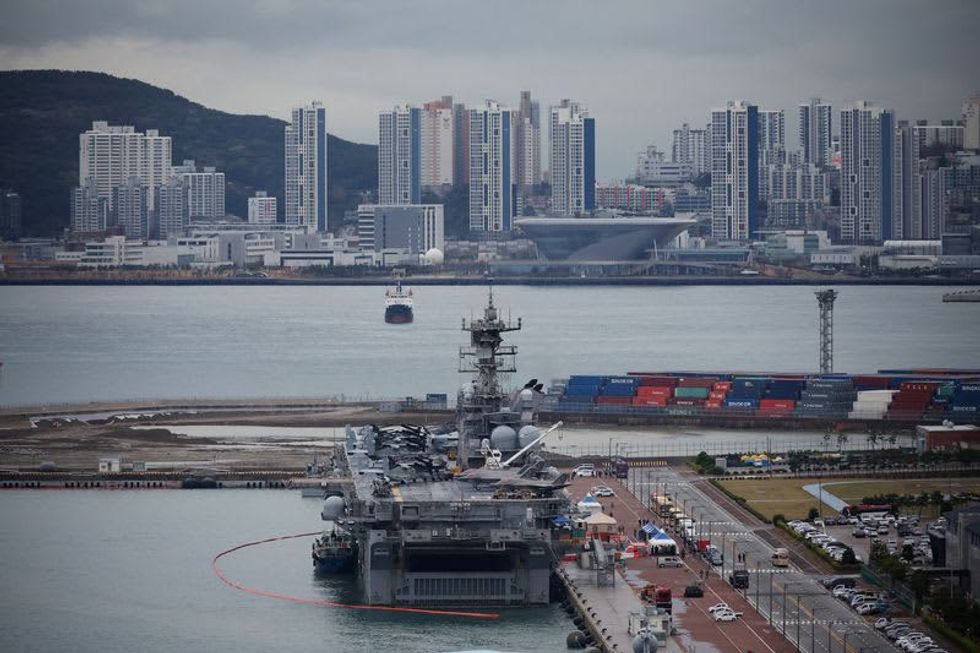
BUSAN, South Korea (Reuters) - South Korean and U.S. troops launched their largest amphibious landing drills in years involving a U.S. amphibious assault ship, officials said on Thursday, a day after North Korea tested four long-range cruise missiles.
The USS Makin Island docked at a naval base in the southeastern port city of Busan on Wednesday to join the Ssangyong exercise, which kicked off on Monday near Pohang on South Korea's east coast and will last until April 3.
About 12,000 sailors and marines from the two countries will take part, as will 30 warships, 70 aircraft and 50 amphibious assault vehicles, the South Korean military said.
Hours before the ship docked, North Korea fired four cruise missiles off its east coast, South Korea said, in apparent protest of ongoing drills by the U.S. and South Korea.
Captain Tony Chavez, commanding officer of the Makin Island, said the launches were "escalatory," and that the combined exercises with South Korea are aimed at building "muscle memory" to respond to a crisis if needed.
"It does not matter where that threat is coming from. We are ensuring that we are able to amass forces to maintain maritime and air superiority and defend Northeast Asia or all of the Indo-Pacific region," Chavez told reporters aboard the ship.
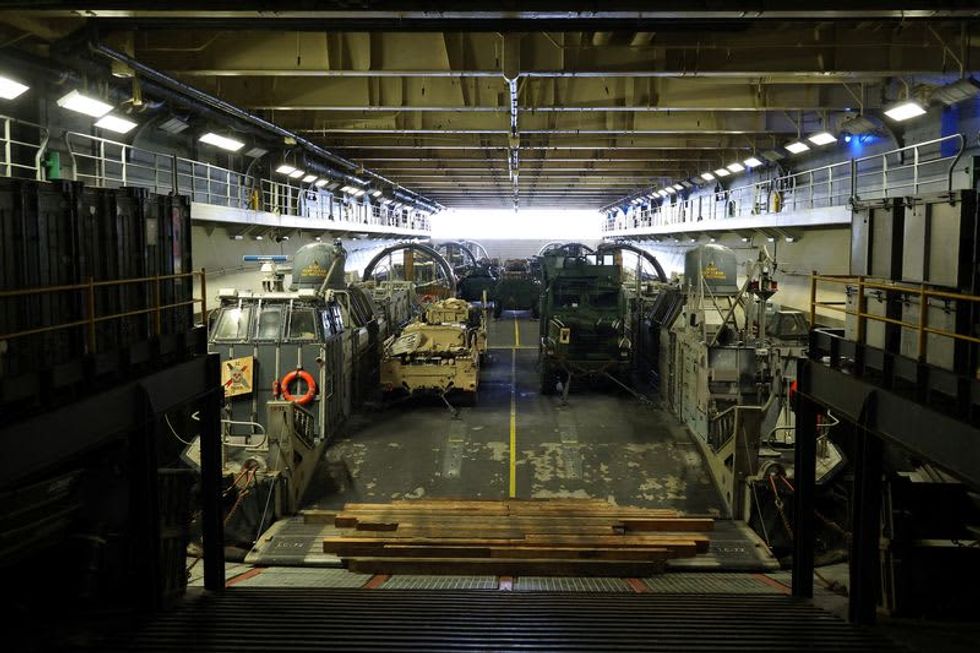
The Makin Island carries 10 F-35 stealth fighters in addition to dozens of armoured vehicles. The ship's welldeck, which can be flooded to provide direct access to the sea, allows it to launch and recover landing craft and other amphibious vehicles, the U.S. military said.
"Our biggest thing is that we have all the Marines," said the Makin Island's public affairs officer, Lieutenant Jarred Reid-Dixon. "We can take people on here and put them on the ground to seize an area if we had to."
The allies were scheduled to conclude 11 days of their regular springtime exercises, called Freedom Shield 23, on Thursday, though they have other field training exercises continuing under the name Warrior Shield.
Pyongyang has long bristled at exercises conducted by South Korean and U.S. forces, saying they are preparation for an invasion of the North. South Korea and the U.S. say the exercises are purely defensive.
Last week, North Korea fired an intercontinental ballistic missile into the sea between the Korean peninsula and Japan in a "warning to the enemies," and conducted what it called a nuclear counterattack simulation against the United States and South Korea over the weekend.
(Reporting by Soo-hyang Choi. Editing by Gerry Doyle)
By Dan Peleschuk and Sergiy Chalyi KYIV/ZAPORIZHZHIA, Ukraine (Reuters) - Russian drones attacked Ukrainian cities and missiles blasted an apartment block, but a months-long ground assault on the eastern town of Bakhmut could be stalling in the face of fierce resistance, according to Ukrainian and British military experts. Russian forces unleashed a wave of air strikes in the north and south of Ukraine as President Vladimir Putin bid farewell on Wednesday to Chinese leader Xi Jinping following a two day visit to Moscow by his fellow autocrat and "dear friend". But staunch resistance by Ukraini...
Elián González, the Cuban boy found clinging to an inner tube near Florida shores who became the center of an international child custody dispute as well as a political battle between Cuba’s late leader Fidel Castro and Cuban exiles in Miami, is set to become a member of the island’s National Assembly after Cubans go to the polls on Sunday. González, 29, was proposed as a candidate for the municipality of Cárdenas, in Matanzas, where he lives and works as assistant director of AT Comercial Varadero, a food import company run by the Cuban Ministry of the Armed Forces. Married and father of a 2-...
SHANGHAI (Reuters) - A Chinese start-up inspired by lockdown isolation has invented a long-distance kissing machine that transmits users' kiss data collected through motion sensors hidden in silicon lips, which simultaneously move when replaying kisses received.
The MUA - named after the sound people commonly make when blowing a kiss - also captures and replays sound and warms up slightly during kissing, making the experience more authentic, said Beijing-based Siweifushe.
Users can even download kissing data submitted via an accompanying app by other users.
The idea was borne out of China's frequent, lengthy and widespread lockdown measures during the three-year COVID-19 pandemic that, at their most severe, saw authorities forbid residents to leave their apartments for months on end.
"I was in a relationship back then, but I couldn't meet my girlfriend due to lockdowns," said inventor Zhao Jianbo.
Then a student at the Beijing Film Academy, he focused his graduate project on the lack of physical intimacy in video calls. He later set up Siweifushe which released MUA, its first product, on Jan. 22 priced around 260 yuan ($38).
In the two weeks after its release, the firm sold over 3,000 kissing machines and received about 20,000 orders, he said.
The MUA resembles a mobile stand with realistic pursed lips protruding from the front. To use it, lovers must download an app onto their smartphones and pair their kissing machines, which they plug into the phone charging port. They activate the device using the app, then when they kiss it, it kisses back.
The device is available in several colours though with the same unisex lips. It has received mixed reviews, with some users saying it was intriguing whereas others said it made them feel uncomfortable. Among the top complaints was its lack of tongue.
Some commentators on social media site Weibo also expressed concern that the device could be used for online erotic content, which is strictly regulated in China.
Zhao said his company complies with regulations, but that "there's little we can do as for how people use the device."
MUA is not the first remote kissing device. Researchers at Tokyo's University of Electro-Communications invented a "kiss transmission machine" in 2011, and Malaysia's Imagineering Institute made a similar gadget called the "Kissinger" in 2016.
($1 = 6.8866 Chinese yuan renminbi)
(Reporting by Shanghai Newsroom; Editing by Christopher Cushing)
KAMPALA (Reuters) - Members of Uganda's LGBTQ community are in shock and fear being arrested after parliament passed a new law that makes it a crime to identify as gay, and imposes tough sentences that include the death penalty in certain cases, an activist said on Wednesday. The "Anti-Homosexuality Bill, 2023" was passed with a near-unanimous majority by lawmakers in the east African country where anti-gay sentiment runs deep. U.S. Secretary of State Antony Blinken said on Wednesday the law would undermine fundamental human rights and "reverse gains in the fight against HIV/AIDS" and urged au...
Ukrainian defenders in the eastern city of Bakhmut, which has largely been destroyed in months of shelling and fighting, said they have repelled new attacks by Russian forces on Wednesday.
The General Staff of the Ukrainian Armed Forces said the Russians had tried to close in on the city with a pincer movement, but that the fresh attempt to encircle Bakhmut from the north and south failed.
"The enemy continued his efforts to capture the city, with significant losses of troops and weapons," wrote the General Staff in Kyiv on Facebook in its daily situation report.
The military also said there had been an overall "decrease in the momentum" of attacks on Bakhmut by the Russian forces.
The battlefield claims could not be independently verified.
The British Defence Ministry had earlier said that there was "a chance" that the Russian assault on Bakhmut was "losing the limited momentum it had obtained." This is in part due to the re-deployment of some Russian units to elsewhere on the front, the analysts said.
Earlier, Ukrainian President Volodymyr Zelensky visited the front line near Bakhmut, where he presented medals to soldiers and went to a military hospital with the governor of the Donetsk region, Pavlo Kyrylenko.
Bakhmut has been the site of intense fighting between Ukrainian and Russian forces for months.
If Moscow's forces manage to overpower the town, analysts say this would open a route to the major cities of Slovyansk and Kramatorsk for Russian troops. That would bring them closer to the complete conquest of the Donetsk region, one of the Kremlin's stated aims since starting the full-scale war.
Zelensky later travelled to Kharkiv, where he praised the city for its resistance to sustained attacks by Russian forces last year.
He presented Mayor Ihor Terekhov with the insignia of a "Hero City of Ukraine," in honour of residents' resistance to Russian attacks last year.
"Kharkiv is a real hero city," Zelensky said, according to the UNIAN news agency. "Thanks to its citizens, this beautiful city, along with other cities, is defending our independence."
A Ukrainian counteroffensive in Kharkiv in May last year prevented Russian troops from pushing further into the country's north-east. The fighting led to high losses on both sides.
Following his visit, Zelensky spoke of the destruction but also the hope that he had seen.
"It is painful to see the towns in the Donbass over which Russia has brought terrible suffering and ruins," he said in his evening video address, mentioning "hourly air raid sirens, constant threat of shelling, a constant threat to life."
But despite the severe destruction and suffering, there is hope in those areas. "You can feel it," he said.
"We will do everything so that the blue and yellow colours can continue their liberation movement and normal life can return to our whole country, from Donetsk to the border," he added, referring to the nation's flag.
He also announced Kyiv's response to Russia's recent attacks targetting cities with combat drones. "We will definitely respond to any attack by the occupiers on our cities," Zelensky said.
"To all Russian attacks we will respond militarily, politically and legally."
At least 14 people were killed in Russian attacks including along the front line in the east and south of Ukraine, and 24 were injured, according to the Ukrainian army press service.
Zelensky referred to the attacks as a new "Russian terror."
"I saw a lot of destruction today in the surrounding area. But the most important thing is victory," he said in an earlier video. Everything will be rebuilt, he promised.
Meanwhile, Russia's anti-aircraft defence and sailors from its Black Sea fleet shot down three Ukrainian drones over Crimea, a Russian official on the Russian-occupied peninsula said.
The shootings caused explosions which broke windows, but there were no casualties, according to Mikhail Razvozhayev, who is governor of Sevastopol in the south-western part of Crimea.
"Warships were not hit," he said.
Russia took control of the peninsula in 2014 and launched an all-out invasion of Ukraine some 13 months ago. Ukraine is determined to free Crimea from Russian control, along with other territory more recently occupied.
Incidents involving drones have occurred in various parts of Crimea, sometimes causing serious damage, injuries and even deaths. The drone attacks have forced Russia to significantly increase its military effort in Crimea.
Ukrainian President Volodymyr Zelensky (R) visits frontline positions in the Donetsk region and awarded the defenders of Bakhmut. -/Ukraine Presidency/dpa
A Romanian court on Wednesday extended the detention of controversial influencer Andrew Tate while he's being investigated along with his brother for alleged human trafficking and rape.
Tate, 36, and his brother Tristan, 34, were arrested in late December, and their detention has been extended every month since then by Romanian judges.
Under Romania's legal system, pre-trial detention can be extended to a maximum of 180 days, pending possible indictment.
The Bucharest Tribunal ruled to extend their detention by a further 30 days, a decision which can be appealed.
The latest extension left the brothers "speechless", their media team said.
"The substantial material damages they have suffered are nothing compared to the moral ones. Their image has been irreparably harmed," it said.
The brothers continue to deny all charges brought against them.
Tate, a British-American former kickboxer who has millions of online followers, along with his younger brother and two Romanian women, are under investigation for allegedly "forming an organised criminal group, human trafficking and rape".
As part of the probe, Romanian police raided several properties connected to the Tate brothers and seized many of their assets, including a collection of luxury cars.
A court document from January said that one woman was "recruited" from the UK after she fell in love with Andrew Tate, who then brought her to Romania "with the goal of sexual exploitation".
In 2016, Tate appeared on the "Big Brother" reality television show in Britain but was removed after a video emerged showing him attacking a woman.
He then turned to social media platforms to promote his divisive views before being banned for misogynistic remarks and hate speech.
Tate was allowed back on Twitter after the South African billionaire Elon Musk bought the company.