Sportscaster Dan Phillips was forced to get through this thing called life for a different employer after being fired following viewer complaints over a broadcast paying tribute to Prince, Awful Announcing reported.
"There were apparently some viewers, as well as management at the station, who did not feel the same way," Phillips said on his Facebook page on Friday. "They felt I was insensitive. And as a result, I was terminated today."
Phillips' April 21 newscast for WZTV-TV was peppered with quotes from the late pop singers' repetoire, featuring lines like, "The clock hits 0:00, party over with -- oops, out of time; it's the [Anaheim] Ducks who are gonna party like it's 1999" to end his recap of Game 4 of the Anaheim/Nashville NHL first-round playoff series.
According to Awful Announcing, Phillips had worked at the station since 2005, but WZTV removed his bio and listing from its on-air talent roster. He has also deleted his Twitter account.
"For now, thanks again for all of your support," he said on his Facebook page. "And if you need an old, washed-up sports guy for anything, please let me know!"
It's a tale of saints and singers: a new Polish musical is bringing some pizzazz to the story of its beloved native son, the late pope John Paul II.
"We're trying to create something big," says the show's writer Michal Kaczmarczyk.
"We will tell his whole life story, from his infancy until his death."
Like many in Poland, 35-year-old Kaczmarczyk adored the pontiff, who was canonised a saint two years ago in April. He queued for 15 hours in Rome after John Paul's death in 2005 just for a chance to bow at his coffin.
Kaczmarczyk has penned the script and lyrics for "Karol", teaming up with hit-maker Filip Siejka to revisit Karol Wojtyla's life in musical form, from his boyhood to his rise to the top of the Roman Catholic Church.
Not only was John Paul the first non-Italian pontiff in four centuries but as a strong advocate for human rights, he was a source of strength for many behind the Iron Curtain and seen as a catalyst in the collapse of communism.
Due to premiere in February 2017 at the large Tauron Arena in Poland's second city Krakow, "Karol" could well prove a hit in a country where 90 percent of the residents are Roman Catholic. Promoters said 500 tickets have already been sold.
Fifteen actors will play the main roles, including a teenage version of the pope-turned-saint dressed in a t-shirt and shorts. Along with dancers, backing singers and extras, the cast runs to almost a hundred.
Polish pop diva Edyta Geppert will sing several of her own hits, integrated into a soundtrack that runs from upbeat pop-rock to tender ballads.
There are light-hearted moments in the tale of a pope who was well-known for his sense of humour -- like the time when an Italian priest, in a bad attempt to speak Polish, tries to ask "How is the pope?" but ends up asking "How's the little dog?"
The pope, played by popular Polish actor and television personality Jacek Kawalec, replies with a cheerful woof.
- 'Run and never look back' -
Karol Wojtyla lived in Krakow for almost four decades, training as a priest in the city during the Nazi occupation and eventually rising to become its archbishop.
Affection for John Paul II runs deep in the city, and the audience may be moved to tears as well as laughter as the show turns to his life's more serious moments.
One song, "Someone Has Ordered Me To Run," inspired by one of his own poems, recalls his doubts about the difficult mission he felt God had bestowed upon him.
"I asked for a drop of water and got the Atlantic, I asked for a stone and got diamonds," sings Kawalec.
"I always have doubts but someone has ordered me to run... and never look back."
The show opens with music evoking the "roaring" 1920s of the pope's birth, before switching to pop-rock as he becomes pope in 1978.
The script also deals with the pontiff's relationship with his mother, who died when little Karol was only nine years old.
Some biographers maintain this explains John Paul II's particular devotion to the Virgin Mary.
Agata Nizinska, playing his mother Emilia, sings a song called "Conversation With My Son" -- an emotional premonition of the pope's vocation, in which she tells him she dreamt she had seen "a palace with a view of a thousand cities".
Casting for the show has not yet finished. Producers are still looking for a youngster to play Karol when he was a football-loving 10-year-old, and another to play the future pope at age 20.
An iconic jacket worn by Prince in the 1984 film "Purple Rain" will be auctioned in Los Angeles in June, auction house Profiles in History said Friday.
"It's definitely the most important piece of screen-worn Prince clothing that's ever come up for auction," Profiles in History president Joe Maddalena said.
"This is the first time ever for something like this, and it might be the only time because the rest of the costumes may be in his personal wardrobe."
The famously private singer gave the jacket to a makeup artist at the end of the shoot, auction house spokesman Jeff Hare told AFP.
It has an asking price of $6,000 to $8,000, but is likely to fetch more at the June 29 sale.
Prince wore the black and white jacket with leather sleeves in a famous scene, as he picks up his co-star Apollonia Kotero on a motorcycle. They ride to a lake, where he convinces her to strip off her tight leather jumpsuit and jump in the cold water.
One of his generation's most influential and prolific musicians, Prince died suddenly on April 21 at the age of 57 at his Paisley Park estate outside Minneapolis.
The cause of death is not yet known.
The June 29 auction will also include costumes from Britney Spears, Katy Perry and Alicia Keys, as well as a glove inlaid with Swarovski crystals that Michael Jackson wore during his "Dangerous" tour in 1992.
Prince's death has revived interest in his work and "Purple Rain" is currently showing in more than 150 theaters in the United States. The movie won Prince an Oscar for best soundtrack.
His next two films, "Under the Cherry Moon" (1986) and "Graffiti Bridge" (1990), were flops that ended his screen career.
Prince also co-directed the concert documentary "Sign o' the Times" (1987).
In an act of audacious reporting Chris Thomas drove out to the Virginia woods (albeit with an unmarked police car following him) where he met with the Grand Imperial Wizard (GIW) of the Rebel Brigade Knights of the Ku Klux Klan (KKK). Or, as the Grand Imperial Wizard continually pronounced it, the "Klu Klux Klan."
During the interview, the GIW said that the Klan was no longer a "racial" group, but now is "political."
Thomas asked the GIW if he had an opinion as to who should be president. "I think Donald Trump would be best for the job." he tells Thomas. "The reason a lot of Klan members like Donald Trump is because a lot of what he believes in, we believe in. We want our country to be safe."
As a consequence of the Klan's political mission, the group has been blanketing leaflets through central Virginia. The GIW says that President Obama has been good for his organization. "He has been a very good recruiting tool for this organization. And it's not because he is black. We are more political than racial."
The GIW is also clear that his organization will never support Ted Cruz, preferring a Kasich presidency. The reason?
" is not an American citizen. Even if I agree with some of the things that Ted Cruz says, I would not support him because he was born in Canada. He is not an American citizen."
The interviews cover several topics, including what differentiates the Klan from Neo-Nazi "punk thug" Dylan Roof. "He was a Nazi Skin-Head. Neo-Nazis and Skin Heads are socialist. We are not socialist."
Paper denies ‘unjustified’ claims that CEO Mark Thompson introduced culture that favors ‘young, white’ and single staffers to older female and black employees
Mark Thompson, the chief executive of the New York Times and former director-general of the BBC, is facing a multimillion-dollar class action lawsuit alleging that he introduced a culture of “deplorable discrimination” based on age, race and gender at the newspaper.
The lawsuit, filed on behalf of two black female employees in their sixties in New York on Thursday, claims that under Thompson’s leadership the US paper of record has “become an environment rife with discrimination”.
The class action lawsuit, seen by the Guardian, alleges that the Times, which promotes its liberal and inclusive social values, preferentially favours its “ideal staffer (young, white, unencumbered with a family)” at the expense of older female and black employees.
“Unbeknownst to the world at large, not only does the Times have an ideal customer (young, white, wealthy), but also an ideal staffer (young, white, unencumbered with a family) to draw that purported ideal customer,” the lawsuit, which the women’s lawyer said could be extended to up to 50 similar alleged victims, states. “In furtherance of these discriminatory goals, the Times has created a workplace rife with disparities.”
A spokeswoman for the Times said: “We have not seen the complaint, but the statements you have shared are completely unjustified attacks on individuals and grossly distort the work environment at the New York Times Company.”
The lawsuit, filed at the US district court of southern New York, claims that since Thompson became CEO of the Times in 2012, after eight years as director-general of the BBC, the paper’s advertising staff has been “systematically becoming increasingly younger and whiter”.
It is claimed that Thompson, who was in charge of the BBC during a series of scandals over the way the broadcaster treats older women including newsreader Moira Stewart, Countryfile’s Miriam O’Reilly and Strictly Come Dancing’s Arlene Phillips, “brought his misogynistic and ageist attitudes across the Atlantic to New York City”.
Following an age-discrimination employment tribunal brought, and won, by O’Reilly in 2011, Thompson admitted that were was “an underlying problem, that – whatever the individual success stories – there are manifestly too few older women broadcasting on the BBC, especially in iconic roles and on iconic topical programmes”. He said the BBC had a duty to “develop and cherish” the “many outstanding women broadcasters” and ensure that they know “age will not be a bar to their future employment” at the broadcaster.
Thompson is said to have hired Meredith Levien, the company’s chief revenue office and a co-defendant, to “carry out his vision of the ideal workforce”. The lawsuit claims that under Thompson, who was paid $8.7m (£6m) last year, and Levien, who was paid $1.8m (£1.2m), “age, sex and race discrimination became the modus operandi at the Times”.
In speeches to staff, Levien is said to have made it clear that she wanted a workforce with “fresh faces” populated by “people who look like the people we are selling to”. She is alleged to have told staff that “this isn’t what our sales team should look like”. The advertising staff, many of whom are older, black and female, said Levien’s comments were “shockingly rife with racially charged innuendos”.
On its website the NYT says it is “committed to an inclusive and diverse workforce that reflects the audience, readers and advertisers we serve” and has “a staff as wide as it is deep, broad in perspective, backgrounds and experiences” so as to “capture the multitude of voices of America and the world, with true fidelity”.
The claimants, Ernestine Grant, 62, and Marjorie Walker, 61, who work in the Times’ advertising department, dispute this. They claim that the company’s advertising directors, who had previously been a mix of races and ages, have become “increasingly younger and whiter”.
“Older advertising directors of color found themselves pushed out through buyouts, or outright terminated, but those vacancies were rapidly filled with younger, white individuals,” the lawsuit said.
They claim they were repeatedly passed over for promotion by younger white employees despite their greater experience. They also claims that “younger white individuals” at the same level as them are paid far more than they are. In addition, they claim they were “denied the opportunities to earn as much as [their] younger white peers because of her race and/or gender”.
Younger white employees in advertising were also allegedly given “summer Fridays”, afternoons off in the summer, while the perk was not offered to older employees of color.
Douglas Wigdor, a partner at Wigdor LLP who is representing the claimants, said: “It is astonishing that a news organization that regularly promotes liberal social viewpoints could have a double standard when it comes to blatantly discriminating and retaliating against its own hard working and dedicated employees.”
The lawsuit claims that the Times’ “gender inequality is so endemic” that Jill Abramson, the paper’s first female editor, was “unable to turn around the troubling realities of the newsroom” and was fired after she complained that she was paid less than her male peers and predecessors. She was replaced by Dean Baquet, the paper’s first African American editor. Abramson is now a regular contributor to the Guardian.
A 2014 survey by the Women’s Media Center researchers found that the Times had the least female bylines, proportionally, of the nation’s 10 largest newspapers. The study found that 69% of stories were written by men and 75% of opinion writers being male.
Proving that there is nowhere on the Internet that is safe from Trump followers, Motherboard is reporting that Bernie Sanders' Second Life headquarters is under siege from Trump supporters.
Second Life allows its users to purchase property in its virtual world, and after one user established a Sanders headquarters, Trump supporters bought the land next door--and promptly built a huge wall next to it. From the top of the wall, Donald Trump shouts "We have twenty times more traffic! I keep winning! You can't stump the Trump!"
Second Life Newser has been documenting the virtual fight in which Trump supporters are trolling Sanders Support Group member Macaria Wind. Sanders headquarters is in the Second Life region of Caspoli, and the Sanders banner can be seen from satellite.
[caption id="attachment_789014" align="alignnone" width="615"] Screenshot taken from Second Life Newser, https://slnewser.blogspot.com/2016/04/political-feud-between-new-trump-and.html[/caption]
Trump's 180 meter wall features a huge American flag, and fireworks spout from the summit. Wind has tried to laugh off the obnoxiousness, but a lot of it has crossed the line into hate tactics. "[What] is not a laughing matter are the racial slurs and bigotry witnessed by one group member who visited Trump HQ when there were actually people there," Wind told Motherboard.
[caption id="attachment_789042" align="alignnone" width="385"] Screengrab of Trump Swastika taken from Motherboard: https://motherboard.vice.com/read/second-life-donald-trump-bernie-sanders[/caption]
Authorities in Minnesota obtained a search warrant in connection with the death of pop star Prince and also won a court order to keep the findings secret, documents showed Thursday.
Chief Deputy Jason Kamerud of the Carver County, Minnesota, sheriff's office cited intense media scrutiny surrounding the death of the 57-year-old performer, in his request for a state district court judge to seal the warrant.
Prince, whose full name was Prince Rogers Nelson, died at his home, a compound known as Paisley Park, in suburban Minneapolis on April 21. Authorities investigating the death found prescription opioid medication on him, according to news outlets on Wednesday from CNN, the Minneapolis Star Tribune and others, that cited anonymous law enforcement sources.
According to documents released by Kamerud on Thursday, the search warrant is for the Paisley Park compound, where Prince also had a recording studio.
In a court order dated Thursday, state District Court Judge Eric Braaten approved sealing the results of the search for 180 days or until the beginning of court proceedings, whichever comes first.
Also on Wednesday, court records showed that a judge appointed a bank to safeguard Prince's estate.
(Reporting by Sharon Bernstein in Sacramento,California; Editing by Bill Trott)
For people who don’t like football, Super Bowl Sunday is the day to run to the kitchen during the plays but sit so glued to the screen watching the ads. The Olympic Games takes Super Bowl ad excitement and multiplies it: sixteen days of airtime provide a lot of opportunities to wow a global audience.
Procter & Gamble posted a two-minute spot—its new ad, “Thank you, Mom,”—and dropped the mic. Those who find themselves leaking water from their eyes at the sight of baby horses or little kids trying their hardest may want to stock up on hankies before watching this summer’s games.
The P&G ad takes its previous tributes to the sacrifices that makes moms make and adds danger, provoking a series of vignettes in which moms protect their kids from all kinds of threats — including those posed by Mother Nature herself.
The opening image is of a little American girl, pigtails held in place with bright pink elastic hair ties, staring frozen as a tornado rushes down on her. The threat of the swirling tornado is intercut with the image of the woman athlete entering the Olympics gymnastics arena. As the vertigo-inducing whirlwind bears down on her, Mom shepherds the little girl into the tornado cellar, saying, “C’mon. C’mon,”the same words the athlete hears as she begins her routine.
Other kids’ stories appear. First, a Brazilian girl in a car, her mom speaking to her in Portugese, and the startling accident, which may raise viewers’ anxiety levels, before the mother’s assurances. Then, a young Chinese boy and his mother in an elevator during an earthquake. A German boy is terrified as he sits in a jet being rocked by the wind, until his mother assures him that “It’s just a little turbulence.”
But the threats to children are not just from the accidents over which people don’t have control. P&G calls out those who torment kids, too, first by a scene in which the German boy is bullied, and then by watching the Brazilian girl get sexually harrassed out in the street. Each time, the mother is there to not only provide reassurance, but also to step in as the protector who will take on the world to keep her child safe. The Chinese athlete calls his mother in tears from his dormitory, defeated by a bad encounter with a mean coach. What she says to him moves him forward.
P&G capitalizes on the stereotypes of maternal behavior, but cuts around any objection by referencing a postmodern world in which the stresses and pressures that children face are as much the products of toxic culture as they are the vagaries of nature and physics. The emotional resonances provoked by the ad are echoed in the violins and piano of the composition, “Experience,” by Luigi Einaudi.
Adweek has already proclaimed the ad “darkly brilliant,” and declares that other ad producers are going to have to work hard to match P&G. And while ads featuring moms and athletes are old news, according to the magazine, this new ad takes the familiar genre and makes it more umbrous:
“If the vignettes here seem particularly dramatic, that's because P&G has to keep the campaign evolving even after it perfected the form back in 2012 with "Best Job.”
Last Thursday, the world was shocked by the untimely death of Prince, the highly prolific, Grammy-winning music icon who not only transformed music and the record industry but also provoked questions about race, gender and sexuality.
Apart from his songs, musical genius and virtuosic skills, the “Purple Rain” singer is also widely recognized for his fierce protection of artistic freedom and his longstanding fight with his first record label, Warner Bros.
It seems only a few years ago that he performed in concerts with the word “slave” written on his face. Partly as an act of protest, he also changed his name to an unpronounceable symbol, causing people to refer to him as “the artist formerly known as Prince.”
In the past few years, the singer remained reluctant to work with internet streaming platforms. Today, his music remains largely unavailable on Spotify and Apple Music. A rare exception is Jay Z’s Tidal, which released his “HITnRUN” albums.
Commentators have been quick to discuss Prince’s positions on intellectual property rights and the music business. Yet, few have explored whether Prince’s music will become more readily available after his death.
Although it is difficult to predict how his unreleased materials will be handled – considering that he does not have any apparent heir – a quick review of what happened after the death of other famously reclusive artists may offer some useful hints.
His music may live forever, but will we be able to hear it?
Reuters
The vault
It is a well-known secret that Prince accumulated a large trove of unreleased materials in a vault – or vaults – in his Paisley Park studio complex.
In interviews conducted last year by The Guardian and the BBC, Brent Fischer, Prince’s longtime collaborator, suggested that this vault contained about 70 percent of the material the singer had ever produced. This figure is mind-boggling considering that Prince released close to 40 studio albums.
Moreover, because of Prince’s widely publicized fight with his record label in the 1990s, many believe that the vault will contain some of Prince’s finest work – material that the singer might have chosen not to release amid that struggle. The last album released by Warner Bros. in the 1990s was ironically titled “The Vault: Old Friends 4 Sale.”
The King of Pop
To some extent, the materials in Prince’s vault remind us of an equally valuable trove of unfinished tracks Michael Jackson left behind following his unexpected death in 2009.
As an avid “MJ” fan, I still remember the suddenly much wider use of his music in movies and TV programs shortly after his death – “Bad” in the movie “Megamind” being a notable example.
Controversies also arose over the posthumous release of his unfinished tracks – as part of the albums “MICHAEL” and “Xscape.” While some – such as Quincy Jones, Jackson’s former producer – questioned the motives behind the release of these albums, others were disappointed by the extra production and packaging that had gone into the original material without the artist’s input.
Regardless of one’s views, however, the much wider use of Jackson’s music, along with increased merchandise sales, quickly catapulted the singer back to eye-popping commercial success. Today, Jackson is at the top of Forbes’ list of “top-earning dead celebrities,” bringing in US$115 million in last year alone.
Michael Jackson’s music had a renaissance after his death.
Reuters
Franz Kafka
Estates and their lawyers have been widely criticized for being greedy and for taking aggressive legal actions to limit public access to the works of the deceased. While property owners have unrestricted rights to dispose of their property – including inheritance – copyrights have become particularly problematic considering that they last for 70 years after an author’s death.
Nevertheless, some estates have managed to make the works of the deceased more widely available. A leading example concerns Franz Kafka. Before he died at the young age of 41, he left specific instructions to his friend and executor, Max Brod:
My last request: Everything I leave behind me … in the way of diaries, manuscripts, letters (my own and others’), sketches and so on, to be burned unread.
Much of what Kafka wrote would never have been read had his friend followed his wishes.
Kafka statue via www.shutterstock.com
Having already verbally declined his friend’s request in person, Brod refused to burn the manuscripts after the writer’s death. Had he followed Kafka’s instructions, we would never have read some of Kafka’s masterpieces, such as “The Trial” and “The Castle.” We might never even have known Kafka’s talents, as he published less than 450 pages in his lifetime!
J.D. Salinger
A more recent example is J.D. Salinger, the author of “Catcher in the Rye.” Despite his wildly successful novel about teenager Holden Caulfield, he withdrew from public life shortly after the novel’s publication in 1951.
Although Salinger continued to write – and had publicly admitted to doing so – the lack of publications since the early 1960s created a longstanding mystery.
Salinger died in 2010. A few years later, a biographer revealed that he might have left instructions to his estate to publish as many as five novels after his death. The release of these novels would not only shed light on the author’s reclusive life but also help us understand better Holden Caulfield’s character.
These letters were published shortly before the death of Salinger, who was fiercely protective of his privacy.
Reuters
Posthumous releases
It remains to be seen what materials from Prince’s vault will be finally released. If past experience with recently deceased music superstars provides any guide, a considerable quantity of these previously unreleased materials will eventually become commercially available – whether Prince would have liked it or not.
Although some will certainly argue that these materials should have been kept hidden given the artist’s lifetime choices, strong support can be drawn from his longstanding fight with record labels, not to mention his 2012 video clip teasing to release “every good thing in the vault.”
Hopefully, Prince’s estate will be able to go through the vault carefully to develop a plan to disseminate the unreleased materials in ways that will honor the artist’s legacy – perhaps as “time capsule” albums. After all, if these materials remain locked up in a vault, it will be a loss to not only his estate but also his many fans around the world.
CNN anchor Carol Costello on Tuesday argued that the solution to ABC's disagreement with host Kelly Ripa was "just treating someone as a human being."
After refusing to come to work because she had not been told in advance that co-host Michael Strahan was leaving, Ripa returned to her talk show on Tuesday morning and chastised the network.
"What's transpired over the course of a few days has been extraordinary in the sense that it started a much greater conversation about communication and consideration," she explained. "And most importantly, respect in the workplace."
"She does deserve respect," Costello insisted to media reporter Brian Stelter later on Tuesday. "Because she is a leader of that show and she should be accorded that respect."
"Talent is often treated like part of the furniture," the CNN host observed knowingly. "You can replace them like furniture. So this time, she made sure they didn't think of her quite that way."
"TV is all about talent management," Stelter opined. "Maybe in some ways, life is all about talent management, deciding what you do and how you do it."
"Talent management makes it sound like petulant children," Costello shot back at Stelter. "As talent, I kind of resent that that."
"So, it's not talent management, it's just treating someone as a human being," she pointed out.
Watch the video below from CNN, broadcast April 25, 2016.
Last Thursday, the world was shocked by the untimely death of Prince, the highly prolific, Grammy-winning music icon who not only transformed music and the record industry but also provoked questions about race, gender and sexuality.
Apart from his songs, musical genius and virtuosic skills, the “Purple Rain” singer is also widely recognized for his fierce protection of artistic freedom and his longstanding fight with his first record label, Warner Bros.
It seems only a few years ago that he performed in concerts with the word “slave” written on his face. Partly as an act of protest, he also changed his name to an unpronounceable symbol, causing people to refer to him as “the artist formerly known as Prince.”
In the past few years, the singer remained reluctant to work with internet streaming platforms. Today, his music remains largely unavailable on Spotify and Apple Music. A rare exception is Jay Z’s Tidal, which released his “HITnRUN” albums.
Commentators have been quick to discuss Prince’s positions on intellectual property rights and the music business. Yet, few have explored whether Prince’s music will become more readily available after his death.
Although it is difficult to predict how his unreleased materials will be handled – considering that he does not have any apparent heir – a quick review of what happened after the death of other famously reclusive artists may offer some useful hints.
The vault
It is a well-known secret that Prince accumulated a large trove of unreleased materials in a vault – or vaults – in his Paisley Park studio complex.
In interviews conducted last year by The Guardian and the BBC, Brent Fischer, Prince’s longtime collaborator, suggested that this vault contained about 70 percent of the material the singer had ever produced. This figure is mind-boggling considering that Prince released close to 40 studio albums.
Moreover, because of Prince’s widely publicized fight with his record label in the 1990s, many believe that the vault will contain some of Prince’s finest work – material that the singer might have chosen not to release amid that struggle. The last album released by Warner Bros. in the 1990s was ironically titled “The Vault: Old Friends 4 Sale.”
The King of Pop
To some extent, the materials in Prince’s vault remind us of an equally valuable trove of unfinished tracks Michael Jackson left behind following his unexpected death in 2009.
As an avid “MJ” fan, I still remember the suddenly much wider use of his music in movies and TV programs shortly after his death – “Bad” in the movie “Megamind” being a notable example.
Controversies also arose over the posthumous release of his unfinished tracks – as part of the albums “MICHAEL” and “Xscape.” While some – such as Quincy Jones, Jackson’s former producer – questioned the motives behind the release of these albums, others were disappointed by the extra production and packaging that had gone into the original material without the artist’s input.
Regardless of one’s views, however, the much wider use of Jackson’s music, along with increased merchandise sales, quickly catapulted the singer back to eye-popping commercial success. Today, Jackson is at the top of Forbes’ list of “top-earning dead celebrities,” bringing in US$115 million in last year alone.
Franz Kafka
Estates and their lawyers have been widely criticized for being greedy and for taking aggressive legal actions to limit public access to the works of the deceased. While property owners have unrestricted rights to dispose of their property – including inheritance – copyrights have become particularly problematic considering that they last for 70 years after an author’s death.
Nevertheless, some estates have managed to make the works of the deceased more widely available. A leading example concerns Franz Kafka. Before he died at the young age of 41, he left specific instructions to his friend and executor, Max Brod:
My last request: Everything I leave behind me … in the way of diaries, manuscripts, letters (my own and others’), sketches and so on, to be burned unread.
Having already verbally declined his friend’s request in person, Brod refused to burn the manuscripts after the writer’s death. Had he followed Kafka’s instructions, we would never have read some of Kafka’s masterpieces, such as “The Trial” and “The Castle.” We might never even have known Kafka’s talents, as he published less than 450 pages in his lifetime!
J.D. Salinger
A more recent example is J.D. Salinger, the author of “Catcher in the Rye.” Despite his wildly successful novel about teenager Holden Caulfield, he withdrew from public life shortly after the novel’s publication in 1951.
Although Salinger continued to write – and had publicly admitted to doing so – the lack of publications since the early 1960s created a longstanding mystery.
Salinger died in 2010. A few years later, a biographer revealed that he might have left instructions to his estate to publish as many as five novels after his death. The release of these novels would not only shed light on the author’s reclusive life but also help us understand better Holden Caulfield’s character.
Posthumous releases
It remains to be seen what materials from Prince’s vault will be finally released. If past experience with recently deceased music superstars provides any guide, a considerable quantity of these previously unreleased materials will eventually become commercially available – whether Prince would have liked it or not.
Although some will certainly argue that these materials should have been kept hidden given the artist’s lifetime choices, strong support can be drawn from his longstanding fight with record labels, not to mention his 2012 video clip teasing to release “every good thing in the vault.”
Hopefully, Prince’s estate will be able to go through the vault carefully to develop a plan to disseminate the unreleased materials in ways that will honor the artist’s legacy – perhaps as “time capsule” albums. After all, if these materials remain locked up in a vault, it will be a loss to not only his estate but also his many fans around the world.
Never-before-seen footage of The Beatles "mucking around" in a make-up studio ahead of a television performance, shot more than half a century ago, was released by Australia's national film and sound archive Tuesday.
The 49-second black-and-white silent film clip -- which the national archive described as "really rare" -- was shot with an 8mm camera belonging to Australian dancer and make-up artist Dawn Swane, who was working at Granada TV in Manchester, Britain, at that time.
The previously unreleased footage, from November 1, 1965, shows the four members of the legendary band having fun in front of the camera as their make-up is applied.
"I was in the make-up room. And so we were having some champagne," Swane, now 83, said in a statement released by the National Film and Sound Archive of Australia (NFSA).
"And anyway, I don't know if it was John (Lennon) or if it was Ringo (Starr) but they took the camera off me and said, 'This is no way to use a camera', and they sort of jiggled it upside down and inside out a bit, and everybody was just mucking around.
"But that was great. I mean they were a nice group of people. They really were."
The clip, along with other home movies, including British actor Michael Caine in the make-up chair, was donated by Swane's daughter Melinda Doring to the national archive.
"We don't have anything as significantly rare in the collection in terms of a home movie," NFSA assistant film curator Tara Marynowsky told AFP.
"(To have) something so high-profile is just quite incredible to have, especially when our client Dawn Swane held on to it for quite some time. Years and years later, we get to uncover this and make that available to audiences... it's really, really rare actually."
Doring said she first saw the footage as a teenager, but came across it again four years ago and realised it was starting to have "vinegar syndrome", a chemical process which causes film to deteriorate.
"I knew there was stuff there that needed to be preserved, so I knew it was the right time to ring up the archive and get it stabilised and preserved before it would have been lost forever," Doring told AFP.
Swane has also kept the original call sheet for the television programme the performers were preparing for, "The Music of Lennon & McCartney", which has on it autographs from all four Beatles as well as legendary American composer Henry Mancini.
Every Game of Thrones season premiere needs its shock reveal – and season six is no different. As the name of the episode – The Red Woman – hints, this one pertains to red priestess Melisandre, to whom, it turns out, there’s much more than meets the eye (don’t worry, no spoilers ensue). Even in a series known for its complex characters and even more complicated morality, Melisandre and her motives remain surprisingly opaque. And it looks as if her story’s only just getting started.
Admired by some, loathed by others, and feared by many, she was the driving force behind Stannis Baratheon’s claim to the throne of Westeros. She had prophesied that he was Azor Ahai, the champion of the Lord of Light reborn, and, as such, Westeros’ best hope against the coming darkness. Inspired by her prophecies and her mysterious powers, Stannis gave up his faith in the seven gods of Westeros and made her one of his most important advisers.
Although monotheism is probably more familiar to viewers than the polytheistic beliefs held by most of the characters on Game of Thrones, it was hard not to be troubled by Melisandre’s religious message. On one hand her prophecies of the coming of a saviour, a hero from the Lord of Light who will defeat the forces of darkness, will sound familiar to those raised in the Christian tradition. But on the other, her god requires blood sacrifice from his followers, which suggests more sinister rituals. Like Melisandre herself, the motives of her god, R'hllor, remain murky.
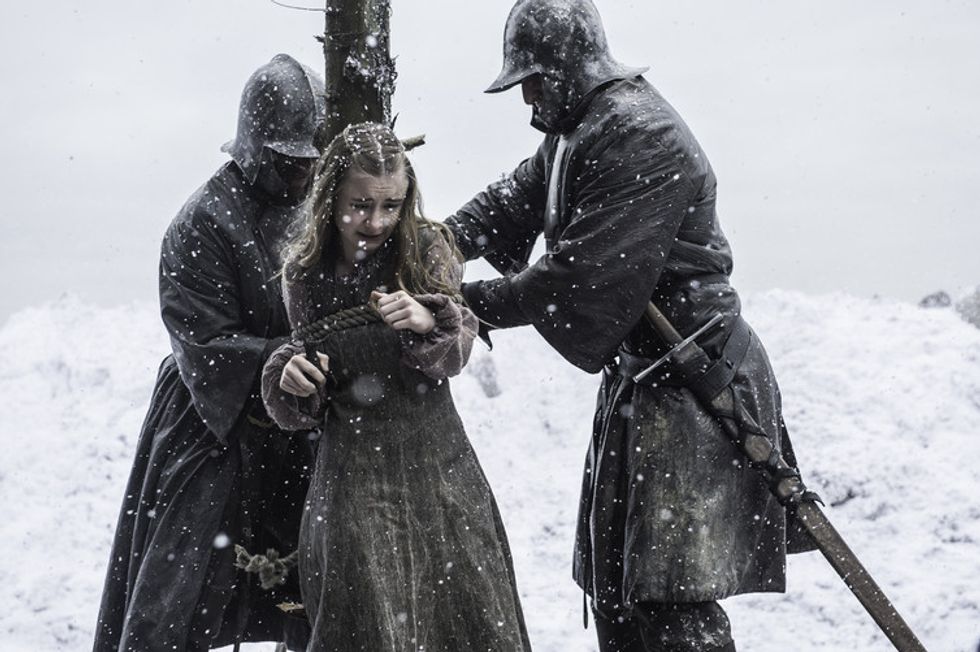
These sacrifices were not only condoned but encouraged by Melisandre, who urged Stannis to burn his daughter Shireen in order to ensure his victory. In our history, wars have been fought in the name of God and heretics have been burned for incorrect beliefs. But child sacrifice is usually associated with religious deviants or covens of witches. And indeed, in spite of Melisandre’s own confidence her visions, Stannis’s death at the end of season five suggests that she has either been deceived or misinterpreted the messages sent by her god. Recent revelations suggest that Melisandre may be more of a witch than a prophet.
The line between between divinely inspired prophet and devilishly influenced witch has always been blurred, especially where women were concerned. The later Middle Ages in particular experienced a flowering of women’s mystical experiences. Although not allowed to become priests, women in this period were increasingly drawn to visions and prophecy and some, like Melisandre, became enormously influential as a result. Bridget of Sweden, for example, successfully campaigned for the papacy to return from Avignon to Rome, and after her death, the account of her revelations circulated widely. The military victories of Joan of Arc made possible the coronation of Charles VII of France and helped bring about the end of the Hundred Years War.
But if God had messages for the faithful believer, so did the devil and his legion of demonic followers. The difficulty was in telling the difference. Sometimes demons impersonated angels or other holy figures to lead the vulnerable astray. Early theologian John Cassian provides a cautionary example of a monk who, after 50 years of pious living in the desert, is deceived by a demon disguised as an angel and throws himself down a well thinking that he is following a divine commandment. When even the pious are not safe from demonic attack, determining whether inspiration is from God or the devil becomes critical.
Theological writings of the period reveal that women, who were often viewed as physically, intellectually and morally deficient, were considered especially vulnerable to these influences – whether divine or demonic. So a woman claiming to receive special communications from God needed to be especially careful.
Joan of Arc on horseback, 1505 manuscript.
Gods and devils
Before sending Joan of Arc to lift the siege at Orleans, Charles VII ordered that she receive a background check and theological examination. The commission assigned to the task endorsed Joan’s piety, but this didn’t protect her from being accused of sorcery and heresy and then burned at the stake once she was captured by her enemies. And English mystic Margery Kempe was also accused of heresy and frequently needed to explain to clerical authorities the nature of her religious experiences in order to receive their approval.
Having approval was essential for success: with it, a female visionary could have her experiences recorded for posterity and perhaps even become a saint. Without it the best she could hope for was to die unknown (better, at least, than death or imprisonment for heresy).
Melisandre may not need the backing of religious authorities, but she needed Stannis as much as he needed her. Without him to fulfil her prophecies, her faith is shaken. Moreover, even if her message is coming directly from her god, it can be difficult to know how to interpret it. Medieval visionary writings often describe the problems of this next hurdle. The recluse Julian of Norwich contemplated aspects of her visions for 20 years. Even then, she concludes the expanded version of her revelations by stating that, although her work has begun, it has not yet been completed. Completion and full understanding will only be possible in the next life.
Only time can tell if Melisandre’s visions are false, or if she has misunderstood the intentions of her god. But, with her most powerful supporter gone, difficult times lie ahead. Whether she will be accused of sorcery and heresy like Joan, rise to prominence like Bridget, or retreat to seclusion like Julian, remains to be seen.