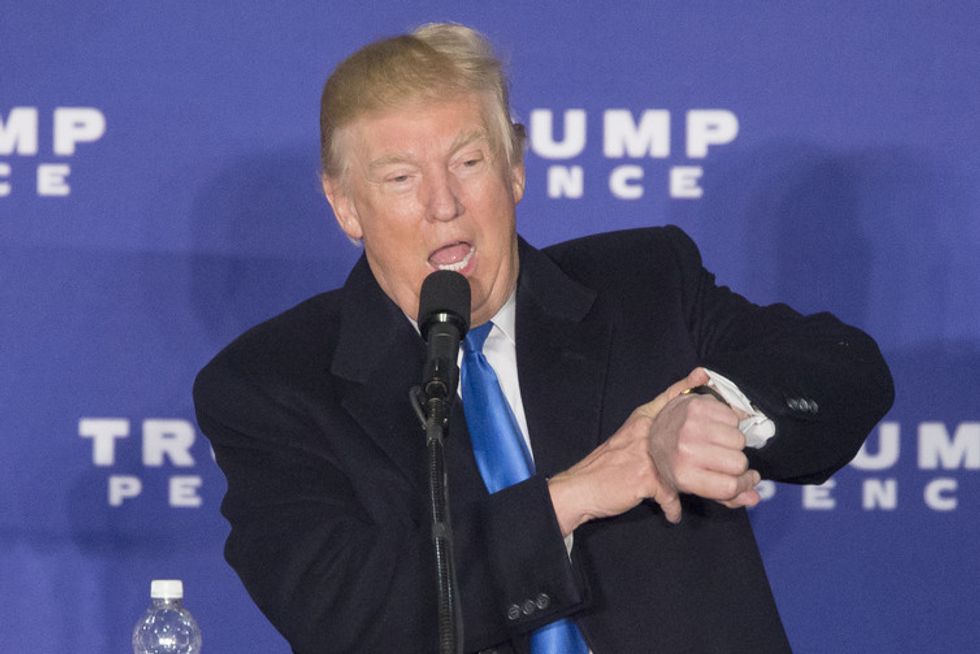
None I could find, however, mentioned what may become future historians’ most convincing explanation for America’s fall, should Donald Trump end up her author and finisher: bad journalism.
America’s media establishment endlessly repeated Republican claims that Hillary Clinton was a threat to the security and good order of the republic, because she stored official emails on her own server, and erased about 33,000 of them she said were private. The New York Times ran three front-page stories about FBI director James Comey’s surprise review of another set of emails found on the computer of Anthony Weiner’s wife, Clinton aide Huma Abedin. This second review, however, like the first, ended up showing no wrongdoing.
This article was originally published at The Washington Spectator
The elite gatekeepers of our public discourse never bothered with context: that every Secretary of State since the invention of the internet had done the same thing, because the State Department’s computer systems have always been awful; that at the end of the administration of the nation’s 41st president a corrupt national archivist appointed by Ronald Reagan upon the recommendation of Dick Cheney signed a secret document giving George H.W. Bush personal, physical custody of the White House’s email backup tapes so they would never enter the public record. (A federal judge voided the document as “arbitrary, capricious, an abuse of discretion, and contrary to law.”) The White House of his son George W. Bush erased 22 million of its official emails, including those under subpoena from Congress. Newspapers archived by the Lexis-Nexis database mentioned Hillary R. Clinton’s 33,000 erased private emails 785 times in 2016. I found six references to George W. Bush’s 22 million erased public ones: four in letters to the editor, one in a London Independent op-ed, another in a guide to the U.S. election for Australians, and one a quotation from a citizen in the Springfield (Ohio) News-Sun.
And now we have Donald Trump, elected in part because of his alleged tender concern for the secure handling of intelligence, making calls to world leaders from Trump Tower’s unsecured telephones.
Trump boogied his way to Pennsylvania Avenue to the tune of the extraordinary finding by a Washington Post-ABC News poll that “corruption in government” was listed by 17 percent of voters as the most important issue in the presidential election, second only to the economy, and ahead of terrorism and health care—and that voters trusted Trump over Clinton to be better on the issue by a margin of 48 to 39 percent, her worst deficit on any issue. This is the part of my article where rhetorical conventions demand I provide a thumbnail sketch of all the reasons why it’s factually absurd that anyone would believe that Donald Trump is less corrupt than Hillary Clinton. I have better things to do with my time than belabor the obvious.
Yet somehow, the great mass of Americans believed Clinton was the crook. Might it have something to do with the myriad articles like, say, “Smoke Surrounds the Clinton Foundation,” by The Los Angeles Times’s top pundit Doyle McManus? This piece, all too typically, despite endeavoring to debunk Trump claims of Clinton corruption, repeated charges like “Doug Band, who helped create the Clinton Global Initiative, sought access to State Department officials for Clinton Foundation donors”—even though donors did not get that access). And that donors harbored the “assumption” that they would “move to the head of the line”—even though they never did.
And what were pundits like McManus smoking? The vapors from a cunning long-term disinformation campaign run by the man Donald Trump appointed as his chief White House political strategist. Steve Bannon chartered a nonprofit “Government Accountability Institute,” whose president, Peter Schweizer, hacked out an insinuation-laden tome, Clinton Cash: The Untold Story of How and Why Foreign Governments and Businesses Helped Make Bill and Hillary Rich, then offered its “findings” on an exclusive pre-publication basis to the Times, which shamefully accepted the deal—with, predictably, the public’s perceptions of Clinton’s trustworthiness cratering in tandem with our national Newspaper of Record’s serial laundering of Steve Bannon’s filth.
Now we have a president-elect who boasts of his immunity from prosecution for leveraging his office for personal gain (“The President can’t have a conflict of interest”). This after having telegraphed, in 2000, his intent to use a presidential run to “make money on it,” for all America’s journalists to see—and ignore. At the Republican convention, Michael Mukasey, the former United States attorney general under George W. Bush, drew appreciative applause for the line that Hillary Clinton would be the “first president in history to take the oath of office after violating it.” No reporter I’m aware of had the initiative to track down Mr. Mukasey to follow up: what do you make of accusations that Donald Trump is laying the groundwork for a day-one violation of Article I, Section 9, Clause 8 of the Constitution (the “Emoluments Clause”), which proscribes any elected official of the United States government from accepting any present, emolument, title, etc. from any foreign state or foreign leader? Trump has already done so several times that we are aware of. These include reports that the government of Georgia has since the election green-lighted a new Trump property there, a phone call with Turkish President Recep Tayyip Erdogan in which Trump promoted his Turkish business partners, and all the foreign dignitaries renting rooms at Trump’s new hotel in Washington at $850 a night.
It was a steely Fox News correspondent who earned a reputation as Donald Trump’s most fearless media adversary: “You’ve called women you don’t like fat pigs, dogs, slobs, and disgusting animals,” Megyn Kelly said to him in an August 2015 debate. “Does that sound to you like the temperament of a man we should elect as president . . . ? Camp Trump savaged her in response, but she continued, apparently undaunted—so much so that by January, Bill Maher said she was doing such a good job keeping Trump on his toes that she should be one of the Republican candidates. In October, she brought Newt Gingrich to the verge of apoplexy by pointing out that Donald Trump was by his own admission a sexual predator. “You’re fascinated with sex and you don’t care about public policy,” Gingrich shrieked in return. Kelly, with astonishing sangfroid, responded that she was in fact “fascinated by the protection of women, and understanding what we’re getting in the Oval Office,” and coolly suggested Gingrich should work on his “anger issues.”
And there, finally, it was: hiding in plain sight, a media superstar who actually understood her vocation. That the job of the Fourth Estate in the run-up to an election is to inform the citizenry about what they need to know about the choices before them, without fear or favor, even at risk of their own careers. Which appeared a serious risk indeed, given that this brave truth-teller was an employee of the Trump-fluffing Fox News.
Except, no. Next came what to my mind was the most bone-chilling revelations of the entire campaign season: that Kelly’s personal safety had grown so precarious that a Fox news executive had to caution Donald Trump’s personal lawyer about emitting further who-will-rid-me-of-this-meddlesome-priest–style messages—before the Fox anchor got capped by some fevered Trump fanatic. (“Let me put it to you in terms you can understand: If Megyn Kelly gets killed, it’s not going to help your candidate.”) Kelly also reported that Trump campaign manager Corey Lewandowski “specifically threatened me if I showed up at the second debate hosted by Fox News.” She also pointed out that Trump’s social-media manager had tweeted, “Watch what happens to her after this election is over.” Problem being, Kelly revealed all this after the election was over. In coordination with the PR campaign for her brand new book. Until those interests aligned, apparently, America did not need to know that the minions of one of the candidates for president were flirting with loosing vigilante assassins upon a journalist.
For the likes of Megyn Kelly, it’s just a business opportunity. Same with CBS chairman Les Moonves, who observed, back in February: “It may not be good for America, but it’s damn good for CBS.” Or, yet worse, a game. Moonves again: “Man, who would have expected the ride we’re all having right now? . . . The money’s rolling in and this is fun.”
For CNN, Trumpland’s been an entire off-the-shelf business model. Their president, Jeff Zucker, was the executive who green-lighted “The Apprentice” while head of NBC Entertainment. He’s a cocktail-party pal with Donald, and has been accused by Huffington Post and BuzzFeed founder Ken Lerer, who knows the media business inside and out, of turning the Trump campaign into the very backbone of their 2016 brand as “a strategy, a programming strategy.”
It’s certainly not, for the Cable News Network, a news story in any recognizable sense, which would imply some sort of responsibility to inform. How could CNN possibly do that after hiring Corey Lewandowski to comment upon a man, Donald Trump, whose emoluments he still received, and who was under a binding legal agreement never to inform the public of anything disparaging about him?
So where are we now? At the razor’s edge. The Trump transition has put in stark relief the very foundations of the profession of journalism in modern America—whose fundamental canon is that there are two legitimate sides to every story, occasionally more, but never less. In a political campaign, they are structured on an iron axis. The Democratic side. The Republican side. Any critical attempt to weigh the utterances of one as more dangerous than the other is, by definition, the worst conceivable professional sin.
Then, the picture that results is presumed to map social reality on a one-to-one basis.
Thus, the crisis. “It is difficult to get a man to understand something, when his salary depends on his not understanding it,” as Upton Sinclair once observed. But by now, the conventional operation has been yielding distortions so palpable that even some mainstream professional journalists and editors are starting to understand it.
But sometimes, they have not.
It’s been a 50-50 sort of thing—and this is the hinge moment I suspect historians will bore down upon with particular intensity some decades hence.
They will study, from the evening of November 17 on NPR’s “All Things Considered,” a searingly courageous and astringent interview with white supremacist Richard Spencer, no punches pulled. He wanted to talk about how school kids naturally sort themselves into races in the cafeteria, and how New Yorkers eye each other warily on the subway: nothing more. Then, for any listener who might find temptation to locate this within the warm bounds of civic reason, reporter Kelly McEvers very effectively and patiently relocated him to the chilliest corners of a civic Antarctica. The edit of the interview led with him pronouncing, “What I would ultimately want is this ideal of a space effectively for Europeans.” Her probing then revealed his affection for the swastika—“an ancient symbol”—and his approval of “people who want to get in touch with their identity as a European”—just not via “physical threats or anything like that.”
This was journalism. This told the truth.
Then came NPR’s “Morning Edition” on November 18—where Steve Inskeep interviewed reporter Scott Horsley on three major Trump appointments, Jeff Sessions for attorney general, and Mike Pompeo for head of the CIA, and Michael Flynn as national security advisor, a series of lies of omission.
Inskeep blandly introduced them as “Trump loyalists,” who “mirror some of the positions that the president-elect himself took during the campaign.” Flynn sharing Trump’s “concerns about radical Islam,” Sessions “a real hard-liner when it comes to illegal immigration.” Flynn—“a Democrat”—“took some flak for taking payments from Russian state television,” and believes “we must be able to deal with Russia.” But, we were reassured, “still describes Russia as a grave threat.” Pompeo, Inskeep observed, “is going to be wading into quite a challenge,” because “Trump has said that he wants the United States to get back into the torture business.”
But Senator Mark Warner was brought in to reassure us: “Hopefully, that hypothetical will—we won’t have to address.” Added Horsley, “the CIA director is a post that is subject to Senate confirmation, as is the attorney general’s post.”
The National Security Advisor, however, is not.
NPR’s producers brought in a former colleague of General Flynn’s, named Sarah Chayes.
Inskeep: “How closely did you work with General Flynn?”
Chayes: “We shared an office. Our desks faced each other.”
“Well, what is he like as an office mate?”
“Fun, for starters . . .”
You see, she explained, he reminded her of the character in “Peanuts,” Pig Pen.
Inskeep almost giggled: “O.K., the kid who was a little dirty, O.K. So you’re saying that things were a little chaotic around General Flynn. But you found this guy to be extraordinarily enthusiastic . . . .”
They kibbitzed like that for a little while longer. Inskeep seemed pleased to learn she had never heard anything prejudiced from him. He asked how she felt when she heard about his selection. She answered, “My heart sank.”
Inskeep sounded surprised: “Really? Why?”
“Everything I just said”—meaning, she hadn’t been joking. Inskeep had plainly thought it all was a jape. She put it bluntly: “The NSA is an institution that, first of all, has to keep the trains running. That’s the first job of the National Security Advisor—is to make the National Security Advisor run.”
Inskeep, impatiently: “O.K.”
Chayes, starkly: “Flynn can’t make anything run.”
Which, considering that she was saying he was objectively unsuited for the job he was to fill—the NSA’s job is to organize, and Flynn is staggeringly disorganized—sounded like something they could have dwelt upon at greater length than what “Peanuts” character he most resembled. But no: “O.K., Sarah, got to stop you there because of the clock.”
Hard break. The show was over. No time to squeeze a word in about Flynn leading the cheers to “Lock Her Up” at the Republican convention, concerning Hillary Clinton’s dodgy email server, though Flynn himself routinely broke security rules he considered “stupid,” including having a forbidden internet connection installed in his Pentagon offices. Nor what security reporter Dana Priest described as his reposts of “the vitriol of anti-Semitic and anti-Muslim commentators.” And in another instance a tweet concerning Clintonite “Sex Crimes w/Children, etc.” Nothing mentioned about the book Flynn co-authored with conspiracy theorist Michael Ledeen, which spread the insane far-right conviction that Islam is not a religion but a conspiracy aimed at destroying Judeo-Christian civilization. (Priest: “I’ve asked Flynn directly about this claim; he has told me that he doesn’t have proof—it’s just something he feels as true.”) Nor his business ties to Turkey, on whose behalf, without disclosure, he has written op-eds advising extradition of an enemy of President Recep Tayyip Erdogan’s regime. Nor that he not merely “appeared” on Russia’s state-sponsored English-language station RT but was a paid speaker at their anniversary gala in Moscow. Nor that he has stated, “I’ve been at war with Islam”—he corrected himself, for political correctness’s sake: “or a component of Islam”—“for the last decade.”
He’s General Jack D. Ripper from Dr. Strangelove. Yet listening to NPR, you’d think he was a disheveled version of Lawrence Eagleburger.
Media on the razor’s edge between truth and acquiescence. Consider two more case studies: The Washington Post and Time magazine.
The Washington Post: it had some great investigations on Trump, for instance the stunning, meticulous reporting of David Fahrenthold demonstrating how the Trump Foundation operates as an elaborate self-enriching scam. The editors loved it. But when columnist Richard Cohen reported that Trump said to someone Cohen knew, about then-13-year-old Ivanka, “Is it wrong to be more sexually attracted to your own daughter than your wife?”, the words, which appeared in an advance draft circulated for publication, were excised in the published version.
It’s almost like they keep score in editorial offices. Only a certain number of horrifying—which is to say, truthful—things can be allowed in a major publication about our president-elect every day, which then must be balanced by something reassuring. Which is to say, something not true. Like the headline the Post circulated for its daily promotional email on November 24: “Trump Looks to Diversify His Cabinet With Latest Picks.” Which, remarkably, was precisely the same angle The New York Times played: “Trump Diversifies Cabinet.” Both were referring to the same individuals, Nikki Haley, and Betsy DeVos. You’d think the lead about Trump’s appointment of Haley would instead be the extraordinary irresponsibility of picking someone without a day’s foreign policy experience in her life as America’s ambassador to the United Nations. Or, concerning Education Secretary-designate DeVos, the fact that she married into a family that built an empire on industrial-scale fraud (the family business, Amway, paid $150 million in 2011 to settle one class action suit), that the company founded by her brother Erik Prince was responsible for the most lawless American massacre of the Iraq war (and then, when contracting with a country with a functioning rule of law got to be too much, turned to building a mercenary air force for rent to Third World nations, in cahoots with China’s largest state-owned investment firm).
Or, you know, that she has no education experience, except if you count writing checks to advocate its privatization.
Time magazine: they just ran a very illuminating piece by historian David Kaiser exposing Steve Bannon’s alarming interpretation of a theory advanced by amateur historians Neil Howe and William Strauss in books like The Fourth Turning: An American Prophesy, that every 80 years or so the United States endures a nation-transforming crisis: “More than once during our interview,” Kaiser wrote of an earlier interview with Bannon, where “he pointed out that each of the three preceding crises had involved a great war, and those conflicts had increased in scope from the American Revolution through the Civil War to the Second World War. He expected a new and even bigger war as part of the current crisis, and he did not seem at all fazed by the prospect.”
That the president elect’s closest adviser both welcomes apocalyptic conflagrations, and will soon be well-positioned to bring one about, is the kind of news you’d think a more responsible national press would be pursuing. I haven’t seen much mention of the fact, beyond my Bolshevik friends on Facebook, however. From the warm and fuzzy confines of Time’s editorial offices, however, I received the following reassuring missive by way of balance:
“5 Potential Quick Victories for President Donald Trump: Few have high expectations for the President-elect’s foreign policy. But he could make some big improvements.”
Click the link. Print it out. Seal between two six-inch thick plates of Lexan glass and bury it 50 feet deep in a lead-lined bunker. Future archaeologists are going to need it. It will help them explain how a once-great civilization fell.
Rick Perlstein is The Washington Spectator’s national correspondent.