Regina Fargis didn’t know what to do.Fargis runs Summit Hills — a health and retirement community in Spartanburg, South Carolina, that offers skilled nursing, activities and communal meals for its residents, most of whom are over 60, the highest-risk category for coronavirus complications. In South Carolina, more than a hundred new cases were emerging daily. So she took precautions: no visitors, hand sanitizer everywhere and regular reminders for residents about the importance of social distancing.For a time, it worked. Many similar facilities were hit hard by the virus, but Summit Hills remai...
The Texas Tribune is using data from the Texas Department of State Health Services to track how many people have tested positive for the novel coronavirus in Texas each day. The state data comes from local health officials, and it may not represent all cases of the disease given limited testing. Here's what we know about the daily numbers.
Even as hospitalizations have increased dramatically in June, Abbott has said closing businesses will be “the last option” and has touted Texas’ hospital capacity as plentiful. But some local officials are worried hospitals could soon become overwhelmed. In late June, some local officials began reviving plans to make backup medical facilities available if hospitals become overwhelmed.
On March 4, DSHS reported Texas’ first positive case of the coronavirus, in Fort Bend County. The patient had recently traveled abroad. A month later on April 4, there were 6,110 cases in 151 counties. As of June 28, there are 148,728 cases in 244 counties. The Tribune is measuring both the number of cases in each county and the rate of cases per 1,000 residents.
Number of cases
Harris and Dallas counties, the two largest in the state, have reported the most cases and deaths.
Cases per 1,000 residents
The rate of cases per 1,000 residents is especially high in the panhandle’sMoore County, where infections are tied to a meatpacking plant. The rate of cases is also high incounties with state prisons such as Walker and Jones. In other rural areas where the presence of the virus has yet to be confirmed, testing has been scarce.
How many people are in the hospital?
On April 6, the state started reporting the number of patients with positive tests who are hospitalized. It was 1,153 that day and 5,497 on June 28. This data does not account for people who are hospitalized but have not gotten a positive test.
Experts say there’s a lag before changes in people’s behaviors, like more social interaction, are reflected in coronavirus case data. It takes about nine to 16 days to see increased infections and generally another five to seven days to see changes in the numbers of people hospitalized, said Rebecca Fischer, an infectious disease epidemiologist at the Texas A&M University School of Public Health. (Some individuals are only diagnosed once they make it to the hospital.)
Total current hospitalizations
The average number of hospitalizations reported over the past seven days shows how the situation has changed over time by deemphasizing daily swings.
The hospitalization rate is calculated by dividing the number of people who are currently hospitalized by the number of active cases, which is the number of total cases minus deaths and estimated recoveries. Estimated recoveries is a DSHS estimate of how many people require hospitalization and how long it takes most people to recover from the virus.
On June 28, the state reported 12,751 available staffed hospital beds, including 1,355 available staffed ICU beds statewide.
According to DSHS, these numbers do not include beds at psychiatric hospitals or other psychiatric facilities. They do include psychiatric and pediatric beds at general hospitals, and pediatric beds at children’s hospitals.
The number of patients hospitalized with the coronavirus tripled in June compared to May 31. While state officials have stressed the state has abundant hospital capacity, there are regional differences in the availability of beds.
Hospital beds in use
The percentage of hospital beds in use shows the strain the coronavirus can put on hospitals. The data is broken down into trauma service regions, showing how the virus has impacted different parts of the state. These regions are administered by Regional Advisory Councils (RACs).
How many people have died?
The first death linked to the coronavirus in Texas occurred March 16 in Matagorda County. As of June 28, 2,393 people who tested positive for the virus have died.
New deaths from coronavirus each day
The average number of deaths reported over the past seven days shows how the situation has changed over time by deemphasizing daily swings.
How have the number of cases increased each day?
On March 24, the Texas Department of State Health Services changed its reporting system to track case counts directly from counties instead of relying on official case forms, which came in later and caused the state’s official count to lag behind other tallies. Increases in testing also led to more detected cases. In May, a large one-day spike was reported after testing was done at meatpacking plants in the Amarillo region.
Since June, the number of new cases each day has trended upwards. Abbott linked these increases to more Texans under the age of 30 testing positive for the virus. He said it’s unclear why this is happening, but has speculated that it could be from increased activity over Memorial Day weekend and other social gatherings.
How has the positivity rate changed?
Gov. Greg Abbott said he is watching the state's positivity rate — the percentage of positive cases to tests conducted. The average daily positivity rate is calculated by dividing the 7-day average of positive cases by the 7-day average of tests conducted. This shows how the situation has changed over time by de-emphasizing daily swings. Public health experts want the average positivity rate to remain below 6%.
In early May, Abbott said a rate over 10% would be a “warning flag”. The state exceeded that mark in June for the first time since April.
The positivity rate differs from the infection rate. In order to obtain an infection rate, everybody would need to be tested, said Hongwei Zhao, an epidemiology professor at the Texas A&M University School of Public Health.
How many people have been tested?
As of June 28, Texas has administered 2,006,724 tests for the coronavirus since March. Expert opinions differ on how much larger that figure needs to be. We do not know the number of Texans who have gotten a test because some people are tested more than once. (Tests from private labs, which make up the majority of reported tests, are not deduplicated.) The state’s tally also does not include pending tests.
Coronavirus test results reported to the state each day
The average number of tests reported over the past seven days shows how the situation has changed over time by deemphasizing daily swings. In April, Abbott set a goal of 30,000 daily tests in the state.
The DSHS data also might not include all of the tests that have been run in Texas. The state has said it is not getting test data from every private lab, and as of mid-May only 3% of tests were coming from public labs. The state has since stopped differentiating between tests reported by public and private labs.
Even as demand for testing has increased, both public and private labs continue to prioritize Texans who meet certain criteria, but every private lab sets its own criteria.
On May 21, DSHS disclosed for the first time that as of a day earlier, it had counted 49,313 antibody tests as part of its "Total Tests" tally. That represents 6.4% of the 770,241 total tests that the state had reported on May 20. Health experts have warned against counting antibody and standard viral tests together because they are distinctly different tests. Antibody tests detect whether someone was previously infected, while standard viral tests determine whether someone currently has the virus.
Antibody tests are typically reported a day late.
How is this impacting Texans of color?
While early reports from other parts of the country indicate black Americans are disproportionately likely to get sick or die from the new coronavirus, it’s virtually impossible to determine if that grim reality is playing out in Texas because information released by state health officials is notably incomplete.
The limited data provided to the Tribune offers a murky glimpse of the virus' impact on Texas communities of color. Race and ethnicity are reported as unknown for a significant portion of the completed case reports. (Agency officials said some people prefer not to provide the information.)
Although state leaders acknowledge the demographic data is lacking, they have indicated the state won't be taking steps to mandate reporting to fill in the gaps. In June, the state announced they are planning on ramping up testing in areas of the state that are predominantly Black and Hispanic, as well as launching a study on the coronavirus’ effect on vulnerable populations.
What else should I know about this data?
These numbers come from the Texas Department of State Health Services, which updates statewide case counts at 3 p.m. each day. The data is from the same morning, and it may lag behind other local news reports.
From March 13 through March 24, the Tribune added cases from Lackland Air Force Base in San Antonio, where hundreds of American evacuees from China and cruise ships were quarantined. Those case counts came from the Centers for Disease Control and Prevention.
Carla Astudillo, Mandi Cai, Darla Cameron, Chris Essig, Anna Novak, Emily Albracht and Alexa Ura contributed to this report.
Previously, The Texas Tribune incorrectly stated our formula for calculating the average daily positivity rate. This has been corrected.
The death toll from Covid-19 reached half a million people on Sunday, according to a Reuters tally, a grim milestone for the global pandemic that seems to be resurgent in some countries even as other regions are still grappling with the first wave.
The respiratory illness caused by the new coronavirus has been particularly dangerous for the elderly, although other adults and children are also among the 500,000 fatalities and more than 10 million reported cases.
While the overall rate of death has flattened in recent weeks, health experts have expressed concerns about record numbers of new cases in countries like the United States, India and Brazil, as well as new outbreaks in parts of Asia.
More than 4,700 people are dying every 24 hours from Covid-19-linked illness, according to Reuters calculations based on an average from June 1 to 27.
That equates to 196 people per hour, or one person every 18 seconds.
About one-quarter of all the deaths so far have been in the United States, the Reuters data shows. The recent surge in cases have been most pronounced in a handful of Southern and Western states that reopened earlier and more aggressively.
The number of cases in Latin America on Sunday surpassed those diagnosed in Europe, making the region the second most affected by the pandemic, after North America.
The first recorded death from the new virus was on January 9, a 61-year-old man from the Chinese city of Wuhan who was a regular shopper at a wet market that has been identified as the source of the outbreak.
In just five months, the Covid-19 death toll has overtaken the number of people who die annually from malaria, one of the most deadly infectious diseases.
The death rate averages out to 78,000 per month, compared with 64,000 AIDS-related deaths and 36,000 malaria deaths, according to 2018 figures from the World Health Organization.
Changing burial rites
The high number of deaths has led to changes to traditional and religious burial rites around the world, with morgues and funeral businesses overwhelmed and loved ones often barred from bidding farewell in person.
In Israel, the custom of washing the bodies of Muslim deceased is not permitted, and instead of being shrouded in cloth, they must be wrapped in a plastic body bag. The Jewish tradition of Shiva where people go to the home of mourning relatives for seven days has also been disrupted.
In Italy, Catholics have been buried without funerals or a blessing from a priest. In New York, city crematories were at one point working overtime, burning bodies into the night as officials scouted for temporary interment sites.
In Iraq, former militiamen have dropped their guns to instead dig graves for coronavirus victims at a specially created cemetery. They have learned how to conduct Christian, as well as Muslim, burials.
Elderly at risk
Public health experts are looking at how demographics affect the death rates in different regions. Some European countries with older populations have reported higher fatality rates, for instance.
An April report by the European Centre for Disease Prevention and Control looked at more than 300,000 cases in 20 countries and found that about 46 percent of all fatalities were over the age of 80.
In Indonesia, hundreds of children are believed to have died, a development health officials have attributed to malnutrition, anemia and inadequate child health facilities.
Health experts caution that the official data likely does not tell the full story, with many believing that both cases and deaths have likely been underreported in some countries.
Governors in multiple states who took President Donald Trump's advice on reopening their economies as quickly as possible during the COVID-19 pandemic have been forced to reverse course, which Politico reports is further damaging his campaign's prospects.
"Republican governors in Florida, Arizona and Texas followed Trump’s lead by quickly reopening their states while taking a lax approach to social distancing and mask-wearing," the publication writes. "Now each of them is seeing skyrocketing coronavirus caseloads and rising hospitalizations, and Republican leaders are in retreat."
Govs. Doug Ducey of Arizona, Ron DeSantis of Florida, and Greg Abbott of Texas have all been forced to slow down or even roll back their reopening plans as their states have been getting hammered by the disease.
Texas last week announced it was shutting down bars entirely, while Florida said it was banning on-premise alcohol consumption in bars.
The Biden campaign has capitalized on the president's stumbles by aggressively hitting him for pushing those states to open up too quickly, only to be struck with a fresh wave of COVID-19 cases, Politico reports.
"The reality is, when it comes to this president’s handling of the pandemic and the subsequent economic disaster that’s befallen our country -- which was totally predictable coming out of the pandemic and his handling of it -- Trump’s failed leadership has been exposed in a profound way," Biden campaign adviser Anita Dunn tells the publication.
Confirmed global cases of the coronavirus hit 10 million Sunday, a grim milestone that came as reported deaths from the disease climbed toward 500,000 and a top U.S. health official warned the country's chances of getting the outbreak back under control were fast disappearing.
"This is a very, very serious situation and the window is closing for us to take action and get this under control," Health and Human Services secretary Alex Azar told CNN's Jake Tapper Sunday.
Data from Johns Hopkins University, which has tracked the disease for months, showed the total confirmed cases around the world at over 10 million by early Sunday afternoon. Total deaths as of press time had nearly exceeded the 500,000 mark.
The U.S. leads the world in total cases with over 2.5 million and in deaths with 125,709. Brazil is a distant second in both categories with around 1.3 million cases and just over 57,000 deaths.
"We are 4% of the world's population and we are 25% of the cases and the deaths," House Speaker Nancy Pelosi (D-Calif.) said on an appearance on ABC Sunday.
On Friday, the U.S. reported the highest number of new cases in a single day, with at least 40,173 new infections. The previous daily high was reported on Thursday.
Several states, including Texas and Washington state, and localities have paused their reopening plans or reimposed some restrictions in hopes of curbing the spread of the virus.
President Donald Trump's management of the disease has been blamed by critics for the nation's high rate of infection and death count. Trump and members of his administration have blamed a host of other factors, including testing, on the high rate.
Former Centers for Disease Control director Dr. Tom Frieden toldFox News Sunday that rationale was simply untrue.
"As a doctor, a scientist, an epidemiologist, I can tell you with 100% certainty that in most states where you're seeing an increase, it is a real increase," said Frieden. "It is not more tests, it is more spread of the virus."
Irish pubs unlock their doors and begin pouring pints on Monday, ending a 15-week dry spell forced by the nation's coronavirus lockdown.
Pubs serving food as well as restaurants and hotels are permitted to open as the republic enters the penultimate stage of its plan to lift stay-at-home restrictions.
All domestic travel restrictions were also lifted, as churches, hairdressers, cinemas and museums opened and mass gatherings of 50 indoors or 200 outdoors were permitted.
But anyone hoping to experience a heaving Irish pub will be disappointed.
Social distancing measures mean drinkers will have to stay seated, with a maximum stay of 105 minutes.
Ireland's 7,000 pubs shut their doors on the eve of St Patrick's Day, which is traditionally marked by street parades and carousing, two weeks before lockdown on March 28.
Anticipation for reopening is high.
"There is a pent-up public demand to return to the pub, mixed with some natural anxiety," said Padraig Cribben, of the Vintners' Federation of Ireland.
Pub industry organizations estimate some 2,000 of their members will open on Monday, while the rest await the final stage of the nation's scheme to reopen on July 20.
Ireland has seen 1,735 deaths in the coronavirus outbreak, according to health department figures on Sunday.
Since peaking at 77 in a day in mid-April, the daily toll has dwindled to single digits in June, prompting the government to quicken its initial "roadmap" to reopen the nation.
The original five-phase plan was reduced to four phases, with shop and pub openings brought forward. Nearly all restrictions are now due to lift in July rather than August.
But chief medical officer Tony Holohan warned Saturday that a growing number of new infections are in the under-35 age bracket.
"This is now a real concern and a worrying trend at a time when many people are reconnecting with friends and loved ones and may be gathering in larger groups," he said.
"COVID-19 is an infection that affects all ages and it is incumbent on all of us to take our individual responsibility seriously."
Most antivirals in use today target parts of an invading virus itself. Unfortunately, SARS-CoV-2 – the virus that causes COVID-19 – has proven hard to kill. But viruses rely on cellular mechanisms in human cells to help them spread, so it should be possible to change an aspect of a person’s body to prevent that and slow down the virus enough to allow the immune system to fight the invader off.
Using this map, we identified a few already existing cancer drugs which alter the function of the kinases that SARS-CoV-2 hijacks, and began testing them in coronavirus-infected cells. The results of these early tests are promising enough that we are working with some groups and have already begun human clinical trials.
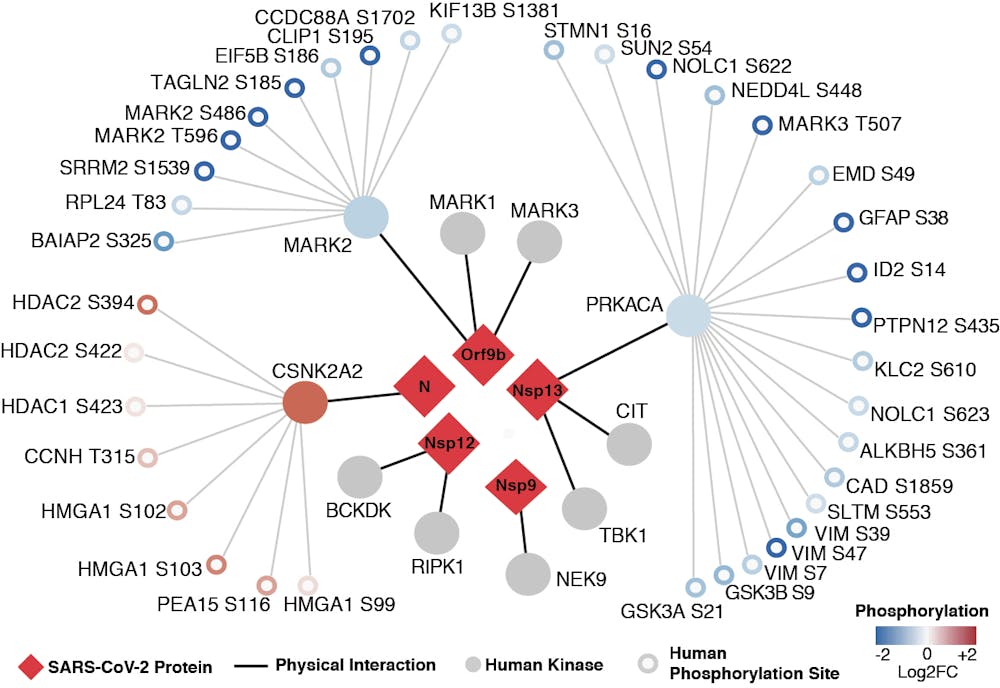
This map shows how the coronavirus changes the function of kinases – cellular switches involved in most biological processes – and the proteins they control. It guided researchers from UCSF to cancer drugs that could fight COVID-19.
Kinases are proteins found in every cell of our body. There are 518 human kinases, and they act as major control hubs for virtually all processes in the body. They are able to add a small marker – a process called phosphorylation – to other proteins and thus change how, if and when a phosphorylated protein can do its work.
For example, if a cell is preparing to grow – say to heal a cut on your finger – specific kinases will turn on and start telling proteins involved in cell growth what to do. Many cancers are caused by overactive kinases leading to uncontrolled cell growth, and drugs that slow kinases down can be highly effective at treating cancer.
Kinases are also fairly easy to target with drugs because of how they add phosphorylation markers to proteins. Researchers have developed a huge number of drugs, particularly cancer drugs, that work by essentially throwing a wrench into the mechanics of specific kinases in order to stop cell growth.
So what does this have to do with the coronavirus? Well, viruses and cancer actually have more in common than you might think. Cancer is essentially a malfunctioning of cellular machinery that causes runaway cell growth.
Viruses also change the function of cellular machinery – albeit on purpose – but instead of causing cell growth, the machinery is repurposed to produce more viruses. Not surprisingly, viruses take control over many kinases to do this.
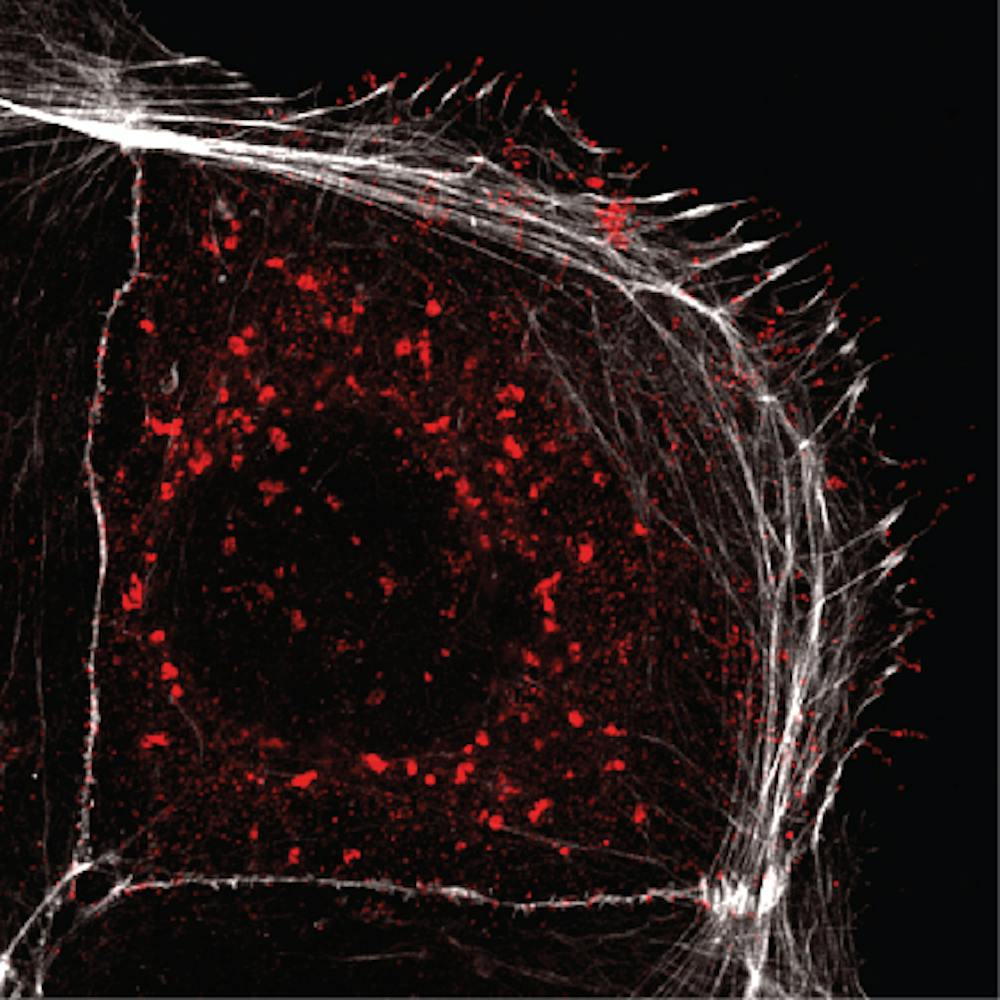
Microscope image shows a cell infected with SARS-CoV-2 and filopodia growths (in white) extending out from the cell surface containing viral particles (in red).
This idea – that SARS-CoV-2 is using kinases to hijack cellular machinery – is why we wanted to build a map of every kinase that is taken over by the coronavirus. Any virus–kinase interaction could be a potential target for drugs.
To do this, we first infected green monkey cells – which are fairly good surrogates for human cells when it comes to virus infection – with SARS-CoV-2. We then ground up these infected cells and used a device called a mass spectrometer to see which proteins were phosphorylated in these infected cells. We then did the same thing with healthy cells.
It is impossible to actually see which kinases are activated at any time, but since each kinase can attach phosphorylation markers to only a few specific proteins, researchers can look at the phosphorylated proteins to determine what kinases are active at any time.
We made two lists: one list of phosphorylated proteins in healthy cells and one list of phosphorylated proteins in infected cells. We then compared the two, and by looking at the differences between the infected and uninfected lists, we were able to determine which kinases the coronavirus uses to reproduce.
Because researchers still don’t fully understand what all 518 human kinases do, we were able to look for effects in only 97 of the ones we know most about. But that turned out to be more than enough. Of those 97 kinases, we found 49 that the virus affects.
Some of the more interesting ones include Casein Kinase 2, which is involved in controlling how a cell is shaped. We also identified several kinases that work together in what is called the p38/MAPK signaling pathway. This pathway responds to and controls our body’s inflammation reaction. It is possible these kinases could be involved in the cytokine storm – a dangerous immune system overreaction – that some patients with severe COVID-19 experience.
While identifying the kinases involved in SARS-CoV-2 replication, we were also able to learn a lot about how the virus changes our bodies. For example, CK2 becomes much more active during the course of coronavirus infection and causes the growth of little tubes that extend from the surface of the cell. Under a microscope, it looks as if the cell has a full head of hair. We think SARS-CoV-2 might be using these long cell outgrowths – called filopodia – as viral highways to get new viruses closer to neighboring cells, thereby making infection easier.
Testing the promising cancer drugs in the lab was the first step, and after dozens showed promise, we began the process of starting clinical trials.
Learning more about the virus’s function is interesting for a biologist like me and could be useful down the road, but the ultimate goal of our project was to find drugs to treat COVID-19.
Once we knew which kinases SARS-CoV-2 uses to replicate and the proteins they change, we looked through a database of around 250 kinase-inhibiting drugs to see if any of them targeted the kinases used by the virus. To increase our chances, we also looked for drugs that hit some of the proteins the kinases act on. And sure enough, we found some.
There are 87 existing drugs that change the kinase-controlled pathways used by the coronavirus. Most of these drugs are already approved for human use or are currently in clinical trials to treat cancer, and could be quickly repurposed to treat COVID-19 patients.
With these leads, our collaborators in New York and Paris tested the effect of 68 of those drugs on cells infected with SARS-CoV-2. Several of these were effective in killing the virus in cells. A few that we are especially excited about – silmitasertib, gilteritinib, ralimetinib, apilimod and dinaciclib – are either approved for treatment, in clinical testing or under preclinical development for various diseases.
Silmitasertib stops Casein Kinase 2, the kinase that causes cells to grow the virus spreading filopodia tubes. As soon as the company that makes silmitasertib heard this news, they announced that they wanted to test the drug against COVID-19 in the clinic.
Drugs hitting kinase pathways have been on the radar of researchers as potential powerful antivirals for years, but none have come to fruition. By looking to this new area of drug applications and using our new mapping approach, our team has added dozens of drugs to the growing list of potential tools to help fight this pandemic.
It is still too early to say whether any of these will work to treat COVID-19 in patients, but the more chances we have, the better.
Vice President Mike Pence told the country this week that the United States successfully flattened the curve, and all is well on the coronavirus front. The comment came as President Donald Trump came back to Tulsa, Oklahoma, with eight staffers who had contracted the virus. Ahead of his massive rally last Saturday, Tulsa experienced a huge increase of COVID-19 cases, helping the state to a record number of cases.
"What!?" comedian John Oliver shouted at Pence at the top of his Sunday episode of "Last Week Tonight."
"That's just an open and stupid lie," he said. "That's like instead of saying your dog is on a farm upstate; your dad said, 'your dog owns a farm upstate that has the market cornered in wholesale wheat and grain supplies for the whole of Saratoga County.' That's not true. The dog is dead, and so, by the way, are over 120,000 Americans."
Oliver then attacked Pence for choosing to omit the recommendation to wear a mask to help slow the spread of the virus.
"I will just never understand why or even how Republicans have made not spreading disease into a culture war issue," Oliver said. "Honestly, this was a missed opportunity for them. You could have printed 'Make America Great Again' on a billion red masks and dropped them out of helicopters. People would have worn them! You're not even capitalizing on a natural disaster correctly, you f*cking idiots!"
A white lady was caught on video over the weekend having a complete meltdown in a Latino-American supermarket in Dallas, Texas.
The Fiesta Market manager politely told the woman to put on a mask only to have her start throwing food from her basket in anger. Item after item was chucked onto the floor, from frozen chicken to chips.
The woman filming the incident explained in Spanish that the latest "Karen" was asked to put her mask back on at the checkout stand. She had apparently worn the mask the whole time through her shopping trip.
Texas has experienced such a huge increase in coronavirus cases that the GOP governor has decided to pause reopening and shutdown some bars in the state. Dallas, in particular, has been a hotbed of COVID-19 cases, and Houston announced this week that they were running out of ICU beds. Texas experienced a record number of hospitalizations for the past 16 days in a row.
President Donald Trump is stuck in a no-win situation. As November approaches, he desperately needs evangelical and right-wing churches to mobilize and get him reelected. However, these churches have also become hotbeds for coronavirus outbreaks.
Politico wrote Sunday that when Trump ordered all churches reopen because they are "essential," he made them into super-spreaders of the COVID-19.
"Clusters of Covid-19 cases are surfacing in counties across the U.S. where in-person religious services have resumed, triggering questions about whether his administration should reassess its campaign to treat houses of worship the same as other essential businesses, or leave them alone and risk additional transmission of the deadly coronavirus — including in communities that are largely supportive of the president," said Politico.
There was an outbreak at a Pentecostal church in Oregon where members came back to worship over Memorial Day weekend. A whopping 258 cases of COVID-19 can now be traced back to the church.
Six different health departments across West Virginia have linked a coronavirus outbreak to churches, one of which had 34 church members test positive.
In Texas, Saturday marked their 16th day in a row of setting records of hospitalizations for the coronavirus. Health officials there have numerous races back to church-related exposure.
It might be one of the reasons that Vice President Mike Pence attended a megachurch service in Texas on Sunday wearing his mask most of the time. He did remove it when he spoke to the audience.
Wearing a mask has somehow become a sign of solidarity to the Republican Party. Texas Lt. Gov. Dan Patrick proclaimed on Fox News that the elderly should be willing to put their children and their grandchildren first, sacrifice themselves, and continue mass reopening even if it means they'll die. Trump has said he doesn't need a mask because he's tested so frequently.
"A senior administration official briefed on the discussions said members of the White House coronavirus task force began expressing serious concerns this week about rising infection rates in a dozen states, particularly after Florida reported record-breaking cases last Wednesday — leading to the task force’s first briefing in two months on Friday," reported Politico. "But the same official said the task force does not consider churches to be super-spreaders, or hotspots for Covid-19 transmission, at this time."
Trump has said that the only reason cases are increasing is because testing is also increasing. It isn't accurate, but it's an excuse Trump is trying to use.
"Now Trump is grappling with the fallout — unforeseen or not — of his aggressive push to reopen churches at a time when he can’t afford to agitate his religious supporters," Politico said. "Polls conducted since the coronavirus pandemic began have shown a steady decline in his favorability rating among white Catholics and white evangelicals, demographics that helped carry him to victory in 2016 and whose backing he will need to defeat Joe Biden, his expected Democratic challenger, this fall."
The United States has become one of the biggest hotspots in the world for the coronavirus and countries are lining up to block Americans from traveling and possibly re-infecting their country.
"Despite the outbreaks occurring in churches and elsewhere, the president’s response lately has been to double down on his effort to jumpstart the U.S. economy and reopen houses of worship, restaurants, manufacturing facilities and retail suppliers," Politico noted.
Trump-loving pastor Robert Jeffress even published a pamphlet asking whether the coronavirus could be “a judgment from God" and mocked stay-at-home orders so that he could hold a big visit he was planning to sell his book at a Dallas megachurch.
Now Jeffress is watching more parishioners contract the virus and urging people to wear masks in houses of worship. Trump still refused to do it while at a megachurch in Arizona this week. He even went so far as to promise the crowd that the U.S. was getting close to "the end of the pandemic."
Vice President Mike Pence praised the work Texas's Republican Gov. Greg Abbot is doing to combat the coronavirus.
Pence, who has chaired the coronavirus task force, has consistently downplayed the pandemic that has killed over 128,000 and sickened nearly 2.6 million Americans.
During the event, Pence was questioned about why President Donald Trump still refuses to wear a mask when Pence has decided that it's clearly important to do so even if he's getting tested. He ignored the question, saying instead, that people should "wear a mask."
"But it does require all Texans to go back to those strategies that we mastered," Pence said. That includes "wearing a facemask, sanitizing your hands, keeping a safe distance."
He told Texans that they must "go back" to washing their hands. What studies have shown, however, is that washing hands isn't as helpful as wearing a mask. Wearing a mask can protect people 75 percent more than without a mask.
Pence praised the work Texas has done to reopen, despite the fact that the reopening of Texas sparked another huge increase in the virus. Houston, Texas, in particular, has filled up the ICU beds. The state has also set new records for coronavirus-related hospitalizations for the 16th day in a row on Saturday. It's unclear why Pence believes this is a standard for reopening if Texas' reopening has resulted in so much more illness.
South Korea said Sunday it will begin allowing limited numbers of spectators at sports games as it seeks to return to normal after months of strict social distancing rules to combat the coronavirus.
The country endured one of the worst early outbreaks of the disease outside China but appears to have brought it broadly under control with an extensive "trace, test and treat" programme while never imposing a compulsory lockdown.
Social distancing rules were relaxed in early May and some professional sports -- including baseball and soccer -- started new seasons albeit behind closed doors.
"We will take phased measures including allowing spectators at sports events," health minister Park Neung-hoo told reporters Sunday, without elaborating.
South Korea's sports ministry is expected to hold a meeting this week to discuss the details, Yonhap news agency reported, and the Korea Baseball Organisation is preparing to fill around 30 percent of stands at its games.
The move comes despite alarm over a second wave of infections in recent weeks, with the South seeing around 35 to 50 new cases a day, mostly in the Seoul metropolitan area where half of the population lives.
Officials reimposed some social distancing measures in late May following fresh clusters in and near Seoul, and most cases reported in the past week have been domestic infections.
Of 62 new cases reported on Sunday -- taking the country's total to 12,715 -- 40 were domestic infections while 22 were people arriving from overseas.
China imposed a strict lockdown on nearly half a million people near the capital to contain a fresh coronavirus outbreak on Sunday, as authorities warned it was soon to "relax" over the new cluster of cases.
After China largely brought the virus under control, hundreds have been infected in Beijing and cases have emerged in neighbouring Hebei province.
Health officials said Sunday that Anxin county—about 150 kilometres (90 miles) from Beijing—will be "fully enclosed and controlled", the same strict measures imposed at the height of the pandemic in the city of Wuhan earlier this year.
Now, only one person from each family will be allowed to go out once a day to purchase necessities such as food and medicine, the county's epidemic prevention task force said in a statement.
Earlier the county had been subject to some travel restrictions, but now individuals are only allowed to leave their homes to seek medical treatment, the notice said.
The move comes after another 14 cases of the virus were reported in the past 24 hours in Beijing, taking the total to 311 since mid-June.
The outbreak was first detected in Beijing's sprawling Xinfadi wholesale food market, which supplies much of the city's fresh produce and sparked concerns over the safety of the food supply chain.
Businesses in Anxin county had supplied freshwater fish to the market, state news agency Xinhua reported.
Some 12 cases of the novel coronavirus were found in the area, including 11 linked to Xinfadi market, the state-run Global Times reported.
The new cases in Beijing have prompted fears of a resurgence of the virus in China.
The capital has mass-tested wholesale market workers, restaurant workers, residents of medium and high-risk neighbourhoods and delivery couriers over the past week.
Testing has now expanded to include all employees of the city's beauty parlours and hair salons, the Global Times said.
Beijing city official Xu Hejian told reporters Saturday: "There is no room for us to relax."
City officials have urged people not to leave the city, closed schools again and locked down dozens of residential compounds to stamp out the virus.
But Wu Zunyou, chief epidemiology expert at the Chinese Center for Disease Control and Prevention, told reporters last week the new outbreak had been "brought under control", and officials lifted a weeks-long lockdown imposed on seven communities in Beijing on Friday.